
Chapter 6 PathGoal Theory Overview PathGoal Theory Perspective
- Slides: 25
Chapter 6: Path-Goal Theory
Overview ÷ Path–Goal Theory Perspective ÷ Conditions of Leadership Motivation ÷ Leader Behaviors & Follower Characteristics ÷ Task Characteristics ÷ How Does PGT Work? Peter G. Northouse, Leadership: Theory and Practice, Seventh Edition. © 2016 SAGE Publications, Inc.
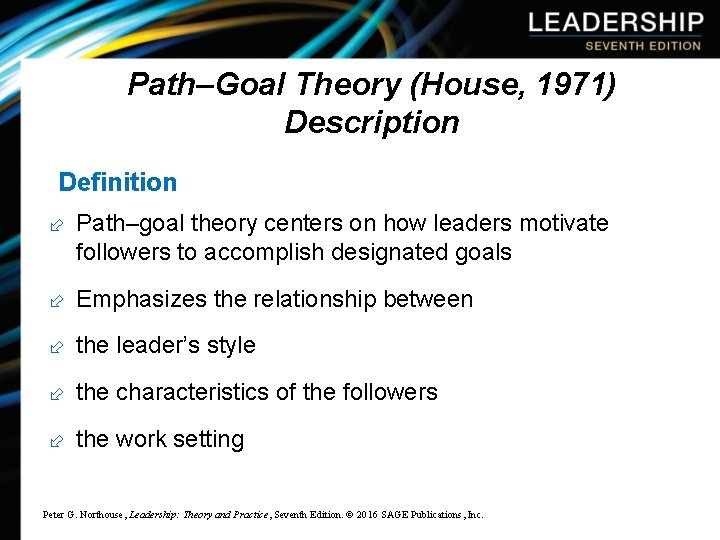
Path–Goal Theory (House, 1971) Description Definition ÷ Path–goal theory centers on how leaders motivate followers to accomplish designated goals ÷ Emphasizes the relationship between ÷ the leader’s style ÷ the characteristics of the followers ÷ the work setting Peter G. Northouse, Leadership: Theory and Practice, Seventh Edition. © 2016 SAGE Publications, Inc.
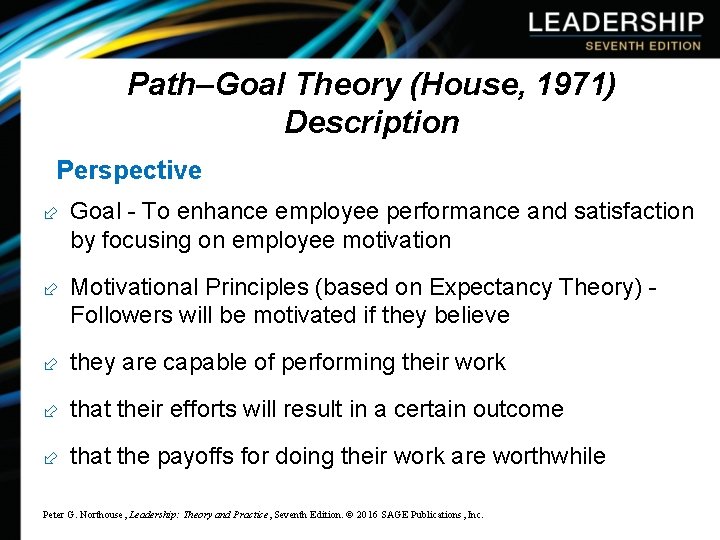
Path–Goal Theory (House, 1971) Description Perspective ÷ Goal - To enhance employee performance and satisfaction by focusing on employee motivation ÷ Motivational Principles (based on Expectancy Theory) - Followers will be motivated if they believe ÷ they are capable of performing their work ÷ that their efforts will result in a certain outcome ÷ that the payoffs for doing their work are worthwhile Peter G. Northouse, Leadership: Theory and Practice, Seventh Edition. © 2016 SAGE Publications, Inc.
Challenge to Leader ÷ Use a leadership style that best meets followers’ motivational needs ÷ choose behaviors that complement or supplement what is missing in the work setting ÷ enhance goal attainment by providing information or rewards ÷ provide followers with the elements they need to reach their goals Peter G. Northouse, Leadership: Theory and Practice, Seventh Edition. © 2016 SAGE Publications, Inc.
Conditions of Leadership Motivation Leadership generates motivation when ÷ It increases the number and kinds of payoffs followers receive from their work ÷ Makes the path to the goal clear and easy to travel through with coaching and direction ÷ Removes obstacles and roadblocks to attaining the goal ÷ Makes the work itself more personally satisfying Peter G. Northouse, Leadership: Theory and Practice, Seventh Edition. © 2016 SAGE Publications, Inc.
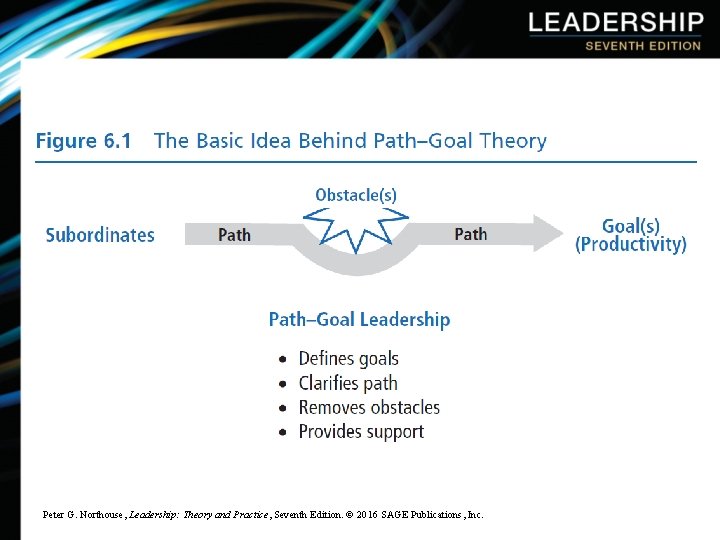
Peter G. Northouse, Leadership: Theory and Practice, Seventh Edition. © 2016 SAGE Publications, Inc.
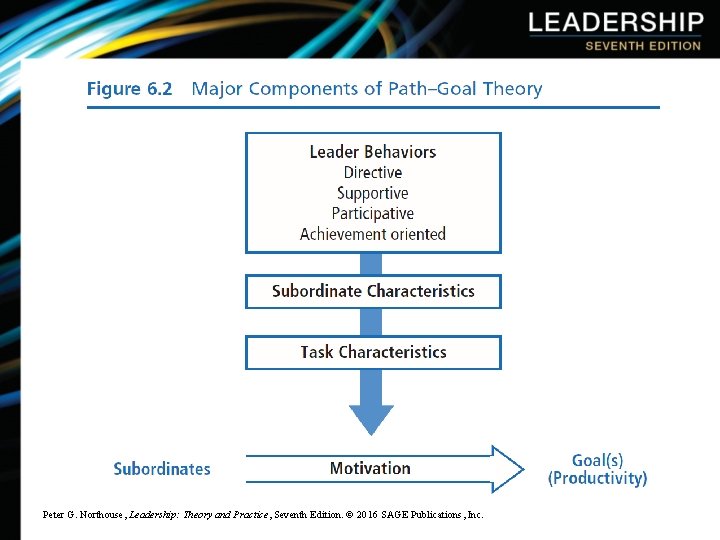
Peter G. Northouse, Leadership: Theory and Practice, Seventh Edition. © 2016 SAGE Publications, Inc.
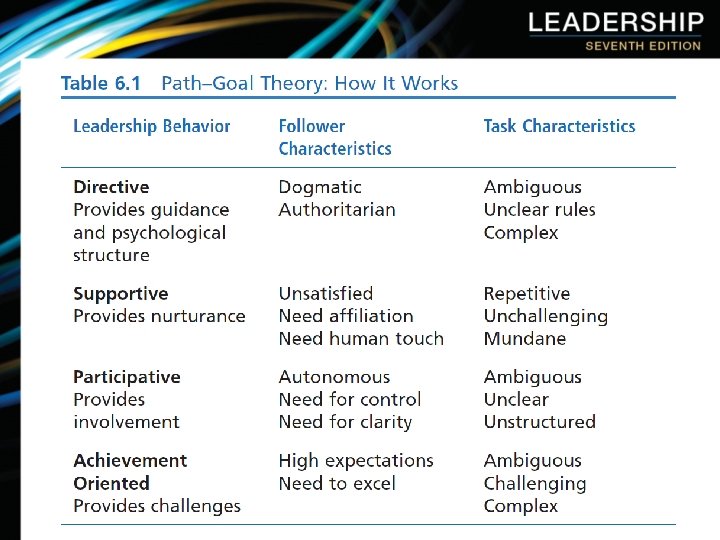
Leader Behaviors Directive Leadership ÷ Leader who gives followers task instruction including: ÷ What is expected of them ÷ How task is to be done ÷ Timeline for task completion ÷ Clear standards of performance ÷ Clear rules & regulations Peter G. Northouse, Leadership: Theory and Practice, Seventh Edition. © 2016 SAGE Publications, Inc.
Leader Behaviors Supportive Leadership Leader who is friendly and approachable: ÷ Attending to well-being & human needs of followers ÷ Using supportive behavior to make work environment pleasant ÷ Treating followers as equals & giving them respect for their status Peter G. Northouse, Leadership: Theory and Practice, Seventh Edition. © 2016 SAGE Publications, Inc.
Leader Behaviors Participative Leadership ÷ Leader who invites followers to share in the decision making: ÷ Consults with followers ÷ Seeks their ideas & opinions ÷ Integrates their input into group/organizational decisions Peter G. Northouse, Leadership: Theory and Practice, Seventh Edition. © 2016 SAGE Publications, Inc.
Leader Behaviors Achievement-Oriented Leadership ÷ Leader who challenges followers to perform work at the highest level possible: ÷ Establishes a high standard of excellence for subordinates ÷ Seeks continuous improvement ÷ Demonstrates a high degree of confidence in followers’ ability to establish & achieve challenging goals Peter G. Northouse, Leadership: Theory and Practice, Seventh Edition. © 2016 SAGE Publications, Inc.
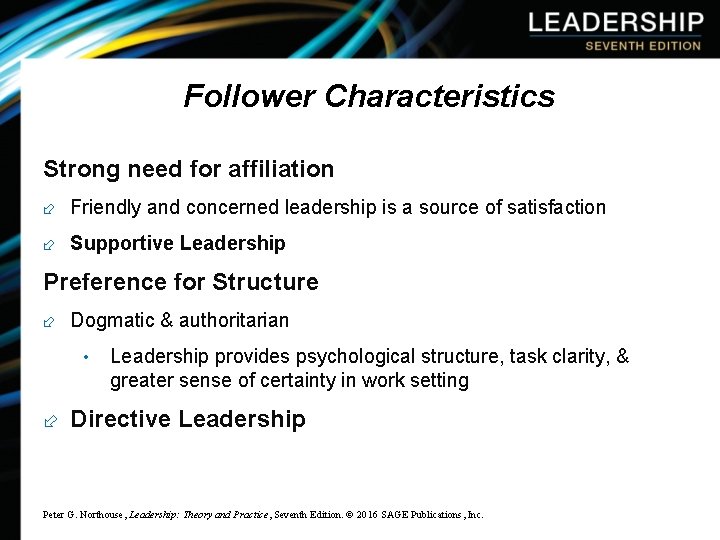
Follower Characteristics Strong need for affiliation ÷ Friendly and concerned leadership is a source of satisfaction ÷ Supportive Leadership Preference for Structure ÷ Dogmatic & authoritarian • Leadership provides psychological structure, task clarity, & greater sense of certainty in work setting ÷ Directive Leadership Peter G. Northouse, Leadership: Theory and Practice, Seventh Edition. © 2016 SAGE Publications, Inc.
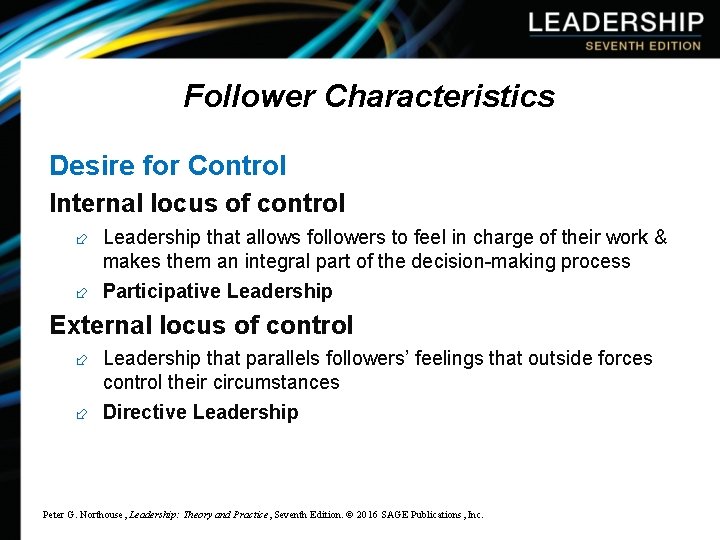
Follower Characteristics Desire for Control Internal locus of control ÷ Leadership that allows followers to feel in charge of their work & makes them an integral part of the decision-making process ÷ Participative Leadership External locus of control ÷ Leadership that parallels followers’ feelings that outside forces control their circumstances ÷ Directive Leadership Peter G. Northouse, Leadership: Theory and Practice, Seventh Edition. © 2016 SAGE Publications, Inc.
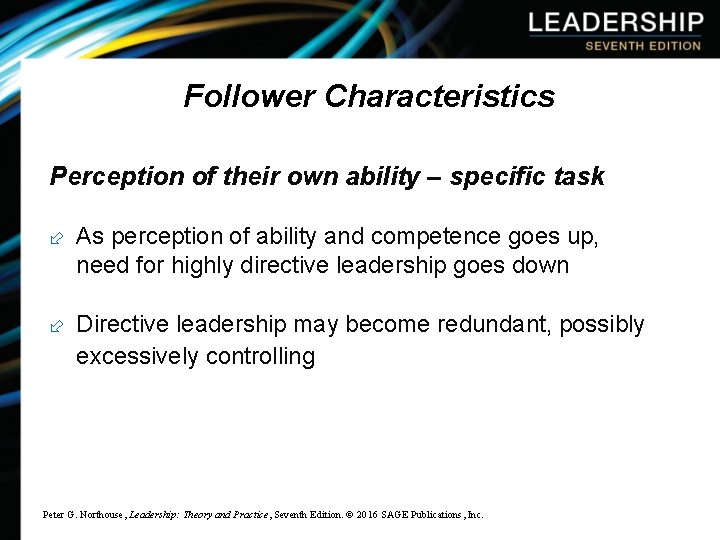
Follower Characteristics Perception of their own ability – specific task ÷ As perception of ability and competence goes up, need for highly directive leadership goes down ÷ Directive leadership may become redundant, possibly excessively controlling Peter G. Northouse, Leadership: Theory and Practice, Seventh Edition. © 2016 SAGE Publications, Inc.
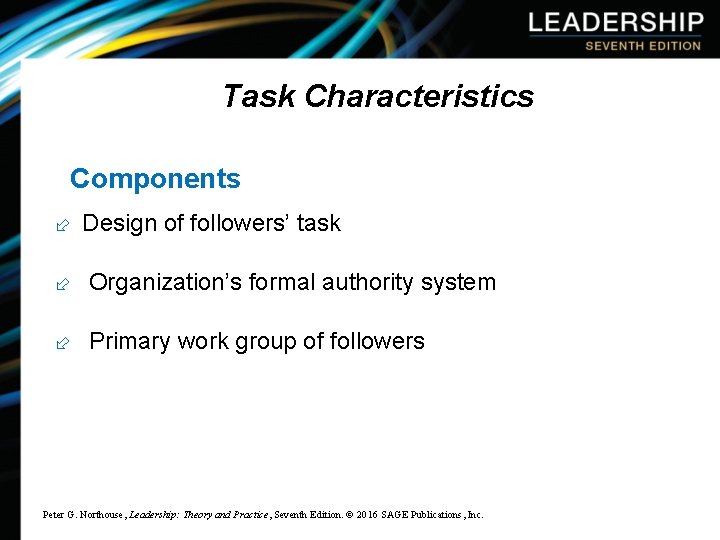
Task Characteristics Components ÷ Design of followers’ task ÷ Organization’s formal authority system ÷ Primary work group of followers Peter G. Northouse, Leadership: Theory and Practice, Seventh Edition. © 2016 SAGE Publications, Inc.
Task Characteristics Task Situations Requiring Leader Involvement ÷ Unclear and ambiguous - Leader needs to provide structure ÷ Highly repetitive - Leader needs to provide support to maintain follower motivation ÷ Weak formal authority - If formal authority system is weak, the leader needs to assist followers by making rules and work requirements clear ÷ Nonsupportive/weak group norms - Leader needs to help build cohesiveness and role responsibility Peter G. Northouse, Leadership: Theory and Practice, Seventh Edition. © 2016 SAGE Publications, Inc.
Task Characteristics Obstacles ÷ Anything in the work setting that gets in the way of followers ÷ They create excessive uncertainties, frustrations, or threats for followers ÷ Leader’s responsibility is to help followers by ÷ Removing the obstacles ÷ Helping followers around them ÷ Assisting with obstacles will increase ÷ Followers’ expectations to complete the task ÷ Their sense of job satisfaction Peter G. Northouse, Leadership: Theory and Practice, Seventh Edition. © 2016 SAGE Publications, Inc.
How Does the Path–Goal Theory Work? ÷ Focus of Path–Goal Theory ÷ Strengths ÷ Criticisms ÷ Application Peter G. Northouse, Leadership: Theory and Practice, Seventh Edition. © 2016 SAGE Publications, Inc.
How Does the Path–Goal Theory Work? ÷ The leader’s job is to help followers reach their goals by directing, guiding, and coaching them along the way ÷ Leaders must evaluate task and follower characteristics and adapt leadership style to these ÷ The theory suggests which style is most appropriate for specific characteristics Peter G. Northouse, Leadership: Theory and Practice, Seventh Edition. © 2016 SAGE Publications, Inc.
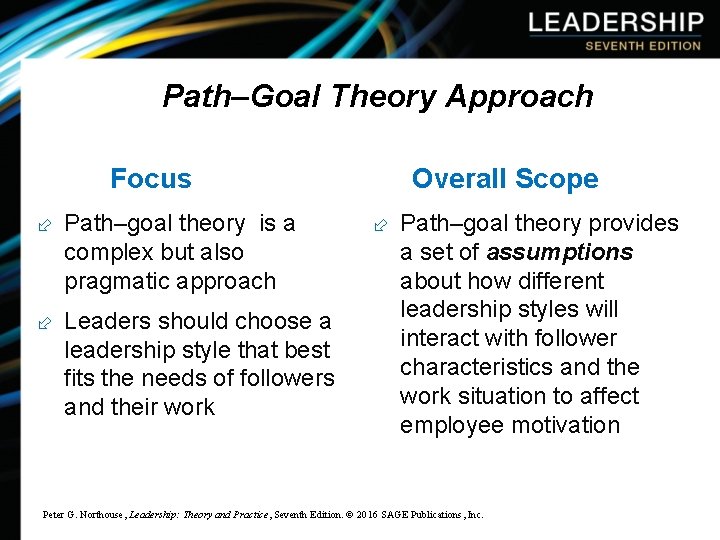
Path–Goal Theory Approach Focus Overall Scope ÷ Path–goal theory is a ÷ Path–goal theory provides complex but also pragmatic approach a set of assumptions about how different leadership styles will interact with follower characteristics and the work situation to affect employee motivation ÷ Leaders should choose a leadership style that best fits the needs of followers and their work Peter G. Northouse, Leadership: Theory and Practice, Seventh Edition. © 2016 SAGE Publications, Inc.
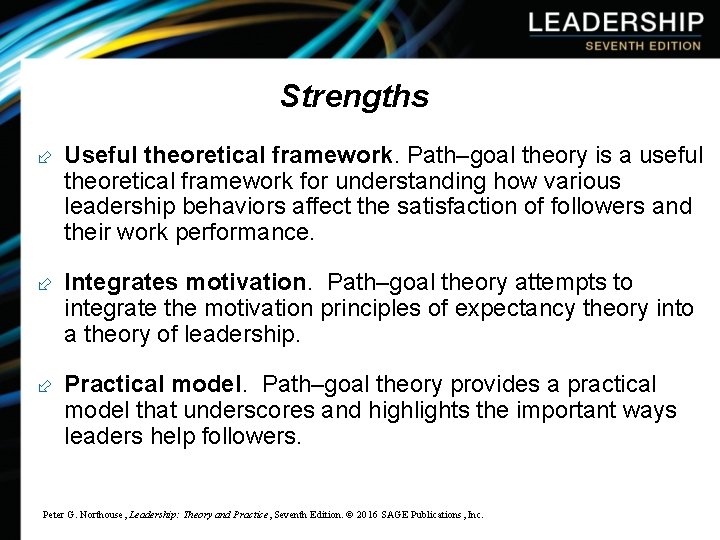
Strengths ÷ Useful theoretical framework. Path–goal theory is a useful theoretical framework for understanding how various leadership behaviors affect the satisfaction of followers and their work performance. ÷ Integrates motivation. Path–goal theory attempts to integrate the motivation principles of expectancy theory into a theory of leadership. ÷ Practical model. Path–goal theory provides a practical model that underscores and highlights the important ways leaders help followers. Peter G. Northouse, Leadership: Theory and Practice, Seventh Edition. © 2016 SAGE Publications, Inc.
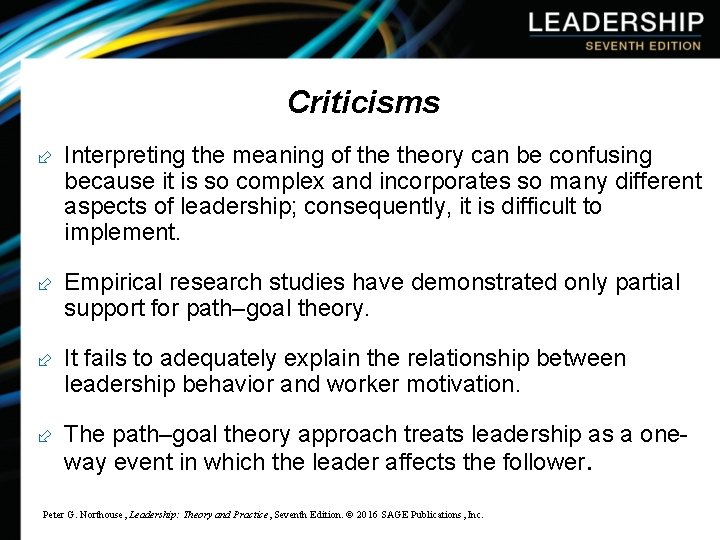
Criticisms ÷ Interpreting the meaning of theory can be confusing because it is so complex and incorporates so many different aspects of leadership; consequently, it is difficult to implement. ÷ Empirical research studies have demonstrated only partial support for path–goal theory. ÷ It fails to adequately explain the relationship between leadership behavior and worker motivation. ÷ The path–goal theory approach treats leadership as a one- way event in which the leader affects the follower. Peter G. Northouse, Leadership: Theory and Practice, Seventh Edition. © 2016 SAGE Publications, Inc.
Application ÷ PGT offers valuable insights that can be applied in ongoing settings to improve one’s leadership. ÷ Informs leaders about when to be directive, supportive, participative, or achievement oriented. ÷ The principles of PGT can be employed by leaders at all organizational levels and for all types of tasks. Peter G. Northouse, Leadership: Theory and Practice, Seventh Edition. © 2016 SAGE Publications, Inc.