
Chapter 6 Part 2 Relevance Red Herring Fallacies



- Slides: 27
Chapter 6 Part 2 Relevance (Red Herring) Fallacies © 2017 Mc. Graw-Hill Higher Education. All rights reserved.
Chapter Outline (1) Define and recognize argumentum ad hominem fallacies. n Define and recognize straw man fallacies. n Define and recognize false dilemma fallacies. n Define and recognize fallacies involved in misplacing the burden of proof. n © 2017 Mc. Graw-Hill Higher Education. All rights reserved. 2
Chapter Outline (2) Define and recognize fallacies involved in begging the question. n Define and recognize fallacies classified as appeals to emotion. n Define and recognize other fallacies involved in arriving at irrelevant conclusions. n © 2017 Mc. Graw-Hill Higher Education. All rights reserved. 3
Appeal to Emotion n Occurs when a speaker or writer "supports" a contention by playing on people's emotions rather than by producing a real argument © 2017 Mc. Graw-Hill Higher Education. All rights reserved. 4
Varieties of Appeals to Emotion Argument from outrage n Scare tactics n Peer pressure fallacy n Appeal to pity n Apple polishing n Guilt tripping n Appeal to envy n Appeal to jealousy n © 2017 Mc. Graw-Hill Higher Education. All rights reserved. 5
Argument from Outrage n Occurs when a speaker or writer attempts to convince people by making them angry rather than by giving them a relevant argument © 2017 Mc. Graw-Hill Higher Education. All rights reserved. 6
Example of Argument from Outrage n “Do you think Apple doesn’t know it hires 12 -year-old children to make its electronics? You think it isn’t aware it pays them slave wages and has them work in buildings without heat or air conditioning? It knows. Apple products can’t be any good. ” © 2017 Mc. Graw-Hill Higher Education. All rights reserved. 7
Scare Tactics A fallacy that occurs when a speaker or writer tries to scare people into accepting an irrelevant conclusion n Example n “Buy Michelin tires. Don’t risk your children’s safety by buying inferior brands. ” n © 2017 Mc. Graw-Hill Higher Education. All rights reserved. 8
Threats Sometimes form a part of the scare tactic n Example n “Buy Michelin tires, or I will see to it that you lose your job. ” n © 2017 Mc. Graw-Hill Higher Education. All rights reserved. 9
Peer Pressure Fallacy Trying to persuade people to do or believe something by playing on their fear of being excluded from a group n Example n “Of course we are winning the war! If you don’t like it here, move to Baghdad, you weirdo!” n © 2017 Mc. Graw-Hill Higher Education. All rights reserved. 10
Fear Mongering n Speakers and writers often make inflammatory or scary statements just to rile people up or frighten them, without pretending that the statements support a specific conclusion. © 2017 Mc. Graw-Hill Higher Education. All rights reserved. 11
Example of Fear Mongering n “I have here in my hand a list of two hundred and five people that were known to the Secretary of State as being members of the Communist Party and who nevertheless are still working and shaping the policy of the State Department. ” - Joseph Mc. Carthy © 2017 Mc. Graw-Hill Higher Education. All rights reserved. 12
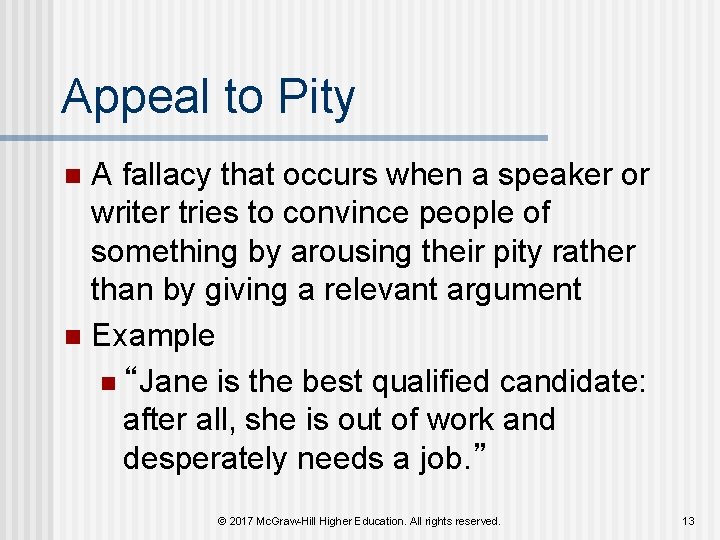
Appeal to Pity A fallacy that occurs when a speaker or writer tries to convince people of something by arousing their pity rather than by giving a relevant argument n Example n “Jane is the best qualified candidate: after all, she is out of work and desperately needs a job. ” n © 2017 Mc. Graw-Hill Higher Education. All rights reserved. 13
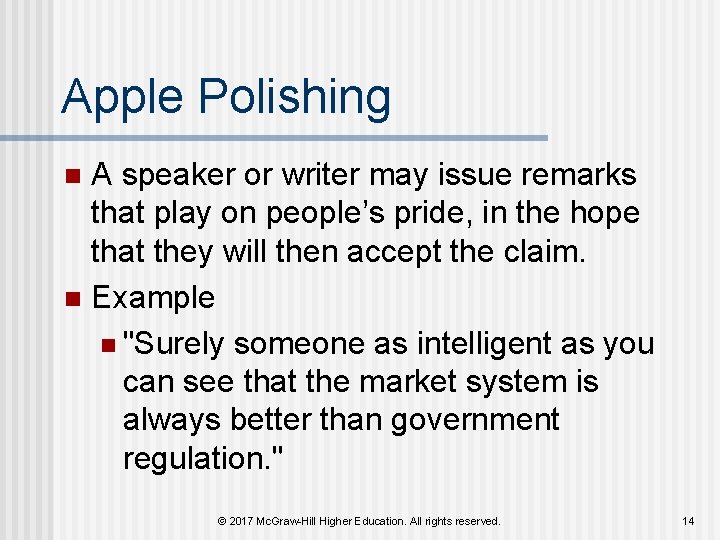
Apple Polishing A speaker or writer may issue remarks that play on people’s pride, in the hope that they will then accept the claim. n Example n "Surely someone as intelligent as you can see that the market system is always better than government regulation. " n © 2017 Mc. Graw-Hill Higher Education. All rights reserved. 14
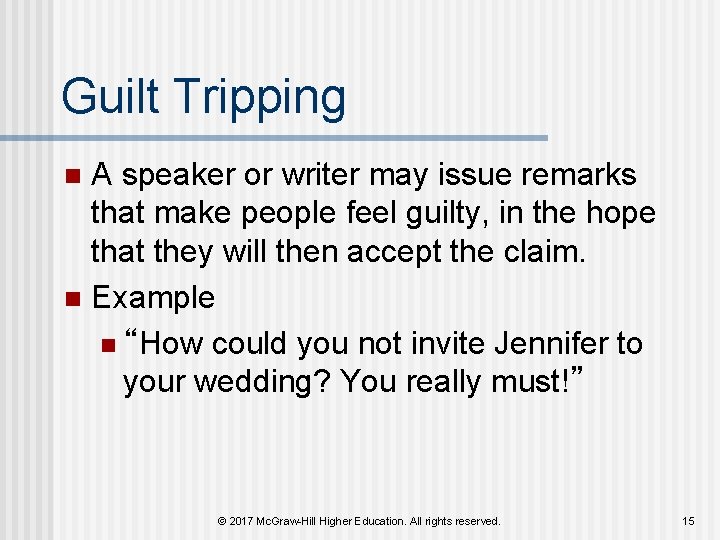
Guilt Tripping A speaker or writer may issue remarks that make people feel guilty, in the hope that they will then accept the claim. n Example n “How could you not invite Jennifer to your wedding? You really must!” n © 2017 Mc. Graw-Hill Higher Education. All rights reserved. 15
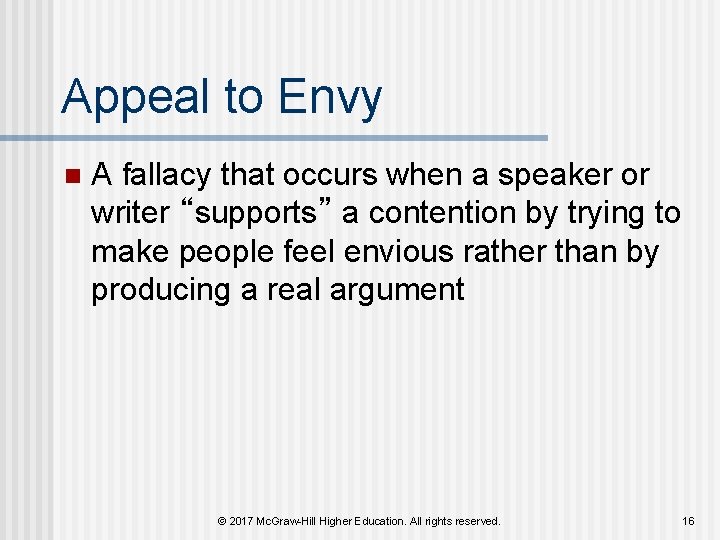
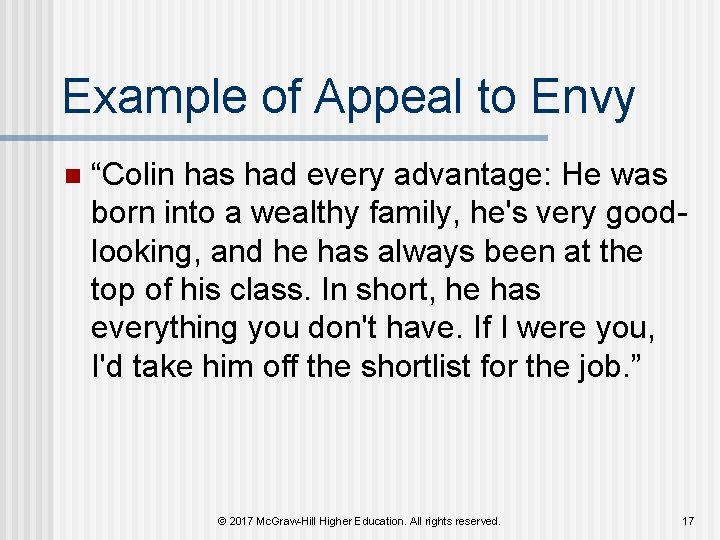
Appeal to Envy n A fallacy that occurs when a speaker or writer “supports” a contention by trying to make people feel envious rather than by producing a real argument © 2017 Mc. Graw-Hill Higher Education. All rights reserved. 16
Example of Appeal to Envy n “Colin has had every advantage: He was born into a wealthy family, he's very goodlooking, and he has always been at the top of his class. In short, he has everything you don't have. If I were you, I'd take him off the shortlist for the job. ” © 2017 Mc. Graw-Hill Higher Education. All rights reserved. 17
Appeal to Jealousy n A fallacy that occurs when a speaker or writer “supports” a contention by trying to make people jealous rather than by producing a real argument © 2017 Mc. Graw-Hill Higher Education. All rights reserved. 18
Example of Appeal to Jealousy n “Listen, I know how much you're in love with Sarah. That's why I'm telling you that Jack has been hitting on her lately. You ought to know that when you're deciding who should be selected for the internship that Jack applied for. ” © 2017 Mc. Graw-Hill Higher Education. All rights reserved. 19
What do all appeals to emotion have in common? They are attempts at persuasion masquerading as arguments. n One needs to be careful because: n Not all arguments that excite the emotions are fallacies. n When the considerations offered truly support a contention, the argument is not a fallacy. n © 2017 Mc. Graw-Hill Higher Education. All rights reserved. 20
Irrelevant Conclusion n Relevance fallacies that do not fit comfortably into the previously mentioned categories of fallacies © 2017 Mc. Graw-Hill Higher Education. All rights reserved. 21
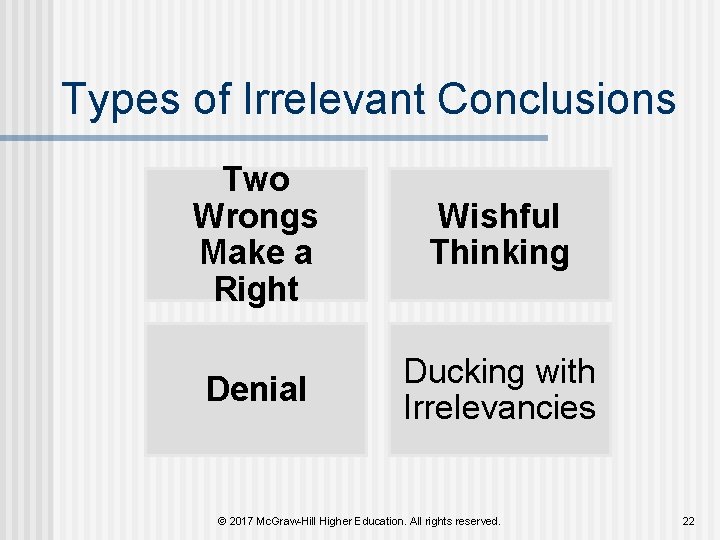
Types of Irrelevant Conclusions Two Wrongs Make a Right Wishful Thinking Denial Ducking with Irrelevancies © 2017 Mc. Graw-Hill Higher Education. All rights reserved. 22
Two Wrongs Make a Right A fallacy that occurs when a speaker or writer thinks that the wrongfulness of a deed is erased as it was done in response to another wrongful deed n Example n “Why should I tell them they undercharged me? You think they would say something if they overcharged me? ” n © 2017 Mc. Graw-Hill Higher Education. All rights reserved. 23
Wishful Thinking A fallacy that occurs when people forget that wanting something to be true is irrelevant to whether it is true n Example n “I really hope I will be the next American Idol. Therefore, I’m sure I will be. ” n © 2017 Mc. Graw-Hill Higher Education. All rights reserved. 24
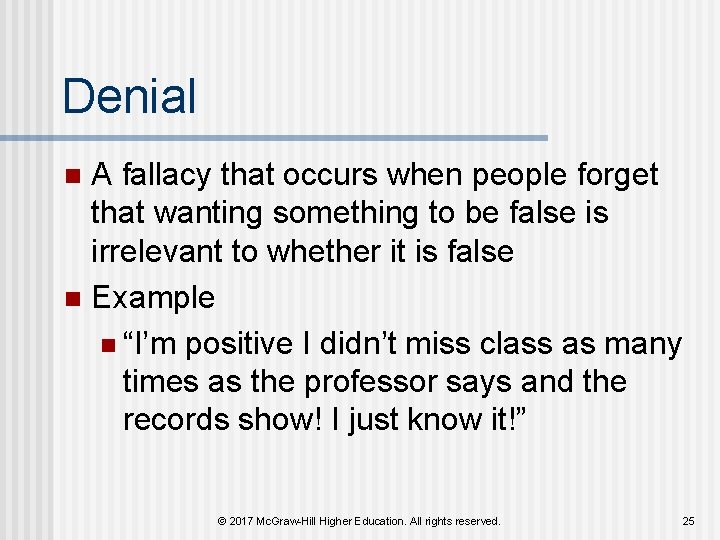
Denial A fallacy that occurs when people forget that wanting something to be false is irrelevant to whether it is false n Example n “I’m positive I didn’t miss class as many times as the professor says and the records show! I just know it!” n © 2017 Mc. Graw-Hill Higher Education. All rights reserved. 25
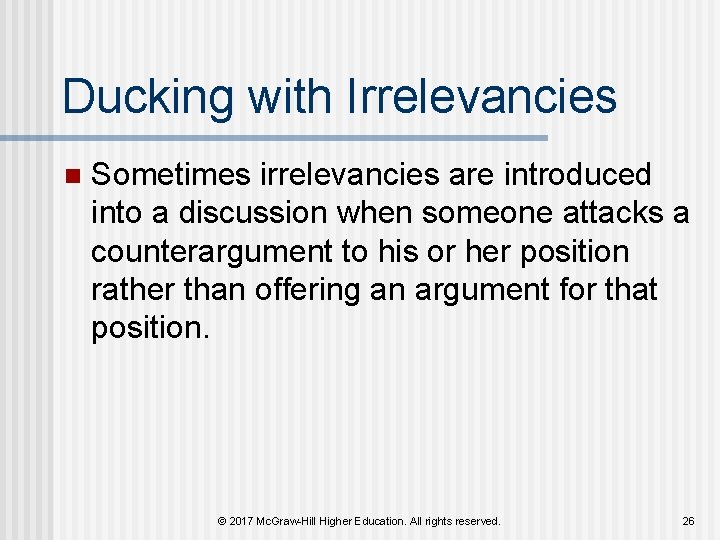
Ducking with Irrelevancies n Sometimes irrelevancies are introduced into a discussion when someone attacks a counterargument to his or her position rather than offering an argument for that position. © 2017 Mc. Graw-Hill Higher Education. All rights reserved. 26
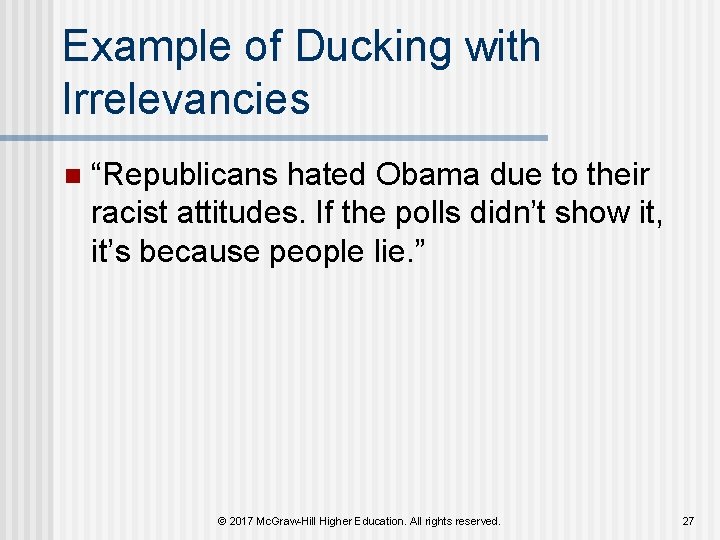
Example of Ducking with Irrelevancies n “Republicans hated Obama due to their racist attitudes. If the polls didn’t show it, it’s because people lie. ” © 2017 Mc. Graw-Hill Higher Education. All rights reserved. 27