
Chapter 6 part 1 Multiprocessor Software High Performance

![Stone multiprocessor example [Sto 77]](https://slidetodoc.com/presentation_image_h2/380ce265e5393deda1d9eefa7de1f644/image-11.jpg "Stone multiprocessor example [Sto 77]")
![Delay. Est(G) { initialize maxsep[] to infinity; step = 0; do { foreach Pi](https://slidetodoc.com/presentation_image_h2/380ce265e5393deda1d9eefa7de1f644/image-26.jpg "Delay. Est(G) { initialize maxsep[] to infinity; step = 0; do { foreach Pi")
![Cyclic scheduling dependencies [Hen 05] © 2005 IEEE](https://slidetodoc.com/presentation_image_h2/380ce265e5393deda1d9eefa7de1f644/image-31.jpg "Cyclic scheduling dependencies [Hen 05] © 2005 IEEE")
- Slides: 42
Chapter 6, part 1: Multiprocessor Software High Performance Embedded Computing Wayne Wolf
Topics n Performance analysis of multiprocessor software. q q q Models. Analysis. Simulation.
What is different about embedded multiprocessor software? n n How does it differ from general-purpose multiprocessor software? How does it differ from a uniprocessor?
Heterogeneity n Hardware platforms are heterogeneous: q q q Practical problems. Must ensure that models of computations work together. Resource allocation problem is restricted.
Delay variations n Delay variations are harder to predict in multiprocessors: q q q n Subtle timing bugs are more likely to be exposed. Makes it harder to use system resources. Long memory access times complicate algorithm design and programming. Scheduling a multiprocessor is hard--information about the state of the processors costs time, energy.
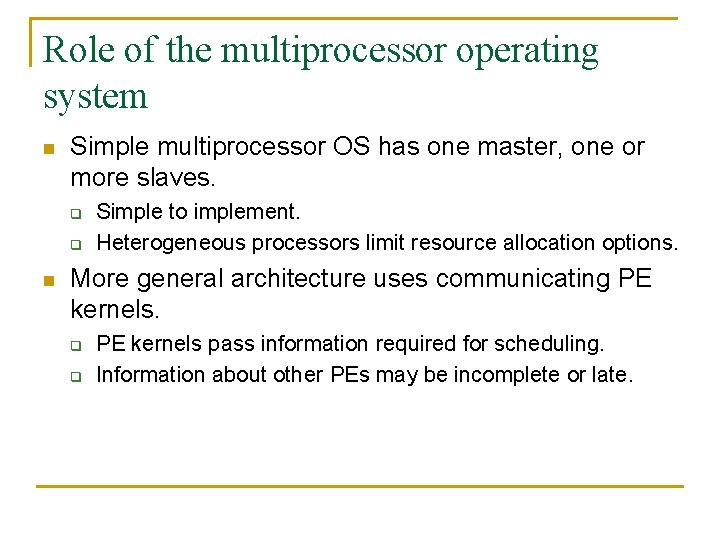
Role of the multiprocessor operating system n Simple multiprocessor OS has one master, one or more slaves. q q n Simple to implement. Heterogeneous processors limit resource allocation options. More general architecture uses communicating PE kernels. q q PE kernels pass information required for scheduling. Information about other PEs may be incomplete or late.
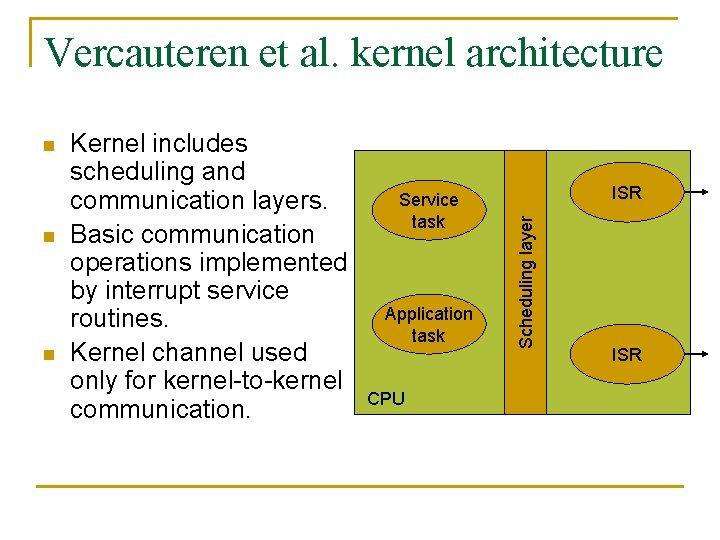
Vercauteren et al. kernel architecture n n Kernel includes scheduling and communication layers. Basic communication operations implemented by interrupt service routines. Kernel channel used only for kernel-to-kernel communication. Service task Application task CPU ISR Scheduling layer n ISR
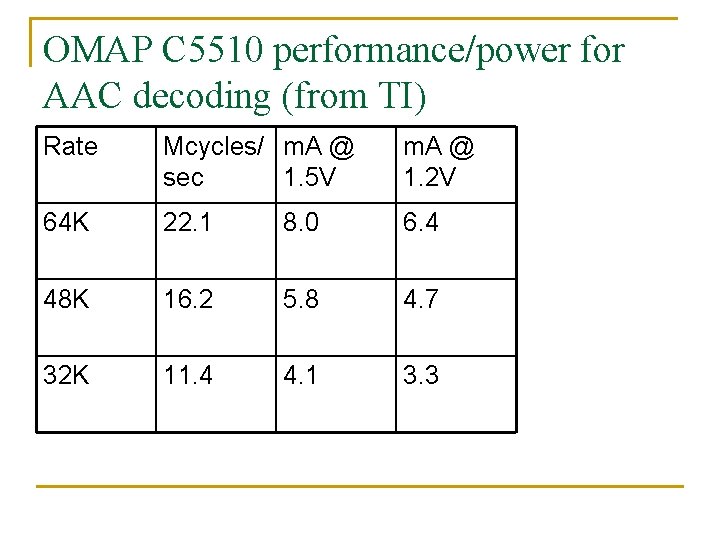
OMAP C 5510 performance/power for AAC decoding (from TI) Rate Mcycles/ m. A @ sec 1. 5 V m. A @ 1. 2 V 64 K 22. 1 8. 0 6. 4 48 K 16. 2 5. 8 4. 7 32 K 11. 4 4. 1 3. 3
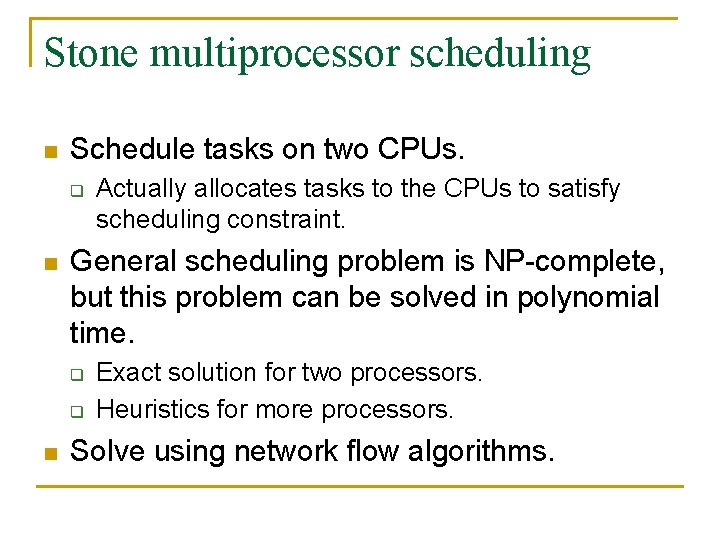
Stone multiprocessor scheduling n Schedule tasks on two CPUs. q n General scheduling problem is NP-complete, but this problem can be solved in polynomial time. q q n Actually allocates tasks to the CPUs to satisfy scheduling constraint. Exact solution for two processors. Heuristics for more processors. Solve using network flow algorithms.
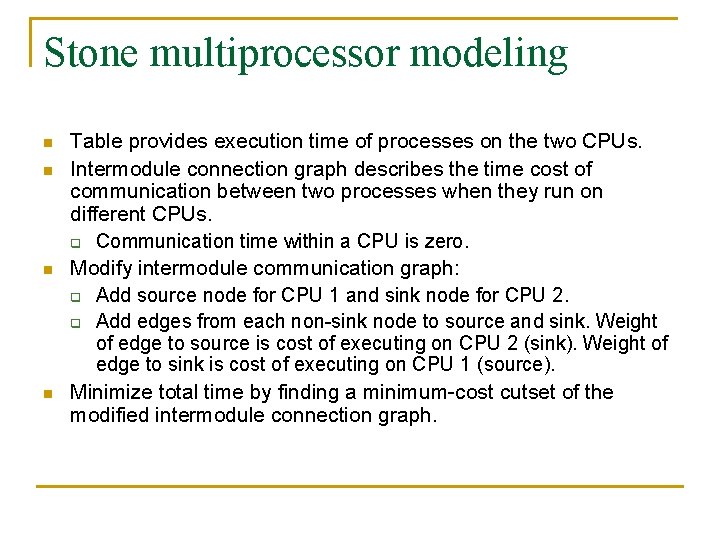
Stone multiprocessor modeling n n Table provides execution time of processes on the two CPUs. Intermodule connection graph describes the time cost of communication between two processes when they run on different CPUs. q Communication time within a CPU is zero. Modify intermodule communication graph: q Add source node for CPU 1 and sink node for CPU 2. q Add edges from each non-sink node to source and sink. Weight of edge to source is cost of executing on CPU 2 (sink). Weight of edge to sink is cost of executing on CPU 1 (source). Minimize total time by finding a minimum-cost cutset of the modified intermodule connection graph.
Stone multiprocessor example [Sto 77]
Static vs. dynamic task allocation n n Dynamic task allocation can choose the CPU for a task at run time. Static task allocation determines allocation to CPU at design time. Static task allocation reduces OS overhead, allows more analysis. Dynamic task allocation helps manage dynamic loads.
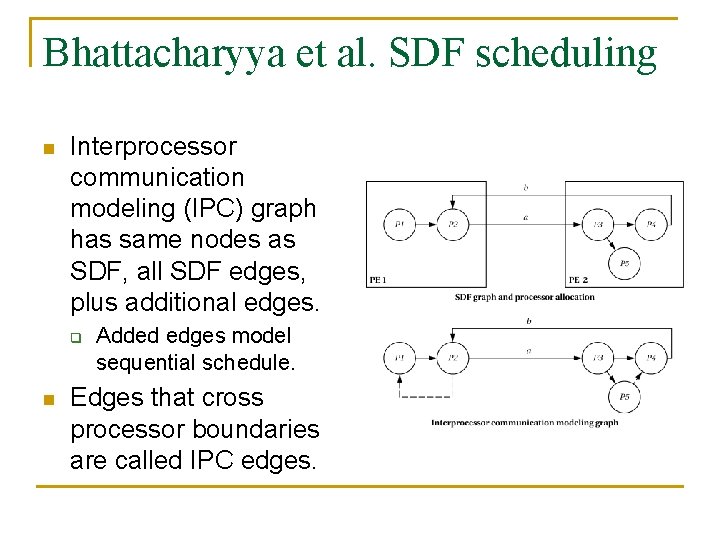
Bhattacharyya et al. SDF scheduling n Interprocessor communication modeling (IPC) graph has same nodes as SDF, all SDF edges, plus additional edges. q n Added edges model sequential schedule. Edges that cross processor boundaries are called IPC edges.
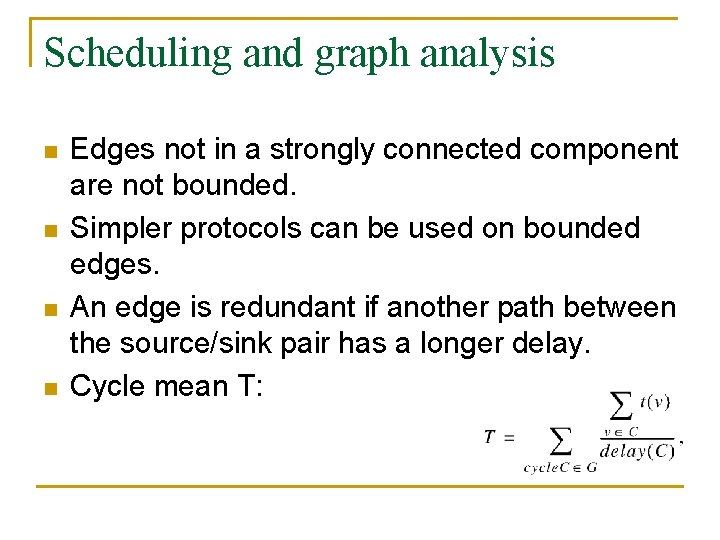
Scheduling and graph analysis n n Edges not in a strongly connected component are not bounded. Simpler protocols can be used on bounded edges. An edge is redundant if another path between the source/sink pair has a longer delay. Cycle mean T:
Critical cycles n n Maximum cycle mean is the largest cycle mean for any strongly connected component. Critical cycle has the maximum cycle mean. Construct strongly connected synchronization graph by adding edges between strongly connected components. Add delays to the added edges to ensure deadlock. q Delays are implemented with buffer memory.
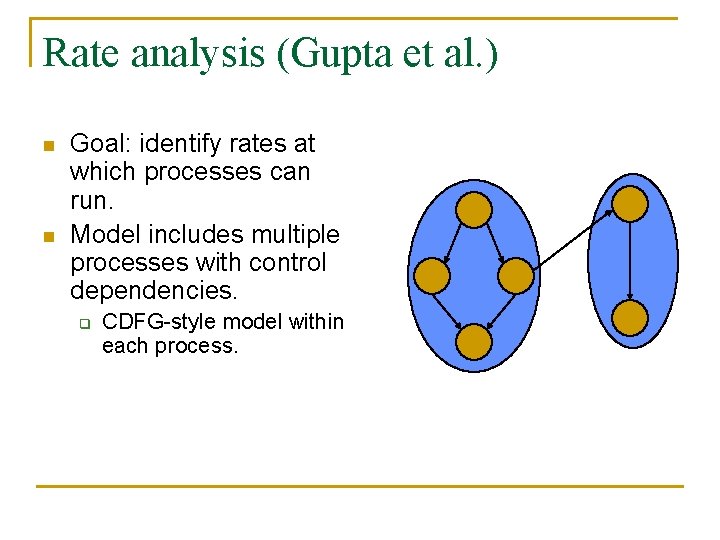
Rate analysis (Gupta et al. ) n n Goal: identify rates at which processes can run. Model includes multiple processes with control dependencies. q CDFG-style model within each process.
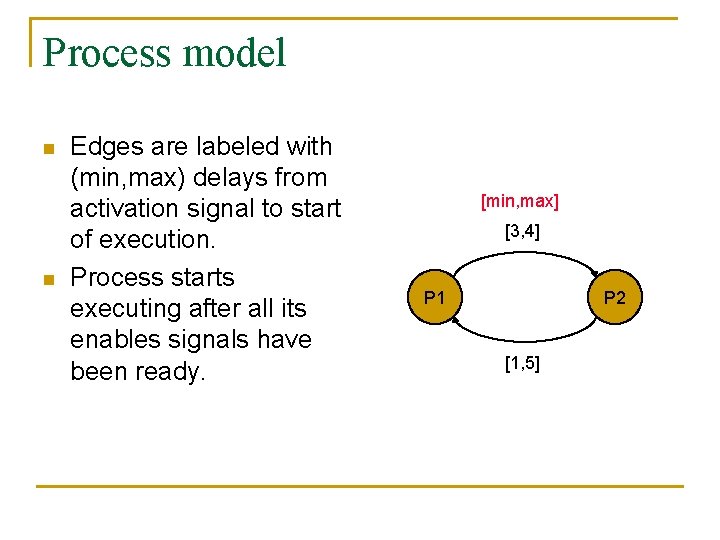
Process model n n Edges are labeled with (min, max) delays from activation signal to start of execution. Process starts executing after all its enables signals have been ready. [min, max] [3, 4] P 1 P 2 [1, 5]
Rate analysis n n Delay around a cycle in the graph is S di. Maximum mean cycle delay is l. In a strongly connected graph all nodes execute at the same rate l. Given a producer and consumer, bounds on rates of consumer is: [ min{rl(P), rl(C)}, min{ru(P), ru(C)} ]
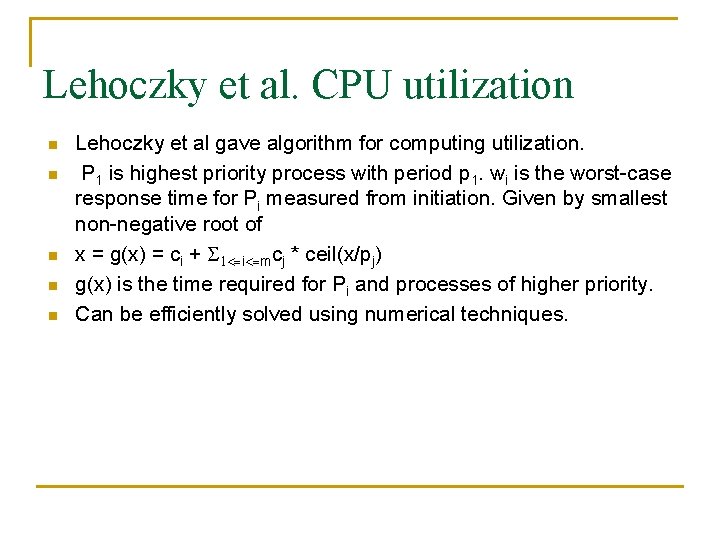
Lehoczky et al. CPU utilization n n Lehoczky et al gave algorithm for computing utilization. P 1 is highest priority process with period p 1. wi is the worst-case response time for Pi measured from initiation. Given by smallest non-negative root of x = g(x) = ci + S 1<=i<=mcj * ceil(x/pj) g(x) is the time required for Pi and processes of higher priority. Can be efficiently solved using numerical techniques.
Distributed system performance n n Longest-path algorithms don’t work under preemption. Several algorithms unroll the schedule to the length of the least common multiple of the periods: q q n n produces a very long schedule; doesn’t work for non-fixed periods. Schedules based on upper bounds may give inaccurate results. Simulation does not provide guarantees.
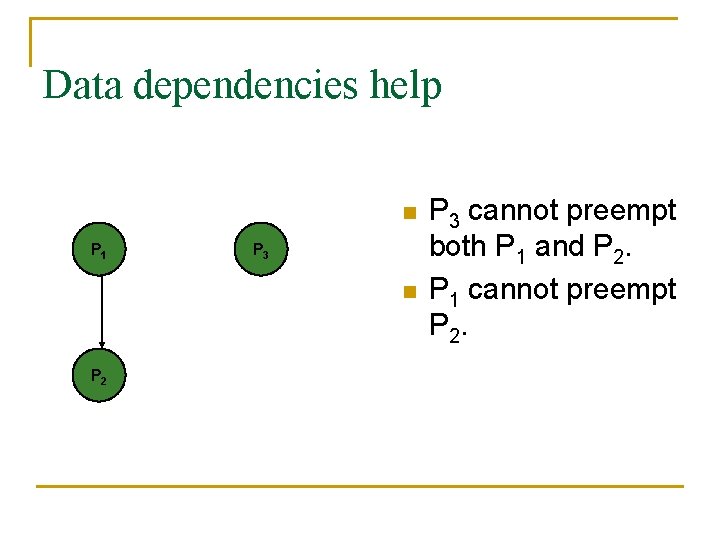
Data dependencies help n P 1 P 3 n P 2 P 3 cannot preempt both P 1 and P 2. P 1 cannot preempt P 2.
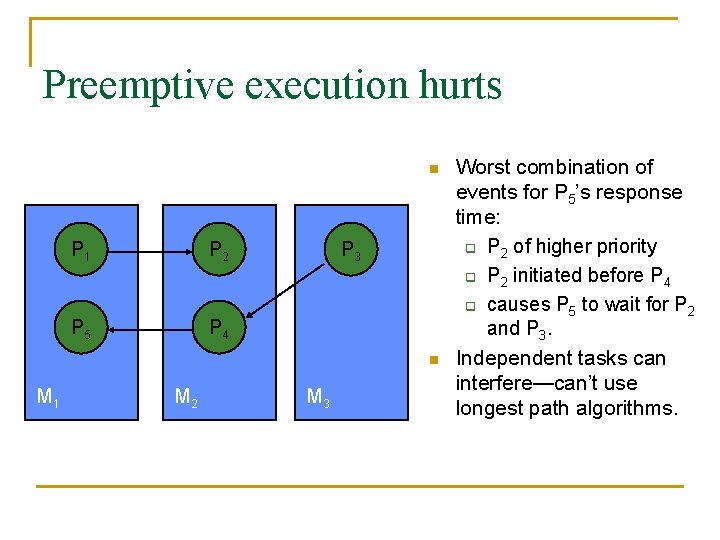
Preemptive execution hurts n P 1 P 2 P 5 P 4 P 3 n M 1 M 2 M 3 Worst combination of events for P 5’s response time: q P 2 of higher priority q P 2 initiated before P 4 q causes P 5 to wait for P 2 and P 3. Independent tasks can interfere—can’t use longest path algorithms.
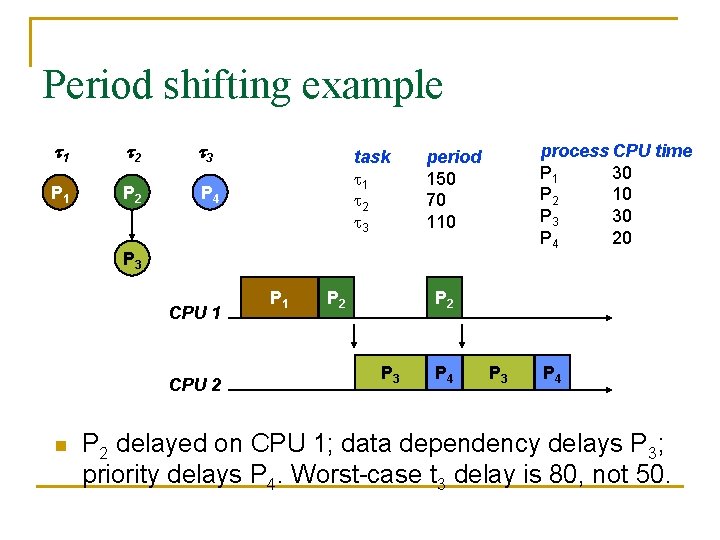
Period shifting example t 1 t 2 t 3 P 1 P 2 P 4 task t 1 t 2 t 3 process CPU time P 1 30 P 2 10 P 3 30 P 4 20 period 150 70 110 P 3 CPU 1 CPU 2 n P 1 P 2 P 3 P 4 P 2 delayed on CPU 1; data dependency delays P 3; priority delays P 4. Worst-case t 3 delay is 80, not 50.
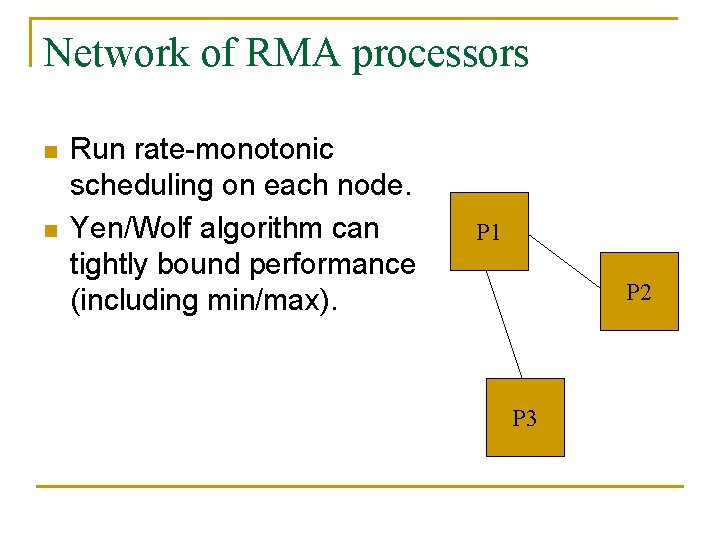
Network of RMA processors n n Run rate-monotonic scheduling on each node. Yen/Wolf algorithm can tightly bound performance (including min/max). P 1 P 2 P 3
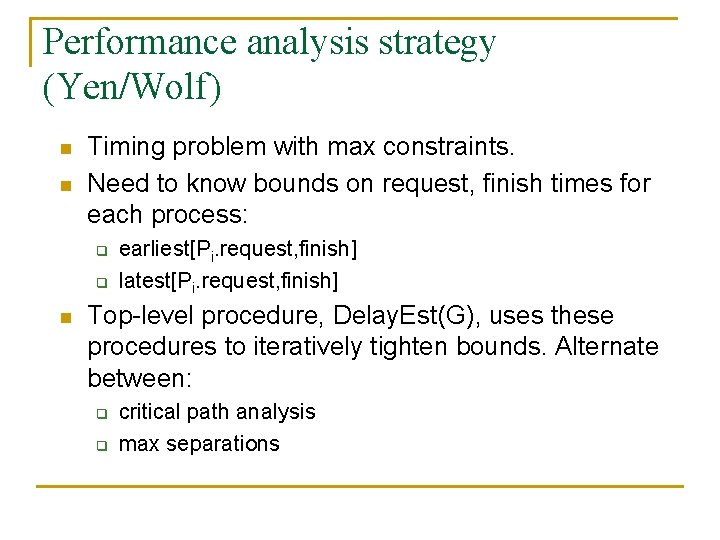
Performance analysis strategy (Yen/Wolf) n n Timing problem with max constraints. Need to know bounds on request, finish times for each process: q q n earliest[Pi. request, finish] latest[Pi. request, finish] Top-level procedure, Delay. Est(G), uses these procedures to iteratively tighten bounds. Alternate between: q q critical path analysis max separations
Delay. Est(G) { initialize maxsep[] to infinity; step = 0; do { foreach Pi { Earliest. Times(Gi); Latest. Times(Gi); } foreach Pi { Max. Separations(Gi); } step++; } while (maxsep[] changed and step < limit); }
Delay. Est summary n n n Gi is subgraph rooted at Pi. Use maximum separations to improve delay estimates in Latest. Times(); call Max. Separations() to derive maximum separations. Step limit can be used to limit CPU time used for estimates.
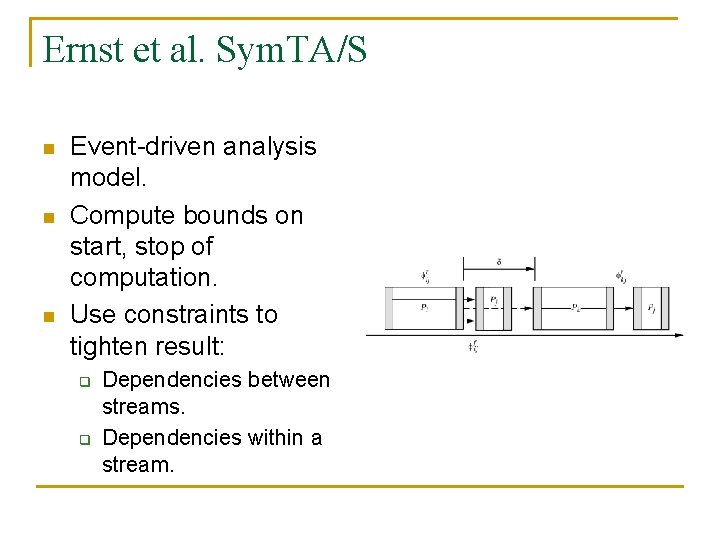
Ernst et al. Sym. TA/S n n n Event-driven analysis model. Compute bounds on start, stop of computation. Use constraints to tighten result: q q Dependencies between streams. Dependencies within a stream.
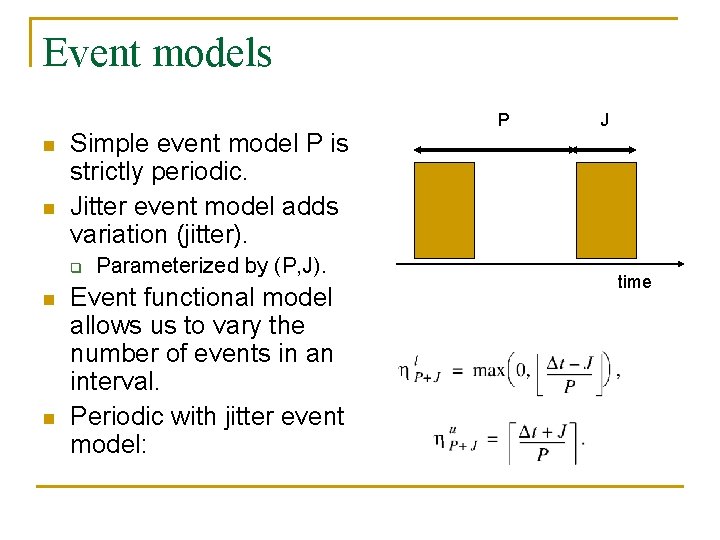
Event models n n Simple event model P is strictly periodic. Jitter event model adds variation (jitter). q n n Parameterized by (P, J). Event functional model allows us to vary the number of events in an interval. Periodic with jitter event model: P J time
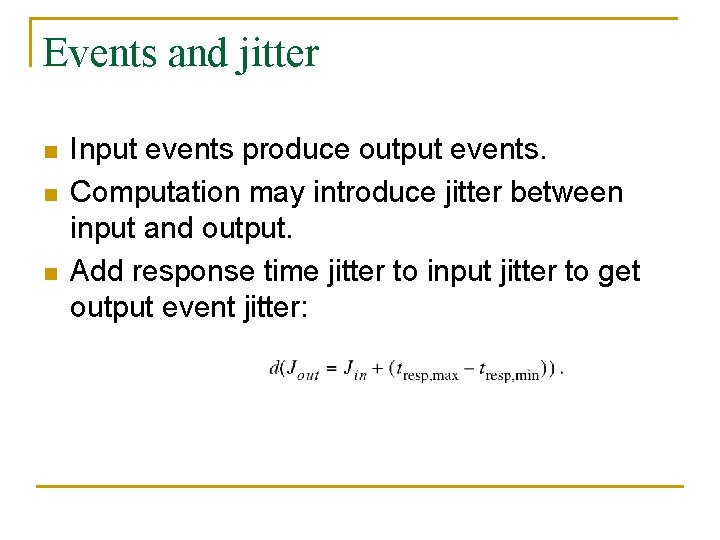
Events and jitter n n n Input events produce output events. Computation may introduce jitter between input and output. Add response time jitter to input jitter to get output event jitter:
Cyclic scheduling dependencies [Hen 05] © 2005 IEEE
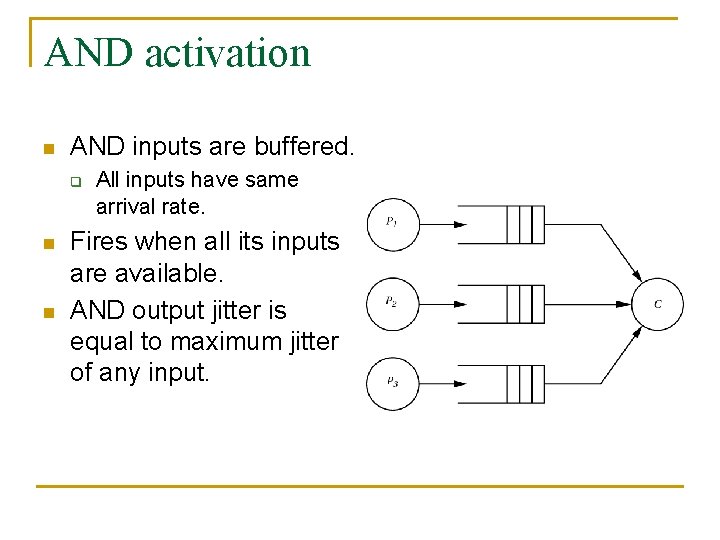
AND activation n AND inputs are buffered. q n n All inputs have same arrival rate. Fires when all its inputs are available. AND output jitter is equal to maximum jitter of any input.
OR activation n n Does not require buffers. Jitter computation is more complex. q Must be approximated. [Hen 05] © 2005 IEEE
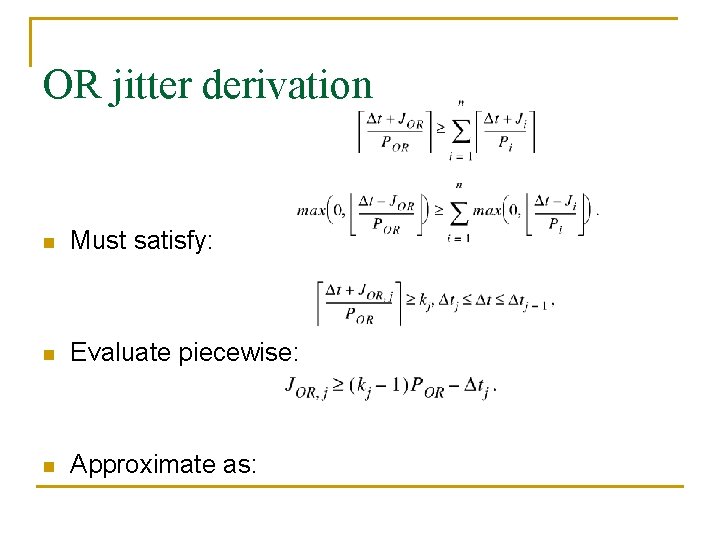
OR jitter derivation n Must satisfy: n Evaluate piecewise: n Approximate as:
Kang et al. distributed signal processing synthesis
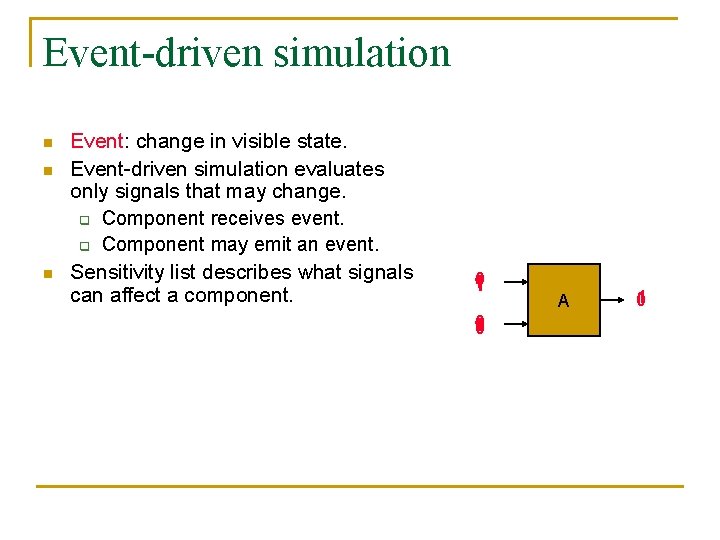
Event-driven simulation n Event: change in visible state. Event-driven simulation evaluates only signals that may change. q Component receives event. q Component may emit an event. Sensitivity list describes what signals can affect a component. 10 10 0 A 01
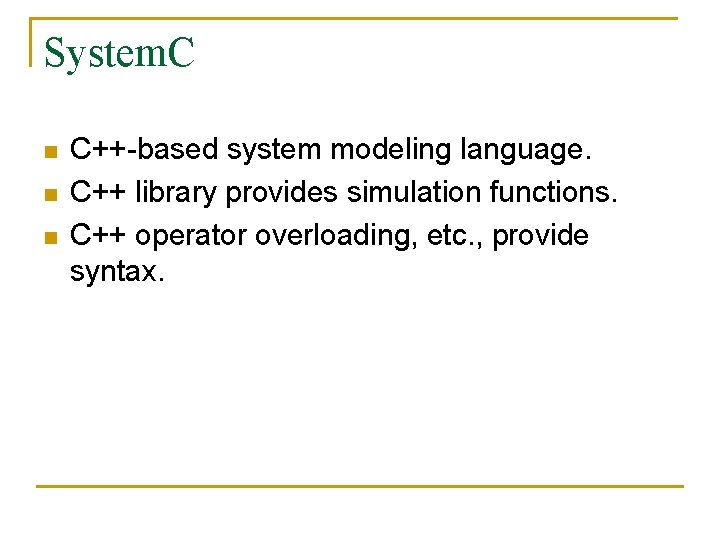
System. C n n n C++-based system modeling language. C++ library provides simulation functions. C++ operator overloading, etc. , provide syntax.
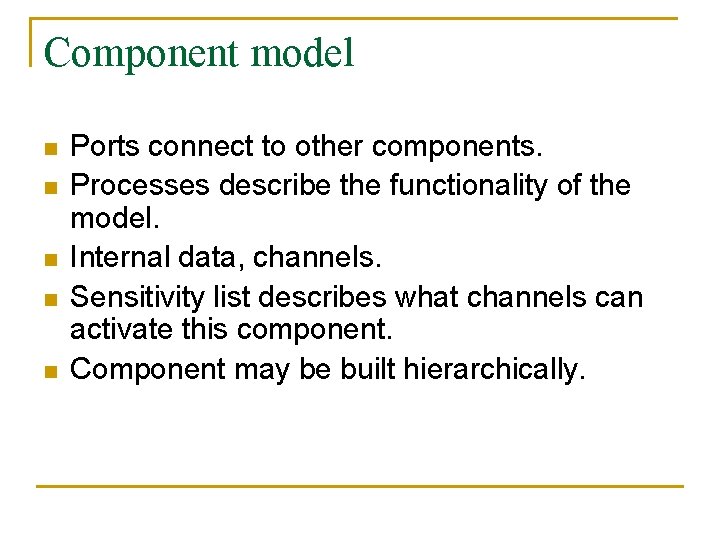
Component model n n n Ports connect to other components. Processes describe the functionality of the model. Internal data, channels. Sensitivity list describes what channels can activate this component. Component may be built hierarchically.
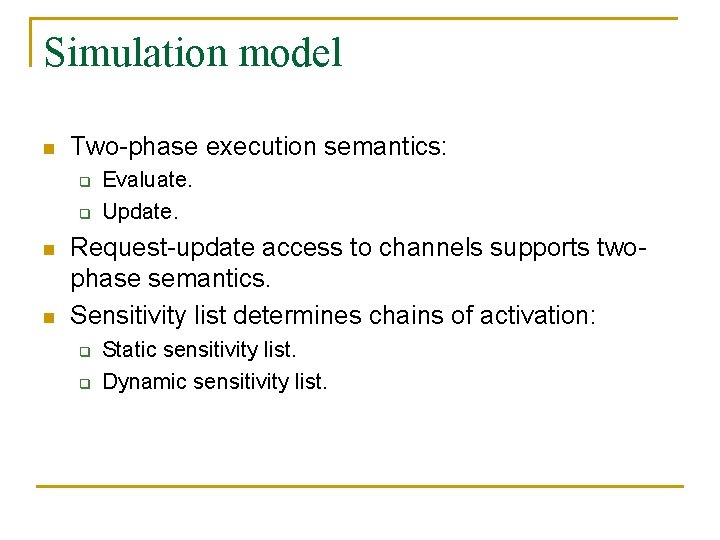
Simulation model n Two-phase execution semantics: q q n n Evaluate. Update. Request-update access to channels supports twophase semantics. Sensitivity list determines chains of activation: q q Static sensitivity list. Dynamic sensitivity list.
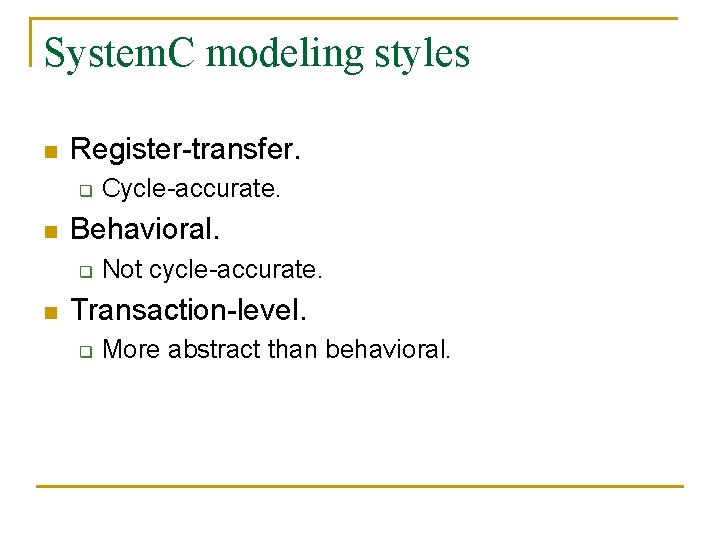
System. C modeling styles n Register-transfer. q n Behavioral. q n Cycle-accurate. Not cycle-accurate. Transaction-level. q More abstract than behavioral.
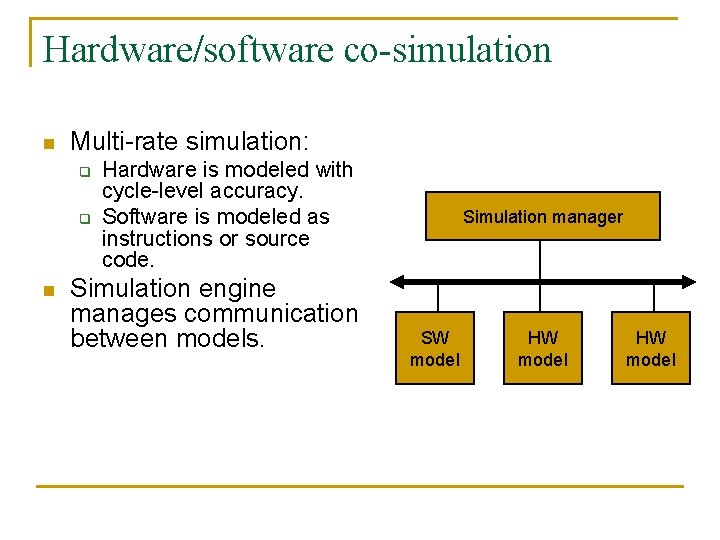
Hardware/software co-simulation n Multi-rate simulation: q q n Hardware is modeled with cycle-level accuracy. Software is modeled as instructions or source code. Simulation engine manages communication between models. Simulation manager SW model HW model
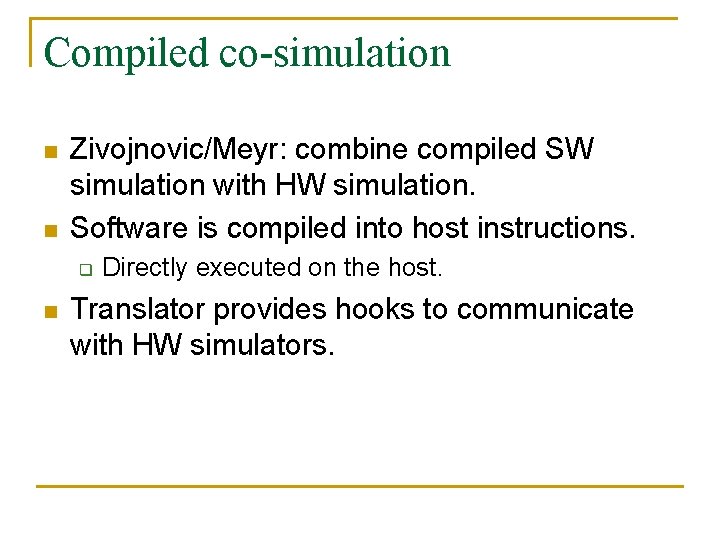
Compiled co-simulation n n Zivojnovic/Meyr: combine compiled SW simulation with HW simulation. Software is compiled into host instructions. q n Directly executed on the host. Translator provides hooks to communicate with HW simulators.