
Chapter 6 Overview b Four major alloy groups
Chapter 6 Overview b Four major alloy groups most common: • Aluminum, magnesium, zinc and ZA b These alloys have a range of properties and characteristics • Properties are slightly less but overlapping with sheet steels • Properties are greater than but somewhat overlapping with high 1
Chapter 6 Objectives b Correctly identify the most common alloy from each major group b Identify the alloy with the highest strength b Identify the major alloying ingredients from an alloy specification b List nine important criteria used to select an alloy for a particular job 2
New Terms b Tensile strength • Maximum stress achieved when pulling a test specimen to failure in the direction of its length b Yield strength • Level of strength at which elastic strain becomes plastic strain 3
New Terms b Elongation • Amount of permanent extension in the vicinity of the fracture in the tension test b Modulus of elasticity • Slope of the elastic portion of the stress -strain curve in mechanical testing 4
Mechanical Properties b Properties include: tensile strength (ultimate), yield strength, elongation (ductility), and modulus of elasticity (MOE) b Predicts how alloy will react to stressed condition • “Strong” alloy: high values of tensile and yield strengths and MOE, and low values of elongation 5
Aluminum Alloy Characteristics b Has a specific gravity of 2. 7= lightweight b As a base, it has 3 primary alloying ingredients: silicon, copper and magnesium b All the other ingredients can be called impurities • In some cases impurities must be controlled at specific levels, in other 6
Aluminum Product Applications b 380 aluminum alloy most commonly used • Lawn mower housings, electronics chassis, engine components, home appliances, tools b 383 and 384: for intricate components, improved die filling, improved resistance to hot cracking b 360: improved corrosion resistance, 7 superior strength
Aluminum Product Applications b 443: greatest ductility b 413: excellent pressure tightness, highly fluid and useful for intricate detail b 390: greatest wear resistance b 518: very good corrosion resistance and ductility; used in marine and aircraft hardware and also in 8 escalators
Magnesium Alloy Characteristics b Has a specific gravity of 1. 74 = lightest commonly used structural metal b As a base, it has 4 primary alloying ingredients: • Aluminum, zinc, manganese and silicon b All other ingredients are impurities and are controlled to maximum limits 9
Magnesium Product Applications b AZ 91 D: found in drive train automotive components as well as handheld and laptop computers b AM 60 A: has good elongation and toughness; used in automotive wheels and steering wheels and archery equipment b AS 41 A: has creep strength at elevated temperatures 10
Zinc Alloy Characteristics b Has a specific gravity of 7. 0 = one of the heavier commonly used structural metal b As a base, has 3 primary alloying ingredients: • Aluminum, magnesium and copper b All other ingredients are impurities and are controlled to maximum limits 11 b Sometimes referred to as Zamak
Zinc Alloy Product Applications b #3 zinc: specified most frequently for functional and hardware castings b #5 zinc: has higher tensile strength, hardness, creep resistance; automotive locks b #7 zinc: has slightly lower hardness and higher ductility; higher fluidity than either #3 or #5; could be a better 12 choice for thinner walls and finer
ZA Alloy Characteristics b Developed in 1950’s b Alloys of zinc, aluminum and copper b Superior properties over Zinc Alloys • • Wear resistance Creep resistance Higher strength Lighter weight 13
9 Criteria: Alloy Cost b An important factor in overall product cost b Cost of alloy should be converted to a volume basis b Aluminum alloys usually have lowest cost per cubic inch b Magnesium and zinc can be competitive because can be cast with 14 thinner walls and at reduced volume
9 Criteria: Process Cost b An important component of overall product cost b Alloys run with hot chamber process usually run in smaller DCMs and at higher production rates than equivalent casting with the cold chamber process b Maintenance and replacement costs 15 can vary significantly
9 Criteria: Structural Properties b Aluminum alloys have the highest modulus of elasticity (MOE) • Relatively high strength/low density b Magnesium has lower strength and rigidity • Competitive with aluminum in some applications through strategic placement of reinforcing ribs b ZA alloys offer highest tensile and 16
9 Criteria: Minimum Weight b Magnesium alloys are the dominant choice if weight must be minimized 17
9 Criteria: Impact Strength and Dent Resistance b Highest among the zinc (Zamak) alloys • Diminishes sharply as temperature is reduced below 32ºF (0ºC) b Impact resistance of aluminum and magnesium alloys varies within each alloy group 18
9 Criteria: Surface Finish b Surface finish best achieved by the zinc and magnesium alloys • Die steel surface quality is essential to casting surface quality 19
9 Criteria: Corrosion Resistance b Corrosion resistance varies from alloy to alloy and within an alloy group • Can be improved with low-cost surface treatments 20
9 Criteria: Bearing Properties and Wear Resistance b Bearing properties and wear resistance • Good for hydrodynamic bearing applications • If partial lubrication only, ZA alloys and 390 aluminum resistant to abrasion and wear 21

9 Criteria: Machineability b Machineability of alloys excellent • Magnesium alloys offer best machinability in terms of tool life, energy consumption and low cutting forces 22
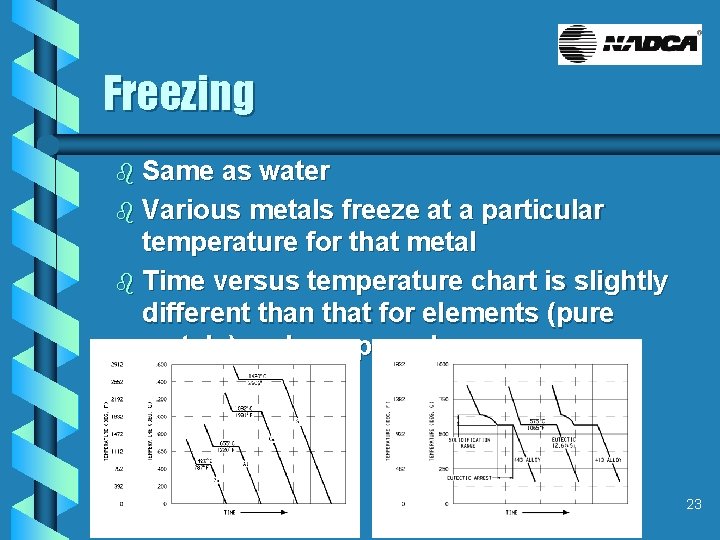
Freezing Same as water b Various metals freeze at a particular temperature for that metal b Time versus temperature chart is slightly different than that for elements (pure metals) and compounds b 23
Quality b Alloy chemical composition is controlled by an ASTM, American Society for Testing and Materials, specification b Each die casting plan has a method for maintaining alloy quality • Begins with purchasing of material, and continues through manufacturing process and shipment 24
Quality: Cleanliness b Cleanliness component of alloy quality b Not as easily checked as chemical composition b Each time alloy is melted, some material is oxidized • Oxides are impurities in alloy that could affect the casting’s properties if not 25 removed
Summary b Designers consider range of issues when creating a die casting b Each alloy has different mechanical properties: tensile strength, yield strength, elongation, and MOE b The alloy chosen must be appropriate to the die casting’s application b Alloy selection is based on 26
- Slides: 26