
Chapter 6 Osseous Tissue and Bone Structure Power
Chapter 6 Osseous Tissue and Bone Structure Power. Point® Lecture Slides prepared by Jason La. Pres Lone Star College - North Harris Copyright © 2010 Pearson Education, Inc.
An Introduction to the Skeletal System § Skeletal system includes § Bones of the skeleton § Cartilages, ligaments, and connective tissues Copyright © 2010 Pearson Education, Inc.
Functions of the Skeletal System § Support § Storage of minerals (calcium) § Storage of lipids (yellow marrow) § Blood cell production (red marrow) § Protection § Leverage (force of motion) Copyright © 2010 Pearson Education, Inc.
Classification of Bones § Bones are classified by § Shape § Internal tissue organization § Bone markings (surface features; marks) Copyright © 2010 Pearson Education, Inc.
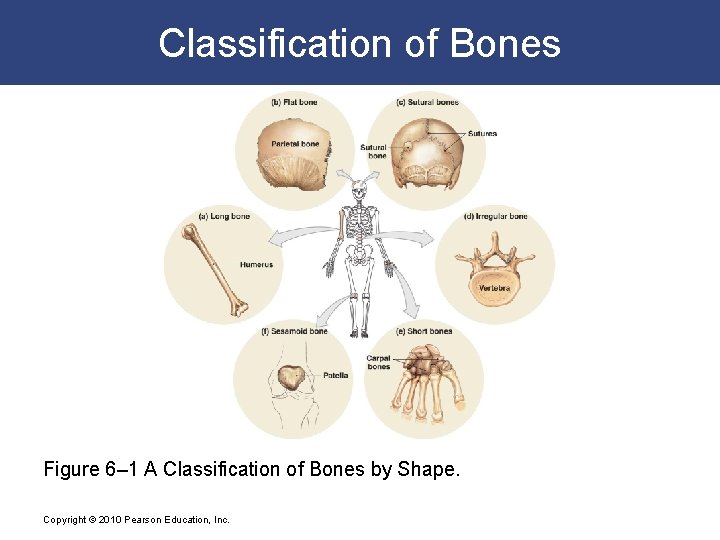
Classification of Bones Figure 6– 1 A Classification of Bones by Shape. Copyright © 2010 Pearson Education, Inc.
Classification of Bones § Bone Shapes § Long bones § Are long and thin § Are found in arms, legs, hands, feet, fingers, and toes § Flat bones § Are thin with parallel surfaces § Are found in the skull, sternum, ribs, and scapulae § Sutural bones § Are small, irregular bones § Are found between the flat bones of the skull Copyright © 2010 Pearson Education, Inc.
Classification of Bones § Bone Shapes § Irregular bones § Have complex shapes § Examples: spinal vertebrae, pelvic bones § Short bones § Are small and thick § Examples: ankle and wrist bones § Sesamoid bones § Are small and flat § Develop inside tendons near joints of knees, hands, and feet Copyright © 2010 Pearson Education, Inc.
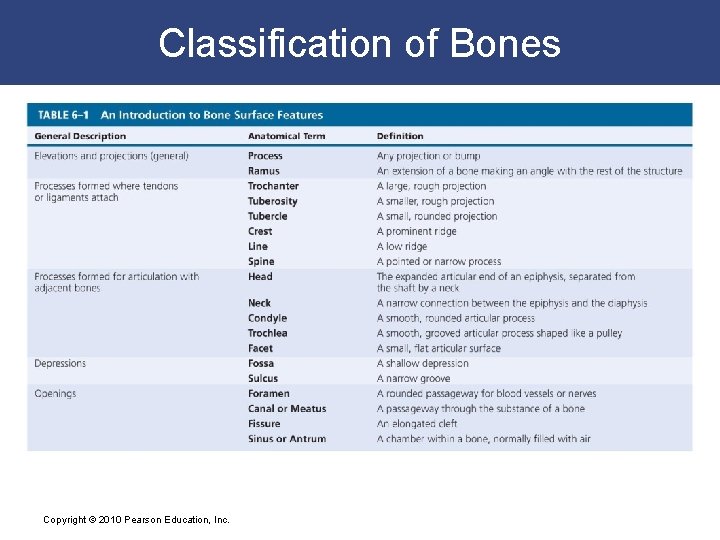
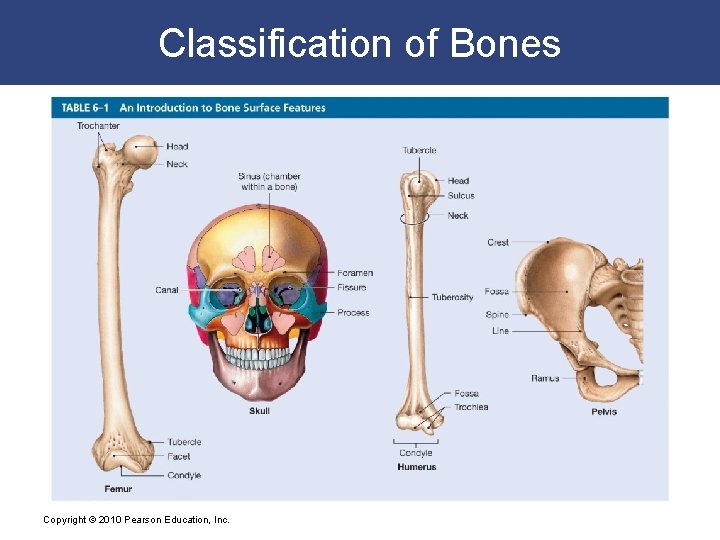
Classification of Bones § Bone Markings § Depressions or grooves § Along bone surface § Projections § Where tendons and ligaments attach § At articulations with other bones § Tunnels § Where blood and nerves enter bone Copyright © 2010 Pearson Education, Inc.
Classification of Bones Copyright © 2010 Pearson Education, Inc.
Classification of Bones Copyright © 2010 Pearson Education, Inc.
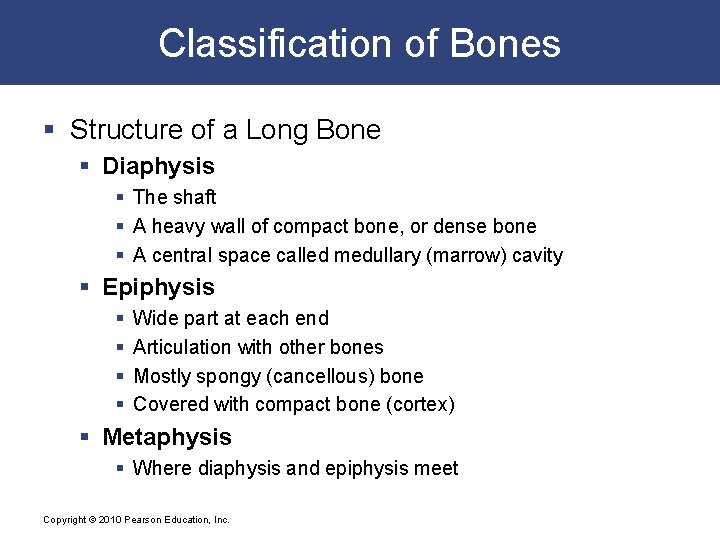
Classification of Bones § Structure of a Long Bone § Diaphysis § The shaft § A heavy wall of compact bone, or dense bone § A central space called medullary (marrow) cavity § Epiphysis § § Wide part at each end Articulation with other bones Mostly spongy (cancellous) bone Covered with compact bone (cortex) § Metaphysis § Where diaphysis and epiphysis meet Copyright © 2010 Pearson Education, Inc.
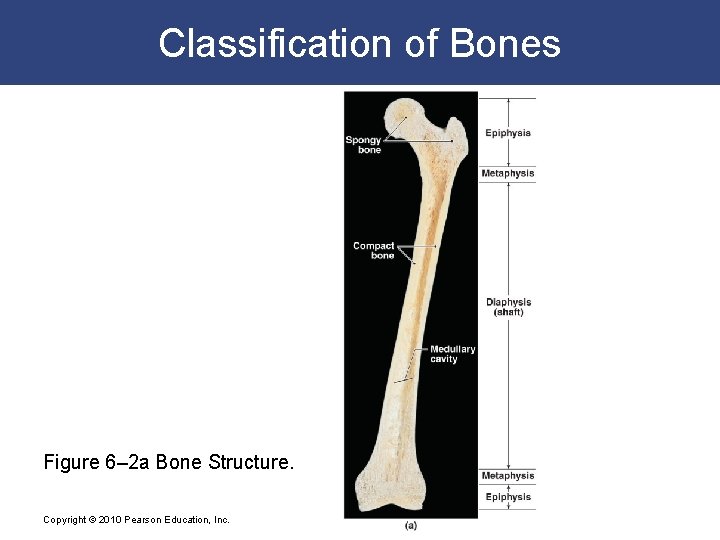
Classification of Bones Figure 6– 2 a Bone Structure. Copyright © 2010 Pearson Education, Inc.
Classification of Bones § Structure of a Flat Bone § The parietal bone of the skull § Resembles a sandwich of spongy bone § Between two layers of compact bone § Within the cranium, the layer of spongy bone between the compact bone is called the diploë Copyright © 2010 Pearson Education, Inc.
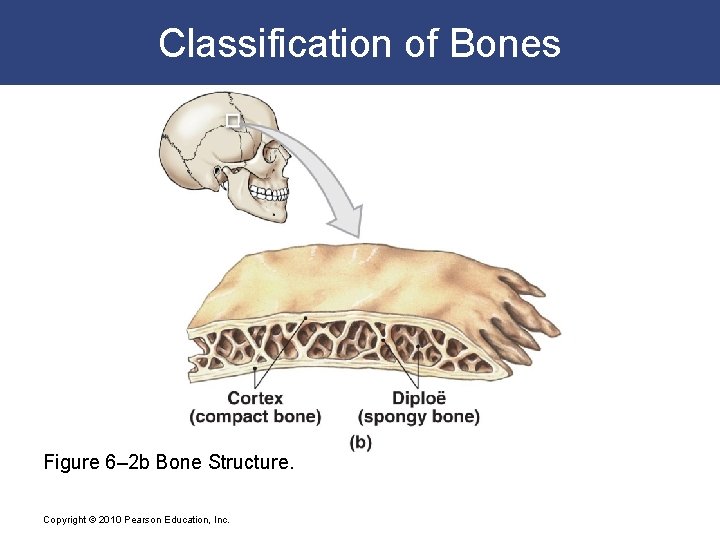
Classification of Bones Figure 6– 2 b Bone Structure. Copyright © 2010 Pearson Education, Inc.
Bone (Osseous) Tissue § Dense, supportive connective tissue § Contains specialized cells § Produces solid matrix of calcium salt deposits § Around collagen fibers Copyright © 2010 Pearson Education, Inc.
Bone (Osseous) Tissue § Characteristics of Bone Tissue § Dense matrix, containing § Deposits of calcium salts § Osteocytes (bone cells) within lacunae organized around blood vessels § Canaliculi § Form pathways for blood vessels § Exchange nutrients and wastes § Periosteum § Covers outer surfaces of bones § Consists of outer fibrous and inner cellular layers Copyright © 2010 Pearson Education, Inc.
Bone (Osseous) Tissue § Matrix Minerals § Two thirds of bone matrix is calcium phosphate, Ca 3(PO 4)2 § Reacts with calcium hydroxide, Ca(OH)2 § To form crystals of hydroxyapatite, Ca 10(PO 4)6(OH)2 § Which incorporates other calcium salts and ions § Matrix Proteins § One third of bone matrix is protein fibers (collagen) Copyright © 2010 Pearson Education, Inc.
Bone (Osseous) Tissue § The Cells of Bone § Make up only 2% of bone mass § Bone contains four types of cells § Osteocytes § Osteoblasts § Osteoprogenitor cells § Osteoclasts Copyright © 2010 Pearson Education, Inc.
Bone (Osseous) Tissue § Osteocytes § Mature bone cells that maintain the bone matrix § Live in lacunae § Are between layers (lamellae) of matrix § Connect by cytoplasmic extensions through canaliculi in lamellae § Do not divide § Functions § To maintain protein and mineral content of matrix § To help repair damaged bone Copyright © 2010 Pearson Education, Inc.
Bone (Osseous) Tissue § Osteoblasts § Immature bone cells that secrete matrix compounds (osteogenesis) § Osteoid—matrix produced by osteoblasts, but not yet calcified to form bone § Osteoblasts surrounded by bone become osteocytes Copyright © 2010 Pearson Education, Inc.
Bone (Osseous) Tissue § Osteoprogenitor cells § Mesenchymal stem cells that divide to produce osteoblasts § Are located in endosteum, the inner, cellular layer of periosteum § Assist in fracture repair Copyright © 2010 Pearson Education, Inc.
Bone (Osseous) Tissue § Osteoclasts § Secrete acids and protein-digesting enzymes § Giant, multinucleate cells § Dissolve bone matrix and release stored minerals (osteolysis) § Are derived from stem cells that produce macrophages Copyright © 2010 Pearson Education, Inc.
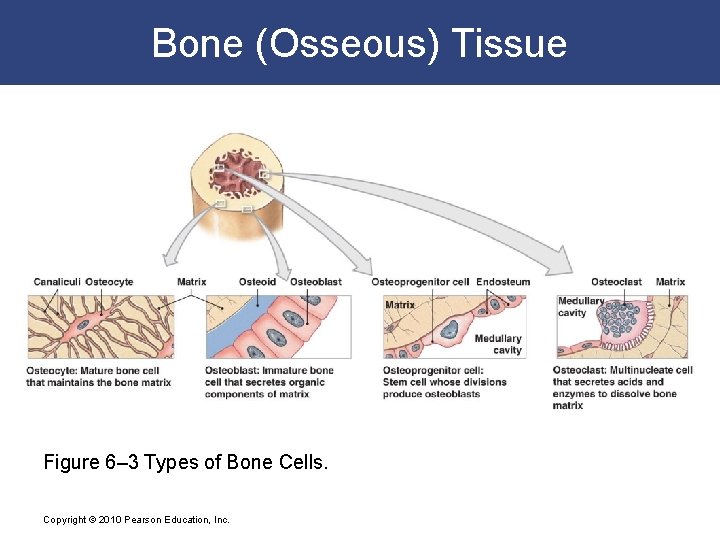
Bone (Osseous) Tissue Figure 6– 3 Types of Bone Cells. Copyright © 2010 Pearson Education, Inc.
Bone (Osseous) Tissue § Homeostasis § Bone building (by osteoblasts) and bone recycling (by osteoclasts) must balance § More breakdown than building, bones become weak § Exercise, particularly weight-bearing exercise, causes osteoblasts to build bone Copyright © 2010 Pearson Education, Inc.
Compact and Spongy Bone § The Structure of Compact Bone § Osteon is the basic unit § Osteocytes are arranged in concentric lamellae § Around a central canal containing blood vessels § Perforating Canals: – perpendicular to the central canal – carry blood vessels into bone and marrow § Circumferential Lamellae § Lamellae wrapped around the long bone § Bind osteons together Copyright © 2010 Pearson Education, Inc.
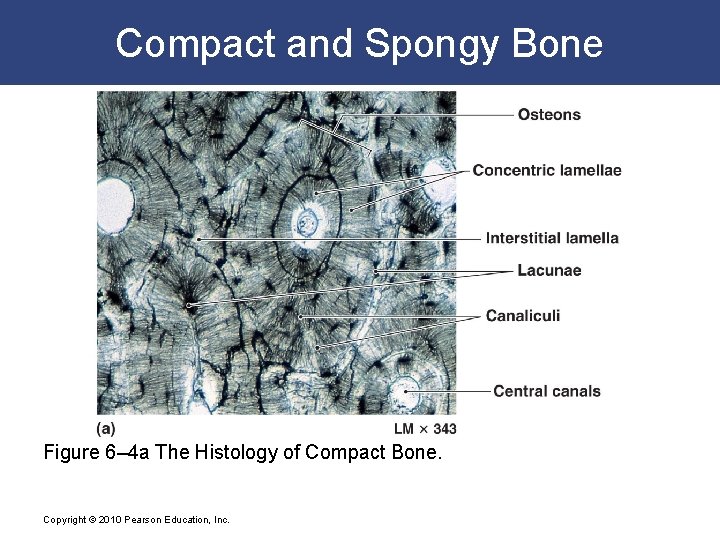
Compact and Spongy Bone Figure 6– 4 a The Histology of Compact Bone. Copyright © 2010 Pearson Education, Inc.
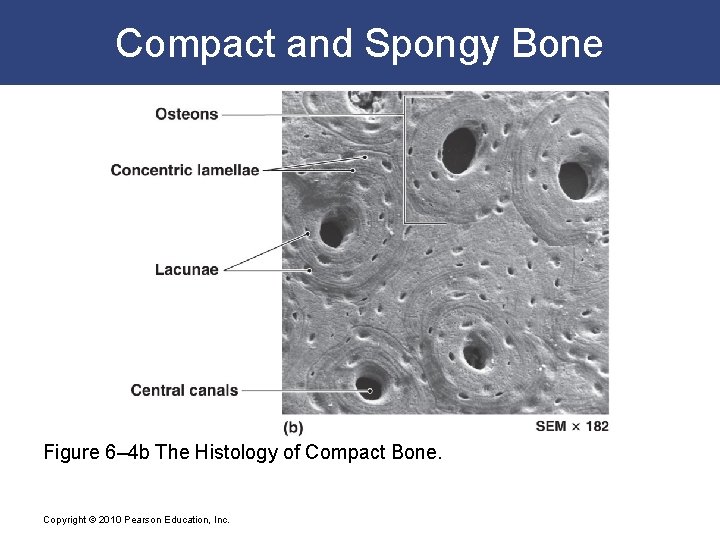
Compact and Spongy Bone Figure 6– 4 b The Histology of Compact Bone. Copyright © 2010 Pearson Education, Inc.
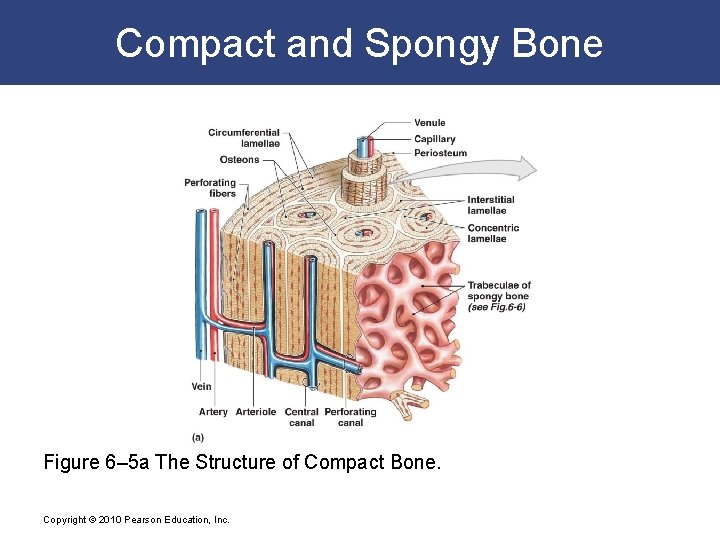
Compact and Spongy Bone Figure 6– 5 a The Structure of Compact Bone. Copyright © 2010 Pearson Education, Inc.
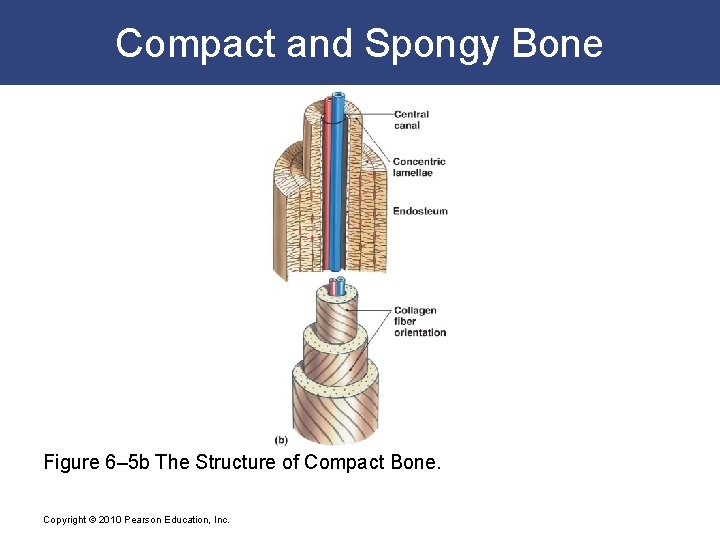
Compact and Spongy Bone Figure 6– 5 b The Structure of Compact Bone. Copyright © 2010 Pearson Education, Inc.
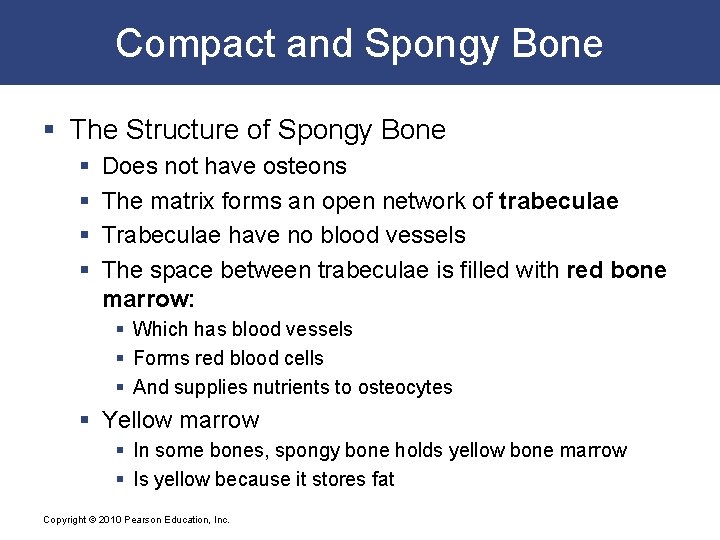
Compact and Spongy Bone § The Structure of Spongy Bone § § Does not have osteons The matrix forms an open network of trabeculae Trabeculae have no blood vessels The space between trabeculae is filled with red bone marrow: § Which has blood vessels § Forms red blood cells § And supplies nutrients to osteocytes § Yellow marrow § In some bones, spongy bone holds yellow bone marrow § Is yellow because it stores fat Copyright © 2010 Pearson Education, Inc.
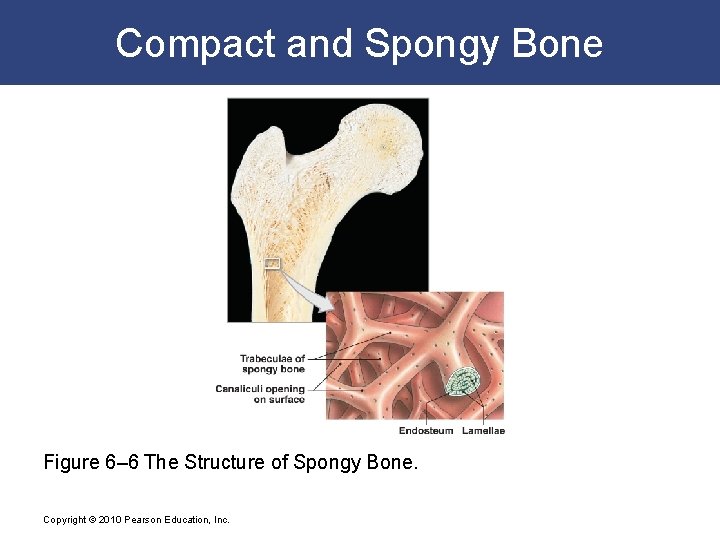
Compact and Spongy Bone Figure 6– 6 The Structure of Spongy Bone. Copyright © 2010 Pearson Education, Inc.
Compact and Spongy Bone § Weight-Bearing Bones § The femur transfers weight from hip joint to knee joint § Causing tension on the lateral side of the shaft § And compression on the medial side Copyright © 2010 Pearson Education, Inc.
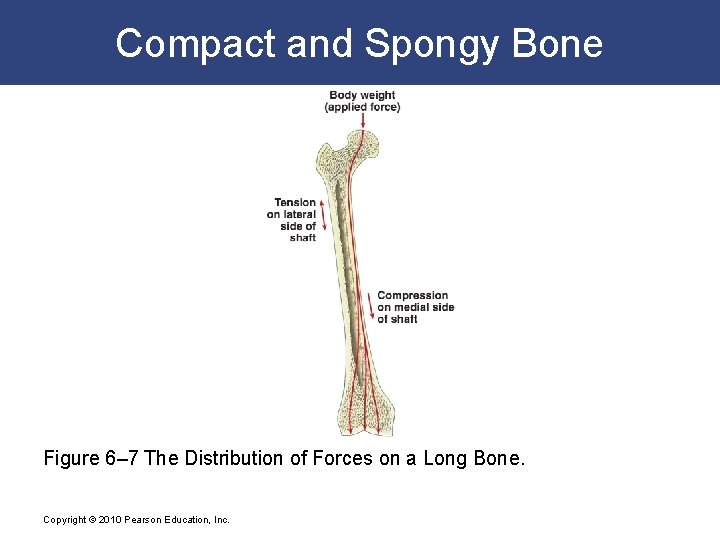
Compact and Spongy Bone Figure 6– 7 The Distribution of Forces on a Long Bone. Copyright © 2010 Pearson Education, Inc.
Compact and Spongy Bone § Compact bone is covered with a membrane § Periosteum on the outside § Covers all bones except parts enclosed in joint capsules § Is made up of an outer, fibrous layer and an inner, cellular layer § Perforating fibers: collagen fibers of the periosteum: – connect with collagen fibers in bone – and with fibers of joint capsules; attach tendons, and ligaments Copyright © 2010 Pearson Education, Inc.
Compact and Spongy Bone § Functions of Periosteum § Isolates bone from surrounding tissues § Provides a route for circulatory and nervous supply § Participates in bone growth and repair Copyright © 2010 Pearson Education, Inc.
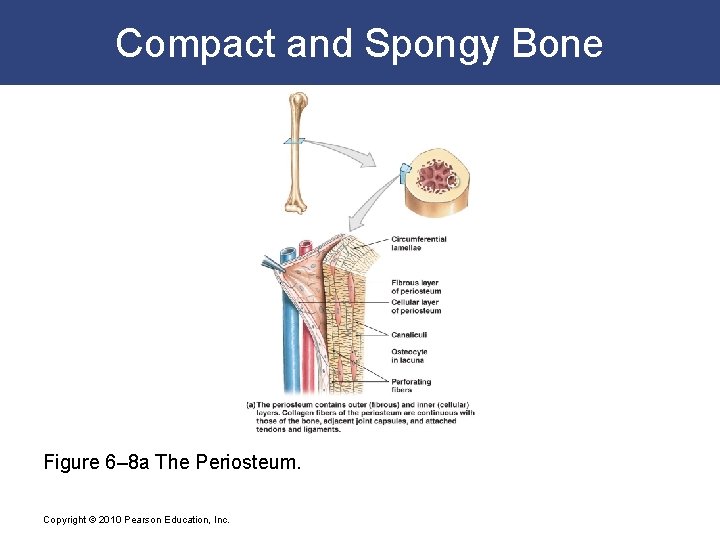
Compact and Spongy Bone Figure 6– 8 a The Periosteum. Copyright © 2010 Pearson Education, Inc.
Compact and Spongy Bone § Compact bone is covered with a membrane: § Endosteum on the inside § An incomplete cellular layer: – lines the medullary (marrow) cavity – covers trabeculae of spongy bone – lines central canals – contains osteoblasts, osteoprogenitor cells, and osteoclasts – is active in bone growth and repair Copyright © 2010 Pearson Education, Inc.
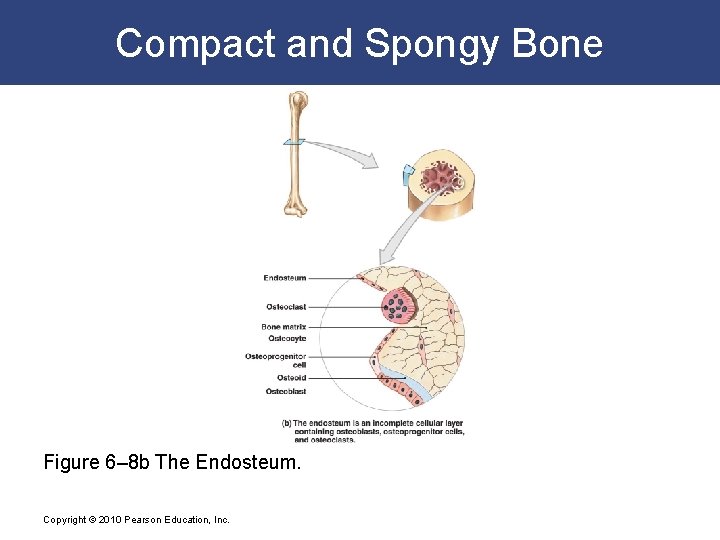
Compact and Spongy Bone Figure 6– 8 b The Endosteum. Copyright © 2010 Pearson Education, Inc.
Bone Formation and Growth § Bone Development § Human bones grow until about age 25 § Osteogenesis § Bone formation § Ossification § The process of replacing other tissues with bone Copyright © 2010 Pearson Education, Inc.
Bone Formation and Growth § Bone Development § Calcification § The process of depositing calcium salts § Occurs during bone ossification and in other tissues § Ossification § The two main forms of ossification are – intramembranous ossification – endochondral ossification Copyright © 2010 Pearson Education, Inc.
Bone Formation and Growth § Endochondral Ossification § Ossifies bones that originate as hyaline cartilage § Most bones originate as hyaline cartilage § There are six main steps in endochondral ossification Copyright © 2010 Pearson Education, Inc.
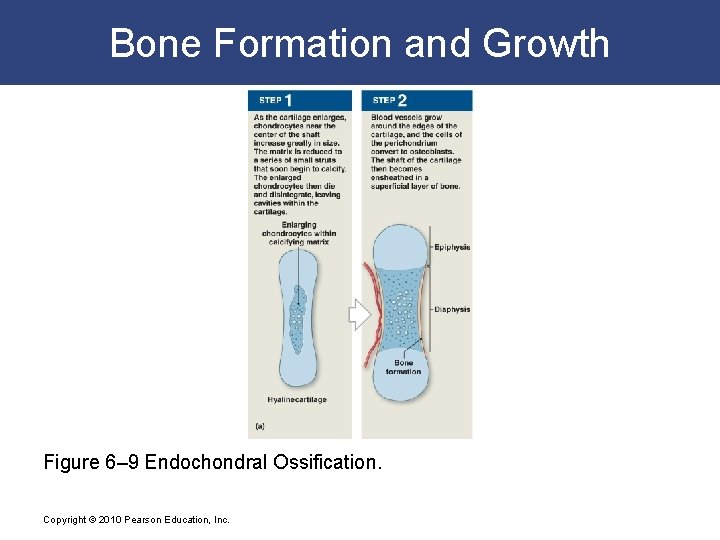
Bone Formation and Growth Figure 6– 9 Endochondral Ossification. Copyright © 2010 Pearson Education, Inc.
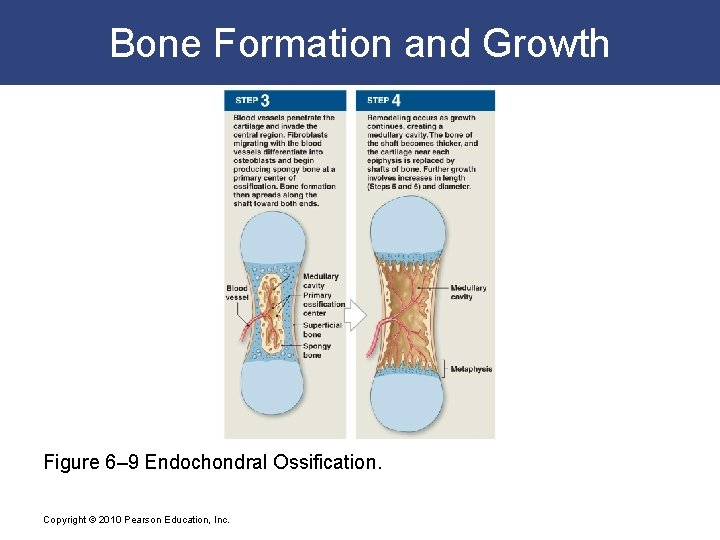
Bone Formation and Growth Figure 6– 9 Endochondral Ossification. Copyright © 2010 Pearson Education, Inc.
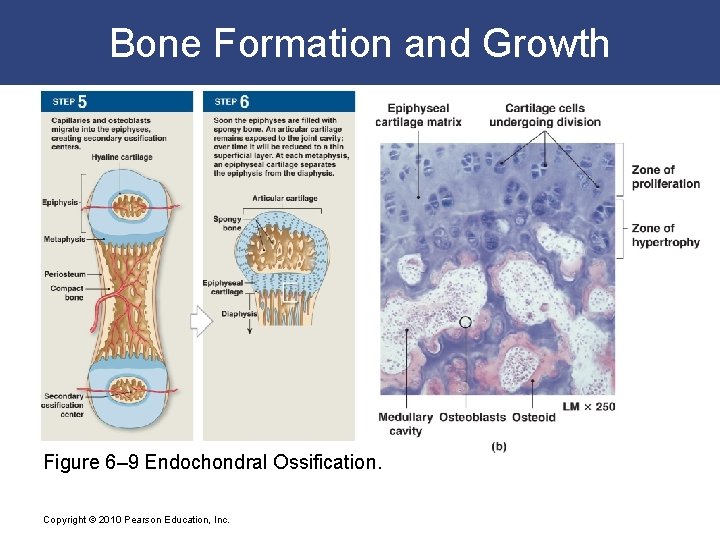
Bone Formation and Growth Figure 6– 9 Endochondral Ossification. Copyright © 2010 Pearson Education, Inc.
Bone Formation and Growth § Appositional growth § Compact bone thickens and strengthens long bone with layers of circumferential lamellae Endochondral Ossification Copyright © 2010 Pearson Education, Inc.
Bone Formation and Growth § Epiphyseal Lines § When long bone stops growing, after puberty § Epiphyseal cartilage disappears § Is visible on X-rays as an epiphyseal line § Mature Bones § As long bone matures § Osteoclasts enlarge medullary (marrow) cavity § Osteons form around blood vessels in compact bone Copyright © 2010 Pearson Education, Inc.
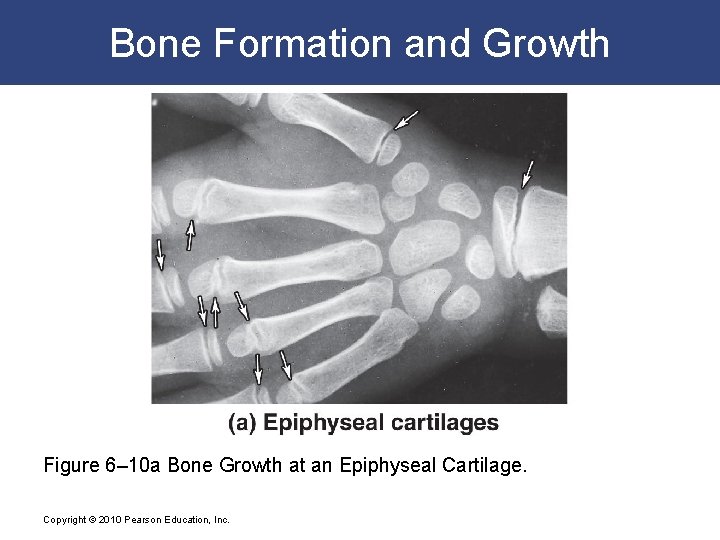
Bone Formation and Growth Figure 6– 10 a Bone Growth at an Epiphyseal Cartilage. Copyright © 2010 Pearson Education, Inc.
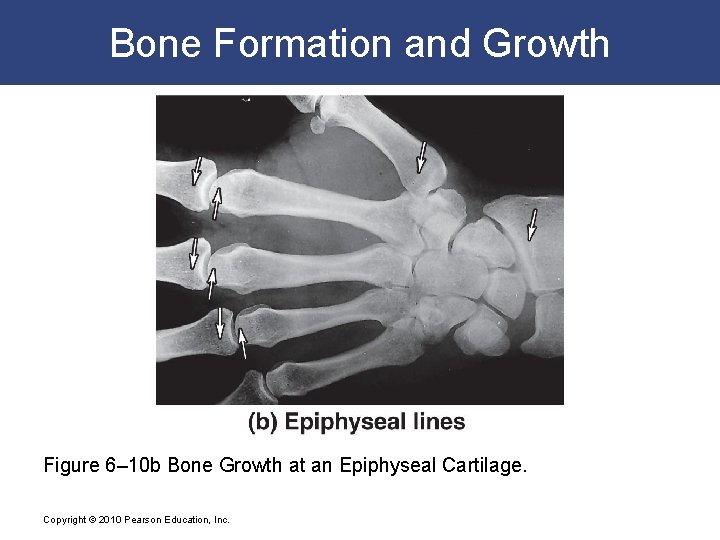
Bone Formation and Growth Figure 6– 10 b Bone Growth at an Epiphyseal Cartilage. Copyright © 2010 Pearson Education, Inc.
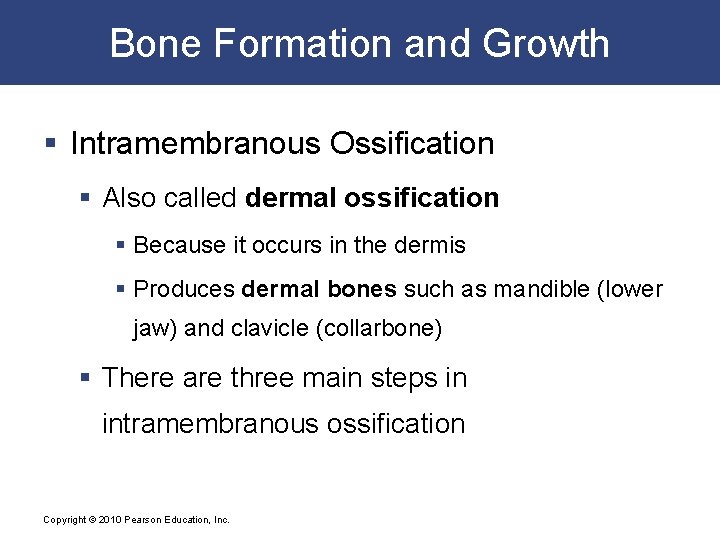
Bone Formation and Growth § Intramembranous Ossification § Also called dermal ossification § Because it occurs in the dermis § Produces dermal bones such as mandible (lower jaw) and clavicle (collarbone) § There are three main steps in intramembranous ossification Copyright © 2010 Pearson Education, Inc.
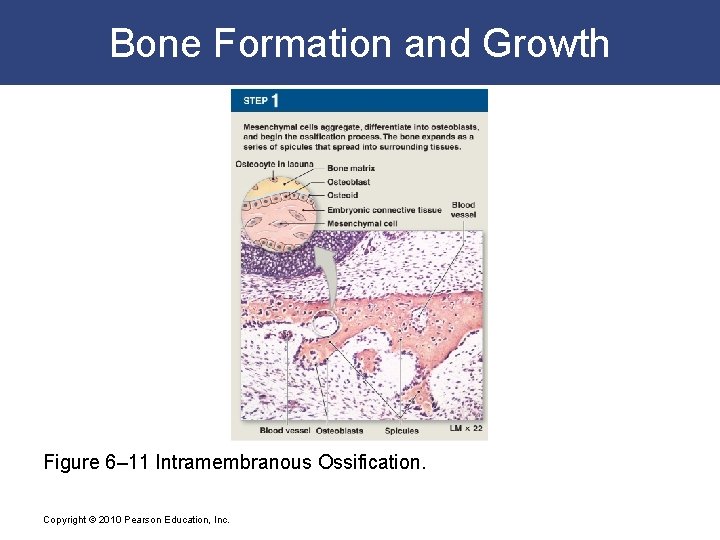
Bone Formation and Growth Figure 6– 11 Intramembranous Ossification. Copyright © 2010 Pearson Education, Inc.
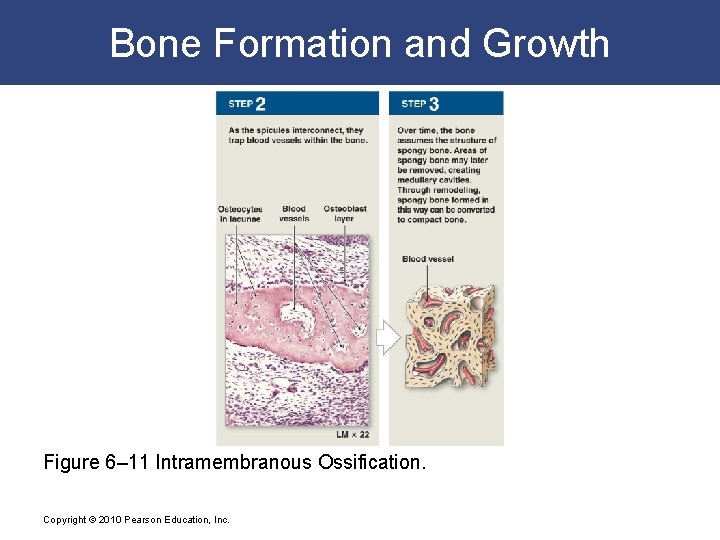
Bone Formation and Growth Figure 6– 11 Intramembranous Ossification. Copyright © 2010 Pearson Education, Inc.
Bone Formation and Growth § Blood Supply of Mature Bones § Three major sets of blood vessels develop § Nutrient artery and vein: – a single pair of large blood vessels – enter the diaphysis through the nutrient foramen – femur has more than one pair § Metaphyseal vessels: – supply the epiphyseal cartilage – where bone growth occurs § Periosteal vessels provide: – blood to superficial osteons – secondary ossification centers Copyright © 2010 Pearson Education, Inc.
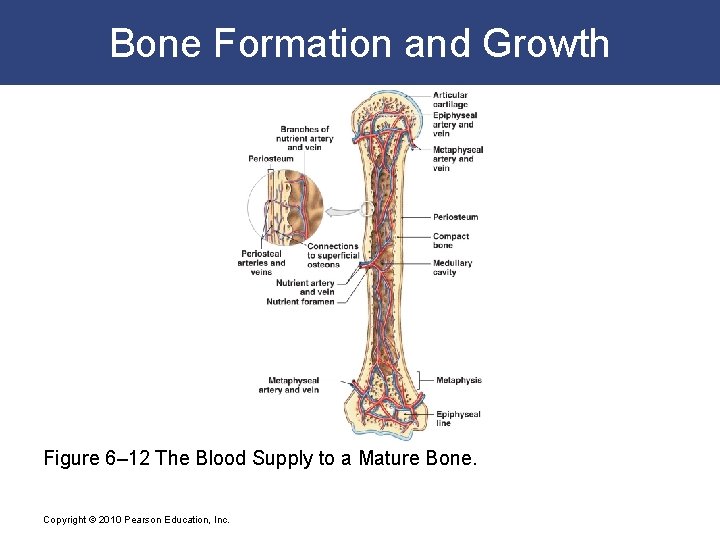
Bone Formation and Growth Figure 6– 12 The Blood Supply to a Mature Bone. Copyright © 2010 Pearson Education, Inc.
Bone Formation and Growth § Lymph and Nerves § The periosteum also contains § Networks of lymphatic vessels § Sensory nerves Copyright © 2010 Pearson Education, Inc.
Bone Remodeling § Process of Remodeling § The adult skeleton § Maintains itself § Replaces mineral reserves § Recycles and renews bone matrix § Involves osteocytes, osteoblasts, and osteoclasts § Bone continually remodels, recycles, and replaces § Turnover rate varies § If deposition is greater than removal, bones get stronger § If removal is faster than replacement, bones get weaker Copyright © 2010 Pearson Education, Inc.
Exercise, Hormones, and Nutrition § Effects of Exercise on Bone § Mineral recycling allows bones to adapt to stress § Heavily stressed bones become thicker and stronger § Bone Degeneration § Bone degenerates quickly § Up to one third of bone mass can be lost in a few weeks of inactivity Copyright © 2010 Pearson Education, Inc.
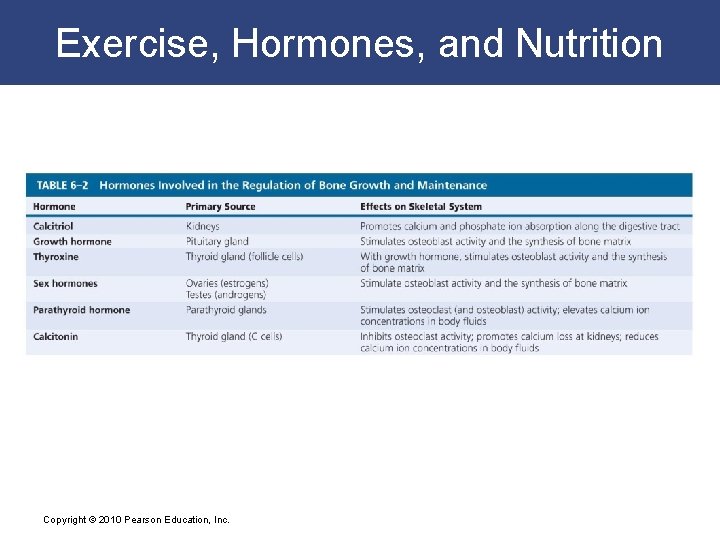
Exercise, Hormones, and Nutrition § Normal bone growth and maintenance requires nutritional and hormonal factors § A dietary source of calcium and phosphate salts § Plus small amounts of magnesium, fluoride, iron, and manganese § The hormone calcitriol § Is made in the kidneys § Helps absorb calcium and phosphorus from digestive tract § Synthesis requires vitamin D 3 (cholecalciferol) Copyright © 2010 Pearson Education, Inc.
Exercise, Hormones, and Nutrition § Normal bone growth and maintenance depend on nutritional and hormonal factors § Vitamin C is required for collagen synthesis, and stimulation of osteoblast differentiation § Vitamin A stimulates osteoblast activity § Vitamins K and B 12 help synthesize bone proteins § Growth hormone and thyroxine stimulate bone growth § Estrogens androgens stimulate osteoblasts § Calcitonin and parathyroid hormone regulate calcium and phosphate levels Copyright © 2010 Pearson Education, Inc.
Exercise, Hormones, and Nutrition Copyright © 2010 Pearson Education, Inc.
Calcium Homeostasis § The Skeleton as a Calcium Reserve § Bones store calcium and other minerals § Calcium is the most abundant mineral in the body § Calcium ions are vital to: – membranes – neurons – muscle cells, especially heart cells Copyright © 2010 Pearson Education, Inc.
Calcium Homeostasis § Calcium Regulation § Calcium ions in body fluids § Must be closely regulated § Homeostasis is maintained § By calcitonin and parathyroid hormone § Which control storage, absorption, and excretion Copyright © 2010 Pearson Education, Inc.
Calcium Homeostasis § Calcitonin and parathyroid hormone control and affect § Bones § Where calcium is stored § Digestive tract § Where calcium is absorbed § Kidneys § Where calcium is excreted Copyright © 2010 Pearson Education, Inc.
Calcium Homeostasis § Parathyroid Hormone (PTH) § Produced by parathyroid glands in neck § Increases calcium ion levels by § Stimulating osteoclasts § Increasing intestinal absorption of calcium § Decreasing calcium excretion at kidneys § Calcitonin § Secreted by C cells (parafollicular cells) in thyroid § Decreases calcium ion levels by § Inhibiting osteoclast activity § Increasing calcium excretion at kidneys Copyright © 2010 Pearson Education, Inc.
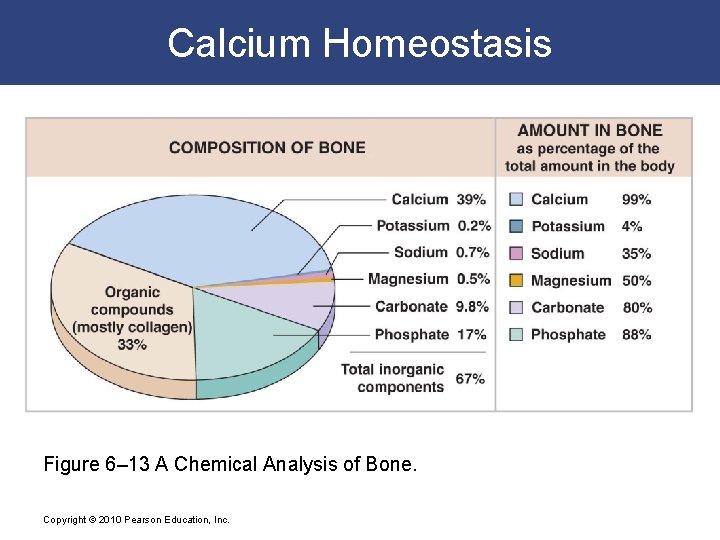
Calcium Homeostasis Figure 6– 13 A Chemical Analysis of Bone. Copyright © 2010 Pearson Education, Inc.
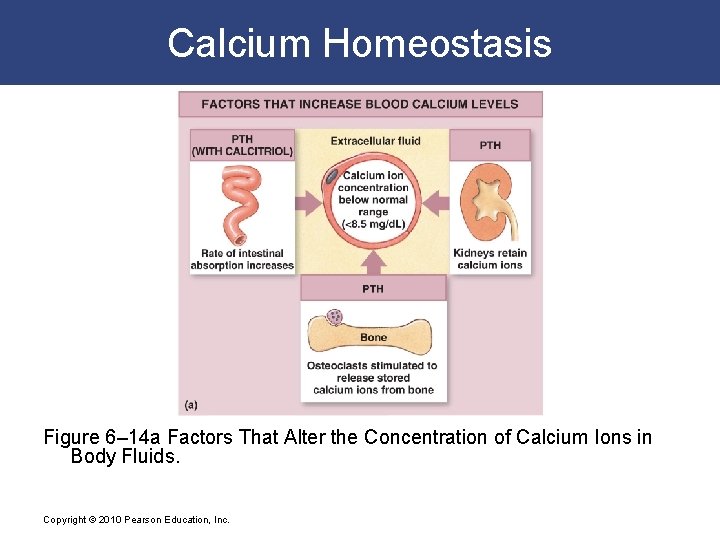
Calcium Homeostasis Figure 6– 14 a Factors That Alter the Concentration of Calcium Ions in Body Fluids. Copyright © 2010 Pearson Education, Inc.
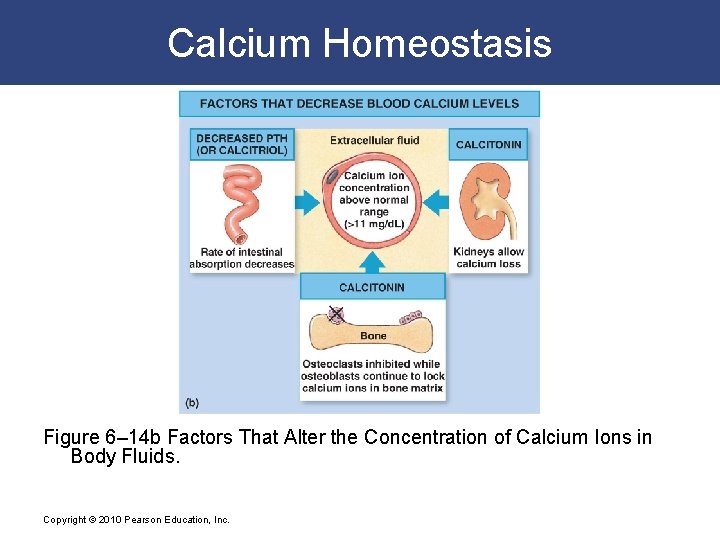
Calcium Homeostasis Figure 6– 14 b Factors That Alter the Concentration of Calcium Ions in Body Fluids. Copyright © 2010 Pearson Education, Inc.
Fractures § Cracks or breaks in bones § Caused by physical stress Copyright © 2010 Pearson Education, Inc.
Fractures § Fractures are repaired in four steps § Bleeding § Produces a clot (fracture hematoma) § Establishes a fibrous network § Bone cells in the area die § Cells of the endosteum and periosteum § Divide and migrate into fracture zone § Calluses stabilize the break: – external callus of cartilage and bone surrounds break – internal callus develops in medullary cavity Copyright © 2010 Pearson Education, Inc.
Fractures § Fractures are repaired in four steps § Osteoblasts § Replace central cartilage of external callus § With spongy bone § Osteoblasts and osteocytes remodel the fracture for up to a year § Reducing bone calluses Steps in the Repair of a Fracture Copyright © 2010 Pearson Education, Inc.
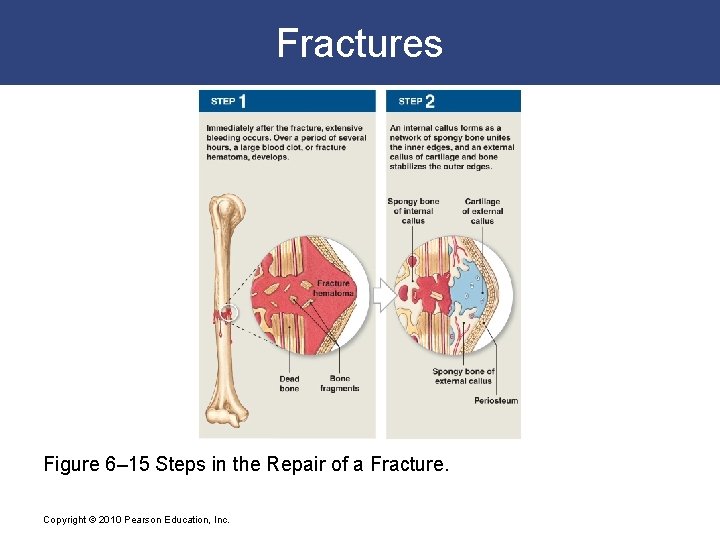
Fractures Figure 6– 15 Steps in the Repair of a Fracture. Copyright © 2010 Pearson Education, Inc.
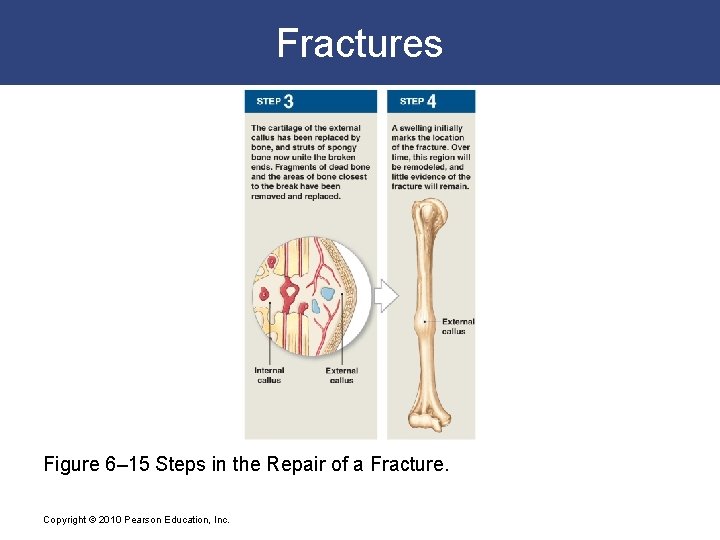
Fractures Figure 6– 15 Steps in the Repair of a Fracture. Copyright © 2010 Pearson Education, Inc.
Fractures § The Major Types of Fractures § Pott fracture § Comminuted fractures § Transverse fractures § Spiral fractures § Displaced fractures § Colles fracture § Greenstick fracture § Epiphyseal fractures § Compression fractures Copyright © 2010 Pearson Education, Inc.
Osteopenia § Bones become thinner and weaker with age § Osteopenia begins between ages 30 and 40 § Women lose 8% of bone mass per decade, men 3% Copyright © 2010 Pearson Education, Inc.
Osteopenia § The epiphyses, vertebrae, and jaws are most affected: § Resulting in fragile limbs § Reduction in height § Tooth loss § Osteoporosis § Severe bone loss § Affects normal function § Over age 45, occurs in § 29% of women § 18% of men Copyright © 2010 Pearson Education, Inc.
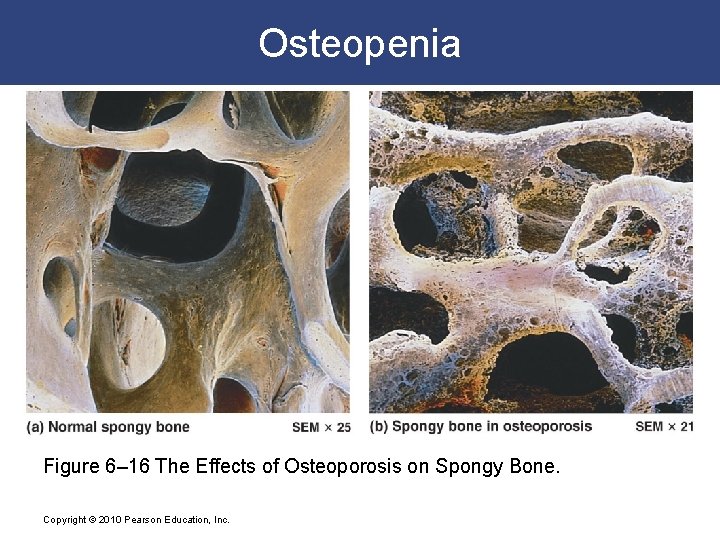
Osteopenia Figure 6– 16 The Effects of Osteoporosis on Spongy Bone. Copyright © 2010 Pearson Education, Inc.
Aging § Hormones and Bone Loss § Estrogens androgens help maintain bone mass § Bone loss in women accelerates after menopause § Cancer and Bone Loss § Cancerous tissues release osteoclast-activating factor § That stimulates osteoclasts § And produces severe osteoporosis Copyright © 2010 Pearson Education, Inc.
- Slides: 76