
Chapter 6 Organizational Structure Management Systems The Fundamentals
- Slides: 18
Chapter 6 Organizational Structure & Management Systems: The Fundamentals of Strategy Implementation Prof. Luciano Thomé e Castro
© 2013 Robert M. Grant www. contemporarystrategyanalysis. com 2
Organizational Structure & Management Systems: The Fundamentals of Strategy Implementation OUTLINE • From strategy to implementation: Strategic planning systems • Organizational design o Specialization and division of labour o The cooperation problem o The coordination problem o Hierarchy in organizational design o Contingency approaches to organizational design • Organizational design: Choosing the right structure o Defining organizational units o Alternative structural forms o Trends in organizational design © 2013 Robert M. Grant www. contemporarystrategyanalysis. com 3
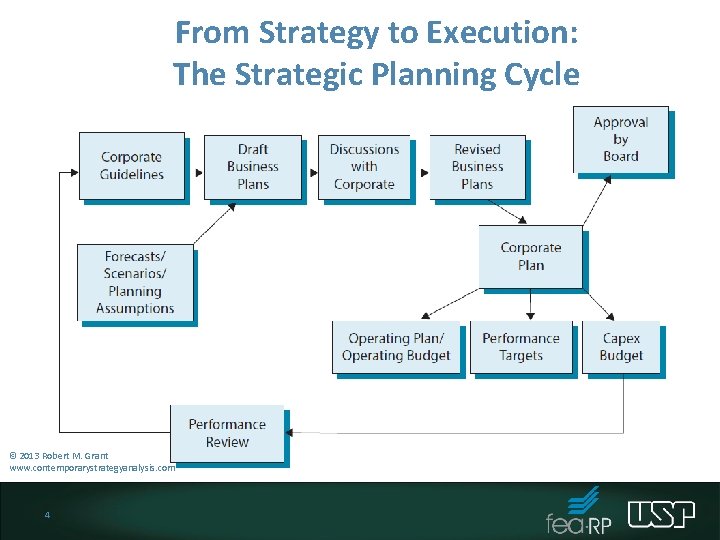
From Strategy to Execution: The Strategic Planning Cycle © 2013 Robert M. Grant www. contemporarystrategyanalysis. com 4
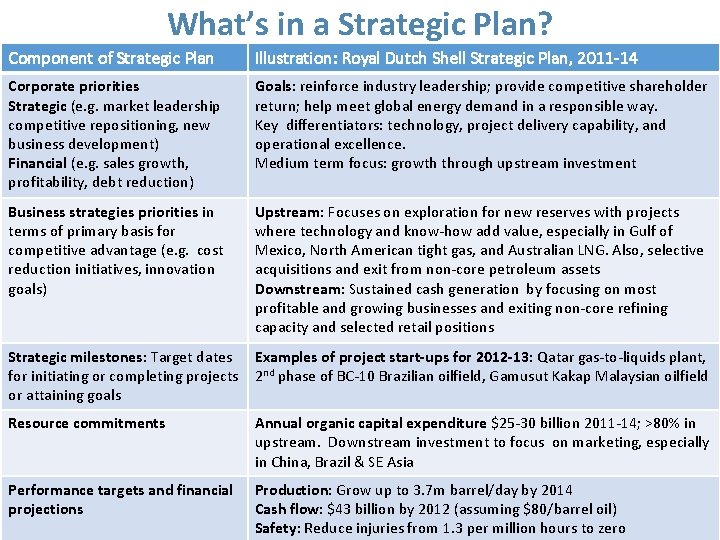
What’s in a Strategic Plan? Component of Strategic Plan Illustration: Royal Dutch Shell Strategic Plan, 2011 -14 Corporate priorities Strategic (e. g. market leadership competitive repositioning, new business development) Financial (e. g. sales growth, profitability, debt reduction) Goals: reinforce industry leadership; provide competitive shareholder return; help meet global energy demand in a responsible way. Key differentiators: technology, project delivery capability, and operational excellence. Medium term focus: growth through upstream investment Business strategies priorities in terms of primary basis for competitive advantage (e. g. cost reduction initiatives, innovation goals) Upstream: Focuses on exploration for new reserves with projects where technology and know-how add value, especially in Gulf of Mexico, North American tight gas, and Australian LNG. Also, selective acquisitions and exit from non-core petroleum assets Downstream: Sustained cash generation by focusing on most profitable and growing businesses and exiting non-core refining capacity and selected retail positions Strategic milestones: Target dates for initiating or completing projects or attaining goals Examples of project start-ups for 2012 -13: Qatar gas-to-liquids plant, 2 nd phase of BC-10 Brazilian oilfield, Gamusut Kakap Malaysian oilfield Resource commitments Annual organic capital expenditure $25 -30 billion 2011 -14; >80% in upstream. Downstream investment to focus on marketing, especially in China, Brazil & SE Asia Performance targets and financial projections 5 Production: Grow up to 3. 7 m barrel/day by 2014 Cash flow: $43 billion by 2012 (assuming $80/barrel oil) © 2013 Robert M. Grant Safety: Reduce injuries from 1. 3 per million hours to zero www. contemporarystrategyanalysis. com
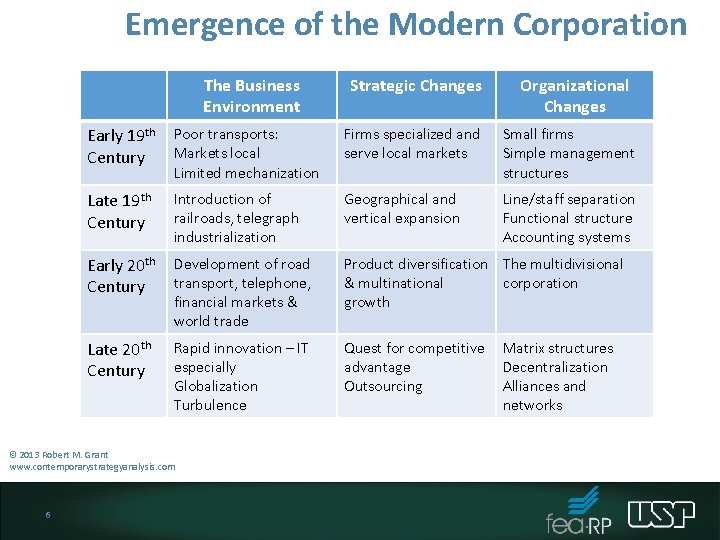
Emergence of the Modern Corporation The Business Environment Organizational Changes Early 19 th Century Poor transports: Markets local Limited mechanization Firms specialized and serve local markets Small firms Simple management structures Late 19 th Century Introduction of railroads, telegraph industrialization Geographical and vertical expansion Line/staff separation Functional structure Accounting systems Early 20 th Century Development of road transport, telephone, financial markets & world trade Product diversification The multidivisional & multinational corporation growth Late 20 th Century Rapid innovation – IT especially Globalization Turbulence Quest for competitive advantage Outsourcing © 2013 Robert M. Grant www. contemporarystrategyanalysis. com 6 Strategic Changes Matrix structures Decentralization Alliances and networks
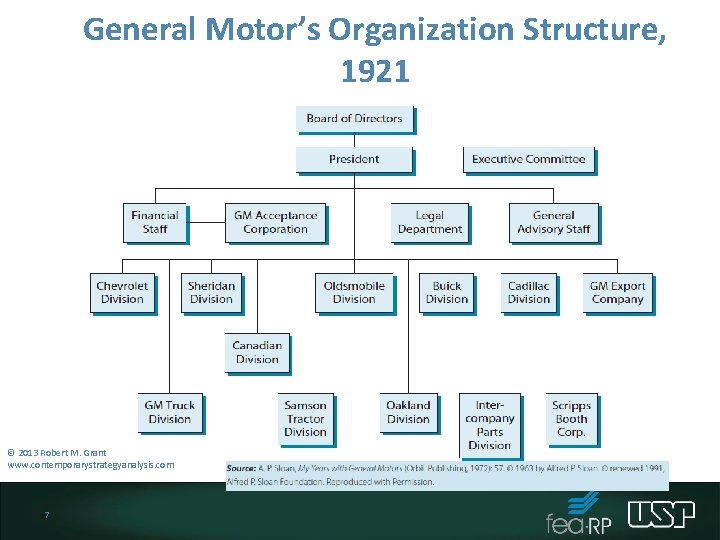
General Motor’s Organization Structure, 1921 © 2013 Robert M. Grant www. contemporarystrategyanalysis. com 7
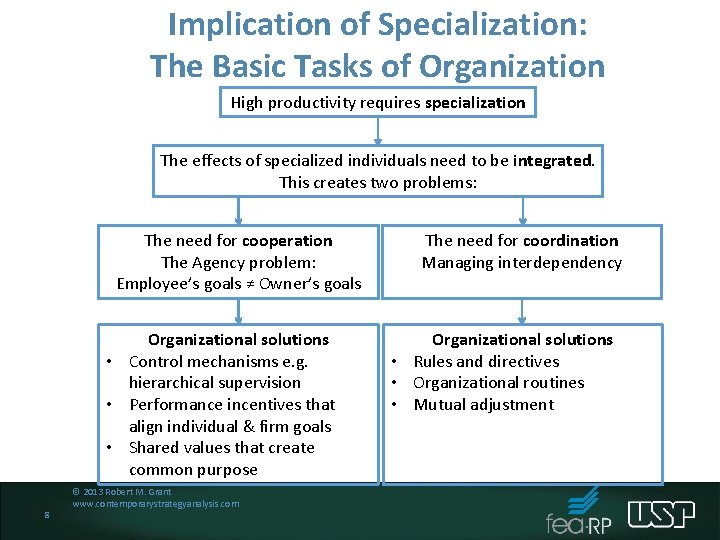
Implication of Specialization: The Basic Tasks of Organization High productivity requires specialization The effects of specialized individuals need to be integrated. This creates two problems: The need for cooperation The Agency problem: Employee’s goals ≠ Owner’s goals Organizational solutions • Control mechanisms e. g. hierarchical supervision • Performance incentives that align individual & firm goals • Shared values that create common purpose 8 © 2013 Robert M. Grant www. contemporarystrategyanalysis. com The need for coordination Managing interdependency Organizational solutions • Rules and directives • Organizational routines • Mutual adjustment
Hierarchy as Control: Weber’s Principles of Bureaucracy Rational-legal authority Specialization of labor Hierarchical structure Coordination and control through rules and standard operating procedures • Standardization of employment practices • Separation of positions and people: authority assigned to a position, not a person • Formalization of administrative acts, decisions and rules • • © 2013 Robert M. Grant www. contemporarystrategyanalysis. com 9
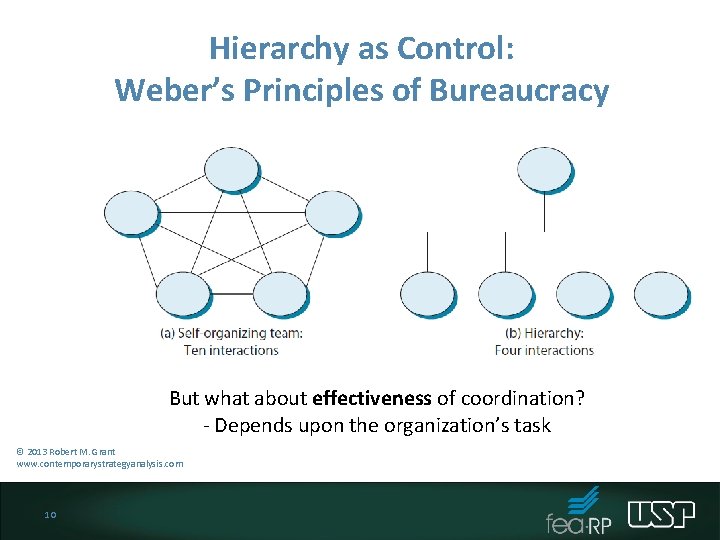
Hierarchy as Control: Weber’s Principles of Bureaucracy But what about effectiveness of coordination? - Depends upon the organization’s task © 2013 Robert M. Grant www. contemporarystrategyanalysis. com 10
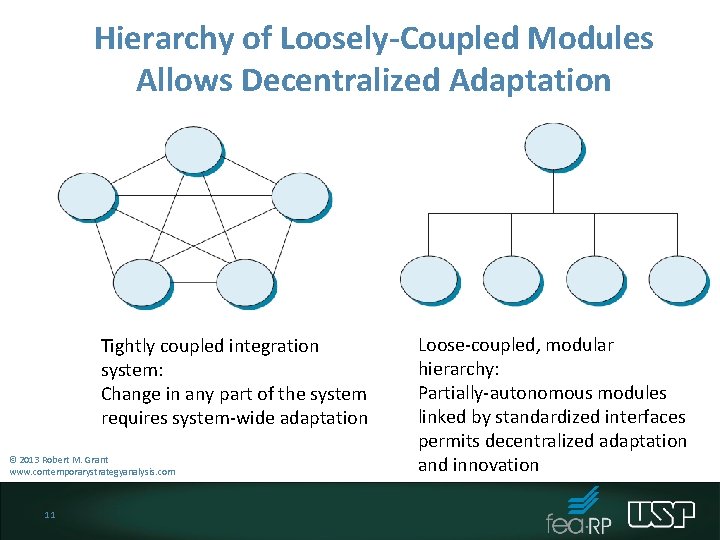
Hierarchy of Loosely-Coupled Modules Allows Decentralized Adaptation Tightly coupled integration system: Change in any part of the system requires system-wide adaptation © 2013 Robert M. Grant www. contemporarystrategyanalysis. com 11 Loose-coupled, modular hierarchy: Partially-autonomous modules linked by standardized interfaces permits decentralized adaptation and innovation
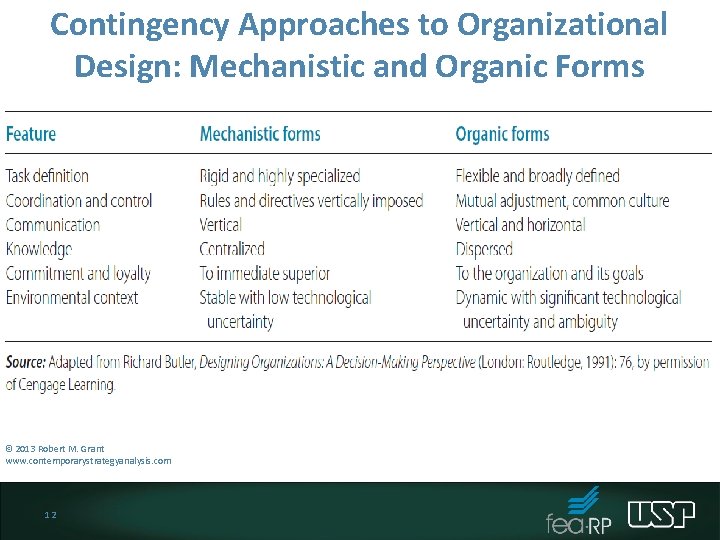
Contingency Approaches to Organizational Design: Mechanistic and Organic Forms © 2013 Robert M. Grant www. contemporarystrategyanalysis. com 12
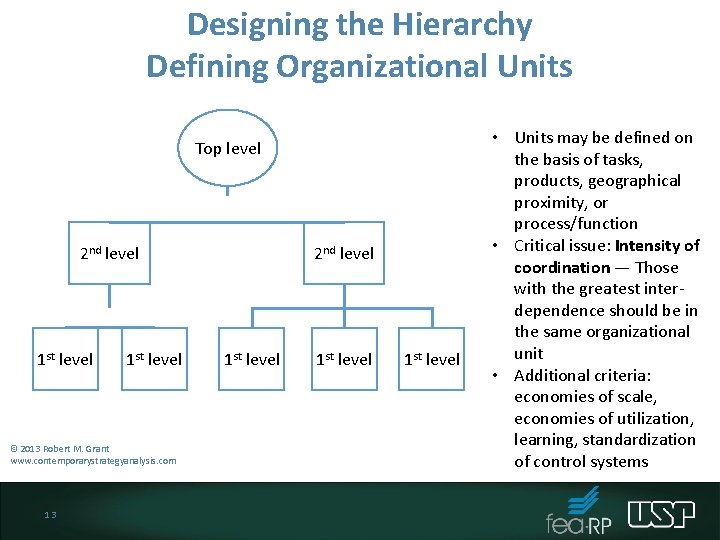
Designing the Hierarchy Defining Organizational Units Top level 2 nd level 1 st level © 2013 Robert M. Grant www. contemporarystrategyanalysis. com 13 1 st level • Units may be defined on the basis of tasks, products, geographical proximity, or process/function • Critical issue: Intensity of coordination — Those with the greatest interdependence should be in the same organizational unit • Additional criteria: economies of scale, economies of utilization, learning, standardization of control systems
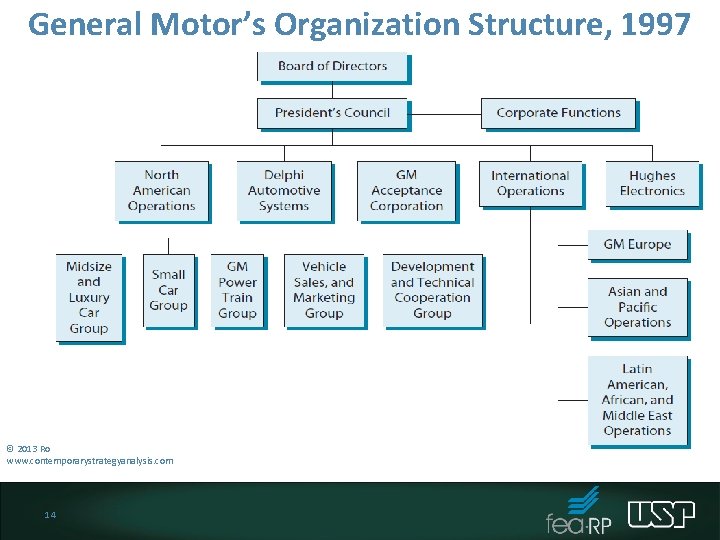
General Motor’s Organization Structure, 1997 © 2013 Robert M. Grant www. contemporarystrategyanalysis. com 14
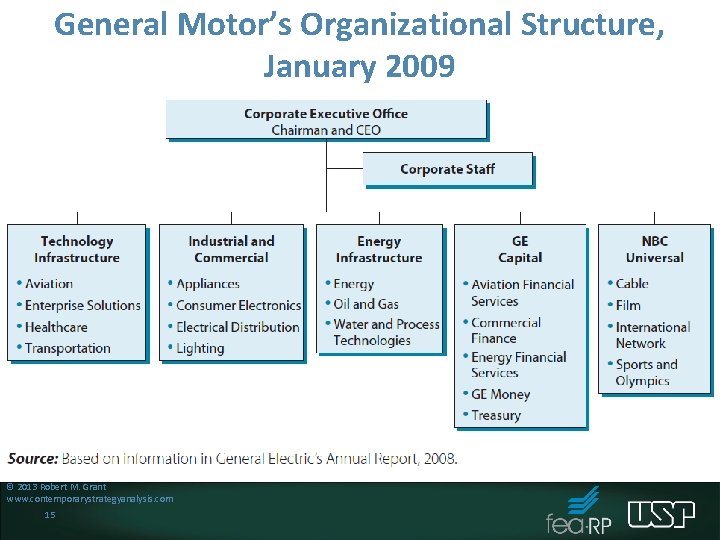
General Motor’s Organizational Structure, January 2009 © 2013 Robert M. Grant www. contemporarystrategyanalysis. com 15
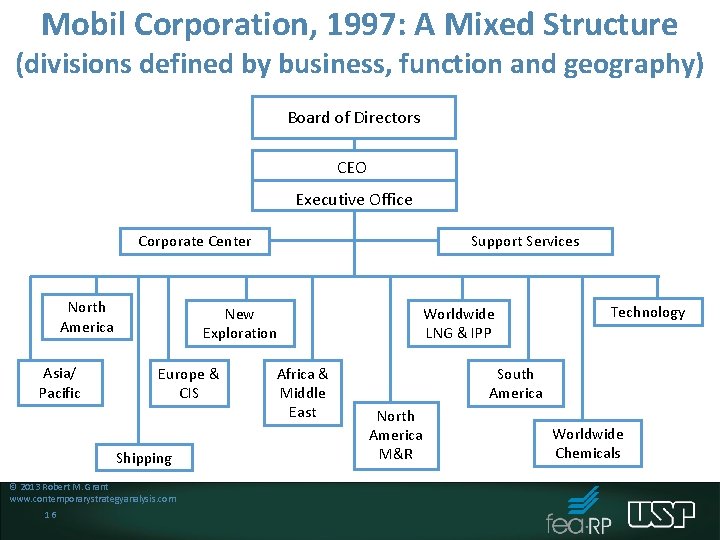
Mobil Corporation, 1997: A Mixed Structure (divisions defined by business, function and geography) Board of Directors CEO Executive Office Corporate Center North America Asia/ Pacific New Exploration Europe & CIS Shipping © 2013 Robert M. Grant www. contemporarystrategyanalysis. com 16 Support Services Africa & Middle East Worldwide LNG & IPP Technology South America North America M&R Worldwide Chemicals
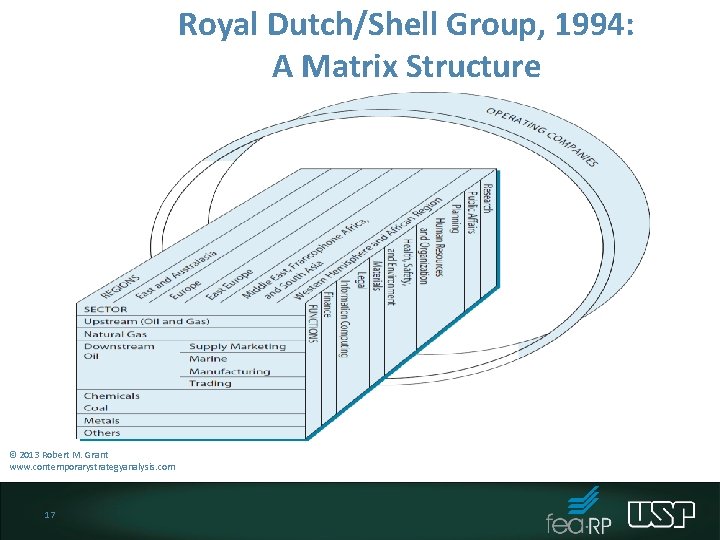
Royal Dutch/Shell Group, 1994: A Matrix Structure © 2013 Robert M. Grant www. contemporarystrategyanalysis. com 17
Recent Trends in Organizational Design • Limited evidence of a “revolution in organizational design” – basic features of organizations (e. g. hierarchy, financial control mechanisms, strategic planning) are still present • Major trends of the past two decades: o Delayering – Organizational hierarchies becoming flatter o Adhocracy and team-based organization – emphasis on shared values, high participation, flexible roles and communication, lack of authority o Project-based organizations – Dynamic structures with time-limited project teams o Network structures – Organizations and groups of organizations where coordination is based upon © 2013 Robert M. Grant www. contemporarystrategyanalysis. com informal social links 18