
Chapter 6 Obtaining Information and Intelligence 2017 Cengage
Chapter 6 Obtaining Information and Intelligence © 2017 Cengage Learning. All rights reserved.
Introduction • Knowledge obtained through questioning and physical evidence is equally important • Questioning can provide leads for finding physical evidence • Confession must be supported by physical evidence or other corroboration © 2017 Cengage Learning. All rights reserved. 2
Sources of Information (Continued) OVERVIEW • Three primary sources of information are available v v v Reports, records, and databases People who are not suspects in a crime but who know something about the crime Suspects in the crime © 2017 Cengage Learning. All rights reserved. 3
Sources of Information (Continued) REPORTS, RECORDS AND DATABASES • • • Local resources Auto track systems Caller ID Pen registers Dialed number recorders (DNRs) State and federal resources © 2017 Cengage Learning. All rights reserved. 4
Sources of Information (Continued) THE INTERNET • Extremely valuable source of information VICTIMS, COMPLAINTS, AND WITNESSES • Neighborhood canvass • Knock and talk • A caution © 2017 Cengage Learning. All rights reserved. 5

Sources of Information (Continued) INFORMANTS • Confidential informants • Establishing reliability SUSPECTS • Directly or indirectly connected with a crime • Field interviews © 2017 Cengage Learning. All rights reserved. 6
Interviewing and Interrogating OVERVIEW • Information is obtained continuously throughout an investigation • Interview v Not suspects, but know something of value • Interrogation v Suspected of direct or indirect involvement © 2017 Cengage Learning. All rights reserved. 7
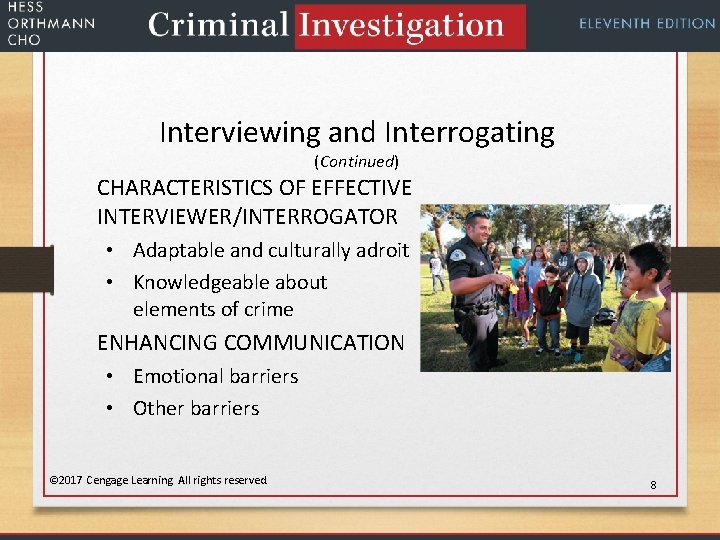
Interviewing and Interrogating (Continued) CHARACTERISTICS OF EFFECTIVE INTERVIEWER/INTERROGATOR • Adaptable and culturally adroit • Knowledgeable about elements of crime ENHANCING COMMUNICATION • Emotional barriers • Other barriers © 2017 Cengage Learning. All rights reserved. 8
Interviewing and Interrogating (Continued) EFFECTIVE QUESTIONING TECHNIQUES • Two basic requirements v v Listen Observe • Types of questions: direct, indirect, closed-ended, open-ended, and leading • Recording and videotaping interviews and interrogations © 2017 Cengage Learning. All rights reserved. 9
The Interview OVERVIEW • Establish priority of obtaining statements • Main sources of information v Complainant, the victim, and witnesses • In most cases, interview complainants first • Record both positive and negative information © 2017 Cengage Learning. All rights reserved. 10
The Interview (Continued) ADVANCE PLANNING • Review reports about the case • Anticipate how people will respond SELECTING THE TIME AND PLACE • Ensure scene is safe and determine complainant • Witnesses recall details best immediately © 2017 Cengage Learning. All rights reserved. 11
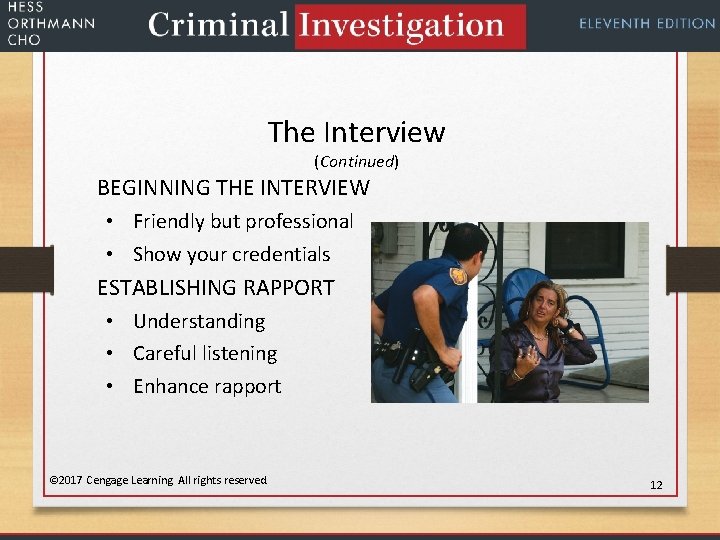
The Interview (Continued) BEGINNING THE INTERVIEW • Friendly but professional • Show your credentials ESTABLISHING RAPPORT • Understanding • Careful listening • Enhance rapport © 2017 Cengage Learning. All rights reserved. 12
The Interview (Continued) NETWORKING AN INTERVIEW • Establishes relationships • Understand networks in your jurisdiction RELUCTANT INTERVIEWEES • Logical approach • Emotional approach © 2017 Cengage Learning. All rights reserved. 13
The Interview THE COGNITIVE INTERVIEW • Tries to get the interviewee to recall scene mentally • Secluded, quiet place free of distractions • Reconstruct the circumstances TESTIMONIAL HEARSAY • Includes prior testimony • Statements made as a result of police interrogation © 2017 Cengage Learning. All rights reserved. 14
The Interview (Continued) STATEMENTS • Legal narrative • Description of events related to a crime • Formal, detailed account CLOSING THE INTERVIEW • Thank the person for cooperating © 2017 Cengage Learning. All rights reserved. 15

The Interrogation THE MIRANDA WARNING • • When Miranda does not apply Waiving the rights The effects of Miranda challenged “QUESTION FIRST” OR “BEACHHEADING” • Found unconstitutional © 2017 Cengage Learning. All rights reserved. 16
The Interrogation (continued) INTERPLAY OF 4 TH AND 5 TH AMENDMENTS • Public safety exception • Right to counsel under the Fifth and Sixth Amendments FOREIGN NATIONALS • Vienna Convention Treaty, signed in 1963 • Diplomatic immunity © 2017 Cengage Learning. All rights reserved. 17
The Interrogation (continued) SELECTING THE TIME AND PLACE • Ideal conditions exist at the police station • Many opinions on furnishings STARTING THE INTERROGATION • Show that you are in command • Watch nonverbal communication © 2017 Cengage Learning. All rights reserved. 18
The Interrogation (continued) ESTABLISHING RAPPORT • Show that cooperation is desirable APPROACHES TO INTERROGATION • • Inquiring directly or indirectly and forcing responses Deflating or inflating the ego and projecting the blame Rationalizing and combining approaches Minimizing or maximizing the crime © 2017 Cengage Learning. All rights reserved. 19
The Interrogation (continued) USING PERSUASION • Make suspect comfortable • Investigative questionnaires ETHICS AND THE USE OF DECEPTION • Limited officially sanctioned deception • Interrogatory deception • Professional behavior remains important © 2017 Cengage Learning. All rights reserved. 20
The Interrogation (continued) THIRD-DEGREE TACTICS • Physical force • Mental or psychological abuse ADMISSIONS AND CONFESSIONS • Voluntary nature of the confession is essential • Bruton rule • Adoptive admission © 2017 Cengage Learning. All rights reserved. 21
Questioning Children and Juveniles CONSIDERATIONS • • • Special considerations exist First step is to build rapport Must obtain parental permission Topics of inquiry may hinder interview Do not underrate young people’s intelligence or cleverness © 2017 Cengage Learning. All rights reserved. 22
Evaluating and Corroborating Information BREAKING A “PAT” STORY • Repeats it word for word innumerable times • Difficult to repeat lies consistently • Story becomes distorted with mistakes and exaggerations • Ask questions that require slightly different answers © 2017 Cengage Learning. All rights reserved. 23
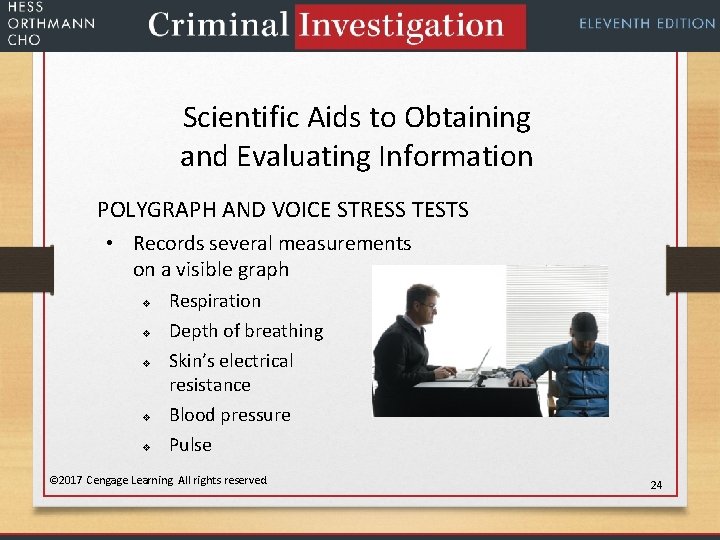
Scientific Aids to Obtaining and Evaluating Information POLYGRAPH AND VOICE STRESS TESTS • Records several measurements on a visible graph v v v Respiration Depth of breathing Skin’s electrical resistance Blood pressure Pulse © 2017 Cengage Learning. All rights reserved. 24
Use of Psychics and Profilers SOURCES FOR LEADS • • Psychics popularized by television Use of psychics in investigations is controversial Profilers are more commonly accepted Profiling combines art and science © 2017 Cengage Learning. All rights reserved. 25
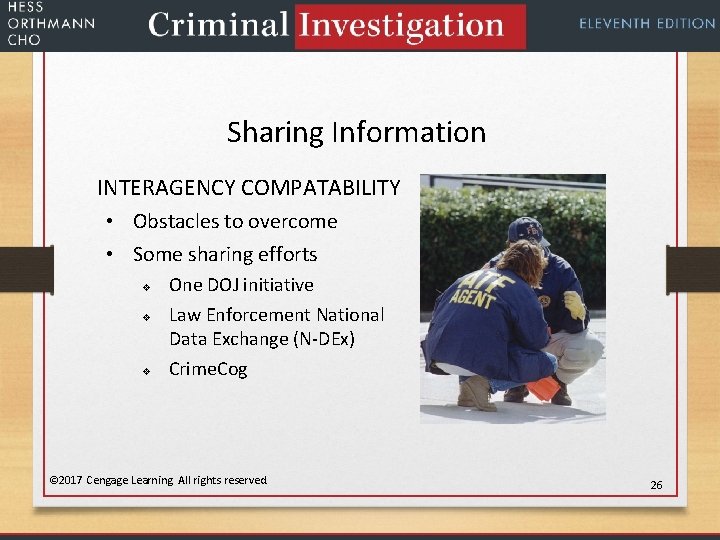
Sharing Information INTERAGENCY COMPATABILITY • Obstacles to overcome • Some sharing efforts v v v One DOJ initiative Law Enforcement National Data Exchange (N-DEx) Crime. Cog © 2017 Cengage Learning. All rights reserved. 26
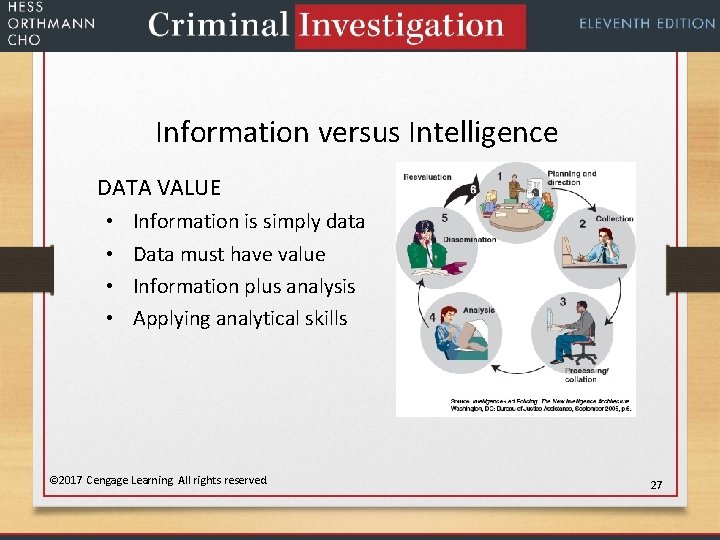
Information versus Intelligence DATA VALUE • • Information is simply data Data must have value Information plus analysis Applying analytical skills © 2017 Cengage Learning. All rights reserved. 27
Summary • The ultimate goal of interviewing and interrogating is to determine the truth • Two basic requirements to obtain information are to listen and to observe • Interview anyone other than a suspect who has information about the case • Special considerations are also observed when questioning children and youths • You can sometimes use scientific aids © 2017 Cengage Learning. All rights reserved. 28
- Slides: 28