
Chapter 6 Objectives v Convert among fractions decimal
Chapter 6 Objectives v Convert among fractions, decimal numbers, ratios, and percents v Learn the relationships among fractions, decimal numbers, ratios, and percents v Use ratio to convert between units of measure
Combined Applications Pages 124 - 134
Page 146 Combined Applications v Health care workers rely on a variety of math systems to achieve their daily tasks. v Knowing different ways to convert efficiently among math systems will benefit you on the job as your expertise grows and your level of responsibility increases. v It is important to have the ability to convert between fractions, decimals, ratios, & percents.
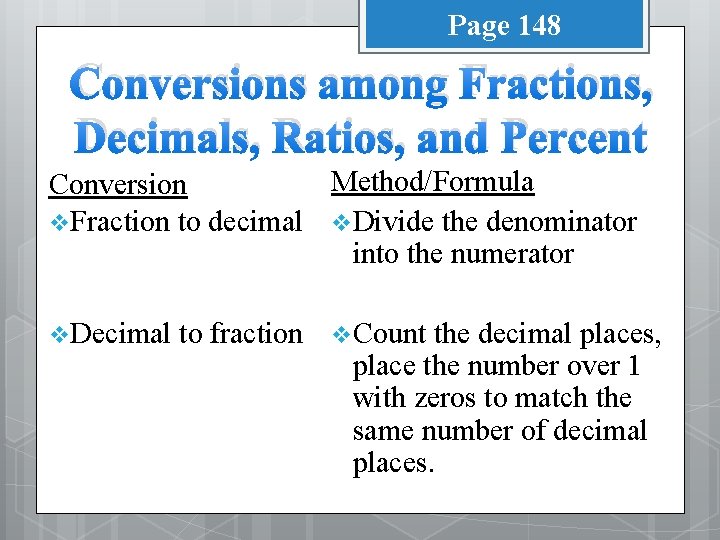
Page 148 Conversions among Fractions, Decimals, Ratios, and Percent Method/Formula Conversion v Fraction to decimal v Divide the denominator into the numerator v Decimal to fraction v Count the decimal places, place the number over 1 with zeros to match the same number of decimal places.
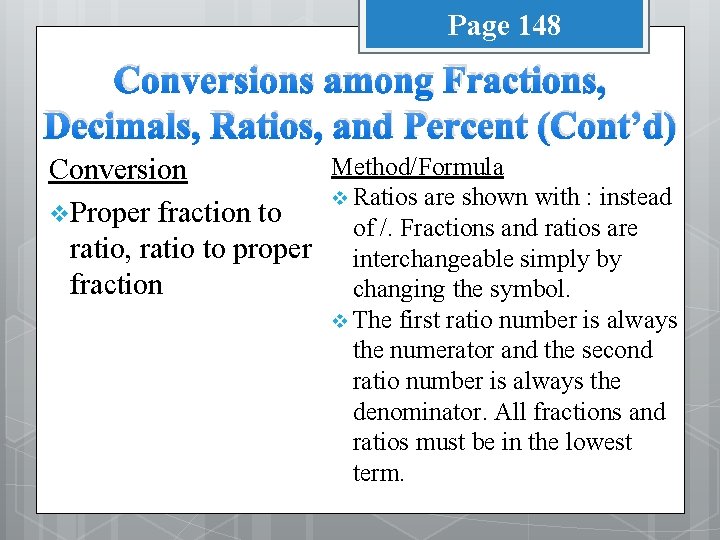
Page 148 Conversions among Fractions, Decimals, Ratios, and Percent (Cont’d) Method/Formula Conversion v Ratios are shown with : instead v Proper fraction to of /. Fractions and ratios are ratio, ratio to proper interchangeable simply by fraction changing the symbol. v The first ratio number is always the numerator and the second ratio number is always the denominator. All fractions and ratios must be in the lowest term.
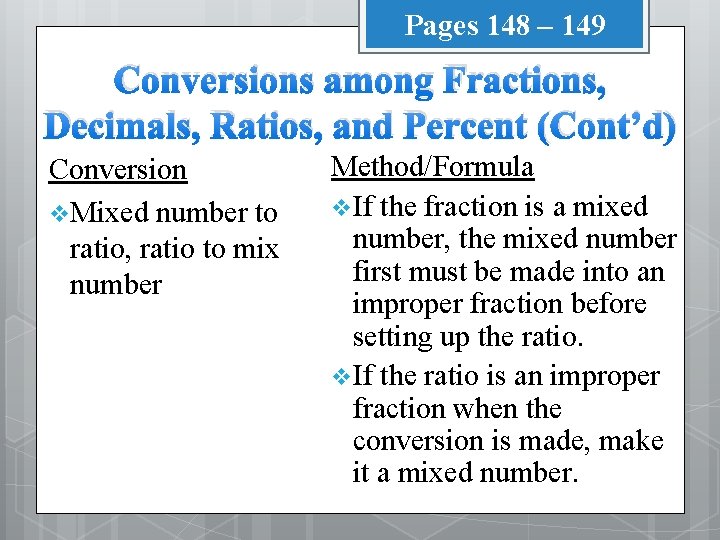
Pages 148 – 149 Conversions among Fractions, Decimals, Ratios, and Percent (Cont’d) Conversion v Mixed number to ratio, ratio to mix number Method/Formula v If the fraction is a mixed number, the mixed number first must be made into an improper fraction before setting up the ratio. v If the ratio is an improper fraction when the conversion is made, make it a mixed number.
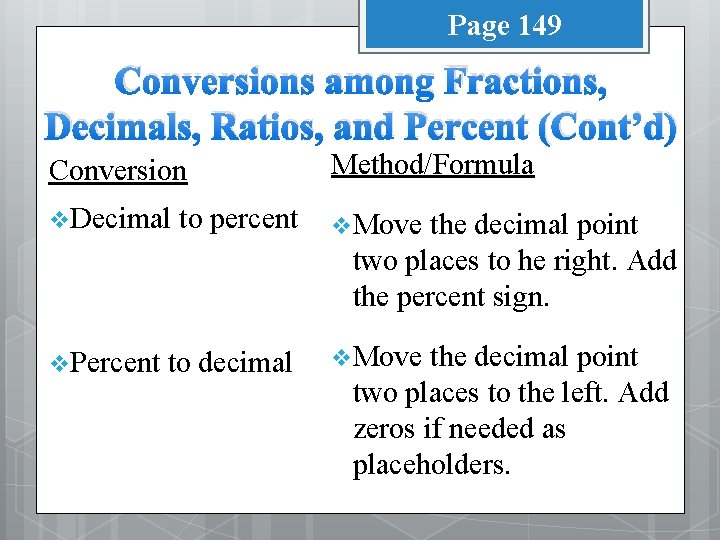
Page 149 Conversions among Fractions, Decimals, Ratios, and Percent (Cont’d) Conversion Method/Formula v Decimal to percent v Move to decimal v Move v Percent the decimal point two places to he right. Add the percent sign. the decimal point two places to the left. Add zeros if needed as placeholders.
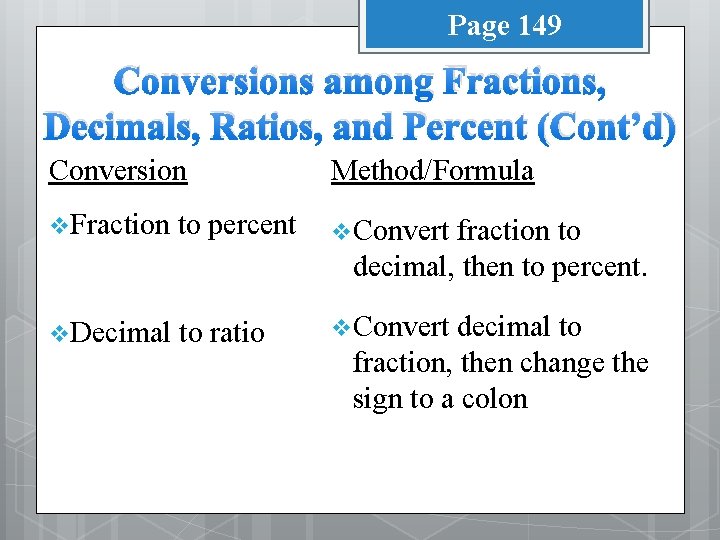
Page 149 Conversions among Fractions, Decimals, Ratios, and Percent (Cont’d) Conversion Method/Formula v Fraction to percent v Convert v Decimal to ratio v Convert fraction to decimal, then to percent. decimal to fraction, then change the sign to a colon
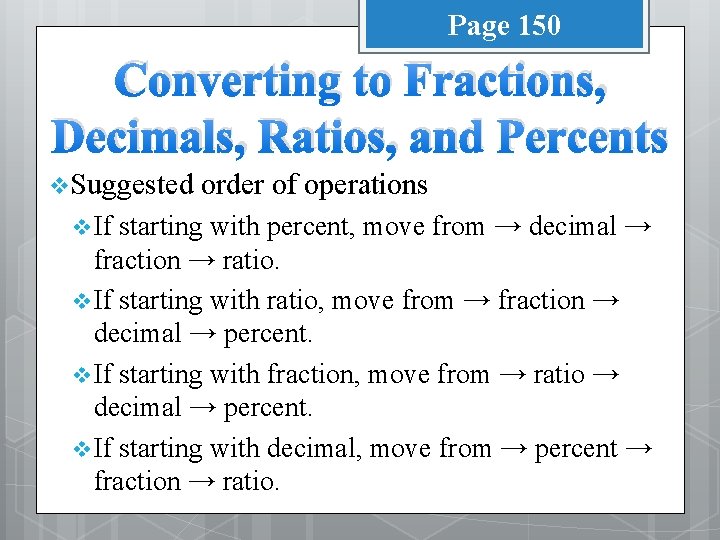
Page 150 Converting to Fractions, Decimals, Ratios, and Percents v Suggested v If order of operations starting with percent, move from → decimal → fraction → ratio. v If starting with ratio, move from → fraction → decimal → percent. v If starting with fraction, move from → ratio → decimal → percent. v If starting with decimal, move from → percent → fraction → ratio.
Page 152 Using Combined Applications in Measurement Conversion v You will used three systems of measure in your work: household (standard measurement), metric measurement, and apothecary measurement. v Critical to your success in measurement conversion is your ability to remember a few key conversions and the proportion method for solving conversions. (metric → metric uses a different conversion method covered in unit 8)
Page 152 Household (Standard) Measurement v Although Household (standard) measurements are used by all of us in our daily activities, they tend to be less accurate than either metric or apothecary measures. This means that household measures are used for the less critical measurements in health care, such as mixing a solution for a client’s foot soak, etc. v Most households use the measures of teaspoon (t or tsp), tablespoon (T or tbsp), cup (c), and so on.
Page 153 Standard Unit of Measure v The basics of standard measure conversions were covered in Unit 4. v Take note of the table on this page you will be referencing it a lot.
Page 155 More Combined Applications v Sometimes measurement conversions require more than one conversion to get to the answer. v These problems cannot be solved by making a straight conversion from what is known to what is unknown. A path must be developed so that you can establish how to get the answer. Think about what conversions most closely match the problem itself, then set up the problem. v Do not rush through the two-step conversions. These require some forethought about how to get from what is known to what is unknown.
- Slides: 13