
Chapter 6 Nutrition in Humans You Are what


- Slides: 61
Chapter 6 Nutrition in Humans You Are what you Eat….
Nutrition n Have you wondered why do we eat?
Why do we eat? Cos you’re hungry? n Cos your tummy aches? n Cos you just love to eat? n Cos you live to eat? n Cos you eat to live? n
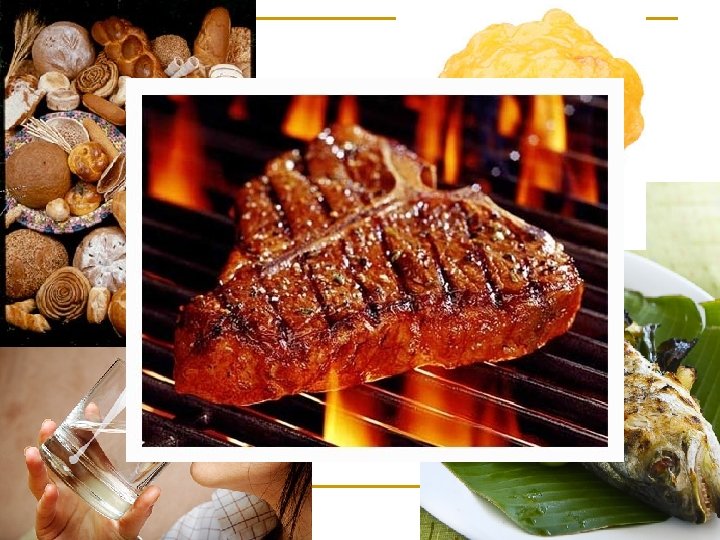
You Eat to LIVE! n We eat to supplement our body with nutrients. n So what type of nutrients do our body need? q q Water Carbohydrates Fats Proteins
Why do we eat? n n You have to realise that everything in our body is made from the very items that you eat. Proteins are used to create enzymes, m. RNA, antibodies & muscles. Fats are used to transport materials within the body and protect vital organs. Carbohydrates are used to provide energy in our body.
Holozoic Nutrition n Holozoic means taking in complex organic matter such as proteins, carbohydrates and fats. n Nutrition is the process of taking in food & converting it into living matter.
Nutrition : 4 Step Process n Feeding / Ingestion q n Digestion q n large food molecules broken down into simpler soluble substances Absorption q n food is taken into the body simple molecules absorbed into body cells Assimilation q absorbed substances are converted & used in the body
Digestion n Physical Digestion q q n Mechanical break down of food into smaller particles. Increases surface area of food for enzymes to act on. Chemical Digestion q q Break down of complex molecules into simple soluble molecules. Eg : proteins amino acids fats glycerol & 3 fatty acids
Animation Time n Let’s take a look at a simple animation on the digestive system. n http: //kitses. com/animation/swfs/digestion. swf
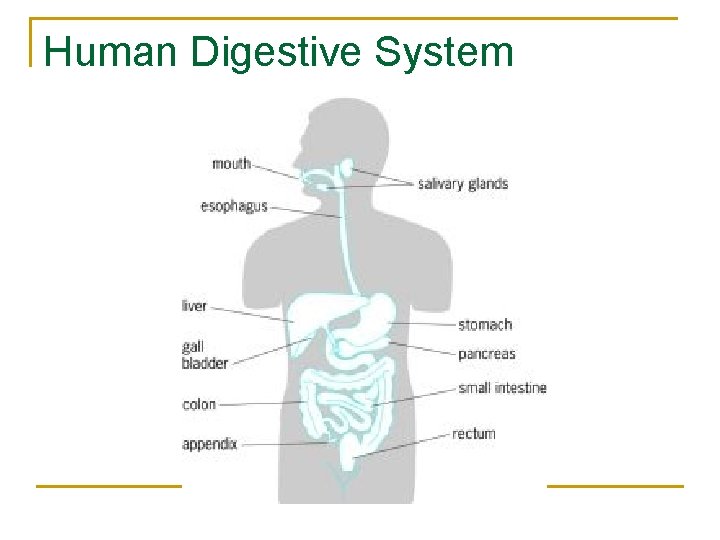
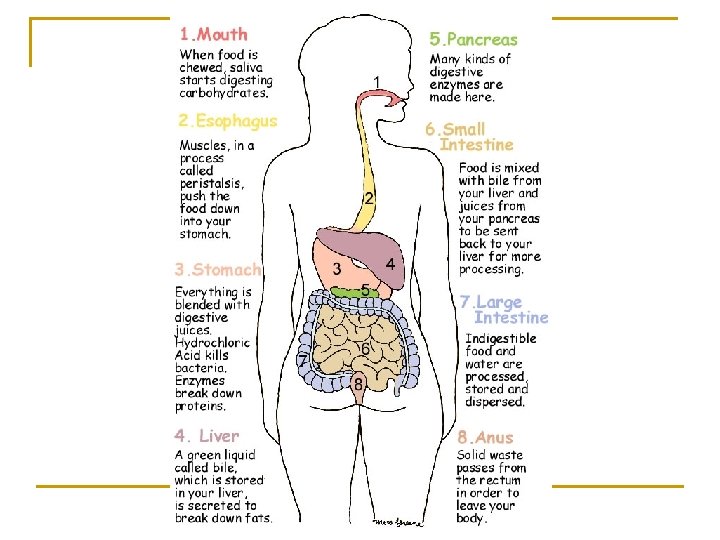
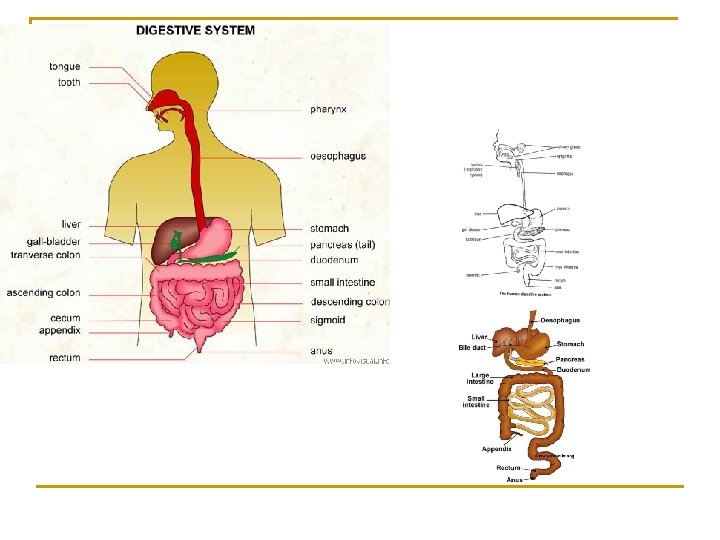
Human Digestive System
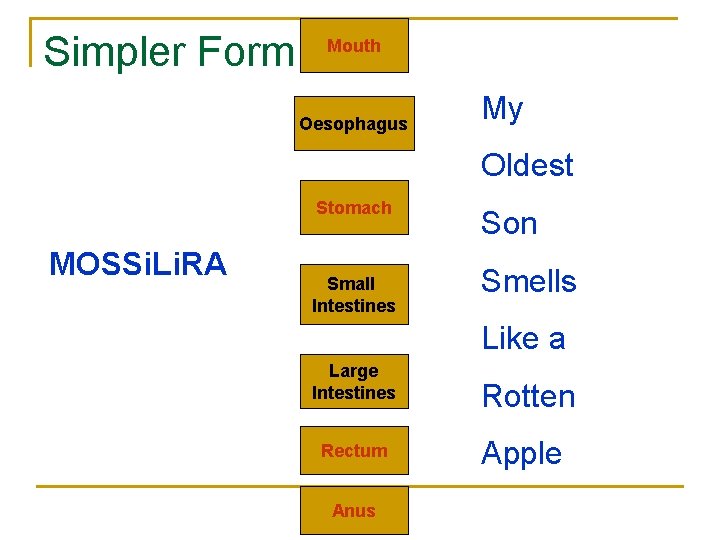
Simpler Form! Mouth Oesophagus My Oldest Stomach MOSSi. Li. RA Small Intestines Son Smells Like a Large Intestines Rectum Anus Rotten Apple
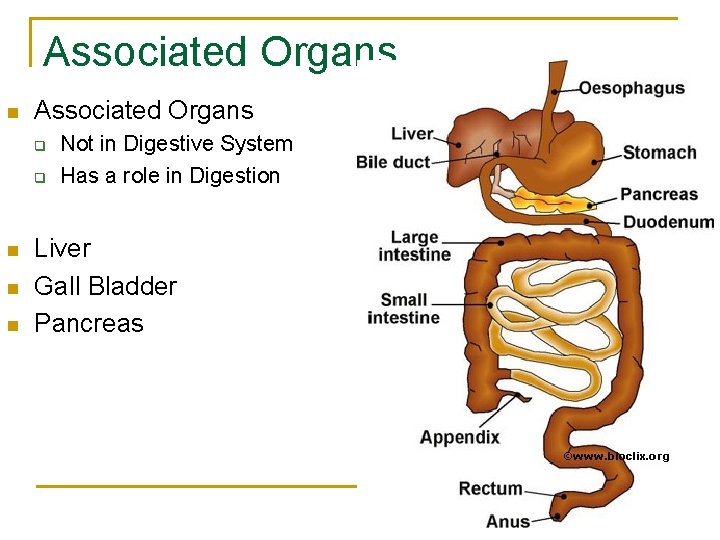
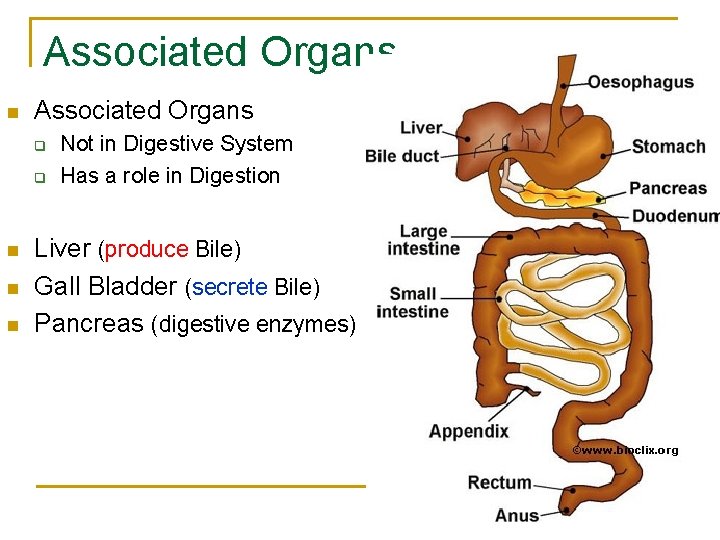
Associated Organs n Associated Organs q q n n n Not in Digestive System Has a role in Digestion Liver Gall Bladder Pancreas
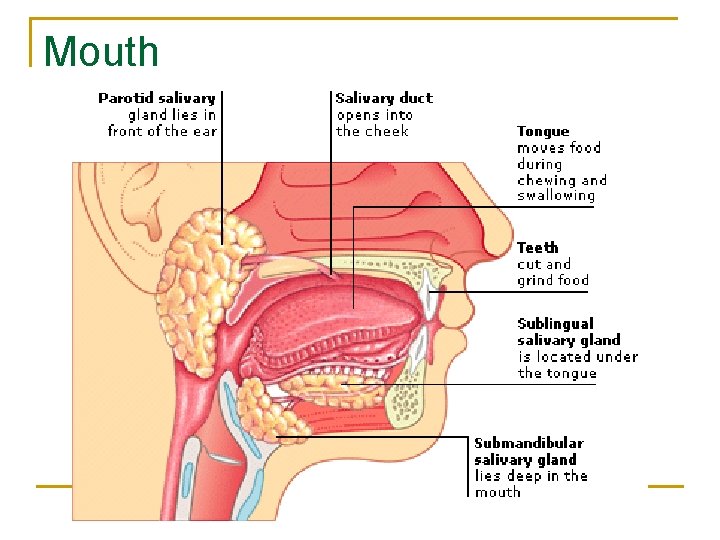
Mouth
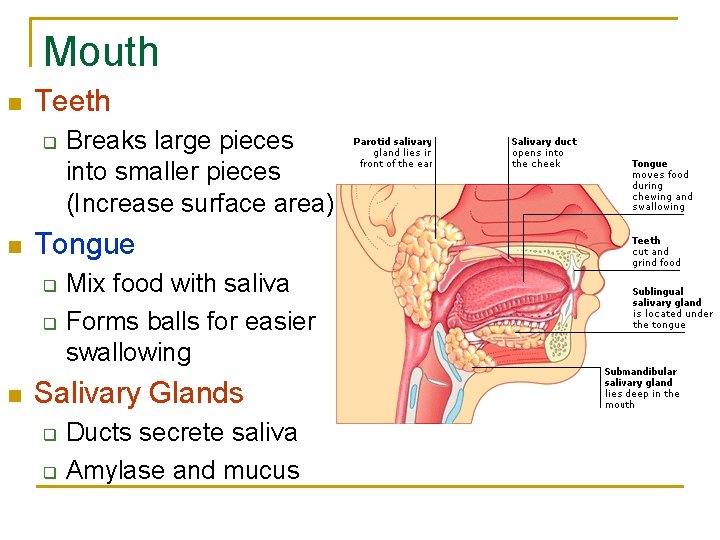
Mouth n Teeth q n Tongue q q n Breaks large pieces into smaller pieces (Increase surface area) Mix food with saliva Forms balls for easier swallowing Salivary Glands q q Ducts secrete saliva Amylase and mucus
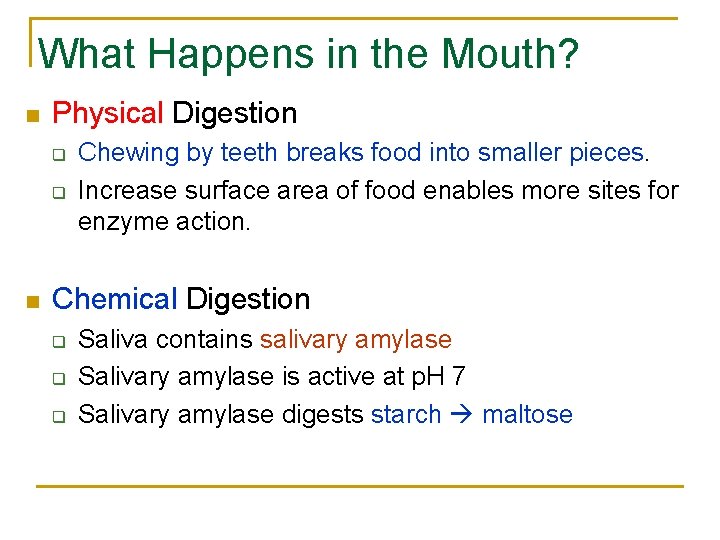
What Happens in the Mouth? n Physical Digestion q q n Chewing by teeth breaks food into smaller pieces. Increase surface area of food enables more sites for enzyme action. Chemical Digestion q q q Saliva contains salivary amylase Salivary amylase is active at p. H 7 Salivary amylase digests starch maltose
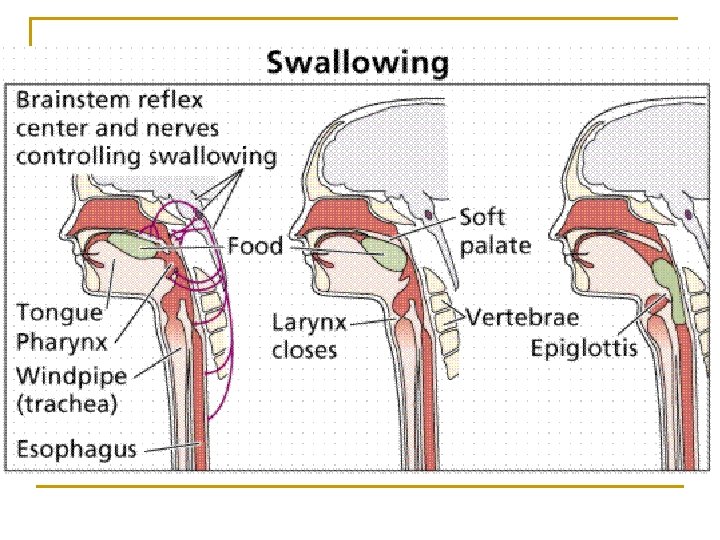
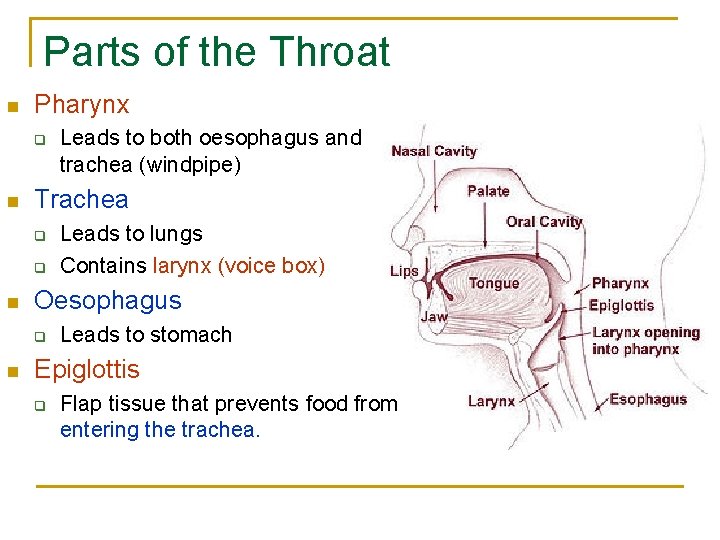
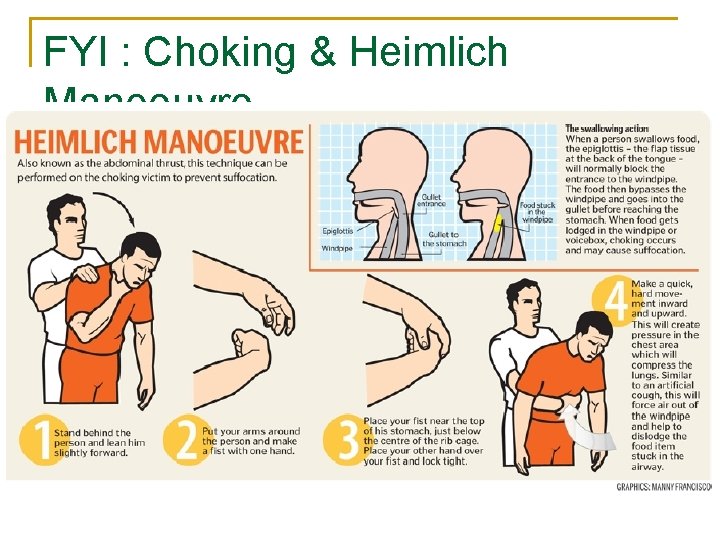
Parts of the Throat n Pharynx q n Trachea q q n Leads to lungs Contains larynx (voice box) Oesophagus q n Leads to both oesophagus and trachea (windpipe) Leads to stomach Epiglottis q Flap tissue that prevents food from entering the trachea.
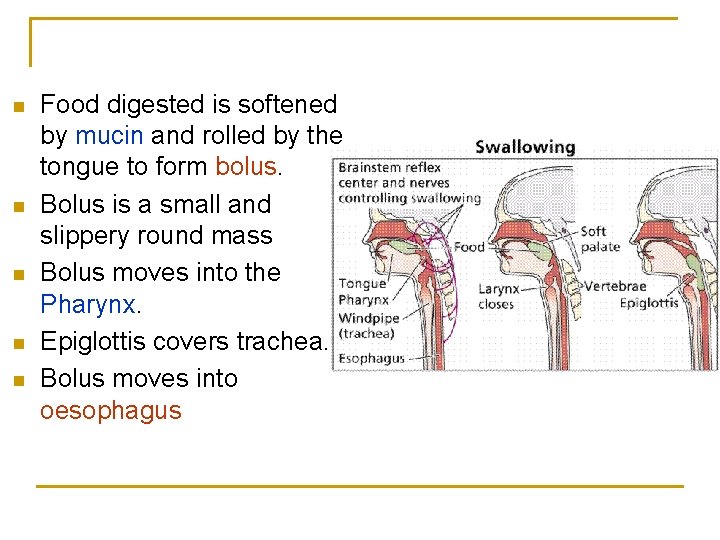
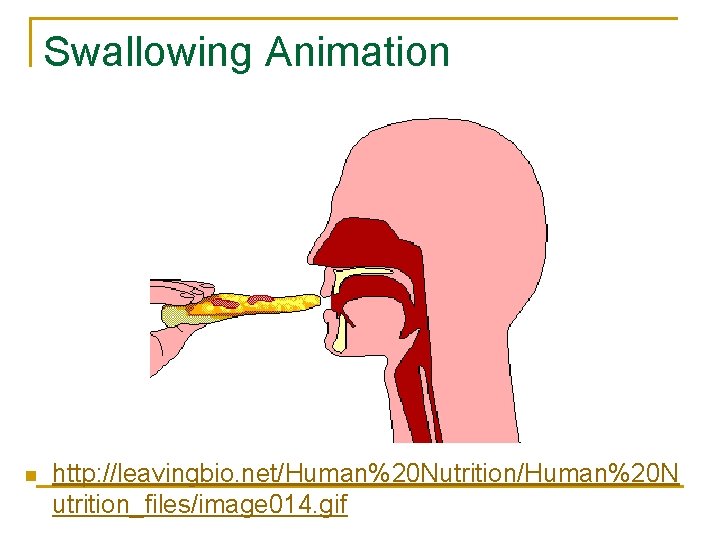
n n n Food digested is softened by mucin and rolled by the tongue to form bolus. Bolus is a small and slippery round mass Bolus moves into the Pharynx. Epiglottis covers trachea. Bolus moves into oesophagus
Swallowing Animation n http: //leavingbio. net/Human%20 Nutrition/Human%20 N utrition_files/image 014. gif
Question Time 1 n n Why do we eat? What are the nutrients that we take in? q n n n What does Holozoic mean? What does Nutrition mean? Name the 4 Steps of Nutrition. q n n State both their complex and simple natures Explain each step. What is the difference between physical & chemical digestion? State the major parts of the Digestive System. In the mouth, what aids physical digestion? Which enzyme is found in the mouth? State it’s optimum p. H and it’s chemical reaction.
FYI : Choking & Heimlich Manoeuvre
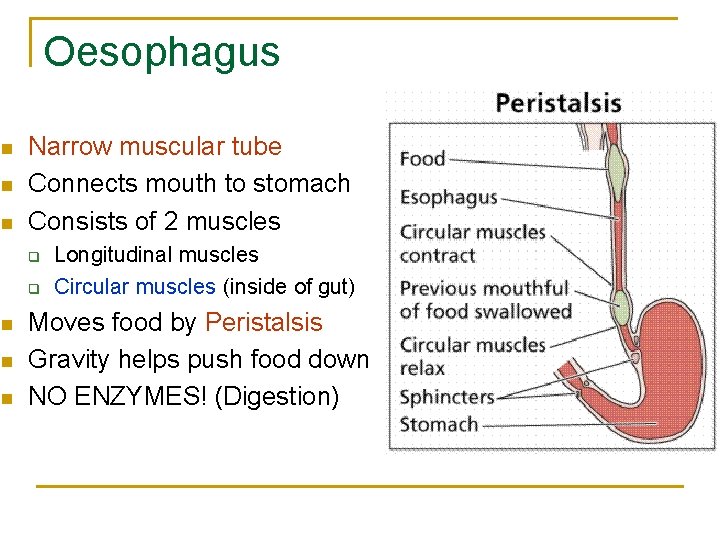
Oesophagus n n n Narrow muscular tube Connects mouth to stomach Consists of 2 muscles q q n n n Longitudinal muscles Circular muscles (inside of gut) Moves food by Peristalsis Gravity helps push food down NO ENZYMES! (Digestion)
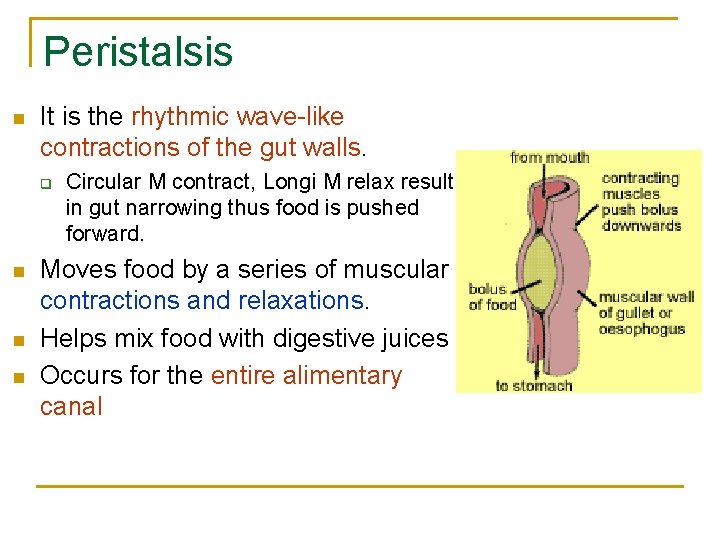
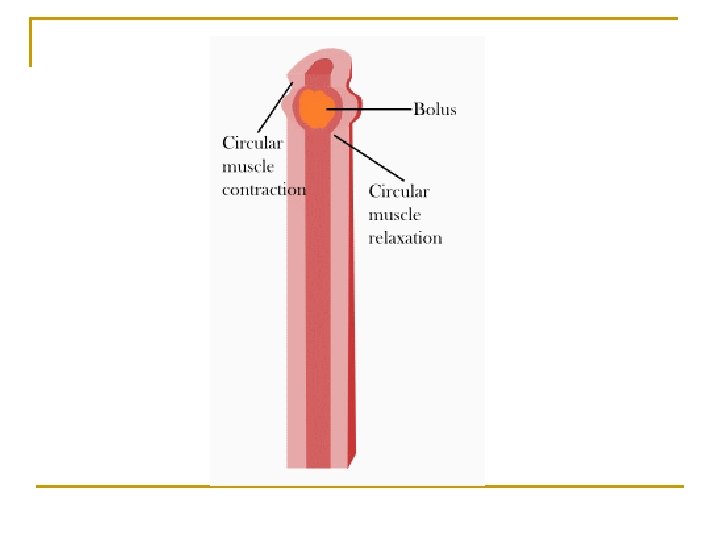
Peristalsis n It is the rhythmic wave-like contractions of the gut walls. q n n n Circular M contract, Longi M relax result in gut narrowing thus food is pushed forward. Moves food by a series of muscular contractions and relaxations. Helps mix food with digestive juices Occurs for the entire alimentary canal
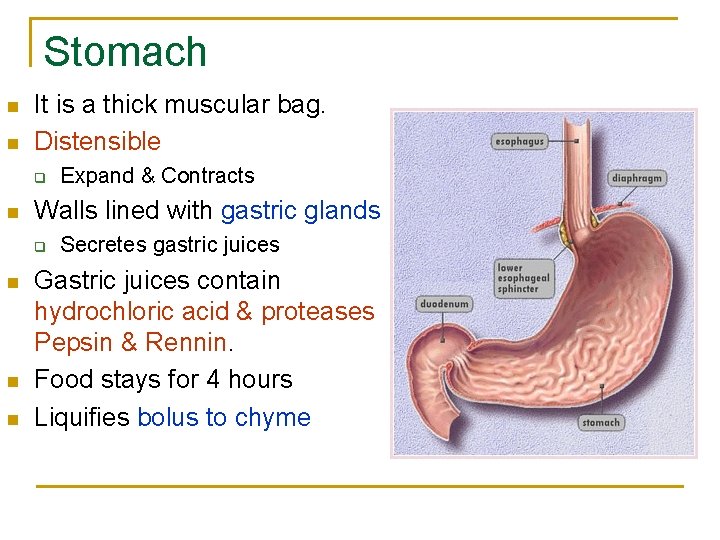
Stomach n n It is a thick muscular bag. Distensible q n Walls lined with gastric glands q n n n Expand & Contracts Secretes gastric juices Gastric juices contain hydrochloric acid & proteases Pepsin & Rennin. Food stays for 4 hours Liquifies bolus to chyme
Functions of HCL n Hydrochloric acid is at p. H 2 (acidic) q q Acid stops salivary amylase action by denaturing it (p. H 7) Kills bacteria & harmful microorganisms Provide optimum p. H for enzymes Activates proteases Pepsin & Rennin n n Pepsinogen Pepsin Prorennin Rennin
What happens in the stomach? n Physical Digestion q q n Chemical Digestion q q n Peristalsis in stomach churns & breaks food Peristalsis mixes bolus with gastric juices Pepsin digest proteins to polypeptides Rennin curdles milk into insoluble casein protein which is digested into polypeptides by pepsin. The digested bolus turns into liquified chyme and moves into the duodenum (small intestines).
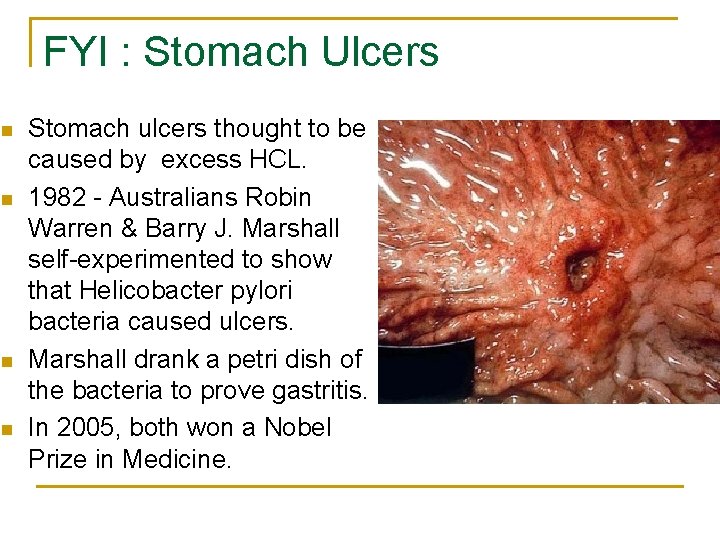
FYI : Stomach Ulcers n n Stomach ulcers thought to be caused by excess HCL. 1982 - Australians Robin Warren & Barry J. Marshall self-experimented to show that Helicobacter pylori bacteria caused ulcers. Marshall drank a petri dish of the bacteria to prove gastritis. In 2005, both won a Nobel Prize in Medicine.
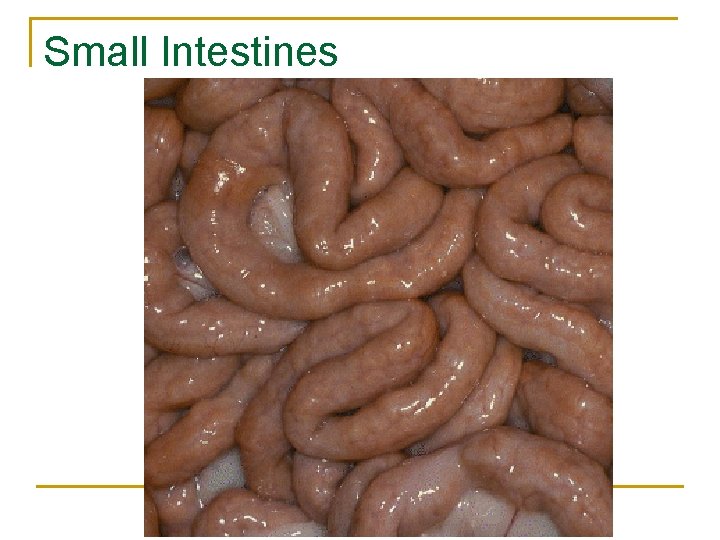
Small Intestines
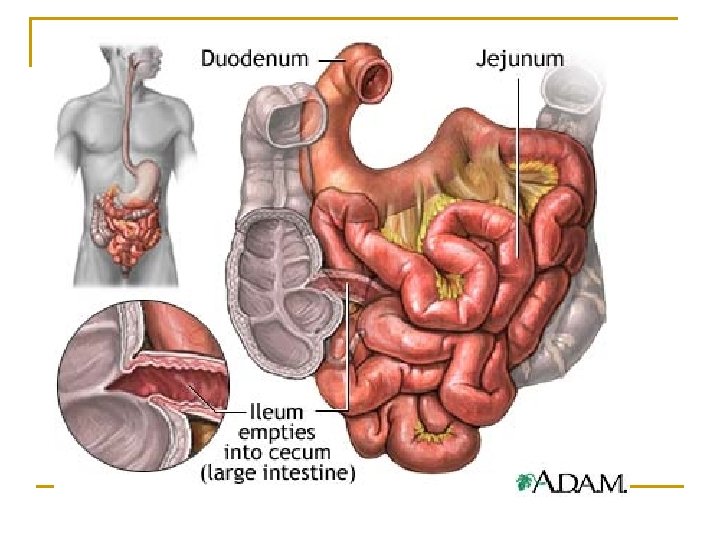
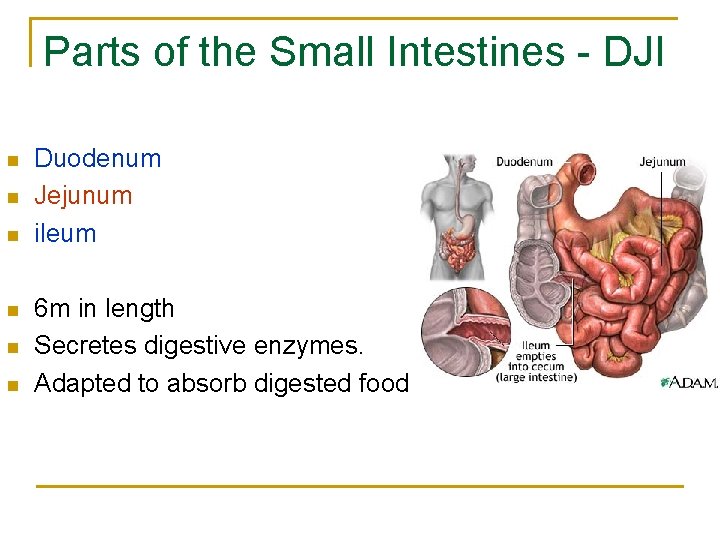
Parts of the Small Intestines - DJI n n n Duodenum Jejunum ileum 6 m in length Secretes digestive enzymes. Adapted to absorb digested food
n n What happens in the Small Chyme from stomach duodenum Intestines? Chemical Digestion q q Intestinal Juice – Maltase, Sucrase, Lactase, Lipase, Peptidase Pancreatic Juice – Pancreatic amylase, lipase & trypsinogen(protease) n Physical Digestion q Bile – produced in the liver and secreted by gall bladder & emulsify fat into smaller globules n All juices are alkaline in nature to neutralise acids. n Absorption by villi into bloodstream
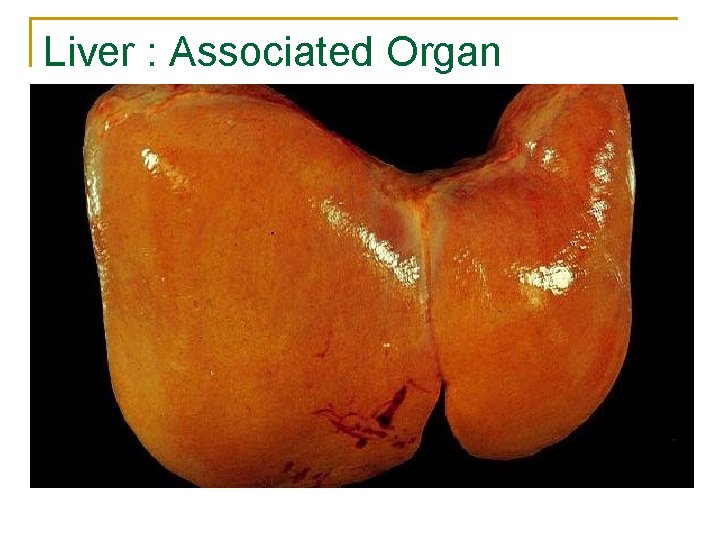
Associated Organs n Associated Organs q q n n n Not in Digestive System Has a role in Digestion Liver (produce Bile) Gall Bladder (secrete Bile) Pancreas (digestive enzymes)
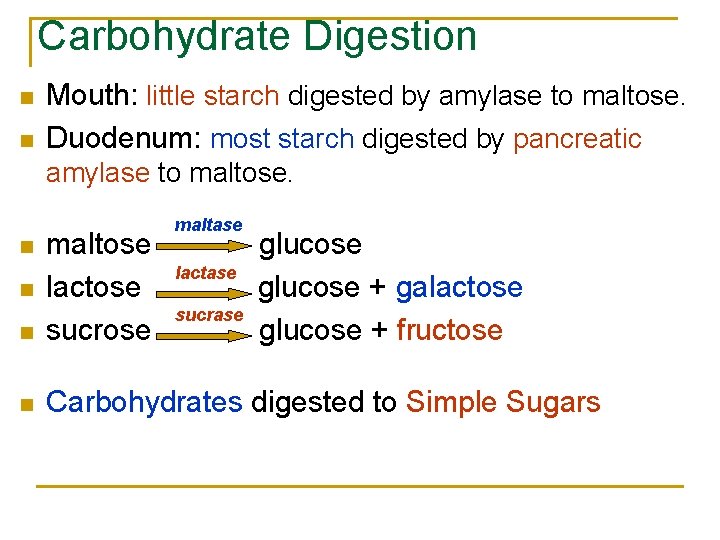
Carbohydrate Digestion n n Mouth: little starch digested by amylase to maltose. Duodenum: most starch digested by pancreatic amylase to maltose. maltase n maltose lactose sucrose n Carbohydrates digested to Simple Sugars n n lactase sucrase glucose + galactose glucose + fructose
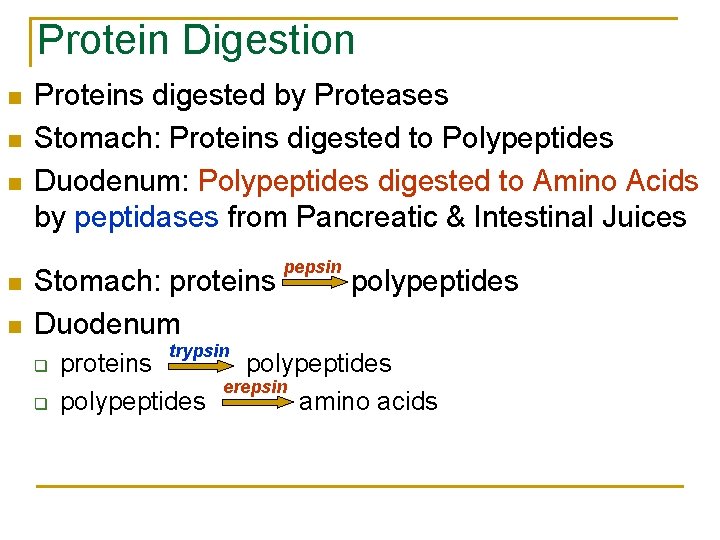
Protein Digestion n n Proteins digested by Proteases Stomach: Proteins digested to Polypeptides Duodenum: Polypeptides digested to Amino Acids by peptidases from Pancreatic & Intestinal Juices Stomach: proteins Duodenum q q trypsin proteins polypeptides pepsin polypeptides erepsin amino acids
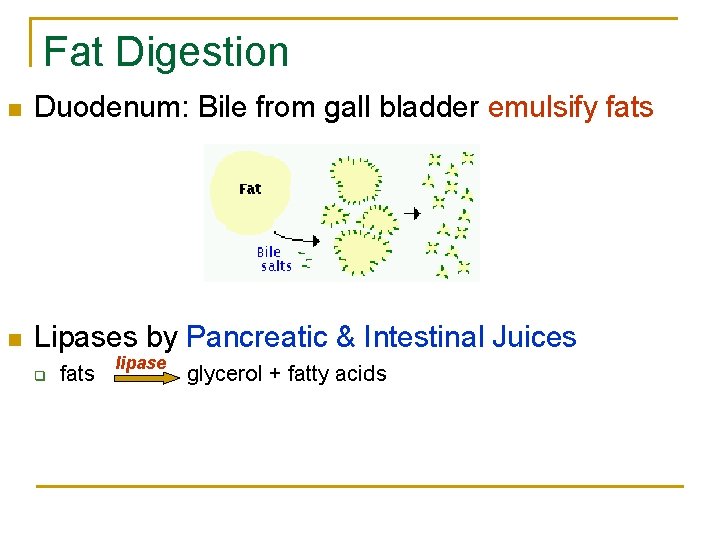
Fat Digestion n Duodenum: Bile from gall bladder emulsify fats n Lipases by Pancreatic & Intestinal Juices q fats lipase glycerol + fatty acids
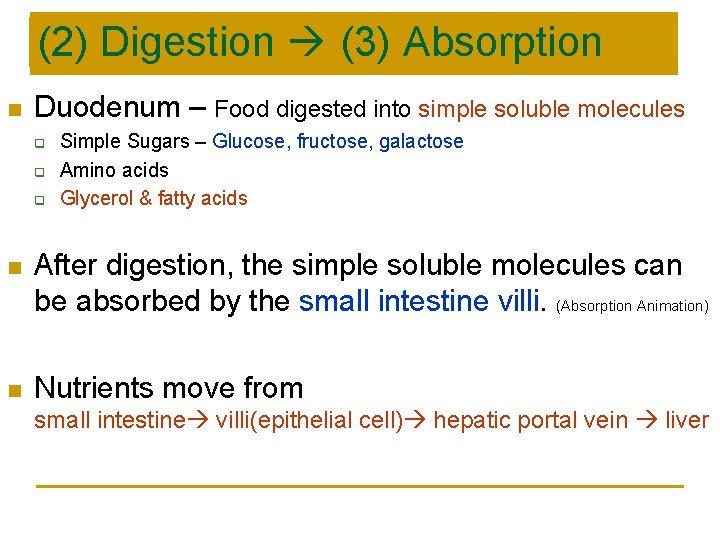
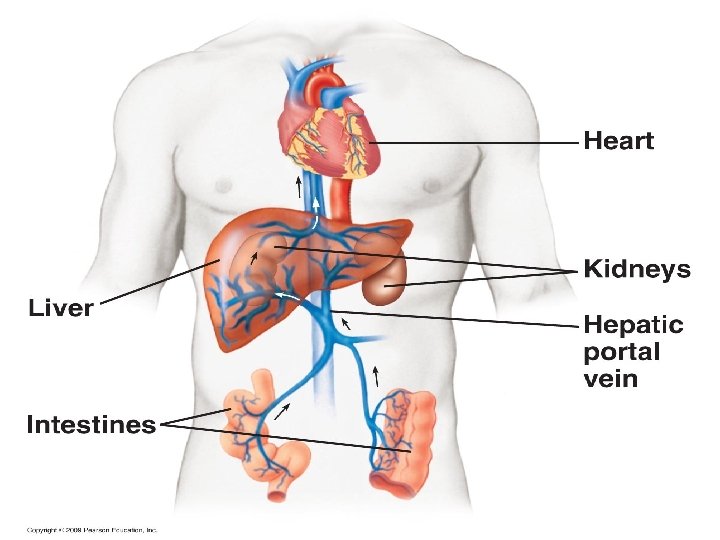
(2) Digestion (3) Absorption n Duodenum – Food digested into simple soluble molecules q q q Simple Sugars – Glucose, fructose, galactose Amino acids Glycerol & fatty acids n After digestion, the simple soluble molecules can be absorbed by the small intestine villi. (Absorption Animation) n Nutrients move from small intestine villi(epithelial cell) hepatic portal vein liver
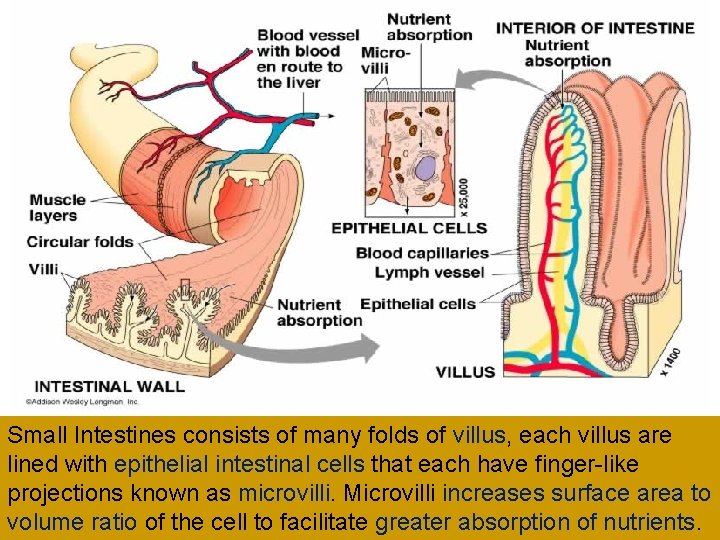
Small Intestines consists of many folds of villus, each villus are lined with epithelial intestinal cells that each have finger-like projections known as microvilli. Microvilli increases surface area to volume ratio of the cell to facilitate greater absorption of nutrients.
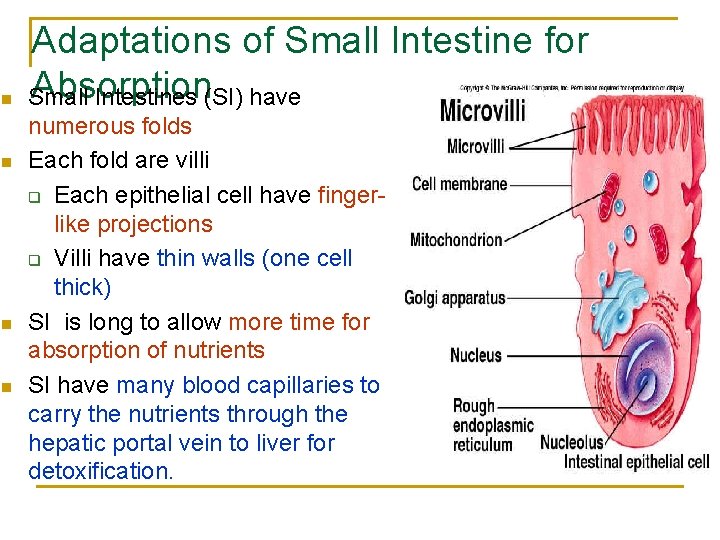
n n Adaptations of Small Intestine for Absorption Small Intestines (SI) have numerous folds Each fold are villi q Each epithelial cell have fingerlike projections q Villi have thin walls (one cell thick) SI is long to allow more time for absorption of nutrients SI have many blood capillaries to carry the nutrients through the hepatic portal vein to liver for detoxification.
Rate of Absorption n Surface area of small intestines (villus) Membrane of epithelial cell (one cell thick) Concentration gradient
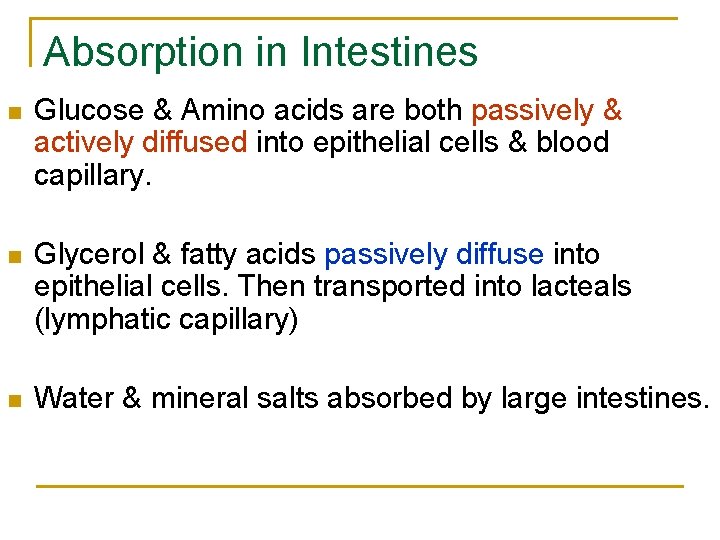
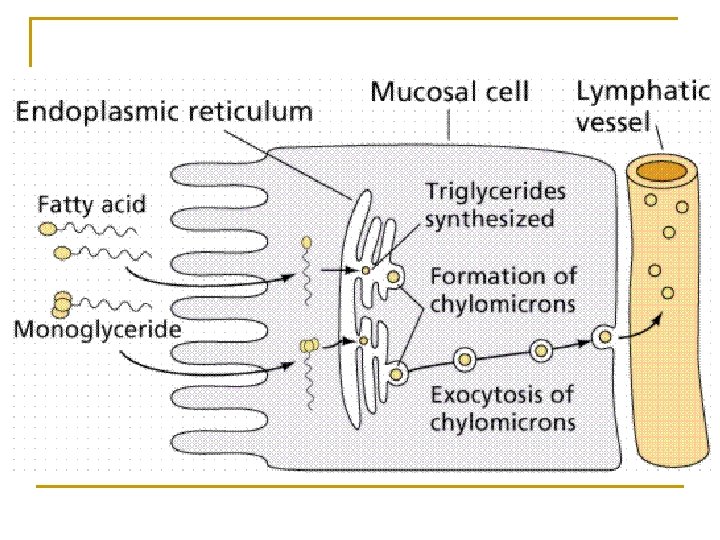
Absorption in Intestines n Glucose & Amino acids are both passively & actively diffused into epithelial cells & blood capillary. n Glycerol & fatty acids passively diffuse into epithelial cells. Then transported into lacteals (lymphatic capillary) n Water & mineral salts absorbed by large intestines.
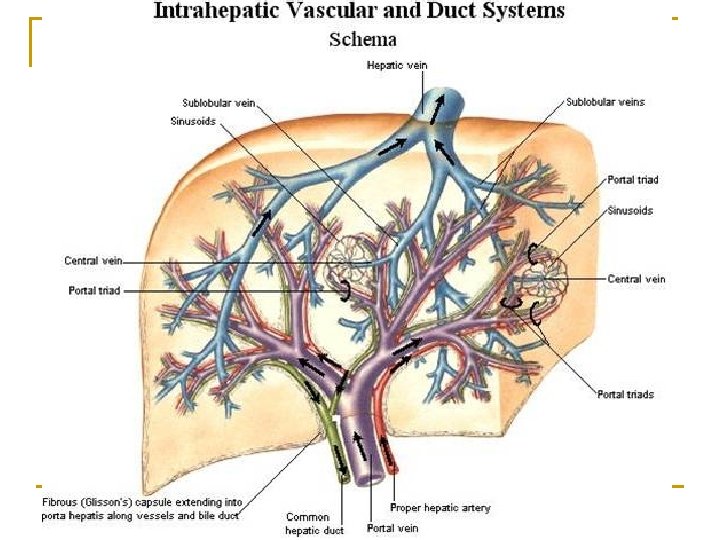
n n n Hepatic portal vein brings nutrients to the liver for assimilation and detoxification. Hepatic artery gives oxygenated blood to the liver. Hepatic vein carries deoxygenated blood from the liver to the inferior vena cava and finally the heart.
Egestion : Rectum & Anus n Rectum q q q n Food digested with it’s nutrients, water & mineral salts removed become faeces Faeces are undigested & unabsorbed food Faeces are temporarily stored Anus q Site of removal of faeces by defecation
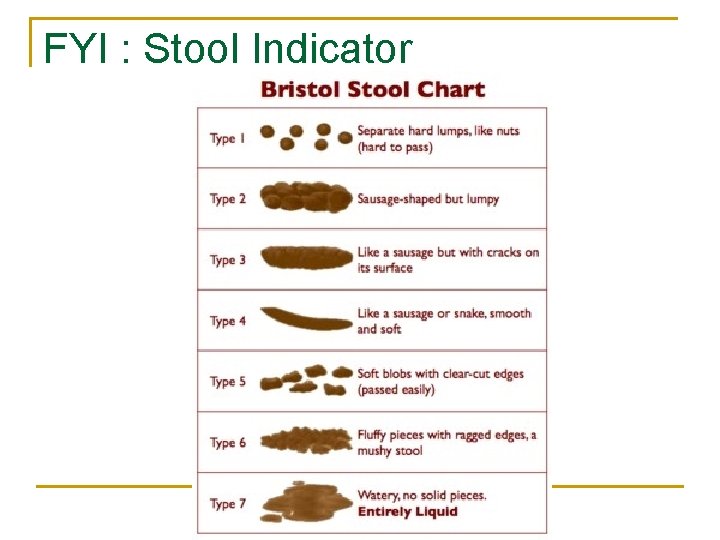
FYI : Stool Indicator
FYI Why can’t we digest Cellulose? (Green Fibres)
What happens to nutrients in the bloodstream? n n Blood rich in nutrients from villi hepatic portal vein liver Assimilation occurs in the liver q n Simple molecules constructed into complex molecules Example: Glucose q q q Glucose used as source of energy for cellular activities Excess glucose in bloodstream is bad for the body Glucose converted to glycogen and stored in liver
Liver : Associated Organ
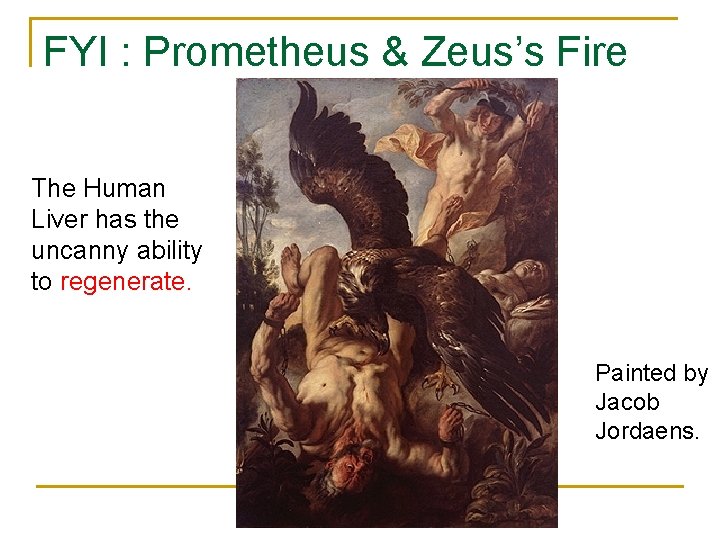
FYI : Prometheus & Zeus’s Fire The Human Liver has the uncanny ability to regenerate. Painted by Jacob Jordaens.
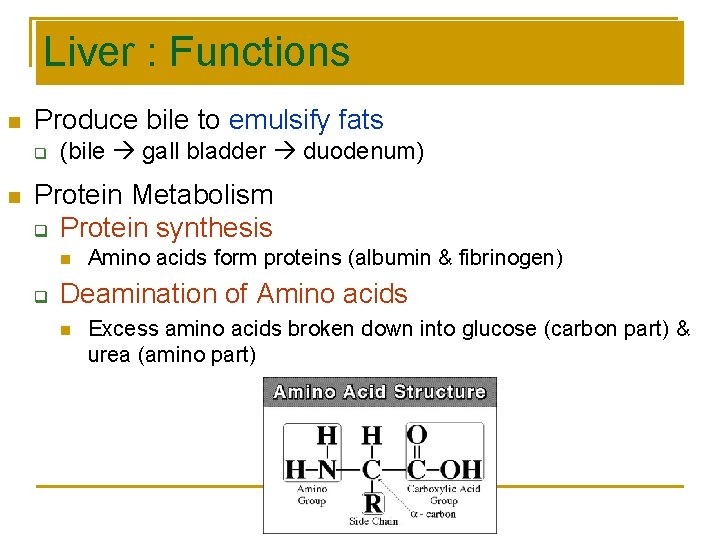
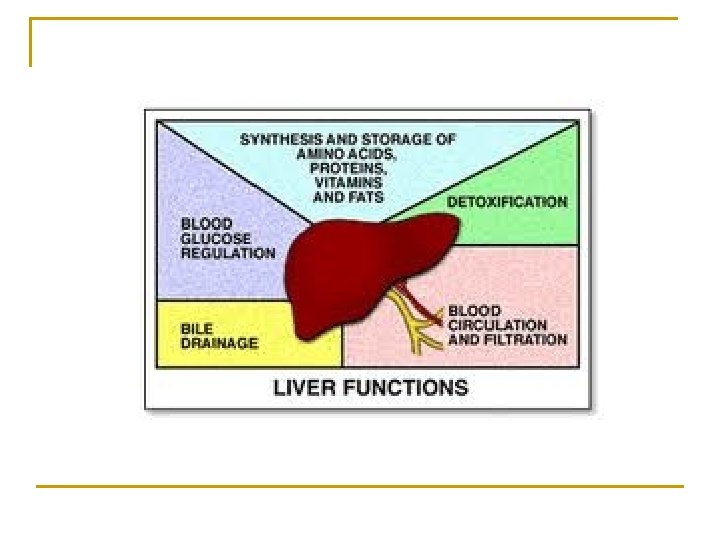
Liver : Functions n Produce bile to emulsify fats q n (bile gall bladder duodenum) Protein Metabolism q Protein synthesis n q Amino acids form proteins (albumin & fibrinogen) Deamination of Amino acids n Excess amino acids broken down into glucose (carbon part) & urea (amino part)
n Detoxification q n Breakdown of Red Blood Cells q q n Breakdown of harmful substances like toxins & bacteria RBC’s are broken down in the spleen to Haemoglobin broken down into iron by liver & is stored Fat Metabolism q q Breakdown of fat to give energy Synthesis of cholesterol and phospholipids
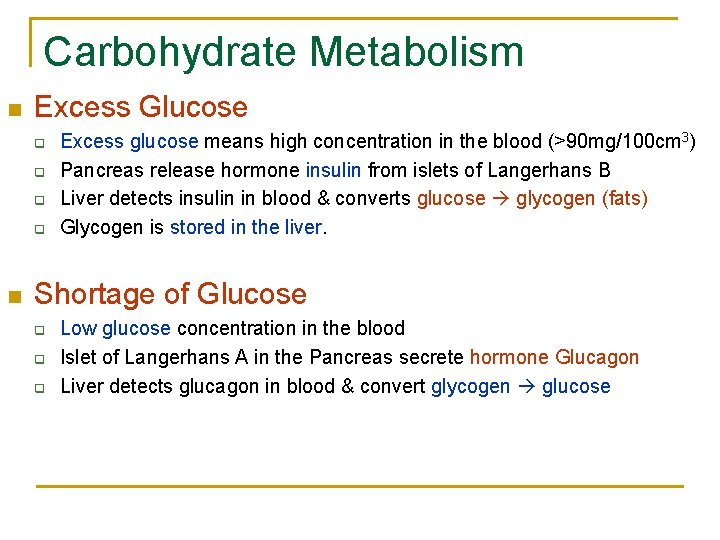
Carbohydrate Metabolism n Excess Glucose q q n Excess glucose means high concentration in the blood (>90 mg/100 cm 3) Pancreas release hormone insulin from islets of Langerhans B Liver detects insulin in blood & converts glucose glycogen (fats) Glycogen is stored in the liver. Shortage of Glucose q q q Low glucose concentration in the blood Islet of Langerhans A in the Pancreas secrete hormone Glucagon Liver detects glucagon in blood & convert glycogen glucose
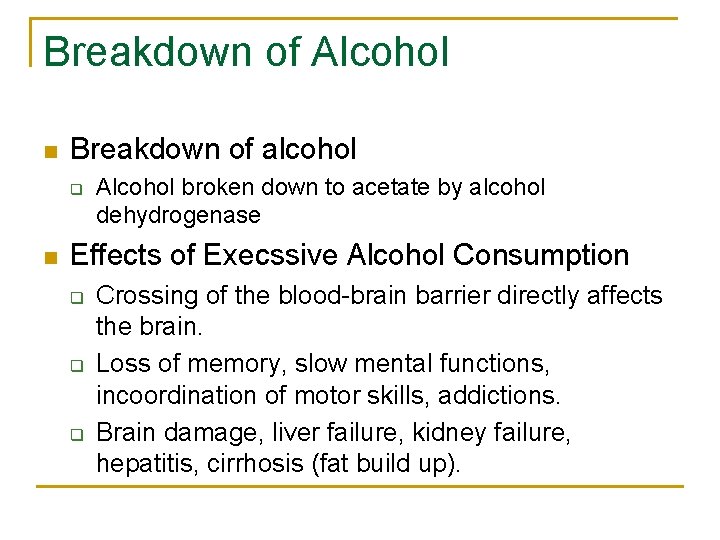
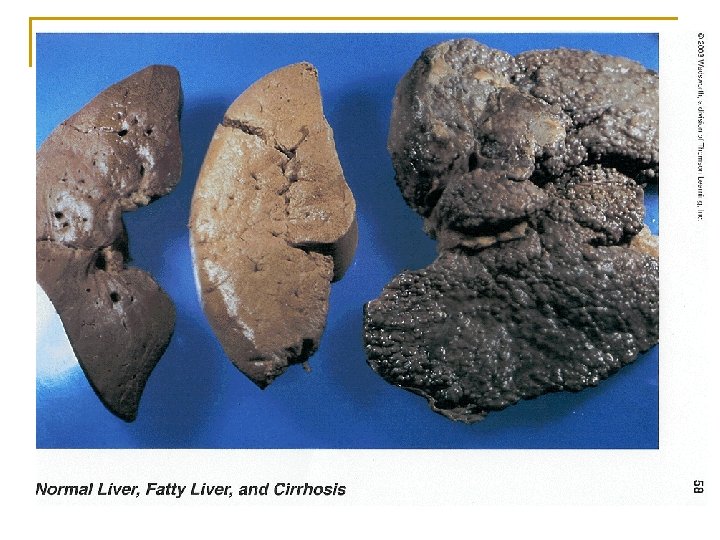
Breakdown of Alcohol n Breakdown of alcohol q n Alcohol broken down to acetate by alcohol dehydrogenase Effects of Execssive Alcohol Consumption q q q Crossing of the blood-brain barrier directly affects the brain. Loss of memory, slow mental functions, incoordination of motor skills, addictions. Brain damage, liver failure, kidney failure, hepatitis, cirrhosis (fat build up).
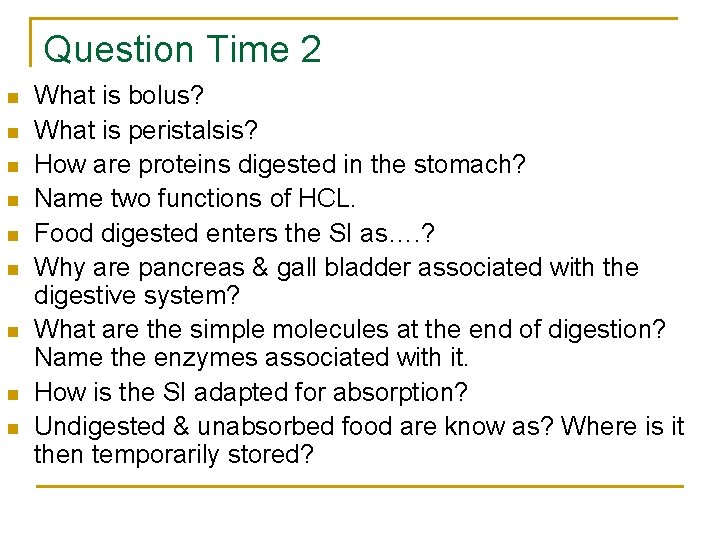
Question Time 2 n n n n n What is bolus? What is peristalsis? How are proteins digested in the stomach? Name two functions of HCL. Food digested enters the SI as…. ? Why are pancreas & gall bladder associated with the digestive system? What are the simple molecules at the end of digestion? Name the enzymes associated with it. How is the SI adapted for absorption? Undigested & unabsorbed food are know as? Where is it then temporarily stored?