
Chapter 6 Nonverbal Intercultural Communication Quotation w There
大学英语 跨文化交际 Chapter 6 Nonverbal Intercultural Communication 黑龙江大学外语部
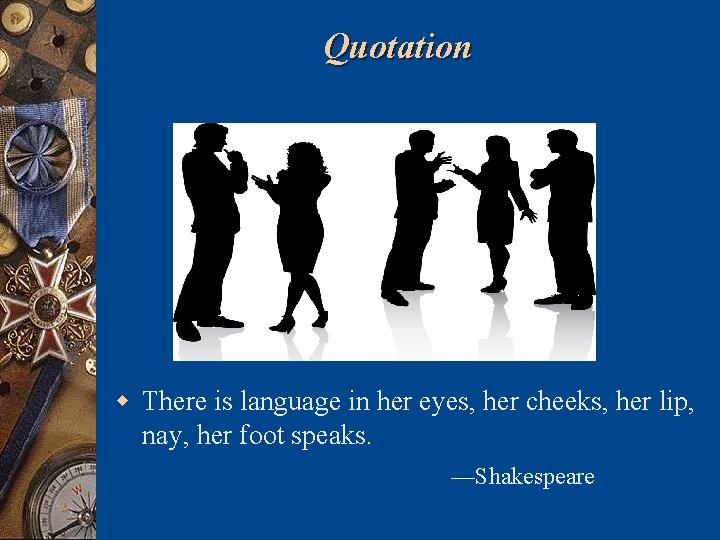
Quotation w There is language in her eyes, her cheeks, her lip, nay, her foot speaks. —Shakespeare
Chapter 6 Nonverbal Intercultural Communication Learning Objectives In this chapter, students will learn how to: w 1. understand th e significance of n onverbal intercultural comm unication w 2. perceive the definition of non verbal intercultural comm unication w 3. describe the functions of non verbal intercultural comm unication w 4. summarize th e categories of no nverbal intercultural comm unication
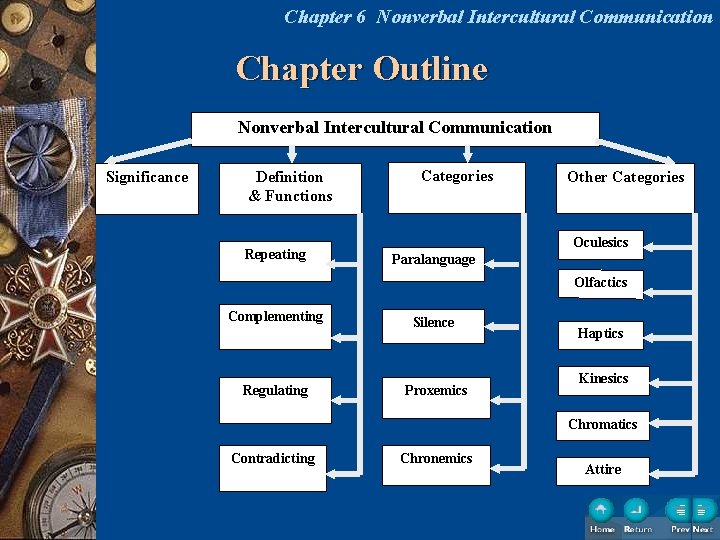
Chapter 6 Nonverbal Intercultural Communication Chapter Outline Nonverbal Intercultural Communication Significance Definition & Functions Repeating Categories Other Categories Oculesics Paralanguage Olfactics Complementing Regulating Silence Proxemics Haptics Kinesics Chromatics Contradicting Chronemics Attire
Chapter 6 Nonverbal Intercultural Communication Lead-in Case: What Is Wrong with the Interaction? Please read case and then discuss the questions in pairs. 1. What are Akira’s and Mitsuko’s impressions on Jim? 2. What is Jim’s impressions on Akira’s and Mitsuko? 3. If you are talking with Jim as an exchange student from China, will his behaviors shock you? How would you respond to the situation?
Text A Chapter 6 Nonverbal Intercultural Communication Significance of Nonverbal Communication Nonverbal behavior is a significant area of communication study for at least three reasons. w Nonverbal behavior accounts for much of the meaning we get from conversations. w Nonverbal behavior spontaneously reflects the subconsciousness. w We cannot avoid communicating through nonverbal signals.
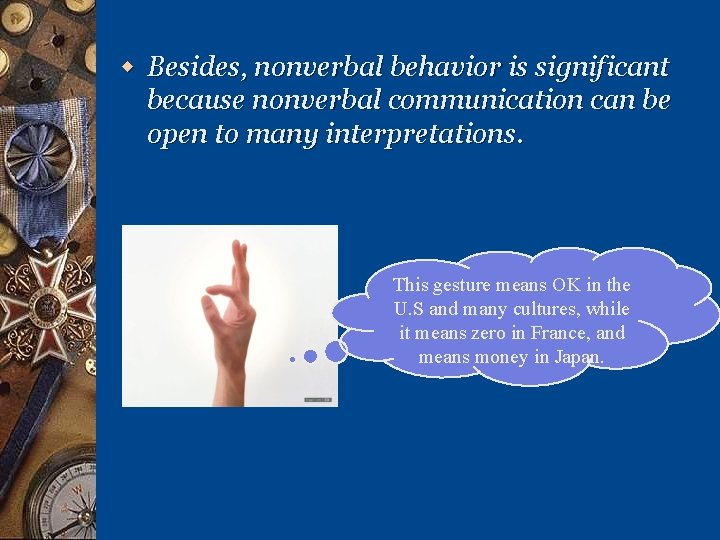
w Besides, nonverbal behavior is significant because nonverbal communication can be open to many interpretations. This gesture means OK in the U. S and many cultures, while it means zero in France, and means money in Japan.
Chapter 6 Nonverbal Intercultural Communication Text B Definition and Functions of Nonverbal Communication Ø Definition of Nonverbal Communication Ø The Functions of Nonverbal Communication
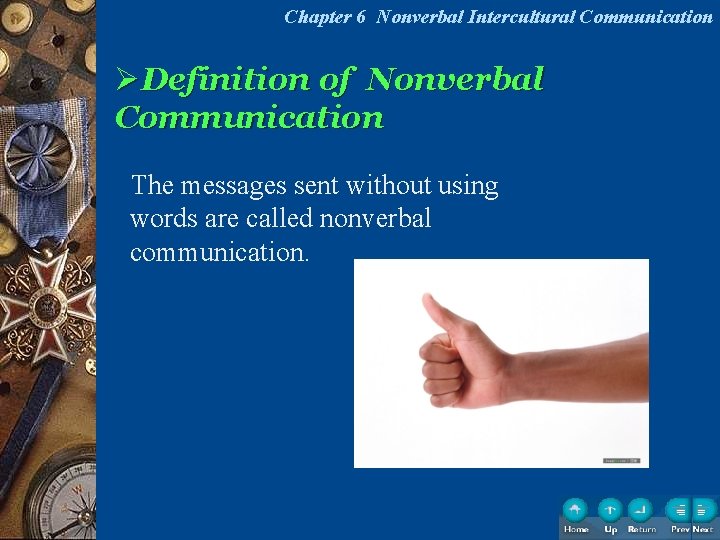
Chapter 6 Nonverbal Intercultural Communication ØDefinition of Nonverbal Communication The messages sent without using words are called nonverbal communication.
Chapter 6 Nonverbal Intercultural Communication ØThe Functions of Nonverbal Communication a. Repeating People use nonverbal communication to repeat, clarify, and emphasize their point of view. For example, nod as saying "yes". b. Complementing Nonverbal communication cues can add to or complement a verbal message. For example, scratch head.
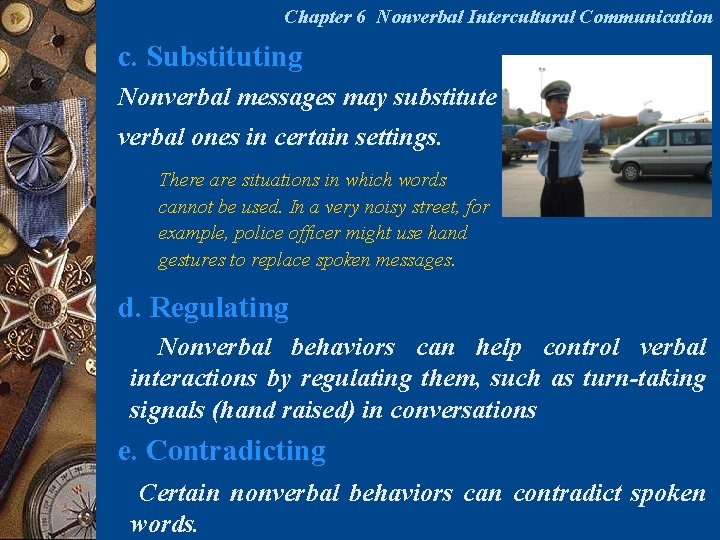
Chapter 6 Nonverbal Intercultural Communication c. Substituting Nonverbal messages may substitute verbal ones in certain settings. There are situations in which words cannot be used. In a very noisy street, for example, police officer might use hand gestures to replace spoken messages. d. Regulating Nonverbal behaviors can help control verbal interactions by regulating them, such as turn-taking signals (hand raised) in conversations e. Contradicting Certain nonverbal behaviors can contradict spoken words.
Chapter 6 Nonverbal Intercultural Communication Text B Paralanguage and Silence 1. Paralanguage(副语言) 2. Silence (沉默 )
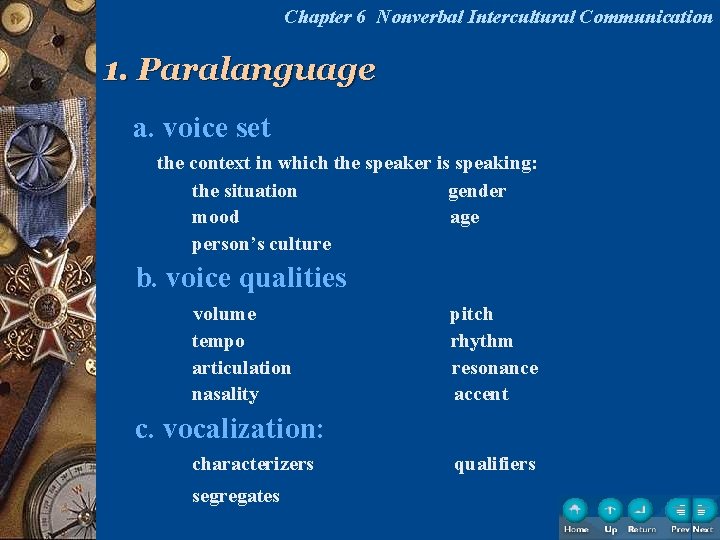
Chapter 6 Nonverbal Intercultural Communication 1. Paralanguage a. voice set the context in which the speaker is speaking: the situation gender mood age person’s culture b. voice qualities volume tempo articulation nasality pitch rhythm resonance accent c. vocalization: characterizers segregates qualifiers
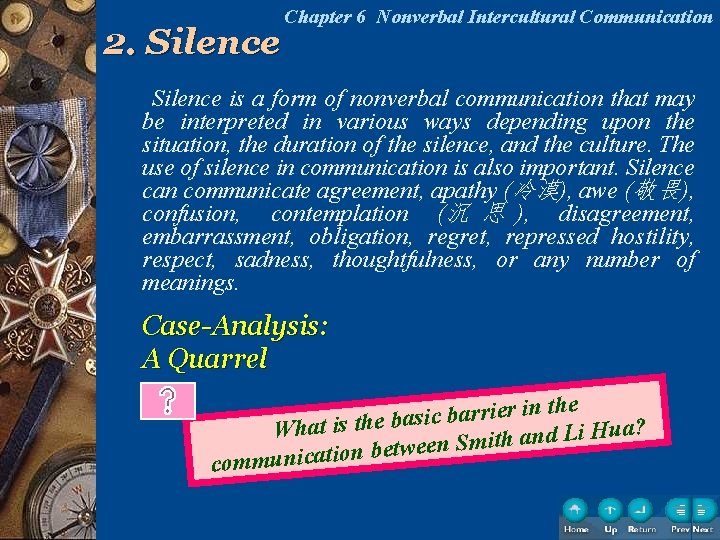
2. Silence Chapter 6 Nonverbal Intercultural Communication Silence is a form of nonverbal communication that may be interpreted in various ways depending upon the situation, the duration of the silence, and the culture. The use of silence in communication is also important. Silence can communicate agreement, apathy (冷漠), awe (敬畏), confusion, contemplation (沉 思 ), disagreement, embarrassment, obligation, regret, repressed hostility, respect, sadness, thoughtfulness, or any number of meanings. Case-Analysis: A Quarrel comm in the r e i r r a b c i s a b ua? What is the H i L d n a h t i Sm n e e w t e b n o i t a unic
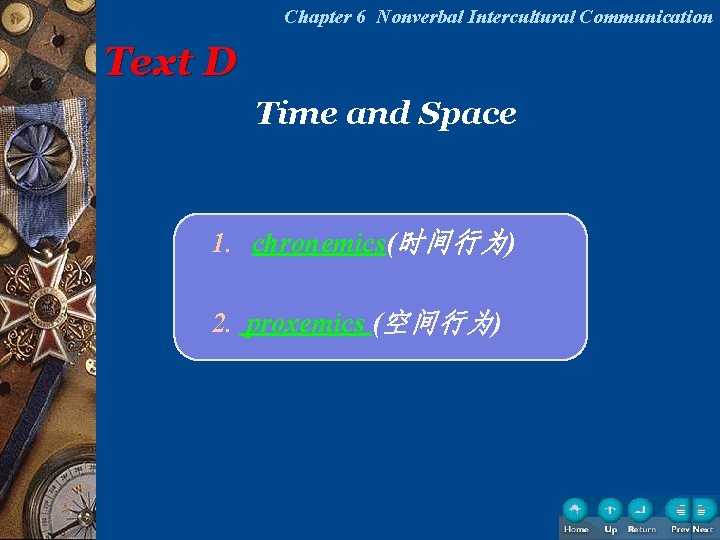
Chapter 6 Nonverbal Intercultural Communication Text D Time and Space 1. chronemics(时间行为) 2. proxemics (空间行为)
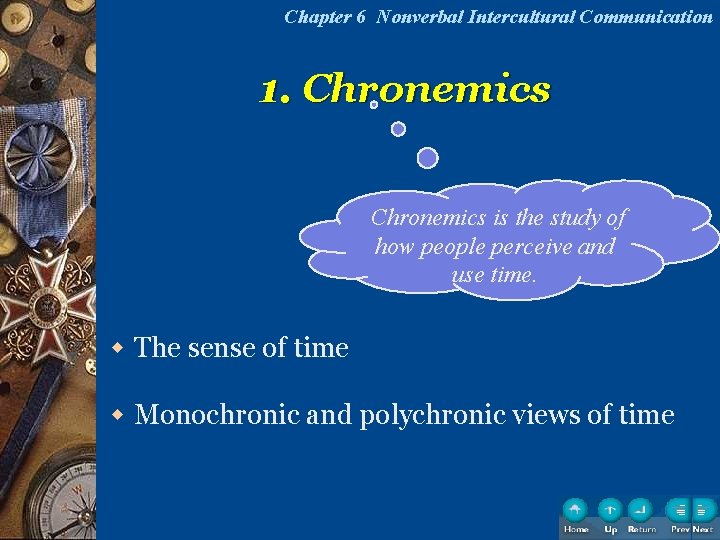
Chapter 6 Nonverbal Intercultural Communication 1. Chronemics is the study of how people perceive and use time. w The sense of time w Monochronic and polychronic views of time
Chapter 6 Nonverbal Intercultural Communication w The sense of time a. Time is cyclical (循环的) Life on earth evolved in response to the cycles of day and night and the ebb and flow of the tides. b. Time is linear (线性的) Western cultures think time is linear — a flow from the past to the present to the future.
Chapter 6 Nonverbal Intercultural Communication w Monochronic and polychronic views of time a. Monochronic time means paying attention to and doing only one thing at a time. b. Polychronic time means being involved with many things at once.
Chapter 6 Nonverbal Intercultural Communication Activity Recall your ow n exper for som ience a eone wh bout w o or whe i s l a aiting t e n you f o r a n are late appoint Describ ment, for an e you appoint r feel circum ment. ings stances under. such
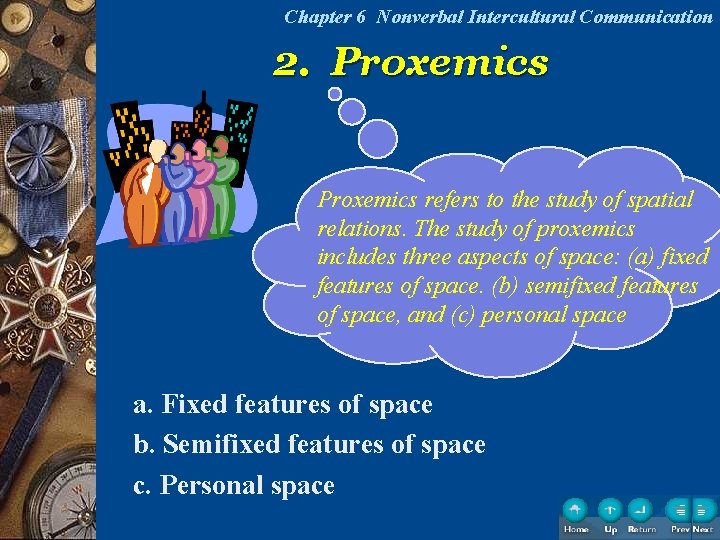
Chapter 6 Nonverbal Intercultural Communication 2. Proxemics refers to the study of spatial relations. The study of proxemics includes three aspects of space: (a) fixed features of space. (b) semifixed features of space, and (c) personal space a. Fixed features of space b. Semifixed features of space c. Personal space
Chapter 6 Nonverbal Intercultural Communication a. Fixed features of space Architecture and spacing of buildings belong to this aspect of space. For example, a person in the United States can drive on a highway for miles and never see a sign of people or dwellings. Therefore, he may be amazed at the closeness of people in China. Intercultural communicators need to realize that cultures have alternative approaches to space and ways of using it.
Chapter 6 Nonverbal Intercultural Communication b. Semifixed features of space refer to spatial arrangements of movable objects within a room, such as furniture arrangement and seating.
Chapter 6 Nonverbal Intercultural Communication Furniture arrangement French space is a reflection of French culture. Everything is centralized, and spatially the entire country is laid out around centers. In Germany, where privacy is stressed, office furniture is spread throughout the office. In Japan, where group participation is encouraged, many desks are arranged hierarchically in the center of a large, common room absent of walls. Chinese geomancy (泥土占卜), feng shui, is the art of arranging the physical environment to establish harmony with the natural environment to achieve happiness, prosperity, and health.
Chapter 6 Nonverbal Intercultural Communication Seating In the Un ited State s, they ten opposite d to talk w them rath e ith those r than th beside th ose seate em. The C d or stan hinese of uneasine d ten exper ss when t ience hey face on oppos someone ite side o directly o f a desk o r sit r table fr om some one.
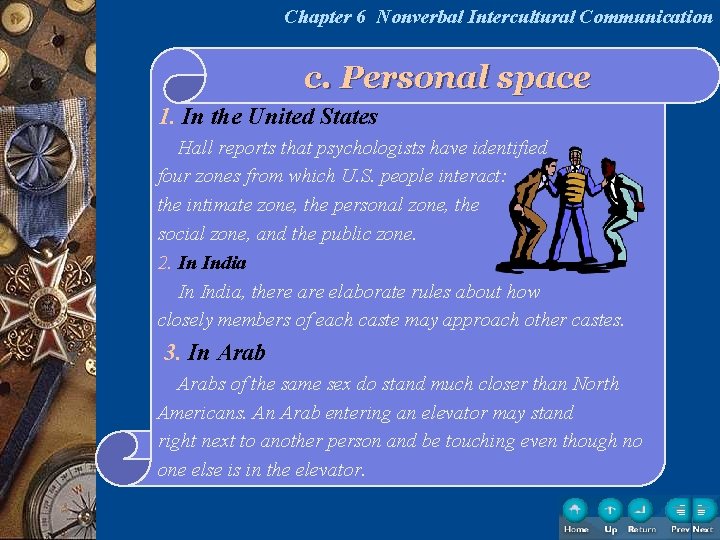
Chapter 6 Nonverbal Intercultural Communication c. Personal space 1. In the United States Hall reports that psychologists have identified four zones from which U. S. people interact: the intimate zone, the personal zone, the social zone, and the public zone. 2. In India, there are elaborate rules about how closely members of each caste may approach other castes. 3. In Arabs of the same sex do stand much closer than North Americans. An Arab entering an elevator may stand right next to another person and be touching even though no one else is in the elevator.
Chapter 6 Nonverbal Intercultural Communication Case-Analysis: Don’t Put Your Hand on My Arm d e n r a e l e ? b e v n o a b c a t Wha the case from
Text E Chapter 6 Nonverbal Intercultural Communication Other Categories of Nonverbal Communication 1. ocuelsics (目光语) 2. olfactics (嗅觉) 3. haptics (触觉行为) 4. kinesics (身势语行为) 5. chromatics (色彩学) 6. attire (服饰)
Chapter 6 Nonverbal Intercultural Communication 1. oculesics The study of communications sent by the eyes is termed oculesics. A prolonged gaze or stare in the United States is considered rude. In other cultures such as Japan, Korea, and Thailand, staring is also considered rude. In most cultures, men do not stare at women. In France and Italy, however, men can stare at women in public. In the United States, staring at a person is considered a sign of interest and may even be interpreted as sexually suggestive.
Chapter 6 Nonverbal Intercultural Communication 2. olfactics The study of communication via smell is called Olfactics. A person’s smell can have a positive or negative effect on the oral message. Activity: Discussion nd a d e l z z u gp n i e b f o e of c n e l e i p r o e e p p x m ee o h r t f d t a c h a t u n o he c t t e y u e o Have yo b t c a k ire d n i h a t y o b t ers. , try b s m e annoyed e y m f I p s? rou e g r r u t u l o u y c h t wit i other s s u c s i. D y h w n o s rea
Chapter 6 Nonverbal Intercultural Communication 3. haptics Haptics or touch refers to communicating through the use of bodily contact. In Thailand Laos, it is rude for a stranger or acquaintance (熟人 ) to touch a child on the top of the head because the head is regarded as the home of the spirit or soul. It is believed that a child’s spirit or soul is not strong enough to be touched and has tendency to become ill if patted. Even placing a hand on the back of an Asian worker’s chair is considered inappropriate. White Muslims hug another person around the shoulders, Korea young people do not touch the shoulders of their elders.
Chapter 6 Nonverbal Intercultural Communication 4. kinesics Kinesics is the term used for communicating through various types of body movements including facial expressions, gestures, posture and stance, and other mannerisms that may accompany or replace oral messages.
Chapter 6 Nonverbal Intercultural Communication a. Gestures l Head movement l Arm movement b. Posture, the way someone stands, sits, or walks, can send positive or negative nonverbal messages. Posture can signal agreement or disagreement. Appropriate posture is related to a person’s status in society. For example, the manager may stand erect when talking to subordinates, but the subordinates may drop their shoulders when talking to the manager. c. Facial expressions
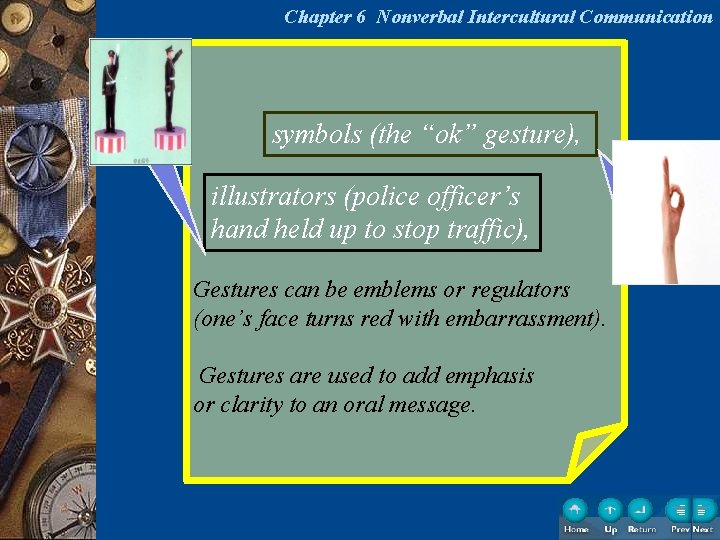
Chapter 6 Nonverbal Intercultural Communication symbols (the “ok” gesture), illustrators (police officer’s hand held up to stop traffic), Gestures can be emblems or regulators (one’s face turns red with embarrassment). Gestures are used to add emphasis or clarity to an oral message.
Chapter 6 Nonverbal Intercultural Communication 5. chromatics Chromatics refers to the study of color use in affecting people’s mood, emotions, and impression of others.
Chapter 6 Nonverbal Intercultural Communication Cultural differences associated with colors include: Ø Black is the color of mourning to many Europeans and U. S. Americans, but white is worn to funerals in Japan and many other nations. Ø In the United States, white is typically worn by brides while in India, red or yellow is worn. Ø Purple is sometimes associated with royalty, but it is the color of death in many Latin American countries. Ø Red (especially red roses) is associated with romance in some cultures including the United States. Red is not an appropriate color for wrapping gifts in Japan. Dark red is the color of mourning along the Ivory Coast.
Chapter 6 Nonverbal Intercultural Communication Cultural differences associated with colors include: Ø Green is not used for wrapping packages in Egypt since green is the nationalist color (as red, white and blue are the nationalist colors in the United States). Men should avoid wearing a green hat in China as this signifies that their wife or sister is a prostitute. Ø In many countries of the world, blue is considered a masculine color, but to people of France and the United Kingdom, red is more masculine. Blue, in Iran, is an undesirable color. Ø While people of the United States consider pink to be the most feminine color, persons in most other countries think of yellow as the most feminine color.

Chapter 6 Nonverbal Intercultural Communication e h t n o f f o t o g y l ing w o n k n u s e n i l r i A United ong H m o r f s t h g i l f l a iti n i s t i g n i r u d t o o f wrong ey h t , n o i s a c c o e h t e rat o m e m m o c o T. g n he Ko t ) 馨 乃 康 ( s n o ati n r a c e t i h w t u o d e y n hand a m o t t a h t d e n r lea y e h t n e h W. s r e g passen and k c u l d a b t n e s e r p re s r e w o l f e t i h w s n s. Asia n o i t a n r a c d e r o t ged n a h c y e h t , h t a e d even
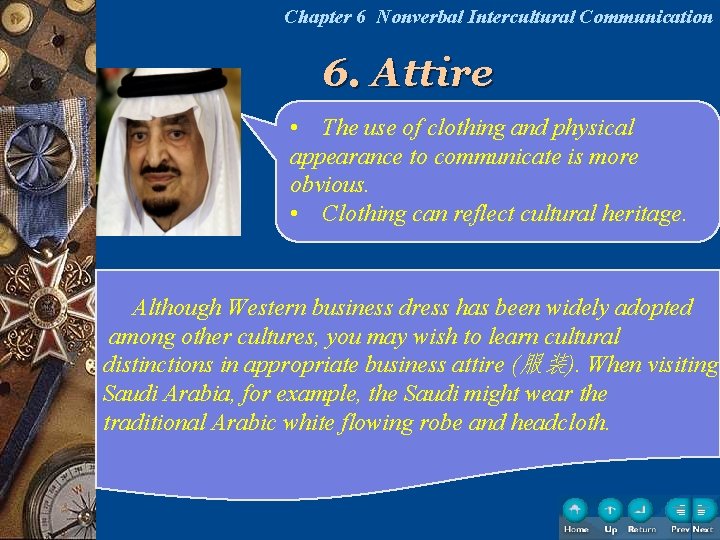
Chapter 6 Nonverbal Intercultural Communication 6. Attire • The use of clothing and physical appearance to communicate is more obvious. • Clothing can reflect cultural heritage. Although Western business dress has been widely adopted among other cultures, you may wish to learn cultural distinctions in appropriate business attire (服装). When visiting Saudi Arabia, for example, the Saudi might wear the traditional Arabic white flowing robe and headcloth.
Chapter 6 Nonverbal Intercultural Communication Case-Analysis: Formality of Dress se? a c e h t m tes o r a f t S n r d ite lea n e U w e n th ca n t i ins a r a h a l m W e u. r p 1 po ke i y? y N r h e f v W o. s s i n o e ie 2. Nik e consumpti ean countr p h o t r e u l i E e wh h t n i e at moder
Assignment ⑴ Give interpretations to the following nonverbal behaviors w An adult pats a child’s head w A customer in a restaurant waves his hand over his head w Two women walk hand in hand on the street ⑵ In what situations might you need to interpret the nonverbal behavior of someone from another culture? What problems could arise from not understanding differences in nonverbal behaviors?

Tha nk y ou!
- Slides: 41