
Chapter 6 Multiple Sequence Alignment Jonathan Pevsner Ph
![Feng-Doolittle MSA occurs in 3 stages [1] Do a set of global pairwise alignments](https://slidetodoc.com/presentation_image_h/fac7d33547ef3ef73615f6eb58fbe873/image-21.jpg "Feng-Doolittle MSA occurs in 3 stages [1] Do a set of global pairwise alignments")
![MUSCLE: next-generation progressive MSA [1] Build a draft progressive alignment Determine pairwise similarity through](https://slidetodoc.com/presentation_image_h/fac7d33547ef3ef73615f6eb58fbe873/image-44.jpg "MUSCLE: next-generation progressive MSA [1] Build a draft progressive alignment Determine pairwise similarity through")
![MUSCLE: next-generation progressive MSA [2] Improve the progressive alignment Compute pairwise identity through current](https://slidetodoc.com/presentation_image_h/fac7d33547ef3ef73615f6eb58fbe873/image-45.jpg "MUSCLE: next-generation progressive MSA [2] Improve the progressive alignment Compute pairwise identity through current")
![MUSCLE: next-generation progressive MSA [3] Refinement of the MSA Split tree in half by](https://slidetodoc.com/presentation_image_h/fac7d33547ef3ef73615f6eb58fbe873/image-46.jpg "MUSCLE: next-generation progressive MSA [3] Refinement of the MSA Split tree in half by")
![Strategy for assessment of alternative multiple sequence alignment algorithms [1] Create or obtain a](https://slidetodoc.com/presentation_image_h/fac7d33547ef3ef73615f6eb58fbe873/image-57.jpg "Strategy for assessment of alternative multiple sequence alignment algorithms [1] Create or obtain a")
- Slides: 71
Chapter 6: Multiple Sequence Alignment Jonathan Pevsner, Ph. D. pevsner@kennedykrieger. org Bioinformatics and Functional Genomics (Wiley-Liss, 3 rd edition, 2015) You may use this Power. Point for teaching
Learning objectives • Explain the three main stages by which Clustal. W performs multiple sequence alignment (MSA); • Describe several alternative programs for MSA (such as MUSCLE, Prob. Cons, and TCoffee); • Explain how they work, and contrast them with Clustal. W; • Explain the significance of performing benchmarking studies and describe several of their basic conclusions for MSA; • Explain the issues surrounding MSA of genomic regions
Outline: multiple sequence alignment (MSA) Introduction; definition of MSA; typical uses Five main approaches to multiple sequence alignment Exact approaches Progressive sequence alignment Iterative approaches Consistency-based approaches Structure-based methods Benchmarking studies: approaches, findings, challenges Databases of Multiple Sequence Alignments Pfam: Protein Family Database of Profile HMMs SMART Conserved Domain Database Integrated multiple sequence alignment resources MSA database curation: manual versus automated Multiple sequence alignments of genomic regions UCSC, Galaxy, Ensembl, alignathon Perspective
Multiple sequence alignment: definition • a collection of three or more protein (or nucleic acid) sequences that are partially or completely aligned • homologous residues are aligned in columns across the length of the sequences • residues are homologous in an evolutionary sense • residues are homologous in a structural sense
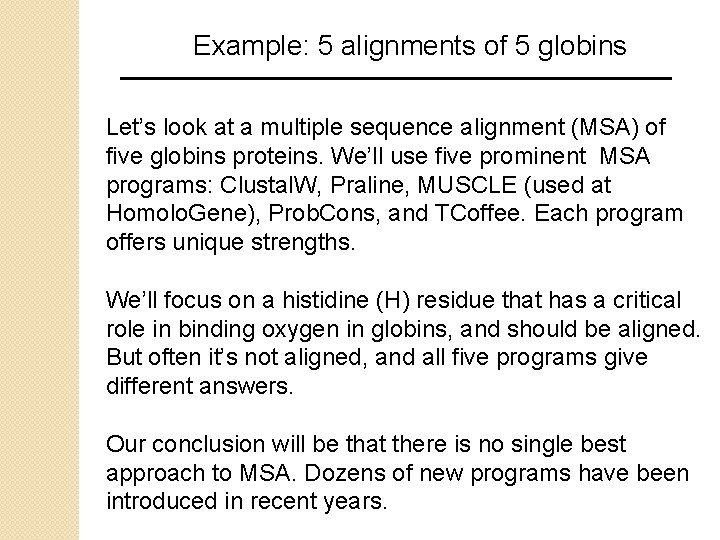
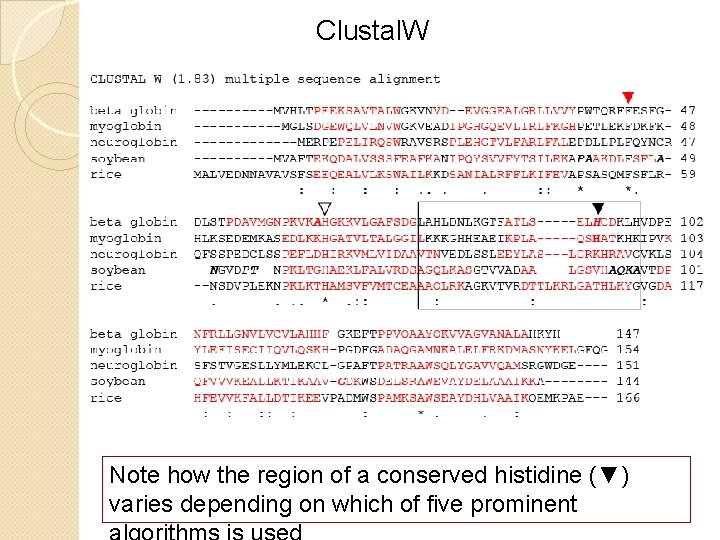
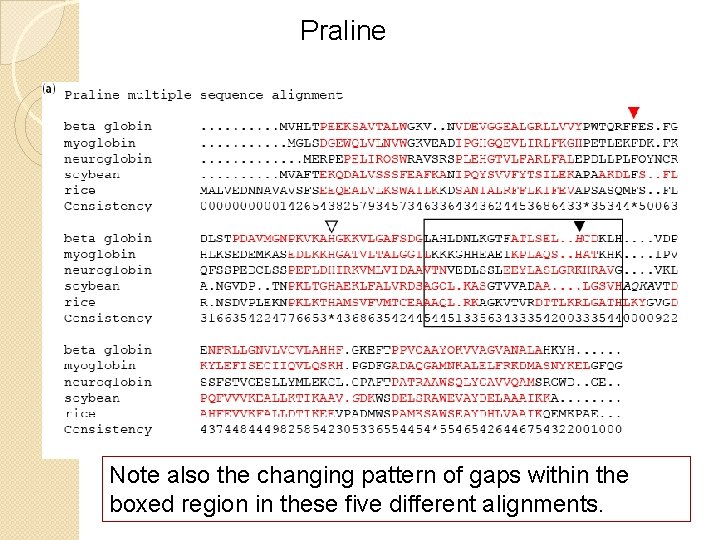
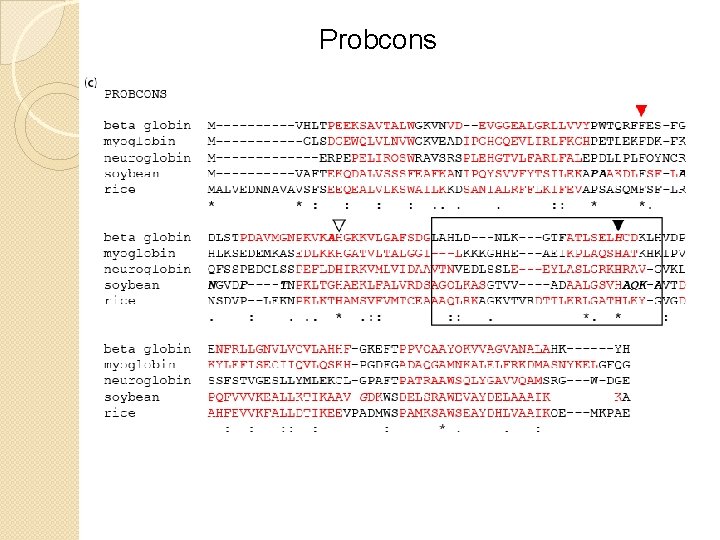
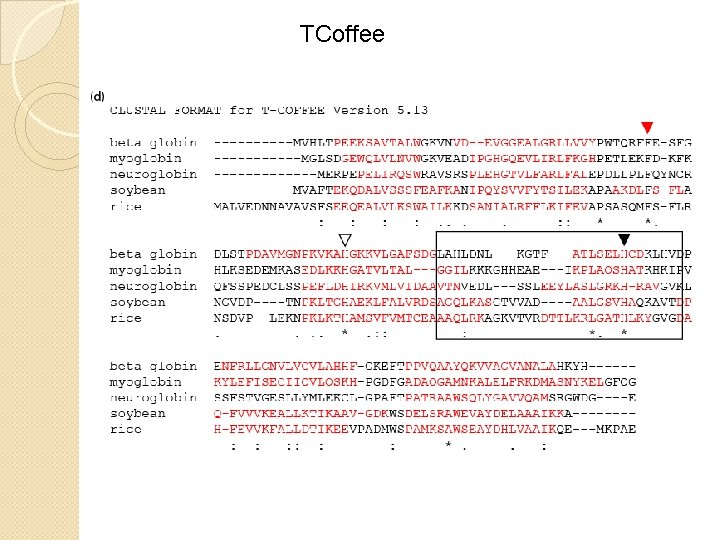
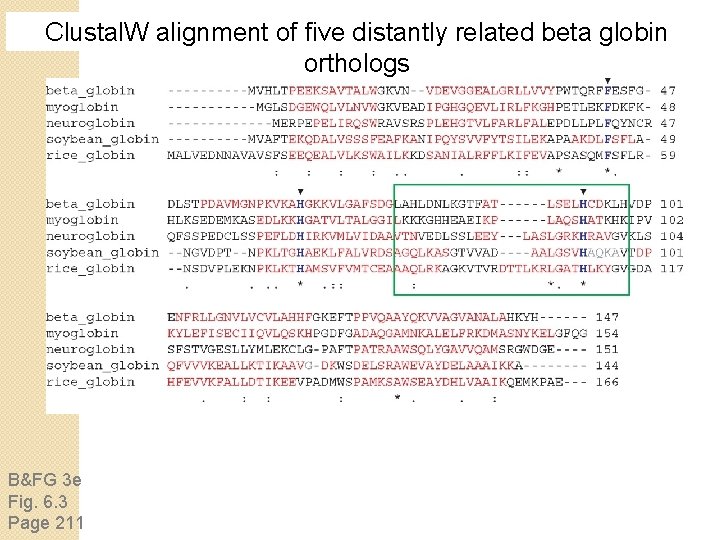
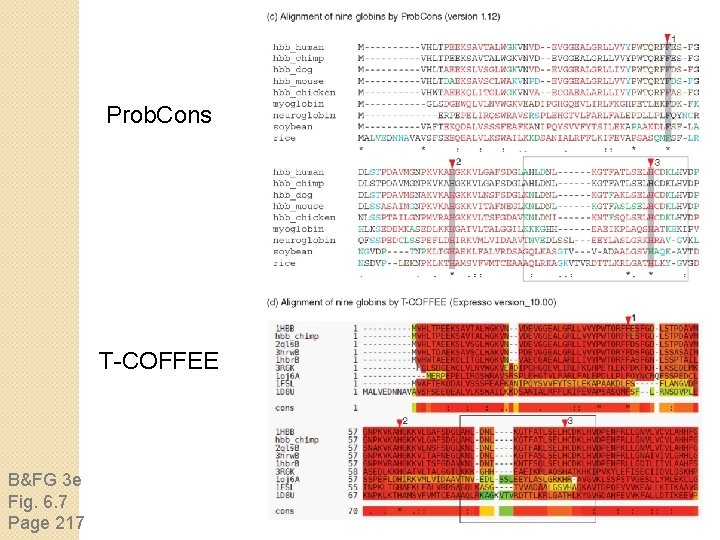
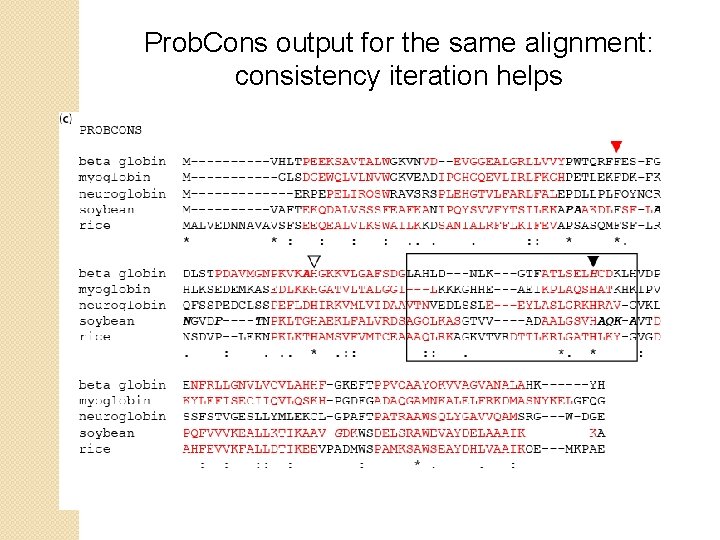
Example: 5 alignments of 5 globins Let’s look at a multiple sequence alignment (MSA) of five globins proteins. We’ll use five prominent MSA programs: Clustal. W, Praline, MUSCLE (used at Homolo. Gene), Prob. Cons, and TCoffee. Each program offers unique strengths. We’ll focus on a histidine (H) residue that has a critical role in binding oxygen in globins, and should be aligned. But often it’s not aligned, and all five programs give different answers. Our conclusion will be that there is no single best approach to MSA. Dozens of new programs have been introduced in recent years.
Clustal. W Note how the region of a conserved histidine (▼) varies depending on which of five prominent
Praline Note also the changing pattern of gaps within the boxed region in these five different alignments.
MUSCLE
Probcons
TCoffee
Multiple sequence alignment: properties • not necessarily one “correct” alignment of a protein family • protein sequences evolve. . . • . . . the corresponding three-dimensional structures of proteins also evolve • may be impossible to identify amino acid residues that align properly (structurally) throughout a multiple sequence alignment • for two proteins sharing 30% amino acid identity, about 50% of the individual amino acids are superposable in the two structures
Multiple sequence alignment: features • some aligned residues, such as cysteines that form disulfide bridges, may be highly conserved • there may be conserved motifs such as a transmembrane domain • there may be conserved secondary structure features • there may be regions with consistent patterns of insertions or deletions (indels)
Multiple sequence alignment: uses • MSA is more sensitive than pairwise alignment to detect homologs • BLAST output can take the form of a MSA, and can reveal conserved residues or motifs • A single query can be searched against a database of MSAs (e. g. PFAM) • Regulatory regions of genes may have consensus sequences identifiable by MSA
Outline: multiple sequence alignment (MSA) Introduction; definition of MSA; typical uses Five main approaches to multiple sequence alignment Exact approaches Progressive sequence alignment Iterative approaches Consistency-based approaches Structure-based methods Benchmarking studies: approaches, findings, challenges Databases of Multiple Sequence Alignments Pfam: Protein Family Database of Profile HMMs SMART Conserved Domain Database Integrated multiple sequence alignment resources MSA database curation: manual versus automated Multiple sequence alignments of genomic regions UCSC, Galaxy, Ensembl, alignathon Perspective
Multiple sequence alignment: exact methods Exact methods of multiple alignment use dynamic programming and are guaranteed to find optimal solutions. But they are not feasible for more than a few sequences.
Multiple sequence alignment: methods Progressive methods: use a guide tree (related to a phylogenetic tree) to determine how to combine pairwise alignments one by one to create a multiple alignment. Examples: CLUSTALW, MUSCLE
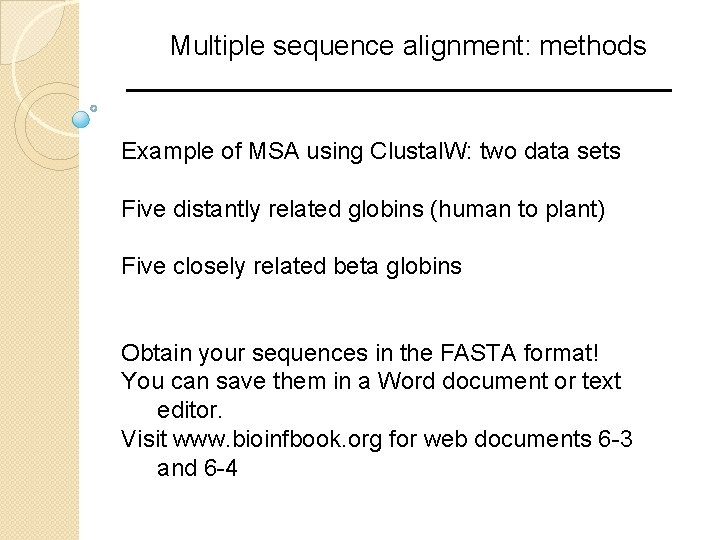
Multiple sequence alignment: methods Example of MSA using Clustal. W: two data sets Five distantly related globins (human to plant) Five closely related beta globins Obtain your sequences in the FASTA format! You can save them in a Word document or text editor. Visit www. bioinfbook. org for web documents 6 -3 and 6 -4
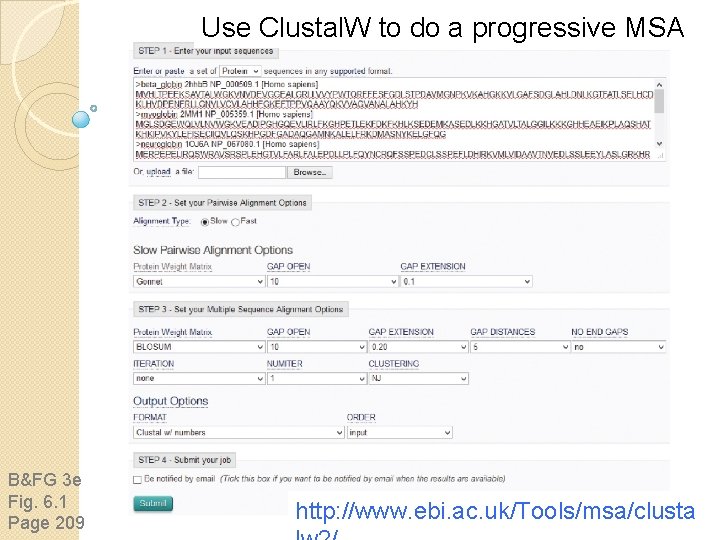
Use Clustal. W to do a progressive MSA B&FG 3 e Fig. 6. 1 Page 209 http: //www. ebi. ac. uk/Tools/msa/clusta
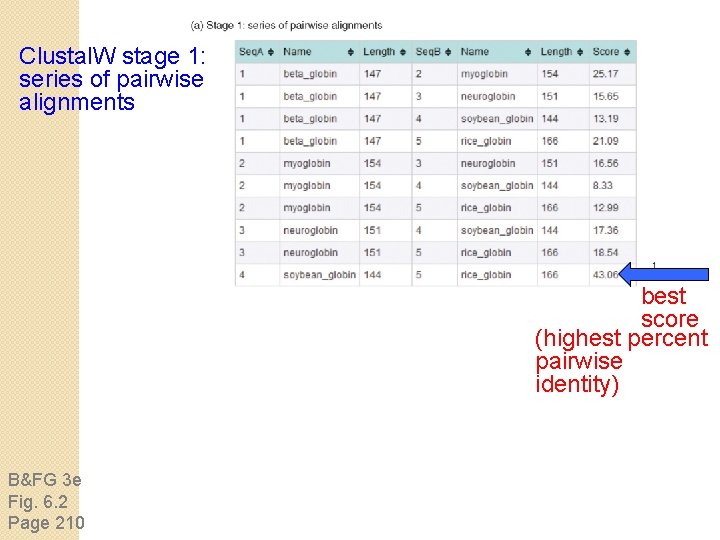
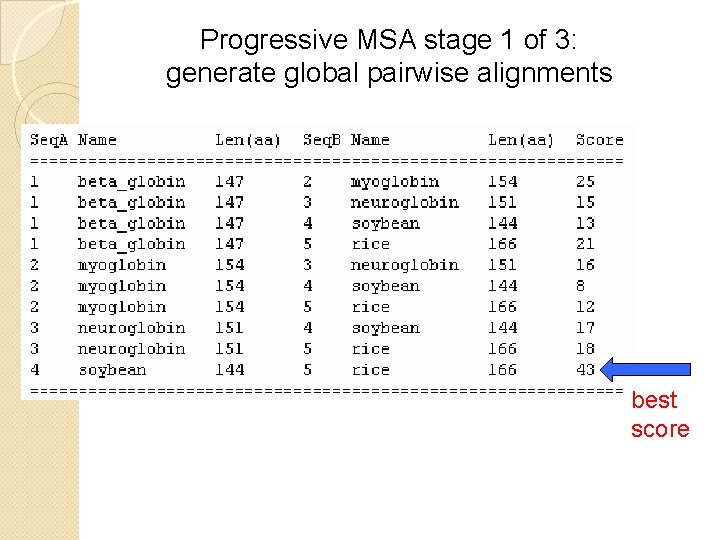
Clustal. W stage 1: series of pairwise alignments best score (highest percent pairwise identity) B&FG 3 e Fig. 6. 2 Page 210
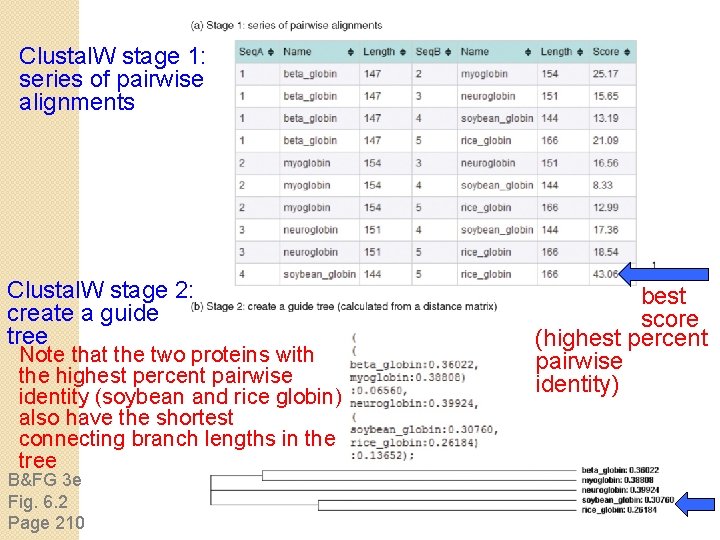
Clustal. W stage 1: series of pairwise alignments Clustal. W stage 2: create a guide tree Note that the two proteins with the highest percent pairwise identity (soybean and rice globin) also have the shortest connecting branch lengths in the tree B&FG 3 e Fig. 6. 2 Page 210 best score (highest percent pairwise identity)
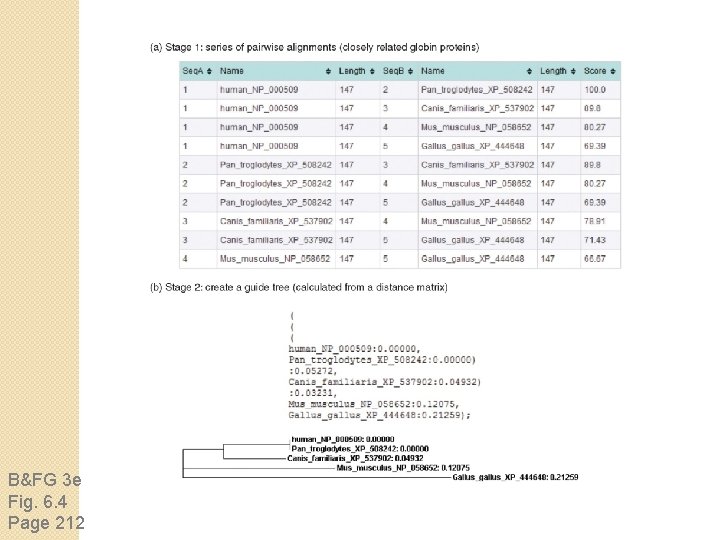
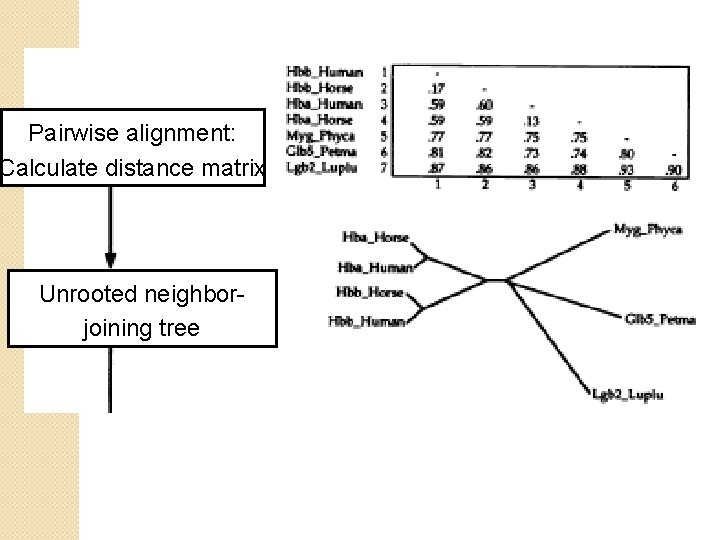
Feng-Doolittle MSA occurs in 3 stages [1] Do a set of global pairwise alignments (Needleman and Wunsch’s dynamic programming algorithm) [2] Create a guide tree [3] Progressively align the sequences
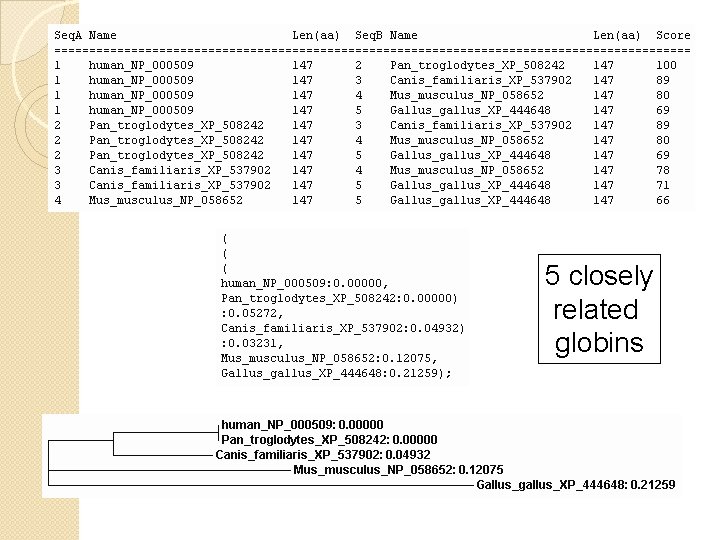
Progressive MSA stage 1 of 3: generate global pairwise alignments best score
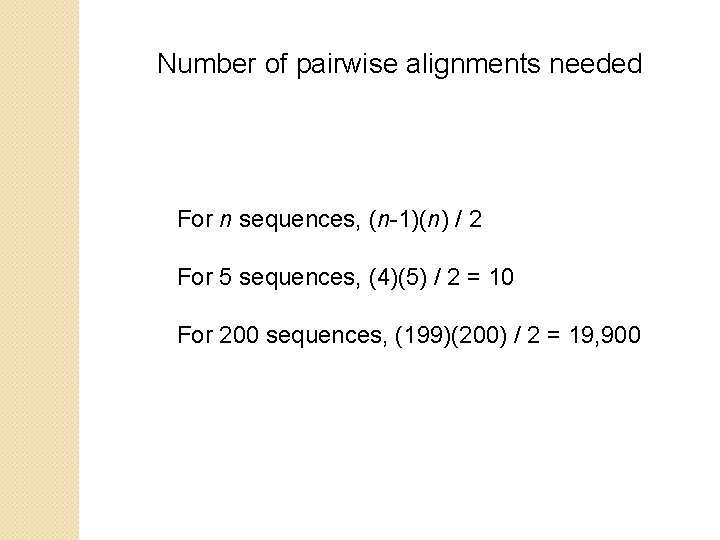
Number of pairwise alignments needed For n sequences, (n-1)(n) / 2 For 5 sequences, (4)(5) / 2 = 10 For 200 sequences, (199)(200) / 2 = 19, 900
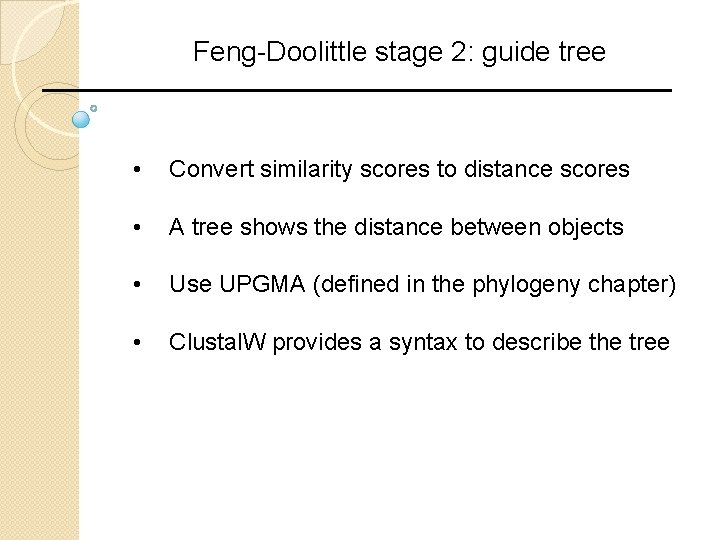
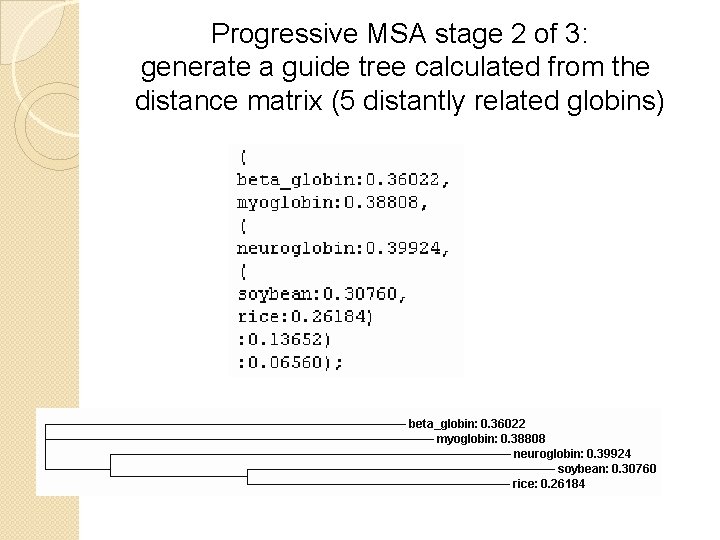
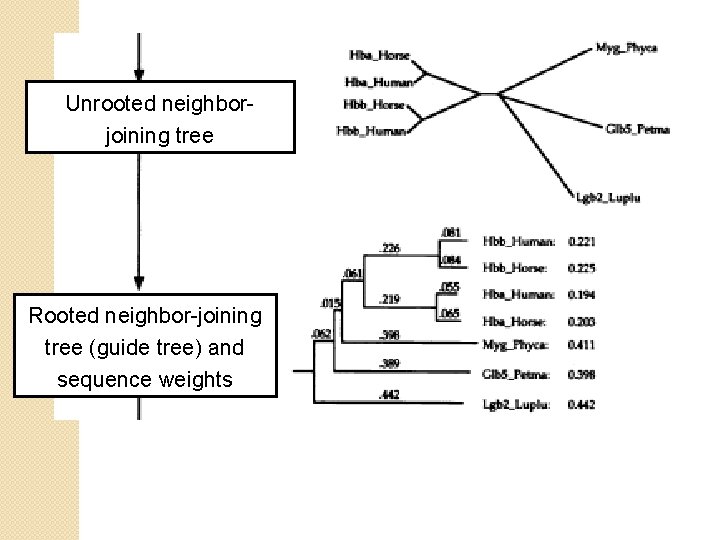
Feng-Doolittle stage 2: guide tree • Convert similarity scores to distance scores • A tree shows the distance between objects • Use UPGMA (defined in the phylogeny chapter) • Clustal. W provides a syntax to describe the tree
Clustal. W alignment of five distantly related beta globin orthologs B&FG 3 e Fig. 6. 3 Page 211
B&FG 3 e Fig. 6. 4 Page 212
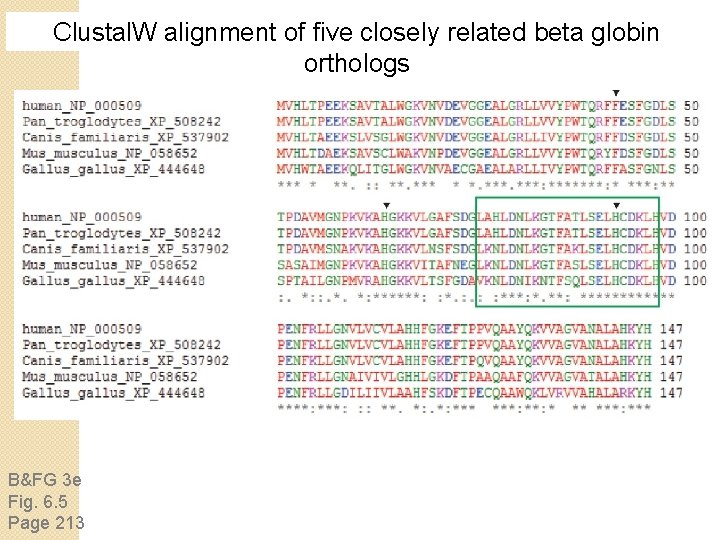
Clustal. W alignment of five closely related beta globin orthologs B&FG 3 e Fig. 6. 5 Page 213
Progressive MSA stage 2 of 3: generate a guide tree calculated from the distance matrix (5 distantly related globins)
5 closely related globins
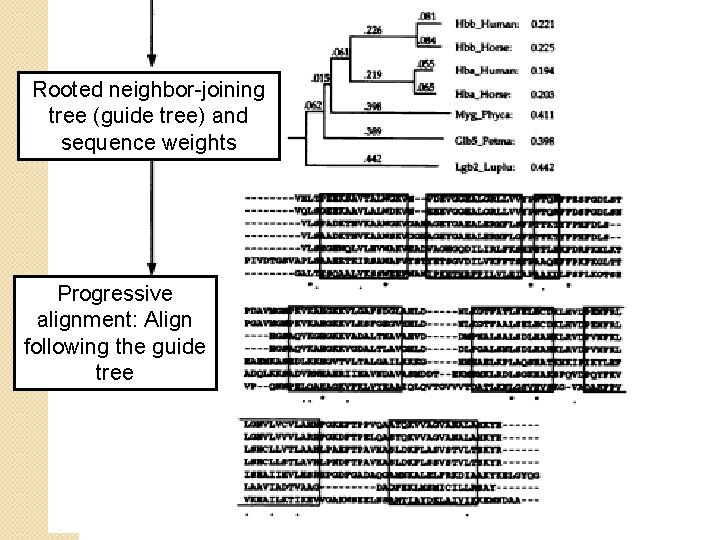
Feng-Doolittle stage 3: progressive alignment • Make a MSA based on the order in the guide tree • Start with the two most closely related sequences • Then add the next closest sequence • Continue until all sequences are added to the MSA • Rule: “once a gap, always a gap. ”
Why “once a gap, always a gap”? • There are many possible ways to make a MSA • Where gaps are added is a critical question • Gaps are often added to the first two (closest) sequences • To change the initial gap choices later on would be to give more weight to distantly related sequences • To maintain the initial gap choices is to trust that those gaps are most believable
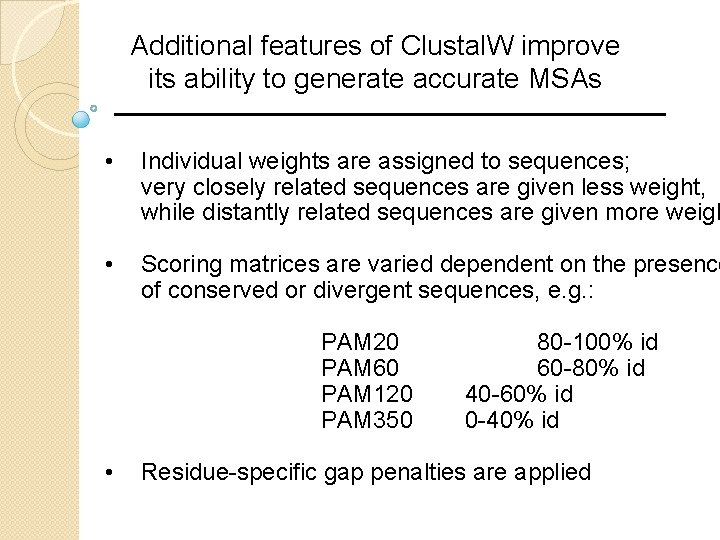
Additional features of Clustal. W improve its ability to generate accurate MSAs • Individual weights are assigned to sequences; very closely related sequences are given less weight, while distantly related sequences are given more weigh • Scoring matrices are varied dependent on the presence of conserved or divergent sequences, e. g. : PAM 20 PAM 60 PAM 120 PAM 350 • 80 -100% id 60 -80% id 40 -60% id 0 -40% id Residue-specific gap penalties are applied
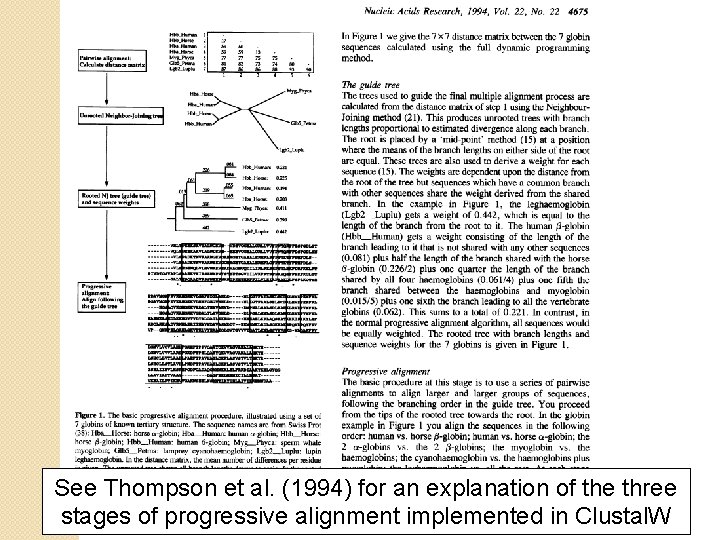
See Thompson et al. (1994) for an explanation of the three stages of progressive alignment implemented in Clustal. W
Pairwise alignment: Calculate distance matrix Unrooted neighborjoining tree
Unrooted neighborjoining tree Rooted neighbor-joining tree (guide tree) and sequence weights
Rooted neighbor-joining tree (guide tree) and sequence weights Progressive alignment: Align following the guide tree
Outline: multiple sequence alignment (MSA) Introduction; definition of MSA; typical uses Five main approaches to multiple sequence alignment Exact approaches Progressive sequence alignment Iterative approaches Consistency-based approaches Structure-based methods Benchmarking studies: approaches, findings, challenges Databases of Multiple Sequence Alignments Pfam: Protein Family Database of Profile HMMs SMART Conserved Domain Database Integrated multiple sequence alignment resources MSA database curation: manual versus automated Multiple sequence alignments of genomic regions UCSC, Galaxy, Ensembl, alignathon Perspective
Iterative approaches: MAFFT � Uses Fast Fourier Transform to speed up profile alignment � Uses fast two-stage method for building alignments using k-mer frequencies � Offers many different scoring and aligning techniques � One of the more accurate programs available � Available as standalone or web interface � Many output formats, including interactive phylogenetic trees Page 19
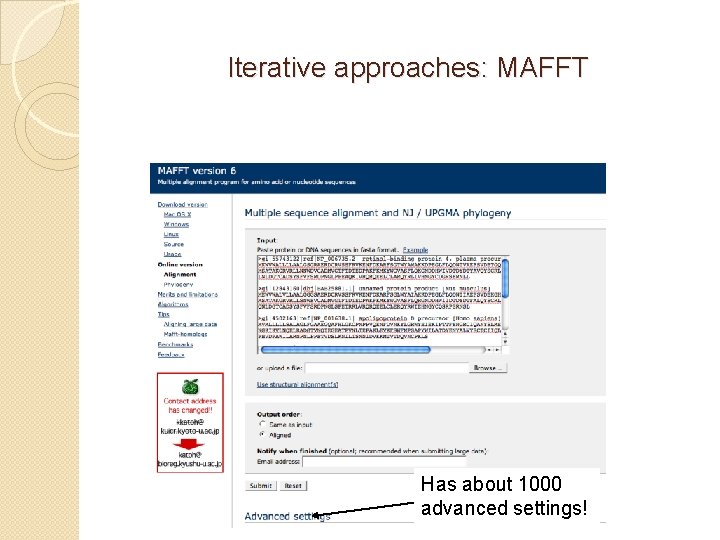
Iterative approaches: MAFFT Has about 1000 advanced settings!
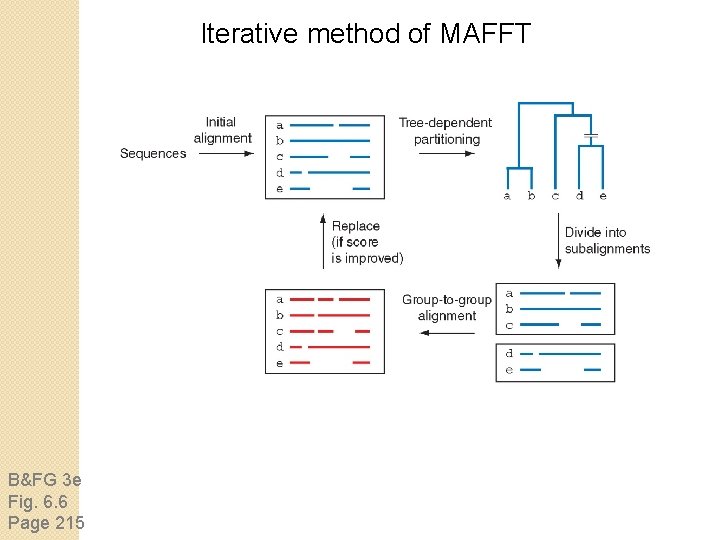
Iterative method of MAFFT B&FG 3 e Fig. 6. 6 Page 215
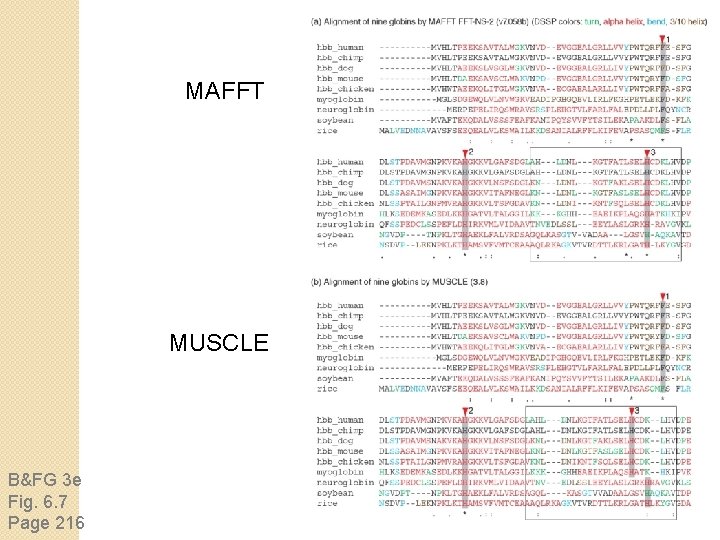
MAFFT MUSCLE B&FG 3 e Fig. 6. 7 Page 216
Prob. Cons T-COFFEE B&FG 3 e Fig. 6. 7 Page 217
Multiple sequence alignment methods Iterative methods: compute a sub-optimal solution and keep modifying that intelligently using dynamic programming or other methods until the solution converges. Examples: MUSCLE, Iter. Align, Praline, MAFFT
MUSCLE: next-generation progressive MSA [1] Build a draft progressive alignment Determine pairwise similarity through k-mer counting (not by alignment) Compute distance (triangular distance) matrix Construct tree using UPGMA Construct draft progressive alignment following tree
MUSCLE: next-generation progressive MSA [2] Improve the progressive alignment Compute pairwise identity through current MSA Construct new tree with Kimura distance measures Compare new and old trees: if improved, repeat this step, if not improved, then we’re done
MUSCLE: next-generation progressive MSA [3] Refinement of the MSA Split tree in half by deleting one edge Make profiles of each half of the tree Re-align the profiles Accept/reject the new alignment
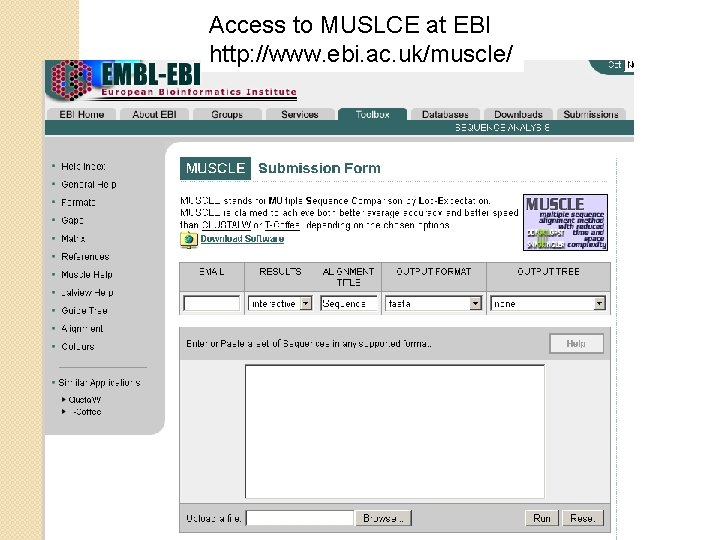
Access to MUSLCE at EBI http: //www. ebi. ac. uk/muscle/
Outline: multiple sequence alignment (MSA) Introduction; definition of MSA; typical uses Five main approaches to multiple sequence alignment Exact approaches Progressive sequence alignment Iterative approaches Consistency-based approaches Structure-based methods Benchmarking studies: approaches, findings, challenges Databases of Multiple Sequence Alignments Pfam: Protein Family Database of Profile HMMs SMART Conserved Domain Database Integrated multiple sequence alignment resources MSA database curation: manual versus automated Multiple sequence alignments of genomic regions UCSC, Galaxy, Ensembl, alignathon Perspective
Multiple sequence alignment: consistency Consistency-based algorithms: generally use a database of both local high-scoring alignments and long-range global alignments to create a final alignment These are very powerful, very fast, and very accurate methods Examples: T-COFFEE, Prrp, Di. Align, Prob. Cons
Prob. Cons—consistency-based approach Combines iterative and progressive approaches with a unique probabilistic model. Uses Hidden Markov Models to calculate probability matrices for matching residues, uses this to construct a guide tree Progressive alignment hierarchically along guide tree Post-processing and iterative refinement (a little like MUSCLE)
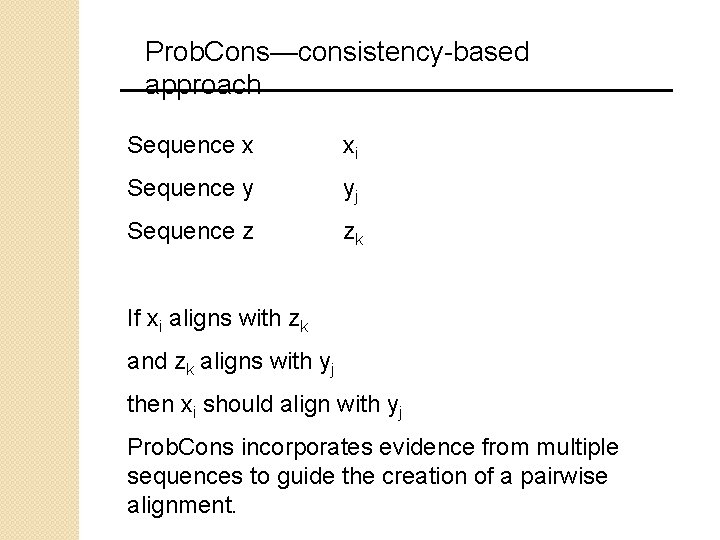
Prob. Cons—consistency-based approach Sequence x xi Sequence y yj Sequence z zk If xi aligns with zk and zk aligns with yj then xi should align with yj Prob. Cons incorporates evidence from multiple sequences to guide the creation of a pairwise alignment.
Prob. Cons output for the same alignment: consistency iteration helps
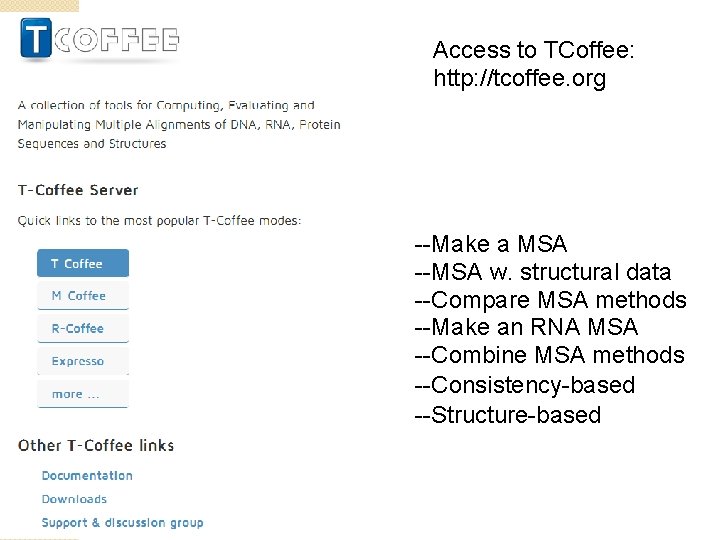
Access to TCoffee: http: //tcoffee. org --Make a MSA --MSA w. structural data --Compare MSA methods --Make an RNA MSA --Combine MSA methods --Consistency-based --Structure-based
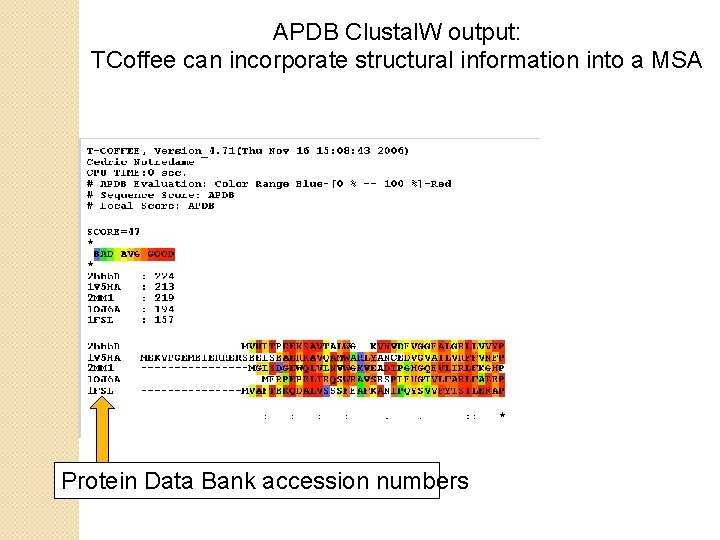
APDB Clustal. W output: TCoffee can incorporate structural information into a MSA Protein Data Bank accession numbers
Outline: multiple sequence alignment (MSA) Introduction; definition of MSA; typical uses Five main approaches to multiple sequence alignment Exact approaches Progressive sequence alignment Iterative approaches Consistency-based approaches Structure-based methods Benchmarking studies: approaches, findings, challenges Databases of Multiple Sequence Alignments Pfam: Protein Family Database of Profile HMMs SMART Conserved Domain Database Integrated multiple sequence alignment resources MSA database curation: manual versus automated Multiple sequence alignments of genomic regions UCSC, Galaxy, Ensembl, alignathon Perspective
Multiple sequence alignment: methods How do we know which program to use? There are benchmarking multiple alignment datasets that have been aligned painstakingly by hand, by structural similarity, or by extremely time- and memory -intensive automated exact algorithms. Some programs have interfaces that are more userfriendly than others. And most programs are excellent so it depends on your preference. If your proteins have 3 D structures, use these to help you judge your alignments. For example, try Expresso at http: //www. tcoffee. org.
Strategy for assessment of alternative multiple sequence alignment algorithms [1] Create or obtain a database of protein sequences for which the 3 D structure is known. Thus we can define “true” homologs using structural criteria. [2] Try making multiple sequence alignments with many different sets of proteins (very related, very distant, few gaps, many gaps, insertions, outliers). [3] Compare the answers.
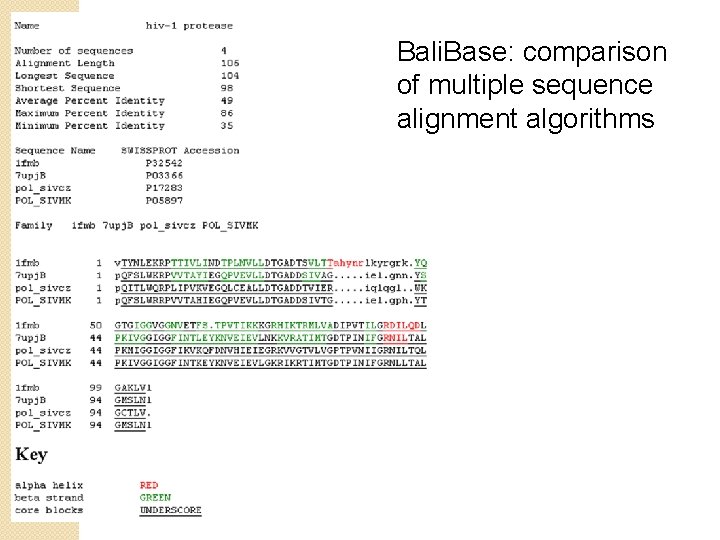
Bali. Base: comparison of multiple sequence alignment algorithms
Multiple sequence alignment: methods Benchmarking tests suggest that Prob. Cons, a consistency-based/progressive algorithm, performs the best on the BAli. BASE set, although MUSCLE, a progressive alignment package, is an extremely fast and accurate program. Clustal. W has been the most popular program. It has a nice interface (especially with Clustal. X) and is easy to use. But several programs perform better. There is no one single best program to use, and your answers will certainly differ (especially if you align divergent protein or DNA sequences)
Outline: multiple sequence alignment (MSA) Introduction; definition of MSA; typical uses Five main approaches to multiple sequence alignment Exact approaches Progressive sequence alignment Iterative approaches Consistency-based approaches Structure-based methods Benchmarking studies: approaches, findings, challenges Databases of Multiple Sequence Alignments Pfam: Protein Family Database of Profile HMMs SMART Conserved Domain Database Integrated multiple sequence alignment resources MSA database curation: manual versus automated Multiple sequence alignments of genomic regions UCSC, Galaxy, Ensembl, alignathon Perspective
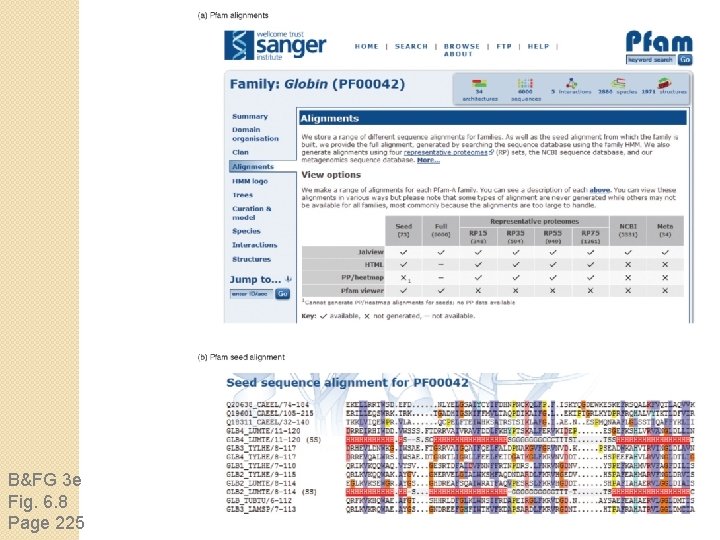
B&FG 3 e Fig. 6. 8 Page 225
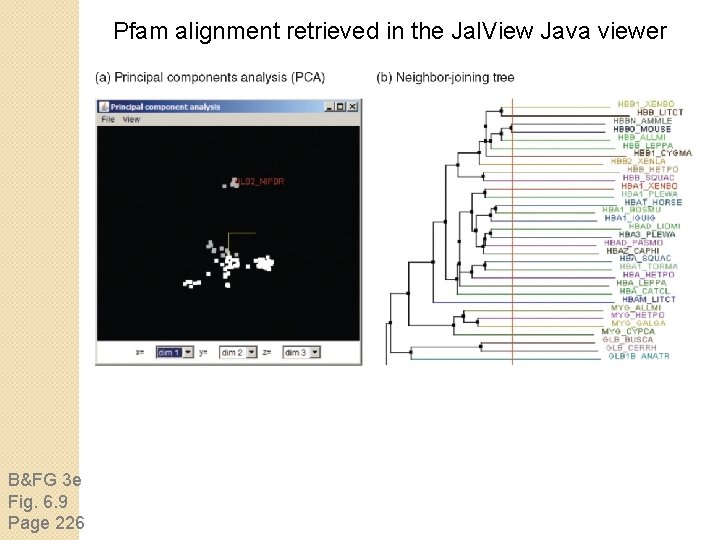
Pfam alignment retrieved in the Jal. View Java viewer B&FG 3 e Fig. 6. 9 Page 226
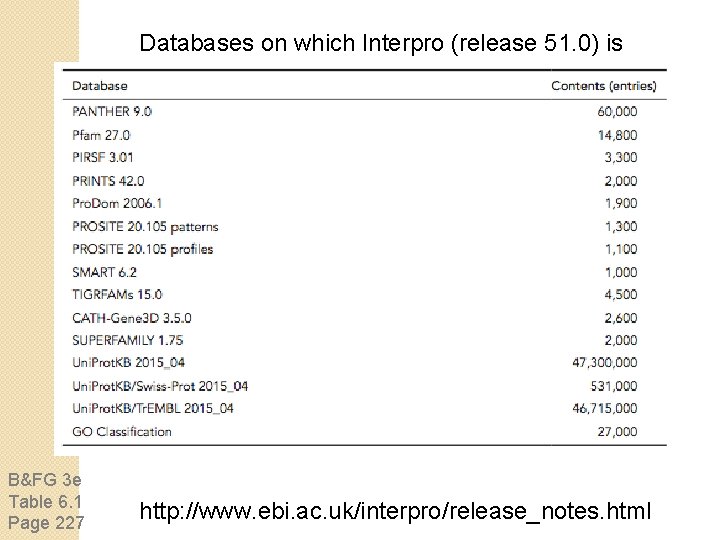
Databases on which Interpro (release 51. 0) is based B&FG 3 e Table 6. 1 Page 227 http: //www. ebi. ac. uk/interpro/release_notes. html
Outline: multiple sequence alignment (MSA) Introduction; definition of MSA; typical uses Five main approaches to multiple sequence alignment Exact approaches Progressive sequence alignment Iterative approaches Consistency-based approaches Structure-based methods Benchmarking studies: approaches, findings, challenges Databases of Multiple Sequence Alignments Pfam: Protein Family Database of Profile HMMs SMART Conserved Domain Database Integrated multiple sequence alignment resources MSA database curation: manual versus automated Multiple sequence alignments of genomic regions UCSC, Galaxy, Ensembl, alignathon Perspective
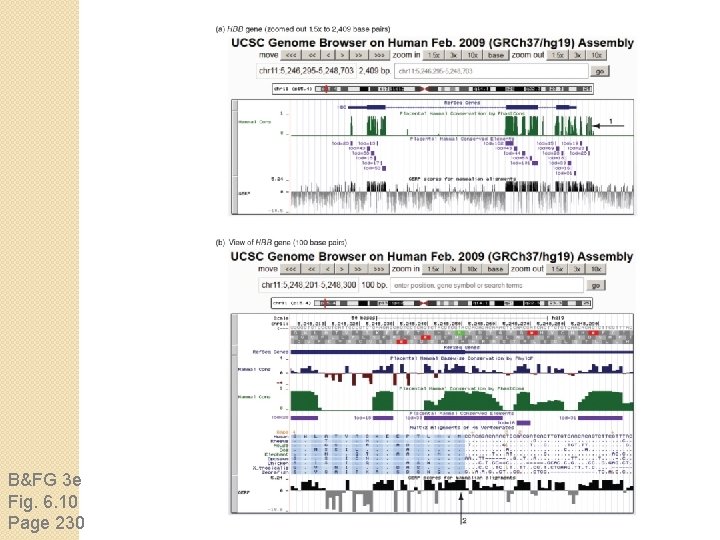
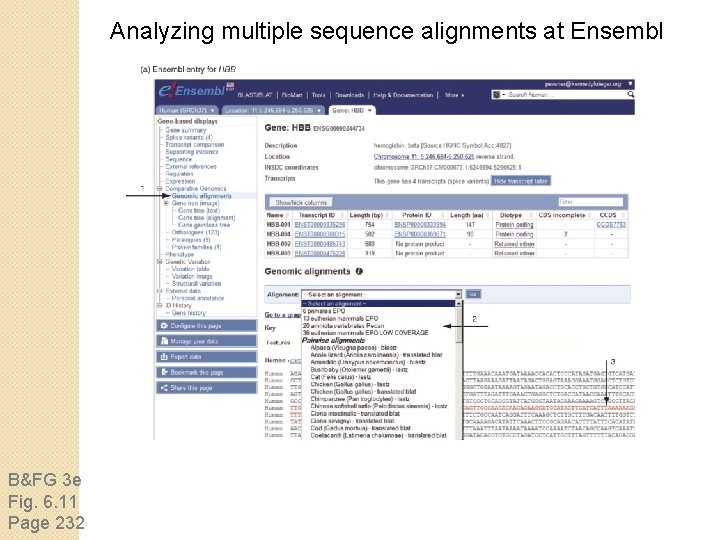
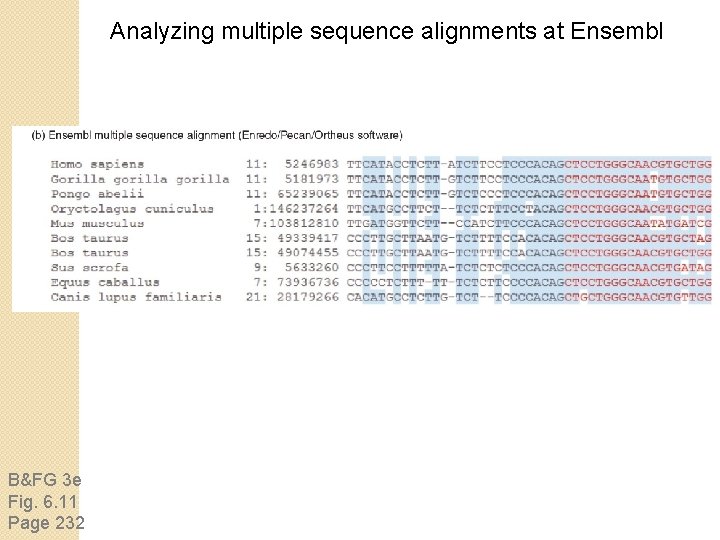
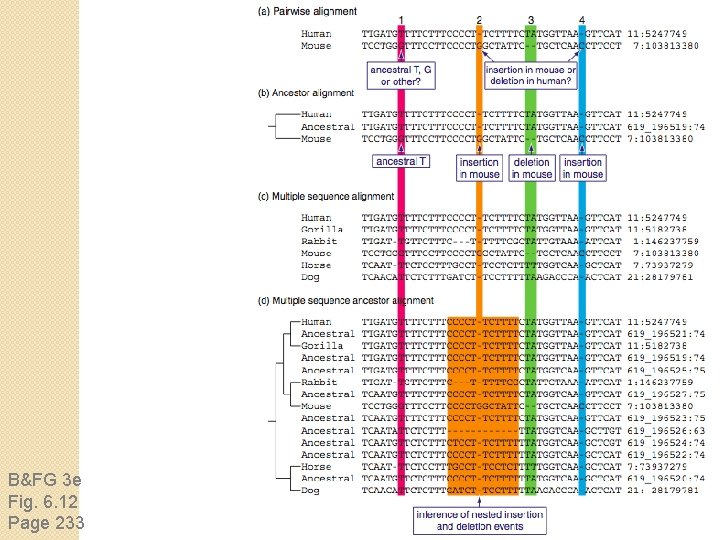
Multiple sequence alignment of genomic DNA There are typically few sequences (up to several dozen), each having up to millions of base pairs. Adding more species improves accuracy. Alignment of divergent sequences often reveals islands of conservation (providing “anchors” for alignment). Chromosomes are subject to inversions, duplications, deletions, and translocations (often involving millions of base pairs). E. g. human chromosome 2 is derived from the fusion of two acrocentric chromosomes. There are no benchmark datasets available.
B&FG 3 e Fig. 6. 10 Page 230
Analyzing multiple sequence alignments at Ensembl B&FG 3 e Fig. 6. 11 Page 232
Analyzing multiple sequence alignments at Ensembl B&FG 3 e Fig. 6. 11 Page 232
B&FG 3 e Fig. 6. 12 Page 233
Outline: multiple sequence alignment (MSA) Introduction; definition of MSA; typical uses Five main approaches to multiple sequence alignment Exact approaches Progressive sequence alignment Iterative approaches Consistency-based approaches Structure-based methods Benchmarking studies: approaches, findings, challenges Databases of Multiple Sequence Alignments Pfam: Protein Family Database of Profile HMMs SMART Conserved Domain Database Integrated multiple sequence alignment resources MSA database curation: manual versus automated Multiple sequence alignments of genomic regions UCSC, Galaxy, Ensembl, alignathon Perspective
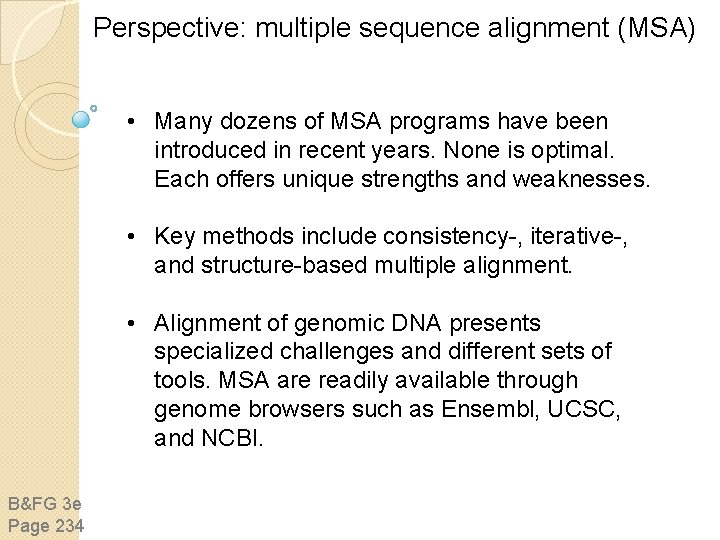
Perspective: multiple sequence alignment (MSA) • Many dozens of MSA programs have been introduced in recent years. None is optimal. Each offers unique strengths and weaknesses. • Key methods include consistency-, iterative-, and structure-based multiple alignment. • Alignment of genomic DNA presents specialized challenges and different sets of tools. MSA are readily available through genome browsers such as Ensembl, UCSC, and NCBI. B&FG 3 e Page 234