
Chapter 6 Methods Liang Introduction to Java Programming
![Ambiguous Invocation public class Ambiguous. Overloading { public static void main(String[] args) { System.](https://slidetodoc.com/presentation_image_h/0baa250851cec9e92732ce85e0be6136/image-48.jpg "Ambiguous Invocation public class Ambiguous. Overloading { public static void main(String[] args) { System.")
- Slides: 56
Chapter 6 Methods Liang, Introduction to Java Programming, Tenth Edition, (c) 2015 Pearson Education, Inc. All rights reserved. 1
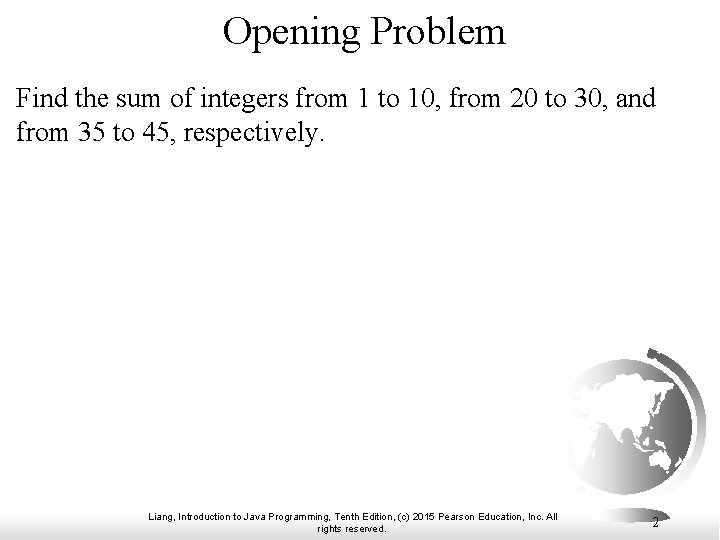
Opening Problem Find the sum of integers from 1 to 10, from 20 to 30, and from 35 to 45, respectively. Liang, Introduction to Java Programming, Tenth Edition, (c) 2015 Pearson Education, Inc. All rights reserved. 2
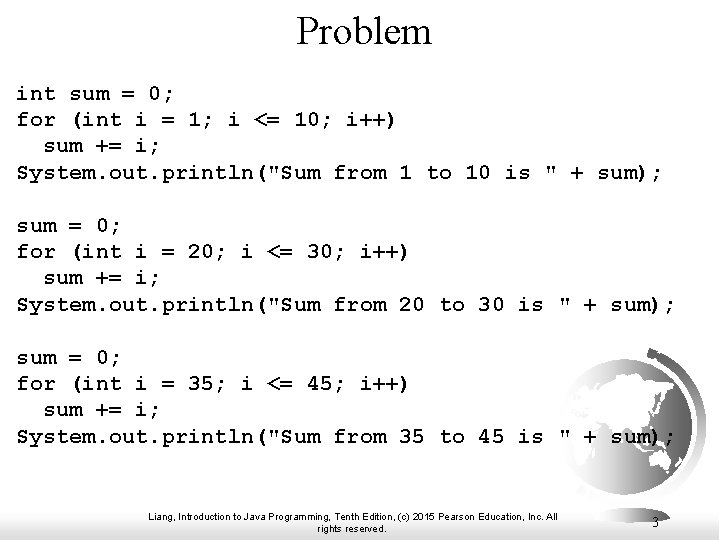
Problem int sum = 0; for (int i = 1; i <= 10; i++) sum += i; System. out. println("Sum from 1 to 10 is " + sum); sum = 0; for (int i = 20; i <= 30; i++) sum += i; System. out. println("Sum from 20 to 30 is " + sum); sum = 0; for (int i = 35; i <= 45; i++) sum += i; System. out. println("Sum from 35 to 45 is " + sum); Liang, Introduction to Java Programming, Tenth Edition, (c) 2015 Pearson Education, Inc. All rights reserved. 3
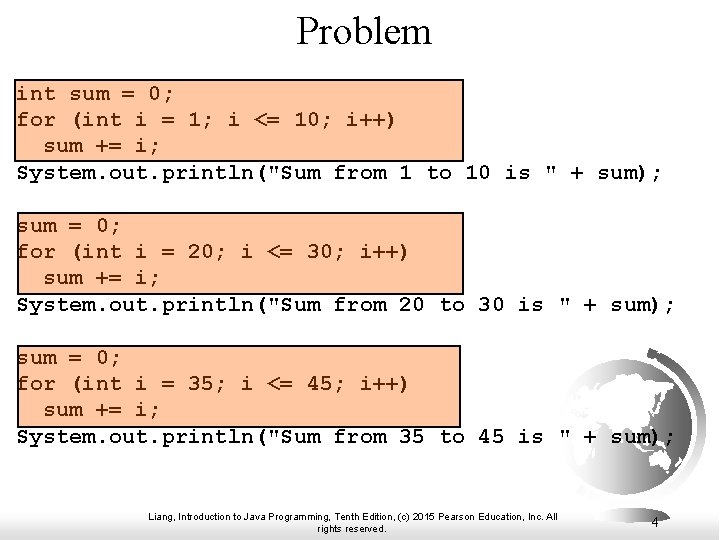
Problem int sum = 0; for (int i = 1; i <= 10; i++) sum += i; System. out. println("Sum from 1 to 10 is " + sum); sum = 0; for (int i = 20; i <= 30; i++) sum += i; System. out. println("Sum from 20 to 30 is " + sum); sum = 0; for (int i = 35; i <= 45; i++) sum += i; System. out. println("Sum from 35 to 45 is " + sum); Liang, Introduction to Java Programming, Tenth Edition, (c) 2015 Pearson Education, Inc. All rights reserved. 4
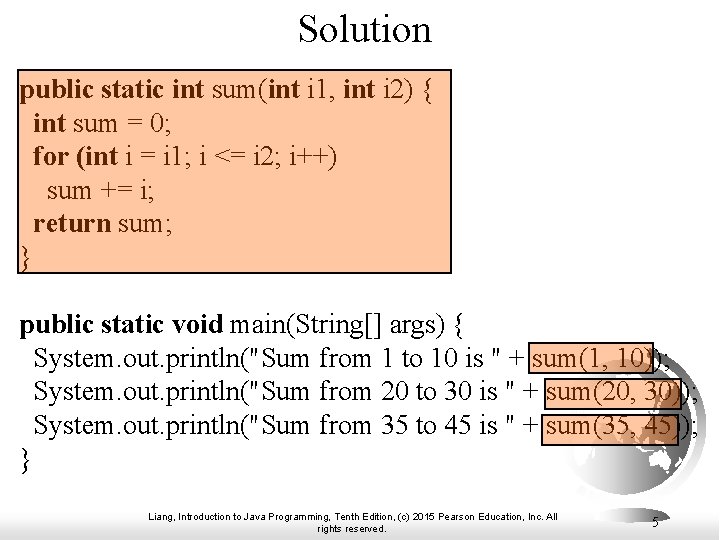
Solution public static int sum(int i 1, int i 2) { int sum = 0; for (int i = i 1; i <= i 2; i++) sum += i; return sum; } public static void main(String[] args) { System. out. println("Sum from 1 to 10 is " + sum(1, 10)); System. out. println("Sum from 20 to 30 is " + sum(20, 30)); System. out. println("Sum from 35 to 45 is " + sum(35, 45)); } Liang, Introduction to Java Programming, Tenth Edition, (c) 2015 Pearson Education, Inc. All rights reserved. 5
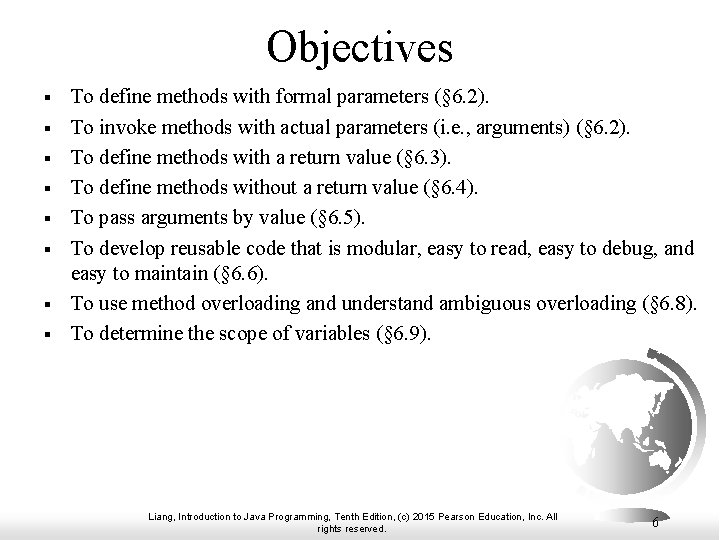
Objectives § § § § To define methods with formal parameters (§ 6. 2). To invoke methods with actual parameters (i. e. , arguments) (§ 6. 2). To define methods with a return value (§ 6. 3). To define methods without a return value (§ 6. 4). To pass arguments by value (§ 6. 5). To develop reusable code that is modular, easy to read, easy to debug, and easy to maintain (§ 6. 6). To use method overloading and understand ambiguous overloading (§ 6. 8). To determine the scope of variables (§ 6. 9). Liang, Introduction to Java Programming, Tenth Edition, (c) 2015 Pearson Education, Inc. All rights reserved. 6
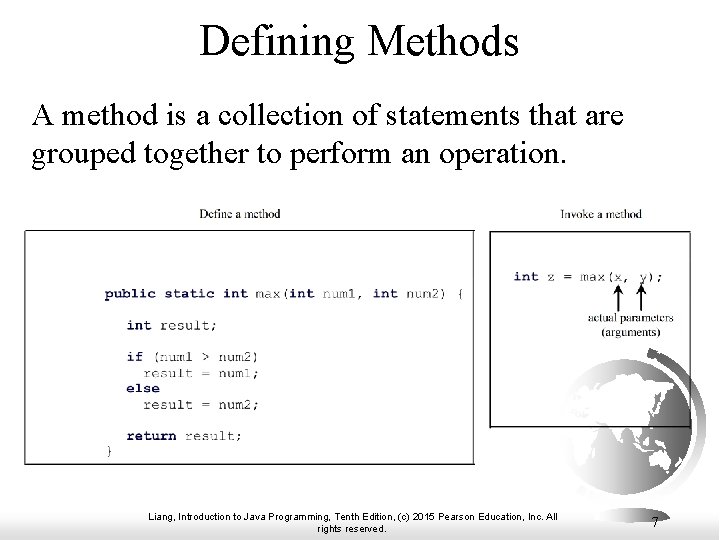
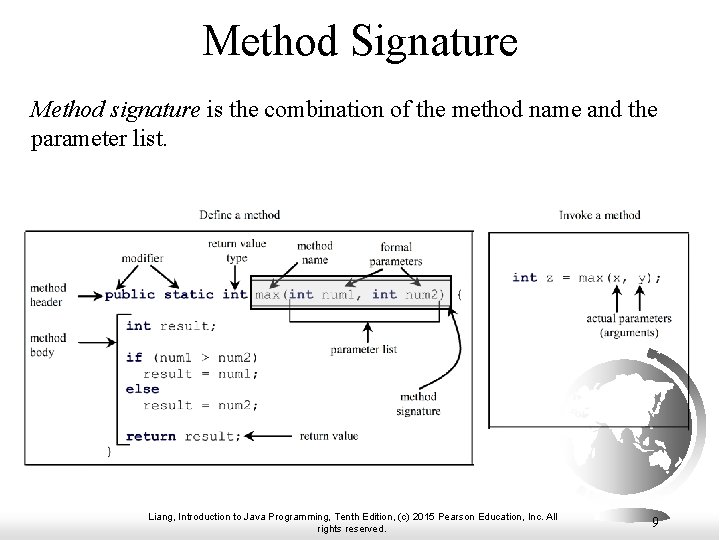
Defining Methods A method is a collection of statements that are grouped together to perform an operation. Liang, Introduction to Java Programming, Tenth Edition, (c) 2015 Pearson Education, Inc. All rights reserved. 7
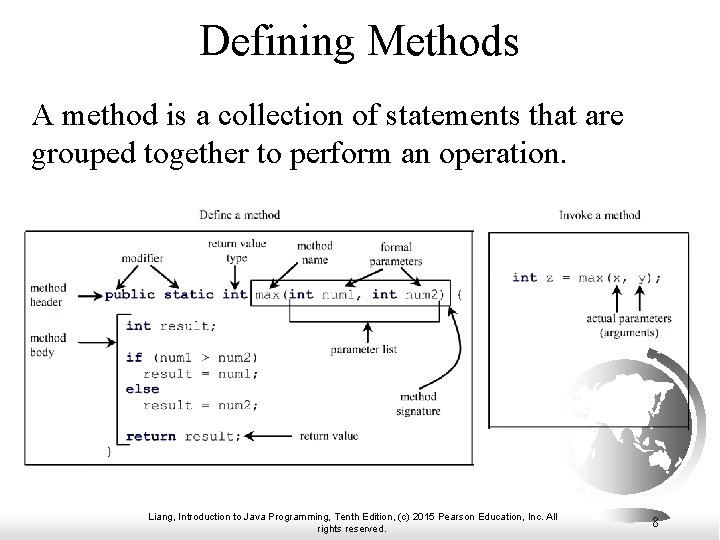
Defining Methods A method is a collection of statements that are grouped together to perform an operation. Liang, Introduction to Java Programming, Tenth Edition, (c) 2015 Pearson Education, Inc. All rights reserved. 8
Method Signature Method signature is the combination of the method name and the parameter list. Liang, Introduction to Java Programming, Tenth Edition, (c) 2015 Pearson Education, Inc. All rights reserved. 9
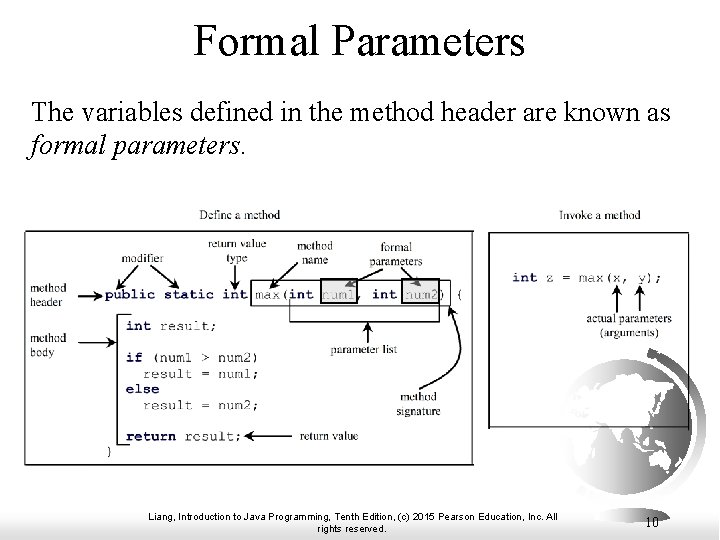
Formal Parameters The variables defined in the method header are known as formal parameters. Liang, Introduction to Java Programming, Tenth Edition, (c) 2015 Pearson Education, Inc. All rights reserved. 10
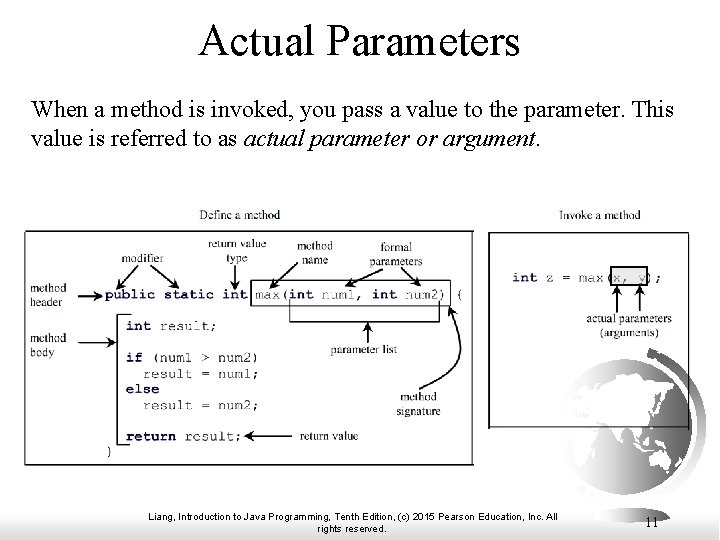
Actual Parameters When a method is invoked, you pass a value to the parameter. This value is referred to as actual parameter or argument. Liang, Introduction to Java Programming, Tenth Edition, (c) 2015 Pearson Education, Inc. All rights reserved. 11
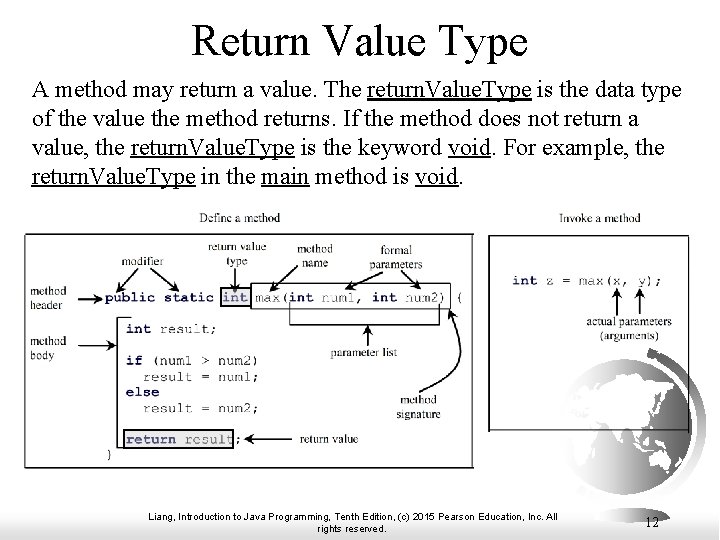
Return Value Type A method may return a value. The return. Value. Type is the data type of the value the method returns. If the method does not return a value, the return. Value. Type is the keyword void. For example, the return. Value. Type in the main method is void. Liang, Introduction to Java Programming, Tenth Edition, (c) 2015 Pearson Education, Inc. All rights reserved. 12
Calling Methods Testing the max method This program demonstrates calling a method max to return the largest of the int values Test. Max Run Liang, Introduction to Java Programming, Tenth Edition, (c) 2015 Pearson Education, Inc. All rights reserved. 13
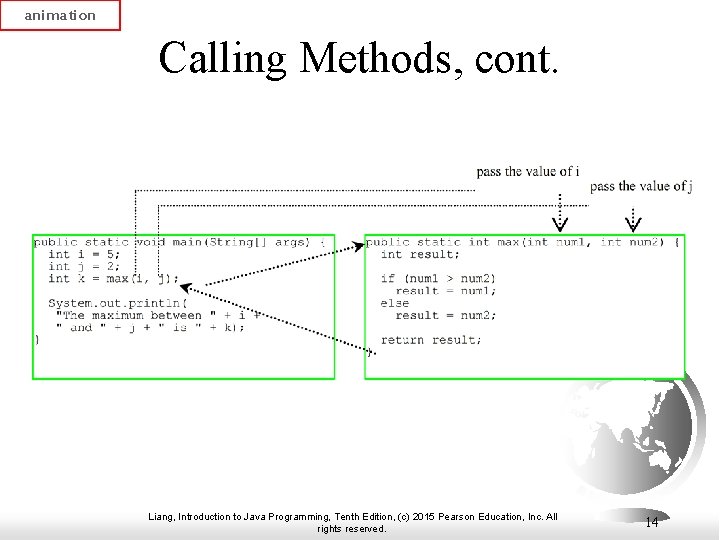
animation Calling Methods, cont. Liang, Introduction to Java Programming, Tenth Edition, (c) 2015 Pearson Education, Inc. All rights reserved. 14
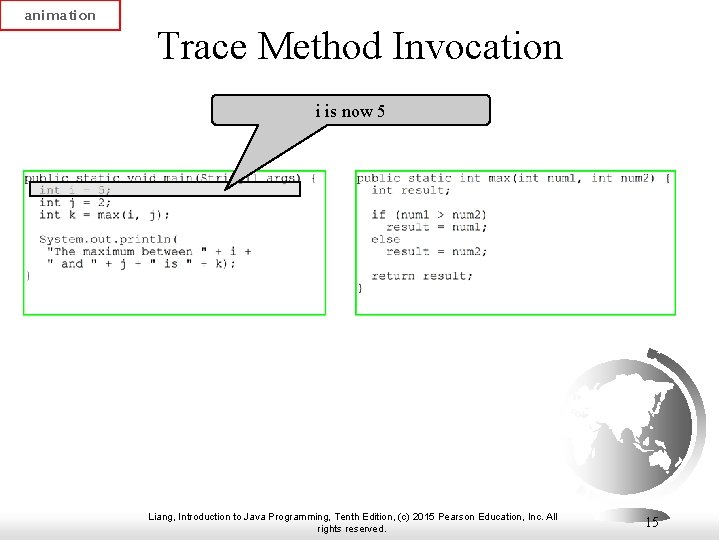
animation Trace Method Invocation i is now 5 Liang, Introduction to Java Programming, Tenth Edition, (c) 2015 Pearson Education, Inc. All rights reserved. 15
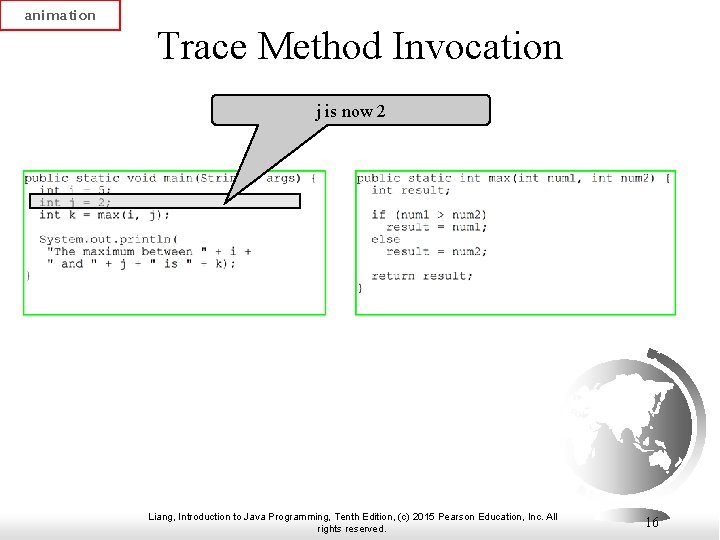
animation Trace Method Invocation j is now 2 Liang, Introduction to Java Programming, Tenth Edition, (c) 2015 Pearson Education, Inc. All rights reserved. 16
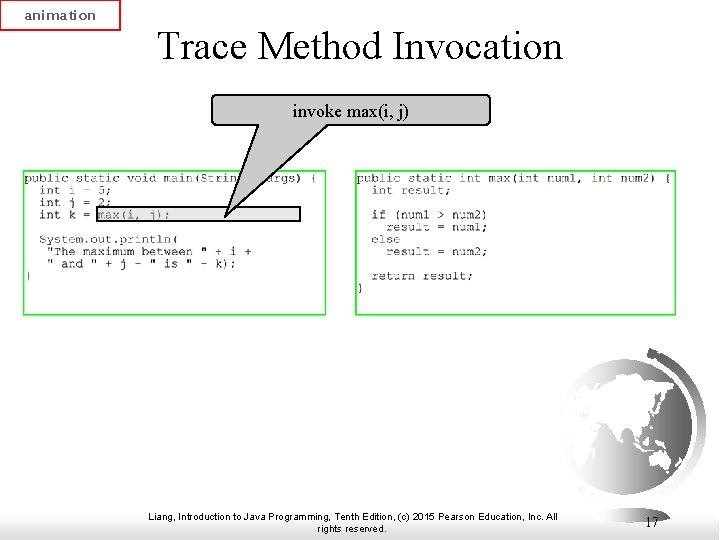
animation Trace Method Invocation invoke max(i, j) Liang, Introduction to Java Programming, Tenth Edition, (c) 2015 Pearson Education, Inc. All rights reserved. 17
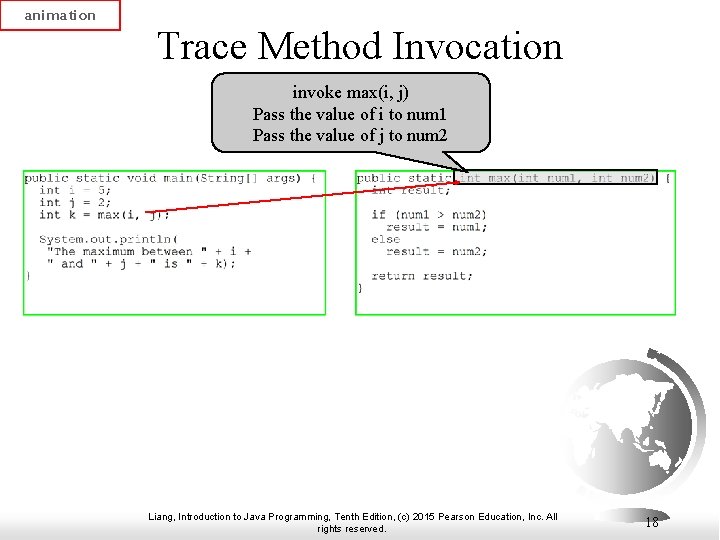
animation Trace Method Invocation invoke max(i, j) Pass the value of i to num 1 Pass the value of j to num 2 Liang, Introduction to Java Programming, Tenth Edition, (c) 2015 Pearson Education, Inc. All rights reserved. 18
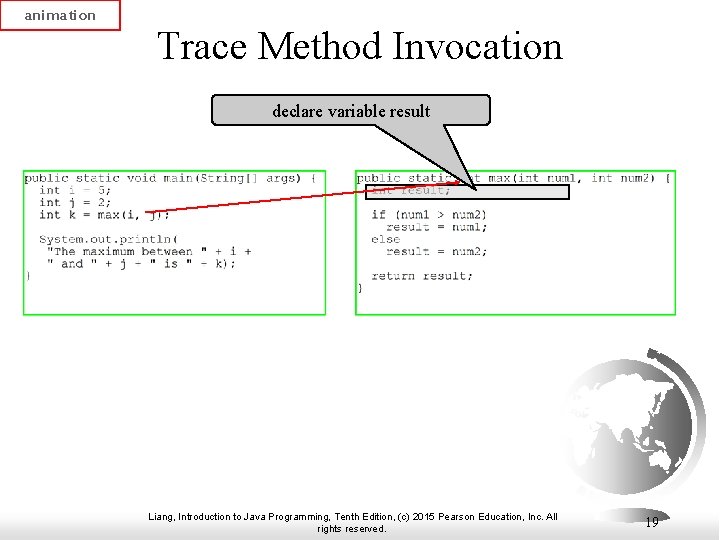
animation Trace Method Invocation declare variable result Liang, Introduction to Java Programming, Tenth Edition, (c) 2015 Pearson Education, Inc. All rights reserved. 19
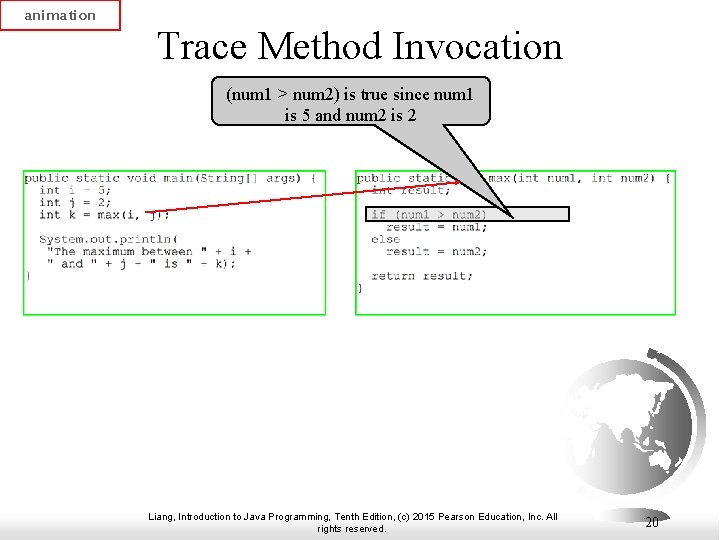
animation Trace Method Invocation (num 1 > num 2) is true since num 1 is 5 and num 2 is 2 Liang, Introduction to Java Programming, Tenth Edition, (c) 2015 Pearson Education, Inc. All rights reserved. 20
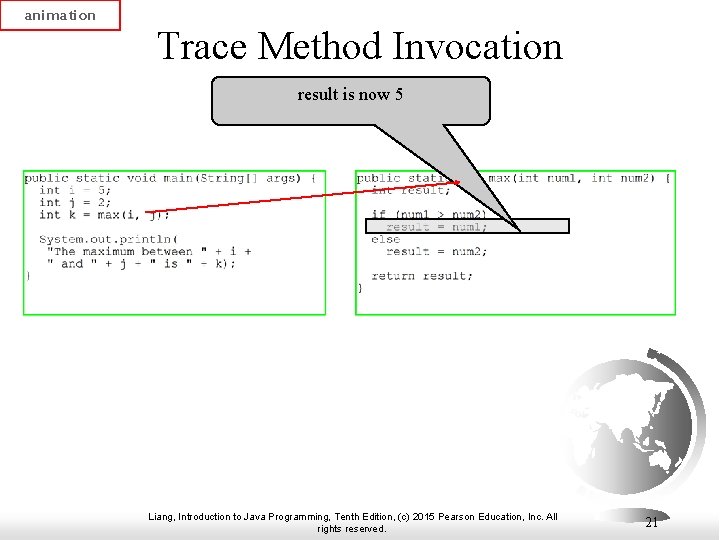
animation Trace Method Invocation result is now 5 Liang, Introduction to Java Programming, Tenth Edition, (c) 2015 Pearson Education, Inc. All rights reserved. 21
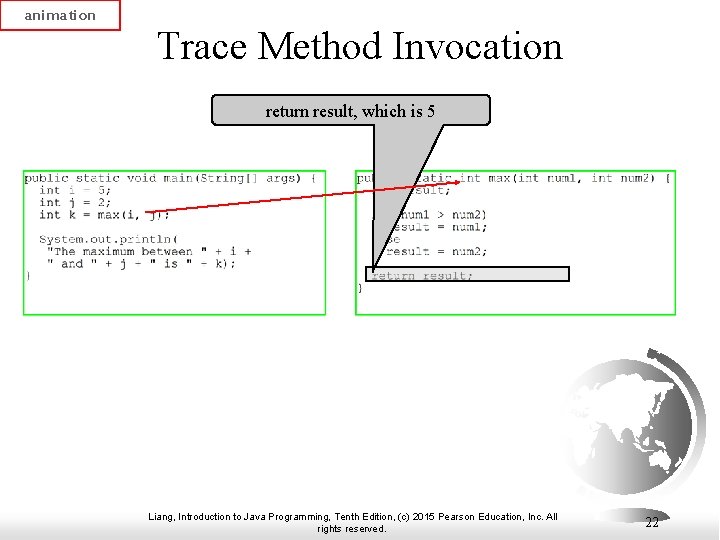
animation Trace Method Invocation return result, which is 5 Liang, Introduction to Java Programming, Tenth Edition, (c) 2015 Pearson Education, Inc. All rights reserved. 22
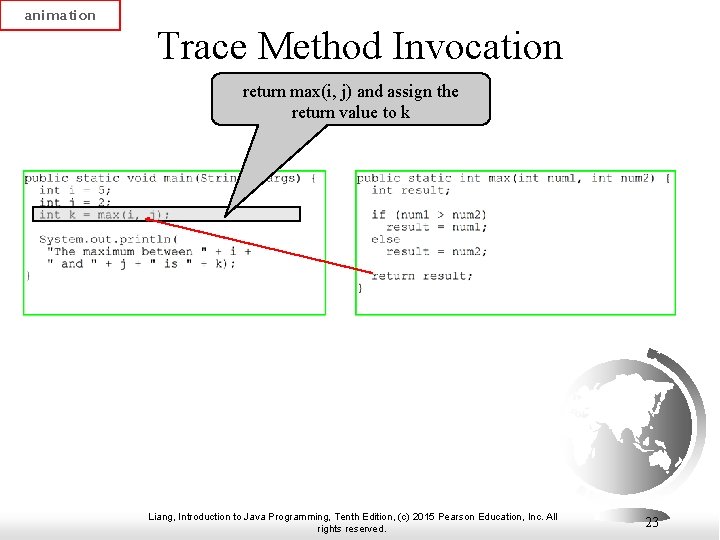
animation Trace Method Invocation return max(i, j) and assign the return value to k Liang, Introduction to Java Programming, Tenth Edition, (c) 2015 Pearson Education, Inc. All rights reserved. 23
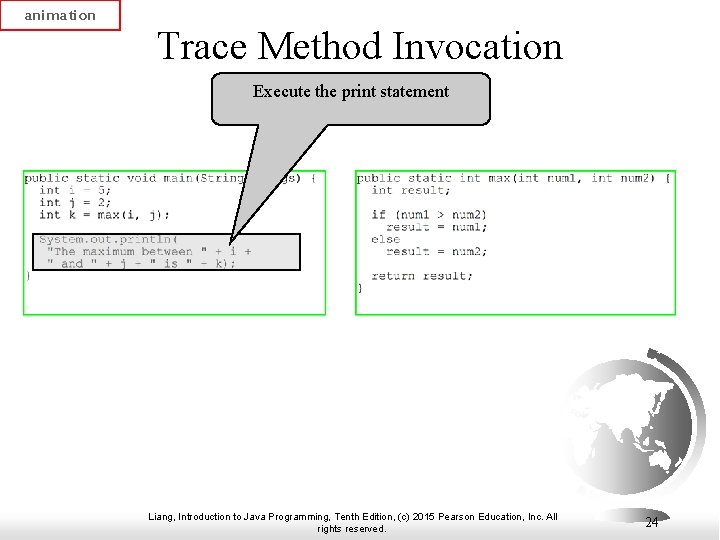
animation Trace Method Invocation Execute the print statement Liang, Introduction to Java Programming, Tenth Edition, (c) 2015 Pearson Education, Inc. All rights reserved. 24
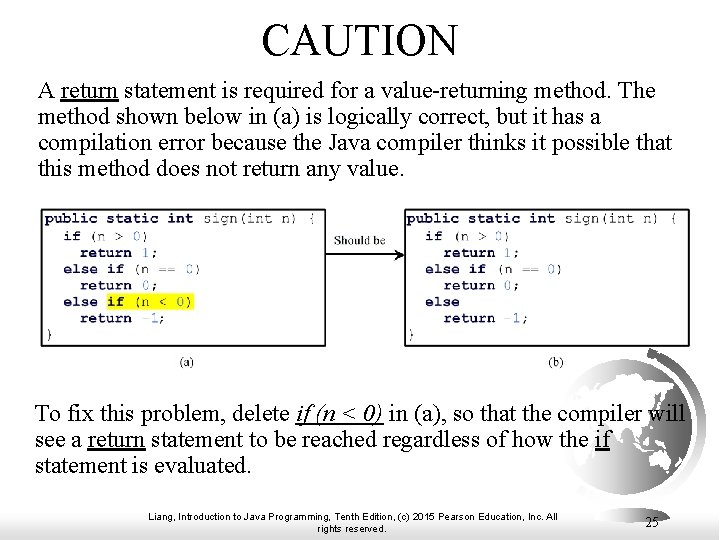
CAUTION A return statement is required for a value-returning method. The method shown below in (a) is logically correct, but it has a compilation error because the Java compiler thinks it possible that this method does not return any value. To fix this problem, delete if (n < 0) in (a), so that the compiler will see a return statement to be reached regardless of how the if statement is evaluated. Liang, Introduction to Java Programming, Tenth Edition, (c) 2015 Pearson Education, Inc. All rights reserved. 25
Reuse Methods from Other Classes NOTE: One of the benefits of methods is for reuse. The max method can be invoked from any class besides Test. Max. If you create a new class Test, you can invoke the max method using Class. Name. method. Name (e. g. , Test. Max. max). Liang, Introduction to Java Programming, Tenth Edition, (c) 2015 Pearson Education, Inc. All rights reserved. 26
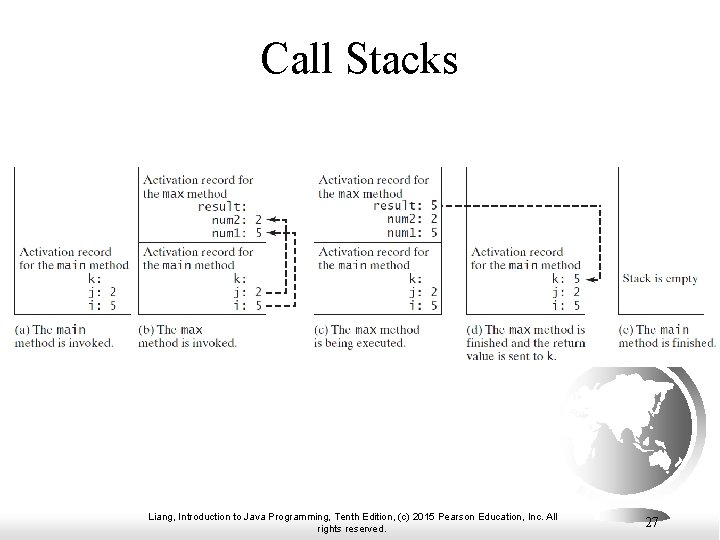
Call Stacks Liang, Introduction to Java Programming, Tenth Edition, (c) 2015 Pearson Education, Inc. All rights reserved. 27
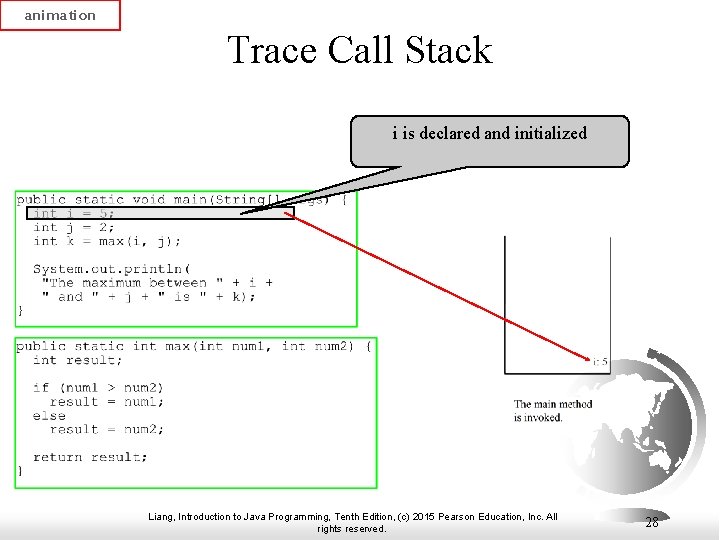
animation Trace Call Stack i is declared and initialized Liang, Introduction to Java Programming, Tenth Edition, (c) 2015 Pearson Education, Inc. All rights reserved. 28
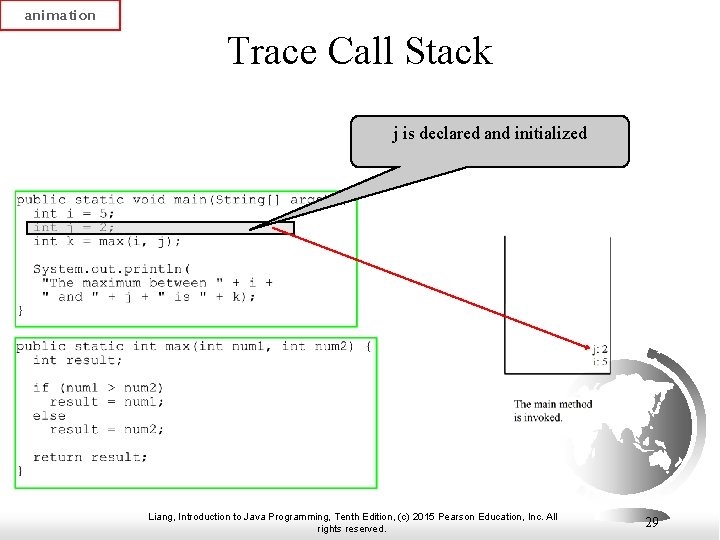
animation Trace Call Stack j is declared and initialized Liang, Introduction to Java Programming, Tenth Edition, (c) 2015 Pearson Education, Inc. All rights reserved. 29
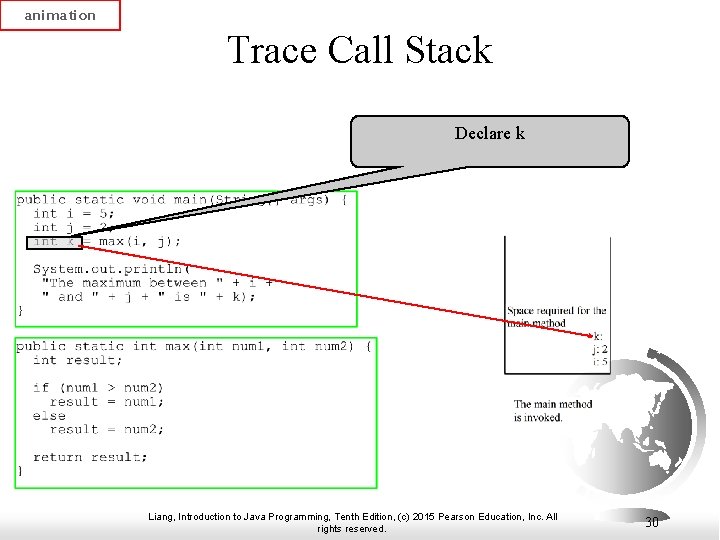
animation Trace Call Stack Declare k Liang, Introduction to Java Programming, Tenth Edition, (c) 2015 Pearson Education, Inc. All rights reserved. 30
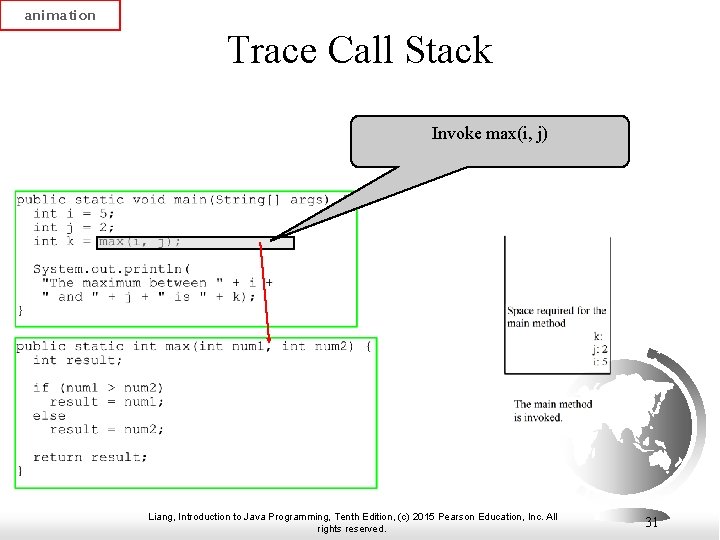
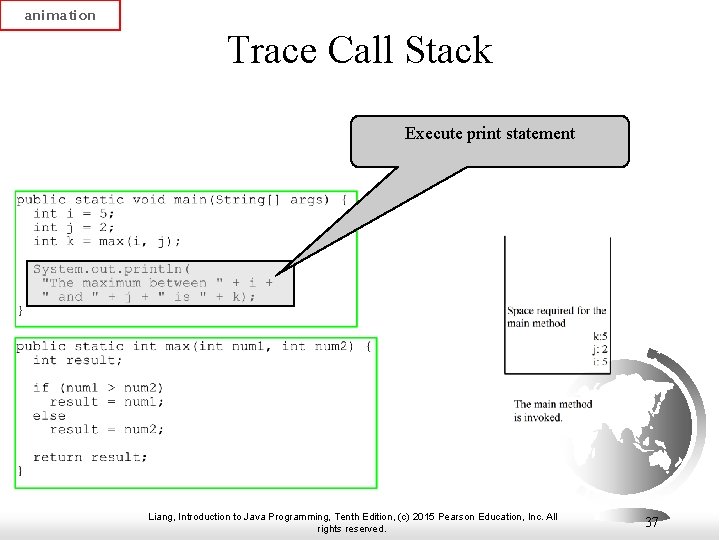
animation Trace Call Stack Invoke max(i, j) Liang, Introduction to Java Programming, Tenth Edition, (c) 2015 Pearson Education, Inc. All rights reserved. 31
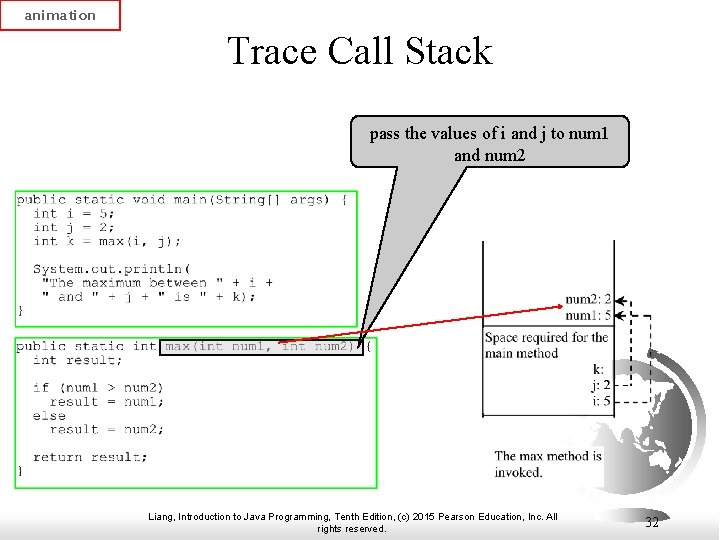
animation Trace Call Stack pass the values of i and j to num 1 and num 2 Liang, Introduction to Java Programming, Tenth Edition, (c) 2015 Pearson Education, Inc. All rights reserved. 32
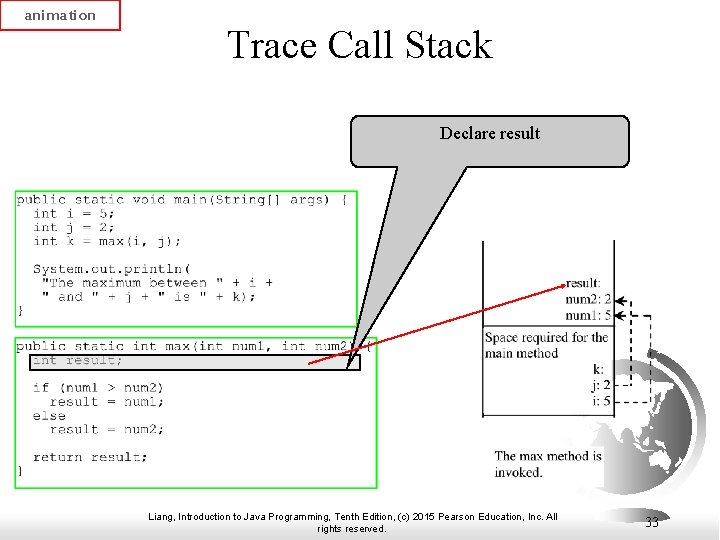
animation Trace Call Stack Declare result Liang, Introduction to Java Programming, Tenth Edition, (c) 2015 Pearson Education, Inc. All rights reserved. 33
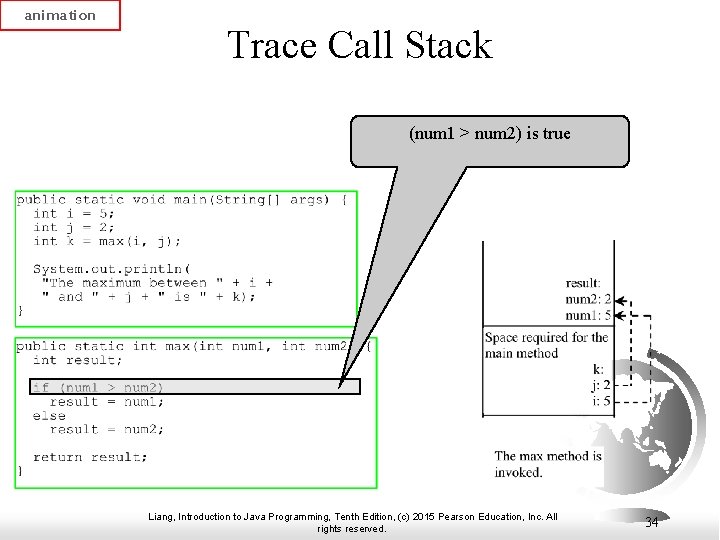
animation Trace Call Stack (num 1 > num 2) is true Liang, Introduction to Java Programming, Tenth Edition, (c) 2015 Pearson Education, Inc. All rights reserved. 34
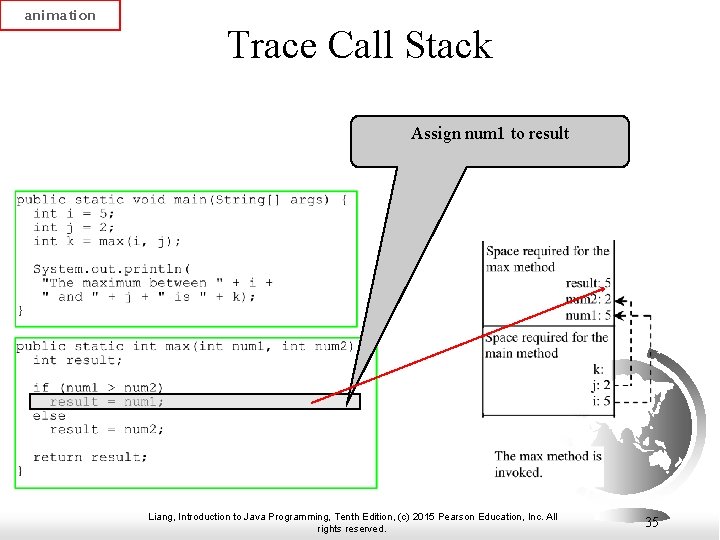
animation Trace Call Stack Assign num 1 to result Liang, Introduction to Java Programming, Tenth Edition, (c) 2015 Pearson Education, Inc. All rights reserved. 35
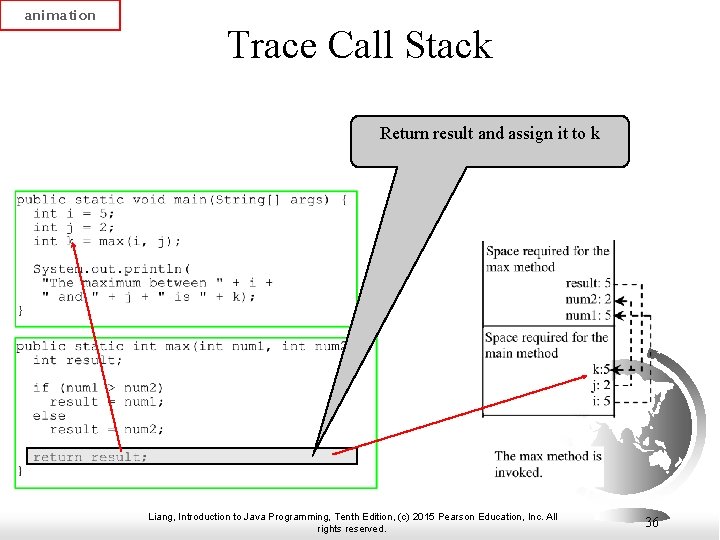
animation Trace Call Stack Return result and assign it to k Liang, Introduction to Java Programming, Tenth Edition, (c) 2015 Pearson Education, Inc. All rights reserved. 36
animation Trace Call Stack Execute print statement Liang, Introduction to Java Programming, Tenth Edition, (c) 2015 Pearson Education, Inc. All rights reserved. 37
void Method Example This type of method does not return a value. The method performs some actions. Test. Void. Method Test. Return. Grade. Method Run Liang, Introduction to Java Programming, Tenth Edition, (c) 2015 Pearson Education, Inc. All rights reserved. 38
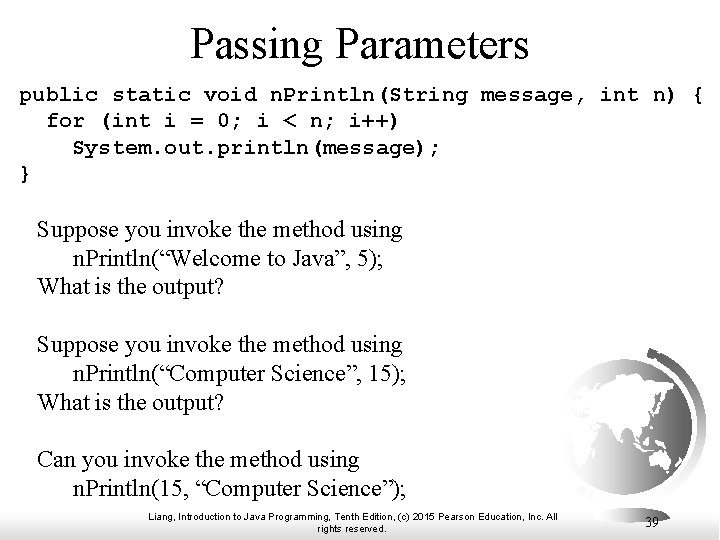
Passing Parameters public static void n. Println(String message, int n) { for (int i = 0; i < n; i++) System. out. println(message); } Suppose you invoke the method using n. Println(“Welcome to Java”, 5); What is the output? Suppose you invoke the method using n. Println(“Computer Science”, 15); What is the output? Can you invoke the method using n. Println(15, “Computer Science”); Liang, Introduction to Java Programming, Tenth Edition, (c) 2015 Pearson Education, Inc. All rights reserved. 39
Pass by Value This program demonstrates passing values to the methods. Increment Run Liang, Introduction to Java Programming, Tenth Edition, (c) 2015 Pearson Education, Inc. All rights reserved. 40
Pass by Value Testing Pass by value This program demonstrates passing values to the methods. Test. Pass. By. Value Run Liang, Introduction to Java Programming, Tenth Edition, (c) 2015 Pearson Education, Inc. All rights reserved. 41
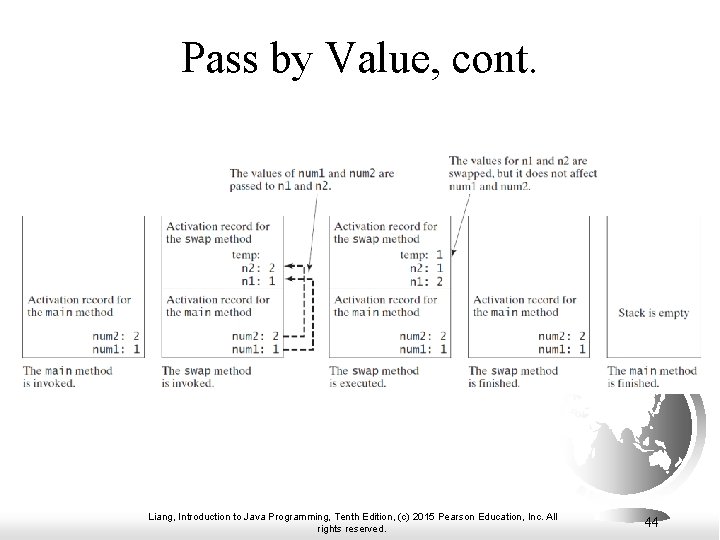
Pass by Value It means that the value of the actual parameter (when a variable) is copied into the formal parameter. Whatever changes made to the formal parameter are local to the method and do not affect/change the value of the actual parameter. Classic example: The Swap method. 42 Liang, Introduction to Java Programming, Tenth Edition, (c) 2015 Pearson Education, Inc. All rights reserved.
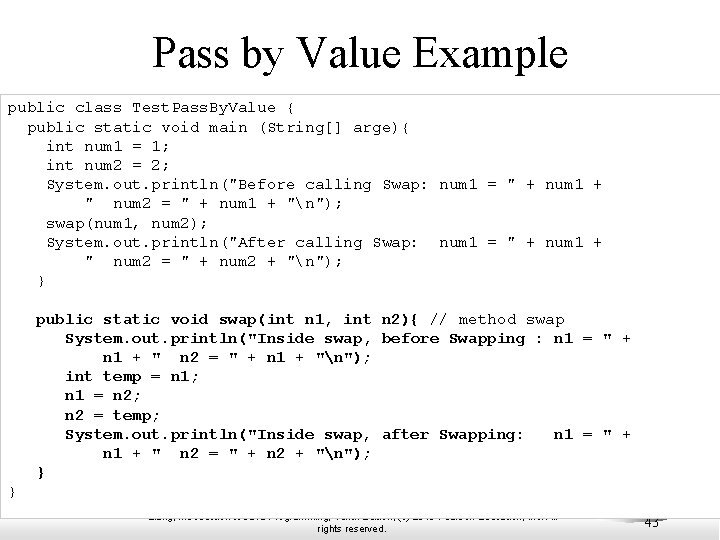
Pass by Value Example public class Test. Pass. By. Value { public static void main (String[] arge){ int num 1 = 1; int num 2 = 2; System. out. println("Before calling Swap: num 1 = " + num 1 + " num 2 = " + num 1 + "n"); swap(num 1, num 2); System. out. println("After calling Swap: num 1 = " + num 1 + " num 2 = " + num 2 + "n"); } public static void swap(int n 1, int n 2){ // method swap System. out. println("Inside swap, before Swapping : n 1 = " + n 1 + " n 2 = " + n 1 + "n"); int temp = n 1; n 1 = n 2; n 2 = temp; System. out. println("Inside swap, after Swapping: n 1 = " + n 1 + " n 2 = " + n 2 + "n"); } } Liang, Introduction to Java Programming, Tenth Edition, (c) 2015 Pearson Education, Inc. All rights reserved. 43
Pass by Value, cont. Liang, Introduction to Java Programming, Tenth Edition, (c) 2015 Pearson Education, Inc. All rights reserved. 44
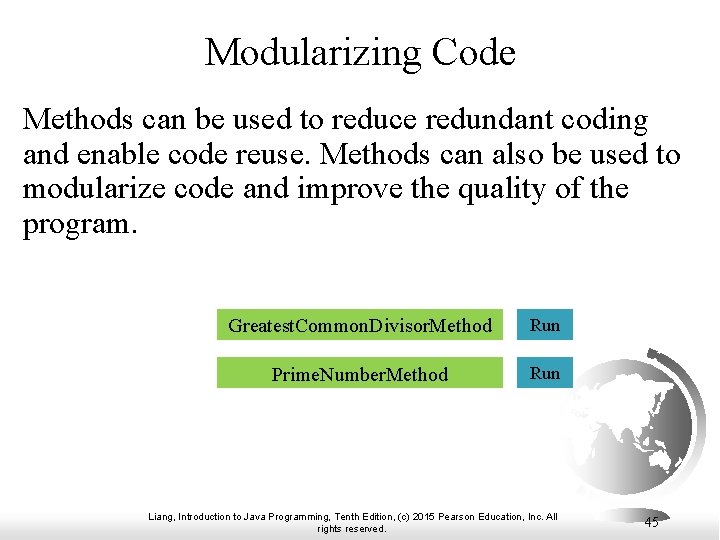
Modularizing Code Methods can be used to reduce redundant coding and enable code reuse. Methods can also be used to modularize code and improve the quality of the program. Greatest. Common. Divisor. Method Run Prime. Number. Method Run Liang, Introduction to Java Programming, Tenth Edition, (c) 2015 Pearson Education, Inc. All rights reserved. 45
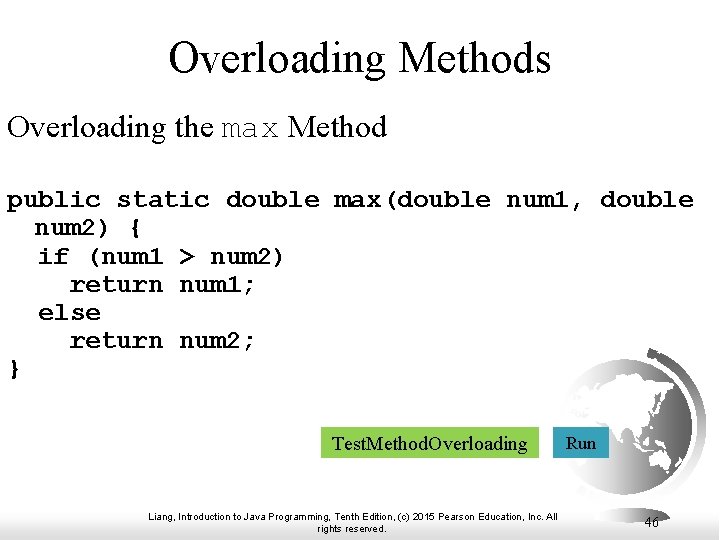
Overloading Methods Overloading the max Method public static double max(double num 1, double num 2) { if (num 1 > num 2) return num 1; else return num 2; } Test. Method. Overloading Liang, Introduction to Java Programming, Tenth Edition, (c) 2015 Pearson Education, Inc. All rights reserved. Run 46
Ambiguous Invocation Sometimes there may be two or more possible matches for an invocation of a method, but the compiler cannot determine the most specific match. This is referred to as ambiguous invocation. Ambiguous invocation is a compile error. Liang, Introduction to Java Programming, Tenth Edition, (c) 2015 Pearson Education, Inc. All rights reserved. 47
Ambiguous Invocation public class Ambiguous. Overloading { public static void main(String[] args) { System. out. println(max(1, 2)); } public static double max(int num 1, double num 2) { if (num 1 > num 2) return num 1; else return num 2; } public static double max(double num 1, int num 2) { if (num 1 > num 2) return num 1; else return num 2; } } Liang, Introduction to Java Programming, Tenth Edition, (c) 2015 Pearson Education, Inc. All rights reserved. 48
Scope of Local Variables A local variable: a variable defined inside a method. Scope: the part of the program where the variable can be referenced. The scope of a local variable starts from its declaration and continues to the end of the block that contains the variable. A local variable must be declared before it can be used. Liang, Introduction to Java Programming, Tenth Edition, (c) 2015 Pearson Education, Inc. All rights reserved. 49
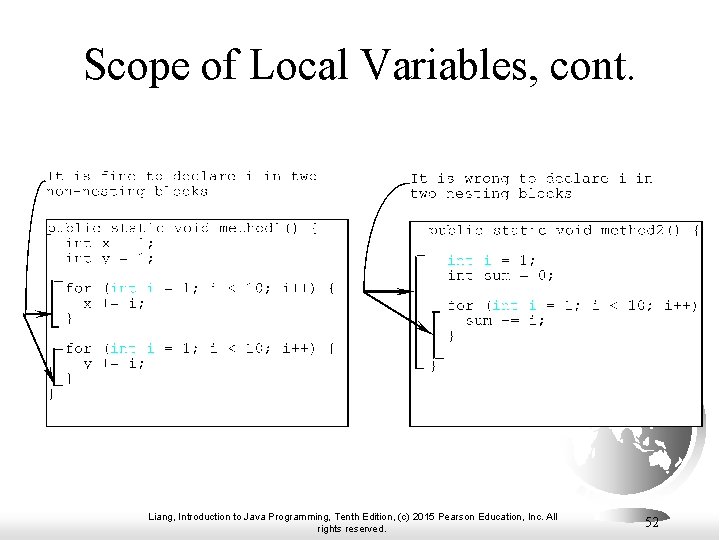
Scope of Local Variables, cont. You can declare a local variable with the same name multiple times in different nonnesting blocks in a method, but you cannot declare a local variable twice in nested blocks. Liang, Introduction to Java Programming, Tenth Edition, (c) 2015 Pearson Education, Inc. All rights reserved. 50
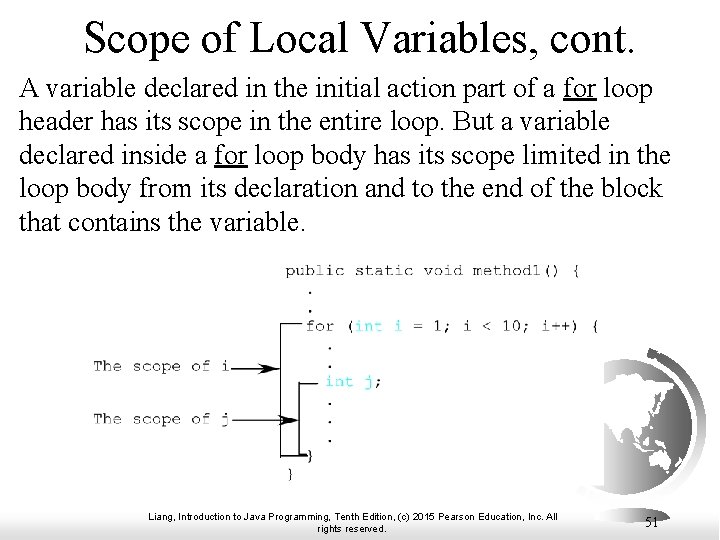
Scope of Local Variables, cont. A variable declared in the initial action part of a for loop header has its scope in the entire loop. But a variable declared inside a for loop body has its scope limited in the loop body from its declaration and to the end of the block that contains the variable. Liang, Introduction to Java Programming, Tenth Edition, (c) 2015 Pearson Education, Inc. All rights reserved. 51
Scope of Local Variables, cont. Liang, Introduction to Java Programming, Tenth Edition, (c) 2015 Pearson Education, Inc. All rights reserved. 52
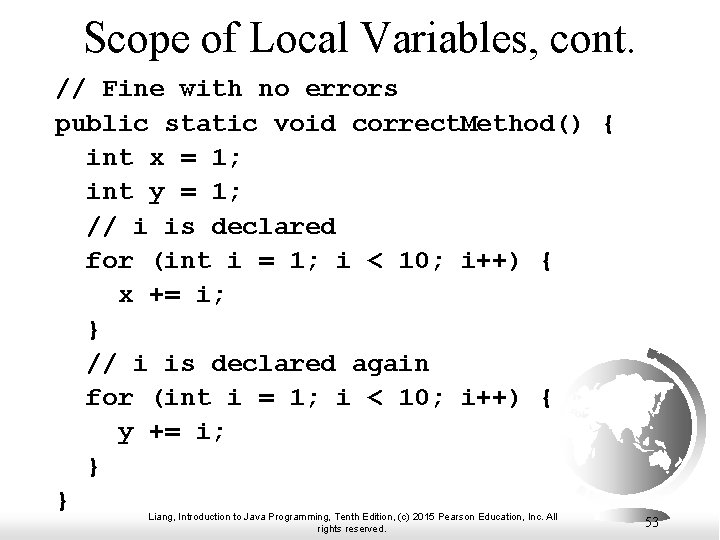
Scope of Local Variables, cont. // Fine with no errors public static void correct. Method() { int x = 1; int y = 1; // i is declared for (int i = 1; i < 10; i++) { x += i; } // i is declared again for (int i = 1; i < 10; i++) { y += i; } } Liang, Introduction to Java Programming, Tenth Edition, (c) 2015 Pearson Education, Inc. All rights reserved. 53
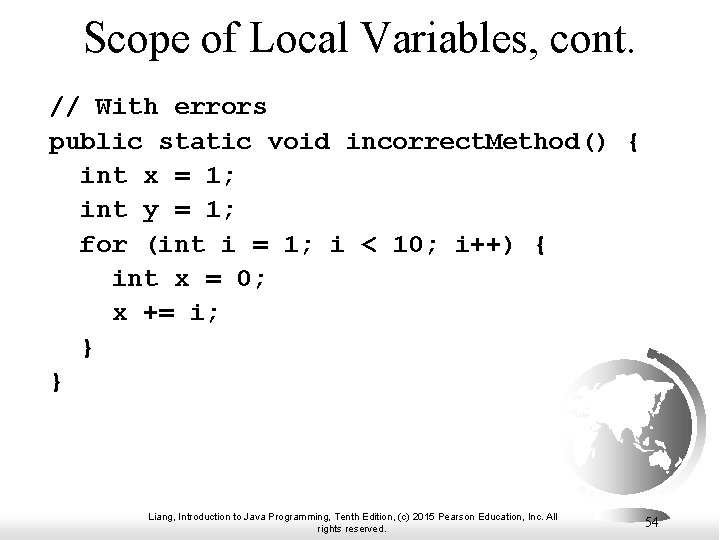
Scope of Local Variables, cont. // With errors public static void incorrect. Method() { int x = 1; int y = 1; for (int i = 1; i < 10; i++) { int x = 0; x += i; } } Liang, Introduction to Java Programming, Tenth Edition, (c) 2015 Pearson Education, Inc. All rights reserved. 54
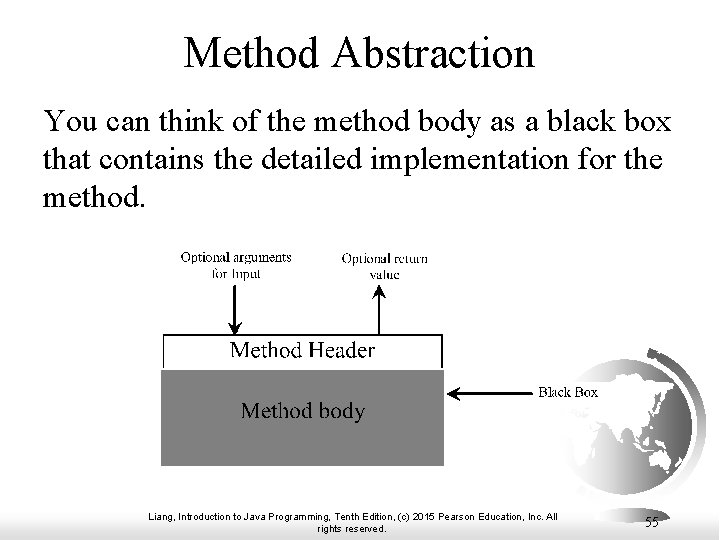
Method Abstraction You can think of the method body as a black box that contains the detailed implementation for the method. Liang, Introduction to Java Programming, Tenth Edition, (c) 2015 Pearson Education, Inc. All rights reserved. 55
Benefits of Methods • Write a method once and reuse it anywhere. • Information hiding. Hide the implementation from the user. • Reduce complexity. Liang, Introduction to Java Programming, Tenth Edition, (c) 2015 Pearson Education, Inc. All rights reserved. 56