
Chapter 6 Manipulating Polyatomic Ions and Chemical Bonding
Chapter 6 Manipulating Polyatomic Ions and Chemical Bonding

Basic Polyatomics Name Formula Hydroxide OH-1 Nitrate NO 3 -1 Ammonium NH 4+1 Phosphate PO 4 -3 Acetate C 2 H 3 O 2 -1 Chromate Cr. O 4 -2 Carbonate CO 3 -2 Dichromate Cr 2 O 7 -2 Sulfate SO 4 -2 Chlorate https: //www. youtube. com/watch? v=ml. Rh. Li c. No 8 Q Cl. O 3 -1

Ways to expand your polyatomics l Polyatomic ions vary in their charges, number of oxygen atoms, and number of hydrogen atoms. l 1. To change the number of oxygens: One more oxygen l Memorized l One less oxygen l Two less oxygens l Cl. O 4 -1 Cl. O 3 -1 Cl. O 2 -1 Cl. O-1 perchlorate chlorite hypochlorite
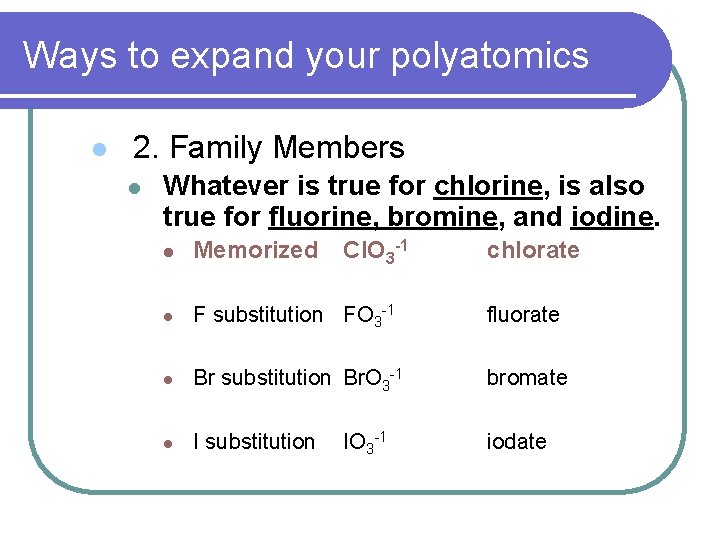
Ways to expand your polyatomics l 2. Family Members l Whatever is true for chlorine, is also true for fluorine, bromine, and iodine. l Memorized Cl. O 3 -1 l F substitution FO 3 -1 fluorate l Br substitution Br. O 3 -1 bromate l I substitution iodate IO 3 -1 chlorate
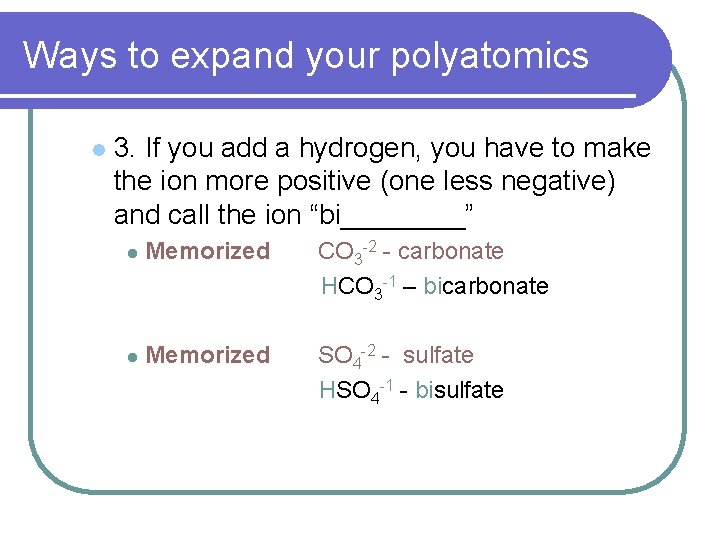
Ways to expand your polyatomics l 3. If you add a hydrogen, you have to make the ion more positive (one less negative) and call the ion “bi____” l Memorized CO 3 -2 - carbonate HCO 3 -1 – bicarbonate l Memorized SO 4 -2 - sulfate HSO 4 -1 - bisulfate
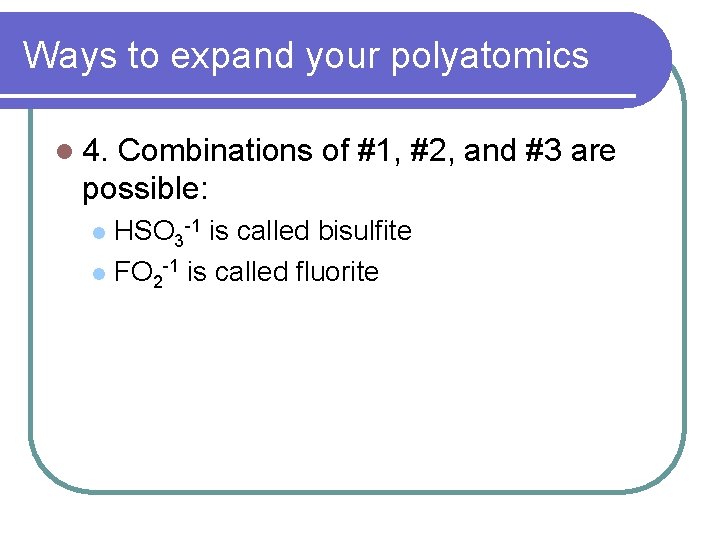
Ways to expand your polyatomics l 4. Combinations of #1, #2, and #3 are possible: HSO 3 -1 is called bisulfite l FO 2 -1 is called fluorite l
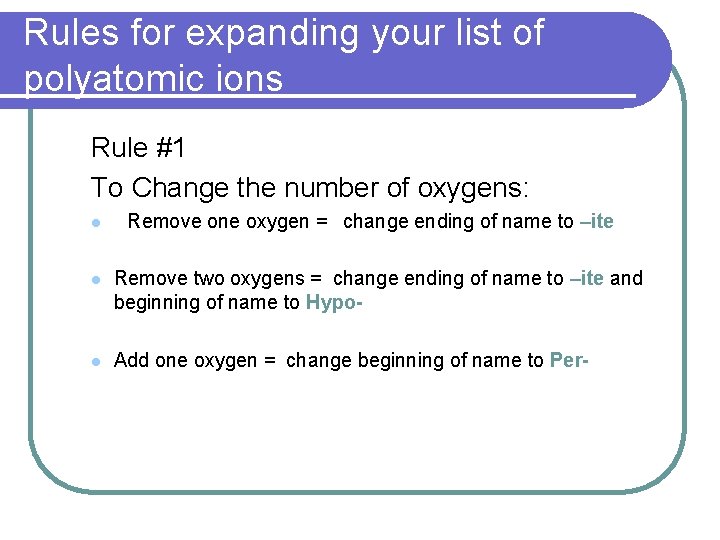
Rules for expanding your list of polyatomic ions Rule #1 To Change the number of oxygens: l Remove one oxygen = change ending of name to –ite l Remove two oxygens = change ending of name to –ite and beginning of name to Hypo- l Add one oxygen = change beginning of name to Per-
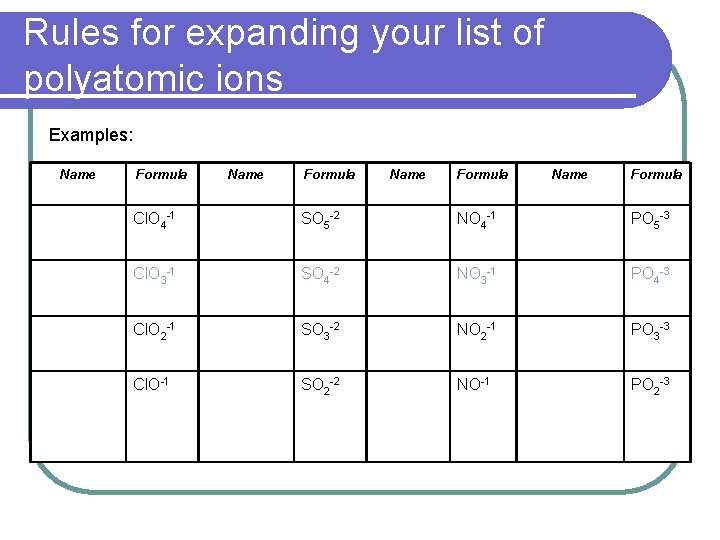
Rules for expanding your list of polyatomic ions Examples: Name Formula Cl. O 4 -1 SO 5 -2 NO 4 -1 PO 5 -3 Cl. O 3 -1 SO 4 -2 NO 3 -1 PO 4 -3 Cl. O 2 -1 SO 3 -2 NO 2 -1 PO 3 -3 Cl. O-1 SO 2 -2 NO-1 PO 2 -3
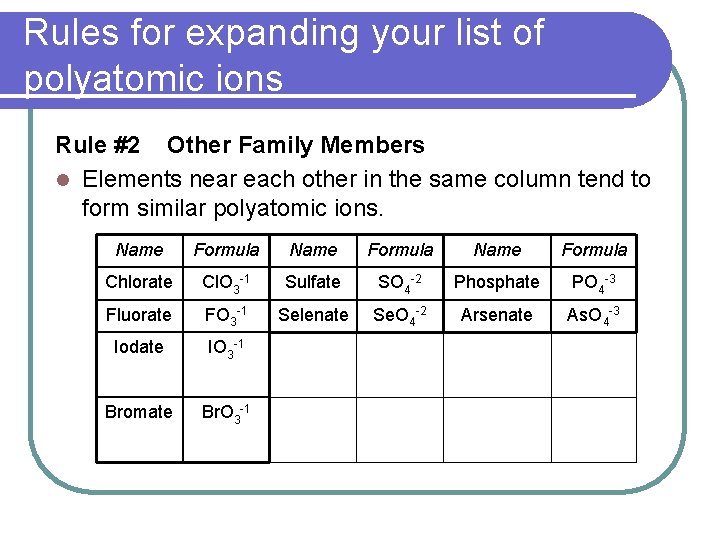
Rules for expanding your list of polyatomic ions Rule #2 Other Family Members l Elements near each other in the same column tend to form similar polyatomic ions. Name Formula Chlorate Cl. O 3 -1 Sulfate SO 4 -2 Phosphate PO 4 -3 Fluorate FO 3 -1 Selenate Se. O 4 -2 Arsenate As. O 4 -3 Iodate IO 3 -1 Bromate Br. O 3 -1
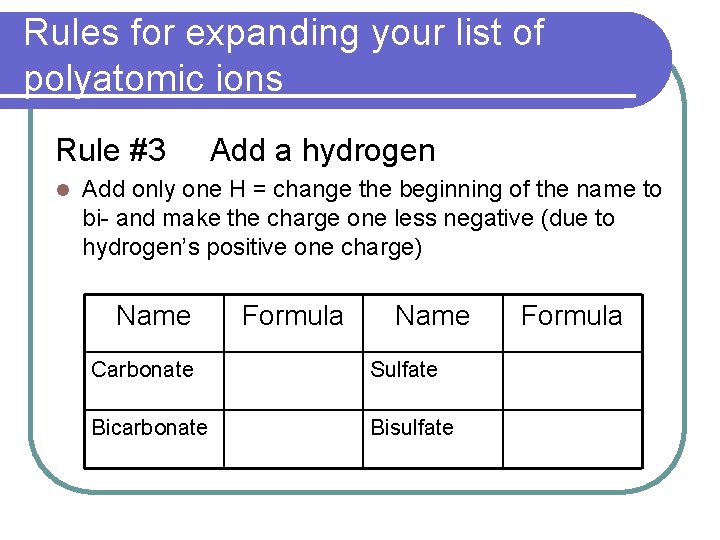
Rules for expanding your list of polyatomic ions Rule #3 l Add a hydrogen Add only one H = change the beginning of the name to bi- and make the charge one less negative (due to hydrogen’s positive one charge) Name Formula Name Carbonate Sulfate Bicarbonate Bisulfate Formula
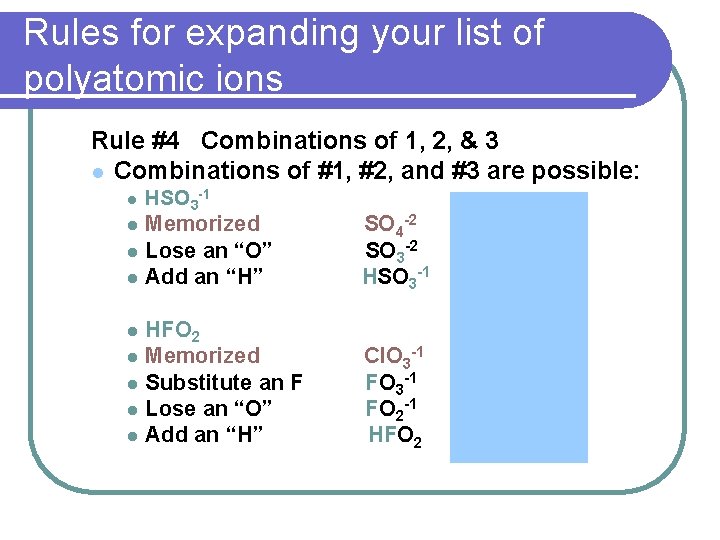
Rules for expanding your list of polyatomic ions Rule #4 Combinations of 1, 2, & 3 l Combinations of #1, #2, and #3 are possible: l l l l l HSO 3 -1 Memorized Lose an “O” Add an “H” SO 4 -2 SO 3 -2 HSO 3 -1 Sulfate Sulfite Bisulfite HFO 2 Memorized Substitute an F Lose an “O” Add an “H” Cl. O 3 -1 FO 2 -1 HFO 2 Chlorate Fluorite Bifluorite
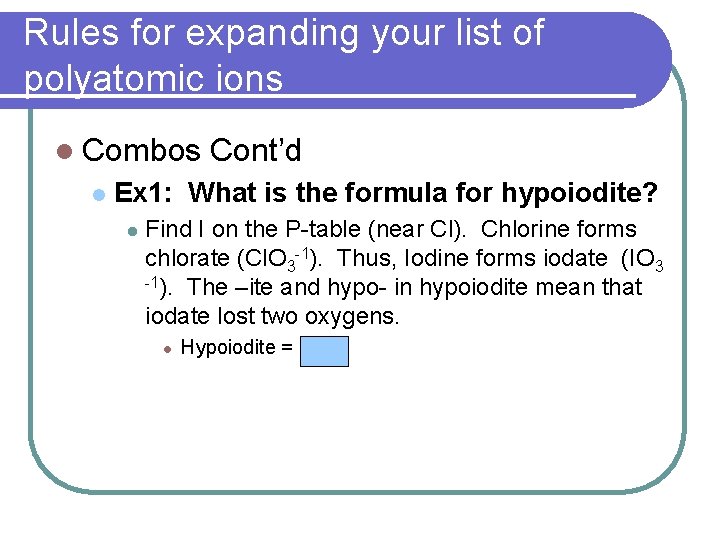
Rules for expanding your list of polyatomic ions l Combos l Cont’d Ex 1: What is the formula for hypoiodite? l Find I on the P-table (near Cl). Chlorine forms chlorate (Cl. O 3 -1). Thus, Iodine forms iodate (IO 3 -1). The –ite and hypo- in hypoiodite mean that iodate lost two oxygens. l Hypoiodite = IO-1
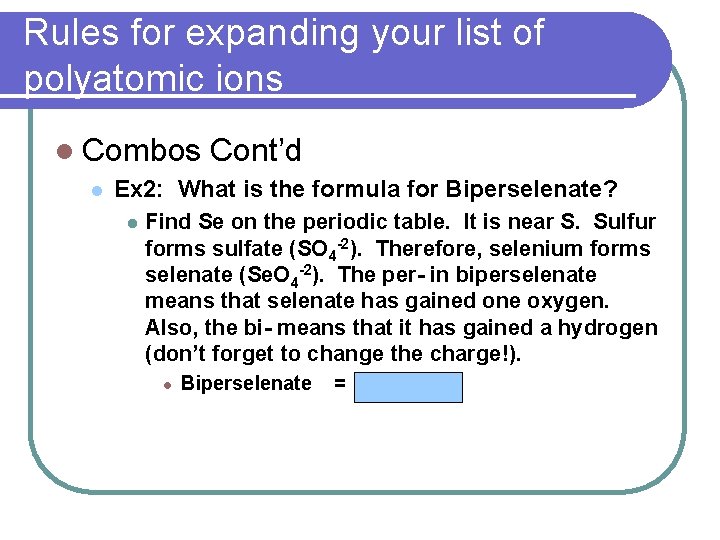
Rules for expanding your list of polyatomic ions l Combos l Cont’d Ex 2: What is the formula for Biperselenate? l Find Se on the periodic table. It is near S. Sulfur forms sulfate (SO 4 -2). Therefore, selenium forms selenate (Se. O 4 -2). The per- in biperselenate means that selenate has gained one oxygen. Also, the bi- means that it has gained a hydrogen (don’t forget to change the charge!). l Biperselenate = HSe. O 5 -1
Monatomic Ions l For nonmetals, almost all single names that end with –ide indicates a single charged atom. l Simply write the symbol and the charge. The periodic table column indirectly indicates the element’s charge. Remember, elements want to have 8 electrons in their outer shell (Octet Rule).
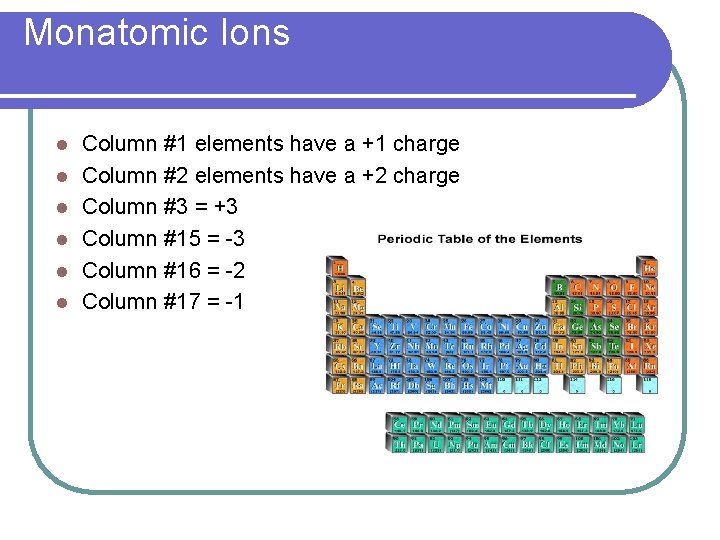
Monatomic Ions l l l Column #1 elements have a +1 charge Column #2 elements have a +2 charge Column #3 = +3 Column #15 = -3 Column #16 = -2 Column #17 = -1
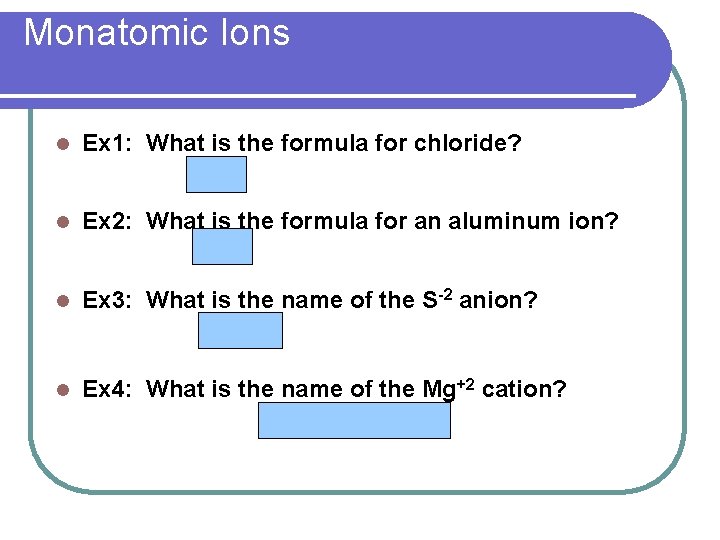
Monatomic Ions l Ex 1: What is the formula for chloride? Cl-1 l Ex 2: What is the formula for an aluminum ion? Al+3 l Ex 3: What is the name of the S-2 anion? Sulfide l Ex 4: What is the name of the Mg+2 cation? Magnesium Ion
6. 1 Introduction to chemical bonding l Most elements are not found alone in nature. They are “stuck” to other atoms. l Chemical Bond - Link between atoms that results from the mutual attraction of their nuclei for their electrons. l Types of chemical bonds: l l l Ionic - transfer of electrons (metal + nonmetal) Covalent - sharing of electrons (2 nonmetals) Metallic - happens in metals when there is only one type of element https: //www. youtube. com/watch? v=QXT 4 OVM 4 v. XI
Introduction to Chemical Bonding l l Covalent bonds may be polar or nonpolar l Polar - unequal sharing of electrons (HCl) l Nonpolar - equal sharing of electrons (H 2) There are two ways to predict polar vs. nonpolar ( and covalent vs. ionic)
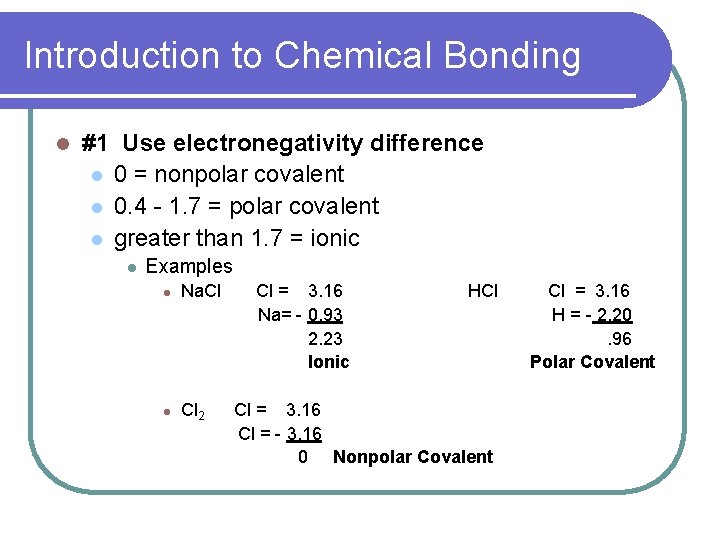
Introduction to Chemical Bonding l #1 Use electronegativity difference l 0 = nonpolar covalent l 0. 4 - 1. 7 = polar covalent l greater than 1. 7 = ionic l Examples l Na. Cl l Cl 2 Cl = 3. 16 Na= - 0. 93 2. 23 Ionic HCl Cl = 3. 16 Cl = - 3. 16 0 Nonpolar Covalent Cl = 3. 16 H = - 2. 20. 96 Polar Covalent
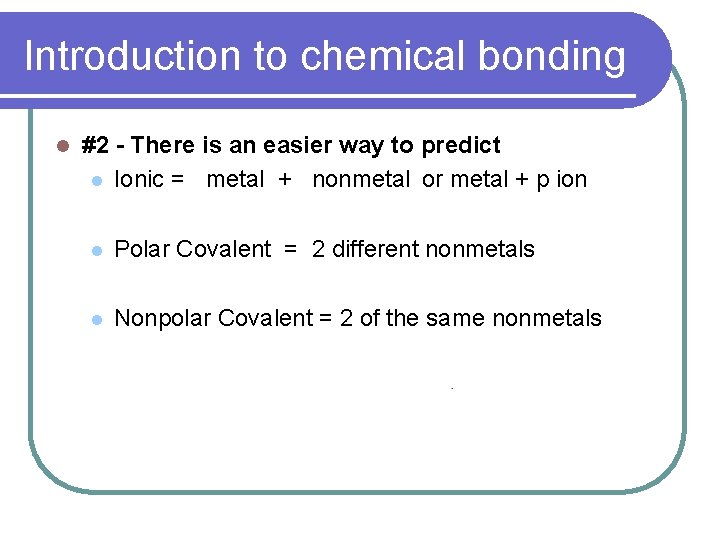
Introduction to chemical bonding l #2 - There is an easier way to predict l Ionic = metal + nonmetal or metal + p ion l Polar Covalent = 2 different nonmetals l Nonpolar Covalent = 2 of the same nonmetals
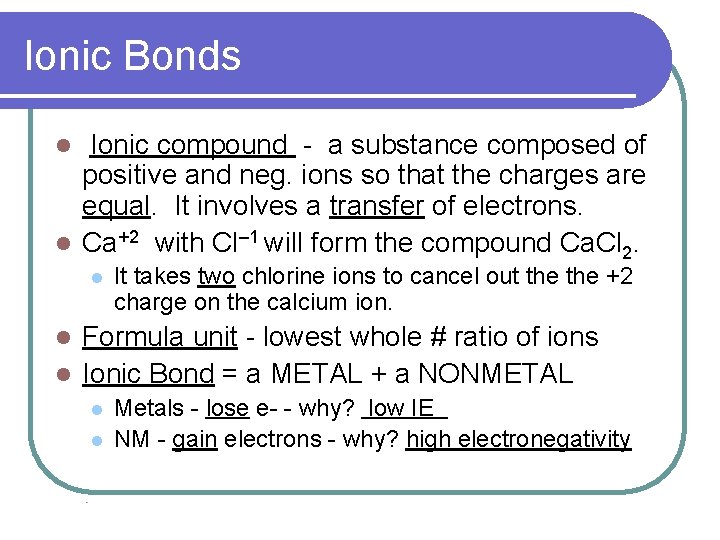
Ionic Bonds Ionic compound - a substance composed of positive and neg. ions so that the charges are equal. It involves a transfer of electrons. l Ca+2 with Cl– 1 will form the compound Ca. Cl 2. l l It takes two chlorine ions to cancel out the +2 charge on the calcium ion. Formula unit - lowest whole # ratio of ions l Ionic Bond = a METAL + a NONMETAL l l l Metals - lose e- - why? low IE NM - gain electrons - why? high electronegativity
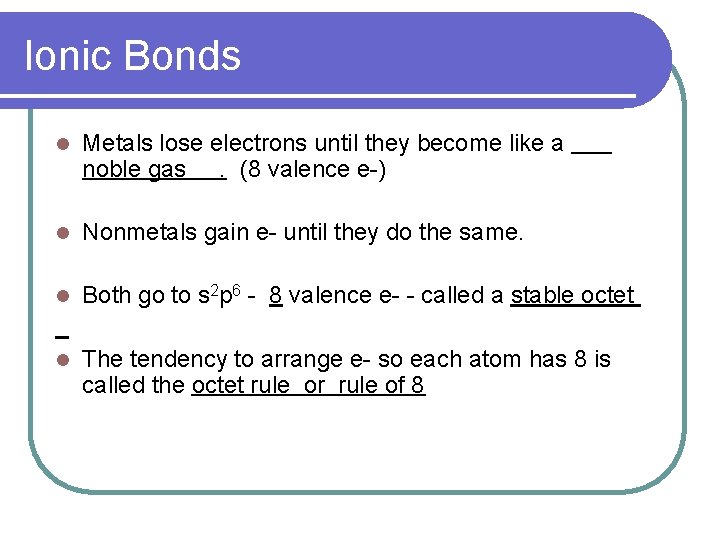
Ionic Bonds l Metals lose electrons until they become like a noble gas. (8 valence e-) l Nonmetals gain e- until they do the same. l Both go to s 2 p 6 - 8 valence e- - called a stable octet l The tendency to arrange e- so each atom has 8 is called the octet rule or rule of 8
![Ionic Bonds l The formation of an ionic bond: Na to Cl = [Na]+1[Cl]-1](http://slidetodoc.com/presentation_image_h2/776d0a7b966fabd79fc1fe2f735704a6/image-23.jpg "Ionic Bonds l The formation of an ionic bond: Na to Cl = [Na]+1[Cl]-1")
Ionic Bonds l The formation of an ionic bond: Na to Cl = [Na]+1[Cl]-1 l Na l 1 s 2 s l 2 p 3 s Cl 1 s 2 s 2 p 3 s 3 p
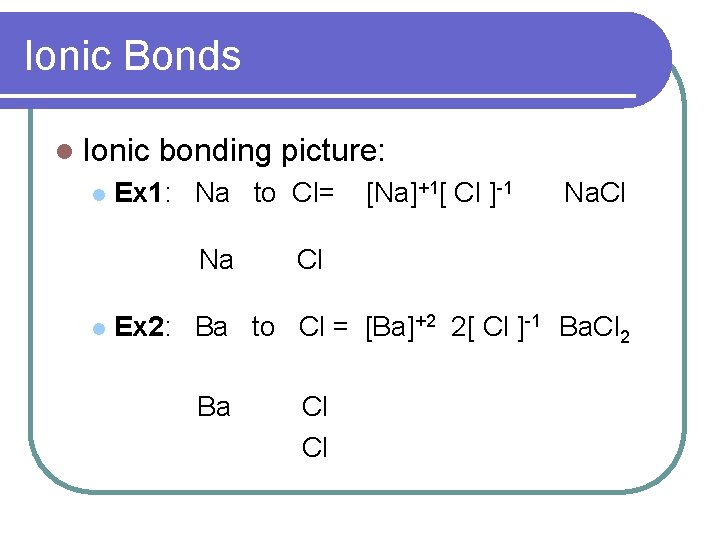
Ionic Bonds l Ionic l bonding picture: Ex 1: Na to Cl= Na l [Na]+1[ Cl ]-1 Na. Cl Cl Ex 2: Ba to Cl = [Ba]+2 2[ Cl ]-1 Ba. Cl 2 Ba Cl Cl
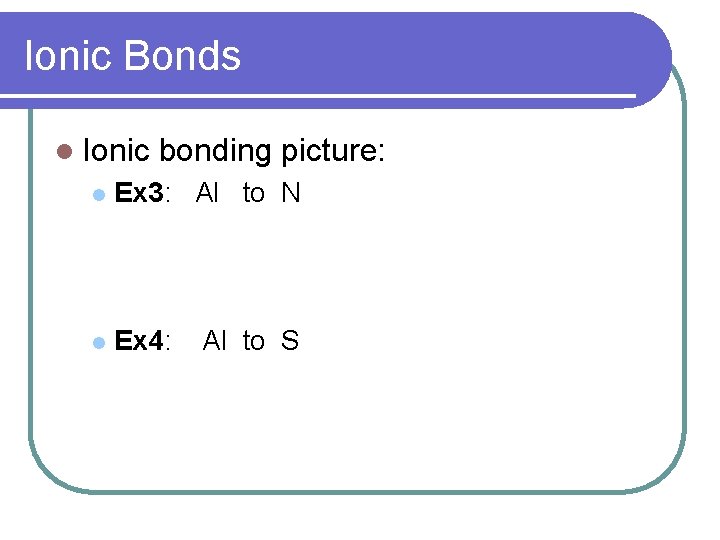
Ionic Bonds l Ionic bonding picture: l Ex 3: Al to N l Ex 4: Al to S
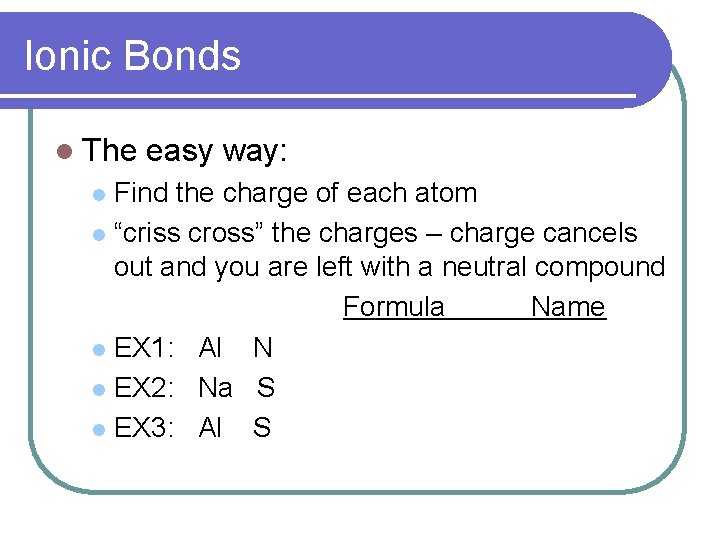
Ionic Bonds l The easy way: Find the charge of each atom l “criss cross” the charges – charge cancels out and you are left with a neutral compound Formula Name l EX 1: Al N l EX 2: Na S l EX 3: Al S l
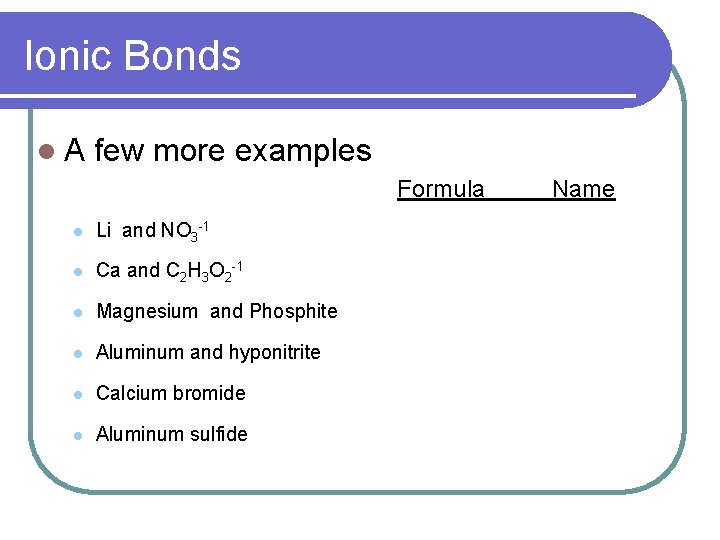
Ionic Bonds l. A few more examples Formula l Li and NO 3 -1 l Ca and C 2 H 3 O 2 -1 l Magnesium and Phosphite l Aluminum and hyponitrite l Calcium bromide l Aluminum sulfide Name
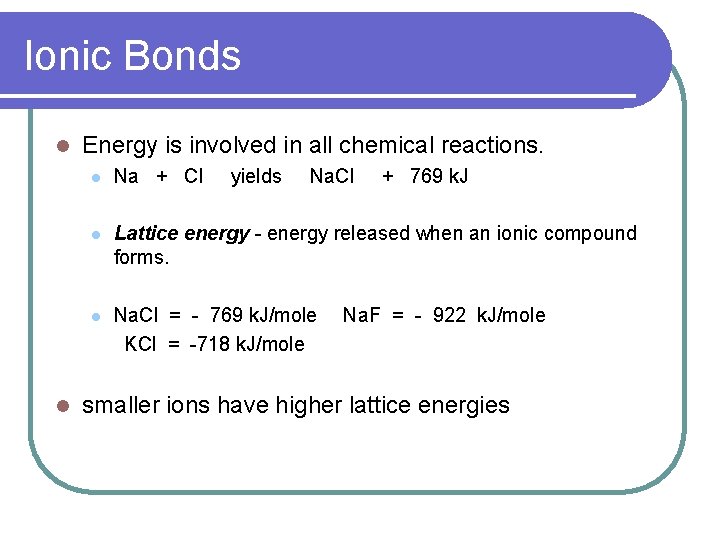
Ionic Bonds l l Energy is involved in all chemical reactions. l Na + Cl yields Na. Cl + 769 k. J l Lattice energy - energy released when an ionic compound forms. l Na. Cl = - 769 k. J/mole KCl = -718 k. J/mole Na. F = - 922 k. J/mole smaller ions have higher lattice energies
Ionic Bonds l Properties of ionic compounds: Hard l Shatter l Conduct electricity l High melting point l l Odorless
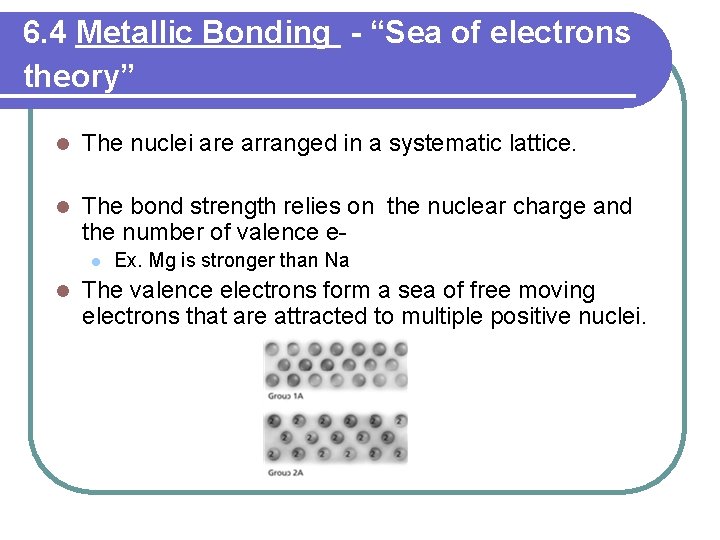
6. 4 Metallic Bonding - “Sea of electrons theory” l The nuclei are arranged in a systematic lattice. l The bond strength relies on the nuclear charge and the number of valence el l Ex. Mg is stronger than Na The valence electrons form a sea of free moving electrons that are attracted to multiple positive nuclei.
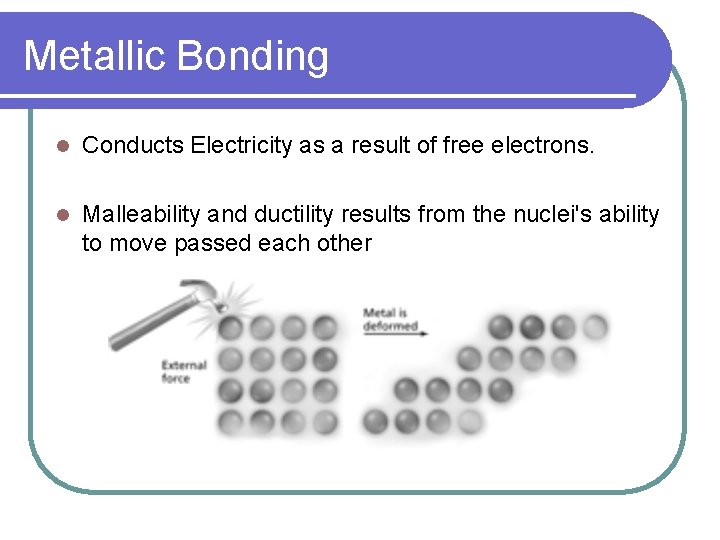
Metallic Bonding l Conducts Electricity as a result of free electrons. l Malleability and ductility results from the nuclei's ability to move passed each other
Metallic Bonding l Remember: l l l in ionic bonds some atoms want e- and some don’t in covalent bonds, all atoms share – in metals, no one atom wants the e-
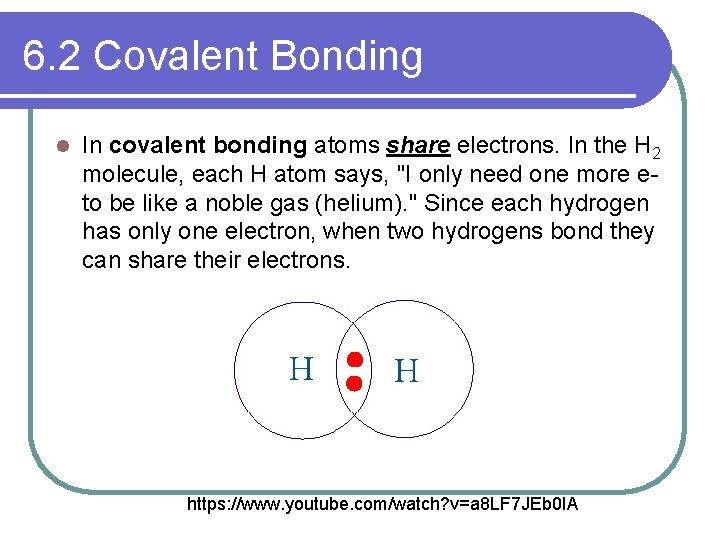
6. 2 Covalent Bonding l In covalent bonding atoms share electrons. In the H 2 molecule, each H atom says, "I only need one more eto be like a noble gas (helium). " Since each hydrogen has only one electron, when two hydrogens bond they can share their electrons. https: //www. youtube. com/watch? v=a 8 LF 7 JEb 0 IA
Covalent Bonding l Molecule - smallest quantity of matter that exists by itself and retains the properties of that substance. Describes a covalently bonded substance. l monatomic molecules - He, Ne, Ar, (noble gases are always monatomic) l diatomic molecules – H 2 O 2 N 2 Cl 2 Br 2 I 2 F 2 (you must memorize these!!) l polyatomic molecules - P 4, S 8, C 6 H 12 O 6
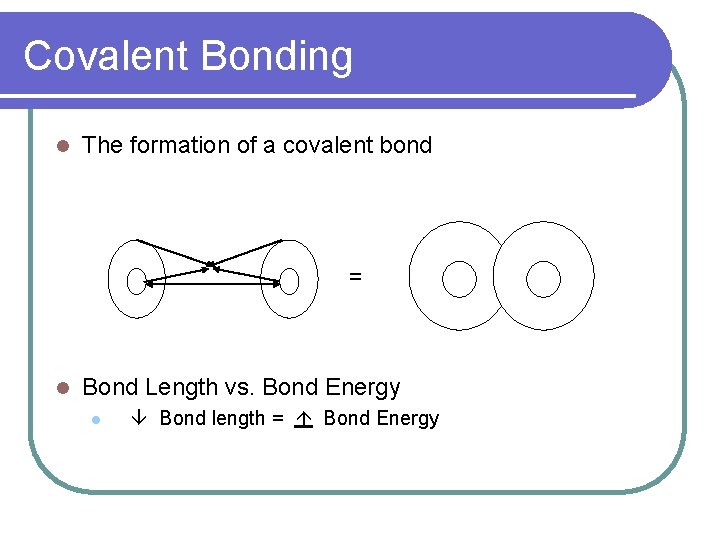
Covalent Bonding l The formation of a covalent bond = l Bond Length vs. Bond Energy l Bond length = Bond Energy
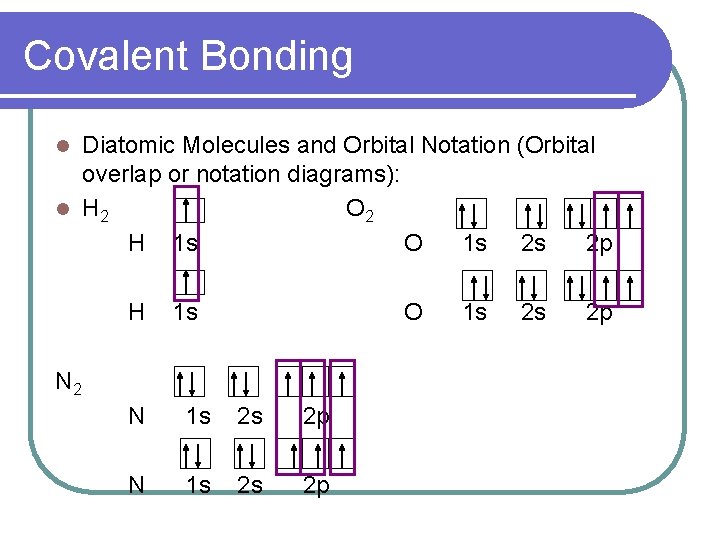
Covalent Bonding Diatomic Molecules and Orbital Notation (Orbital overlap or notation diagrams): l H 2 O 2 H 1 s O 1 s 2 s 2 p l H 1 s O N 2 N 1 s 2 s 2 p
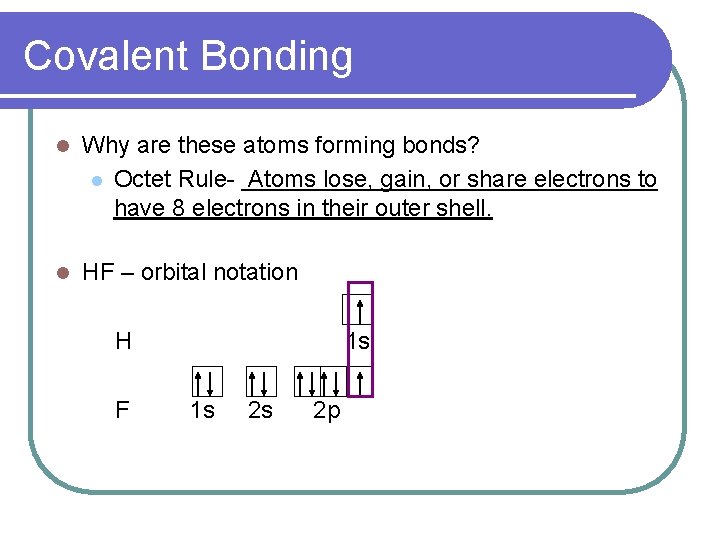
Covalent Bonding l Why are these atoms forming bonds? l Octet Rule- Atoms lose, gain, or share electrons to have 8 electrons in their outer shell. l HF – orbital notation H F 1 s 1 s 2 s 2 p
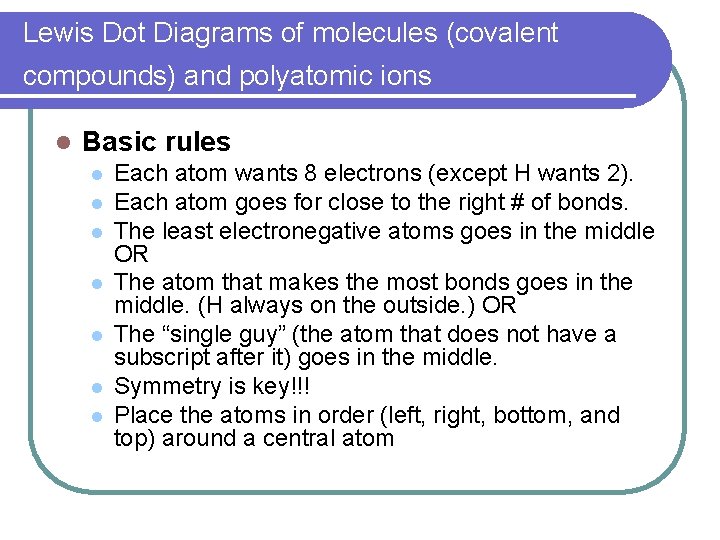
Lewis Dot Diagrams of molecules (covalent compounds) and polyatomic ions l Basic rules l l l l Each atom wants 8 electrons (except H wants 2). Each atom goes for close to the right # of bonds. The least electronegative atoms goes in the middle OR The atom that makes the most bonds goes in the middle. (H always on the outside. ) OR The “single guy” (the atom that does not have a subscript after it) goes in the middle. Symmetry is key!!! Place the atoms in order (left, right, bottom, and top) around a central atom
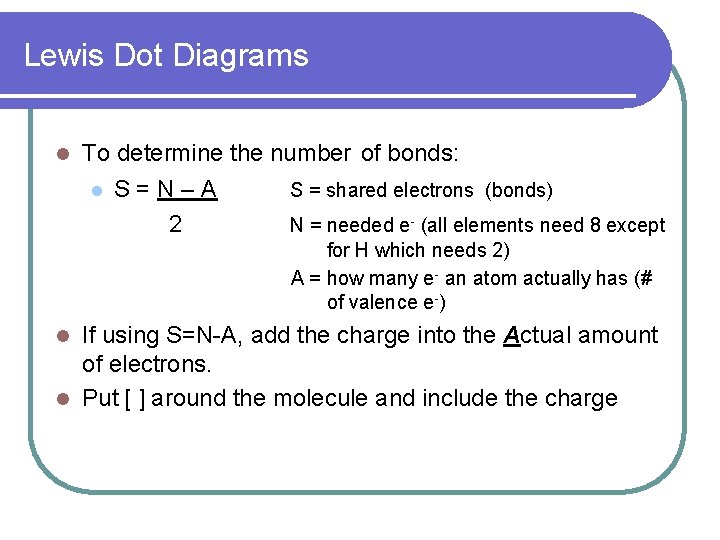
Lewis Dot Diagrams l To determine the number of bonds: l S=N–A 2 S = shared electrons (bonds) N = needed e- (all elements need 8 except for H which needs 2) A = how many e - an atom actually has (# of valence e-) If using S=N-A, add the charge into the Actual amount of electrons. l Put [ ] around the molecule and include the charge l
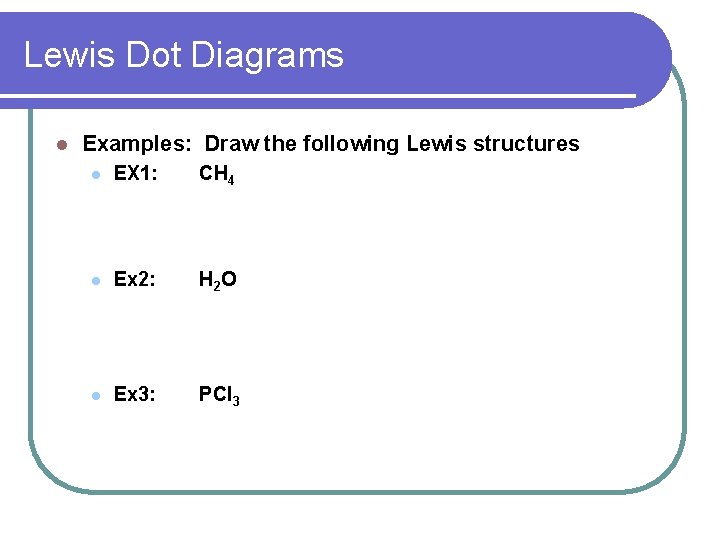
Lewis Dot Diagrams l Examples: Draw the following Lewis structures l EX 1: CH 4 l Ex 2: H 2 O l Ex 3: PCl 3
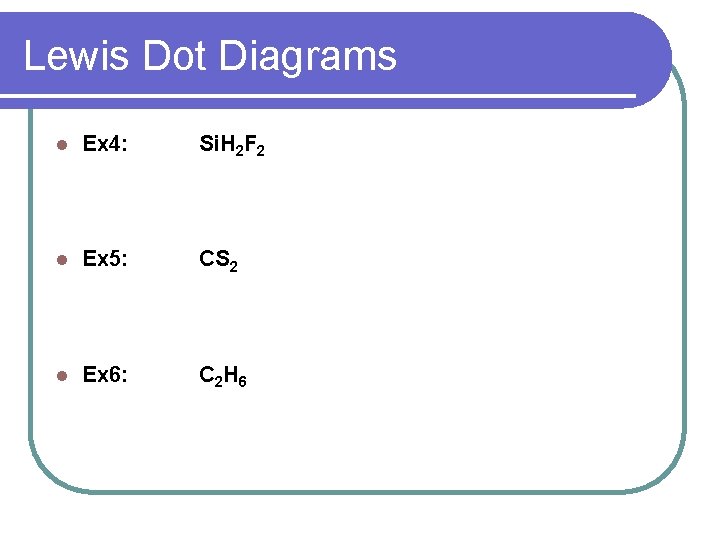
Lewis Dot Diagrams l Ex 4: Si. H 2 F 2 l Ex 5: CS 2 l Ex 6: C 2 H 6
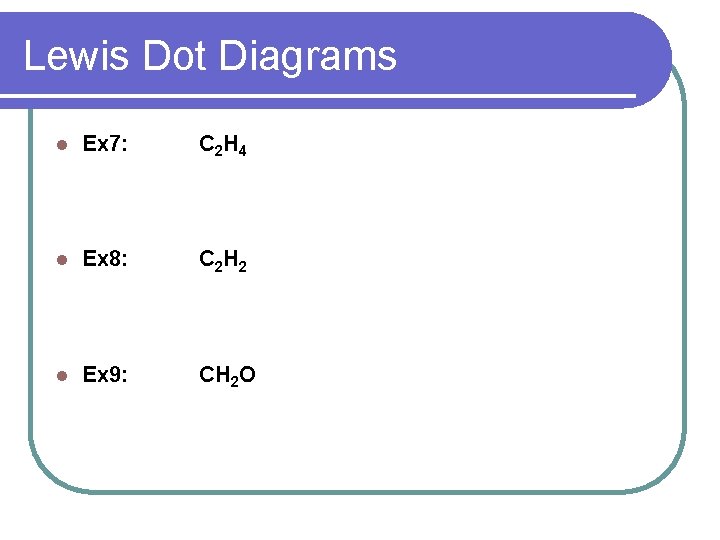
Lewis Dot Diagrams l Ex 7: C 2 H 4 l Ex 8: C 2 H 2 l Ex 9: CH 2 O
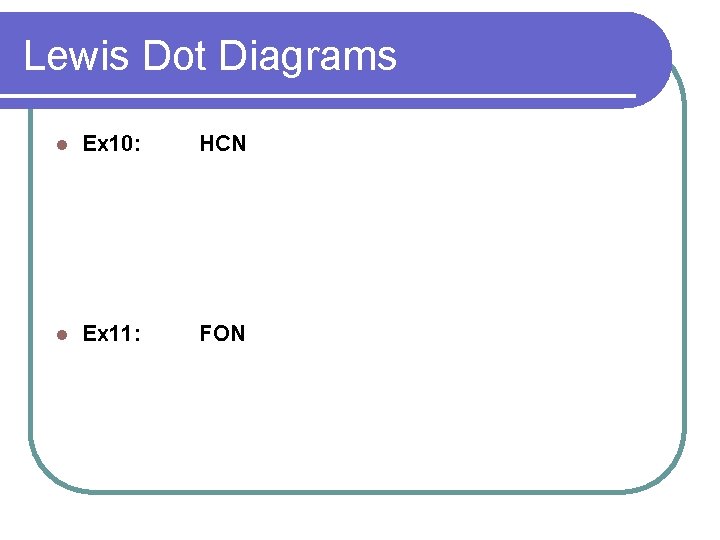
Lewis Dot Diagrams l Ex 10: HCN l Ex 11: FON
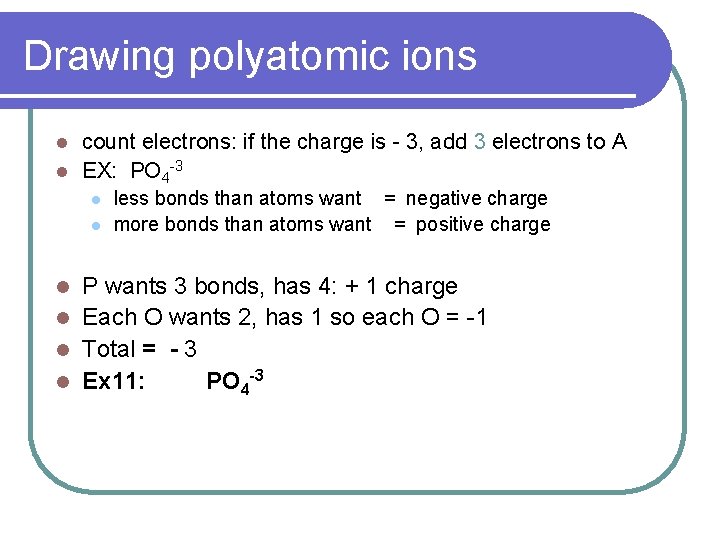
Drawing polyatomic ions count electrons: if the charge is - 3, add 3 electrons to A l EX: PO 4 -3 l less bonds than atoms want = negative charge more bonds than atoms want = positive charge P wants 3 bonds, has 4: + 1 charge l Each O wants 2, has 1 so each O = -1 l Total = - 3 l Ex 11: PO 4 -3 l
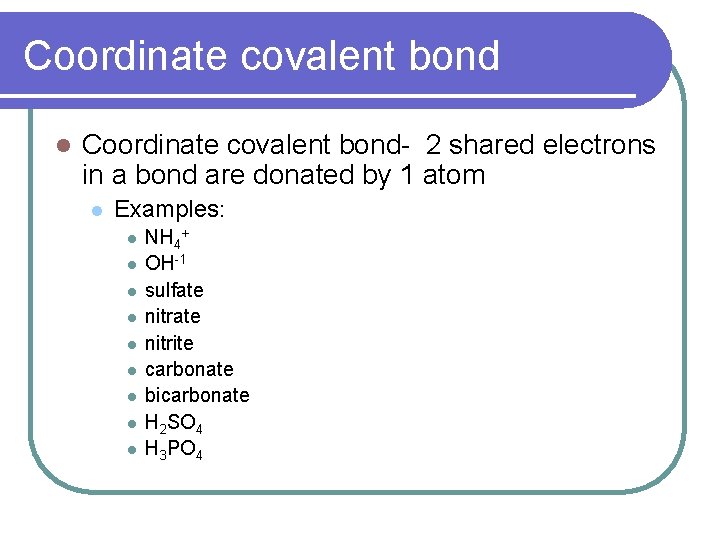
Coordinate covalent bond l Coordinate covalent bond- 2 shared electrons in a bond are donated by 1 atom l Examples: l l l l l NH 4+ OH-1 sulfate nitrite carbonate bicarbonate H 2 SO 4 H 3 PO 4
6. 5 The Properties of Molecular Compounds l Valence shell electron pair repulsion theory (VESPER) – e- pairs get as far away from each other as possible l Because of this we can predict the shape of molecules based on how many bonds and lone pairs are on the central atom
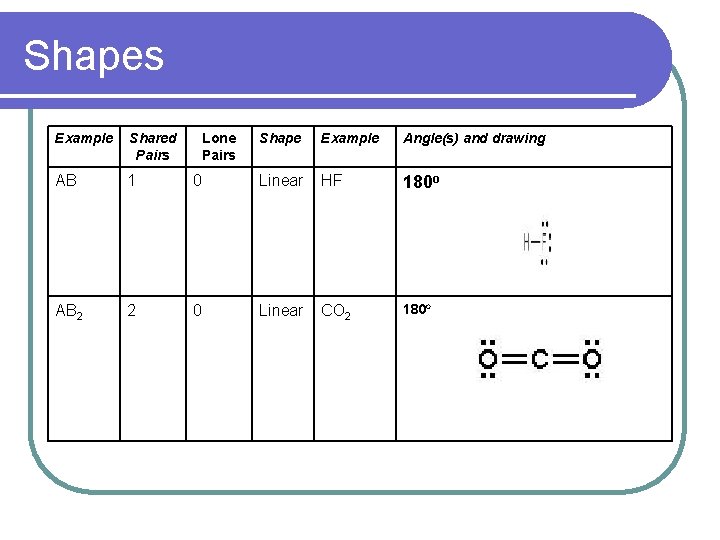
Shapes Example Shared Pairs AB 1 AB 2 2 Lone Pairs Shape Example Angle(s) and drawing 0 Linear HF 180 o 0 Linear CO 2 180 o
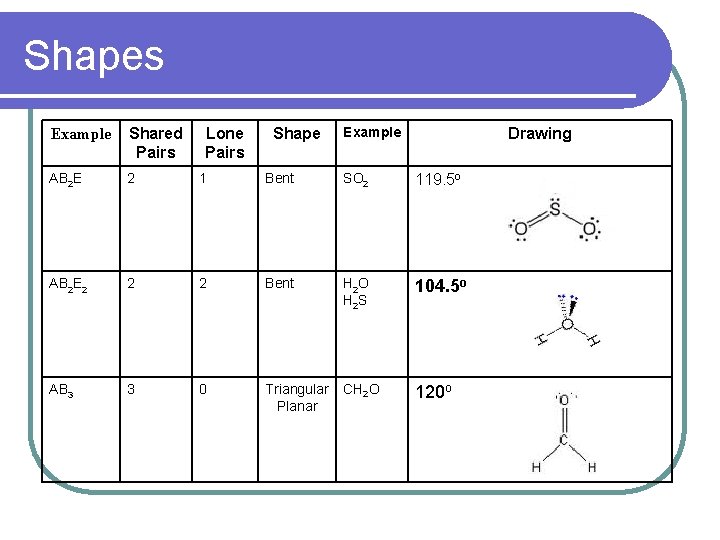
Shapes Lone Pairs Shape Example Shared Pairs Drawing AB 2 E 2 1 Bent SO 2 119. 5 o AB 2 E 2 2 2 Bent H 2 O H 2 S 104. 5 o AB 3 3 0 Triangular Planar CH 2 O 120 o
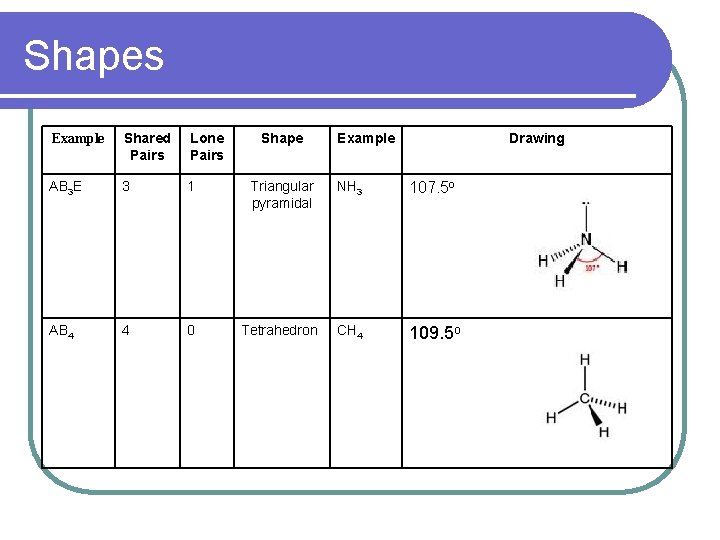
Shapes Example Shared Pairs Lone Pairs Shape Example Drawing AB 3 E 3 1 Triangular pyramidal NH 3 107. 5 o AB 4 4 0 Tetrahedron CH 4 109. 5 o
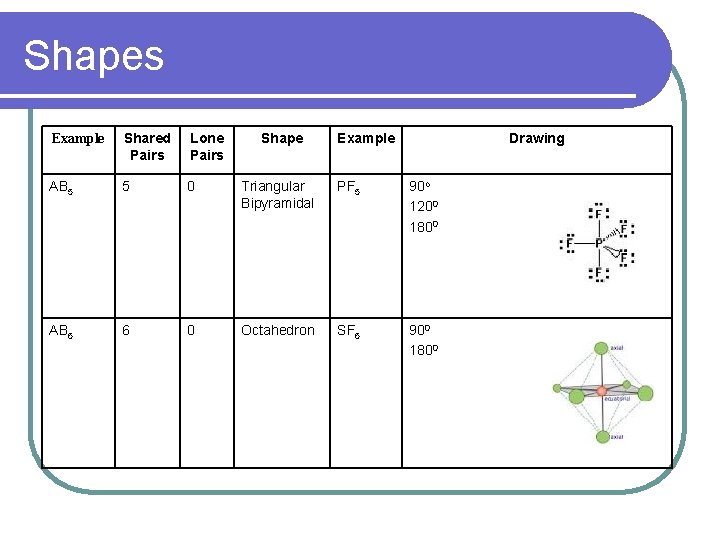
Shapes Example Shared Pairs Lone Pairs Shape Example Drawing AB 5 5 0 Triangular Bipyramidal PF 5 90 o 1200 1800 AB 6 6 0 Octahedron SF 6 900 1800
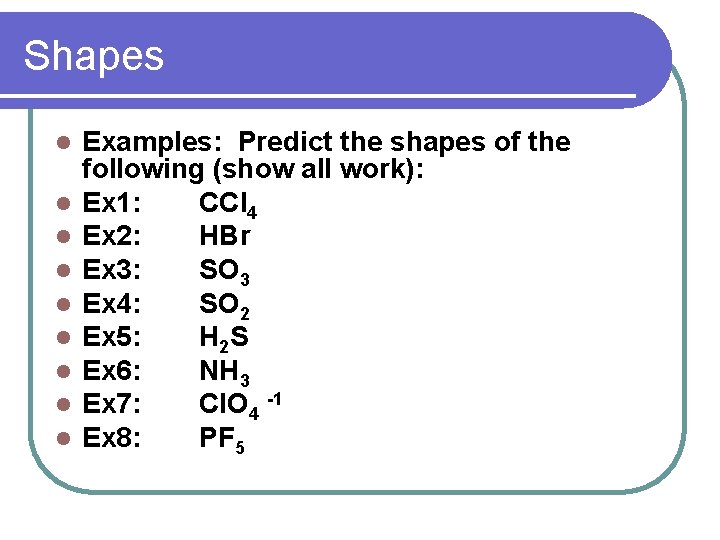
Shapes l l l l l Examples: Predict the shapes of the following (show all work): Ex 1: CCl 4 Ex 2: HBr Ex 3: SO 3 Ex 4: SO 2 Ex 5: H 2 S Ex 6: NH 3 Ex 7: Cl. O 4 -1 Ex 8: PF 5
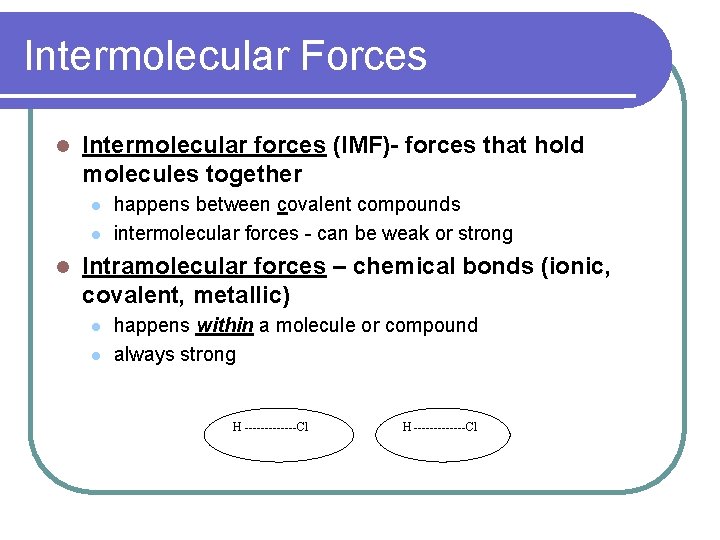
Intermolecular Forces l Intermolecular forces (IMF)- forces that hold molecules together l l l happens between covalent compounds intermolecular forces - can be weak or strong Intramolecular forces – chemical bonds (ionic, covalent, metallic) l l happens within a molecule or compound always strong H -------------Cl
Intermolecular Forces l Types of intermolecular forces l dipole-dipole l dipole - when electrons are unevenly distributed l l Ex 1: predict the IMF that occurs with HCl Ex 2: predict the IMF that occurs with H 2 O (***one of the most impt. Ever!)
Intermolecular Forces hydrogen bonding - H-bonding is a “super-duper” dipole-dipole l l H-bonding happens any time H is bonded to F, O, or N l Hydrogen bond is FON!!! Why does this happen? l l l A large difference in electronegativity between F, O, or N and H results in one end of the molecule being very negative, while the other end is very positive.
Intermolecular Forces l Effect of H-bonds on physical properties: l H-bonding tends to cause the following in substances: l l l Boiling Point Heat of Vaporization Vapor Pressure Melting Point H-bonds causes water to expand when it freezes. H-bonding is also responsible for the shapes of proteins.
Intermolecular Forces l Recap: l l l Polar molecules have dipole-dipole IMF holding them together. H-bonding is “super” dipole-dipole IMF These two types of IMF usually result in substances being solids or liquids at room temp. Most nonpolar covalent substances are gases at room temp. as the forces holding them together are not strong enough to keep the molecules attracted hence they are gases O 2, H 2, N 2 - straight nonpolar substances CO 2 - have dipoles, but nonpolar due to its molecular geometry
Intermolecular Forces Van der Waals Forces (London Forces) l l Temporarily induced dipoles caused by the motion of electrons. more electrons = more attraction so, bigger atoms have stronger Van der Waals forces Occur with noble gases
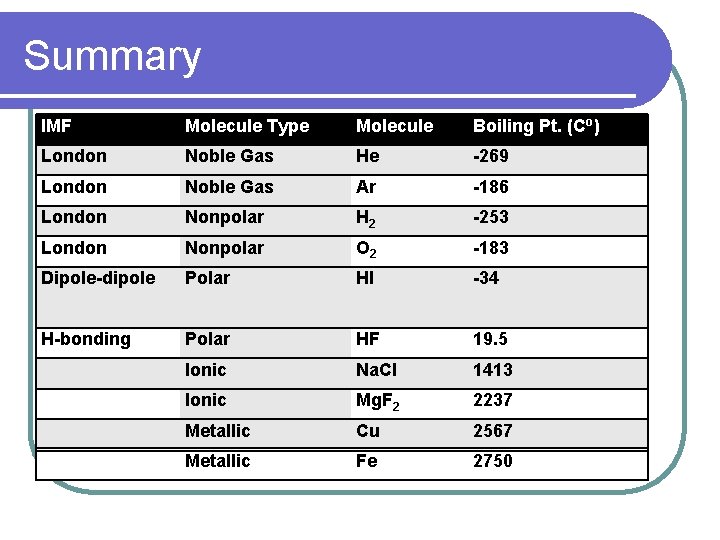
Summary IMF Molecule Type Molecule Boiling Pt. (Co) London Noble Gas He -269 London Noble Gas Ar -186 London Nonpolar H 2 -253 London Nonpolar O 2 -183 Dipole-dipole Polar HI -34 H-bonding Polar HF 19. 5 Ionic Na. Cl 1413 Ionic Mg. F 2 2237 Metallic Cu 2567 Metallic Fe 2750
Bonding l Bond Energy -what is the strength of chemical bonds? l bond energy - energy needed to break a bond measured in k. J/mole l bond strength and stability: l l l stronger bond - more stable -needs more energy to break the bond weaker bond - takes little energy to break the bond so the chemical is unstable chemical changes favor lower energy states exothermic reactions are favored
Bonding l Bond Strength which is stronger? - single, double, or triple bond? Triple l which is shortest bond length? s, d, or t? triple l which is stronger, short or long bonds? short l
- Slides: 60