
Chapter 6 Making Sense of Statistical Significance Effect
- Slides: 9
Chapter 6 Making Sense of Statistical Significance: Effect Size and Statistical Power Part 1: Feb. 19, 2008
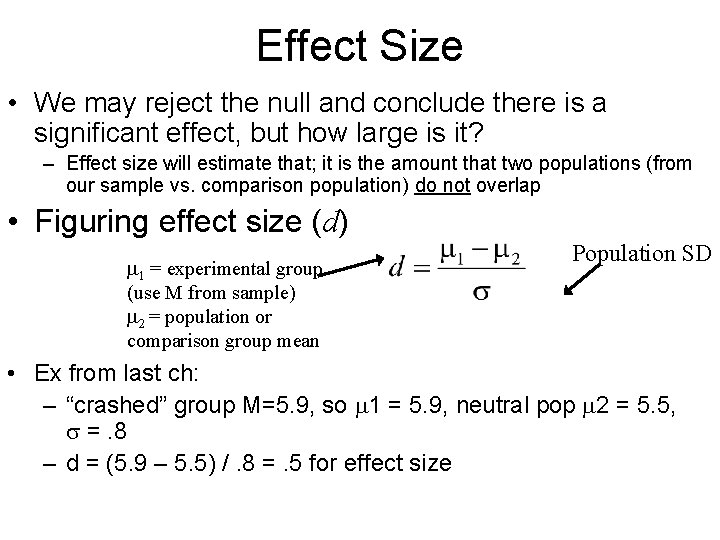
Effect Size • We may reject the null and conclude there is a significant effect, but how large is it? – Effect size will estimate that; it is the amount that two populations (from our sample vs. comparison population) do not overlap • Figuring effect size (d) 1 = experimental group (use M from sample) 2 = population or comparison group mean Population SD • Ex from last ch: – “crashed” group M=5. 9, so 1 = 5. 9, neutral pop 2 = 5. 5, =. 8 – d = (5. 9 – 5. 5) /. 8 =. 5 for effect size
Effect Size • Effect size conventions – make conclusions about how large/important effect is – small – medium – large around d =. 2 (or -. 2) around d =. 5 (or -. 5) around d =. 8 (or -. 8) – Ex) The difference between the ‘crashed’ and neutral groups was a significant and medium-sized effect. • Speaks to ‘practical significance’ – an indication of the importance of a statistically significant effect – May have a highly statistically signif effect (due to large N), but may not have much practical significance – in reality, may not be too impressive!
Statistical Power • Probability that the study will produce a statistically significant result when the research hypothesis is in fact true – That is, what is the power to correctly reject the null? – Upper right quadrant in decision table – Want to maximize our chances that our study has the power to find a true/real result • Can calculate power before the study using predictions of means
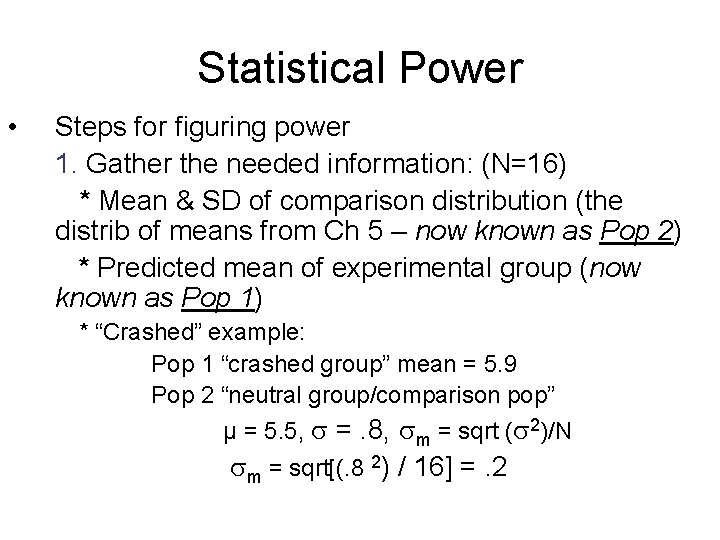
Statistical Power • Steps for figuring power 1. Gather the needed information: (N=16) * Mean & SD of comparison distribution (the distrib of means from Ch 5 – now known as Pop 2) * Predicted mean of experimental group (now known as Pop 1) * “Crashed” example: Pop 1 “crashed group” mean = 5. 9 Pop 2 “neutral group/comparison pop” μ = 5. 5, =. 8, m = sqrt ( 2)/N m = sqrt[(. 8 2) / 16] =. 2
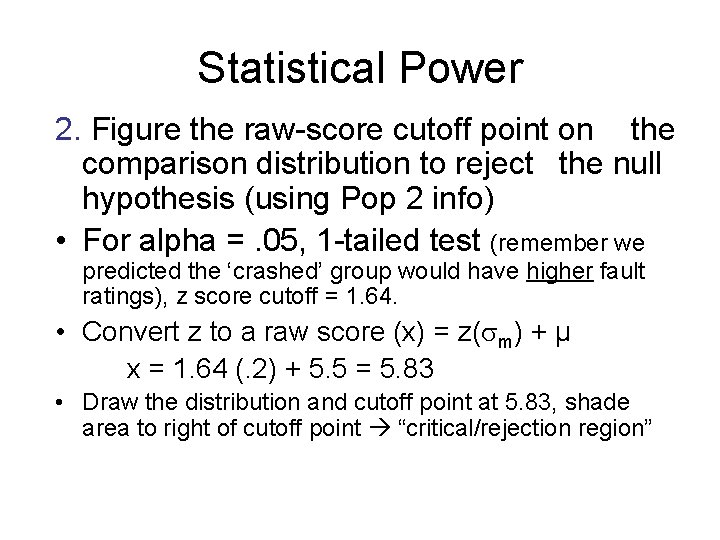
Statistical Power 2. Figure the raw-score cutoff point on the comparison distribution to reject the null hypothesis (using Pop 2 info) • For alpha =. 05, 1 -tailed test (remember we predicted the ‘crashed’ group would have higher fault ratings), z score cutoff = 1. 64. • Convert z to a raw score (x) = z( m) + μ x = 1. 64 (. 2) + 5. 5 = 5. 83 • Draw the distribution and cutoff point at 5. 83, shade area to right of cutoff point “critical/rejection region”
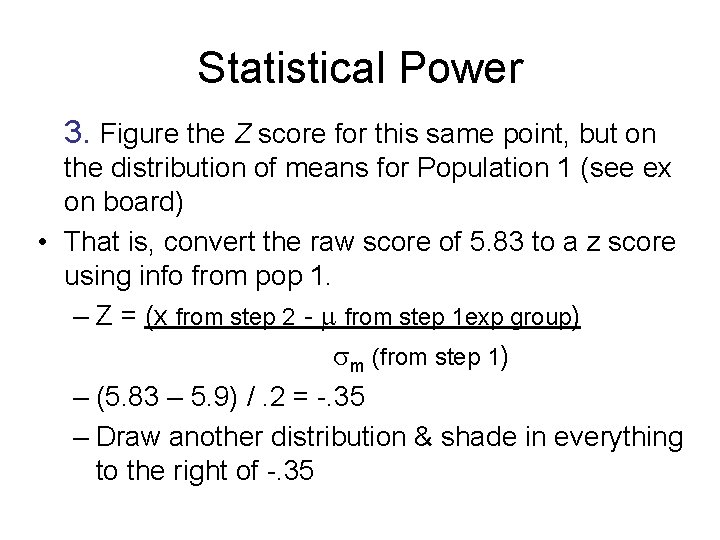
Statistical Power 3. Figure the Z score for this same point, but on the distribution of means for Population 1 (see ex on board) • That is, convert the raw score of 5. 83 to a z score using info from pop 1. – Z = (x from step 2 - from step 1 exp group) m (from step 1) – (5. 83 – 5. 9) /. 2 = -. 35 – Draw another distribution & shade in everything to the right of -. 35
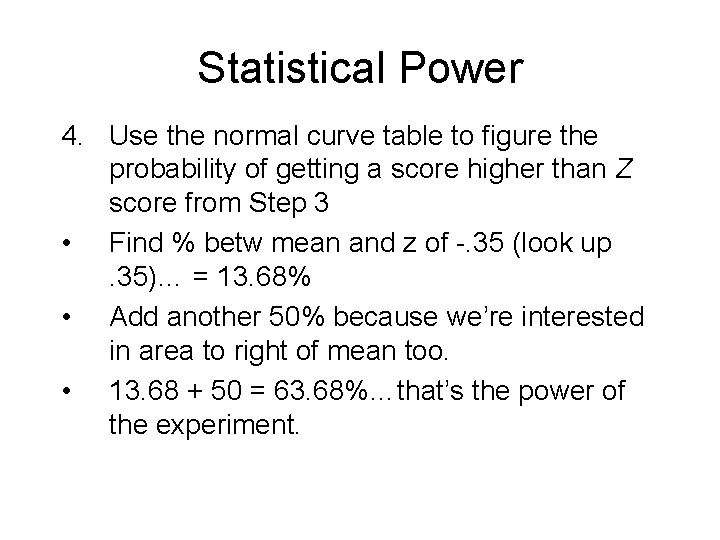
Statistical Power 4. Use the normal curve table to figure the probability of getting a score higher than Z score from Step 3 • Find % betw mean and z of -. 35 (look up. 35)… = 13. 68% • Add another 50% because we’re interested in area to right of mean too. • 13. 68 + 50 = 63. 68%…that’s the power of the experiment.
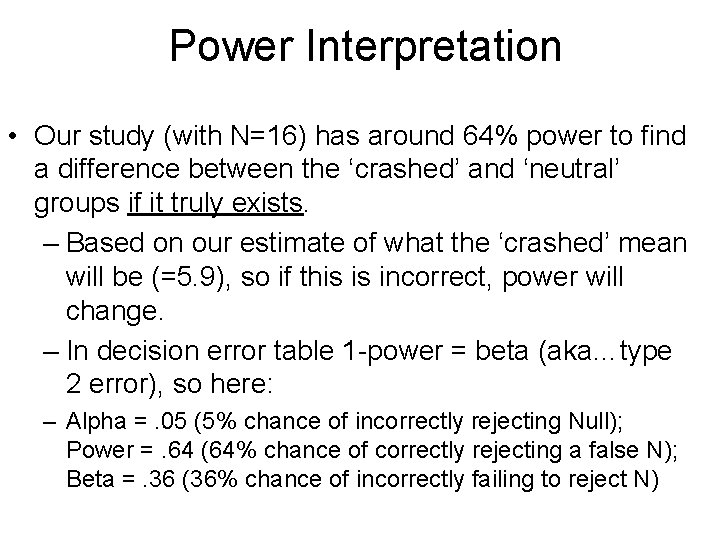
Power Interpretation • Our study (with N=16) has around 64% power to find a difference between the ‘crashed’ and ‘neutral’ groups if it truly exists. – Based on our estimate of what the ‘crashed’ mean will be (=5. 9), so if this is incorrect, power will change. – In decision error table 1 -power = beta (aka…type 2 error), so here: – Alpha =. 05 (5% chance of incorrectly rejecting Null); Power =. 64 (64% chance of correctly rejecting a false N); Beta =. 36 (36% chance of incorrectly failing to reject N)