
Chapter 6 Lesson 4 Objective To use properties
Chapter 6 Lesson 4 Objective: To use properties of diagonals of rhombuses and rectangles.

Rhombuses
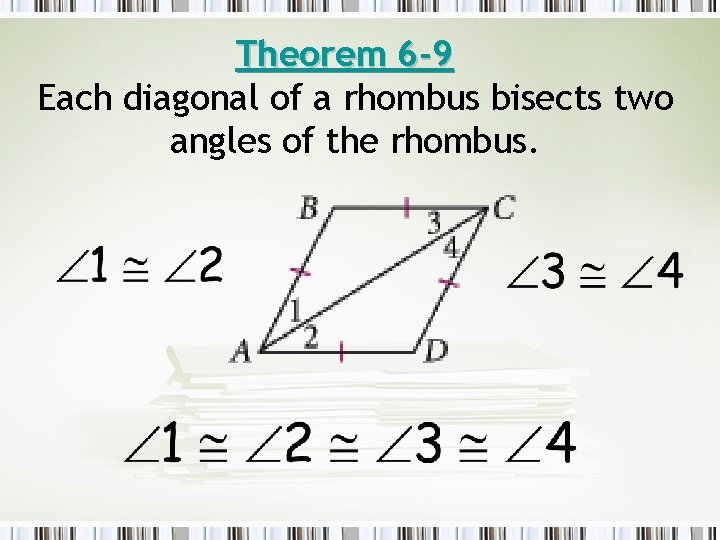
Theorem 6 -9 Each diagonal of a rhombus bisects two angles of the rhombus.
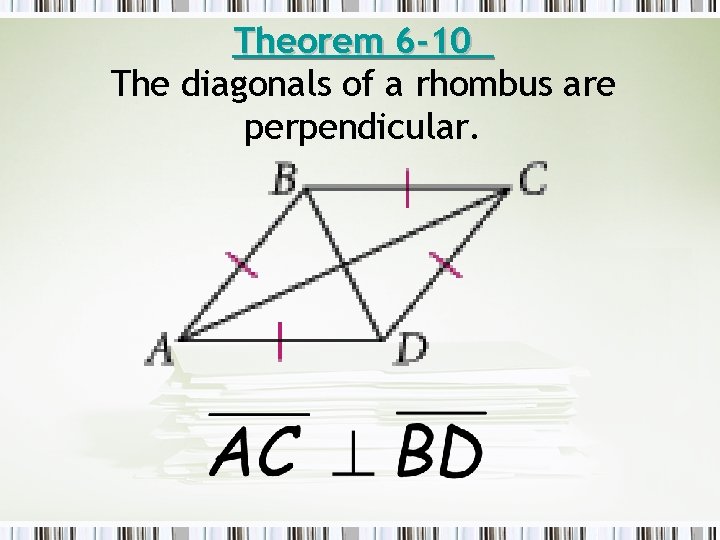
Theorem 6 -10 The diagonals of a rhombus are perpendicular.
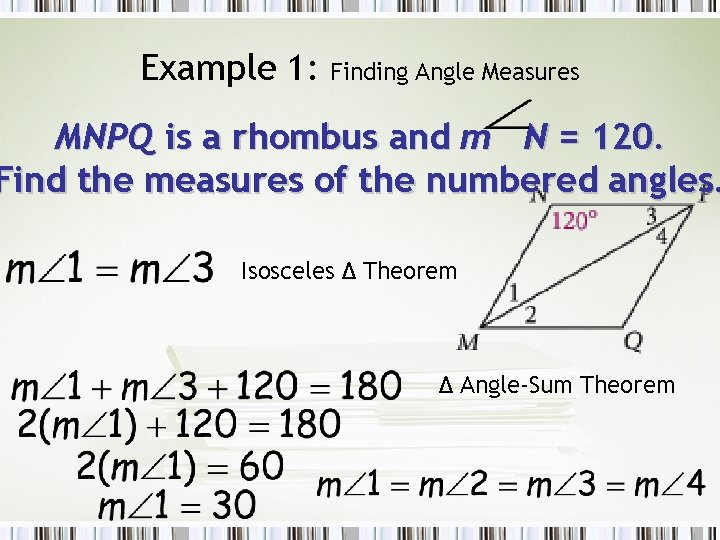
Example 1: Finding Angle Measures MNPQ is a rhombus and m N = 120. Find the measures of the numbered angles. Isosceles ∆ Theorem ∆ Angle-Sum Theorem
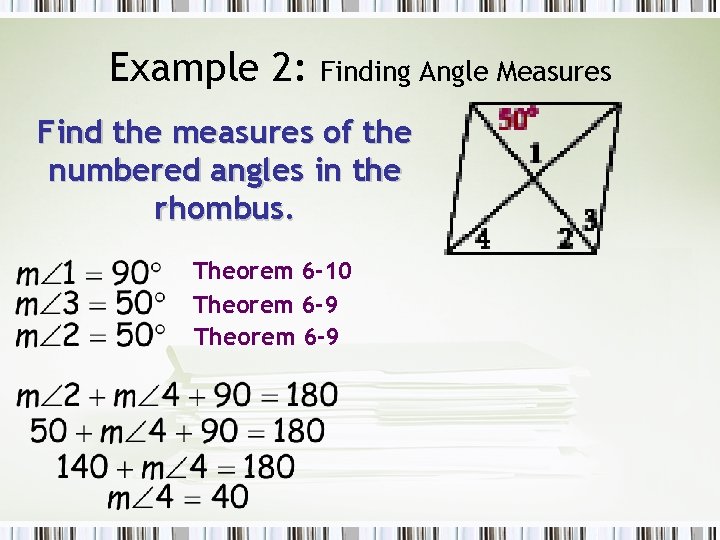
Example 2: Finding Angle Measures Find the measures of the numbered angles in the rhombus. Theorem 6 -10 Theorem 6 -9
Rectangles
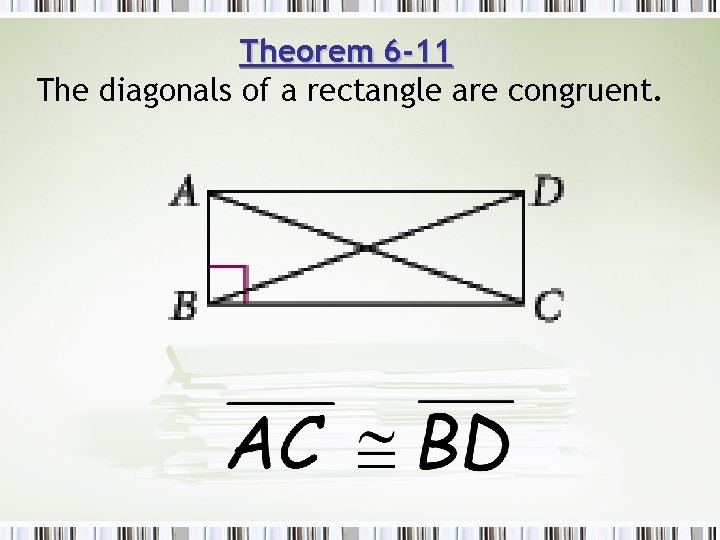
Theorem 6 -11 The diagonals of a rectangle are congruent.
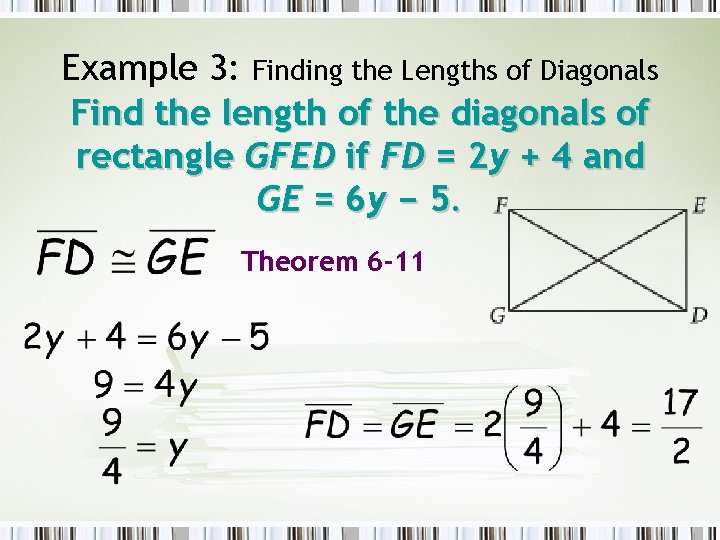
Example 3: Finding the Lengths of Diagonals Find the length of the diagonals of rectangle GFED if FD = 2 y + 4 and GE = 6 y − 5. Theorem 6 -11

Example 4: Finding the Lengths of Diagonals Find the length of the diagonals of GFED if FD = 5 y – 9 and GE = y + 5. Theorem 6 -11
Is the parallelogram a rhombus or a rectangle?
Theorem 6 -12 If one diagonal of a parallelogram bisects two angles of the parallelogram, then the parallelogram is a rhombus. Theorem 6 -13 If the diagonals of a parallelogram are perpendicular, then the parallelogram is a rhombus. Theorem 6 -14 If the diagonals of a parallelogram are congruent, then the parallelogram is a rectangle.
Example 5: Recognizing Special Parallelograms Determine whether the quadrilateral can be a parallelogram. If not, write impossible.
Example 6: Recognizing Special Parallelograms A diagonal of a parallelogram bisects two angles of the parallelogram. Is it possible for the parallelogram to have sides of length 5, 6, 5, and 6? No; if one diagonal bisects two angles, then the figure is a rhombus and cannot have two non-congruent sides.
Assignment Pg. 315 #1 -21; 45 -50; 57 -60
- Slides: 15