
Chapter 6 Lesson 3 The Development of Judaism


- Slides: 15
Chapter 6, Lesson 3 The Development of Judaism
Return to Judah ► The families of the Judeans who were exiled to Babylon spent 70 years away from Judah. § During the exile, they became known as Jews. § Their religion is known as Judaism. ► While in Babylon, the Jews no longer had a temple to worship God. § It is believed they instead used synagogues (Jewish houses) of worship. ► The Jews would worship on the Sabbath, which according to tradition, last from sundown Friday to nightfall Saturday. § During this weekly day of worship and rest, Jews prayed and spoke of their religion and history.
Rebuilding Judah ► While some Jews were ok with living in Babylon permanently, others hoped to return to Judah. § It was finally achieved when the Persians swept across Southwest Asia, defeating the Chaldeans and taking over Babylon. § In 538 B. C. , the Persian king Cyrus II let the Jews return to Judah. ► Some would stay in Babylon but many would return to Judah and rebuild Jerusalem. § They also constructed to replace the one destroyed by the Chaldeans known as the Second Temple.
Rebuilding Judah ► The Persians set up officials to rule the country and collect taxes from the people. § The Jews were not allowed to have their own government or king. § Mostly depended on religious leaders such as temple priests and scribes to guide them. ► Many priests were religious scholars who had a deep understanding of the faith. § Scribes lectured in synagogues and taught in schools.
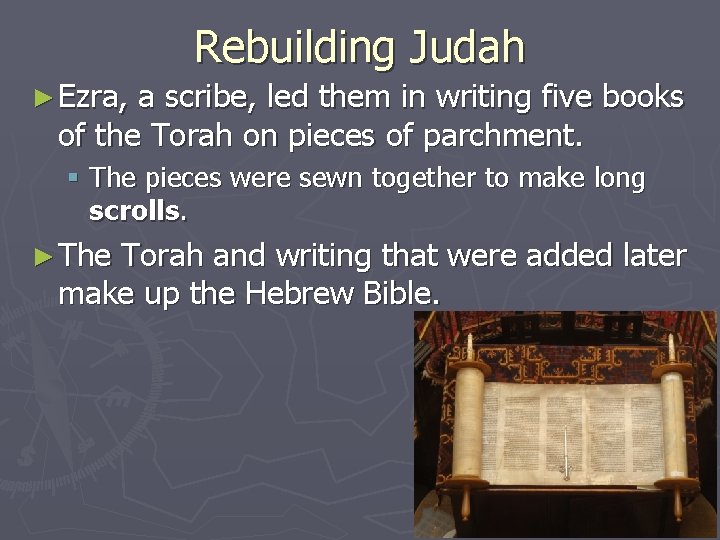
Rebuilding Judah ► Ezra, a scribe, led them in writing five books of the Torah on pieces of parchment. § The pieces were sewn together to make long scrolls. ► The Torah and writing that were added later make up the Hebrew Bible.
What Is In the Hebrew Bible? ► The Hebrew Bible clearly defined rules for the ancient Jews and is made up in three parts. § The Torah, the Prophets, and the Writings. ► It contains a series of 24 books written and collected over many centuries. § Explains the laws and rules of the Israelites. § Reflects the Culture of the people through Jewish history, art, literature, poetry, and proverbs.
What Is In the Hebrew Bible? ► Genesis, the first book of the Torah, presents the Israelite view of human beginnings. § According to this, God created the Earth in six days, and rested on the seventh. ► Also explains how God punished the world for wicked behavior. § In this book, God warns Noah that a flood is coming, and commands him to build an ark, or large boat. § Noah, his family, and two of every animal in the world boarded the ship as the world flood. § After the flood God placed a rainbow in the sky to signify a flood would never destroy the world again.
What Is In the Hebrew Bible? ► God also explains in Genesis why people in the world speak different languages. § Tells how the city of Babel tried to build a tower to reach heaven. § God did not approve of this and made the people speak different languages to prevent them from completing the tower. § He then scattered the people around the world. ► Later parts describe what the Jews hoped for a future.
What Is In the Hebrew Bible? ► The Book of Isaiah described God’s plan for a peaceful world: “[W]ill beat their swords into plowshares and their spears into pruning hooks. Nation will not take up sword against nation, nor will they train for war anymore. ” – Isaiah 2: 4 ► The book of Daniel explains that evil and suffering would one day be replaced by goodness. § Daniel, a Jew, was an advisor to a Babylonian King but did not worship Babylonian Gods. § He was punished by being thrown into a lion’s den but God protected him serving as an example that God would save them. § Christians and Muslims also share hope of a better world in which good triumphs over evil.
Jewish Daily Life ► The Torah provides teachings for daily living and it shaped the family life of early Jews. § It gave instruction on what foods to eat and what clothes to wear. § Also dealt with helping the poor, being honest with their neighbors, and applying laws fairly. § Finally, it also spoke of individual worth and responsibility, self-discipline, and served as a reminder to be loyal to God.
The Jewish Family ► The Torah specifies roles for the father and mother of the house. § If a father died, his sons would take his place as head of the household. ► Jewish families also stressed education, especially for young men. § Once a son was old enough they learned to worship God and learned a trade. § Under the guidance of religious leaders they would learn to read the Torah. (Much of all they learned was from the Torah. ) § Because reading the Torah was central to Jewish life, religious teachers became community leaders.
The Jewish Family ► Daughters learned from their mothers to be wives, mothers, and housekeepers. § It also included learning about Jewish food, the Sabbath, and holidays. ► They also learned about the ancient women of Israel such as Ruth and her mother-in-law Naomi. § According to the Hebrew Bible, Naomi’s husband her two sons died. § One of the sons was married to Ruth though she was not Jewish and she made the ultimate decision of being with her Mother-in-law in Bethlehem. § This showed the girls how important family was.
Dietary Laws ► Jewish law tells what they can eat. § They could eat beef and lamb but not pork. § Laws about food were known as kashrut, which meant “that which is proper. ” § They believed that by following these laws they showed their obedience to God. ► Food that is prepared according to Jewish dietary laws are considered kosher. § Many items you see in the store have a symbol to show if it is kosher. § Animals used in kosher meat must be killed in a certain way.
Dietary Laws ► The meat must be inspected, salted, and soaked in water. § If the food is not kosher it is considered unclean. § They are not allowed to eat meat and dairy together. § They cannot eat shellfish (crabs, etc. ) or shrimp. ► Some foods have religious significance. § The seder (say-duhr) is a special meal eaten over Passover and is used to celebrate the Exodus of the Jews from Egypt.
Dietary Laws § Foods such as lamb, hardboiled eggs, vinegar, salt water, herbs, and matzoh (flatbread) are served at the seder. § During the meal, the youngest child at the table asks questions about Passover. § The Adults and older children at the table recite the answer to the question together. § Example: Eating bitter herbs reflect the bitter experience of the Jews living in exile. § The tradition of eating special foods at Passover and reflecting on history is sacred to the Jewish people.