
Chapter 6 Lecture Slide 1 The Cultural Landscape

- Slides: 58
Chapter 6 Lecture Slide 1 The Cultural Landscape Eleventh Edition Religions Matthew Cartlidge University of Nebraska-Lincoln © 2014 Pearson Education, Inc.
Key Issues Slide 2 • Where are religions distributed? • Why do religions have different distributions? • Why do religions organize space and distinctive patterns? • Why do territorial conflicts arise among religious groups? © 2014 Pearson Education, Inc.
Learning Outcomes Slide 3 • 6. 1. 1: Describe the distribution of the major religions. • 6. 1. 2: Describe the distribution of the major branches of Christianity. • 6. 1. 3: Identify the major branches of Islam and Buddhism. • 6. 1. 4: Describe the distribution of the largest ethnic religions. © 2014 Pearson Education, Inc.
Learning Outcomes Slide 4 • 6. 2. 1: Describe the process of origin of universalizing religions. • 6. 2. 2: Understand differences in the origin of universalizing and ethnic religions. • 6. 2. 3: Describe the process of diffusion of universalizing religions. • 6. 2. 4: Compare the diffusion of universalizing and ethnic religions. © 2014 Pearson Education, Inc.
Learning Outcomes Slide 5 • 6. 3. 1: Compare the role of places of worship and various religions. • 6. 3. 2: Explain why places are sacred in universalizing religions. • 6. 3. 3: Analyze the importance of the physical geography in ethnic religions. • 6. 3. 4: Describe ways in which the landscape is used in religiously significant ways. • 6. 3. 5: Compare the calendars and holidays of ethnic and universalizing religions. © 2014 Pearson Education, Inc.
Learning Outcomes Slide 6 • 6. 3. 6: Compare the administrative organization of hierarchical and locally autonomous religions. • 6. 4. 1: Understand reasons for religious conflicts arising from government policies. • 6. 4. 2: Summarize reasons for conflicts between religions. • 6. 4. 3: Analyze reasons for religious conflicts in the Middle East. • 6. 4. 4: Describe differences in geographic frameworks in the Middle East. © 2014 Pearson Education, Inc.
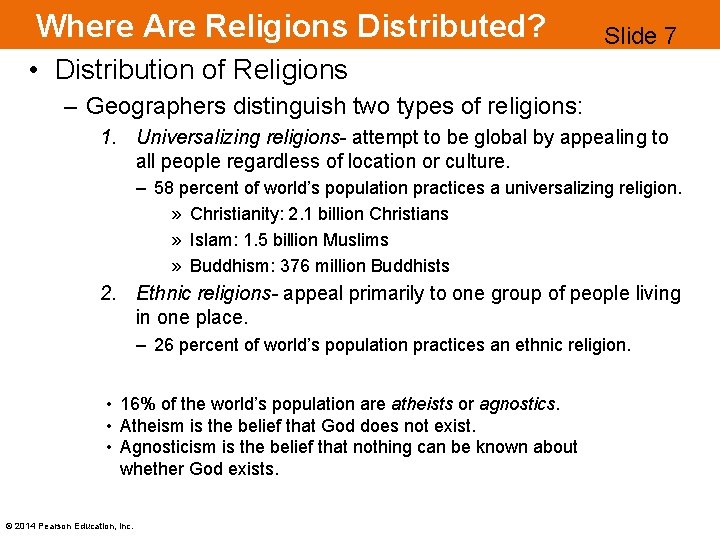
Where Are Religions Distributed? Slide 7 • Distribution of Religions – Geographers distinguish two types of religions: 1. Universalizing religions- attempt to be global by appealing to all people regardless of location or culture. – 58 percent of world’s population practices a universalizing religion. » Christianity: 2. 1 billion Christians » Islam: 1. 5 billion Muslims » Buddhism: 376 million Buddhists 2. Ethnic religions- appeal primarily to one group of people living in one place. – 26 percent of world’s population practices an ethnic religion. • 16% of the world’s population are atheists or agnostics. • Atheism is the belief that God does not exist. • Agnosticism is the belief that nothing can be known about whether God exists. © 2014 Pearson Education, Inc.
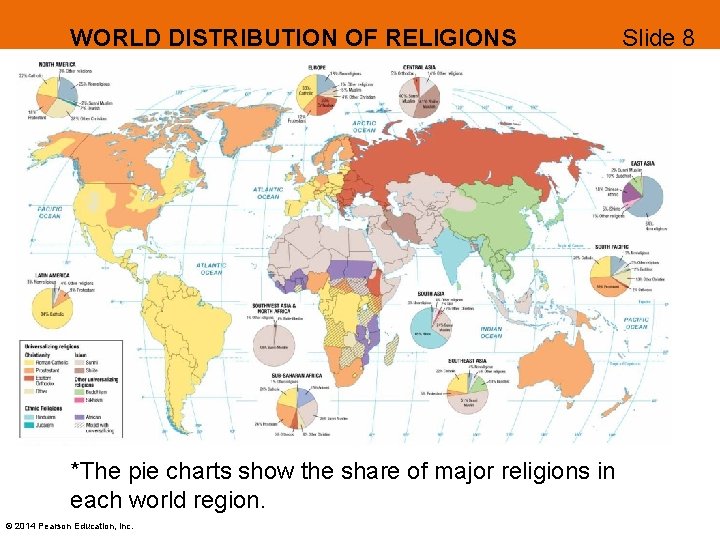
WORLD DISTRIBUTION OF RELIGIONS *The pie charts show the share of major religions in each world region. © 2014 Pearson Education, Inc. Slide 8
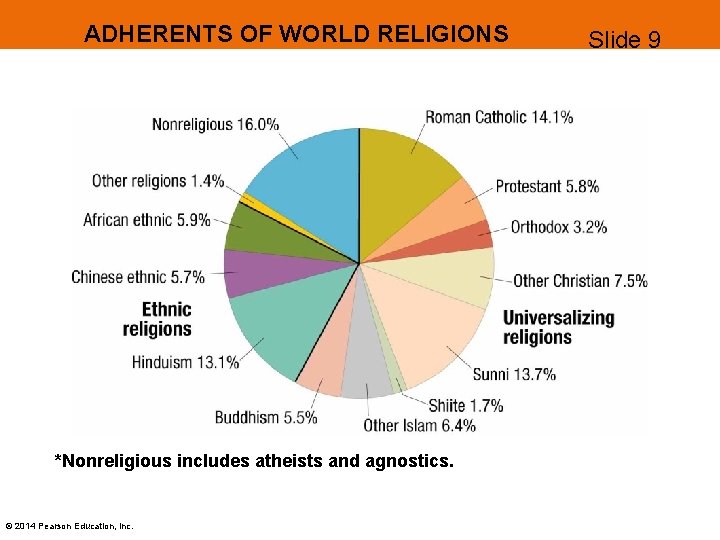
ADHERENTS OF WORLD RELIGIONS *Nonreligious includes atheists and agnostics. © 2014 Pearson Education, Inc. Slide 9
Where Are Religions Distributed? Slide 10 • Branches of Universalizing Religions – Three principal universalizing religions divided into branches, denominations, and sects. • A branch is a large and fundamental division within a religion. • A denomination is a division of a branch that unites a number of local congregations in a single legal and administrative body. • A sect is a relatively small group that has broken away from an established denomination. © 2014 Pearson Education, Inc.
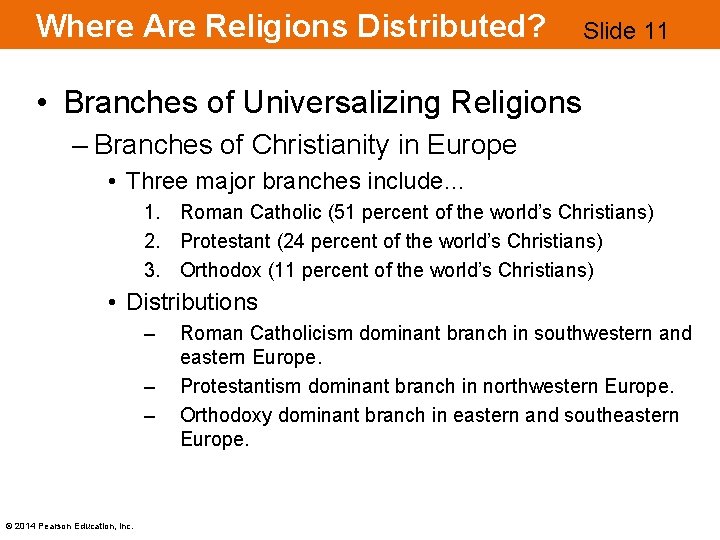
Where Are Religions Distributed? Slide 11 • Branches of Universalizing Religions – Branches of Christianity in Europe • Three major branches include… 1. Roman Catholic (51 percent of the world’s Christians) 2. Protestant (24 percent of the world’s Christians) 3. Orthodox (11 percent of the world’s Christians) • Distributions – – – © 2014 Pearson Education, Inc. Roman Catholicism dominant branch in southwestern and eastern Europe. Protestantism dominant branch in northwestern Europe. Orthodoxy dominant branch in eastern and southeastern Europe.
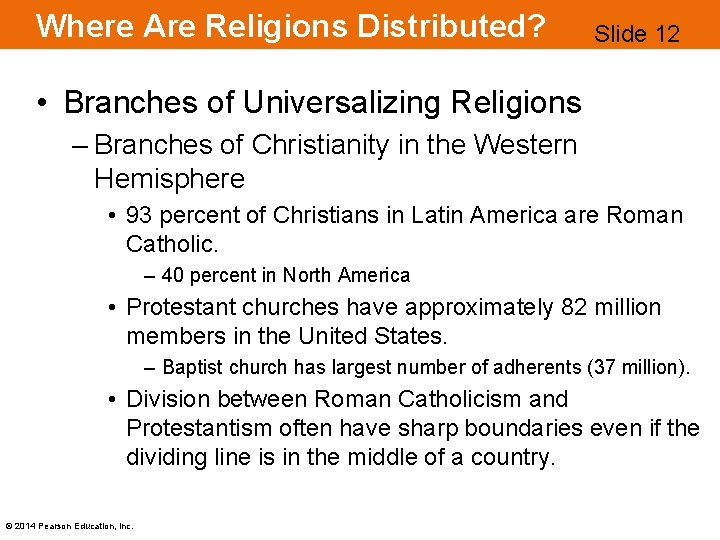
Where Are Religions Distributed? Slide 12 • Branches of Universalizing Religions – Branches of Christianity in the Western Hemisphere • 93 percent of Christians in Latin America are Roman Catholic. – 40 percent in North America • Protestant churches have approximately 82 million members in the United States. – Baptist church has largest number of adherents (37 million). • Division between Roman Catholicism and Protestantism often have sharp boundaries even if the dividing line is in the middle of a country. © 2014 Pearson Education, Inc.
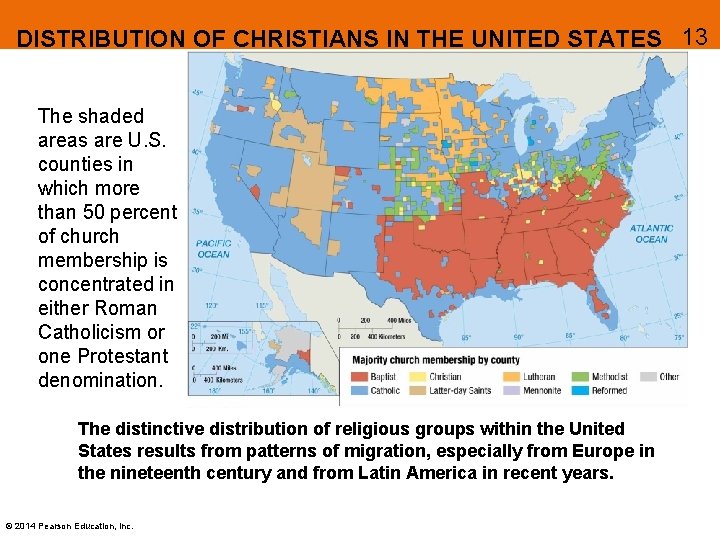
DISTRIBUTION OF CHRISTIANS IN THE UNITED STATES 13 The shaded areas are U. S. counties in which more than 50 percent of church membership is concentrated in either Roman Catholicism or one Protestant denomination. The distinctive distribution of religious groups within the United States results from patterns of migration, especially from Europe in the nineteenth century and from Latin America in recent years. © 2014 Pearson Education, Inc.
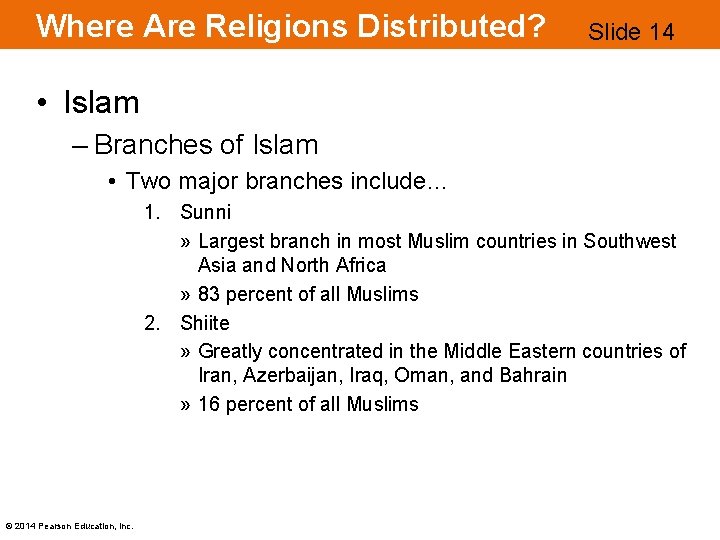
Where Are Religions Distributed? Slide 14 • Islam – Branches of Islam • Two major branches include… 1. Sunni » Largest branch in most Muslim countries in Southwest Asia and North Africa » 83 percent of all Muslims 2. Shiite » Greatly concentrated in the Middle Eastern countries of Iran, Azerbaijan, Iraq, Oman, and Bahrain » 16 percent of all Muslims © 2014 Pearson Education, Inc.
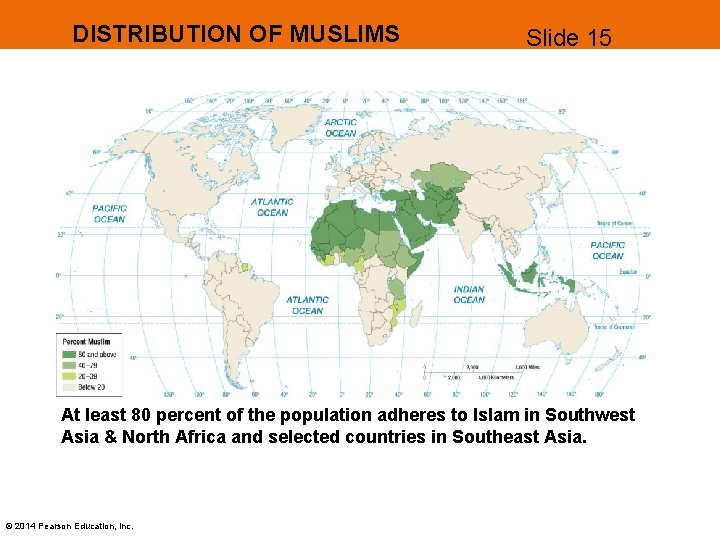
DISTRIBUTION OF MUSLIMS Slide 15 At least 80 percent of the population adheres to Islam in Southwest Asia & North Africa and selected countries in Southeast Asia. © 2014 Pearson Education, Inc.
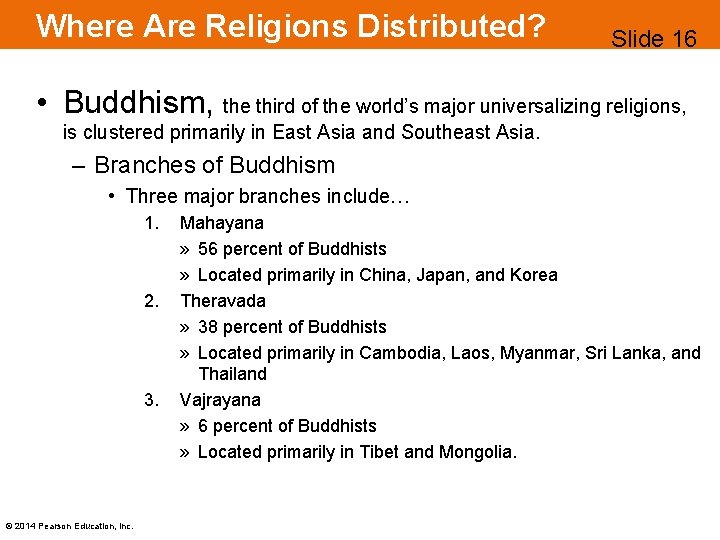
Where Are Religions Distributed? Slide 16 • Buddhism, the third of the world’s major universalizing religions, is clustered primarily in East Asia and Southeast Asia. – Branches of Buddhism • Three major branches include… 1. 2. 3. © 2014 Pearson Education, Inc. Mahayana » 56 percent of Buddhists » Located primarily in China, Japan, and Korea Theravada » 38 percent of Buddhists » Located primarily in Cambodia, Laos, Myanmar, Sri Lanka, and Thailand Vajrayana » 6 percent of Buddhists » Located primarily in Tibet and Mongolia.
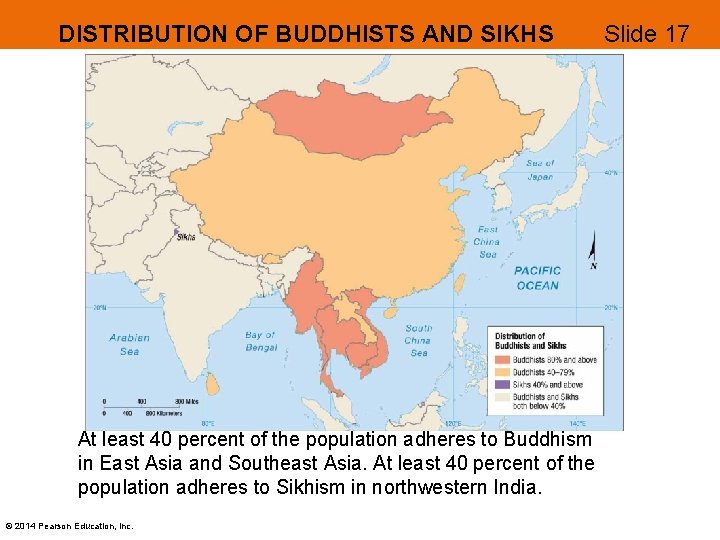
DISTRIBUTION OF BUDDHISTS AND SIKHS At least 40 percent of the population adheres to Buddhism in East Asia and Southeast Asia. At least 40 percent of the population adheres to Sikhism in northwestern India. © 2014 Pearson Education, Inc. Slide 17
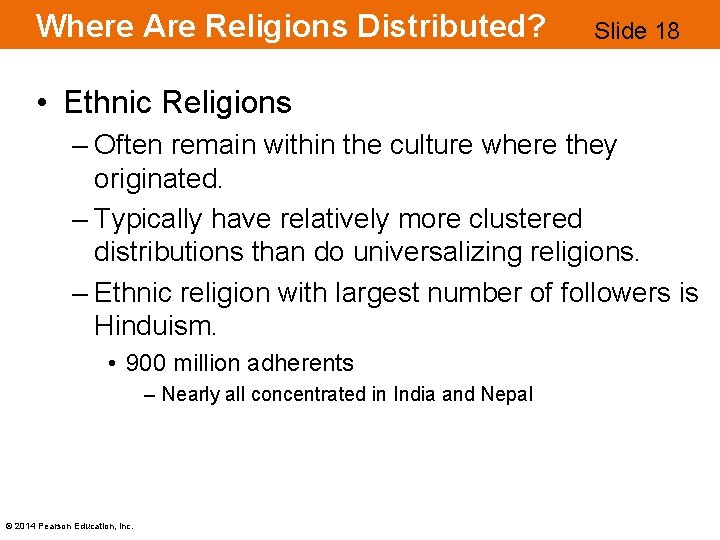
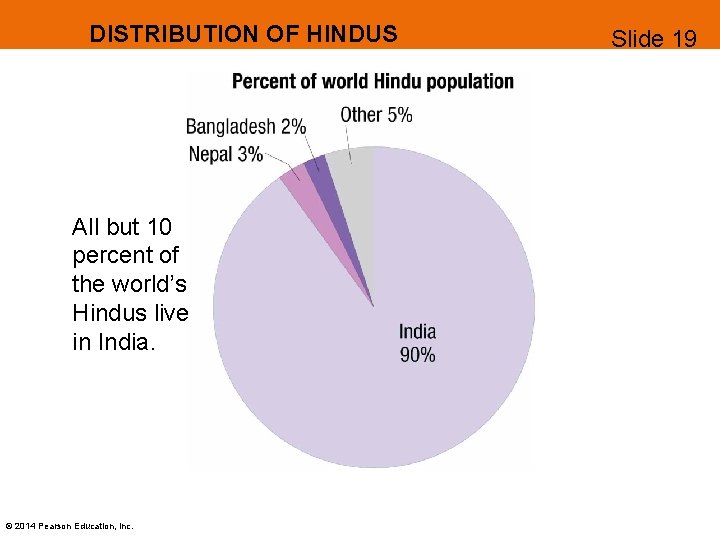
Where Are Religions Distributed? Slide 18 • Ethnic Religions – Often remain within the culture where they originated. – Typically have relatively more clustered distributions than do universalizing religions. – Ethnic religion with largest number of followers is Hinduism. • 900 million adherents – Nearly all concentrated in India and Nepal © 2014 Pearson Education, Inc.
DISTRIBUTION OF HINDUS All but 10 percent of the world’s Hindus live in India. © 2014 Pearson Education, Inc. Slide 19
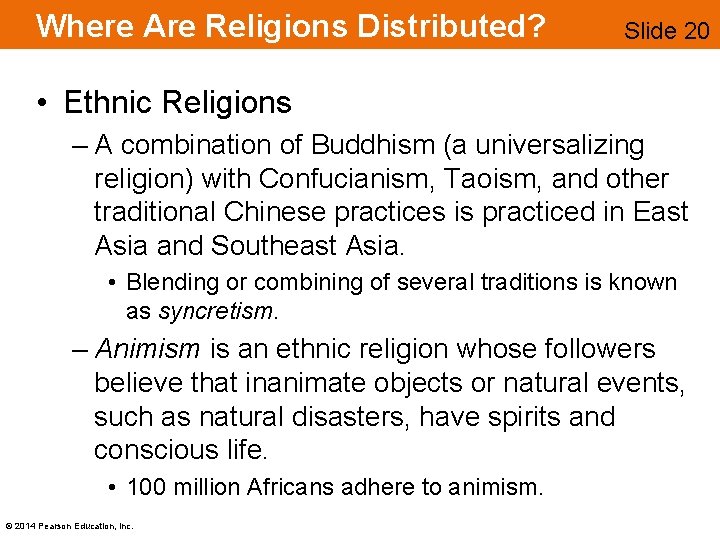
Where Are Religions Distributed? Slide 20 • Ethnic Religions – A combination of Buddhism (a universalizing religion) with Confucianism, Taoism, and other traditional Chinese practices is practiced in East Asia and Southeast Asia. • Blending or combining of several traditions is known as syncretism. – Animism is an ethnic religion whose followers believe that inanimate objects or natural events, such as natural disasters, have spirits and conscious life. • 100 million Africans adhere to animism. © 2014 Pearson Education, Inc.
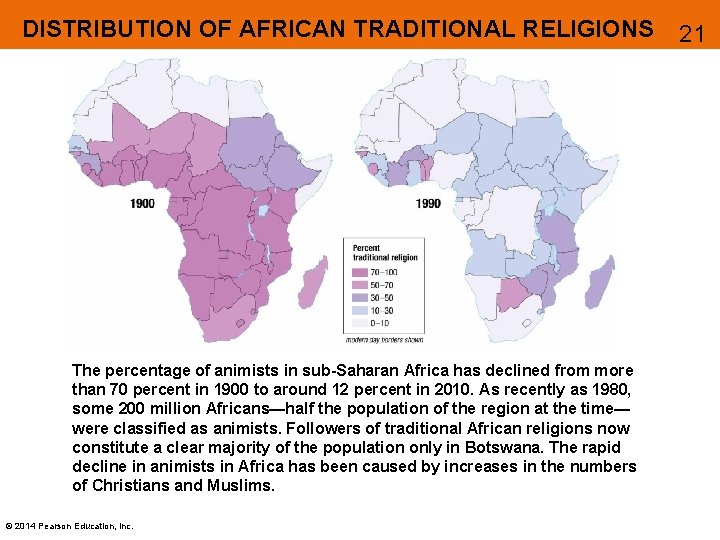
DISTRIBUTION OF AFRICAN TRADITIONAL RELIGIONS The percentage of animists in sub-Saharan Africa has declined from more than 70 percent in 1900 to around 12 percent in 2010. As recently as 1980, some 200 million Africans—half the population of the region at the time— were classified as animists. Followers of traditional African religions now constitute a clear majority of the population only in Botswana. The rapid decline in animists in Africa has been caused by increases in the numbers of Christians and Muslims. © 2014 Pearson Education, Inc. 21
Where Are Religions Distributed? Slide 22 • Ethnic Religions – Judaism • First recorded religion to espouse monotheism, belief that there is only one God. – Contrasts polytheism- the worship of a collection of gods. • Distribution – 2/5 live in the United States – 2/5 live in Israel. • Christianity and Islam find some of their roots in Judaism. © 2014 Pearson Education, Inc.
Why Do Religions Have Different Distributions? Slide 23 • Origins of Religions – Universalizing regions have precise places of origin. • Often based on events in the life of an influential man. – Ethnic religions not tied to single historical individual; often have unclear or unknown origins. – Buddhism • Founded: ~2, 500 years ago • Founder: Siddhartha Gautama • Origin: India © 2014 Pearson Education, Inc.
Why Do Religions Have Different Distributions? Slide 24 • Origins of Religions – Christianity • Founded: ~2, 000 years ago • Founding: Based on teachings of Jesus • Origin: Region located in present-day Palestine – Islam • Founded: ~1, 500 years ago • Founder: Prophet Muhammad • Origin: Makkah (Mecca) located in present-day Saudi Arabia © 2014 Pearson Education, Inc.
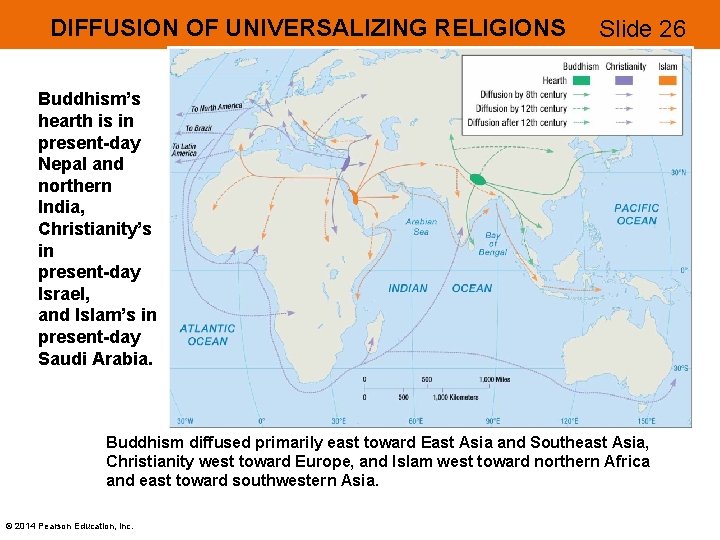
Why Do Religions Have Different Distributions? Slide 25 • Diffusion of Religions – Asia is home to each hearth for Christianity, Islam, and Buddhism. – Followers transmitted the messages preached in the hearths to people elsewhere. – Each of the three main universalizing religions has a distinct diffusion pattern. © 2014 Pearson Education, Inc.
DIFFUSION OF UNIVERSALIZING RELIGIONS Slide 26 Buddhism’s hearth is in present-day Nepal and northern India, Christianity’s in present-day Israel, and Islam’s in present-day Saudi Arabia. Buddhism diffused primarily east toward East Asia and Southeast Asia, Christianity west toward Europe, and Islam west toward northern Africa and east toward southwestern Asia. © 2014 Pearson Education, Inc.
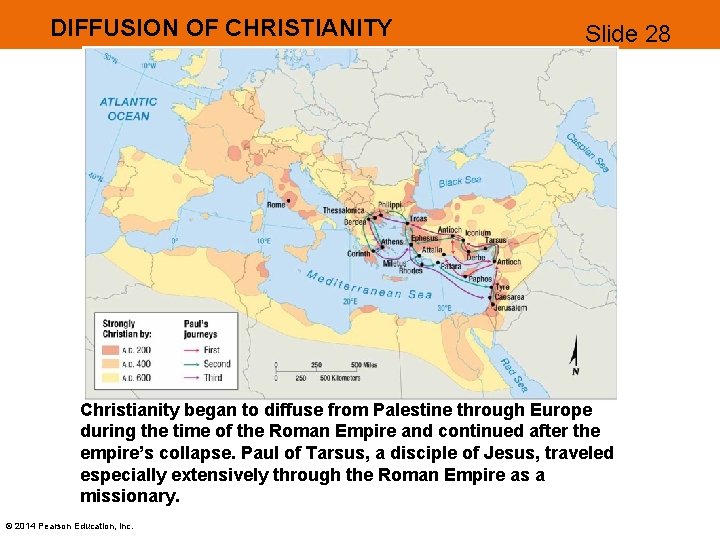
Why Do Religions Have Different Distributions? Slide 27 • Diffusion of Religions – Christianity • Hierarchical Diffusion – Emperor Constantine helped diffuse the religion throughout the Roman Empire by embracing Christianity. • Relocation Diffusion – Missionaries, individuals who help transmit a religion through relocation diffusion, initially diffused the religion along protected sea routes and the excellent Roman roads. – Migration and missionary activity by Europeans since 1500 have extended Christianity all over the world. » Permanent resettlement in the Americas, Australia, and New Zealand » Further diffusion was achieved by conversion of indigenous populations to Christianity. © 2014 Pearson Education, Inc.
DIFFUSION OF CHRISTIANITY Slide 28 Christianity began to diffuse from Palestine through Europe during the time of the Roman Empire and continued after the empire’s collapse. Paul of Tarsus, a disciple of Jesus, traveled especially extensively through the Roman Empire as a missionary. © 2014 Pearson Education, Inc.
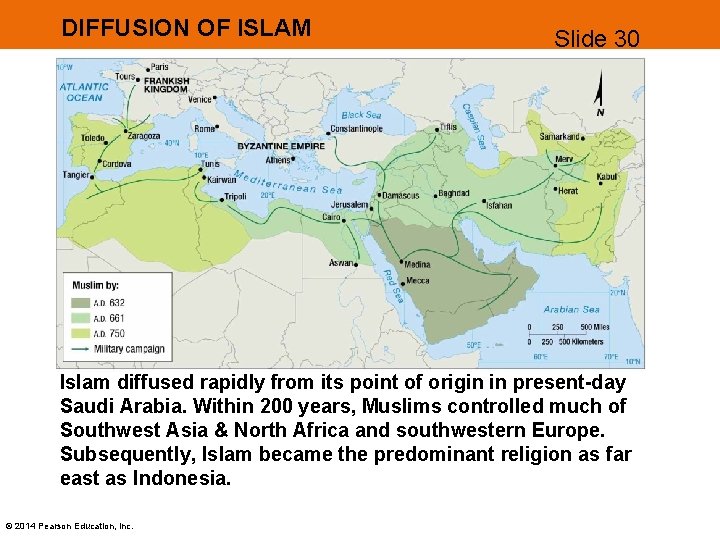
Why Do Religions Have Different Distributions? Slide 29 • Diffusion of Religions – Islam • Muhammad’s successors organized followers into armies and led a conquest to spread the religion over an extensive area of… – Africa – Asia – Europe • Relocation diffusion of missionaries to portions of sub. Saharan Africa and Southeast Asia transmitted the religion well beyond its hearth. © 2014 Pearson Education, Inc.
DIFFUSION OF ISLAM Slide 30 Islam diffused rapidly from its point of origin in present-day Saudi Arabia. Within 200 years, Muslims controlled much of Southwest Asia & North Africa and southwestern Europe. Subsequently, Islam became the predominant religion as far east as Indonesia. © 2014 Pearson Education, Inc.
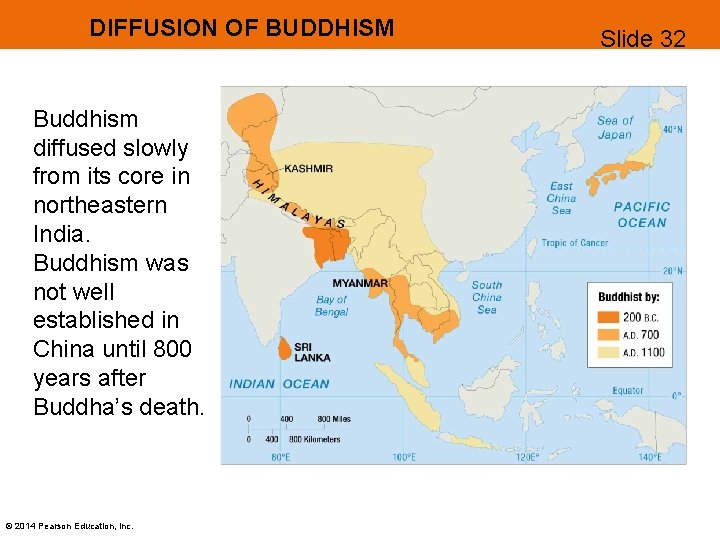
Why Do Religions Have Different Distributions? Slide 31 • Diffusion of Religions – Buddhism • Diffused relatively slowly from its origin in northeastern India. • Emperor Asoka accredited with much of its diffusion throughout the Magadhan Empire (273 to 232 B. C. ). – Missionaries sent to territories neighboring the empire. • Buddhism introduced to China along trade routes in the first century A. D. © 2014 Pearson Education, Inc.
DIFFUSION OF BUDDHISM Buddhism diffused slowly from its core in northeastern India. Buddhism was not well established in China until 800 years after Buddha’s death. © 2014 Pearson Education, Inc. Slide 32
Why Do Religions Have Different Distributions? Slide 33 • Diffusion of Religions – Ethnic Religions • Most have limited, if any, diffusion. – Lack missionaries • Diffusion to new places is possible, if adherents migrate for economic gains and are not forced to adopt a strongly entrenched universalizing religion. • Judaism’s diffusion is unlike other ethnic religions because it is practiced well beyond its place of origin. – Other nationalities have historically persecuted Jews living in their midst because of their retention of Judaism. © 2014 Pearson Education, Inc.
Why Do Religions Organize Space in Distinctive Patterns? Slide 34 • Sacred Space – Geographers study the impact on the landscape made by all religions. • Places of worship are sacred structures that physically anchor religion to landscape. – Christian Church » More significant role in Christianity than in other religions because of belief that building is the house of God. » Church traditionally largest and tallest building in a community. Additional significance given to it by locating it in a prominent location—e. g. , square or center of town » No single architectural style – Bahá’í Houses of Worship » Dispersed to different continents » Open to adherents of all religions © 2014 Pearson Education, Inc.
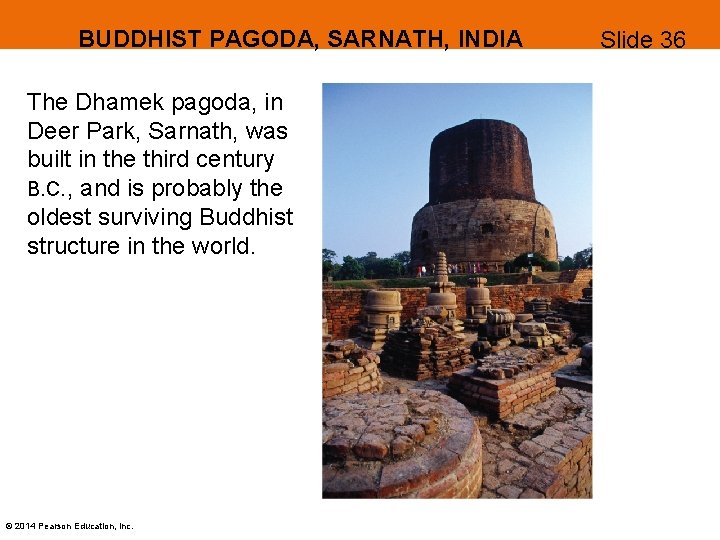
Why Do Religions Organize Space in Distinctive Patterns? Slide 35 • Sacred Space – Muslim Mosques » Space for community assembly » Not viewed as a sanctified place » Attention to cardinal directions is emphasized— e. g. , pulpit at end of a courtyard faces Makkah. » Distinctive feature is a minaret, a tower where a man known as a muezzin summons people to worship. – Buddhist Pagodas » Prominent and ornate element on landscape that often includes tall, many-sided towers arranged in a series of tiers, balconies, and slanting roofs. » Contain relics believed to be a portion of Buddha’s body or clothing. » Not designed for congregational worship. © 2014 Pearson Education, Inc.
BUDDHIST PAGODA, SARNATH, INDIA The Dhamek pagoda, in Deer Park, Sarnath, was built in the third century B. C. , and is probably the oldest surviving Buddhist structure in the world. © 2014 Pearson Education, Inc. Slide 36
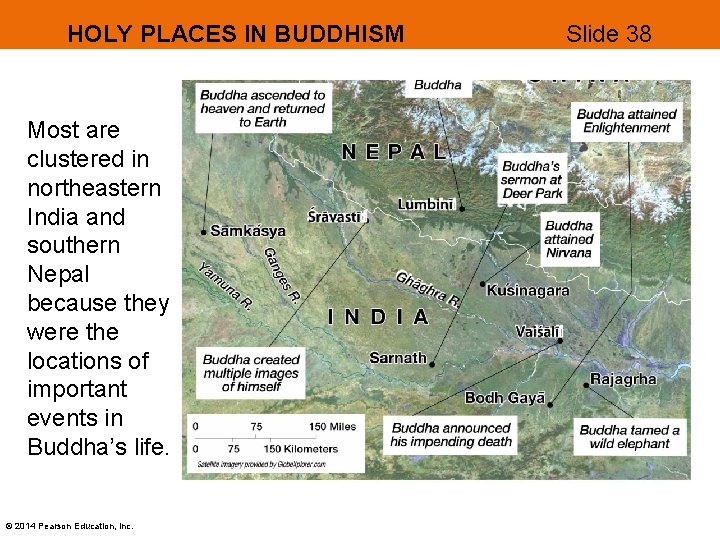
Why Do Religions Organize Space in Distinctive Patterns? Slide 37 • Sacred Places in Universalizing Religions – Cities and places associated with the founder’s life are endowed with holiness. • Not necessarily in close proximity of each other • Not needed to be related to any particular physical environment – Buddhism and Islam place most emphasis on identifying shrines that mark locations of important events in the life of Buddha or Muhammad. • Pilgrimages, journeys for religious purposes, are incorporated in Islamic doctrine. © 2014 Pearson Education, Inc.
HOLY PLACES IN BUDDHISM Most are clustered in northeastern India and southern Nepal because they were the locations of important events in Buddha’s life. © 2014 Pearson Education, Inc. Slide 38
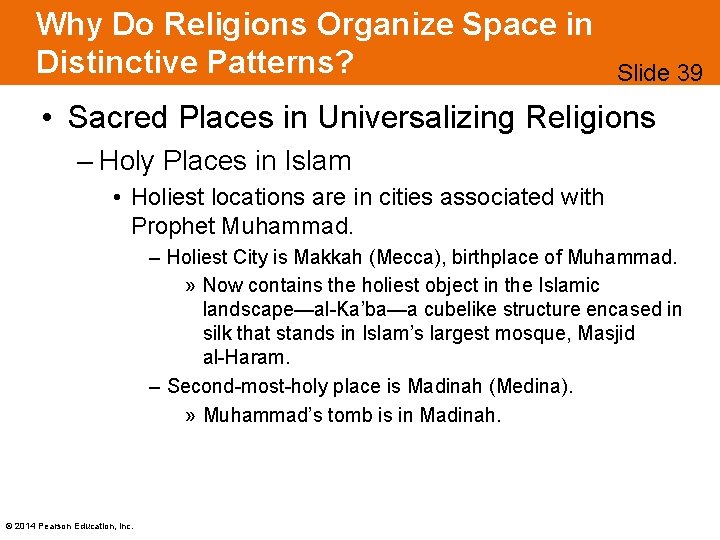
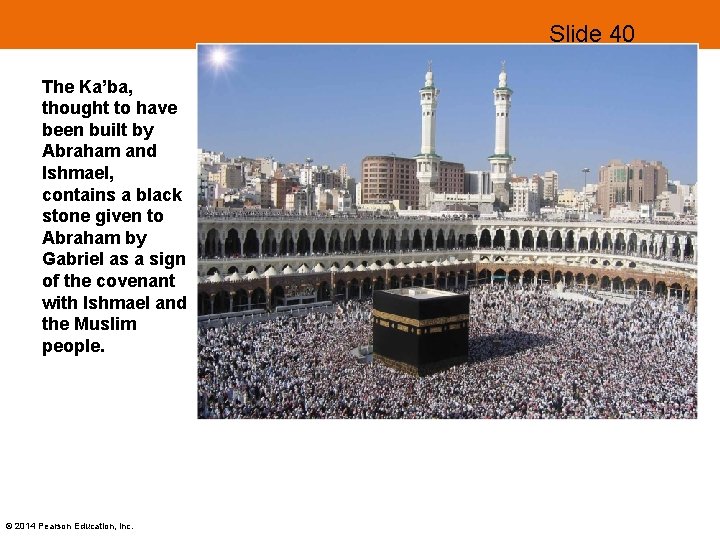
Why Do Religions Organize Space in Distinctive Patterns? Slide 39 • Sacred Places in Universalizing Religions – Holy Places in Islam • Holiest locations are in cities associated with Prophet Muhammad. – Holiest City is Makkah (Mecca), birthplace of Muhammad. » Now contains the holiest object in the Islamic landscape—al-Ka’ba—a cubelike structure encased in silk that stands in Islam’s largest mosque, Masjid al-Haram. – Second-most-holy place is Madinah (Medina). » Muhammad’s tomb is in Madinah. © 2014 Pearson Education, Inc.
Slide 40 The Ka’ba, thought to have been built by Abraham and Ishmael, contains a black stone given to Abraham by Gabriel as a sign of the covenant with Ishmael and the Muslim people. © 2014 Pearson Education, Inc.
Why Do Religions Organize Space in Distinctive Patterns? Slide 41 • The Landscape in Ethnic Religions – Ethnic religions are closely tied to the physical geography of a particular place. • Hindu Landscape – Hinduism closely tied to physical geography of India » Mt. Kailas is holy because it is home to Siva. » Holiest places are riverbanks and coastlines. » Hindus believe that they achieve purification by bathing in holy rivers—e. g. , Ganges River • Solstice – Special significance in some ethnic religions » Stonehenge is a prominent remnant of a pagan structure aligned so that sun rises between two stones on solstices. © 2014 Pearson Education, Inc.
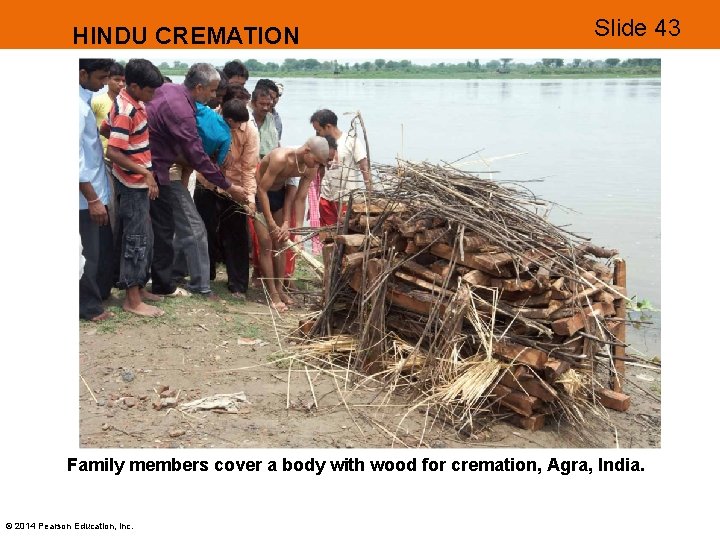
Why Do Religions Organize Space in Distinctive Patterns? Slide 42 • Disposing of the Dead – Climate, topography, and religious doctrine combine to create differences in practices to shelter the dead. • Burial – Christians, Muslims, and Jews typically bury the deceased in designated areas called cemeteries. » Cemeteries were typically only public open space in congested urban places prior to the nineteenth century. • Cremation – Hindus wash the bodies of the deceased with water from the Ganges River first, then burn them with a slow fire on a funeral pyre. © 2014 Pearson Education, Inc.
HINDU CREMATION Slide 43 Family members cover a body with wood for cremation, Agra, India. © 2014 Pearson Education, Inc.
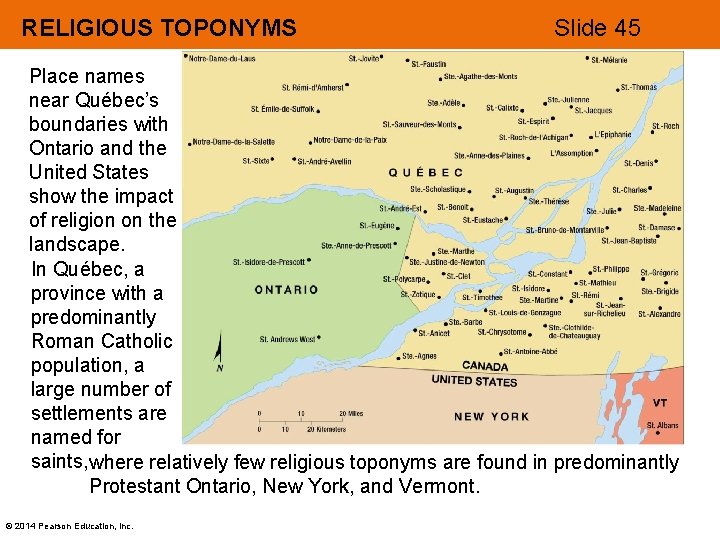
Why Do Religions Organize Space in Distinctive Patterns? Slide 44 • Religious Settlements and Place Names – Most human settlements serve an economic purpose, but some are established primarily for religious reasons. • Utopian settlement is an ideal community built around a religious way of life. – Salt Lake City culminated the utopian movement in the United States when it was built by the Mormons. – Layout of Salt Lake City is based on a plan of the city of Zion given to the church by the prophet Joseph Smith. – Roman Catholic immigrants have frequently given religious place names, or toponyms, to settlements primarily in the U. S. Southwest and Quebec. © 2014 Pearson Education, Inc.
RELIGIOUS TOPONYMS Slide 45 Place names near Québec’s boundaries with Ontario and the United States show the impact of religion on the landscape. In Québec, a province with a predominantly Roman Catholic population, a large number of settlements are named for saints, where relatively few religious toponyms are found in predominantly Protestant Ontario, New York, and Vermont. © 2014 Pearson Education, Inc.
Why Do Religions Organize Space in Distinctive Patterns? Slide 46 • The Calendar – Universalizing and ethnic religions approach the calendar differently. • Ethnic Religion – Holidays are closely aligned with natural events associated with the physical geography of the homeland. – Prominent feature is celebration of the seasons. » Closely tied to local agriculture • Universalizing Religion – Major holidays relate to events in the life of the founder rather than the seasons of one particular place. » Ramadan (Islam): part of five pillars of faith » Easter (Christian): resurrection of Jesus © 2014 Pearson Education, Inc.
Why Do Religions Organize Space in Distinctive Patterns? Slide 47 • Administration of Space – Universalizing religions must be connected to ensure consistency of doctrine. • Hierarchical Religions – Exemplifies a well-defined geographic structure and organizes territory into local administrative units. » Roman Catholic Church created administrative units on much of Earth’s inhabited land with each being headed by a leader who is accountable to the next higher-ordered leader. • Locally Autonomous Religions – Islam » No religious hierarchy » No formal territorial organization » Everyone is expected to participate in the rituals and is encouraged to pray privately. © 2014 Pearson Education, Inc.
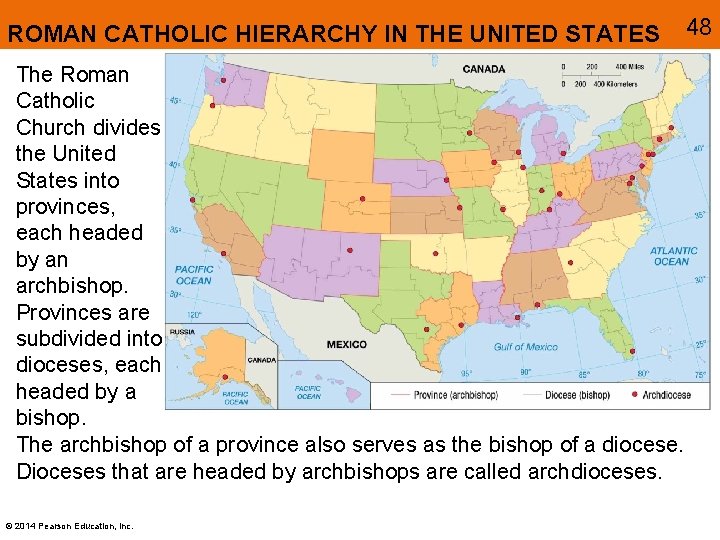
ROMAN CATHOLIC HIERARCHY IN THE UNITED STATES The Roman Catholic Church divides the United States into provinces, each headed by an archbishop. Provinces are subdivided into dioceses, each headed by a bishop. The archbishop of a province also serves as the bishop of a diocese. Dioceses that are headed by archbishops are called archdioceses. © 2014 Pearson Education, Inc. 48
Why Do Territorial Conflicts Arise among Religious Groups? Slide 49 • Religion versus Government Policies – Religious groups may oppose policies seen as contradicting their religious values. • Religion is element of cultural diversity that has led to most conflict in places. – Religious fundamentalism, a literal interpretation and strict adherence to basic principles of a religion, has spurred more intense conflict recently. • Taliban versus Western Values – Taliban’s control of Afghanistan’s government in the 1990 s led to strict laws opposing Western values. » “Western, non-Islamic” leisure activities banned » Ex: Soccer stadiums converted to settings for executions and floggings. © 2014 Pearson Education, Inc.
Why Do Territorial Conflicts Arise among Religious Groups? Slide 50 • Religion versus Religion – Conflicts most likely to occur at a boundary between two religious groups. • Religious Wars in Ireland – A small faction chose to join the United Kingdom when Ireland became independent in 1937. » 46 percent protestant and 40 percent Roman Catholic (2001) – Roman Catholics have been victimized by discriminatory practices, such as exclusion form higher-paying jobs and better schools. – Belfast, the capital city, is highly segregated. – Protests by Roman Catholics began in 1968 with bloodshed of both Protestants and Roman Catholics. © 2014 Pearson Education, Inc.
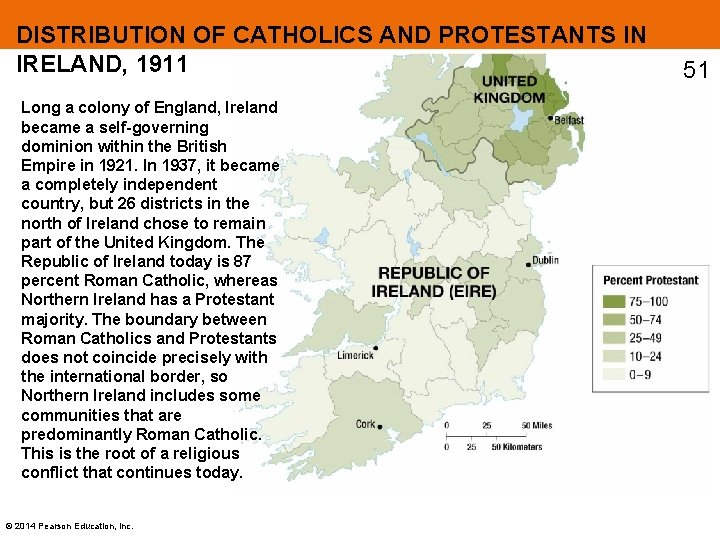
DISTRIBUTION OF CATHOLICS AND PROTESTANTS IN IRELAND, 1911 Long a colony of England, Ireland became a self-governing dominion within the British Empire in 1921. In 1937, it became a completely independent country, but 26 districts in the north of Ireland chose to remain part of the United Kingdom. The Republic of Ireland today is 87 percent Roman Catholic, whereas Northern Ireland has a Protestant majority. The boundary between Roman Catholics and Protestants does not coincide precisely with the international border, so Northern Ireland includes some communities that are predominantly Roman Catholic. This is the root of a religious conflict that continues today. © 2014 Pearson Education, Inc. 51
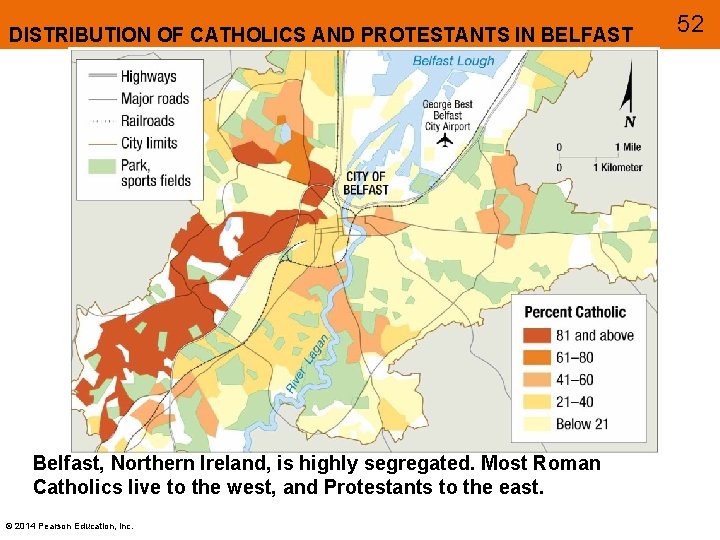
DISTRIBUTION OF CATHOLICS AND PROTESTANTS IN BELFAST Belfast, Northern Ireland, is highly segregated. Most Roman Catholics live to the west, and Protestants to the east. © 2014 Pearson Education, Inc. 52
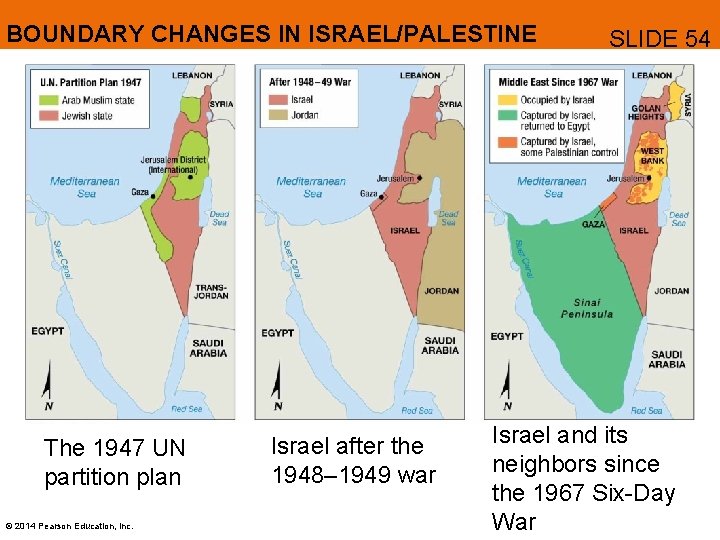
Why Do Territorial Conflicts Arise among Religious Groups? Slide 53 • Religious Wars in the Middle East – Conflict in the Middle East is among the world’s longest standing. • Jews, Christians, and Muslims have fought nearly 2, 000 years to control the same small strip of Land in the Eastern Mediterranean. – Judaism: special claim to the territory it calls the Promised Land where major events in the development in the religion occurred. – Islam: Muslim army conquered this land in seventh century A. D. Jerusalem is the third holiest city to Muslims, because it is believed to be where Muhammad ascended into heaven. – Christianity: considers it the Holy Land Jerusalem the Holy City, because the major events in Jesus’s life, death, and resurrection occurred there. • Although they can trace their origins to Abraham, the religions have diverged in ways that make cohabitation difficult. • To recapture the Holy Land from its Muslim conquerors, European Christians launched a series of military campaigns, known as the Crusades over 150 -year period. © 2014 Pearson Education, Inc.
BOUNDARY CHANGES IN ISRAEL/PALESTINE The 1947 UN partition plan © 2014 Pearson Education, Inc. Israel after the 1948– 1949 war SLIDE 54 Israel and its neighbors since the 1967 Six-Day War
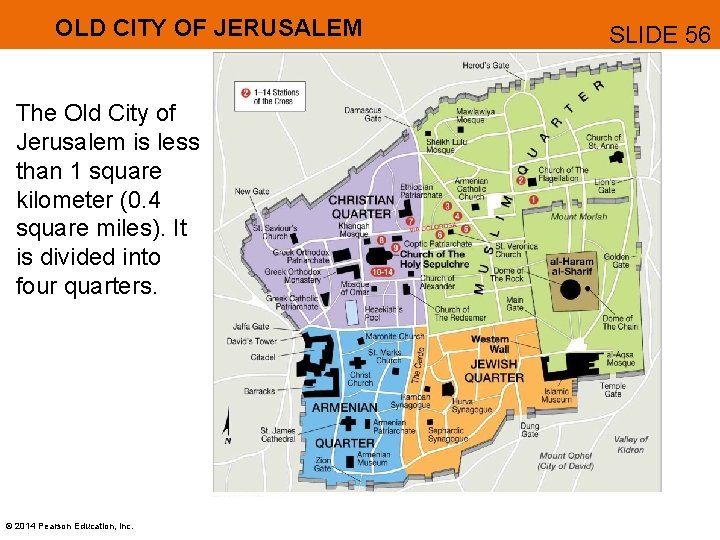
Why Do Territorial Conflicts Arise among Religious Groups? SLIDE 55 • Conflicting Perspectives of the Holy Land – After the 1973 war, the Palestinians emerged as Israel’s principal opponent. – Palestinians viewed themselves as the legitimate rulers of Israel. • Biggest obstacle to peace in the Middle East is the status of Jerusalem. – Peace will likely not be possible, if one religion has political control over Jerusalem. *Most sacred space for Muslims in Jerusalem was built on top of the most sacred space for Jews. © 2014 Pearson Education, Inc.
OLD CITY OF JERUSALEM The Old City of Jerusalem is less than 1 square kilometer (0. 4 square miles). It is divided into four quarters. © 2014 Pearson Education, Inc. SLIDE 56
Summary SLIDE 57 • The world has three large universalizing religions—Christianity, Islam, and Buddhism—each of which is divided into branches and denominations. • A universalizing religion has a known origin and clear patterns of diffusion, whereas ethnic religions typically have unknown origins and little diffusion. © 2014 Pearson Education, Inc.
Summary SLIDE 58 • Holy places and holidays in a universalizing religion are related to the events in the life of its founder or prophet. They are related to the local physical geography in an ethnic religion. • With the Earth’s surface dominated by four large religions, expansion of the territory occupied by one religion may reduce the territory of another. © 2014 Pearson Education, Inc.