
Chapter 6 Lecture Outline Prepared by Ashlyn Smith
Chapter 6 Lecture Outline Prepared by Ashlyn Smith Anderson University 1 Copyright © Mc. Graw-Hill Education. Permission required for reproduction or display.
6. 1 Mixtures • Pure substances— elements, covalent compounds, and ionic compounds. • Most matter we come into contact with is a mixture of two or more pure substances. • A heterogeneous mixture does not have a uniform composition throughout the sample. • A homogeneous mixture has a uniform composition throughout the sample. 2
6. 1 Mixtures A. Solutions • A solution is a homogeneous mixture that contains small particles. Liquid solutions are transparent. • Solutions consist of two parts: 1. The solute is the substance present in a lesser amount. 2. The solvent is the substance present in a larger amount. • An aqueous solution has water as the solvent. 3
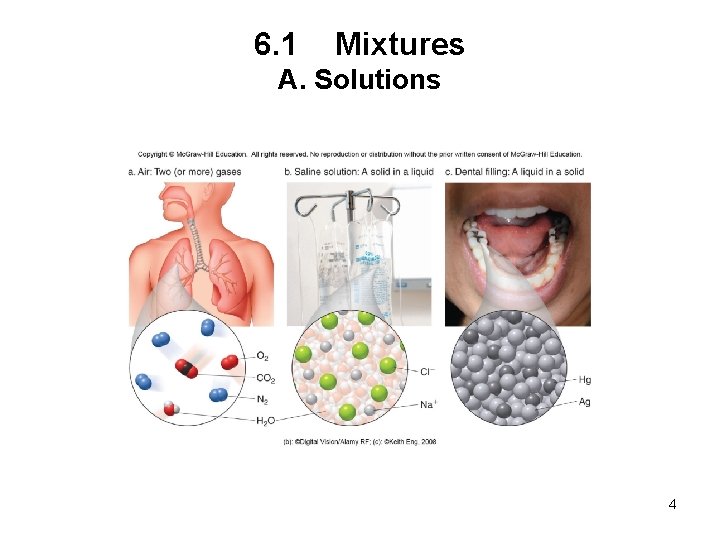
6. 1 Mixtures A. Solutions 4

6. 2 Electrolytes and Nonelectrolytes A. Classification • A substance that conducts an electric current in water is called an electrolyte. Na. Cl(aq) dissociates into Na+(aq) and Cl−(aq) • A substance that does not conduct an electric current in water is called a nonelectrolyte. H 2 O 2 does not dissociate 5

6. 2 Electrolytes and Nonelectrolytes A. Classification • A strong electrolyte dissociates completely in water to form ions. • A weak electrolyte dissociates partially in water to form some ions, leaving mostly uncharged molecules. 6
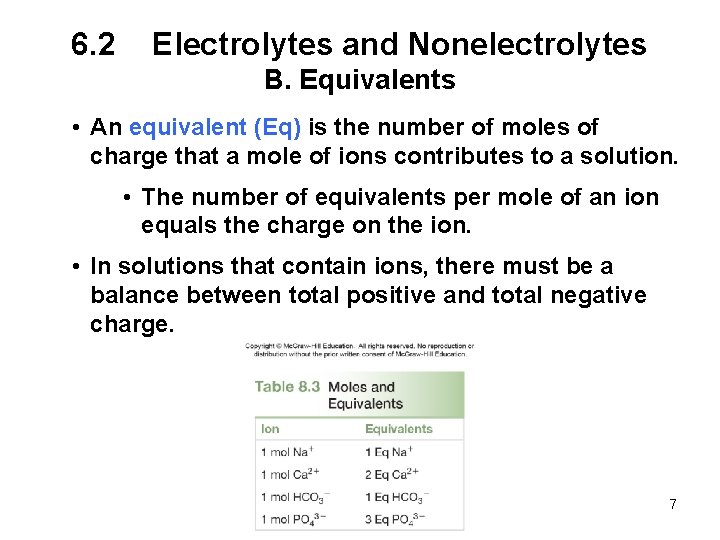
6. 2 Electrolytes and Nonelectrolytes B. Equivalents • An equivalent (Eq) is the number of moles of charge that a mole of ions contributes to a solution. • The number of equivalents per mole of an ion equals the charge on the ion. • In solutions that contain ions, there must be a balance between total positive and total negative charge. 7
6. 3 Solubility—General Features • Solubility is the amount of solute that dissolves in a given amount of solvent. • It is usually reported in grams of solute per 100 m. L of solution (g/100 m. L). • A saturated solution contains the maximum number of grams of solute that can dissolve. • An unsaturated solution contains less than the maximum number of grams of solute that can dissolve. 8
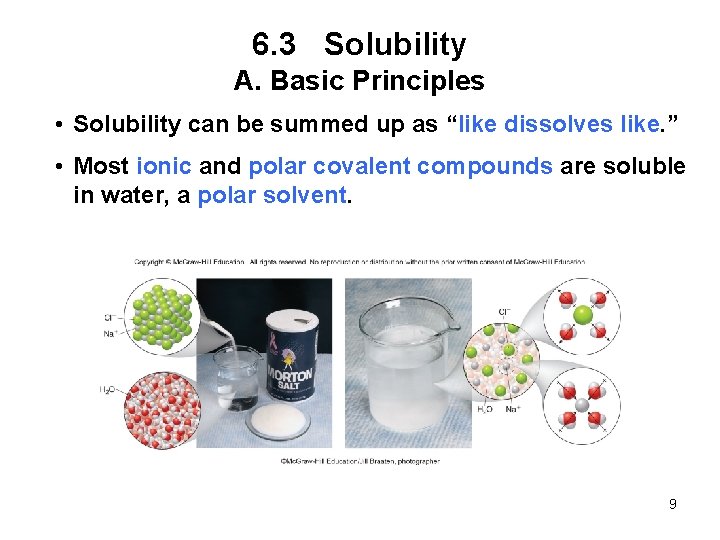
6. 3 Solubility A. Basic Principles • Solubility can be summed up as “like dissolves like. ” • Most ionic and polar covalent compounds are soluble in water, a polar solvent. 9
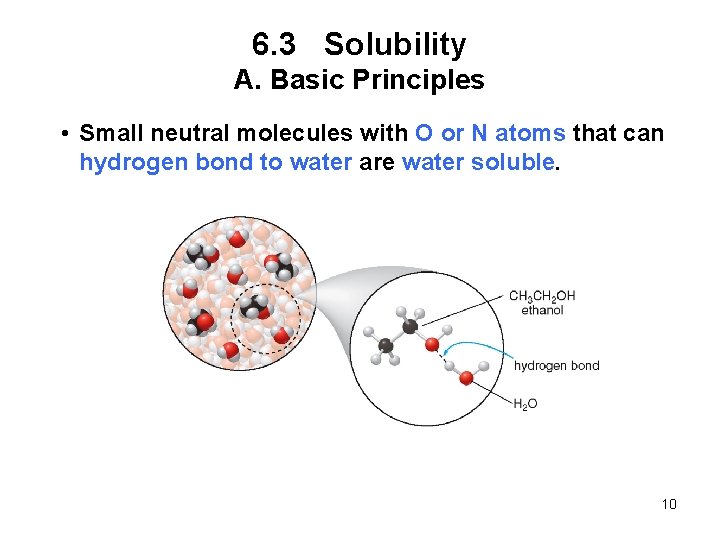
6. 3 Solubility A. Basic Principles • Small neutral molecules with O or N atoms that can hydrogen bond to water are water soluble. 10
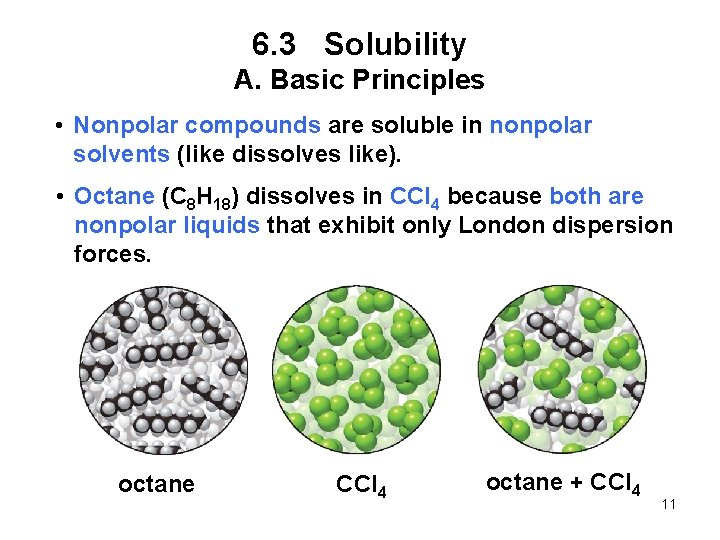
6. 3 Solubility A. Basic Principles • Nonpolar compounds are soluble in nonpolar solvents (like dissolves like). • Octane (C 8 H 18) dissolves in CCl 4 because both are nonpolar liquids that exhibit only London dispersion forces. octane CCl 4 octane + CCl 4 11
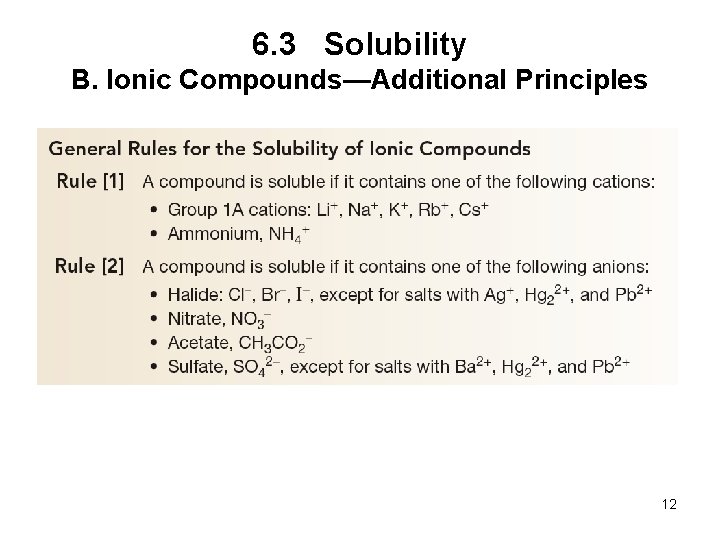
6. 3 Solubility B. Ionic Compounds—Additional Principles 12
6. 4 Solubility-- Effects of T and P A. Temperature (T) Effects • For most ionic and molecular solids, solubility generally increases as temperature increases. • By dissolving a solid in a solvent at high temperature and allowing it to cool slowly, a supersaturated solution can be made. • A supersaturated solution contains more than the predicted maximum amount of solute at a given temperature. • The solubility of a gas decreases with increasing temperature. 13
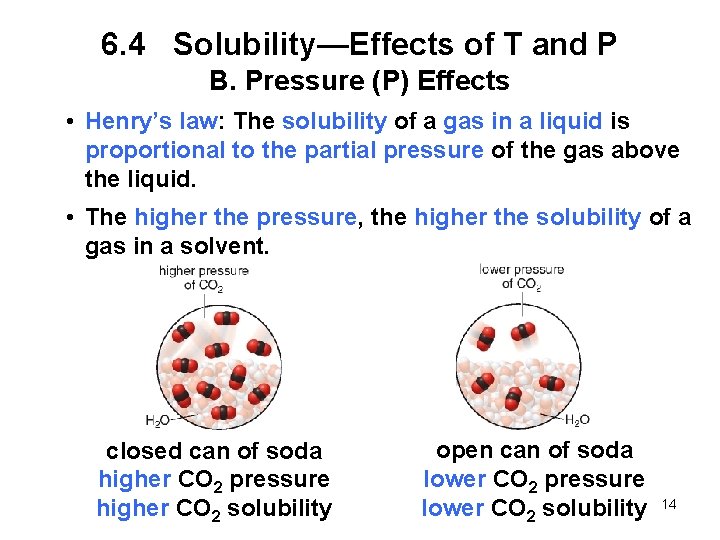
6. 4 Solubility—Effects of T and P B. Pressure (P) Effects • Henry’s law: The solubility of a gas in a liquid is proportional to the partial pressure of the gas above the liquid. • The higher the pressure, the higher the solubility of a gas in a solvent. closed can of soda higher CO 2 pressure higher CO 2 solubility open can of soda lower CO 2 pressure lower CO 2 solubility 14
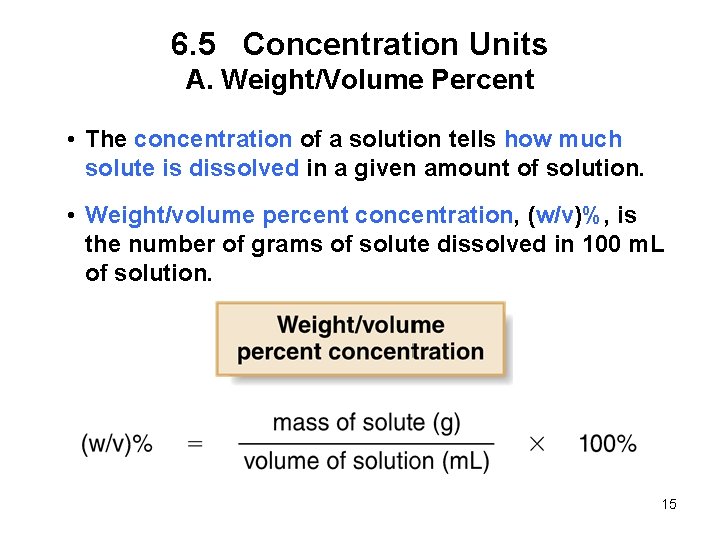
6. 5 Concentration Units A. Weight/Volume Percent • The concentration of a solution tells how much solute is dissolved in a given amount of solution. • Weight/volume percent concentration, (w/v)%, is the number of grams of solute dissolved in 100 m. L of solution. 15
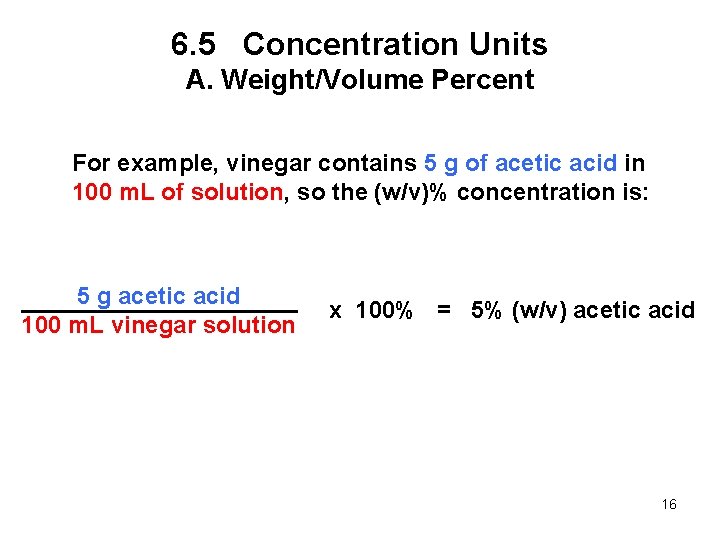
6. 5 Concentration Units A. Weight/Volume Percent For example, vinegar contains 5 g of acetic acid in 100 m. L of solution, so the (w/v)% concentration is: 5 g acetic acid 100 m. L vinegar solution x 100% = 5% (w/v) acetic acid 16
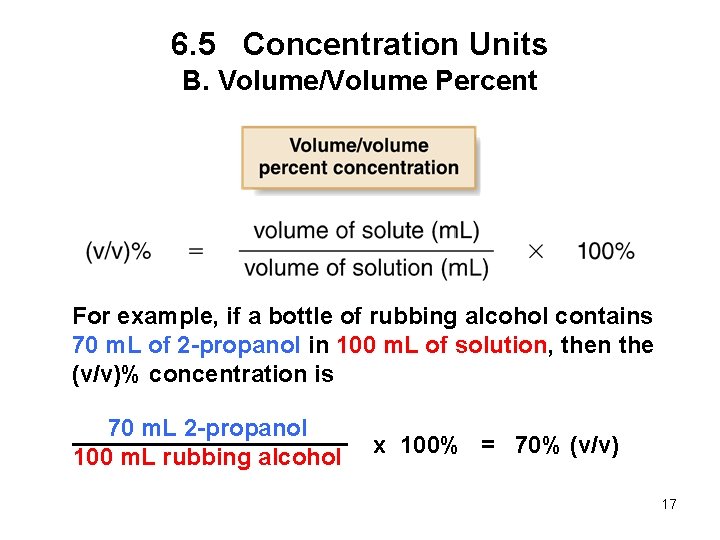
6. 5 Concentration Units B. Volume/Volume Percent For example, if a bottle of rubbing alcohol contains 70 m. L of 2 -propanol in 100 m. L of solution, then the (v/v)% concentration is 70 m. L 2 -propanol 100 m. L rubbing alcohol x 100% = 70% (v/v) 17
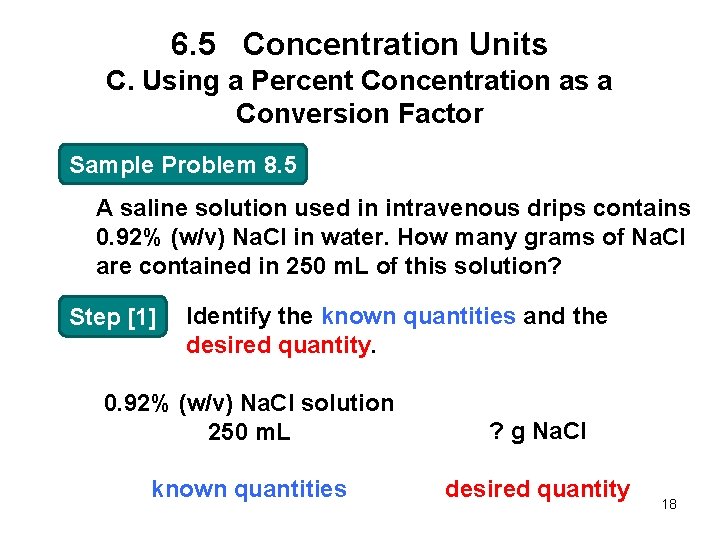
6. 5 Concentration Units C. Using a Percent Concentration as a Conversion Factor Sample Problem 8. 5 A saline solution used in intravenous drips contains 0. 92% (w/v) Na. Cl in water. How many grams of Na. Cl are contained in 250 m. L of this solution? Step [1] Identify the known quantities and the desired quantity. 0. 92% (w/v) Na. Cl solution 250 m. L ? g Na. Cl known quantities desired quantity 18
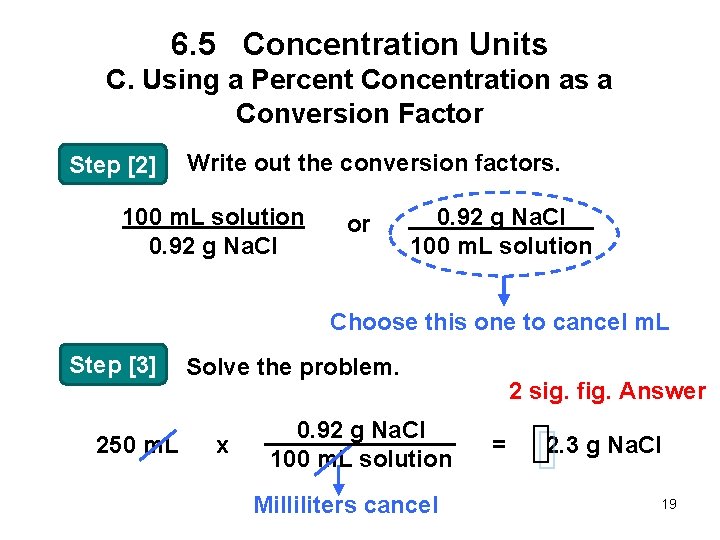
6. 5 Concentration Units C. Using a Percent Concentration as a Conversion Factor Step [2] Write out the conversion factors. 100 m. L solution 0. 92 g Na. Cl or 0. 92 g Na. Cl 100 m. L solution Choose this one to cancel m. L Step [3] 250 m. L Solve the problem. x 0. 92 g Na. Cl 100 m. L solution Milliliters cancel 2 sig. fig. Answer = 2. 3 g Na. Cl 19
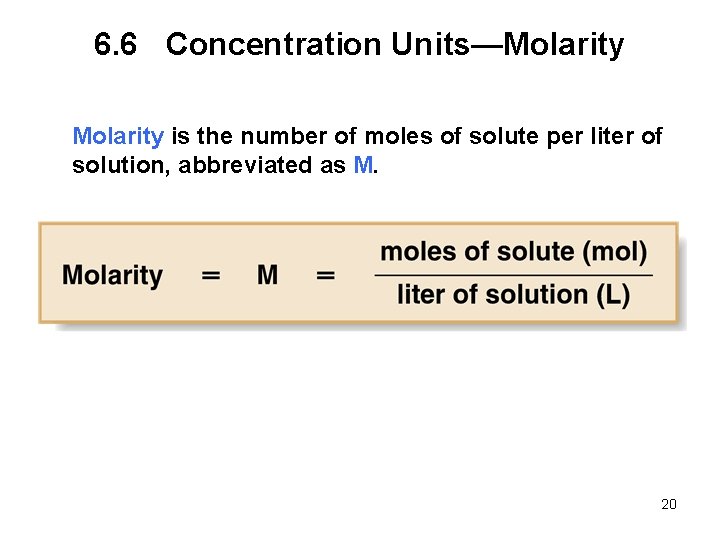
6. 6 Concentration Units—Molarity is the number of moles of solute per liter of solution, abbreviated as M. 20
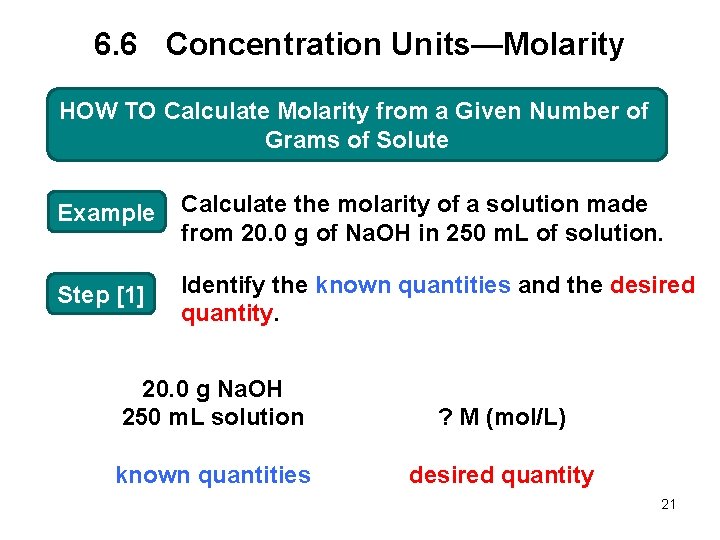
6. 6 Concentration Units—Molarity HOW TO Calculate Molarity from a Given Number of Grams of Solute Example Calculate the molarity of a solution made from 20. 0 g of Na. OH in 250 m. L of solution. Step [1] Identify the known quantities and the desired quantity. 20. 0 g Na. OH 250 m. L solution ? M (mol/L) known quantities desired quantity 21
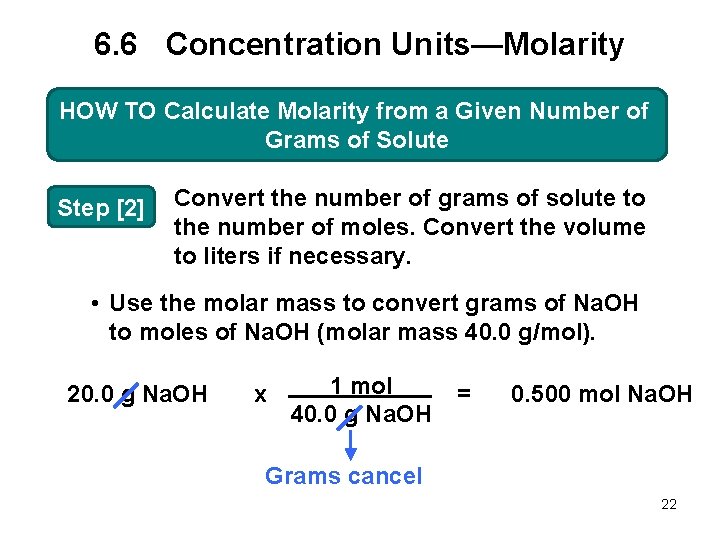
6. 6 Concentration Units—Molarity HOW TO Calculate Molarity from a Given Number of Grams of Solute Step [2] Convert the number of grams of solute to the number of moles. Convert the volume to liters if necessary. • Use the molar mass to convert grams of Na. OH to moles of Na. OH (molar mass 40. 0 g/mol). 20. 0 g Na. OH x 1 mol 40. 0 g Na. OH = 0. 500 mol Na. OH Grams cancel 22
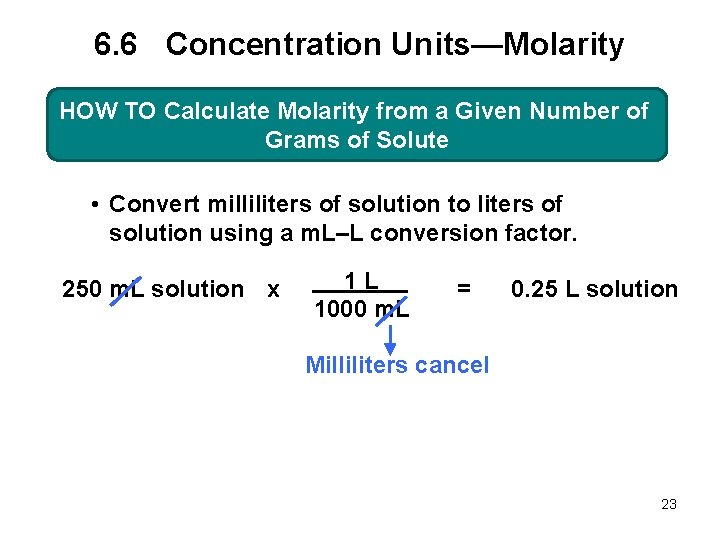
6. 6 Concentration Units—Molarity HOW TO Calculate Molarity from a Given Number of Grams of Solute • Convert milliliters of solution to liters of solution using a m. L–L conversion factor. 250 m. L solution x 1 L 1000 m. L = 0. 25 L solution Milliliters cancel 23
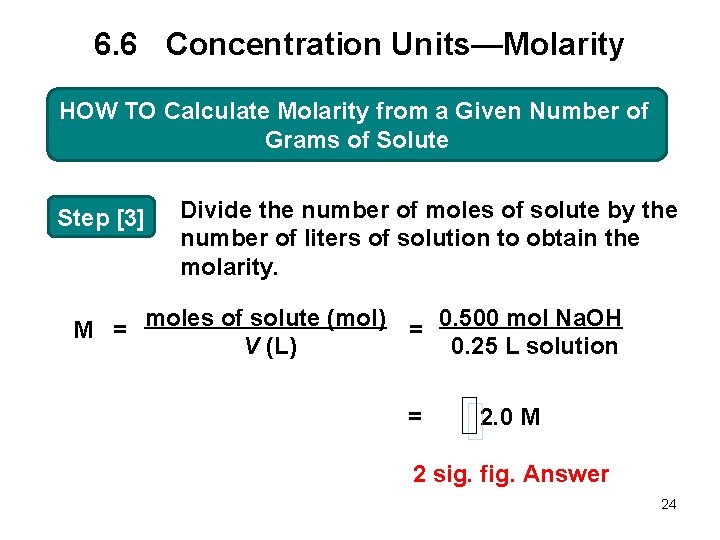
6. 6 Concentration Units—Molarity HOW TO Calculate Molarity from a Given Number of Grams of Solute Step [3] Divide the number of moles of solute by the number of liters of solution to obtain the molarity. M = moles of solute (mol) = 0. 500 mol Na. OH V (L) 0. 25 L solution = 2. 0 M 2 sig. fig. Answer 24
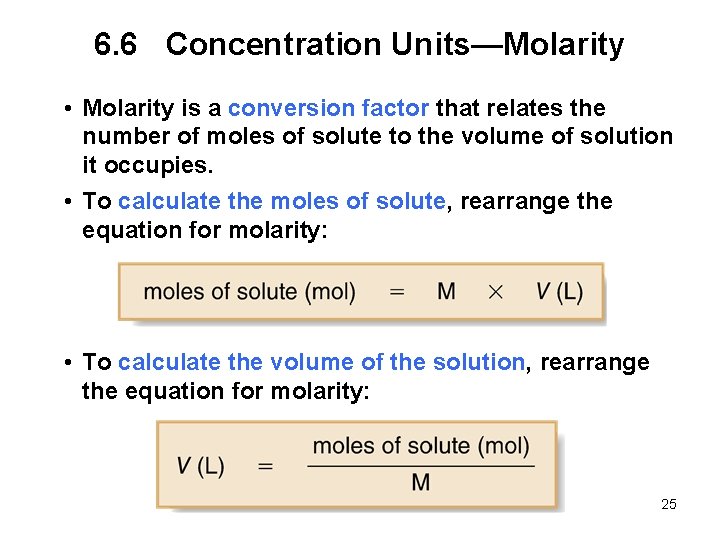
6. 6 Concentration Units—Molarity • Molarity is a conversion factor that relates the number of moles of solute to the volume of solution it occupies. • To calculate the moles of solute, rearrange the equation for molarity: • To calculate the volume of the solution, rearrange the equation for molarity: 25
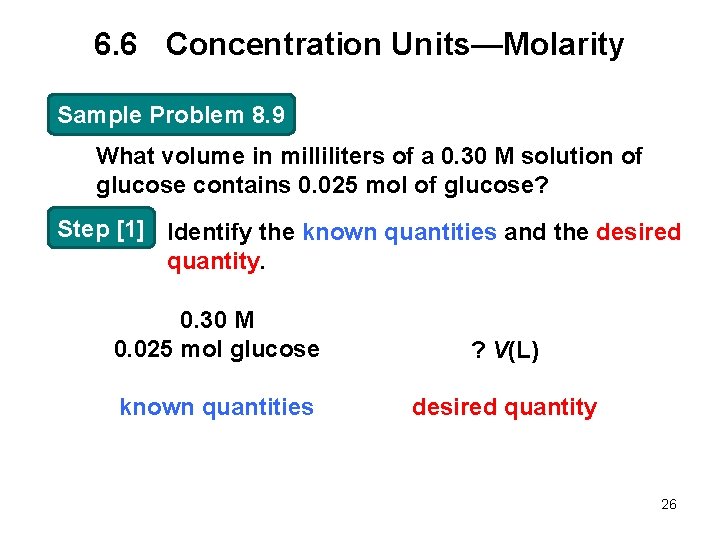
6. 6 Concentration Units—Molarity Sample Problem 8. 9 What volume in milliliters of a 0. 30 M solution of glucose contains 0. 025 mol of glucose? Step [1] Identify the known quantities and the desired quantity. 0. 30 M 0. 025 mol glucose ? V(L) known quantities desired quantity 26
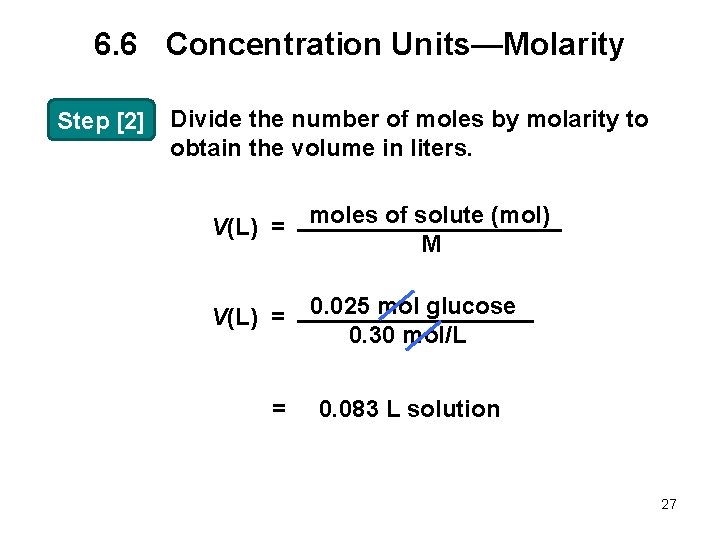
6. 6 Concentration Units—Molarity Step [2] Divide the number of moles by molarity to obtain the volume in liters. V(L) = moles of solute (mol) M V(L) = = 0. 025 mol glucose 0. 30 mol/L 0. 083 L solution 27
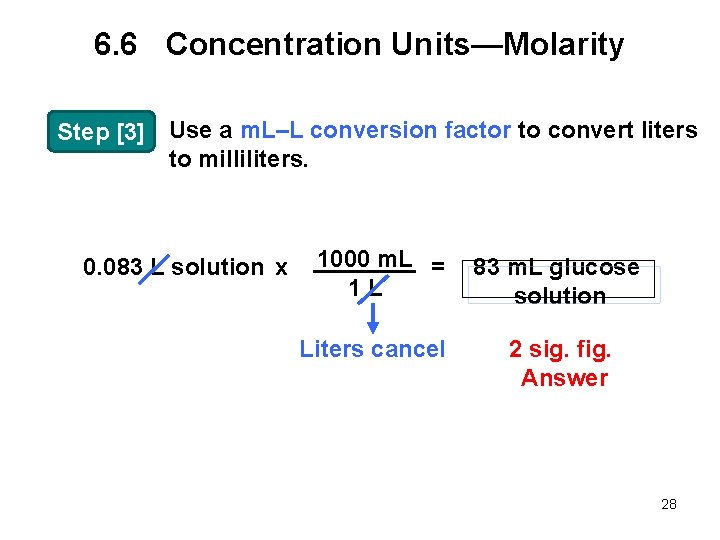
6. 6 Concentration Units—Molarity Step [3] Use a m. L–L conversion factor to convert liters to milliliters. 0. 083 L solution x 1000 m. L = 1 L Liters cancel 83 m. L glucose solution 2 sig. fig. Answer 28
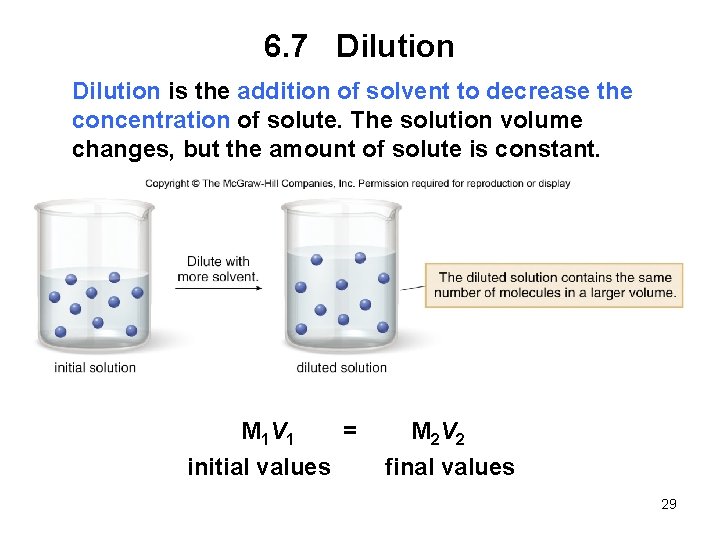
6. 7 Dilution is the addition of solvent to decrease the concentration of solute. The solution volume changes, but the amount of solute is constant. M 1 V 1 = initial values M 2 V 2 final values 29
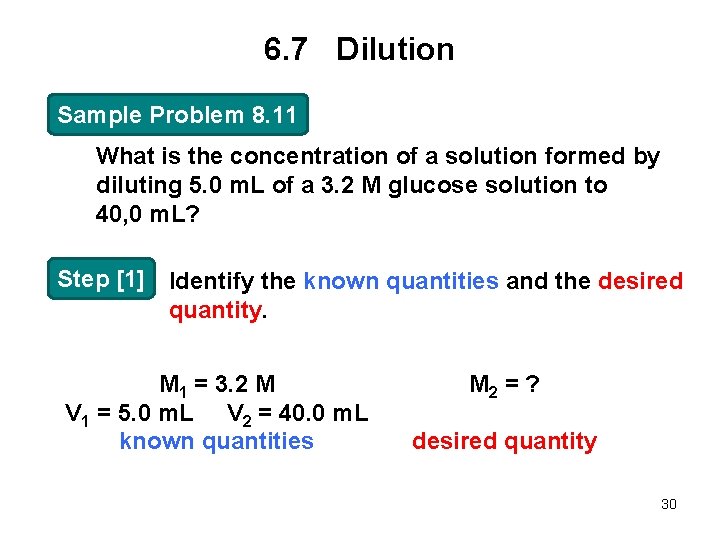
6. 7 Dilution Sample Problem 8. 11 What is the concentration of a solution formed by diluting 5. 0 m. L of a 3. 2 M glucose solution to 40, 0 m. L? Step [1] Identify the known quantities and the desired quantity. M 1 = 3. 2 M V 1 = 5. 0 m. L V 2 = 40. 0 m. L known quantities M 2 = ? desired quantity 30
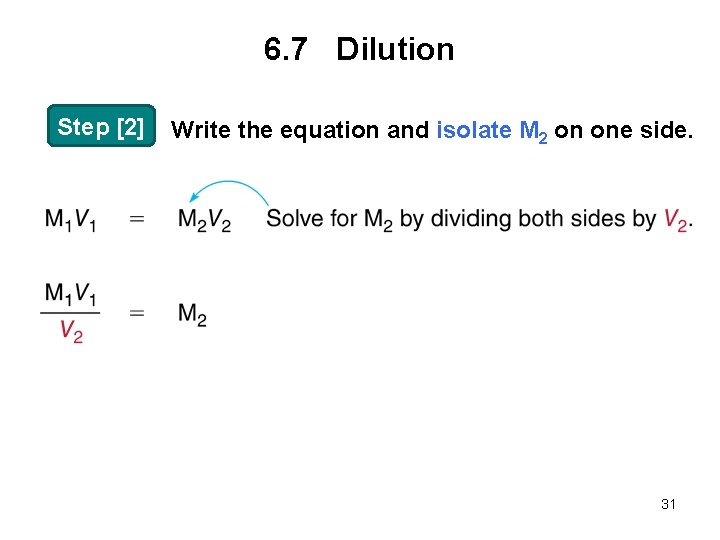
6. 7 Dilution Step [2] Write the equation and isolate M 2 on one side. 31
- Slides: 31