
Chapter 6 Lecture Body Composition 2014 Pearson Education
Chapter 6 Lecture Body Composition © 2014 Pearson Education, Inc.
Learning Objectives • Define body composition • Explain the relationship between body fat percentage and disease risk • Explain the concept of optimal body weight • Discuss the importance of assessing body composition • Explain body composition assessment using hydrostatic weighing, the skinfold test, body mass index, and waist-to-hip circumference ratio © 2014 Pearson Education, Inc.
Body Composition • The relative amounts of fat and fat-free tissues (bone, muscle, organs) in the body • Expressed as percentage of fat in the body – Overweight – body fat percentage above the recommended level – Obesity – >25% body fat for men – >35% body fat for women © 2014 Pearson Education, Inc.
Body Composition Relationship to Health Essential Fat • Located in nerves and cell membranes • Necessary for body functioning • 3% for men • 12% for women Storage Fat • Located in adipose tissue • visceral (around organs) • subcutaneous (below the skin) • 8– 19% for men, recommended low end of 12– 15% for young adult • 21– 32% for women, recommended low end of 21– 25% for young adult © 2014 Pearson Education, Inc.

Storage Fat © 2014 Pearson Education, Inc.

Body Composition Relationship to Health Android Pattern of Obesity • Fat is primarily stored in upper body and around the waist • Most common in men • Greater risk of developing heart disease and diabetes Gynoid Pattern of Obesity • Fat is primarily stored in waist, hips, and thighs • Most common in women © 2014 Pearson Education, Inc.
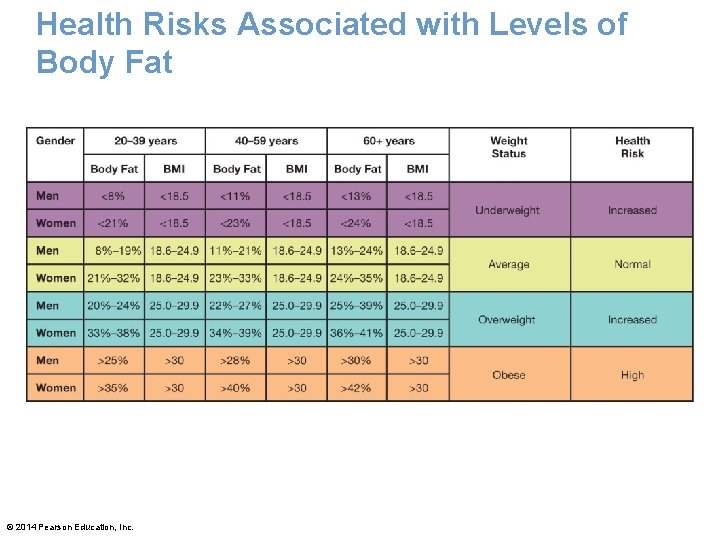
Health Risks Associated with Levels of Body Fat © 2014 Pearson Education, Inc.
Overweight and Obesity in the United States • Current obesity estimates – 34% of adults – 17% of children/adolescents ( 2– 19 yrs. ) • NIH estimates obesity directly contributes to 15– 20% of deaths in United States • Contributes significant effect on health care costs – 10% of all medical costs in United States – $147 billion per year direct medical costs – predicted to rise sharply in future • WHO indicates U. S. obesity rates highest in world – in 2010 every state had 20% or higher obesity rate – 36 states 25% or more – 12 states 30% or more • Adult rates are leveling off • Childhood obesity rates show NO evidence of decreasing © 2014 Pearson Education, Inc.
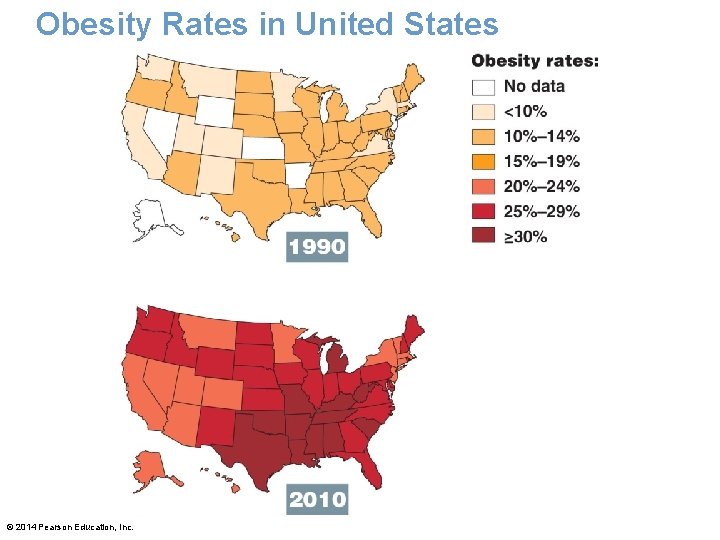
Obesity Rates in United States © 2014 Pearson Education, Inc.
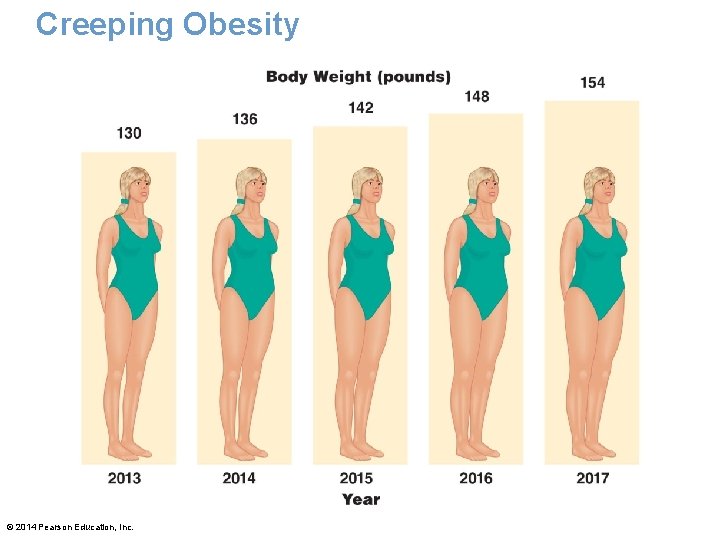
Creeping Obesity © 2014 Pearson Education, Inc.
Chronic Conditions of Overweight and Obesity • Heart disease (also called cardiovascular disease or CVD) • Diabetes • Cancers (breast, prostate, colon) • Joint problems and osteoarthritis • Sleep apnea • Gallbladder disease • Menstrual abnormalities • Difficulty with conception and pregnancy complications © 2014 Pearson Education, Inc.
Benefits of a Healthy Weight Mental Benefits • Better self-esteem & body image • More positive mindset • Less anxiety and depression Physical Benefits • Lower risk of diabetes, cardiovascular disease, and cancer • Easier motion for physical activity and everyday living • Lower death rate © 2014 Pearson Education, Inc.
Health Effects of Underweight • Loss of muscle mass and strength resulting from malnutrition • Osteoporosis • Menstrual abnormalities that can lead to infertility Severe underweight from eating disorders (anorexia nervosa and bulimia) can lead to • Heart problems • Digestive disorders • Kidney damage • Anemia • Lethargy • Muscle weakness • Dry skin • Compromised immune function © 2014 Pearson Education, Inc.
Assessing Body Composition Field Methods • Height/weight tables • Body mass index (BMI) • Skinfold test • Waist measurement & waist-to-hip ratio Laboratory Measures • Dual energy X-ray absorptiometry (DXA) • Hydrostatic weighing • Air displacement • Bioelectrical impedance analysis (BIA) © 2014 Pearson Education, Inc.
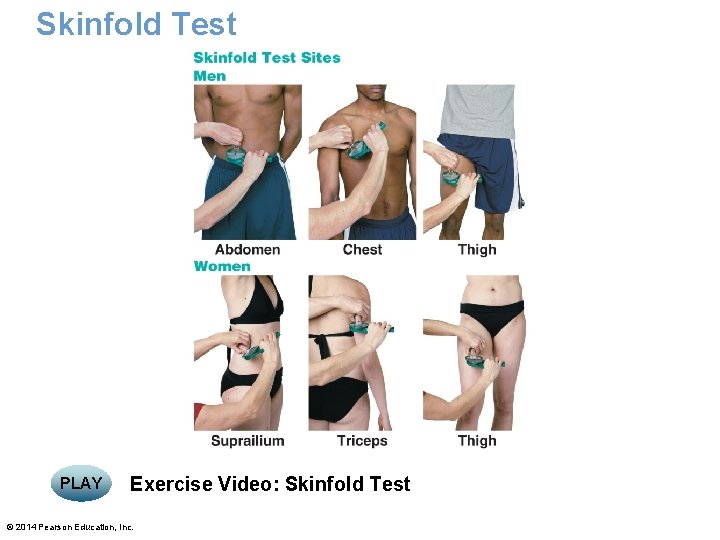
Skinfold Test PLAY Exercise Video: Skinfold Test © 2014 Pearson Education, Inc.
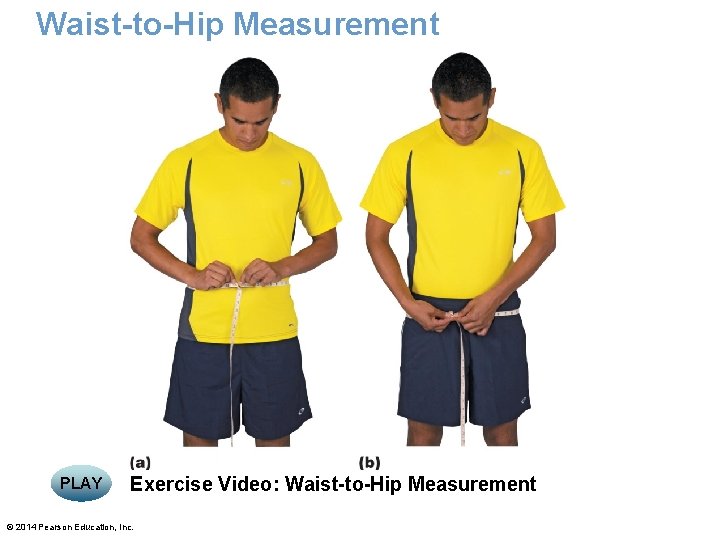
Waist-to-Hip Measurement PLAY Exercise Video: Waist-to-Hip Measurement © 2014 Pearson Education, Inc.
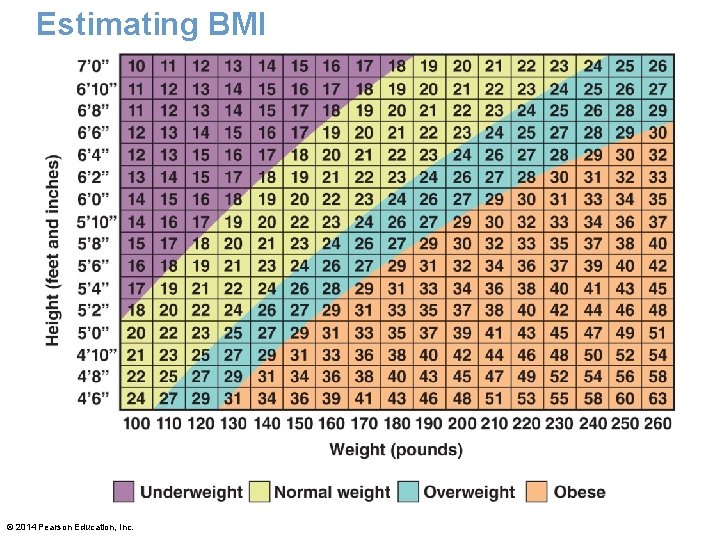
Estimating BMI © 2014 Pearson Education, Inc.
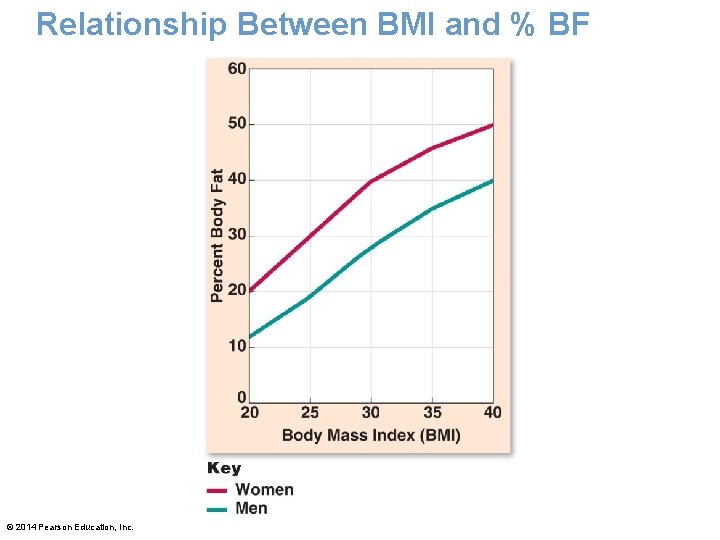
Relationship Between BMI and % BF © 2014 Pearson Education, Inc.
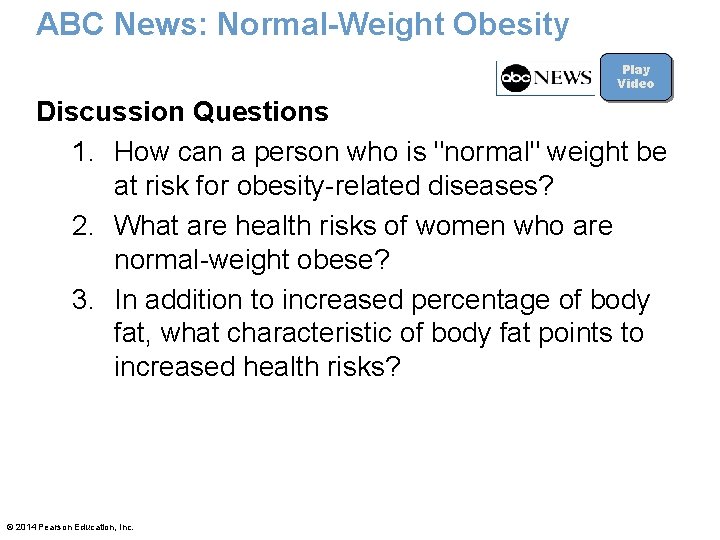
ABC News: Normal-Weight Obesity Play Video Discussion Questions 1. How can a person who is "normal" weight be at risk for obesity-related diseases? 2. What are health risks of women who are normal-weight obese? 3. In addition to increased percentage of body fat, what characteristic of body fat points to increased health risks? © 2014 Pearson Education, Inc.
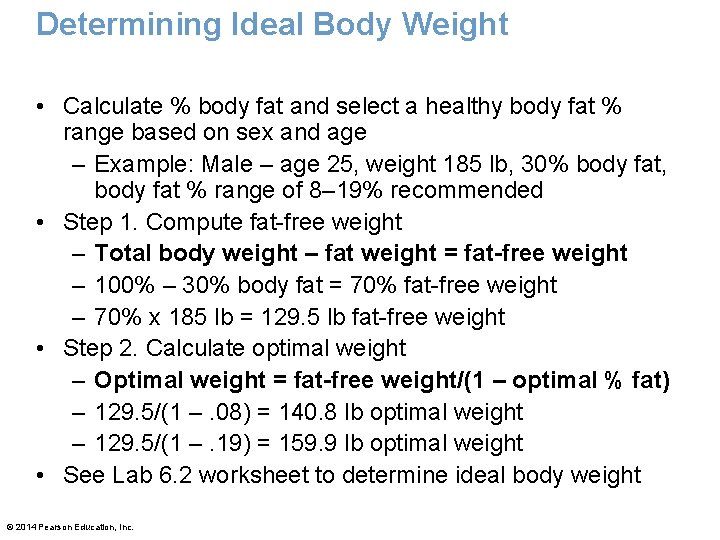
Determining Ideal Body Weight • Calculate % body fat and select a healthy body fat % range based on sex and age – Example: Male – age 25, weight 185 lb, 30% body fat, body fat % range of 8– 19% recommended • Step 1. Compute fat-free weight – Total body weight – fat weight = fat-free weight – 100% – 30% body fat = 70% fat-free weight – 70% x 185 lb = 129. 5 lb fat-free weight • Step 2. Calculate optimal weight – Optimal weight = fat-free weight/(1 – optimal % fat) – 129. 5/(1 –. 08) = 140. 8 lb optimal weight – 129. 5/(1 –. 19) = 159. 9 lb optimal weight • See Lab 6. 2 worksheet to determine ideal body weight © 2014 Pearson Education, Inc.
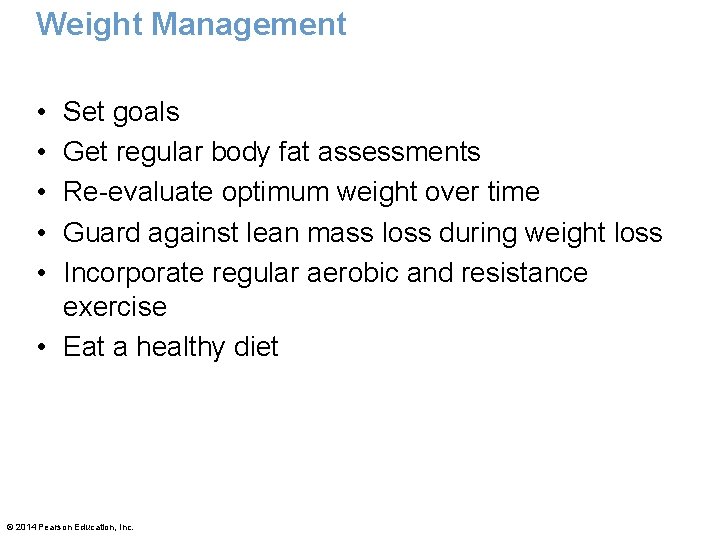
Weight Management • • • Set goals Get regular body fat assessments Re-evaluate optimum weight over time Guard against lean mass loss during weight loss Incorporate regular aerobic and resistance exercise • Eat a healthy diet © 2014 Pearson Education, Inc.
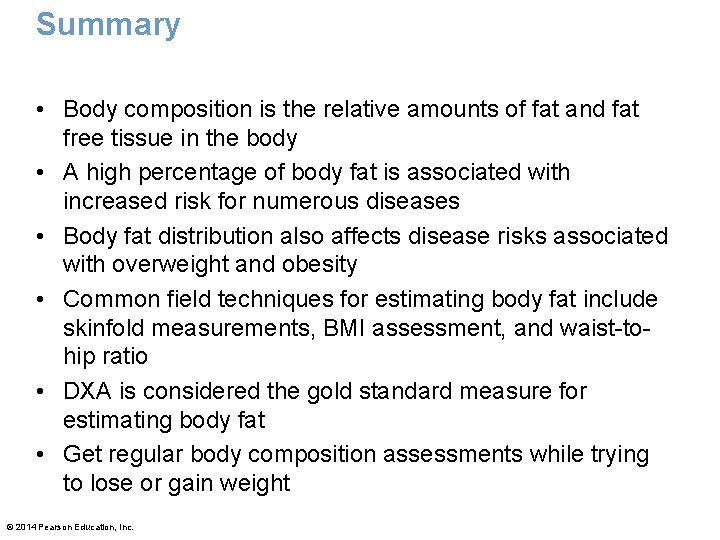
Summary • Body composition is the relative amounts of fat and fat free tissue in the body • A high percentage of body fat is associated with increased risk for numerous diseases • Body fat distribution also affects disease risks associated with overweight and obesity • Common field techniques for estimating body fat include skinfold measurements, BMI assessment, and waist-tohip ratio • DXA is considered the gold standard measure for estimating body fat • Get regular body composition assessments while trying to lose or gain weight © 2014 Pearson Education, Inc.
- Slides: 22