
Chapter 6 IT Architecture Evolution and Alternatives Two
- Slides: 47
Chapter 6 IT Architecture: Evolution and Alternatives
Two Tensions Policies for guiding the deployment of IT development staff and activity in the future must deal with two sets of tensions: • Innovation vs. Control (Chapter 6) • IT Dominance vs. User Dominance (Chapter 7) Dr. Chen, IT Architecture; Organizing and Leading the IT Functions TM -2
Roles of IT • IT is no longer simply a tool to support “back-office” transactions; it has become a strategic business component, enabling the redefinition of markets and industries and the strategies and designs of firms competing within them. Dr. Chen, IT Architecture; Organizing and Leading the IT Functions TM -3
LABOR FORCE COMPOSITION 1900 -1996 Source: Laudon & Laudon 1999 Dr. Chen, IT Architecture; Organizing and Leading the IT Functions TM -4
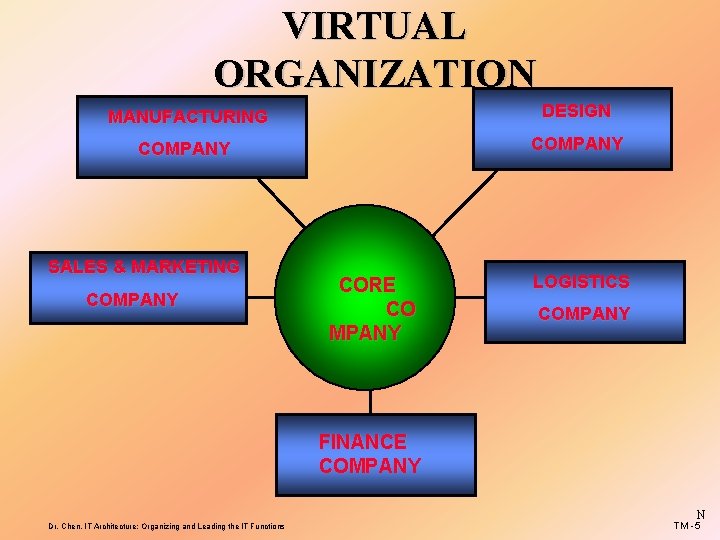
VIRTUAL ORGANIZATION MANUFACTURING DESIGN COMPANY SALES & MARKETING COMPANY CORE CO MPANY LOGISTICS COMPANY FINANCE COMPANY Dr. Chen, IT Architecture; Organizing and Leading the IT Functions N TM -5
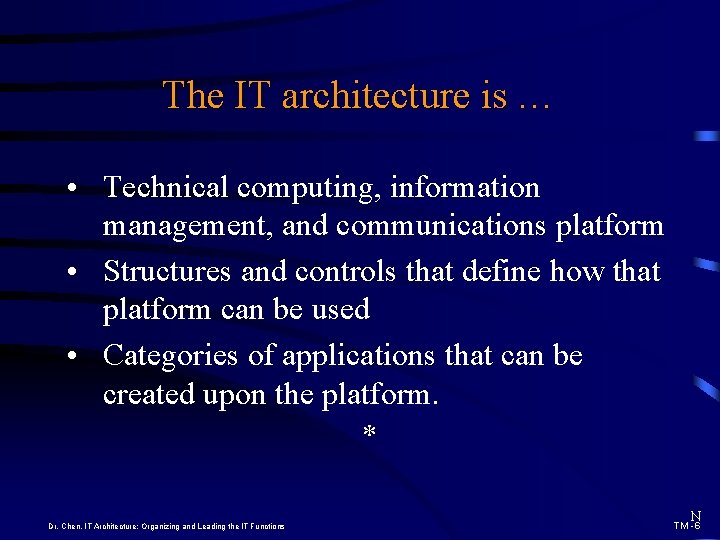
The IT architecture is … • Technical computing, information management, and communications platform • Structures and controls that define how that platform can be used • Categories of applications that can be created upon the platform. * Dr. Chen, IT Architecture; Organizing and Leading the IT Functions N TM -6
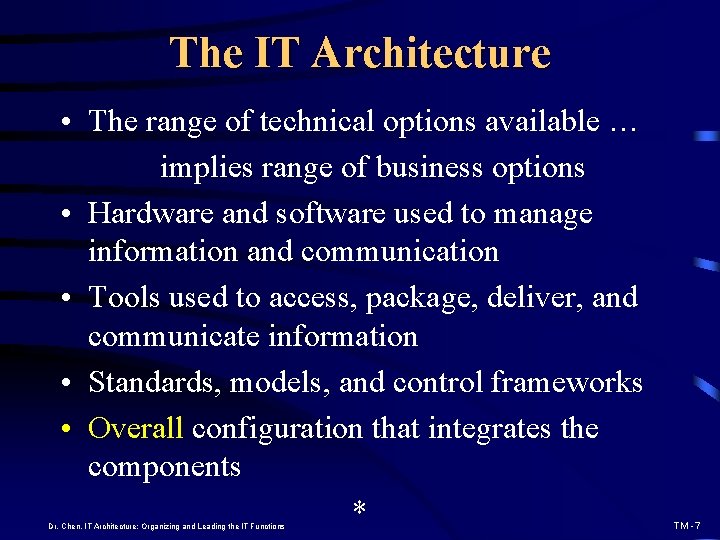
The IT Architecture • The range of technical options available … implies range of business options • Hardware and software used to manage information and communication • Tools used to access, package, deliver, and communicate information • Standards, models, and control frameworks • Overall configuration that integrates the components * Dr. Chen, IT Architecture; Organizing and Leading the IT Functions TM -7
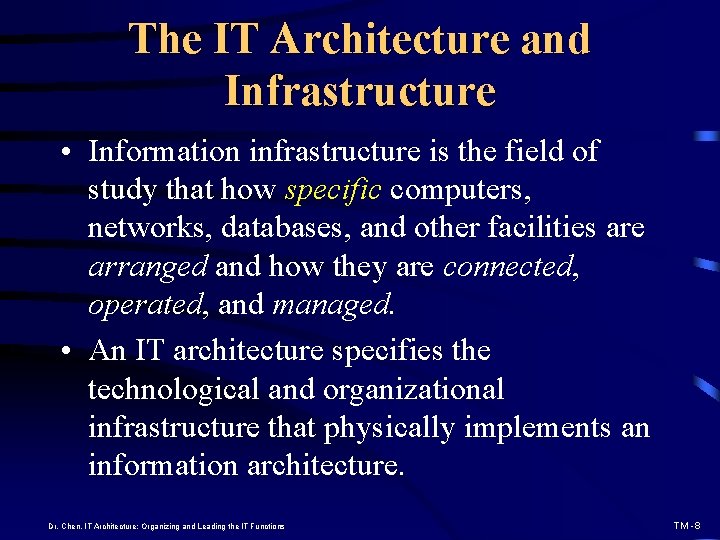
The IT Architecture and Infrastructure • Information infrastructure is the field of study that how specific computers, networks, databases, and other facilities are arranged and how they are connected, operated, and managed. • An IT architecture specifies the technological and organizational infrastructure that physically implements an information architecture. Dr. Chen, IT Architecture; Organizing and Leading the IT Functions TM -8
Four Eras • Mainframe (1950 s to 1970 s) • Microcomputer (Late 1970 s and 1980 s) • Distributed Information Systems (Late 1980 s to the Present) • Ubiquitous (Are we there yet? ) (See Table 6 -1) Dr. Chen, IT Architecture; Organizing and Leading the IT Functions TM -9
Assessing the Value of IT Expenditures/Investments ÊEfficiency savings … budgeted expense ËIndividual productivity and decision quality … allocation to business units ÌEnable and support business strategy … inherent in cost of implementing strategy • Investments in the platform … capital investments • Value Measures… (e. g. , TCO) – direct benefits – secondary benefits 3 options benefits 3 proprietary benefits 3 strategic necessity benefit Dr. Chen, IT Architecture; Organizing and Leading the IT Functions N TM -10
Managing the Islands of Automation • Integration obstacles • Costs and time are underestimated – training 3 end users 3 MIS support staff – coordinate and manage the complex network and information management • TCO: Total Cost of Ownership – Desktop and network – Capital, technical support, administration, and end user Dr. Chen, IT Architecture; Organizing and Leading the IT Functions TM -11
Metrics • Metrics are combined measures and variables that quantify a goal. • Metric values are the numerical values for metrics. • Time horizon is the period allowed for achieving the goal or objective. Dr. Chen, IT Architecture; Organizing and Leading the IT Functions TM -12
What is Total Cost of Ownership (TCO)? • is collective (and usually annualized) cost (both direct and indirect) of providing and maintaining corporate information services • Goals of TCO is to help enterprises understand many of components involved in both the budgeted and unbudgeted costs of acquiring, operating, and managing their IT infrastructures throughout its life cycle. Dr. Chen, IT Architecture; Organizing and Leading the IT Functions TM -13
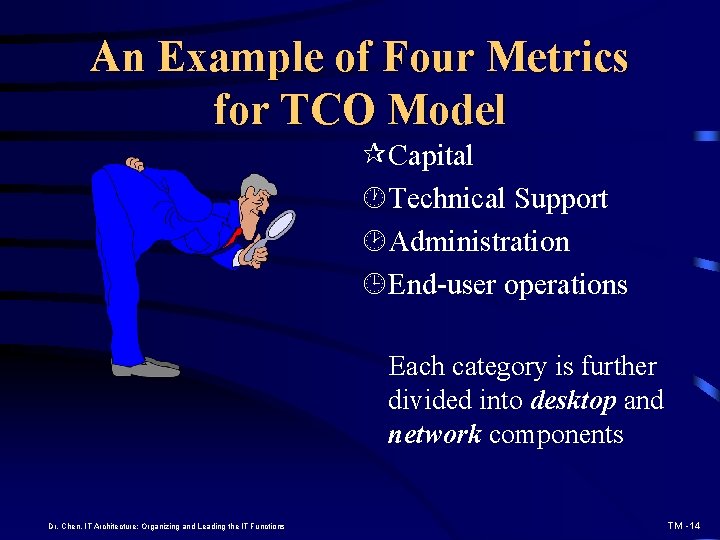
An Example of Four Metrics for TCO Model ¶Capital ·Technical Support ¸Administration ¹End-user operations Each category is further divided into desktop and network components Dr. Chen, IT Architecture; Organizing and Leading the IT Functions TM -14
Managing Global Telecommunications • Performance, cost, and reliability • Capabilities and regulations • Timing – Managing timing is the key challenge of paving the way for the much-touted global village Dr. Chen, IT Architecture; Organizing and Leading the IT Functions TM -15
Managing the IT Legacy • • Flux in standards Lack of skilled professionals Dependence on “legacy” applications How to implement change while maintaining operations? • The management wants to complete company’s technology transfer – on time and within the budget – but. . . Dr. Chen, IT Architecture; Organizing and Leading the IT Functions TM -16
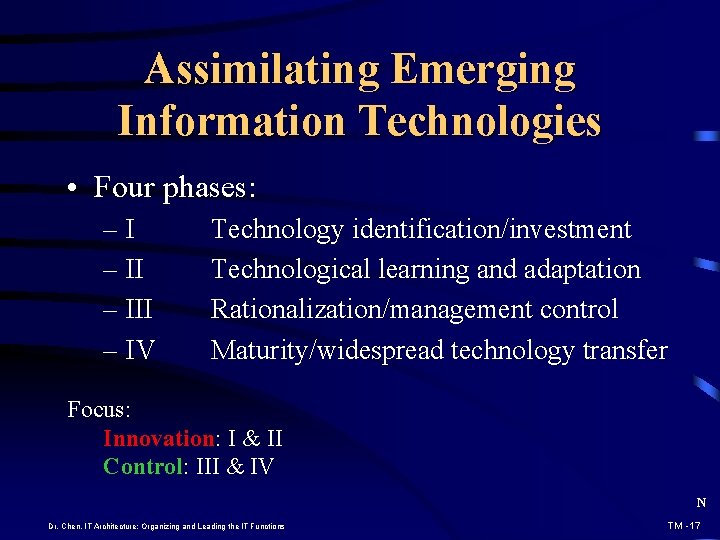
Assimilating Emerging Information Technologies • Four phases: –I – III – IV Technology identification/investment Technological learning and adaptation Rationalization/management control Maturity/widespread technology transfer Focus: Innovation: I & II Control: III & IV N Dr. Chen, IT Architecture; Organizing and Leading the IT Functions TM -17
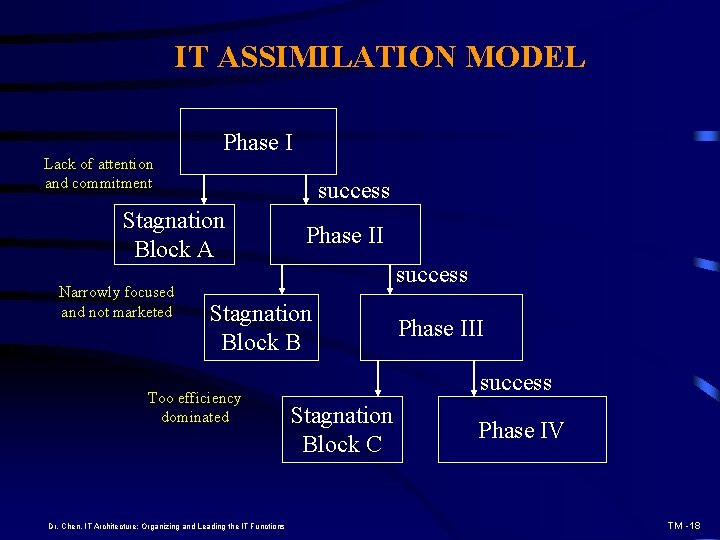
IT ASSIMILATION MODEL Lack of attention and commitment Phase I success Stagnation Block A Narrowly focused and not marketed Phase II success Stagnation Block B Too efficiency dominated Dr. Chen, IT Architecture; Organizing and Leading the IT Functions Phase III success Stagnation Block C Phase IV TM -18
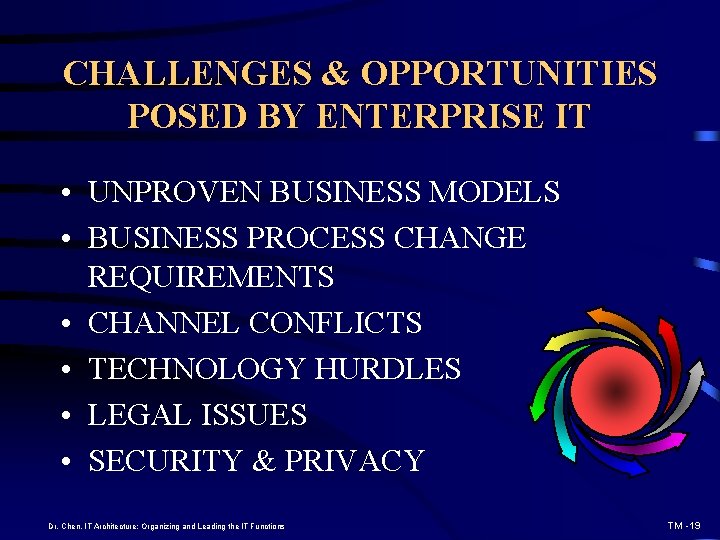
CHALLENGES & OPPORTUNITIES POSED BY ENTERPRISE IT • UNPROVEN BUSINESS MODELS • BUSINESS PROCESS CHANGE REQUIREMENTS • CHANNEL CONFLICTS • TECHNOLOGY HURDLES • LEGAL ISSUES • SECURITY & PRIVACY Dr. Chen, IT Architecture; Organizing and Leading the IT Functions TM -19
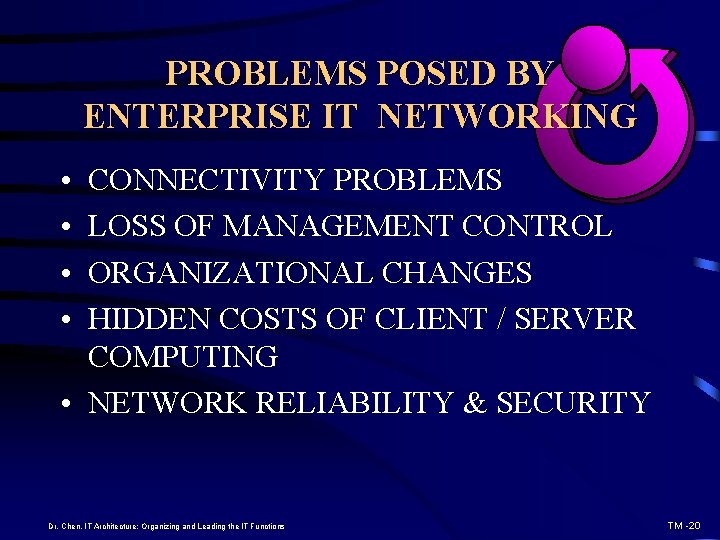
PROBLEMS POSED BY ENTERPRISE IT NETWORKING • • CONNECTIVITY PROBLEMS LOSS OF MANAGEMENT CONTROL ORGANIZATIONAL CHANGES HIDDEN COSTS OF CLIENT / SERVER COMPUTING • NETWORK RELIABILITY & SECURITY Dr. Chen, IT Architecture; Organizing and Leading the IT Functions TM -20
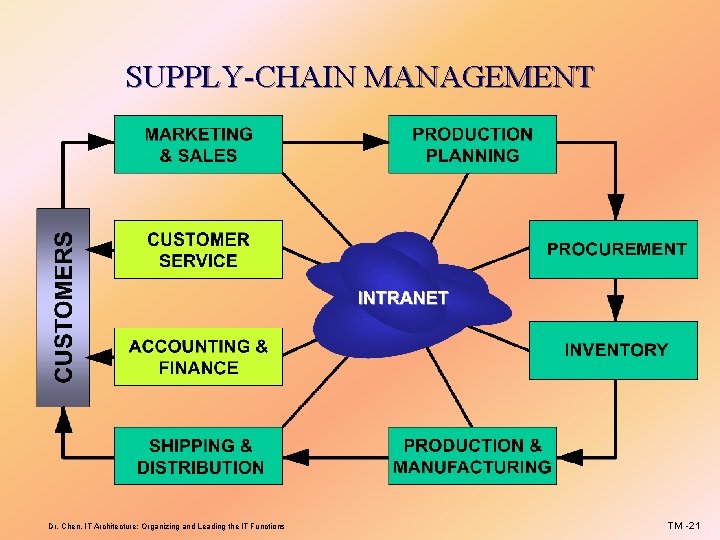
SUPPLY-CHAIN MANAGEMENT Dr. Chen, IT Architecture; Organizing and Leading the IT Functions TM -21
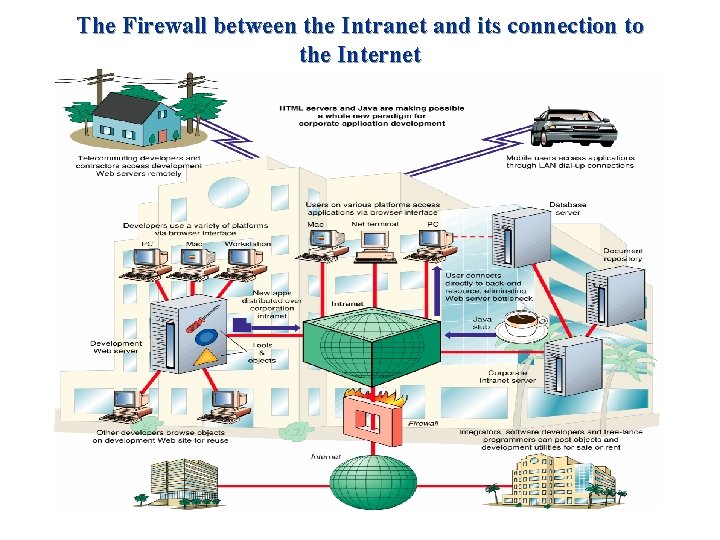
The Firewall between the Intranet and its connection to the Internet
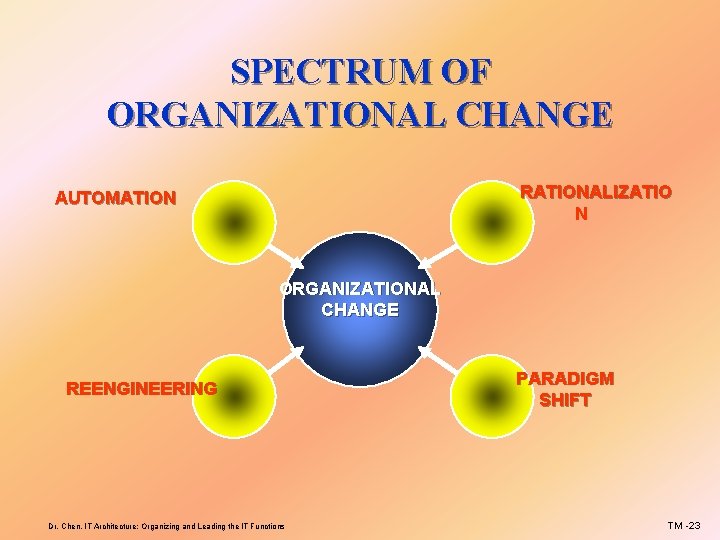
SPECTRUM OF ORGANIZATIONAL CHANGE RATIONALIZATIO N AUTOMATION ORGANIZATIONAL CHANGE REENGINEERING Dr. Chen, IT Architecture; Organizing and Leading the IT Functions PARADIGM SHIFT TM -23
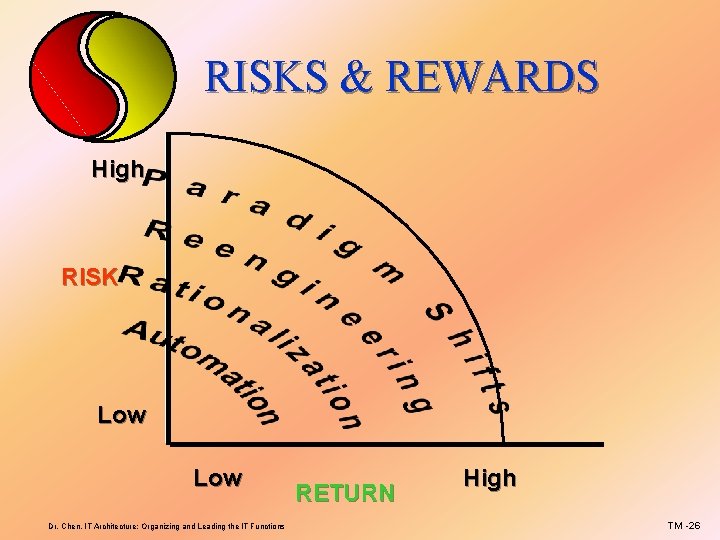
SPECTRUM OF ORGANIZATIONAL CHANGE • AUTOMATION: AUTOMATION Using technology to perform tasks efficiently / effectively • RATIONALIZATION OF PROCEDURES: Streamline SOPs; eliminate bottlenecks • BUSINESS REENGINEERING: REENGINEERING Radical redesign of processes to improve cost, quality, service; maximize benefits of technology • PARADIGM SHIFT * Dr. Chen, IT Architecture; Organizing and Leading the IT Functions TM -24
PARADIGM SHIFT • PARADIGM IS A COMPLETE MENTAL MODEL OF HOW A COMPLEX SYSTEM FUNCTIONS • A PARADIGM SHIFT INVOLVES RETHINKING THE NATURE OF THE BUSINESS, THE ORGANIZATION; A COMPLETE RECONCEPTION OF HOW THE SYSTEM SHOULD FUNCTION Dr. Chen, IT Architecture; Organizing and Leading the IT Functions TM -25
RISKS & REWARDS High RISK Low Dr. Chen, IT Architecture; Organizing and Leading the IT Functions RETURN High TM -26
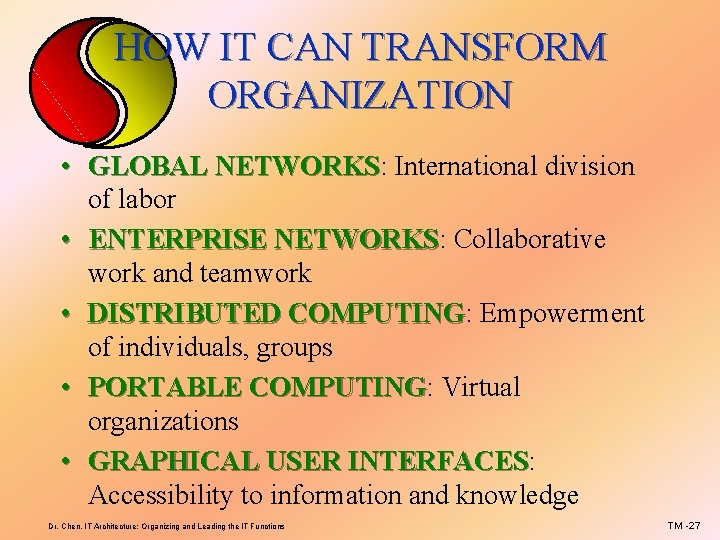
HOW IT CAN TRANSFORM ORGANIZATION • GLOBAL NETWORKS: NETWORKS International division of labor • ENTERPRISE NETWORKS: NETWORKS Collaborative work and teamwork • DISTRIBUTED COMPUTING: COMPUTING Empowerment of individuals, groups • PORTABLE COMPUTING: COMPUTING Virtual organizations • GRAPHICAL USER INTERFACES: INTERFACES Accessibility to information and knowledge Dr. Chen, IT Architecture; Organizing and Leading the IT Functions TM -27
Senior management roles with IT • As IT becomes the major platform upon which a company is organized and business is conducted, senior management can no longer delegate responsibility for IT to operating managers and IT professionals. • Senior management must become active players with issues of strategies and policies that guide the development and deployment of IT within the firm must be defined, enforced, and continuously reviewed as part of an ongoing process of developing and monitoring business strategy. Dr. Chen, IT Architecture; Organizing and Leading the IT Functions TM -28
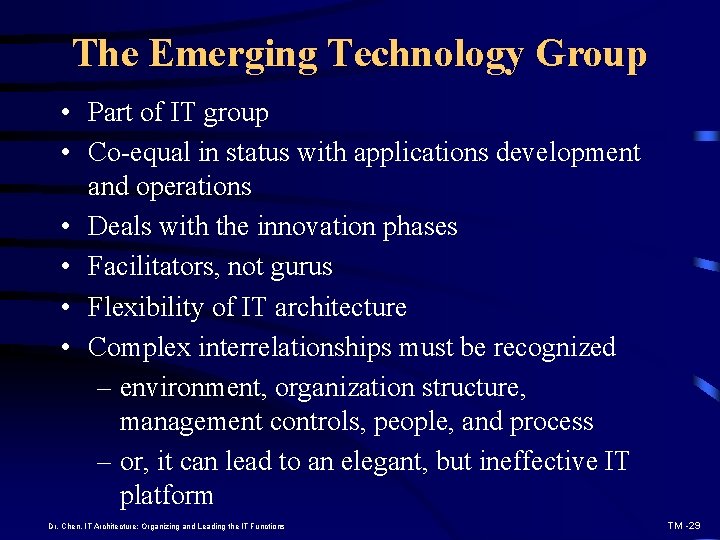
The Emerging Technology Group • Part of IT group • Co-equal in status with applications development and operations • Deals with the innovation phases • Facilitators, not gurus • Flexibility of IT architecture • Complex interrelationships must be recognized – environment, organization structure, management controls, people, and process – or, it can lead to an elegant, but ineffective IT platform Dr. Chen, IT Architecture; Organizing and Leading the IT Functions TM -29
Chapter 7 Organizing and Leading the Information Technology Function Two Tensions: • Innovation vs. Control (Chapter 6) • IT Dominance vs. User Dominance Dr. Chen, IT Architecture; Organizing and Leading the IT Functions TM -30
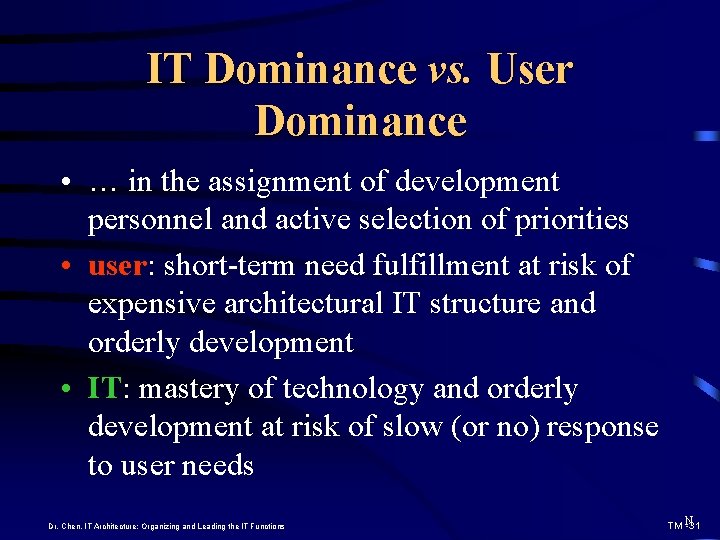
IT Dominance vs. User Dominance • … in the assignment of development personnel and active selection of priorities • user: short-term need fulfillment at risk of expensive architectural IT structure and orderly development • IT: mastery of technology and orderly development at risk of slow (or no) response to user needs Dr. Chen, IT Architecture; Organizing and Leading the IT Functions TM N -31
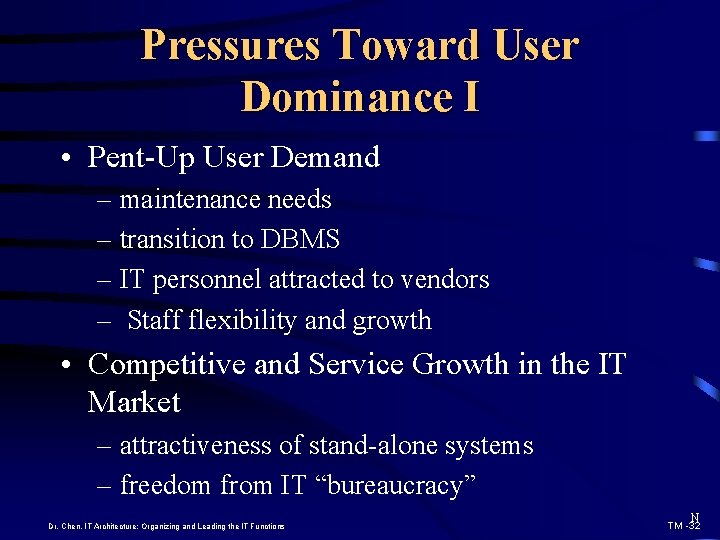
Pressures Toward User Dominance I • Pent-Up User Demand – maintenance needs – transition to DBMS – IT personnel attracted to vendors – Staff flexibility and growth • Competitive and Service Growth in the IT Market – attractiveness of stand-alone systems – freedom from IT “bureaucracy” Dr. Chen, IT Architecture; Organizing and Leading the IT Functions N TM -32
The Driving Forces Behind Outsourcing • Two drivers – focus 3 on core business – value 3 shareholder Dr. Chen, IT Architecture; Organizing and Leading the IT Functions TM -33
Pressures Toward User Dominance II • User Control – development – maintenance • Fit with the Organization – decentralization – conglomerates • User Learning – user leads change: “demand-pull” Dr. Chen, IT Architecture; Organizing and Leading the IT Functions N TM -34
Pressures Toward User Dominance III Summary: • User dominance provides short-term user control – the pressures driving users toward purchase, development, and/or use of local systems and software. Dr. Chen, IT Architecture; Organizing and Leading the IT Functions TM -35
Pressures Toward IT Control I • Staff Professionalism – more opportunities to attract and challenge professionals – ability to insert new blood – easier to maintain professional standards • Feasibility Study Concerns – users tend to underestimate complexity of software and growth in demand for system – users fail to recognize additional applications of a system – vendor stability – technology transfer within organization Dr. Chen, IT Architecture; Organizing and Leading the IT Functions N TM -36
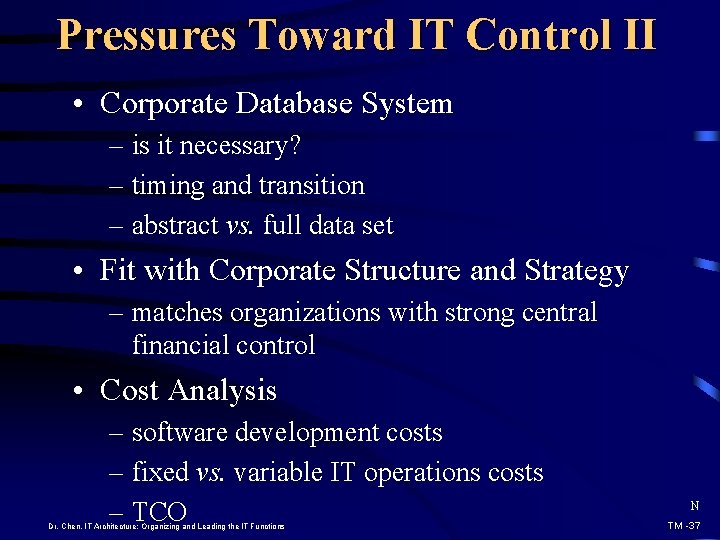
Pressures Toward IT Control II • Corporate Database System – is it necessary? – timing and transition – abstract vs. full data set • Fit with Corporate Structure and Strategy – matches organizations with strong central financial control • Cost Analysis – software development costs – fixed vs. variable IT operations costs – TCO Dr. Chen, IT Architecture; Organizing and Leading the IT Functions N TM -37
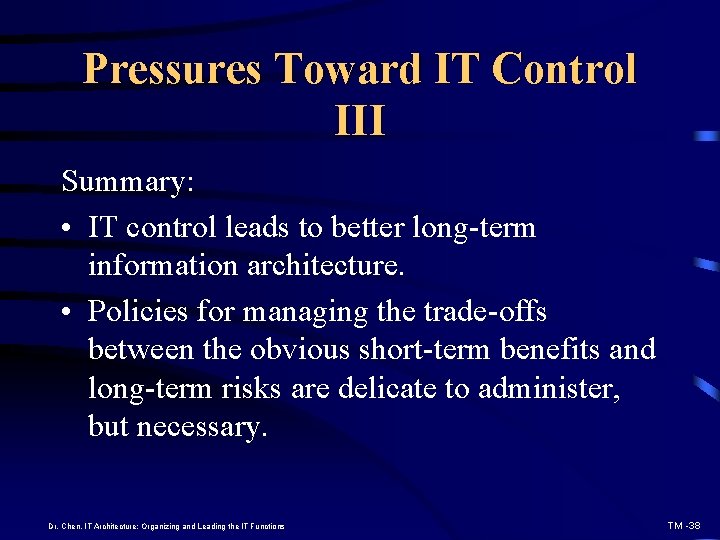
Pressures Toward IT Control III Summary: • IT control leads to better long-term information architecture. • Policies for managing the trade-offs between the obvious short-term benefits and long-term risks are delicate to administer, but necessary. Dr. Chen, IT Architecture; Organizing and Leading the IT Functions TM -38
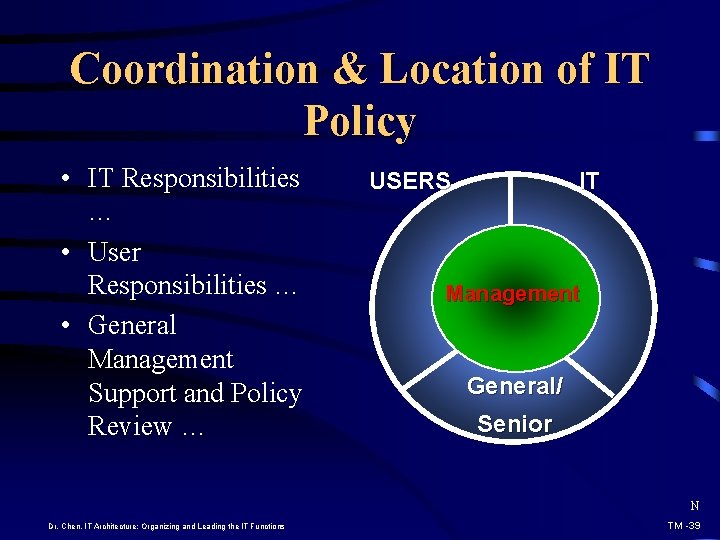
Coordination & Location of IT Policy • IT Responsibilities … • User Responsibilities … • General Management Support and Policy Review … USERS IT Management General/ Senior N Dr. Chen, IT Architecture; Organizing and Leading the IT Functions TM -39
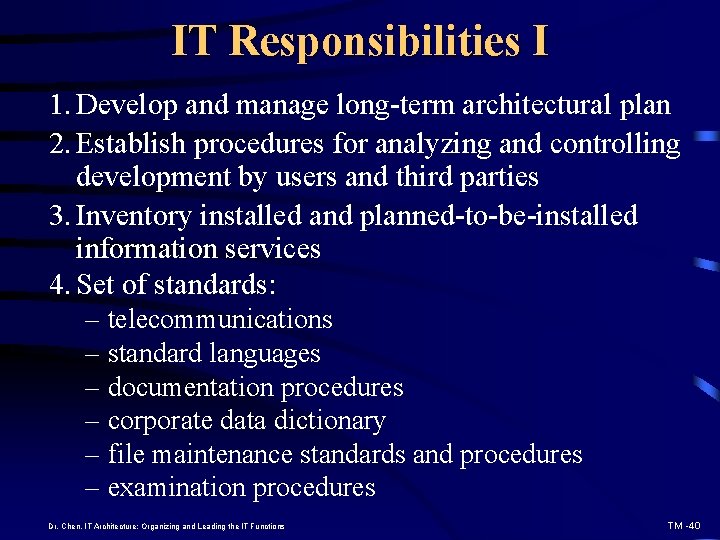
IT Responsibilities I 1. Develop and manage long-term architectural plan 2. Establish procedures for analyzing and controlling development by users and third parties 3. Inventory installed and planned-to-be-installed information services 4. Set of standards: – telecommunications – standard languages – documentation procedures – corporate data dictionary – file maintenance standards and procedures – examination procedures Dr. Chen, IT Architecture; Organizing and Leading the IT Functions TM -40
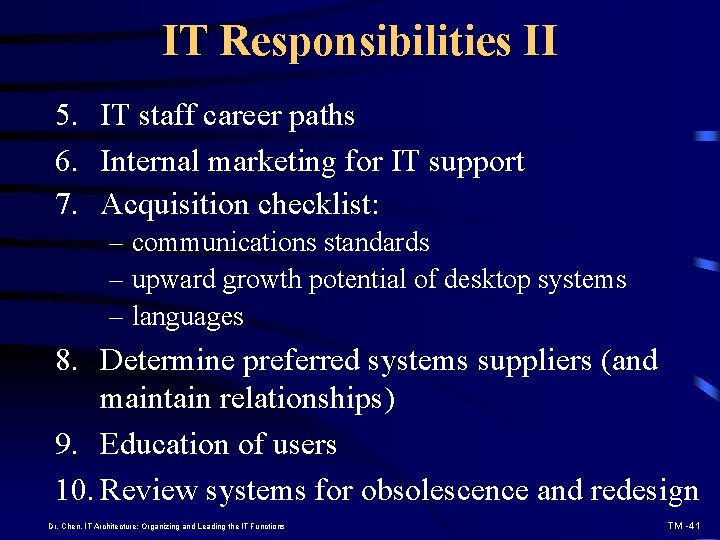
IT Responsibilities II 5. IT staff career paths 6. Internal marketing for IT support 7. Acquisition checklist: – communications standards – upward growth potential of desktop systems – languages 8. Determine preferred systems suppliers (and maintain relationships) 9. Education of users 10. Review systems for obsolescence and redesign Dr. Chen, IT Architecture; Organizing and Leading the IT Functions TM -41
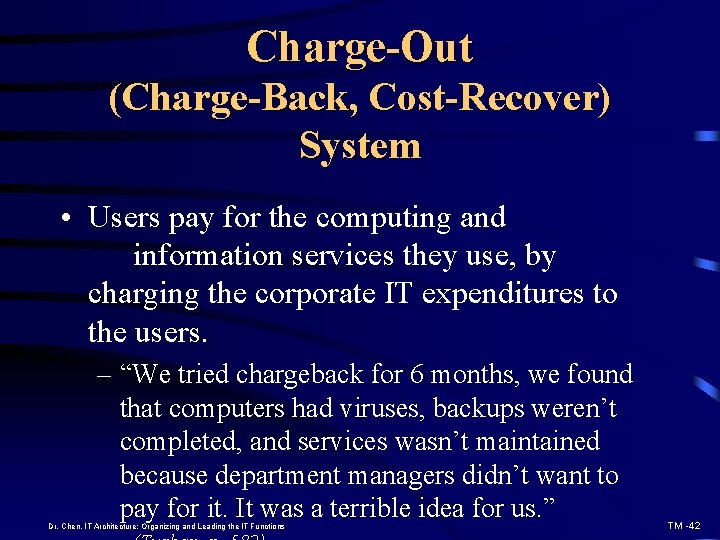
Charge-Out (Charge-Back, Cost-Recover) System • Users pay for the computing and information services they use, by charging the corporate IT expenditures to the users. – “We tried chargeback for 6 months, we found that computers had viruses, backups weren’t completed, and services wasn’t maintained because department managers didn’t want to pay for it. It was a terrible idea for us. ” Dr. Chen, IT Architecture; Organizing and Leading the IT Functions TM -42
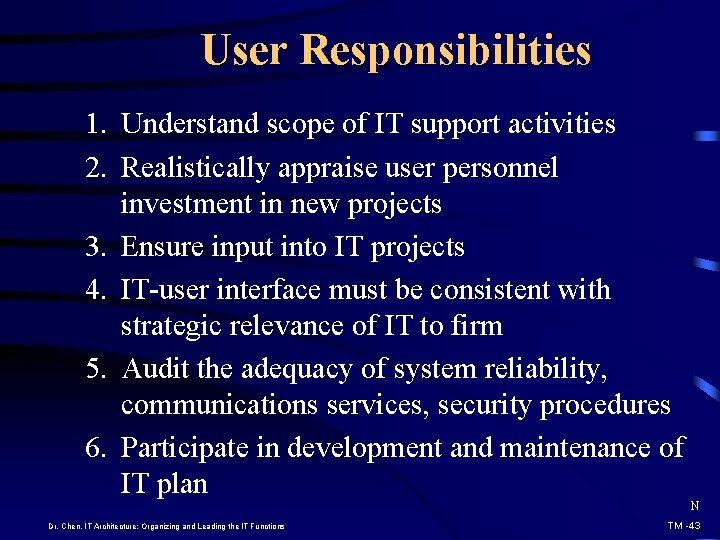
User Responsibilities 1. Understand scope of IT support activities 2. Realistically appraise user personnel investment in new projects 3. Ensure input into IT projects 4. IT-user interface must be consistent with strategic relevance of IT to firm 5. Audit the adequacy of system reliability, communications services, security procedures 6. Participate in development and maintenance of IT plan Dr. Chen, IT Architecture; Organizing and Leading the IT Functions N TM -43
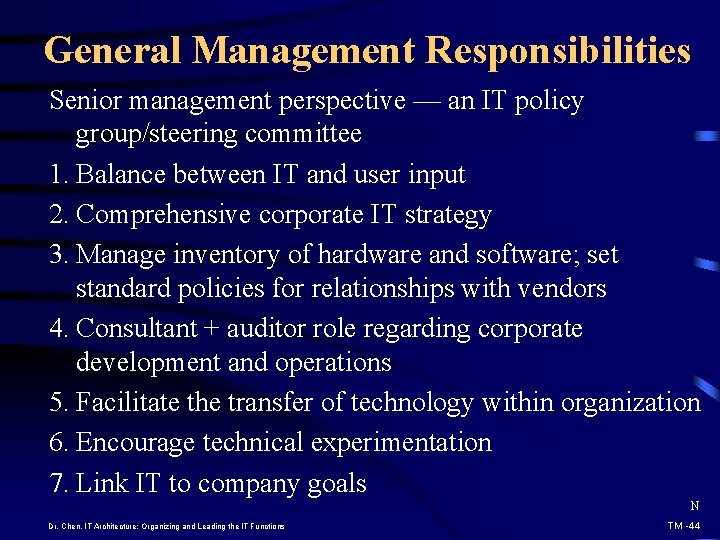
General Management Responsibilities Senior management perspective — an IT policy group/steering committee 1. Balance between IT and user input 2. Comprehensive corporate IT strategy 3. Manage inventory of hardware and software; set standard policies for relationships with vendors 4. Consultant + auditor role regarding corporate development and operations 5. Facilitate the transfer of technology within organization 6. Encourage technical experimentation 7. Link IT to company goals N Dr. Chen, IT Architecture; Organizing and Leading the IT Functions TM -44
Topics for the “HOW” Paper • • Marketing the solution Architecture Risk assessment Implementation plan (coding, testing, cutover, training, conversion) – no specific coding is needed, mention the HW/SW – others see SDLC and other details • Results control architecture Dr. Chen, IT Architecture; Organizing and Leading the IT Functions TM -45
Break Time
That’s All, Folks