
CHAPTER 6 INVENTORY VALUATION Perpetual vs Periodic Inventory
- Slides: 31
CHAPTER 6 INVENTORY VALUATION
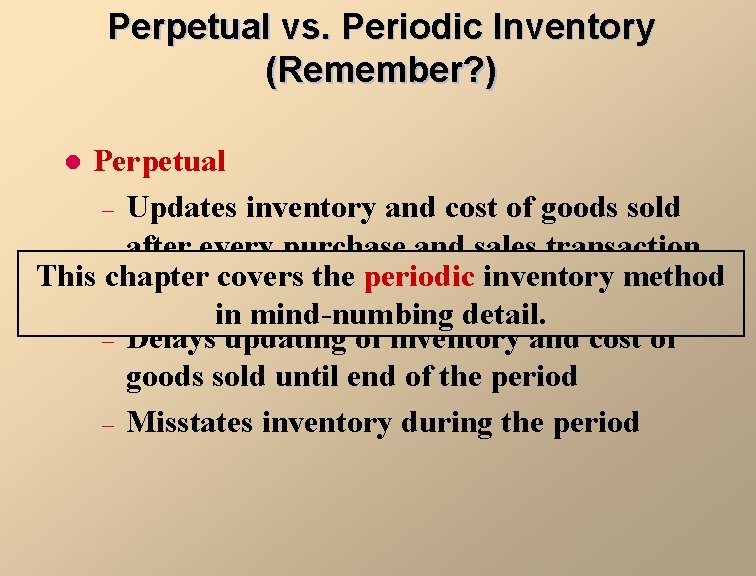
Perpetual vs. Periodic Inventory (Remember? ) Perpetual – Updates inventory and cost of goods sold after every purchase and sales transaction This chapter covers the periodic inventory method l Periodic in mind-numbing detail. – Delays updating of inventory and cost of goods sold until end of the period – Misstates inventory during the period l
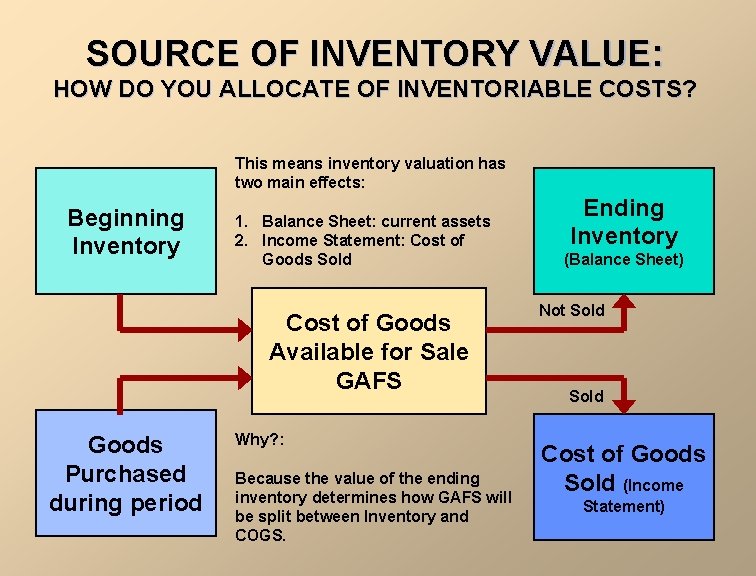
SOURCE OF INVENTORY VALUE: HOW DO YOU ALLOCATE OF INVENTORIABLE COSTS? This means inventory valuation has two main effects: Beginning Inventory 1. Balance Sheet: current assets 2. Income Statement: Cost of Goods Sold Cost of Goods Available for Sale GAFS Goods Purchased during period Why? : Because the value of the ending inventory determines how GAFS will be split between Inventory and COGS. Ending Inventory (Balance Sheet) Not Sold Cost of Goods Sold (Income Statement)
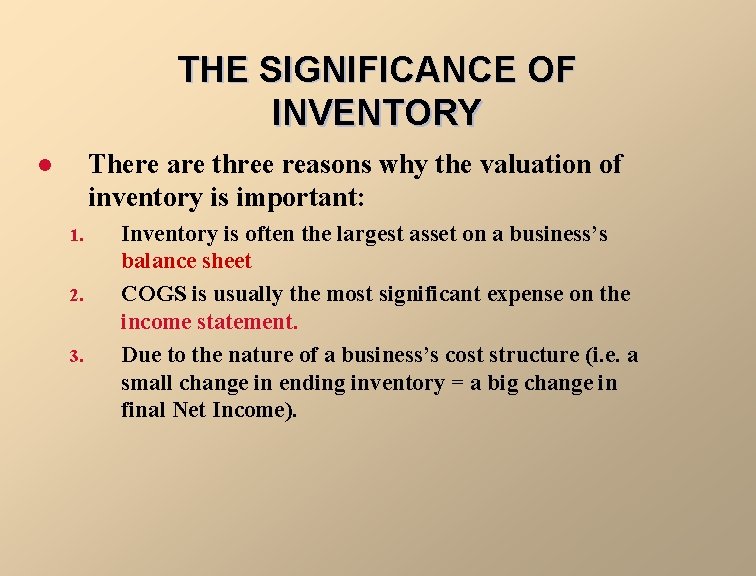
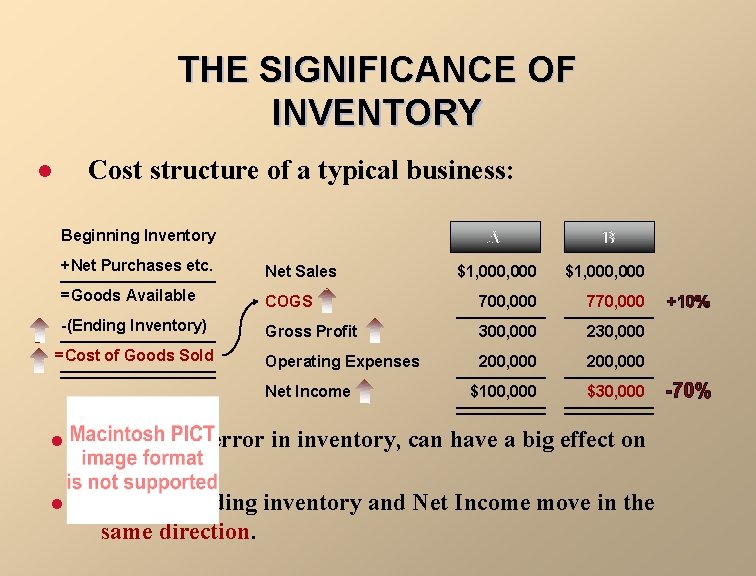
THE SIGNIFICANCE OF INVENTORY There are three reasons why the valuation of inventory is important: l 1. 2. 3. Inventory is often the largest asset on a business’s balance sheet COGS is usually the most significant expense on the income statement. Due to the nature of a business’s cost structure (i. e. a small change in ending inventory = a big change in final Net Income).
THE SIGNIFICANCE OF INVENTORY Cost structure of a typical business: l Beginning Inventory A B $1, 000, 000 +Net Purchases etc. Net Sales =Goods Available COGS 700, 000 770, 000 -(Ending Inventory) Gross Profit 300, 000 230, 000 Operating Expenses 200, 000 $100, 000 $30, 000 =Cost of Goods Sold Net Income l l So a small error in inventory, can have a big effect on Net Income NOTE: Ending inventory and Net Income move in the same direction. +10% -70%
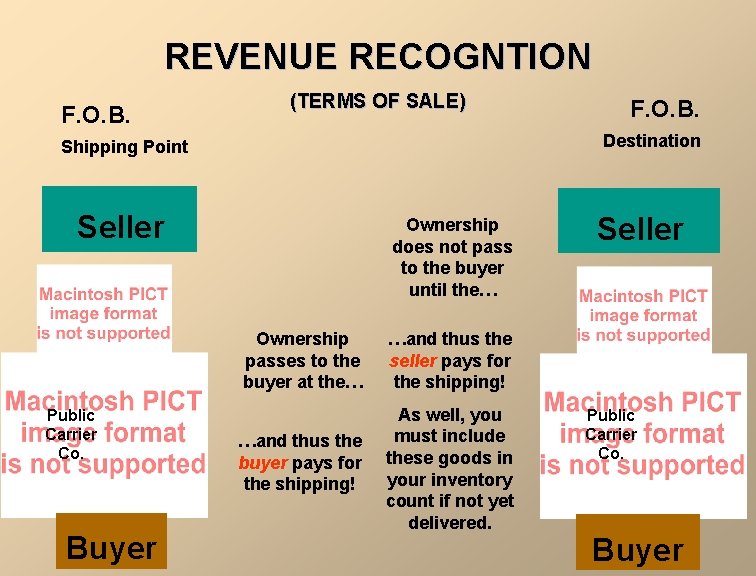
REVENUE RECOGNTION F. O. B. (TERMS OF SALE) Destination Shipping Point Seller Public Carrier Co. Buyer F. O. B. Ownership does not pass to the buyer until the… Ownership passes to the buyer at the… …and thus the seller pays for the shipping! …and thus the buyer pays for the shipping! As well, you must include these goods in your inventory count if not yet delivered. Seller Public Carrier Co. Buyer
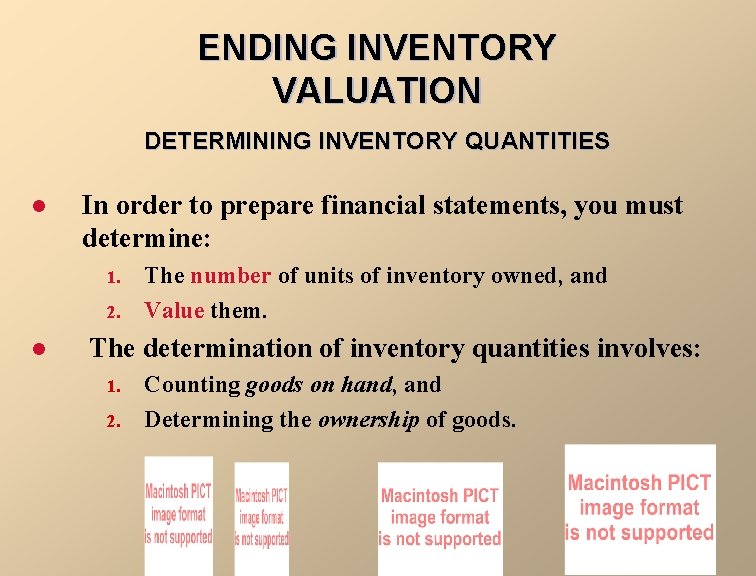
ENDING INVENTORY VALUATION DETERMINING INVENTORY QUANTITIES l In order to prepare financial statements, you must determine: 1. 2. l The number of units of inventory owned, and Value them. The determination of inventory quantities involves: 1. 2. Counting goods on hand, and Determining the ownership of goods.
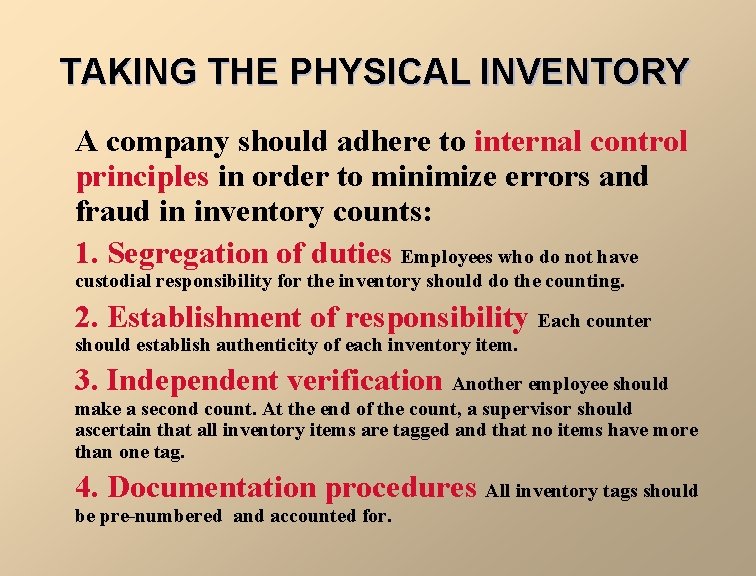
TAKING THE PHYSICAL INVENTORY A company should adhere to internal control principles in order to minimize errors and fraud in inventory counts: 1. Segregation of duties Employees who do not have custodial responsibility for the inventory should do the counting. 2. Establishment of responsibility Each counter should establish authenticity of each inventory item. 3. Independent verification Another employee should make a second count. At the end of the count, a supervisor should ascertain that all inventory items are tagged and that no items have more than one tag. 4. Documentation procedures All inventory tags should be pre-numbered and accounted for.
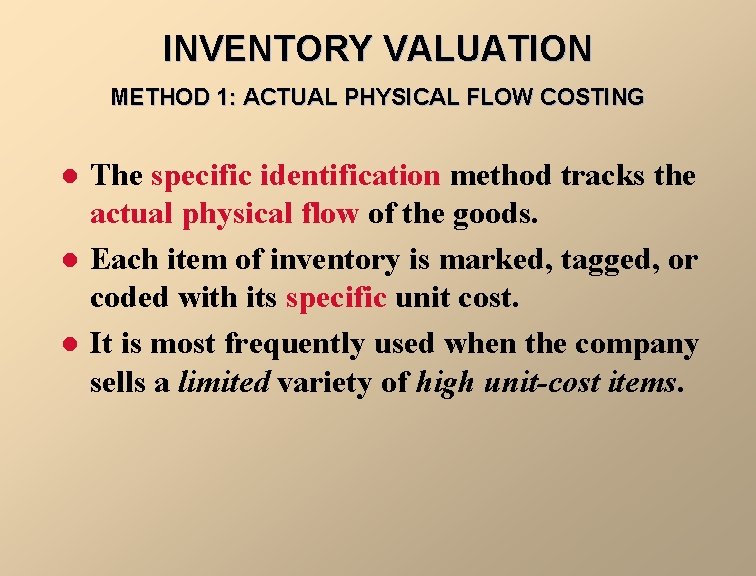
INVENTORY VALUATION METHOD 1: ACTUAL PHYSICAL FLOW COSTING l l l The specific identification method tracks the actual physical flow of the goods. Each item of inventory is marked, tagged, or coded with its specific unit cost. It is most frequently used when the company sells a limited variety of high unit-cost items.
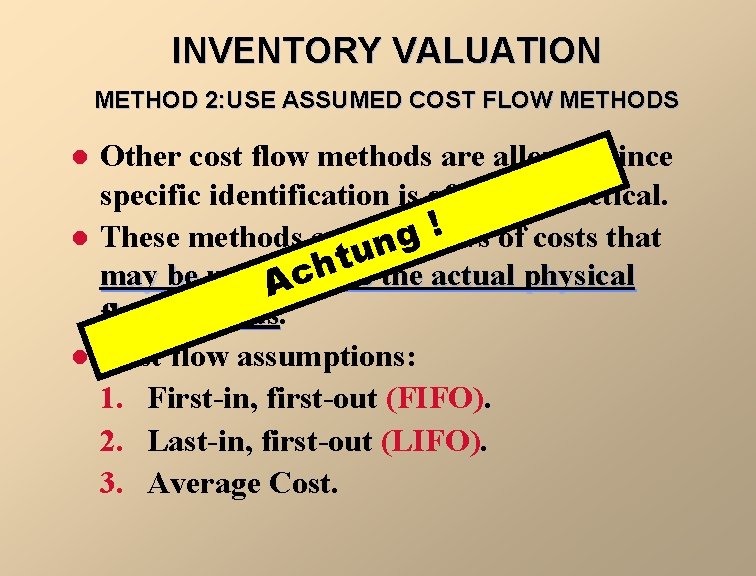
INVENTORY VALUATION METHOD 2: USE ASSUMED COST FLOW METHODS l l l Other cost flow methods are allowed since specific identification is often impractical. ! of costs that These methods assume flows g n u t h may be unrelated c A to the actual physical flow of goods Cost flow assumptions: 1. First-in, first-out (FIFO). 2. Last-in, first-out (LIFO). 3. Average Cost.
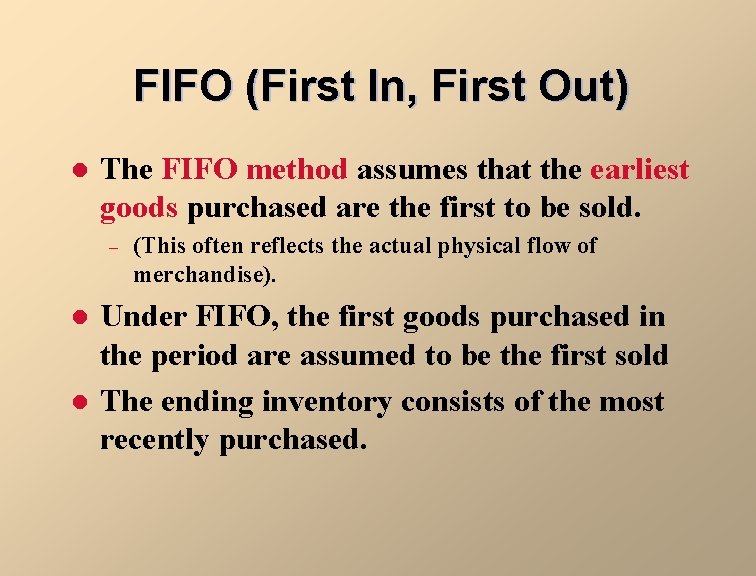
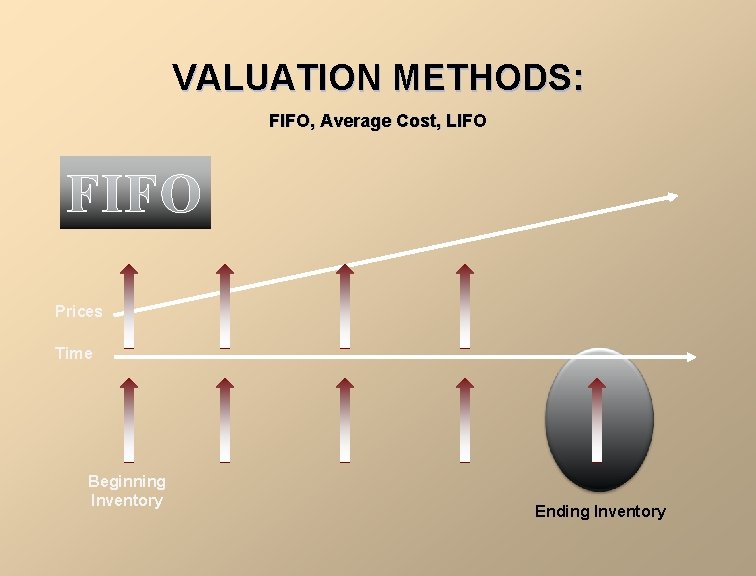
FIFO (First In, First Out) l The FIFO method assumes that the earliest goods purchased are the first to be sold. – l l (This often reflects the actual physical flow of merchandise). Under FIFO, the first goods purchased in the period are assumed to be the first sold The ending inventory consists of the most recently purchased.
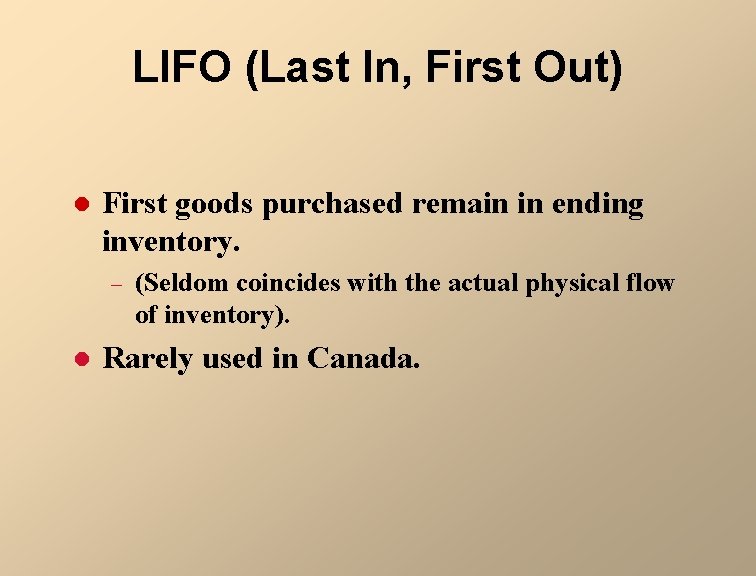
LIFO (Last In, First Out) l First goods purchased remain in ending inventory. – l (Seldom coincides with the actual physical flow of inventory). Rarely used in Canada.
AVERAGE COST l l The average cost method assumes that the goods available for sale are homogeneous. The allocation of the cost of goods available for sale is made on the basis of the weighted average unit cost incurred.
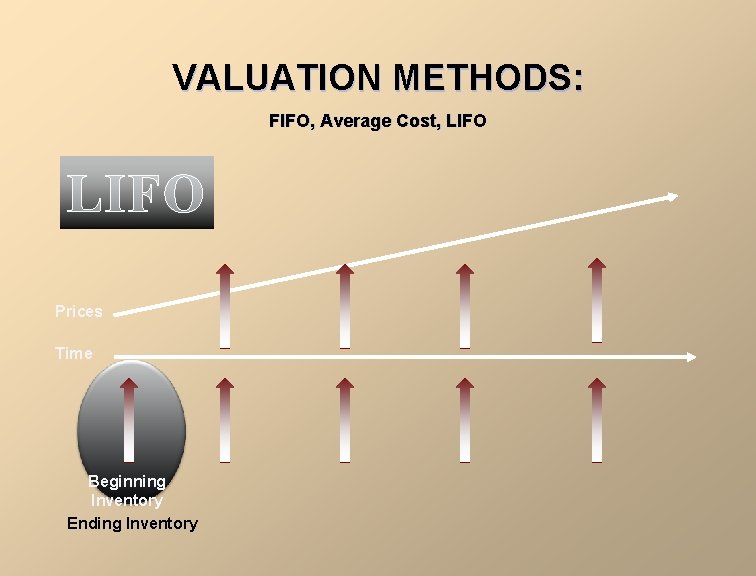
VALUATION METHODS: FIFO, Average Cost, LIFO FIFO Prices Time Beginning Inventory Ending Inventory
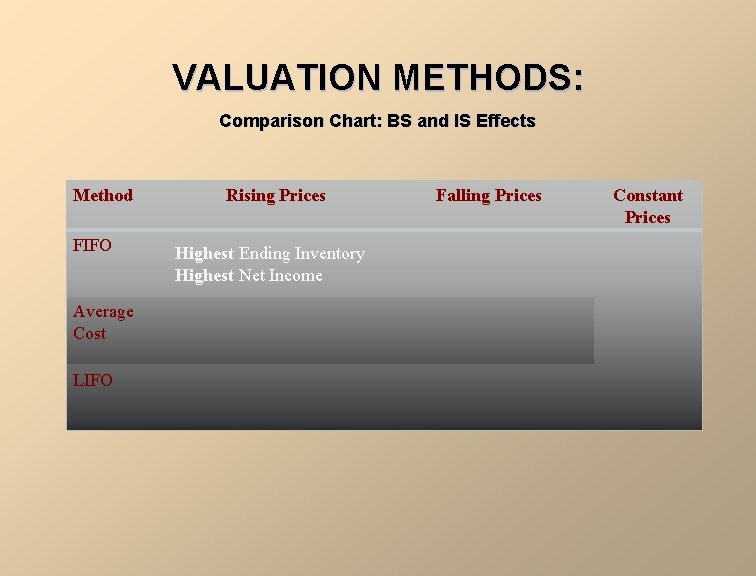
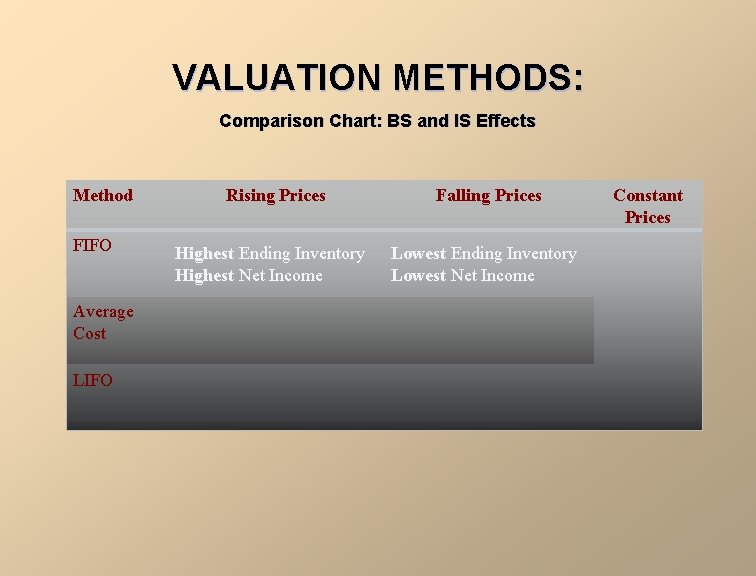
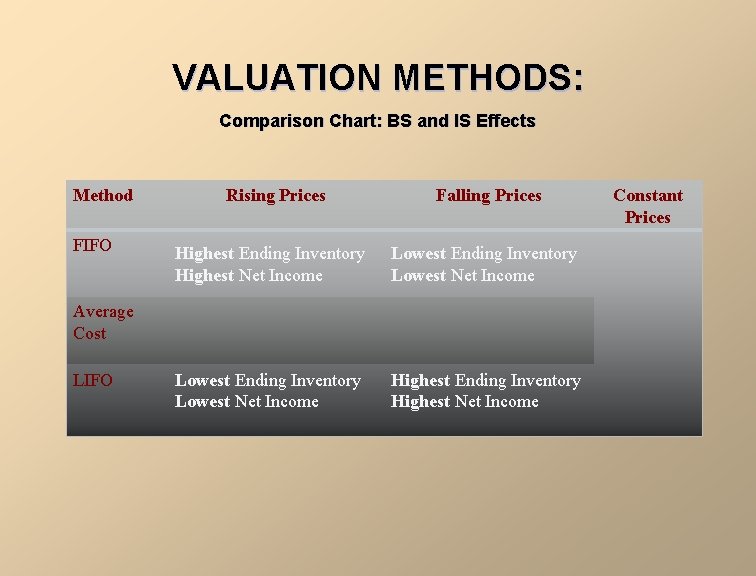
VALUATION METHODS: Comparison Chart: BS and IS Effects Method FIFO Average Cost LIFO Rising Prices Highest Ending Inventory Highest Net Income Falling Prices Constant Prices
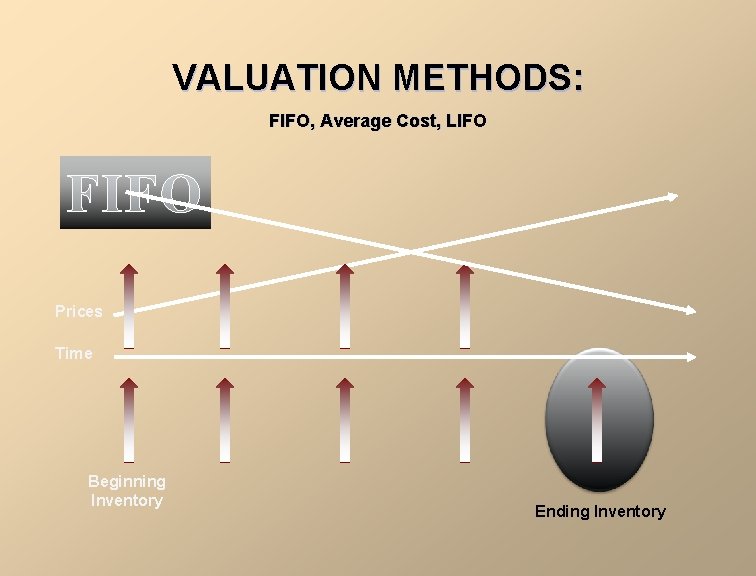
VALUATION METHODS: FIFO, Average Cost, LIFO FIFO Prices Time Beginning Inventory Ending Inventory
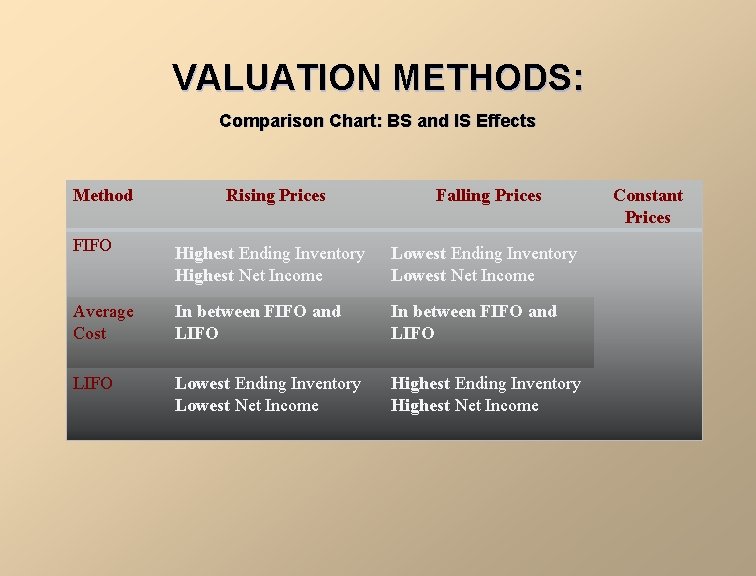
VALUATION METHODS: Comparison Chart: BS and IS Effects Method FIFO Average Cost LIFO Rising Prices Highest Ending Inventory Highest Net Income Falling Prices Lowest Ending Inventory Lowest Net Income Constant Prices
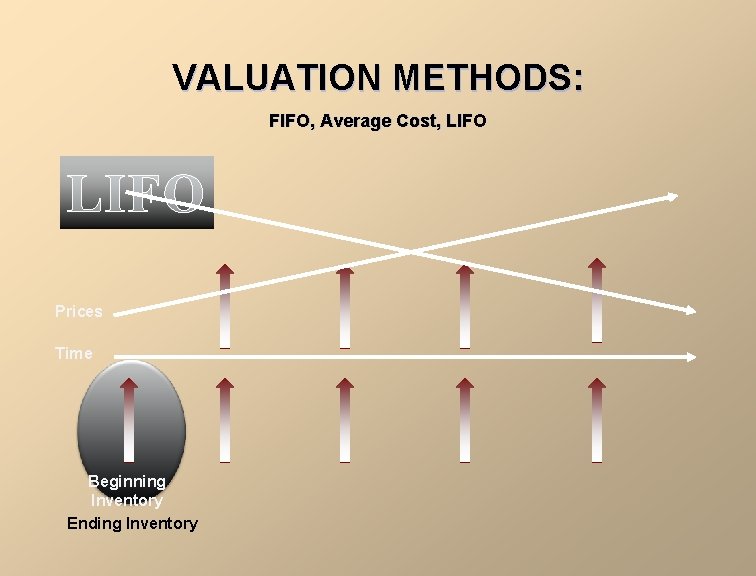
VALUATION METHODS: FIFO, Average Cost, LIFO Prices Time Beginning Inventory Ending Inventory
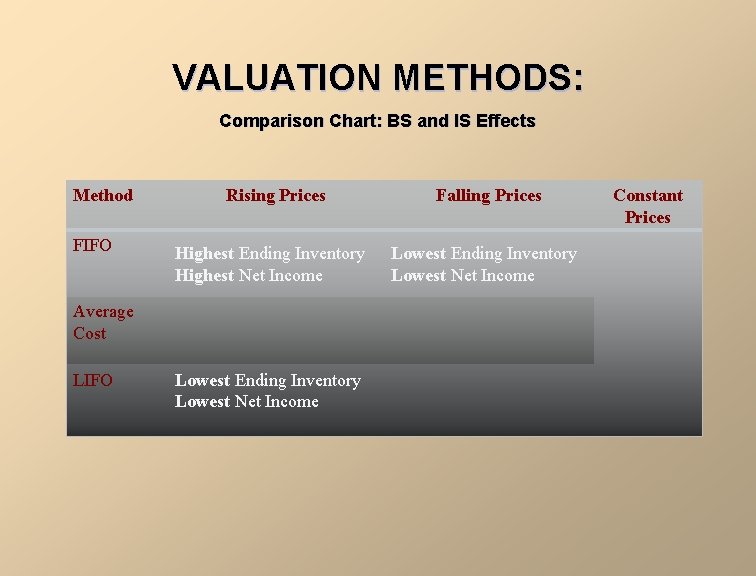
VALUATION METHODS: Comparison Chart: BS and IS Effects Method FIFO Rising Prices Highest Ending Inventory Highest Net Income Average Cost LIFO Lowest Ending Inventory Lowest Net Income Falling Prices Lowest Ending Inventory Lowest Net Income Constant Prices
VALUATION METHODS: FIFO, Average Cost, LIFO Prices Time Beginning Inventory Ending Inventory
VALUATION METHODS: Comparison Chart: BS and IS Effects Method FIFO Rising Prices Falling Prices Highest Ending Inventory Highest Net Income Lowest Ending Inventory Lowest Net Income Highest Ending Inventory Highest Net Income Average Cost LIFO Constant Prices
VALUATION METHODS: Comparison Chart: BS and IS Effects Method Rising Prices Falling Prices FIFO Highest Ending Inventory Highest Net Income Lowest Ending Inventory Lowest Net Income Average Cost In between FIFO and LIFO Lowest Ending Inventory Lowest Net Income Highest Ending Inventory Highest Net Income Constant Prices
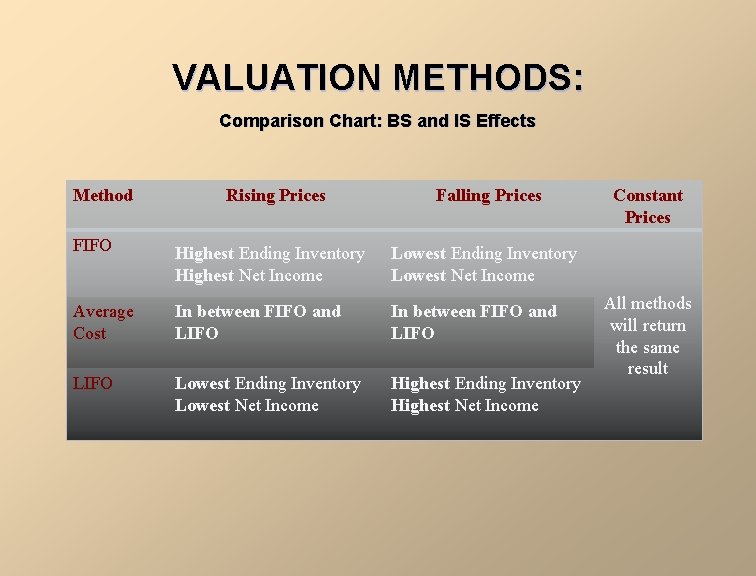
VALUATION METHODS: Comparison Chart: BS and IS Effects Method Rising Prices Falling Prices FIFO Highest Ending Inventory Highest Net Income Lowest Ending Inventory Lowest Net Income Average Cost In between FIFO and LIFO Lowest Ending Inventory Lowest Net Income Highest Ending Inventory Highest Net Income Constant Prices All methods will return the same result
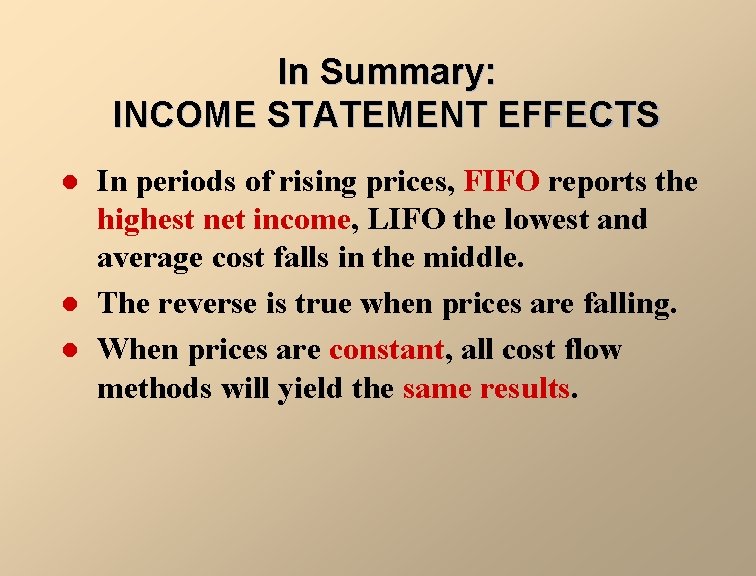
In Summary: INCOME STATEMENT EFFECTS l l l In periods of rising prices, FIFO reports the highest net income, LIFO the lowest and average cost falls in the middle. The reverse is true when prices are falling. When prices are constant, all cost flow methods will yield the same results.
In Summary: BALANCE SHEET EFFECTS FIFO produces the best balance sheet valuation. This is because the inventory costs are closer to their current, or replacement, costs (since what’s left is the most recently purchased). Why?
INVENTORY VALUATION AND THE CONSISTENTCY GAAP l l l A company needs to use its chosen cost flow method consistently from one accounting period to another. Such consistent application enhances the comparability of financial statements over successive fiscal periods. When a company adopts a different cost flow method, the change and its effects on net income should be disclosed in the financial statements.
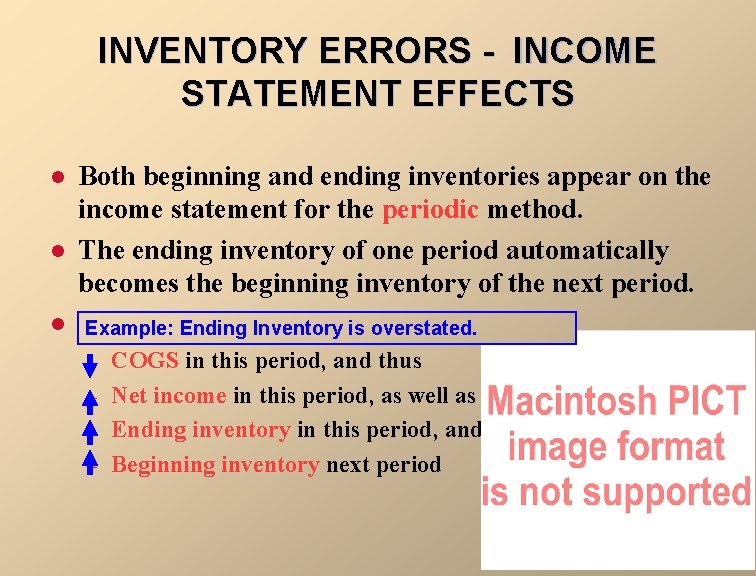
INVENTORY ERRORS - INCOME STATEMENT EFFECTS l l l Both beginning and ending inventories appear on the income statement for the periodic method. The ending inventory of one period automatically becomes the beginning inventory of the next period. An inventory in this period, affects: Example: Endingerror Inventory is overstated. – – COGS in this period, and thus Net income in this period, as well as Ending inventory in this period, and Beginning inventory next period
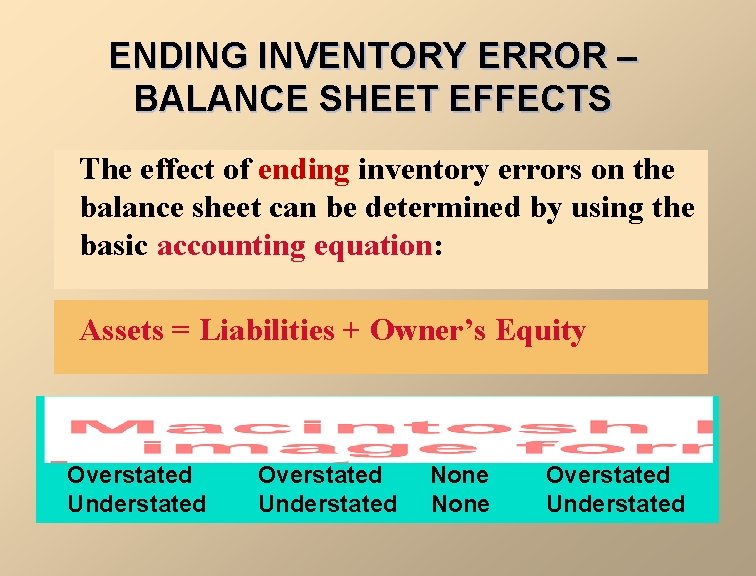
ENDING INVENTORY ERROR – BALANCE SHEET EFFECTS The effect of ending inventory errors on the balance sheet can be determined by using the basic accounting equation: Assets = Liabilities + Owner’s Equity Overstated Understated None Overstated Understated
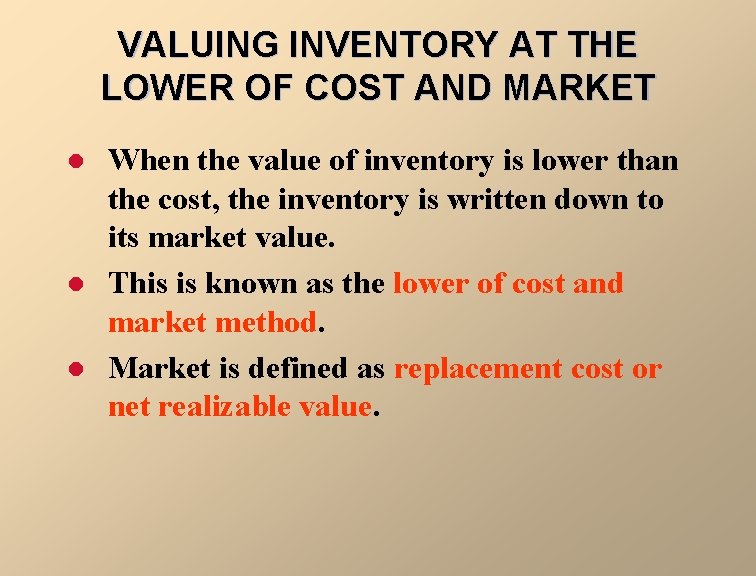
VALUING INVENTORY AT THE LOWER OF COST AND MARKET l l l When the value of inventory is lower than the cost, the inventory is written down to its market value. This is known as the lower of cost and market method. Market is defined as replacement cost or net realizable value.
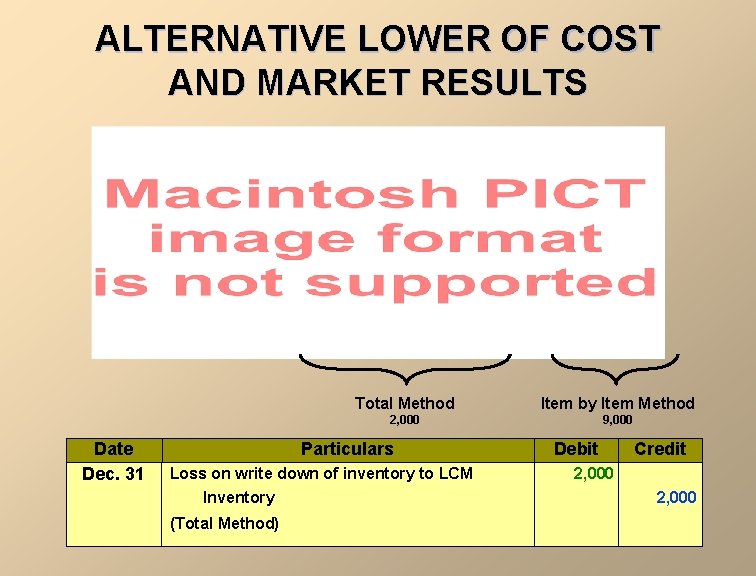
ALTERNATIVE LOWER OF COST AND MARKET RESULTS Date Dec. 31 Total Method Item by Item Method 2, 000 9, 000 Particulars Loss on write down of inventory to LCM Inventory (Total Method) Debit Credit 2, 000
Do the following Problems: P 6 -4 A P 6 -5 A P 6 -6 A P 6 -8 A (c & d)