
CHAPTER 6 Introduction to accounting costing and investment

- Slides: 77
CHAPTER 6 Introduction to accounting , costing and investment evaluation
ACCOUNTING It is an information system that reports on the economic activities and financial condition of a business or other organization. Accounting information can be used to assess past financial performance of a company and help predict its future performance. All kinds of organizations—government agencies, nonprofit organizations, and others —rely on accounting to gauge their progress
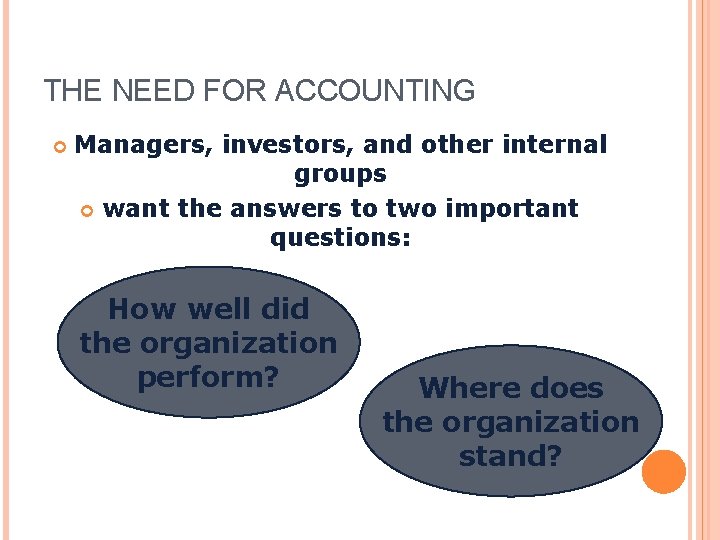
THE NEED FOR ACCOUNTING Managers, investors, and other internal groups want the answers to two important questions: How well did the organization perform? Where does the organization stand?
FIELDS IN ACCOUNTING Financial accounting – recording of transaction for a business enterprise. Cost accounting – determination and control of cost of manufacturing processes and manufactured proudacts. Management accounting – uses historical and estimated data, deals with specific problems at various levels Tax accounting – deals with the preparation of tax returns. International accounting- concerned with problems the international trade of multi natioinal trade organization.
CONT… Accounts The elements are divided into classifications called accounts. For instance there are different kinds of assets. A business would have a cash account like a checking account and they might also own a building.
CHART OF ACCOUNTS Every company has a chart of accounts, sort of like a table of contents in a book. Each account is assigned a number Usually assets start with 1, liabilities 2, stockholder’s equity 3, income 4, cost of goods sold 5, other expenses 6.
BALANCE SHEET Highlights the relative strength of a company at a point in time. Terms related to the balance sheet: assets, liabilities, owner’s equity.
ASSETS Assets are things you own or resources a business owns. The assets of a business belong to its creditors and investors. Tangible assets-this you can touch like machinery, buildings, land, computers, etc. Intangible assets-things you cannot tough such as right to patents, rights to payments from customers, copyrights or trademarks.
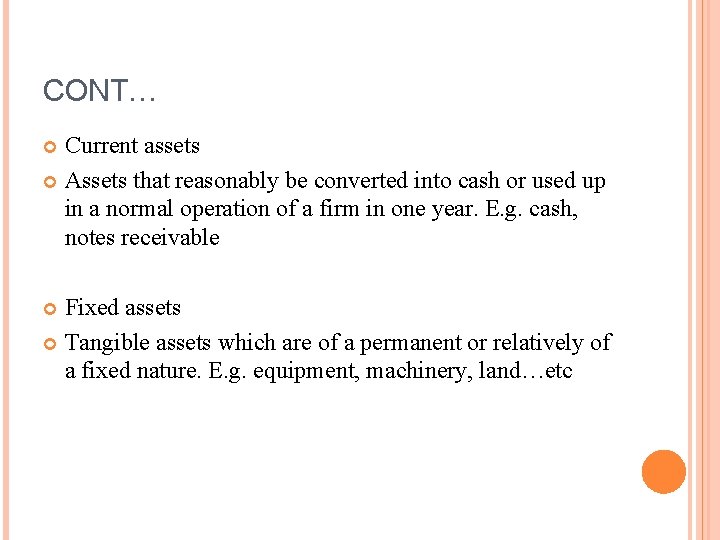
CONT… Current assets Assets that reasonably be converted into cash or used up in a normal operation of a firm in one year. E. g. cash, notes receivable Fixed assets Tangible assets which are of a permanent or relatively of a fixed nature. E. g. equipment, machinery, land…etc
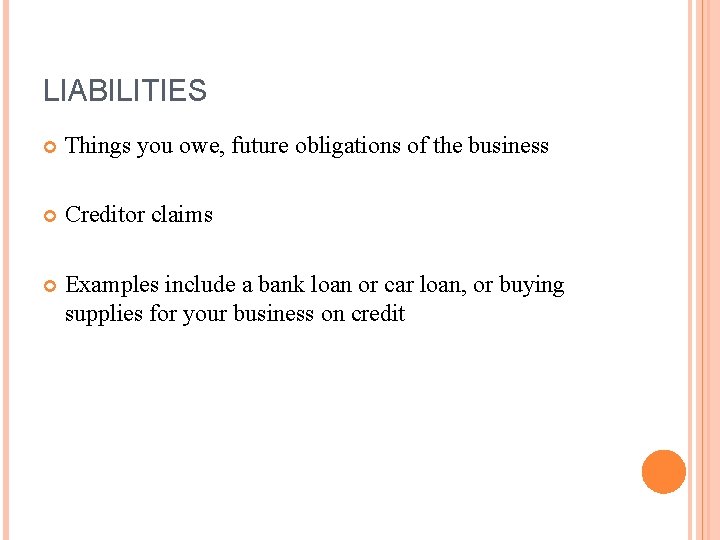
LIABILITIES Things you owe, future obligations of the business Creditor claims Examples include a bank loan or car loan, or buying supplies for your business on credit
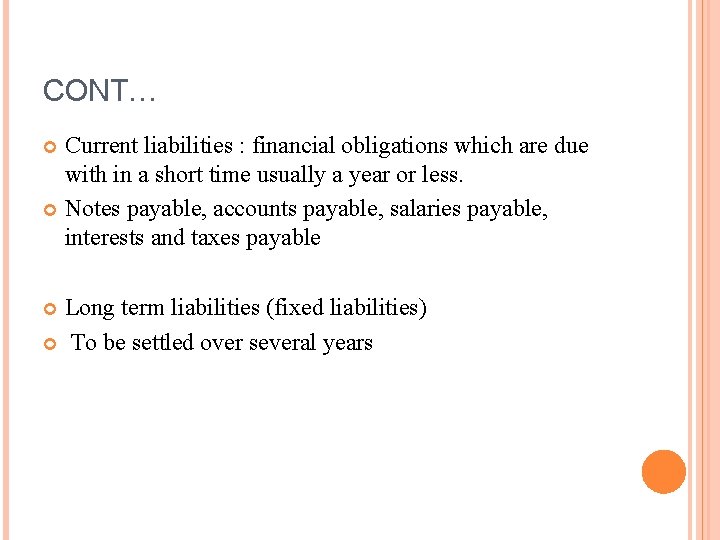
CONT… Current liabilities : financial obligations which are due with in a short time usually a year or less. Notes payable, accounts payable, salaries payable, interests and taxes payable Long term liabilities (fixed liabilities) To be settled over several years
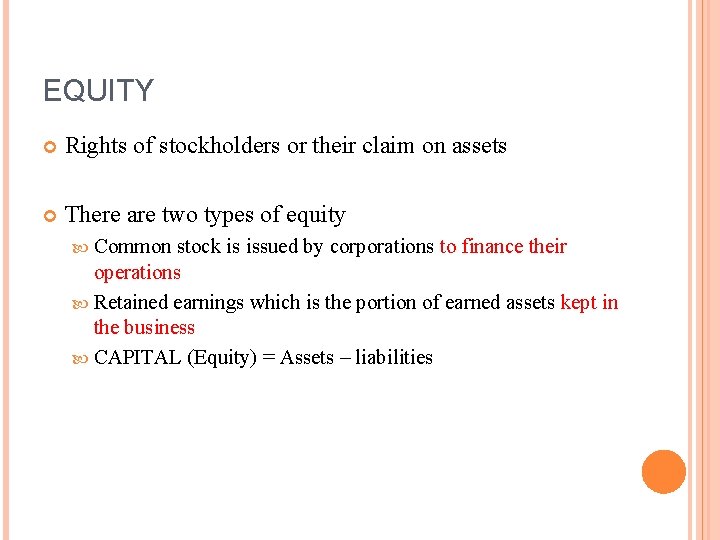
EQUITY Rights of stockholders or their claim on assets There are two types of equity Common stock is issued by corporations to finance their operations Retained earnings which is the portion of earned assets kept in the business CAPITAL (Equity) = Assets – liabilities
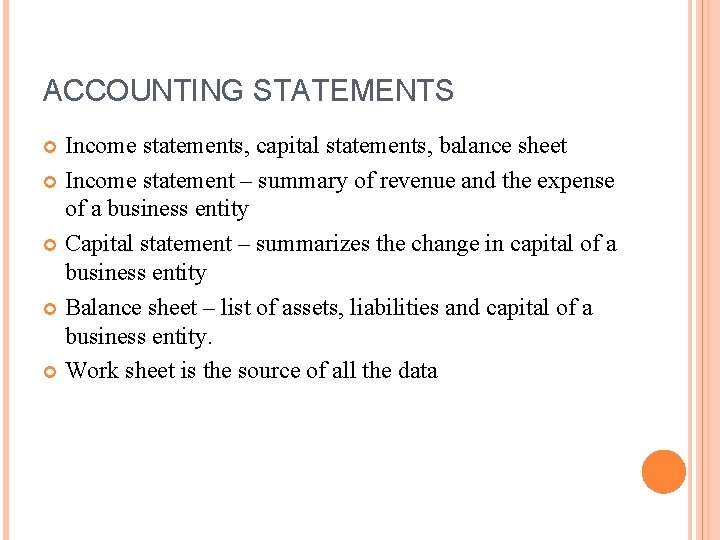
ACCOUNTING STATEMENTS Income statements, capital statements, balance sheet Income statement – summary of revenue and the expense of a business entity Capital statement – summarizes the change in capital of a business entity Balance sheet – list of assets, liabilities and capital of a business entity. Work sheet is the source of all the data
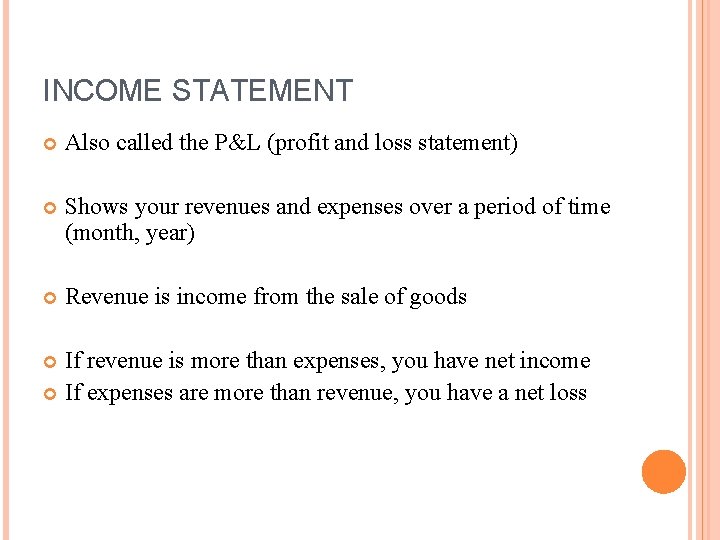
INCOME STATEMENT Also called the P&L (profit and loss statement) Shows your revenues and expenses over a period of time (month, year) Revenue is income from the sale of goods If revenue is more than expenses, you have net income If expenses are more than revenue, you have a net loss
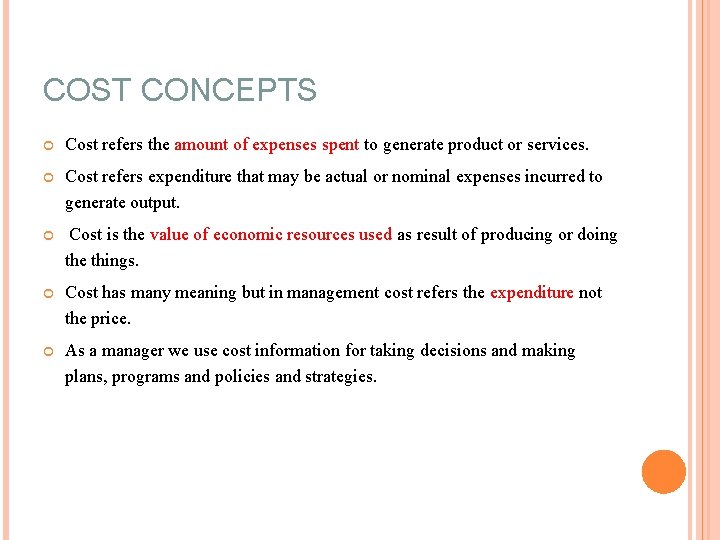
COST CONCEPTS Cost refers the amount of expenses spent to generate product or services. Cost refers expenditure that may be actual or nominal expenses incurred to generate output. Cost is the value of economic resources used as result of producing or doing the things. Cost has many meaning but in management cost refers the expenditure not the price. As a manager we use cost information for taking decisions and making plans, programs and policies and strategies.
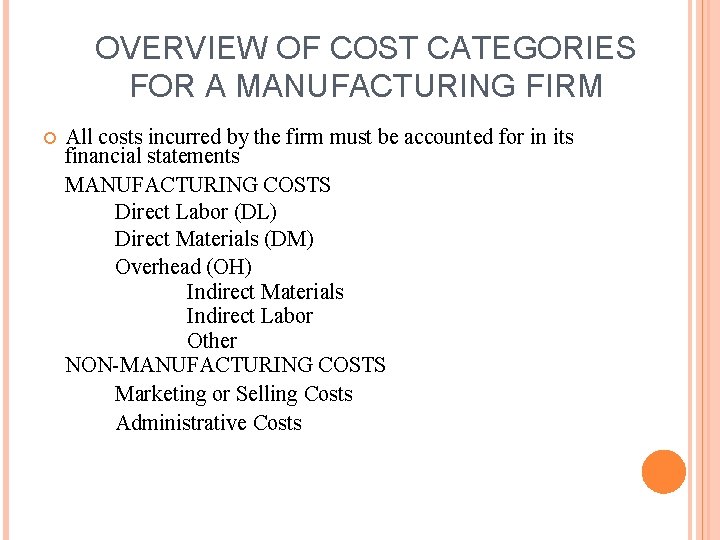
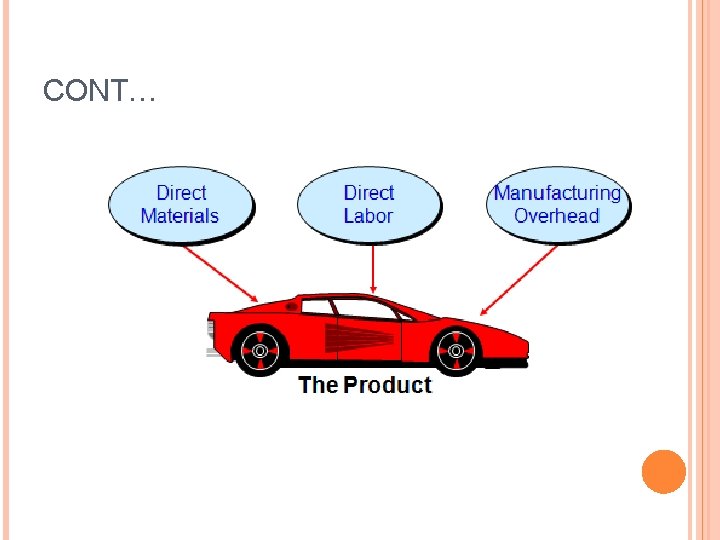
OVERVIEW OF COST CATEGORIES FOR A MANUFACTURING FIRM All costs incurred by the firm must be accounted for in its financial statements MANUFACTURING COSTS Direct Labor (DL) Direct Materials (DM) Overhead (OH) Indirect Materials Indirect Labor Other NON-MANUFACTURING COSTS Marketing or Selling Costs Administrative Costs
CONT… Manufacturing costs are those costs that are directly involved in manufacturing of products and services. Examples of manufacturing costs include raw materials costs and salary of labor workers. Manufacturing cost is divided into three broad categories by most companies.
DIRECT MATERIALS COST: The materials that go into final product are called raw materials. This term is somewhat misleading, since it seems to imply unprocessed natural resources like wood pulp or iron ore. Actually raw materials refer to any materials that are used in the final product; and the finished product of one company can become raw material of another company. For example plastic produced by manufacturers of plastic is a finished product for them but is a raw material for Compaq Computers for its personal computers.
DIRECT LABOR COST The term direct labor is reserved for those labor costs that can be essentially traced to individual units of products. Direct labor is sometime called touch labor, since direct labor workers typically touch the product while it is being made. The labor cost of assembly line workers, for example, is a direct labor cost, as would the labor cost of carpenter, bricklayer and machine operator.
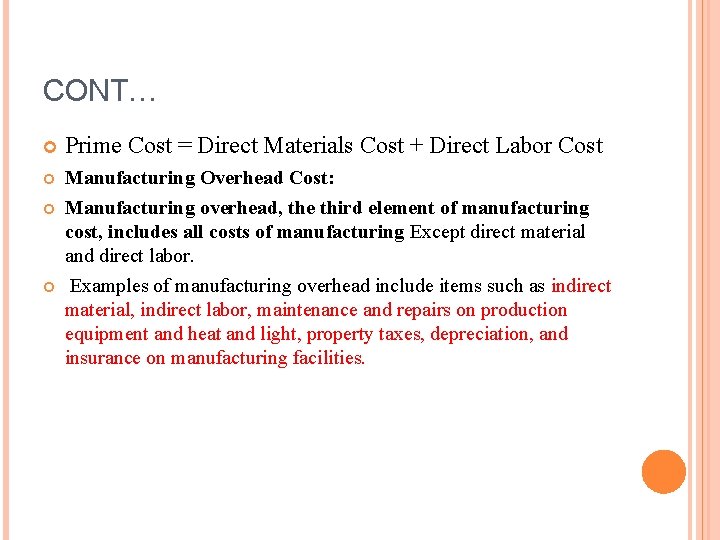
CONT… Prime Cost = Direct Materials Cost + Direct Labor Cost Manufacturing Overhead Cost: Manufacturing overhead, the third element of manufacturing cost, includes all costs of manufacturing Except direct material and direct labor. Examples of manufacturing overhead include items such as indirect material, indirect labor, maintenance and repairs on production equipment and heat and light, property taxes, depreciation, and insurance on manufacturing facilities.
NON-MANUFACTURING COSTS: Non-manufacturing costs are those costs that are not incurred to manufacture a product. Examples of such costs are salary of sales person and advertising expenses. Generally non-manufacturing costs are further classified into two categories. 1. Marketing and Selling Costs 2. Administrative Costs
CONT… Marketing or Selling Costs: Marketing or selling costs include all costs necessary to secure customer orders and get the finished product into the hands of the customers. These costs are often called order getting or order filling costs. Examples of marketing or selling costs include advertising costs, shipping costs, sales commission and sales salary.
CONT… Administrative Costs: Administrative costs include all executive, organizational, and clerical costs associated with general management of an organization rather than with manufacturing, marketing, or selling. Examples of administrative costs include executive compensation, general accounting, secretarial, public relations, and similar costs involved in the overall, general administration of the organization as a whole.
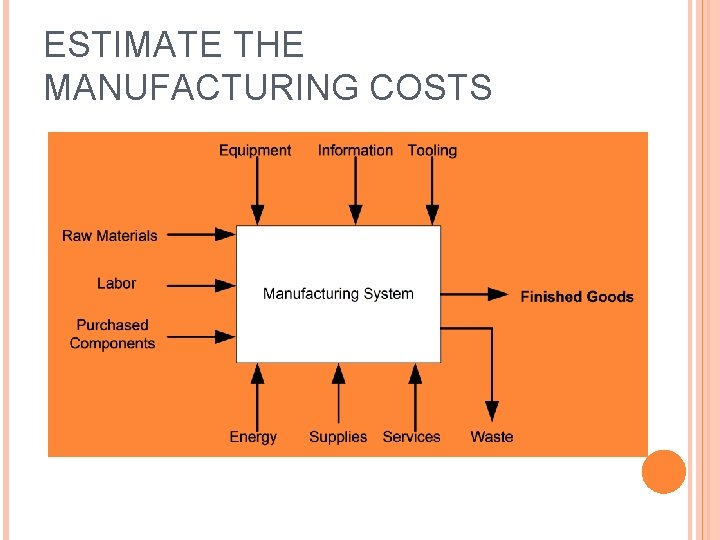
ESTIMATE THE MANUFACTURING COSTS
CONT…
MANUFACTURING COSTS DEFINED Sum of all the expenditures for the inputs of the system (i. e. purchased components, energy, raw materials, etc. ) and for disposal of the wastes produced by the system
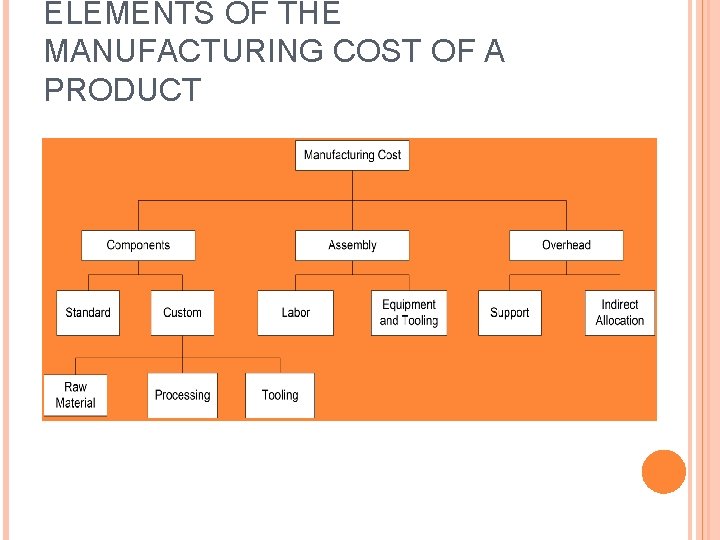
ELEMENTS OF THE MANUFACTURING COST OF A PRODUCT
MANUFACTURING COST OF A PRODUCT Component Costs (parts of the product) Parts purchased from supplier Custom parts made in the manufacturer’s own plant or by suppliers according to the manufacturer’s design specifications Assembly Costs (labor, equipment, & tooling) Overhead Costs (all other costs) Support Costs (material handling, quality assurance, purchasing, shipping, receiving, facilities, etc. ) Indirect Allocations (not directly linked to a particular product but must be paid for to be in business)
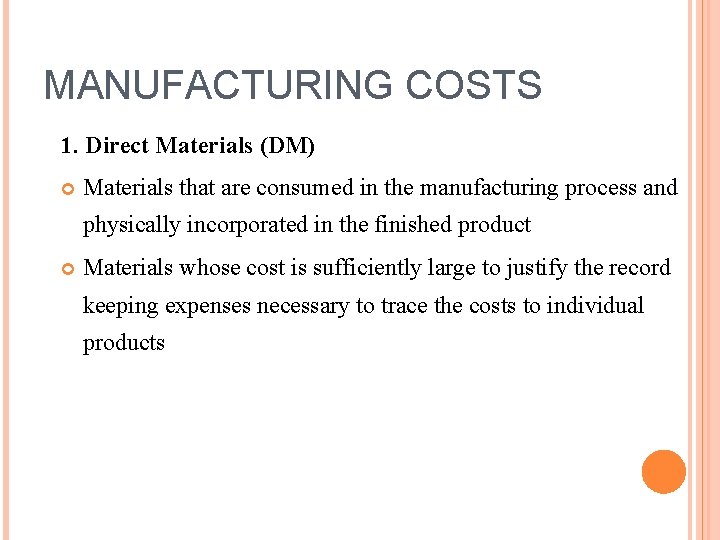
MANUFACTURING COSTS 1. Direct Materials (DM) Materials that are consumed in the manufacturing process and physically incorporated in the finished product Materials whose cost is sufficiently large to justify the record keeping expenses necessary to trace the costs to individual products
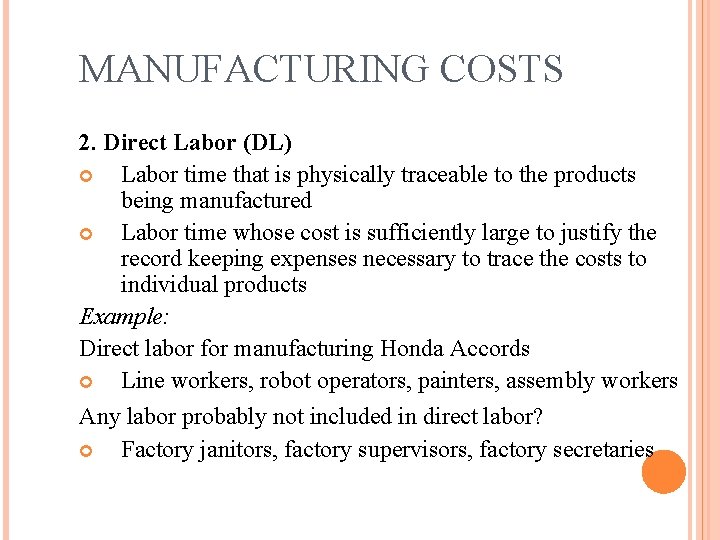
MANUFACTURING COSTS 2. Direct Labor (DL) Labor time that is physically traceable to the products being manufactured Labor time whose cost is sufficiently large to justify the record keeping expenses necessary to trace the costs to individual products Example: Direct labor for manufacturing Honda Accords Line workers, robot operators, painters, assembly workers Any labor probably not included in direct labor? Factory janitors, factory supervisors, factory secretaries
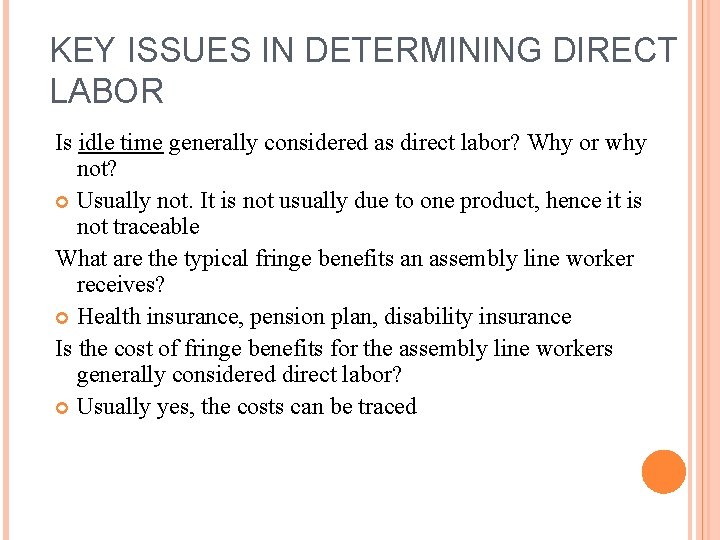
KEY ISSUES IN DETERMINING DIRECT LABOR Is idle time generally considered as direct labor? Why or why not? Usually not. It is not usually due to one product, hence it is not traceable What are the typical fringe benefits an assembly line worker receives? Health insurance, pension plan, disability insurance Is the cost of fringe benefits for the assembly line workers generally considered direct labor? Usually yes, the costs can be traced
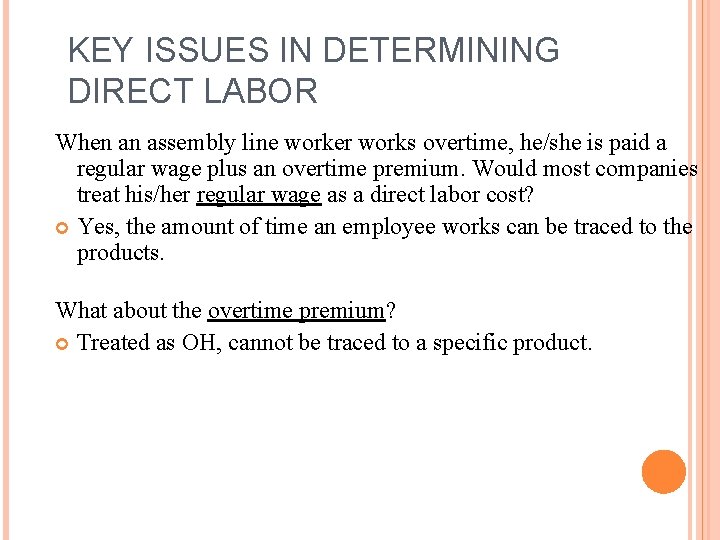
KEY ISSUES IN DETERMINING DIRECT LABOR When an assembly line worker works overtime, he/she is paid a regular wage plus an overtime premium. Would most companies treat his/her regular wage as a direct labor cost? Yes, the amount of time an employee works can be traced to the products. What about the overtime premium? Treated as OH, cannot be traced to a specific product.
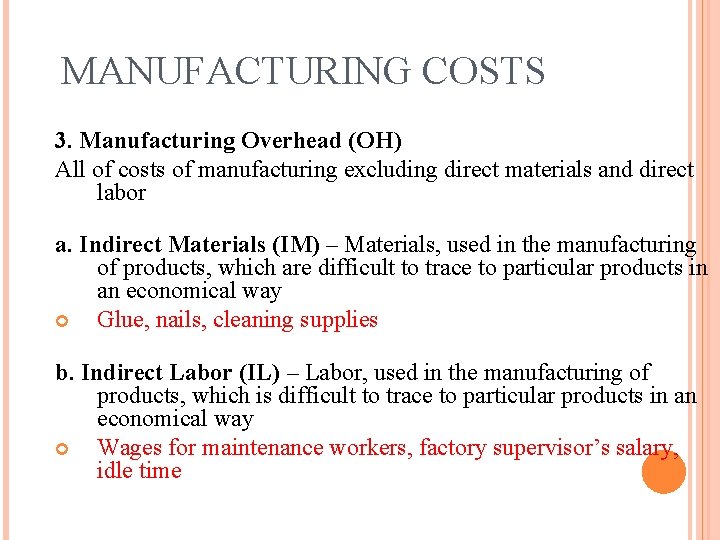
MANUFACTURING COSTS 3. Manufacturing Overhead (OH) All of costs of manufacturing excluding direct materials and direct labor a. Indirect Materials (IM) – Materials, used in the manufacturing of products, which are difficult to trace to particular products in an economical way Glue, nails, cleaning supplies b. Indirect Labor (IL) – Labor, used in the manufacturing of products, which is difficult to trace to particular products in an economical way Wages for maintenance workers, factory supervisor’s salary, idle time
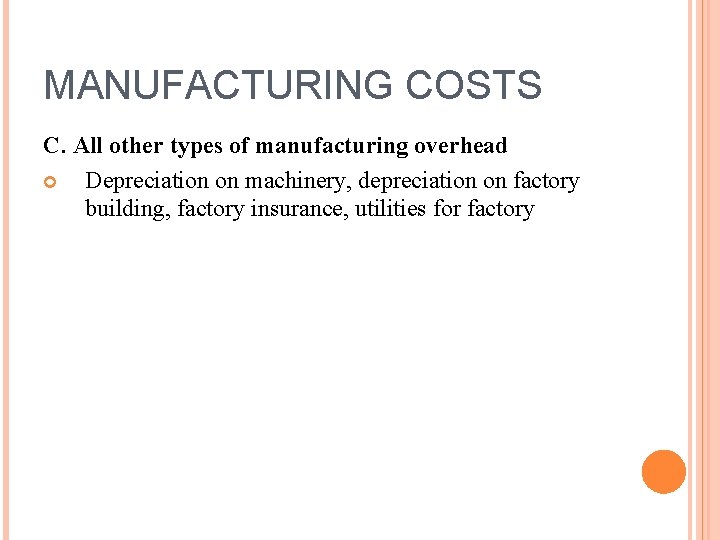
MANUFACTURING COSTS C. All other types of manufacturing overhead Depreciation on machinery, depreciation on factory building, factory insurance, utilities for factory
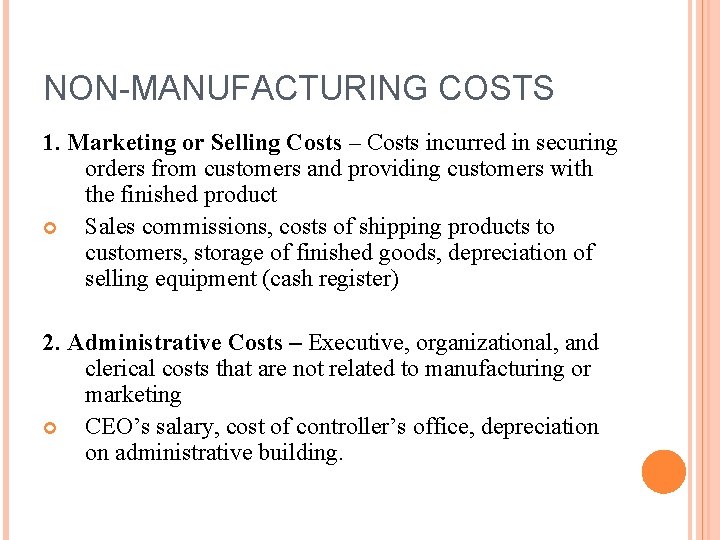
NON-MANUFACTURING COSTS 1. Marketing or Selling Costs – Costs incurred in securing orders from customers and providing customers with the finished product Sales commissions, costs of shipping products to customers, storage of finished goods, depreciation of selling equipment (cash register) 2. Administrative Costs – Executive, organizational, and clerical costs that are not related to manufacturing or marketing CEO’s salary, cost of controller’s office, depreciation on administrative building.
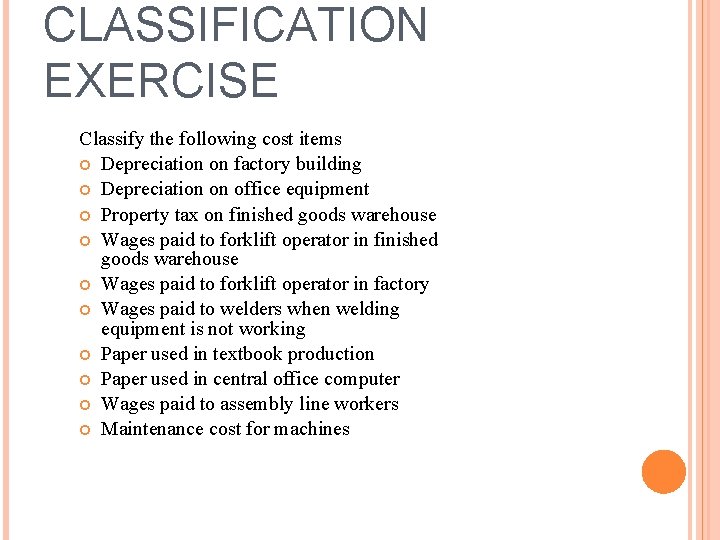
CLASSIFICATION EXERCISE Classify the following cost items Depreciation on factory building Depreciation on office equipment Property tax on finished goods warehouse Wages paid to forklift operator in factory Wages paid to welders when welding equipment is not working Paper used in textbook production Paper used in central office computer Wages paid to assembly line workers Maintenance cost for machines
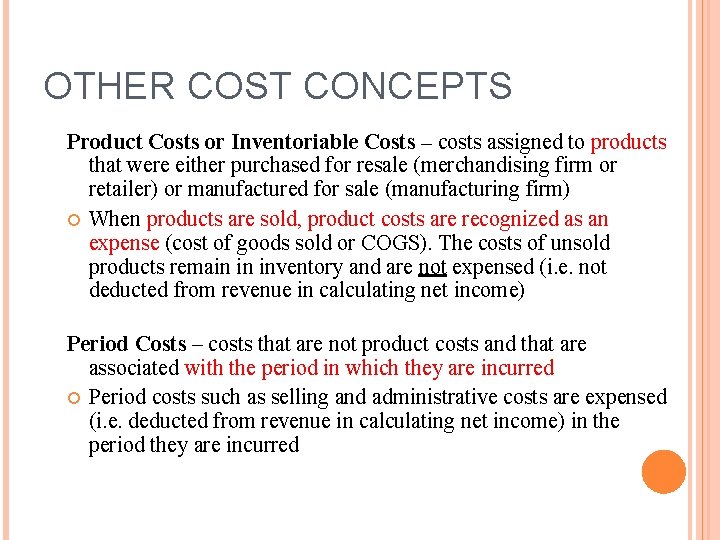
OTHER COST CONCEPTS Product Costs or Inventoriable Costs – costs assigned to products that were either purchased for resale (merchandising firm or retailer) or manufactured for sale (manufacturing firm) When products are sold, product costs are recognized as an expense (cost of goods sold or COGS). The costs of unsold products remain in inventory and are not expensed (i. e. not deducted from revenue in calculating net income) Period Costs – costs that are not product costs and that are associated with the period in which they are incurred Period costs such as selling and administrative costs are expensed (i. e. deducted from revenue in calculating net income) in the period they are incurred
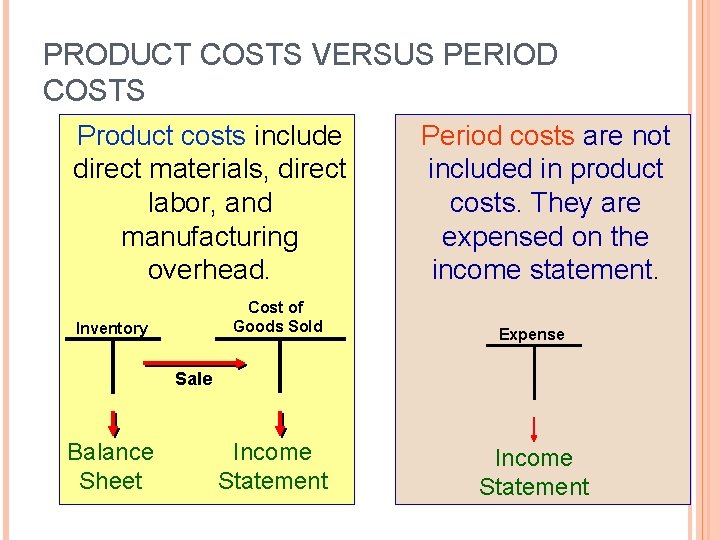
PRODUCT COSTS VERSUS PERIOD COSTS Product costs include direct materials, direct labor, and manufacturing overhead. Cost of Goods Sold Inventory Period costs are not included in product costs. They are expensed on the income statement. Expense Sale Balance Sheet Income Statement
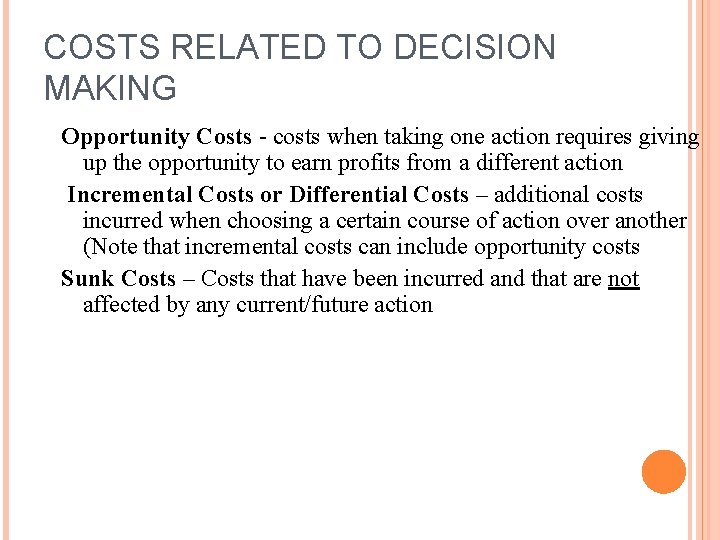
COSTS RELATED TO DECISION MAKING Opportunity Costs - costs when taking one action requires giving up the opportunity to earn profits from a different action Incremental Costs or Differential Costs – additional costs incurred when choosing a certain course of action over another (Note that incremental costs can include opportunity costs Sunk Costs – Costs that have been incurred and that are not affected by any current/future action
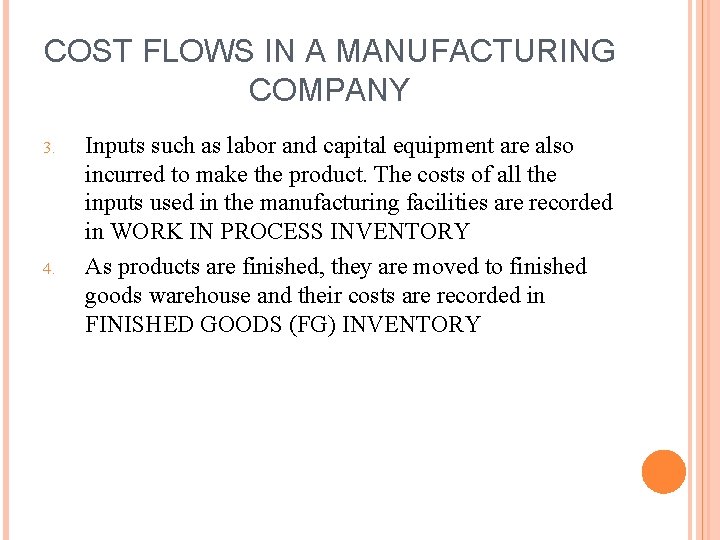
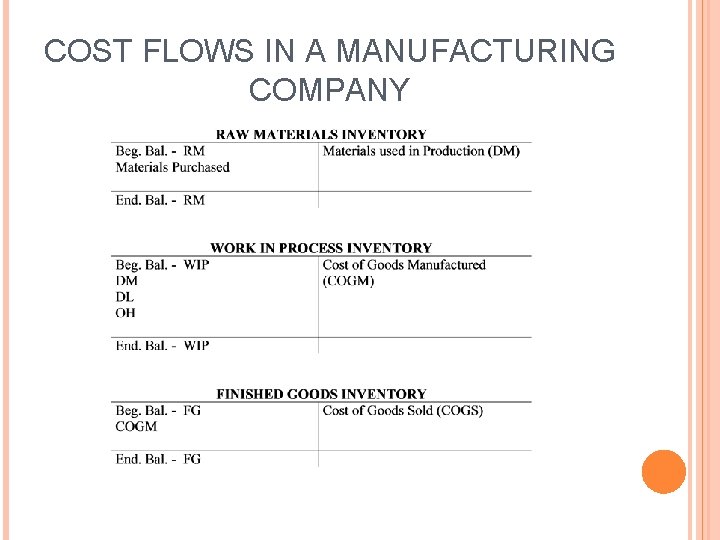
COST FLOWS IN A MANUFACTURING COMPANY 3. 4. Inputs such as labor and capital equipment are also incurred to make the product. The costs of all the inputs used in the manufacturing facilities are recorded in WORK IN PROCESS INVENTORY As products are finished, they are moved to finished goods warehouse and their costs are recorded in FINISHED GOODS (FG) INVENTORY
COST FLOWS IN A MANUFACTURING COMPANY
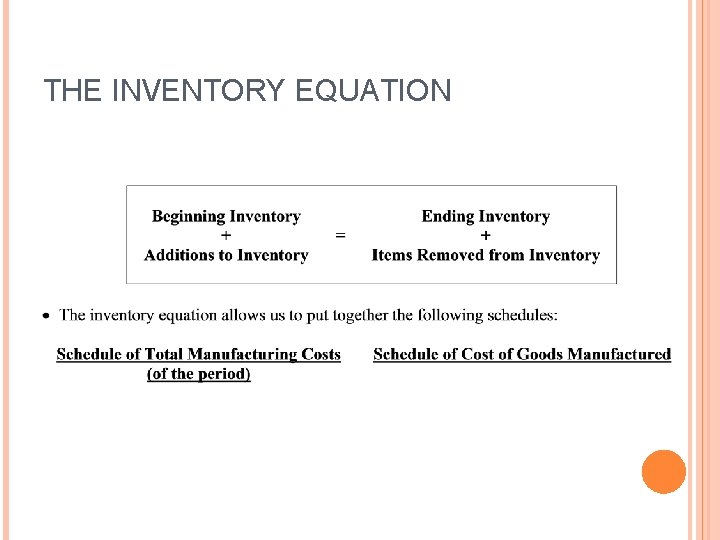
THE INVENTORY EQUATION
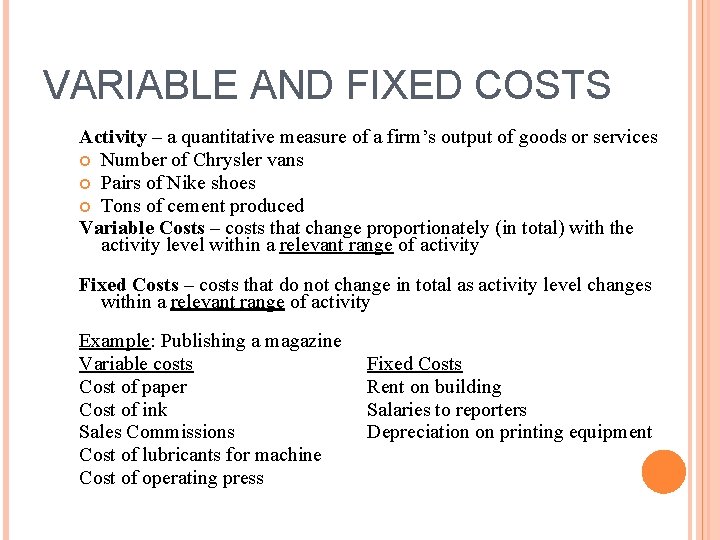
VARIABLE AND FIXED COSTS Activity – a quantitative measure of a firm’s output of goods or services Number of Chrysler vans Pairs of Nike shoes Tons of cement produced Variable Costs – costs that change proportionately (in total) with the activity level within a relevant range of activity Fixed Costs – costs that do not change in total as activity level changes within a relevant range of activity Example: Publishing a magazine Variable costs Cost of paper Cost of ink Sales Commissions Cost of lubricants for machine Cost of operating press Fixed Costs Rent on building Salaries to reporters Depreciation on printing equipment
CONT…
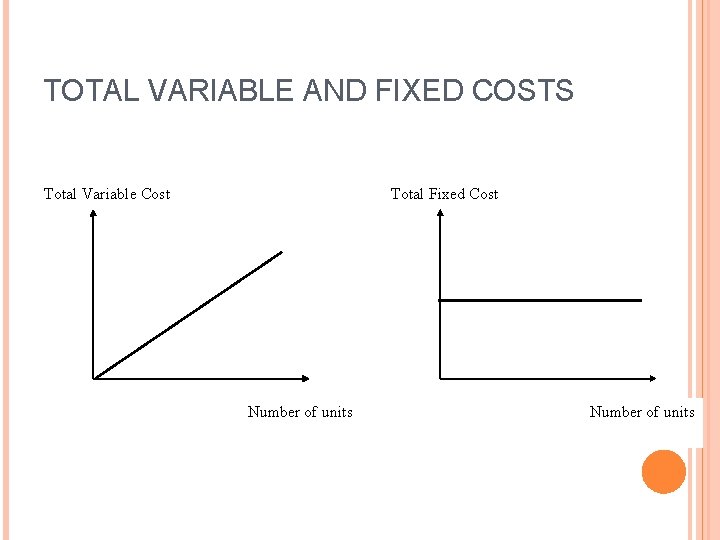
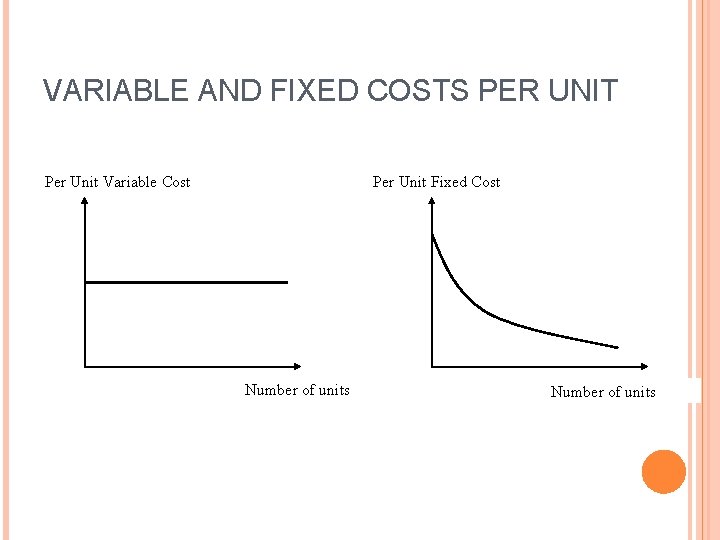
CONT… Fixed Cost A cost that remains constant within a given period of time and range of activity in spite of fluctuations in production. Per unit fixed cost with the change in the volume of production. If the production increases, fixed cost per unit decreases and as there is decrease in production, the fixed cost per unit increases. Rent and insurance of building, depreciation on plant and machinery, salary of employees etc. , are some examples of fixed costs.
CONT… Variable costs are those cost which vary directly in proportion to change in volume of production/output. The cost which increases or decreases in the same proportion in which the units produced is termed as variable cost. Direct material, direct labor , direct expenses, variable overheads are some examples of variable cost.
TOTAL VARIABLE AND FIXED COSTS Total Variable Cost Total Fixed Cost Number of units
VARIABLE AND FIXED COSTS PER UNIT Per Unit Variable Cost Per Unit Fixed Cost Number of units
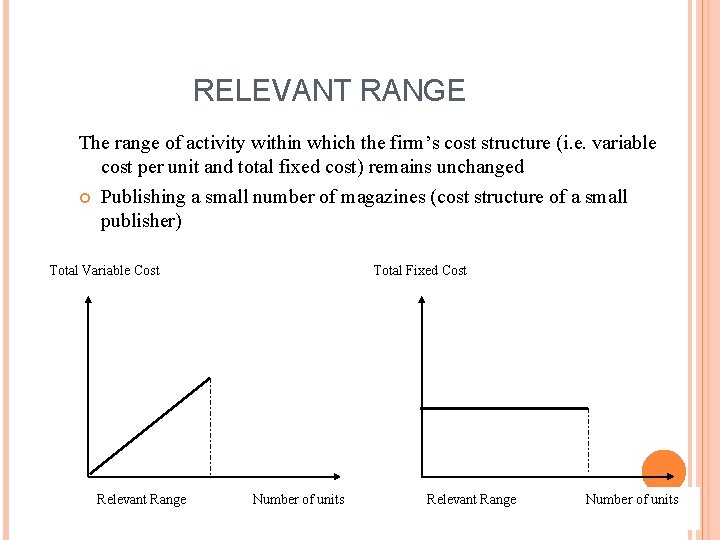
RELEVANT RANGE The range of activity within which the firm’s cost structure (i. e. variable cost per unit and total fixed cost) remains unchanged Publishing a small number of magazines (cost structure of a small publisher) Total Variable Cost Relevant Range Total Fixed Cost Number of units Relevant Range Number of units
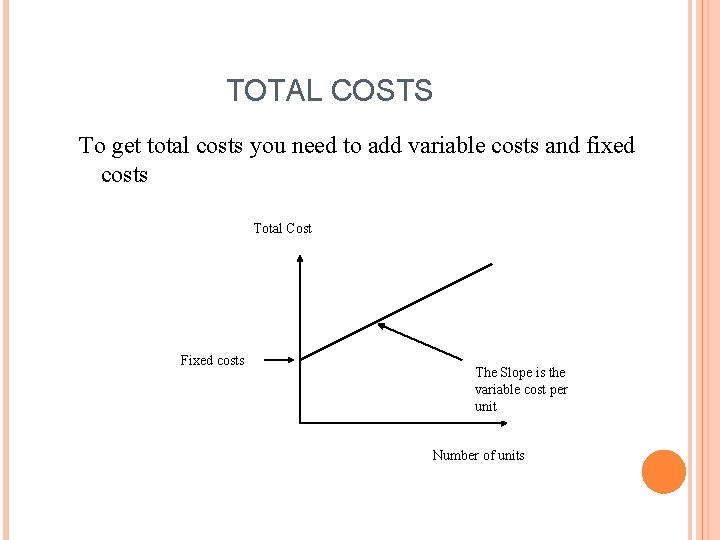
TOTAL COSTS To get total costs you need to add variable costs and fixed costs Total Cost Fixed costs The Slope is the variable cost per unit Number of units
COST ESTIMATING Cost estimating is the estimation of the expected cost of producing a job or executing a manufacturing order before the actual production is taken up or predicting what new products will cost, before they are made. The expected expenditure on all the items used to make a product is added to give the estimated cost of final product.
CONT… COST ACCOUNTING Costing or cost accounting means classifying, recording and allocating the appropriate expenditure for determining the cost of production and achieved by keeping a continuous record of all the costs involved in manufacturing.
CONT… Costing or cost accounting gives the actual expenditure incurred on the production of the component based on the records of expenditure on various activities involved, when the product has already been manufactured
CONT… estimating is a type of forecasting and gives the expected expenditure to be incurred on the manufacture of the product before the actual manufacturing is taken up. Also, cost estimating is done by qualified engineers, whereas costing is done by accountants or cost accountants.
BASIC STEPS IN COST ESTIMATION 1. Make thorough study of cost estimation request to understand it fully 2. Make an analysis of the product and prepare a bill of materials. 3. Make separate lists of parts to be purchased from the market and parts to be manufactured in plant.
CONT… 4. Determine the cost of parts to be purchased from outside. 5. Estimate the material cost for the parts/components to be manufactured in plant. 6. Make manufacturing process plan for the parts to be manufactured in plant. 7. Estimate the machining time for each operation listed in the manufacturing process plan. 8. Multiply each operation time by the labour wage rate and add them up to find direct labour cost. 9. Add the estimate of step 4, 5, and 8 to get prime cost of component. 10. Apply overhead costs to get the total cost of the component. The selling price of the component is estimated by adding profit to the total cost obtained in step 10
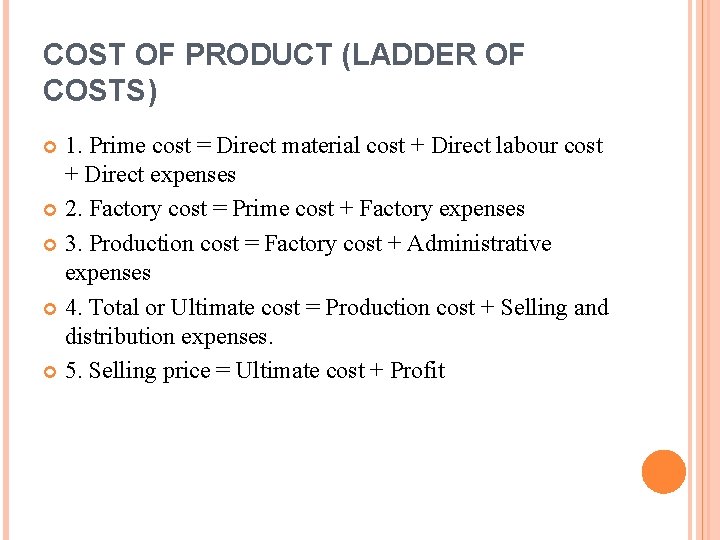
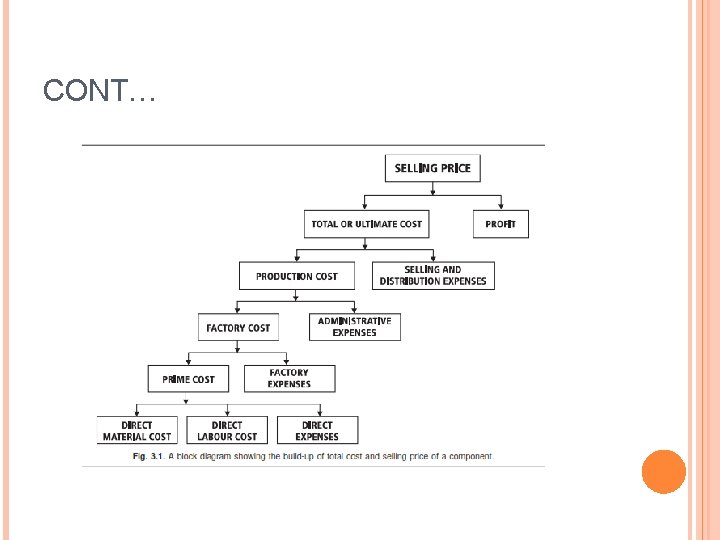
COST OF PRODUCT (LADDER OF COSTS) 1. Prime cost = Direct material cost + Direct labour cost + Direct expenses 2. Factory cost = Prime cost + Factory expenses 3. Production cost = Factory cost + Administrative expenses 4. Total or Ultimate cost = Production cost + Selling and distribution expenses. 5. Selling price = Ultimate cost + Profit
CONT…
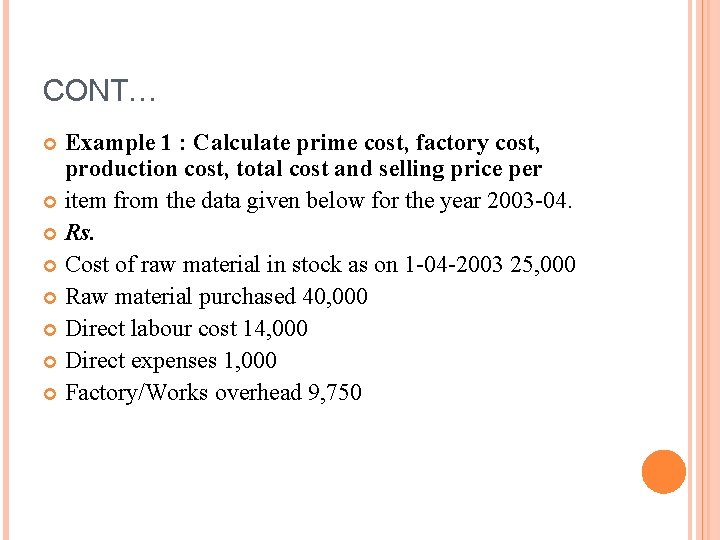
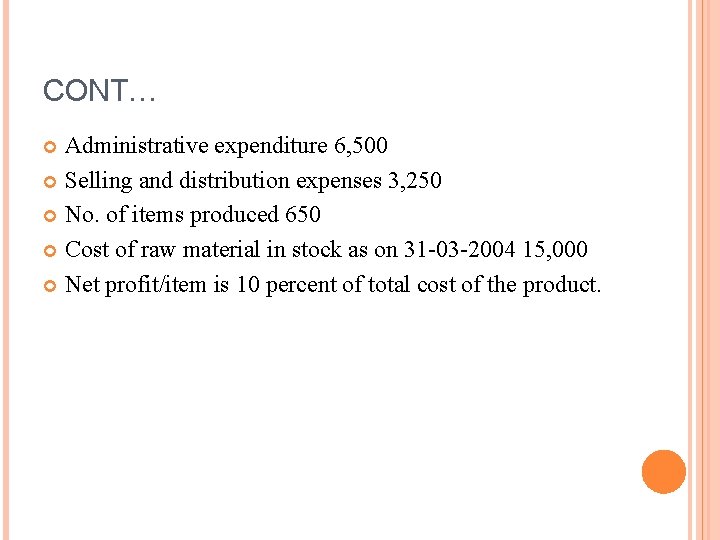
CONT… Example 1 : Calculate prime cost, factory cost, production cost, total cost and selling price per item from the data given below for the year 2003 -04. Rs. Cost of raw material in stock as on 1 -04 -2003 25, 000 Raw material purchased 40, 000 Direct labour cost 14, 000 Direct expenses 1, 000 Factory/Works overhead 9, 750
CONT… Administrative expenditure 6, 500 Selling and distribution expenses 3, 250 No. of items produced 650 Cost of raw material in stock as on 31 -03 -2004 15, 000 Net profit/item is 10 percent of total cost of the product.
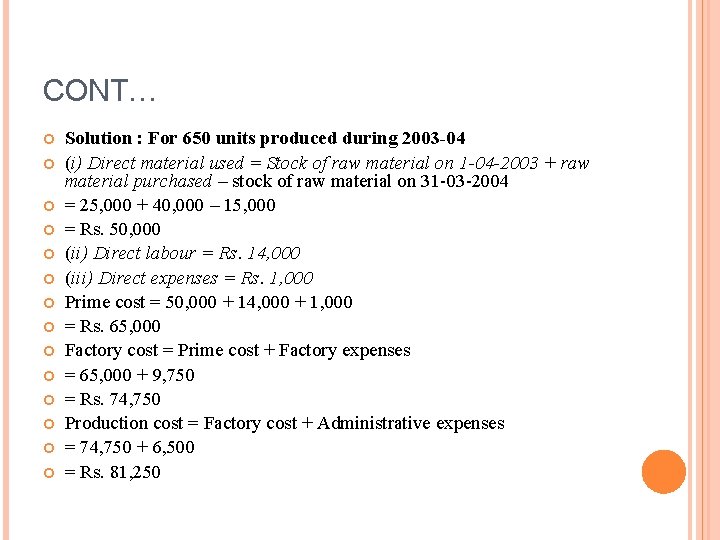
CONT… Solution : For 650 units produced during 2003 -04 (i) Direct material used = Stock of raw material on 1 -04 -2003 + raw material purchased – stock of raw material on 31 -03 -2004 = 25, 000 + 40, 000 – 15, 000 = Rs. 50, 000 (ii) Direct labour = Rs. 14, 000 (iii) Direct expenses = Rs. 1, 000 Prime cost = 50, 000 + 14, 000 + 1, 000 = Rs. 65, 000 Factory cost = Prime cost + Factory expenses = 65, 000 + 9, 750 = Rs. 74, 750 Production cost = Factory cost + Administrative expenses = 74, 750 + 6, 500 = Rs. 81, 250
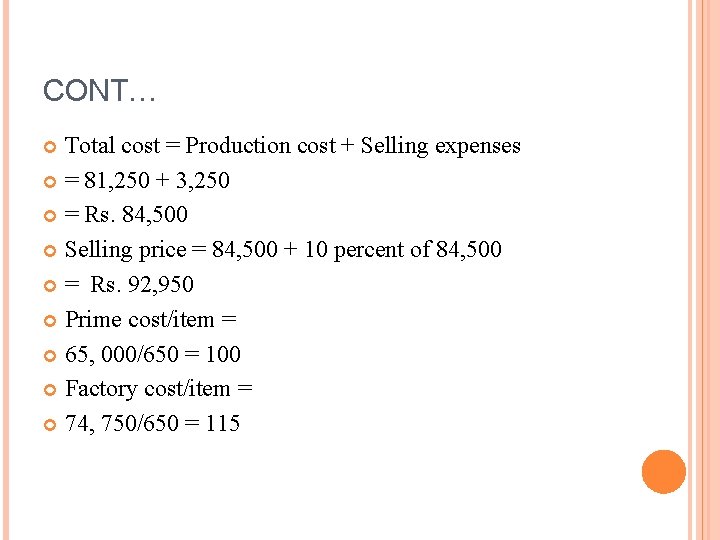
CONT… Total cost = Production cost + Selling expenses = 81, 250 + 3, 250 = Rs. 84, 500 Selling price = 84, 500 + 10 percent of 84, 500 = Rs. 92, 950 Prime cost/item = 65, 000/650 = 100 Factory cost/item = 74, 750/650 = 115
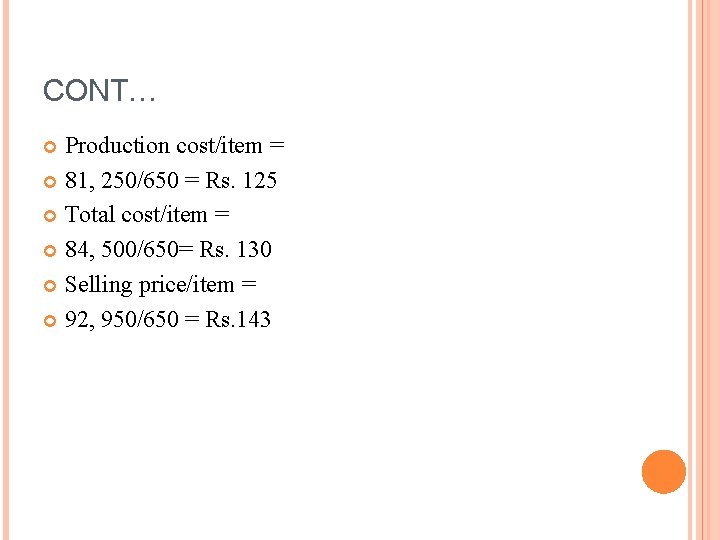
CONT… Production cost/item = 81, 250/650 = Rs. 125 Total cost/item = 84, 500/650= Rs. 130 Selling price/item = 92, 950/650 = Rs. 143
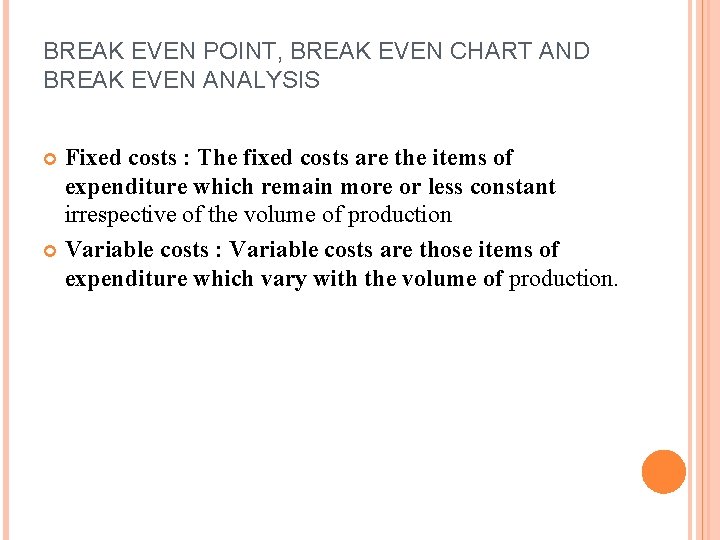
BREAK EVEN POINT, BREAK EVEN CHART AND BREAK EVEN ANALYSIS Fixed costs : The fixed costs are the items of expenditure which remain more or less constant irrespective of the volume of production Variable costs : Variable costs are those items of expenditure which vary with the volume of production.
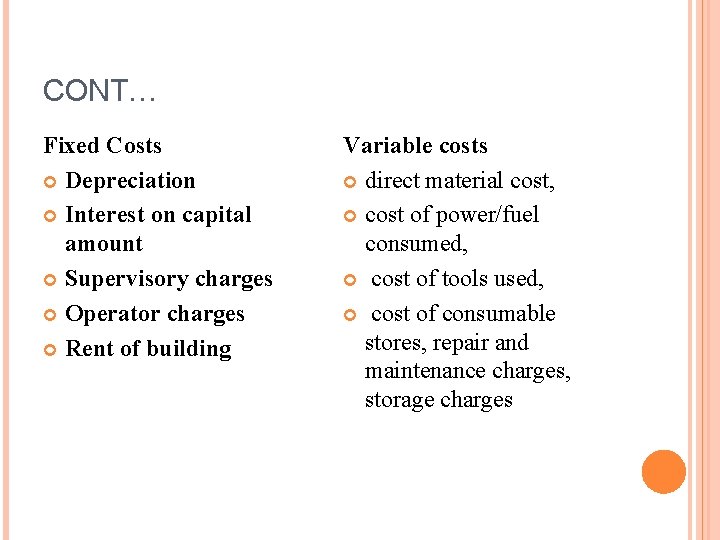
CONT… Fixed Costs Depreciation Interest on capital amount Supervisory charges Operator charges Rent of building Variable costs direct material cost, cost of power/fuel consumed, cost of tools used, cost of consumable stores, repair and maintenance charges, storage charges
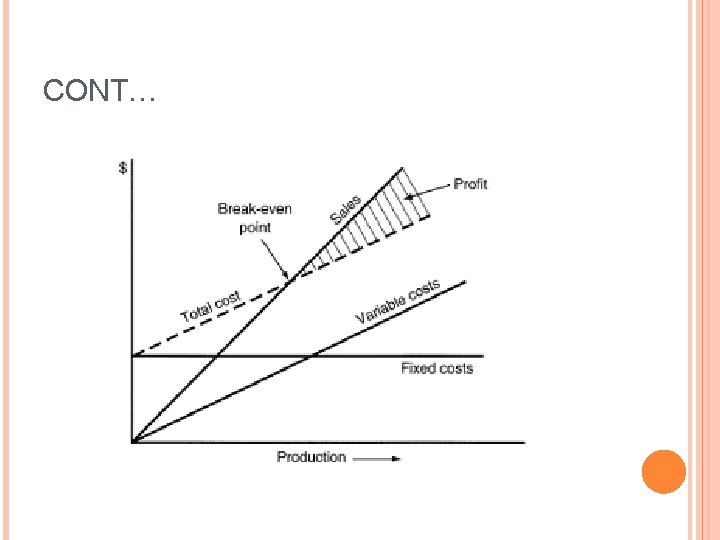
CONT… Break-even point (BEP) represents the production quantity for which the total cost of producing the goods equals the total sales price. At break-even point there will be neither any profit nor any loss to the manufacturer.
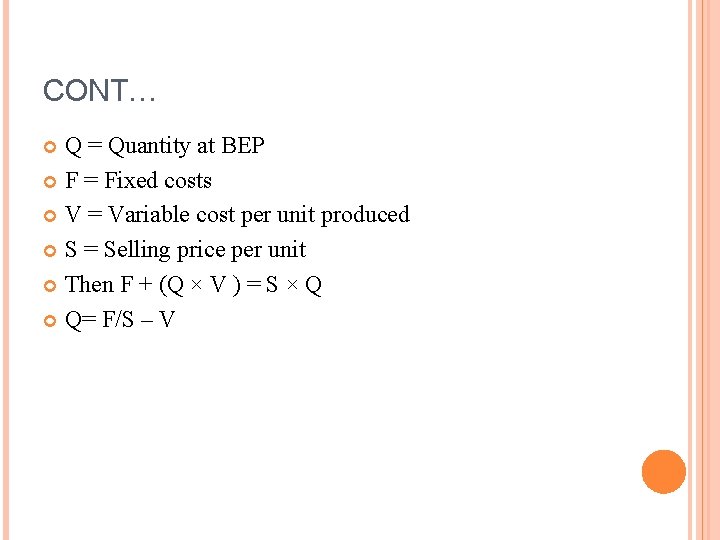
CONT… Q = Quantity at BEP F = Fixed costs V = Variable cost per unit produced S = Selling price per unit Then F + (Q × V ) = S × Q Q= F/S – V
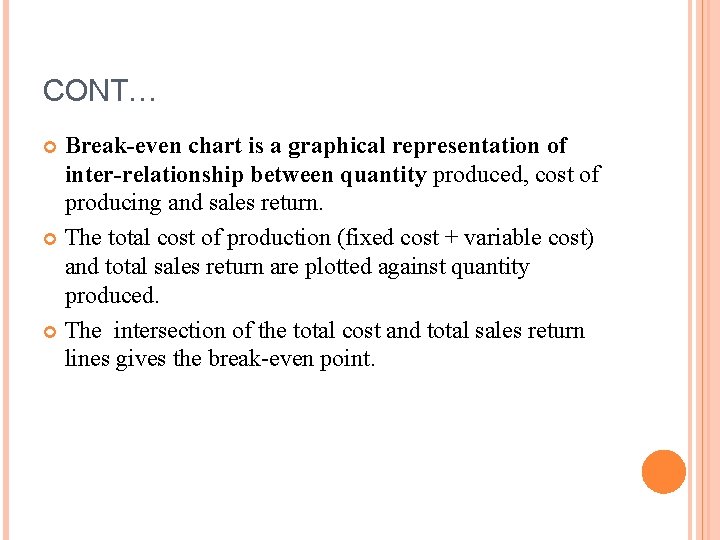
CONT… Break-even chart is a graphical representation of inter-relationship between quantity produced, cost of producing and sales return. The total cost of production (fixed cost + variable cost) and total sales return are plotted against quantity produced. The intersection of the total cost and total sales return lines gives the break-even point.
CONT…
INVESTMENT EVALUATION Total investment costs: Defined as the sum of fixed capital (fixed investments plus production capital costs) and net working capital Fixed Assets: It comprises of fixed investments and preproduction capital costs.
CONT… 1) Fixed Investments: Land & site preparation, Building & civil works, Plant machinery & equipment including auxiliary equipment, Certain incorporate fixed assets such as industrial property rights. 2) Pre- production capital expenditure: A) Expenditures incurred during the registration & formation of the company like legal fees for preparation memorandum, articles of association & similar documents.
CONT… B)Consultant fees for preparing studies, engineering services & supervision of erection & construction. C) Other expenditures for planning the project. D) Salaries , Travel expenses, social security contributions of personnel engaged during the pre-production period. E) Preparatory installations such as camps, temporary offices, stores etc. F) Training costs, including fees, travel and living expenses, salaries and stipends of the trainees G) Interest on loan during construction
WORKING CAPITAL Defined as the current assets minus current liabilities. It indicates the financial means required to operate the project according to its production program. Current assets- Receivables, inventories(raw material, auxiliary material, supplies packaging materials, spares and small tools), work in progress, finished products and cash. Current liabilities- Accounts payable (creditors) and are free of interest.
CONT… Working Capital= Current Assets - Current Liabilities Or Working Capital= Permanent Capital - Fixed Capital Types of Capital: Three types- Equity, Debt and Mezzanine.
SOURCES OF FINANCING Equity capital providers, commercial banks, Export credit agencies, Bilateral and Multilateral aid agencies, Industrial investors, National and regional development banks, Capital markets and Local currency funding.
CONT… Interest is the excess amount which one earns over one’s money lent to someone else (individual, banks, organizations etc. ) Interest may arise from one of the following reasons: Interest is a compensation for a current income foregoing. Ex: If a farmer lends his money, he forgoes some income, which he could have earned by using that money for some productive purpose such as using increased quantities of fertilizer. Interest is a reward somebody is entitled to, for his sacrifice of present pleasure by lending his money to somebody else.