
Chapter 6 Interviews and Eyewitness Identifications Objectives Identify

Chapter 6 Interviews and Eyewitness Identifications
Objectives • Identify the evidence collected by investigators in the BP gas station robbery and discuss its role in the identification and apprehension of the perpetrator • Identify the difference between primary and secondary witnesses • Identify and discuss the methods of eyewitness identification Brandl, Criminal Investigation 4 e SAGE Publishing, 2018 3
Objectives • Identify the pros and cons of using facial identification software and forensic sketches to create composite pictures of suspects • Discuss the value of eyewitness identifications Brandl, Criminal Investigation 4 e SAGE Publishing, 2018 4
Objectives • Discuss the three phases of human memory and discuss how factors at each phase may affect the retrieval of information from witnesses • Identify and discuss the rationale of the recommended line-up procedures • Discuss the role of hypnosis in criminal investigations Brandl, Criminal Investigation 4 e SAGE Publishing, 2018 5
Objectives • Discuss the research on the accuracy of hypnotically elicited testimony • Compare and contrast the cognitive interviewing approach with standard police interviews • Discuss the contributions of cognitive interviewing in enhancing memory recall Brandl, Criminal Investigation 4 e SAGE Publishing, 2018 6
From the Case File: BP Gas Station Robbery • The clerk at a BP gas station in Germantown, Wisconsin called the police after an armed robbery • The suspect entered the store and grabbed a can of Mountain Dew. After some suspicious behavior, the white male suspect hit the clerk with a hard object repeatedly and grabbed money out of the open cash drawer Brandl, Criminal Investigation 4 e SAGE Publishing, 2018 7
From the Case File: BP Gas Station Robbery • After a struggle, the suspect got into a red, rusty Jeep fleeing northbound on Bell Road • The suspect was described as having some facial hair growth, 25– 30 yoa, 5’ 9”, 130 lb, blue jeans, a dark top, and a dark baseball cap Brandl, Criminal Investigation 4 e SAGE Publishing, 2018 8
From the Case File: BP Gas Station Robbery A neighborhood canvass revealed a black shirt recently discarded The police also discovered a stolen 1998 red Jeep Grand Cherokee SUV in a Pic N Save parking lot In the car, a $20 bill was recovered. In a nearby trashcan, a dark baseball cap and a diet Mountain Dew can were also recovered The suspect driving the vehicle, Russell D. Warchol, matched the description of the perpetrator and was convicted of his crimes Brandl, Criminal Investigation 4 e SAGE Publishing, 2018 9
Interviews Defined • An investigative interview is any questioning that is intended to produce information regarding a particular crime or suspect – The goal of an investigative interview is to develop information to move the investigation forward Brandl, Criminal Investigation 4 e SAGE Publishing, 2018 10

Types of Witnesses and Witness Information • Primary witnesses – Have direct knowledge of a crime or suspect o Some primary witnesses are eyewitnesses. Eyewitnesses saw the crime occur or saw related events right before or after • Secondary witnesses – Have information about related events before or after the crime Brandl, Criminal Investigation 4 e SAGE Publishing, 2018 11

Types of Witnesses and Witness Information • Witnesses can provide information regarding: – Actions of the perpetrator – Descriptions of the perpetrator – An identification of the perpetrator Brandl, Criminal Investigation 4 e SAGE Publishing, 2018 12
Methods of Eyewitness Identification • Witness provides information for a composite picture of the perpetrator – A forensic sketch or composite software (like FACES) can be created through a witness’ description • Confirmatory photograph – Should only be used when witness knows the identity of the perpetrator Brandl, Criminal Investigation 4 e SAGE Publishing, 2018 13
Methods of Eyewitness Identification • Mug shot books – Mug shot books contain photographs of previously arrested or detained individuals matching the witness’ description • Show-up identification – Show-up situations involve bringing the suspect to the witness for identification, usually when there was a quick apprehension Brandl, Criminal Investigation 4 e SAGE Publishing, 2018 14
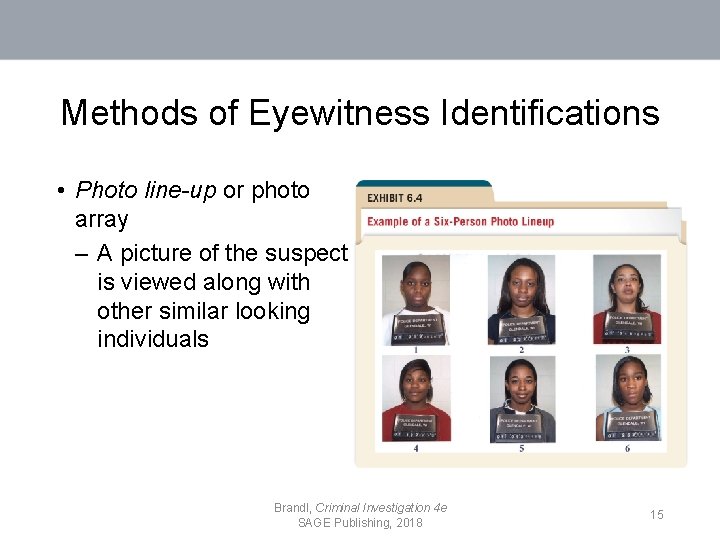
Methods of Eyewitness Identifications • Photo line-up or photo array – A picture of the suspect is viewed along with other similar looking individuals Brandl, Criminal Investigation 4 e SAGE Publishing, 2018 15

Methods of Eyewitness Identifications • Physical, or live, line-up – Physical line-ups involve a witness viewing the suspect and other similar looking individuals in a controlled setting for identification Brandl, Criminal Investigation 4 e SAGE Publishing, 2018 16
Value of Eyewitness Identifications in Establishing Proof • Eyewitness identification is one of the least reliable types of information yet is the one of the most persuasive at establishing proof • Eyewitness error is the most common factor in wrongful convictions Brandl, Criminal Investigation 4 e SAGE Publishing, 2018 17
The Memory Process and the Identification Task • Encoding is when the event is perceived • Storage involves the filing of information • Retrieval occurs when the mental record or the “file” is activated Brandl, Criminal Investigation 4 e SAGE Publishing, 2018 18
Factors that Influence the Accuracy of Eyewitness Evidence • During the encoding stage, the following factors may influence the accuracy of the information obtained: – Circumstances like the lighting conditions and the duration of the event can have an impact – Characteristics of witnesses may also have an effect, like fear, expectations, knowledge, age, physical conditions, and gender Brandl, Criminal Investigation 4 e SAGE Publishing, 2018 19
Factors that Influence the Accuracy of Eyewitness Evidence • During the storage stage, misleading or inaccurate information obtained at the time of the event and the length of time that passes may inhibit the accuracy of eyewitness information • During the retrieval stage, the manner of retrieval may effect the accuracy of eyewitness information, such as the way interview questions are worded Brandl, Criminal Investigation 4 e SAGE Publishing, 2018 20
Guidelines for the Collection of Eyewitness Evidence • Guidelines for the line-up: – The person conducting the line-up should not know who the suspect is – Eyewitnesses should be told that the perpetrator might not be present in a line-up (relative-judgment process) – The suspect should not stand out in any way – A clear statement regarding the confidence of the eyewitness’ identification should be reported Brandl, Criminal Investigation 4 e SAGE Publishing, 2018 21
Problems with Line-ups • The description may not be accurate • The perpetrator may have a unique feature noticed by the witness • If there are multiple witnesses of a crime, these witnesses may provide conflicting descriptions of the perpetrator Brandl, Criminal Investigation 4 e SAGE Publishing, 2018 22
Hypnosis • Hypnosis is an altered state of consciousness that is characterized by an increased responsiveness to suggestion – It is used to enhance memory recall in a witness • Hypnotic testimony, and testimony taken after hypnosis are not admissible in court Brandl, Criminal Investigation 4 e SAGE Publishing, 2018 23
Cognitive Interviewing • Cognitive interviewing encourages the witness to recall the context of the observed event and search through his/her memory for details • Techniques: – Recreate the context of the original event – Concentrate and focus through deep breathing and closing eyes – Retrieve the event in multiple ways – Other techniques should also be used to enhance recollection of specific pieces of information Brandl, Criminal Investigation 4 e SAGE Publishing, 2018 24
Cognitive Interviewing vs. Traditional Police Interviewing • Problems associated with traditional police interviewing: – Frequent interruptions – Short-answer, close-ended questions – Inappropriate, arbitrary, or rigid sequencing of questions – Negative phrasing of questions Brandl, Criminal Investigation 4 e SAGE Publishing, 2018 25
Cognitive Interviewing vs. Traditional Police Interviewing – – – Non-neutral questions Inappropriate or formal language Questions are asked rapidly Judgmental or insensitive comments may be made Failure to follow-up on potential leads Brandl, Criminal Investigation 4 e SAGE Publishing, 2018 26
Basic Rules of Effective Police Interviews • Witnesses should be separated and interviewed one at a time • Interviews should be conducted away from distractions • Interviews should be conducted as soon as possible after the event • Interviewers should develop a rapport with witnesses Brandl, Criminal Investigation 4 e SAGE Publishing, 2018 27
- Slides: 27