
Chapter 6 Interviewing Conscious Communication Interview Types Interrogation
- Slides: 11
Chapter 6 Interviewing & Conscious Communication
Interview Types Interrogation Persuasive or sales Performance review Information or focus group Employment
Interrogation Most mindless form of interviewing One-sided interview Usually concentrates on negative Do not use if you want to: • Build rapport • Gain information • Develop consensus
Persuasive or Sales Typically a ‘sales call’ Usually one-sided Can be manipulative
Performance Review or appraisal of employee’s work and job performance Manager imparts most of the information Designed to: • • Give feedback on performance Reward good performance Set expectations for improvement Solve any problems that exist
Information or Focus Group Used to: • Gather specific information • Further understanding • Test a concept or idea Focus Groups: • A group assembled to help explore an idea or to test a product
Employment Most common form of interview Purpose is to create a match between employee and employer Participants should • • Define goals and expectations prior to interview Be honest to ensure a good fit Allow information to flow back and forth Make informed choice based on available information
Step 1: Choose Set the goals for the interview Develop a job description • First impression potential employees have • Includes job details, required experience and education, and often a salary range Post the job ad
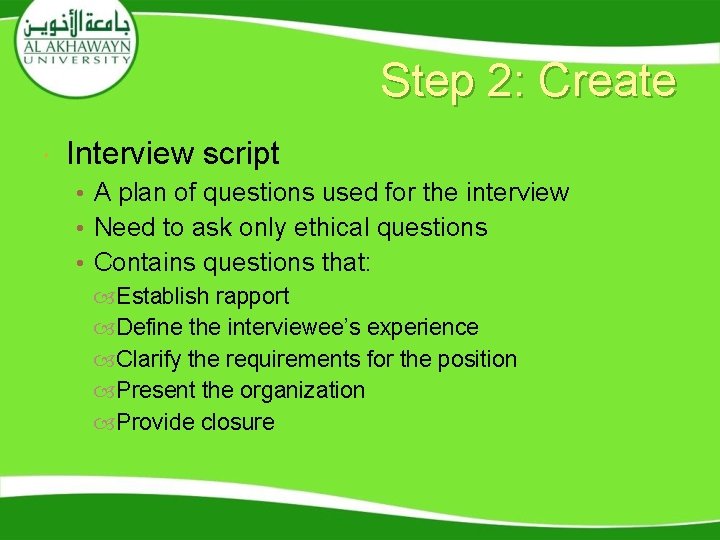
Step 2: Create Interview script • A plan of questions used for the interview • Need to ask only ethical questions • Contains questions that: Establish rapport Define the interviewee’s experience Clarify the requirements for the position Present the organization Provide closure
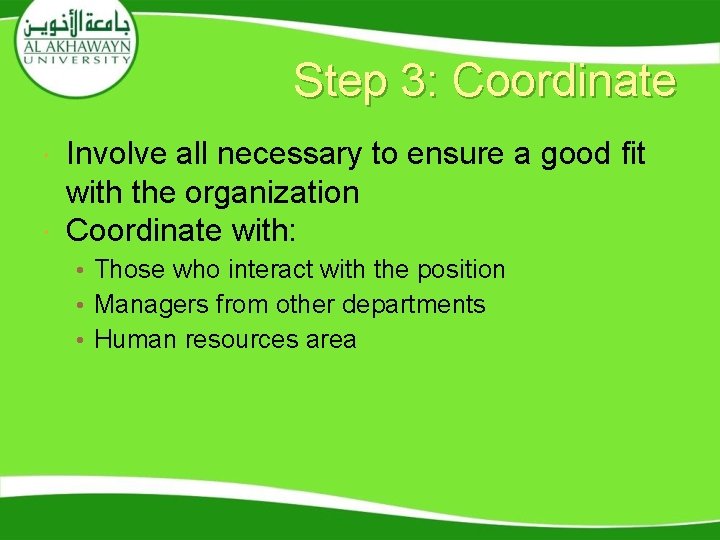
Step 3: Coordinate Involve all necessary to ensure a good fit with the organization Coordinate with: • Those who interact with the position • Managers from other departments • Human resources area
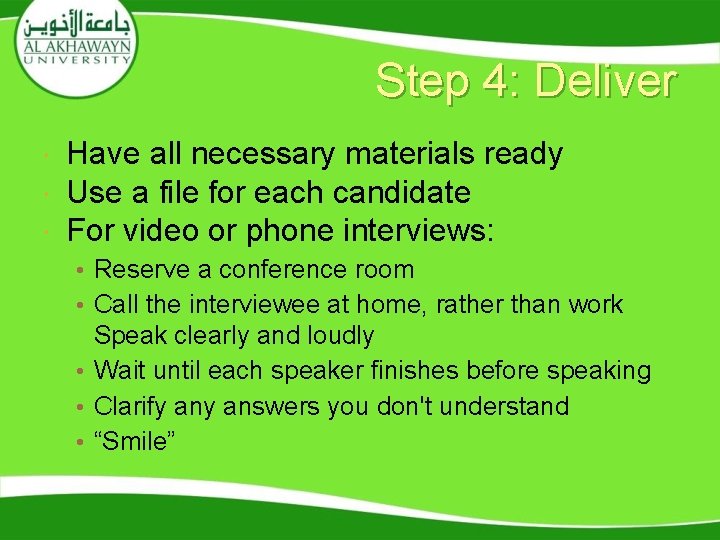
Step 4: Deliver Have all necessary materials ready Use a file for each candidate For video or phone interviews: • Reserve a conference room • Call the interviewee at home, rather than work Speak clearly and loudly • Wait until each speaker finishes before speaking • Clarify answers you don't understand • “Smile”