
Chapter 6 Inheritance l l Chapter 6 Inheritance
- Slides: 20
Chapter 6 Inheritance l l Chapter 6 Inheritance Basics Programming with Inheritance Java: an Introduction to Computer Science & Programming - Walter Savitch 1
Principles of OOP l l l Chapter 6 OOP - Object-Oriented Programming Principles discussed in previous chapters: » Information Hiding » Encapsulation » Polymorphism In this chapter » Inheritance Java: an Introduction to Computer Science & Programming - Walter Savitch 2
Why OOP? l l Chapter 6 To try to deal with the complexity of programs To apply principles of abstraction to simplify the tasks of writing, testing, maintaining and understanding complex programs To increase code reuse » to reuse classes developed for one application in other applications instead of writing new programs from scratch ("Why reinvent the wheel? ") Inheritance is a major technique for realizing these objectives Java: an Introduction to Computer Science & Programming - Walter Savitch 3
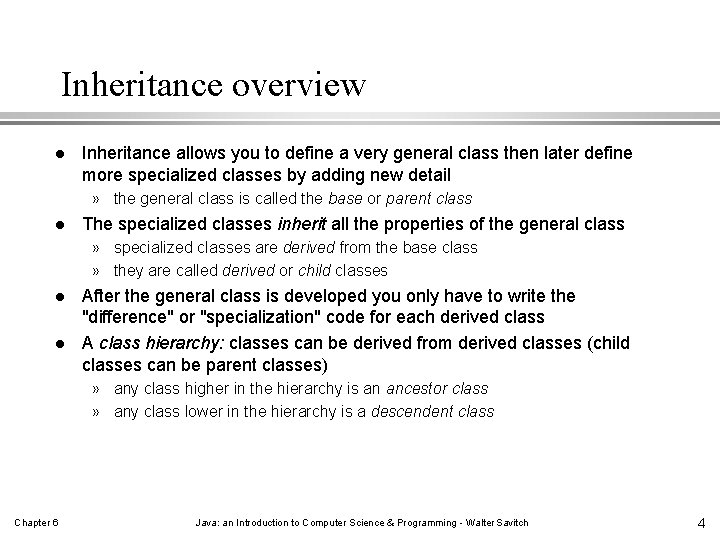
Inheritance overview l Inheritance allows you to define a very general class then later define more specialized classes by adding new detail » the general class is called the base or parent class l The specialized classes inherit all the properties of the general class » specialized classes are derived from the base class » they are called derived or child classes l l After the general class is developed you only have to write the "difference" or "specialization" code for each derived class A class hierarchy: classes can be derived from derived classes (child classes can be parent classes) » any class higher in the hierarchy is an ancestor class » any class lower in the hierarchy is a descendent class Chapter 6 Java: an Introduction to Computer Science & Programming - Walter Savitch 4
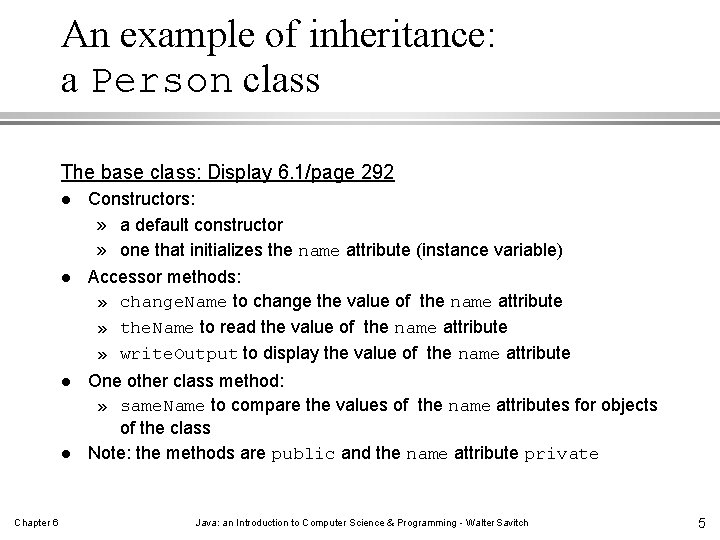
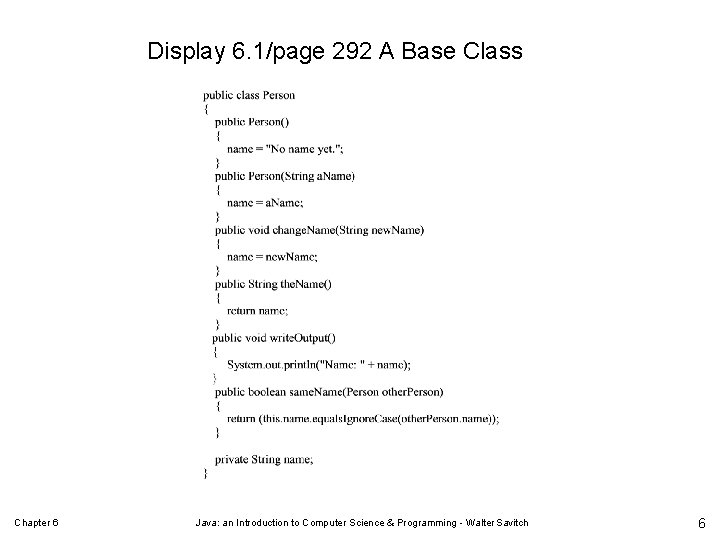
An example of inheritance: a Person class The base class: Display 6. 1/page 292 l Constructors: » a default constructor » one that initializes the name attribute (instance variable) l Accessor methods: » change. Name to change the value of the name attribute » the. Name to read the value of the name attribute » write. Output to display the value of the name attribute l One other class method: » same. Name to compare the values of the name attributes for objects of the class Note: the methods are public and the name attribute private l Chapter 6 Java: an Introduction to Computer Science & Programming - Walter Savitch 5
Display 6. 1/page 292 A Base Class Chapter 6 Java: an Introduction to Computer Science & Programming - Walter Savitch 6
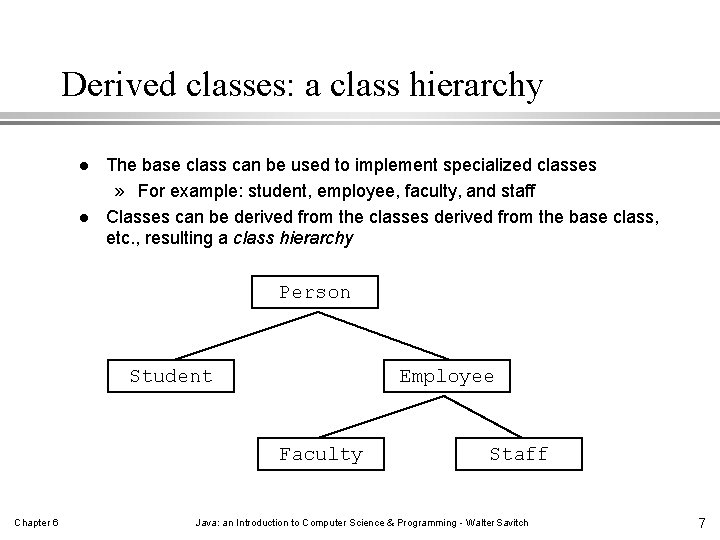
Derived classes: a class hierarchy l l The base class can be used to implement specialized classes » For example: student, employee, faculty, and staff Classes can be derived from the classes derived from the base class, etc. , resulting a class hierarchy Person Student Employee Faculty Chapter 6 Staff Java: an Introduction to Computer Science & Programming - Walter Savitch 7
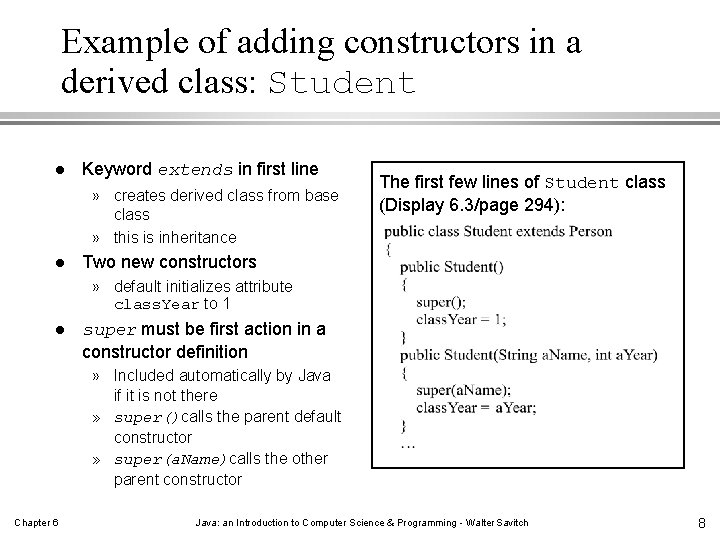
Example of adding constructors in a derived class: Student l Keyword extends in first line » creates derived class from base class » this is inheritance l The first few lines of Student class (Display 6. 3/page 294): Two new constructors » default initializes attribute class. Year to 1 l super must be first action in a constructor definition » Included automatically by Java if it is not there » super()calls the parent default constructor » super(a. Name)calls the other parent constructor Chapter 6 Java: an Introduction to Computer Science & Programming - Walter Savitch 8
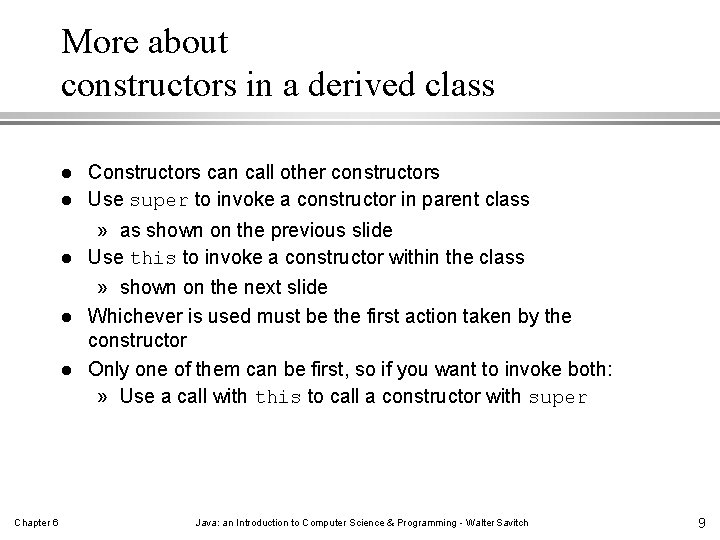
More about constructors in a derived class l l l Chapter 6 Constructors can call other constructors Use super to invoke a constructor in parent class » as shown on the previous slide Use this to invoke a constructor within the class » shown on the next slide Whichever is used must be the first action taken by the constructor Only one of them can be first, so if you want to invoke both: » Use a call with this to call a constructor with super Java: an Introduction to Computer Science & Programming - Walter Savitch 9
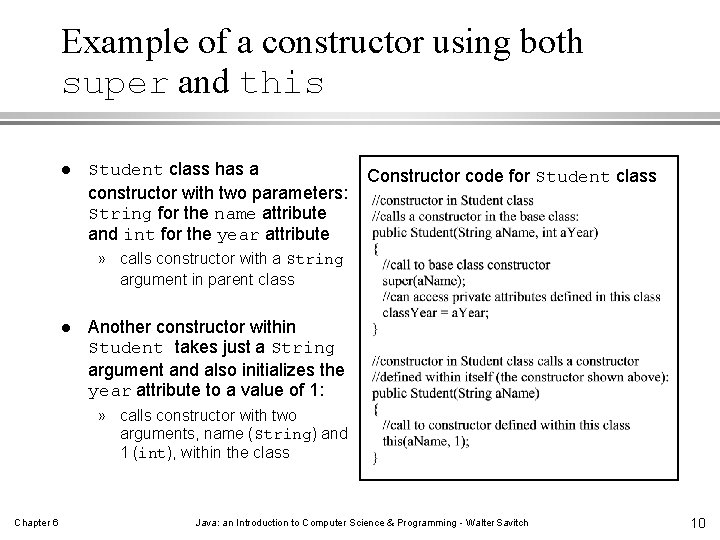
Example of a constructor using both super and this l Student class has a constructor with two parameters: String for the name attribute and int for the year attribute Constructor code for Student class » calls constructor with a String argument in parent class l Another constructor within Student takes just a String argument and also initializes the year attribute to a value of 1: » calls constructor with two arguments, name (String) and 1 (int), within the class Chapter 6 Java: an Introduction to Computer Science & Programming - Walter Savitch 10
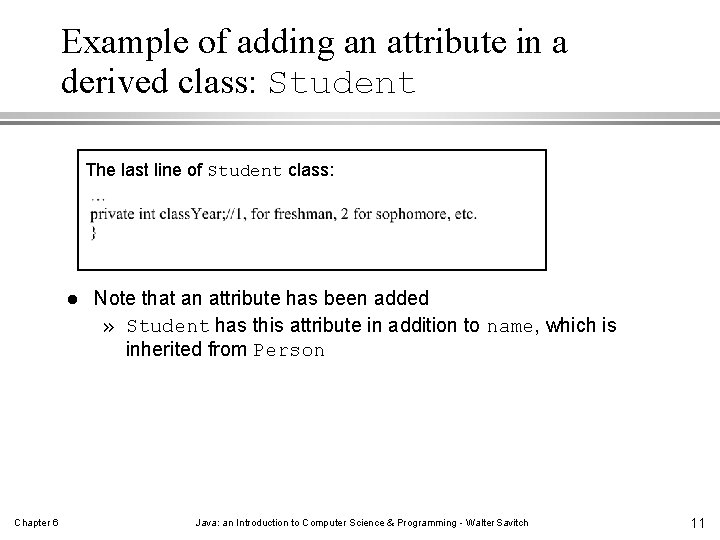
Example of adding an attribute in a derived class: Student The last line of Student class: l Chapter 6 Note that an attribute has been added » Student has this attribute in addition to name, which is inherited from Person Java: an Introduction to Computer Science & Programming - Walter Savitch 11
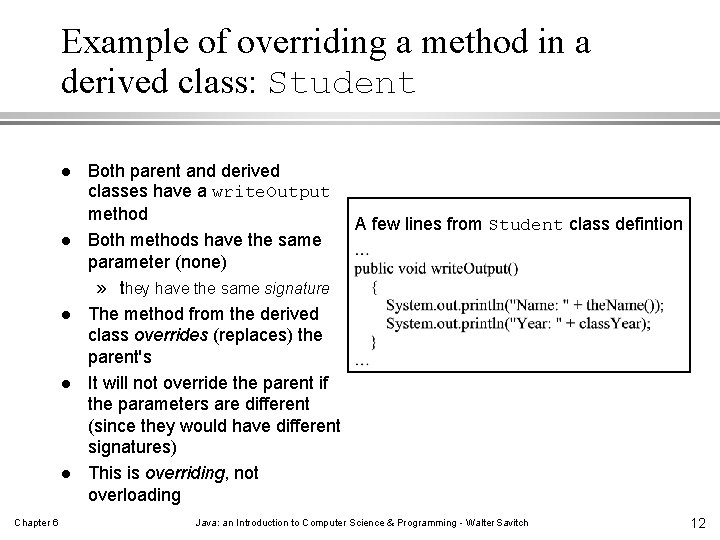
Example of overriding a method in a derived class: Student l l l Chapter 6 Both parent and derived classes have a write. Output method A few lines from Student class defintion Both methods have the same parameter (none) » they have the same signature The method from the derived class overrides (replaces) the parent's It will not override the parent if the parameters are different (since they would have different signatures) This is overriding, not overloading Java: an Introduction to Computer Science & Programming - Walter Savitch 12
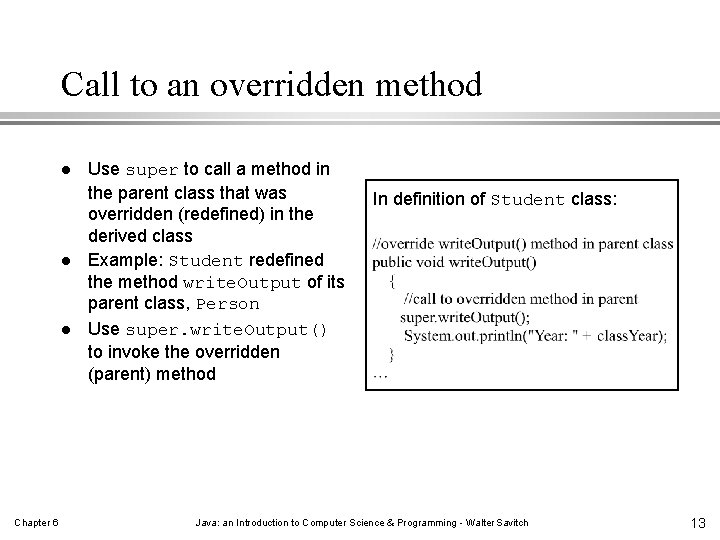
Call to an overridden method l l l Chapter 6 Use super to call a method in the parent class that was overridden (redefined) in the derived class Example: Student redefined the method write. Output of its parent class, Person Use super. write. Output() to invoke the overridden (parent) method In definition of Student class: Java: an Introduction to Computer Science & Programming - Walter Savitch 13
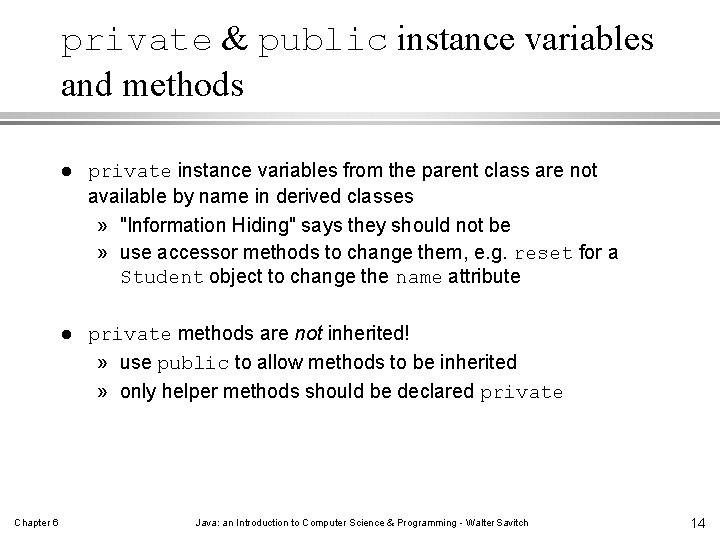
private & public instance variables and methods Chapter 6 l private instance variables from the parent class are not available by name in derived classes » "Information Hiding" says they should not be » use accessor methods to change them, e. g. reset for a Student object to change the name attribute l private methods are not inherited! » use public to allow methods to be inherited » only helper methods should be declared private Java: an Introduction to Computer Science & Programming - Walter Savitch 14
What is the "type" of a derived class? l l l Chapter 6 Derived classes have more than one type Of course they have the type of the derived class (the class they define) They also have the type of every ancestor class » all the way to the top of the class hierarchy All classes derive from the original, predefined class Object is called the Eve class since it is the original class for all other classes Java: an Introduction to Computer Science & Programming - Walter Savitch 15
How do programs know where to go next? l l Chapter 6 Programs normally execute in sequence Non-sequential execution occurs with: » selection (if/if-else/switch) and repetition (while/do-while/for) (depending on the test it may not go in sequence) » method calls, which jump to the location in memory that contains the method's instructions and returns to the calling program when the method is finished executing One job of the compiler is to try to figure out the memory addresses for these jumps The compiler cannot always know the address » sometimes it needs to be determined at run time Java: an Introduction to Computer Science & Programming - Walter Savitch 16
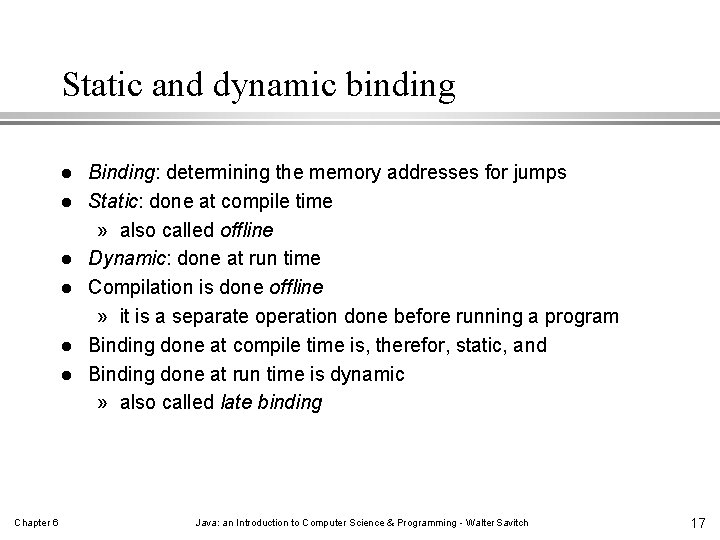
Static and dynamic binding l l l Chapter 6 Binding: determining the memory addresses for jumps Static: done at compile time » also called offline Dynamic: done at run time Compilation is done offline » it is a separate operation done before running a program Binding done at compile time is, therefor, static, and Binding done at run time is dynamic » also called late binding Java: an Introduction to Computer Science & Programming - Walter Savitch 17
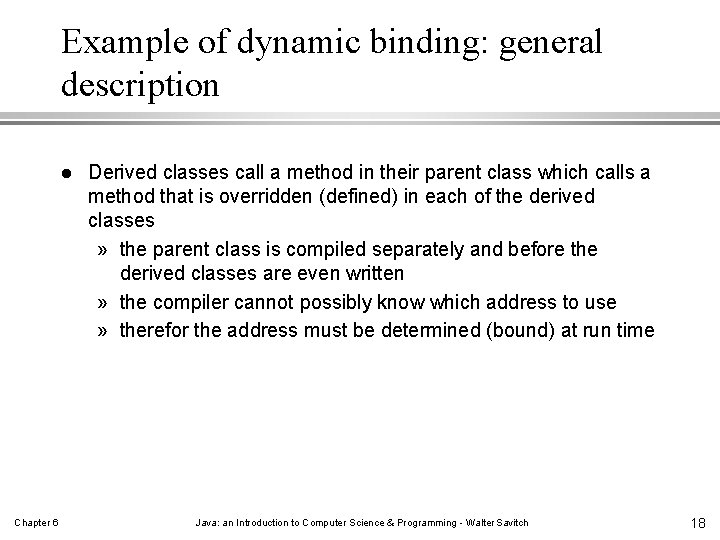
Example of dynamic binding: general description l Chapter 6 Derived classes call a method in their parent class which calls a method that is overridden (defined) in each of the derived classes » the parent class is compiled separately and before the derived classes are even written » the compiler cannot possibly know which address to use » therefor the address must be determined (bound) at run time Java: an Introduction to Computer Science & Programming - Walter Savitch 18
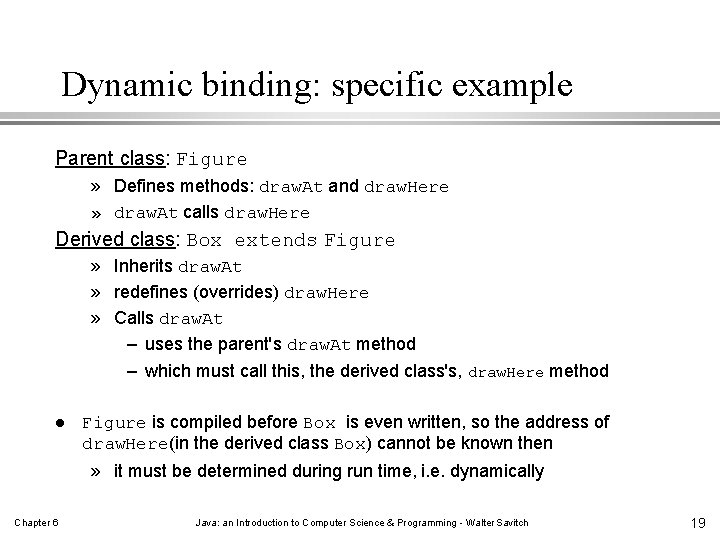
Dynamic binding: specific example Parent class: Figure » Defines methods: draw. At and draw. Here » draw. At calls draw. Here Derived class: Box extends Figure » Inherits draw. At » redefines (overrides) draw. Here » Calls draw. At – uses the parent's draw. At method – which must call this, the derived class's, draw. Here method l Figure is compiled before Box is even written, so the address of draw. Here(in the derived class Box) cannot be known then » it must be determined during run time, i. e. dynamically Chapter 6 Java: an Introduction to Computer Science & Programming - Walter Savitch 19
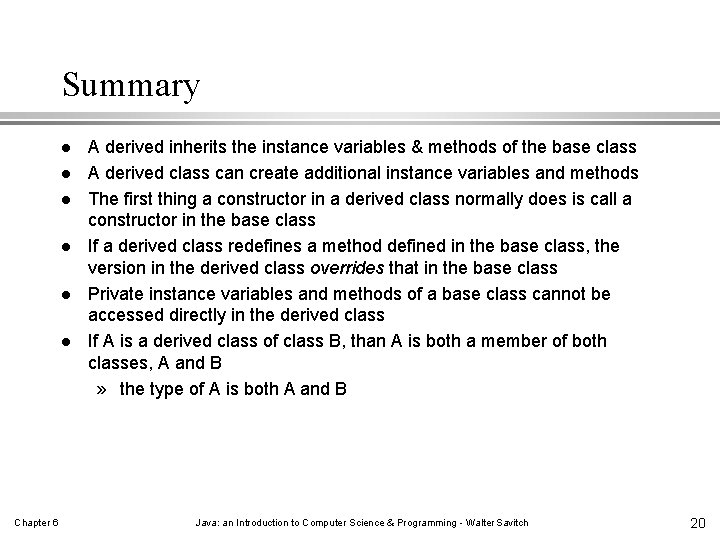
Summary l l l Chapter 6 A derived inherits the instance variables & methods of the base class A derived class can create additional instance variables and methods The first thing a constructor in a derived class normally does is call a constructor in the base class If a derived class redefines a method defined in the base class, the version in the derived class overrides that in the base class Private instance variables and methods of a base class cannot be accessed directly in the derived class If A is a derived class of class B, than A is both a member of both classes, A and B » the type of A is both A and B Java: an Introduction to Computer Science & Programming - Walter Savitch 20