
Chapter 6 INFERENTIAL STATISTICS I Foundations and sampling
- Slides: 62
Chapter 6 INFERENTIAL STATISTICS I: Foundations and sampling distribution
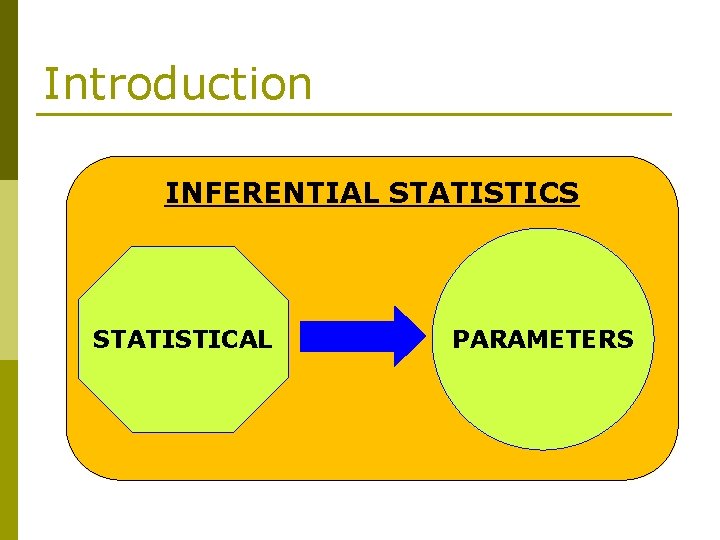
Introduction INFERENTIAL STATISTICS STATISTICAL PARAMETERS
p Statistical estimation theory: n n n p Find a value for the index in the sample level, the goal is to infer the value of the index in the population. Punctual estimation: if it provides a single value. Estimation by intervals: if it facilitates a range of values whose limits we expected to be the population mean. Statistical decision theory : n n Procedure to make decisions in the field of statistical inference. We’ll see in chapter 8.
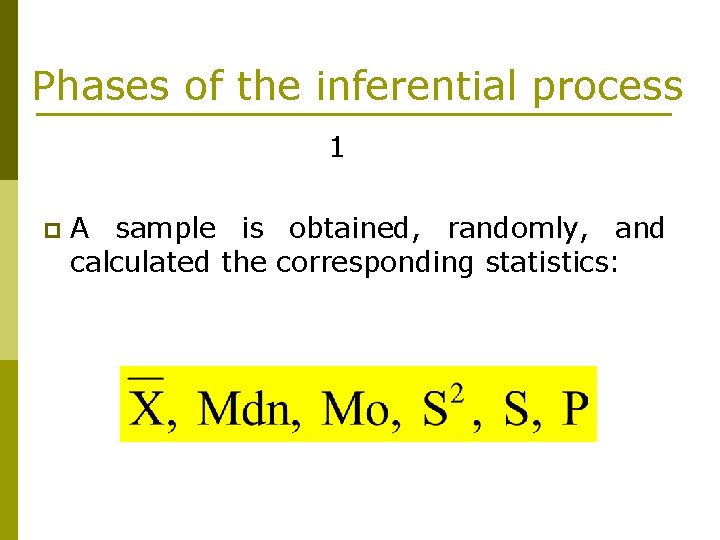
Phases of the inferential process 1 p A sample is obtained, randomly, and calculated the corresponding statistics:
2 p We wonder: What would have happened if we had worked with the entire population?
3 Know the probabilistic model of possible outcomes: * normal law, binomial, * Ji-square, * Student-Fisher’ t, * Snedecor’ F Etc. . . p It is known because we have information about similar situations or because it is deductible.
4 Construction of the STATISTIC SAMPLING DISTRIBUTION (means or proportions). That is, construct the distribution of all possible outcomes. p
5 p Knowing the sampling distribution and the underlying probability model, we just can make probability judgments about the statistics.
Sampling error theory 9
As larger the sample size and better sampling procedure performed, easier would be that the statistical value is close to the parameter value satisfactorily. p p. But, it is expected that there is some discrepancy between them (sampling error). p Solution: n n We renounce to know the precise and specific sampling error. We can have some confidence that this error does not exceed a limit amount. Thanks to the inference, this amount is known with a certain confidence.
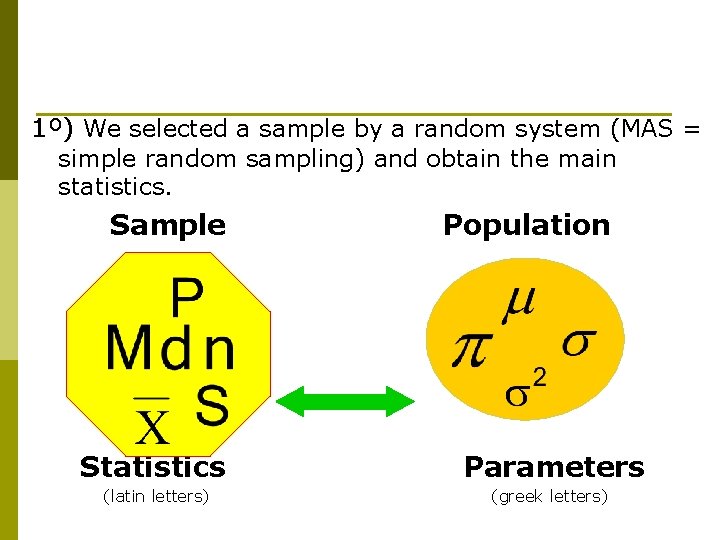
1º) We selected a sample by a random system (MAS = simple random sampling) and obtain the main statistics. Sample Population Statistics Parameters (latin letters) (greek letters)
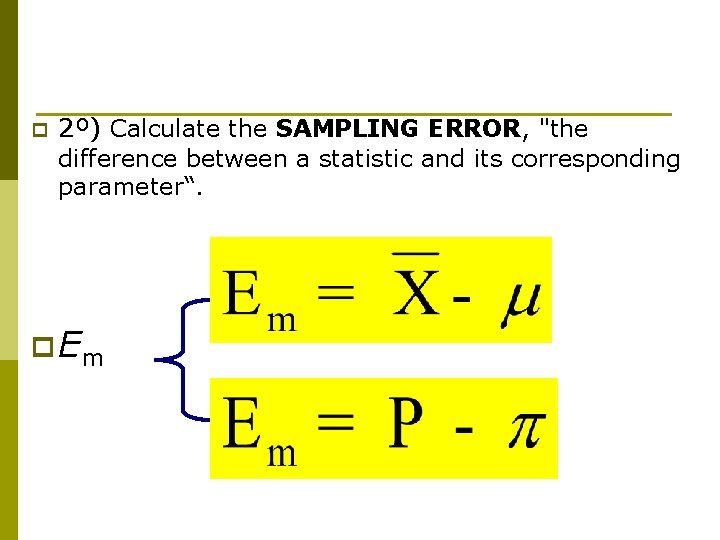
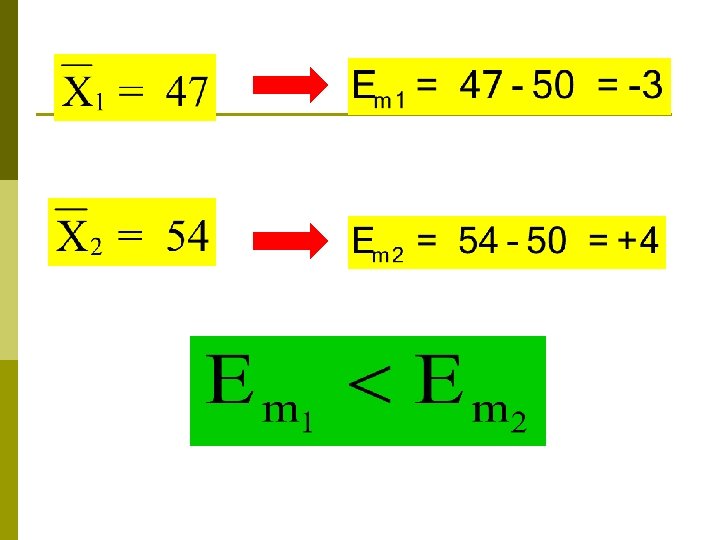
p 2º) Calculate the SAMPLING ERROR, "the difference between a statistic and its corresponding parameter“. p Em
p Ex. The mean in the sample is 13. 2 and there is a 0. 05 probability of being wrong in asserting that the population mean differs from 13. 2 in 2 units, plus or minus.
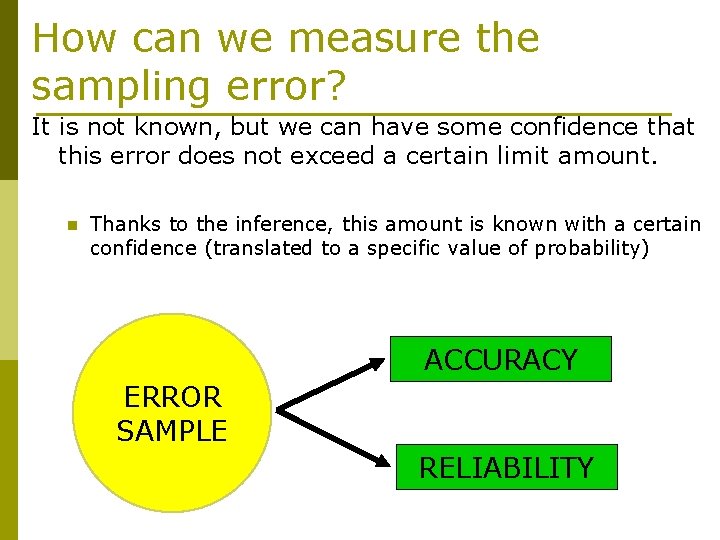
How can we measure the sampling error? It is not known, but we can have some confidence that this error does not exceed a certain limit amount. n Thanks to the inference, this amount is known with a certain confidence (translated to a specific value of probability) ACCURACY ERROR SAMPLE RELIABILITY
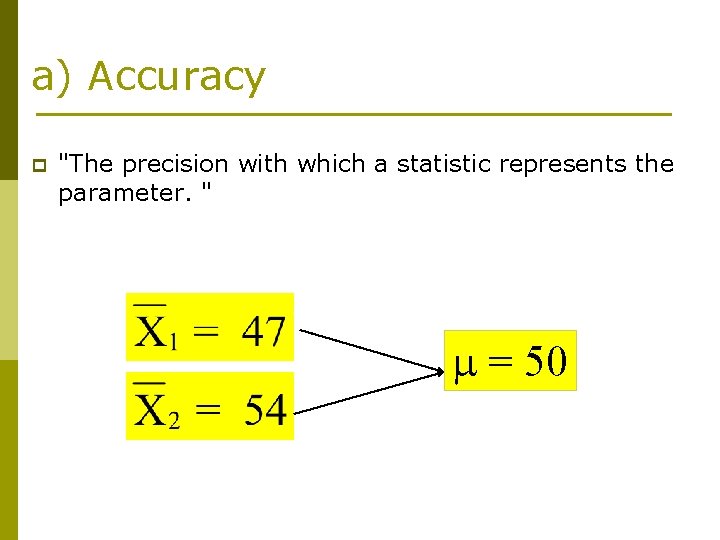
a) Accuracy p "The precision with which a statistic represents the parameter. " = 50
b) Reliability p "The measure of the constancy of a statistic when you get several samples of the same type and size. "
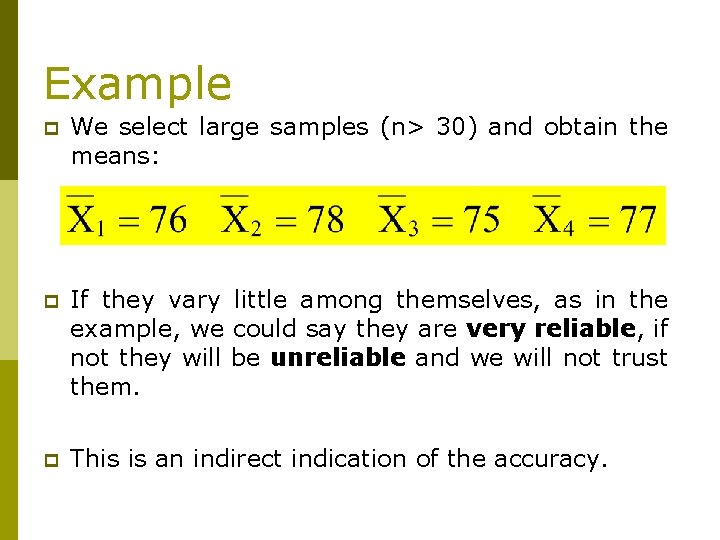
Example p We select large samples (n> 30) and obtain the means: p If they vary little among themselves, as in the example, we could say they are very reliable, if not they will be unreliable and we will not trust them. p This is an indirect indication of the accuracy.
p Knowledge about the context in which the inference is being madeallows us to conclude at the population level, with a degree of certain security or certainty. p To obtain this probability measure, it’s necessary to know how rare or expected is to find what we have found. n We need to know a sampling distribution and a probability model associated with it.
SAMPLING DISTRIBUTION p To arrive to the knowledge of sampling distributions should follow a process of construction in 3 phases:
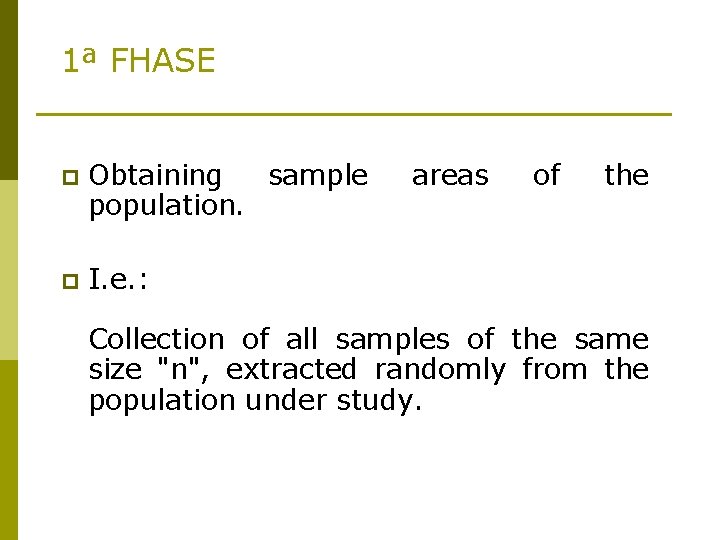
1ª FHASE p Obtaining sample population. p I. e. : areas of the Collection of all samples of the same size "n", extracted randomly from the population under study.
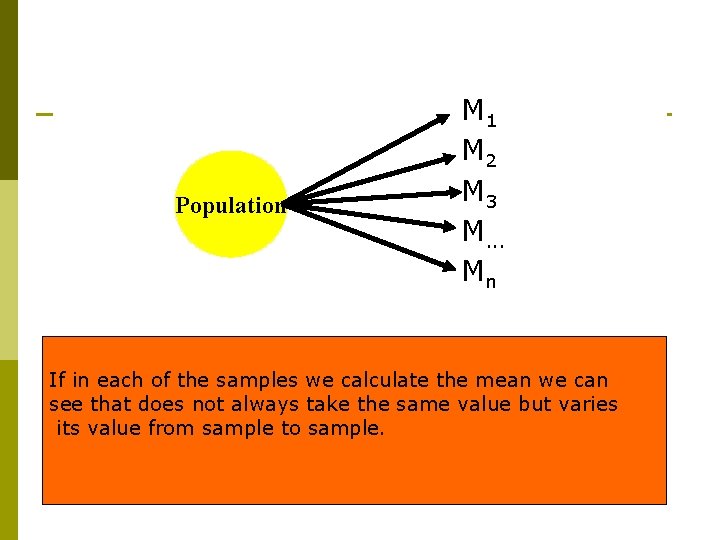
Population M 1 M 2 M 3 M. . . Mn If in each of the samples we calculate the mean we can see that does not always take the same value but varies its value from sample to sample.
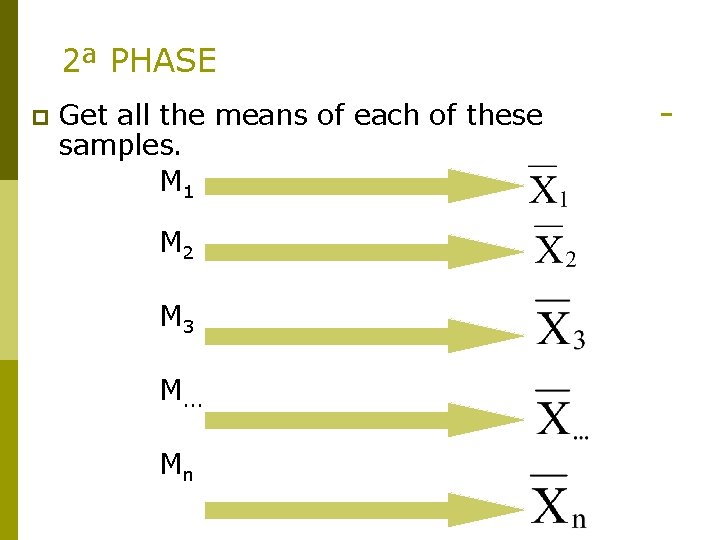
2ª PHASE p Get all the means of each of these samples. M 1 M 2 M 3 M. . . Mn
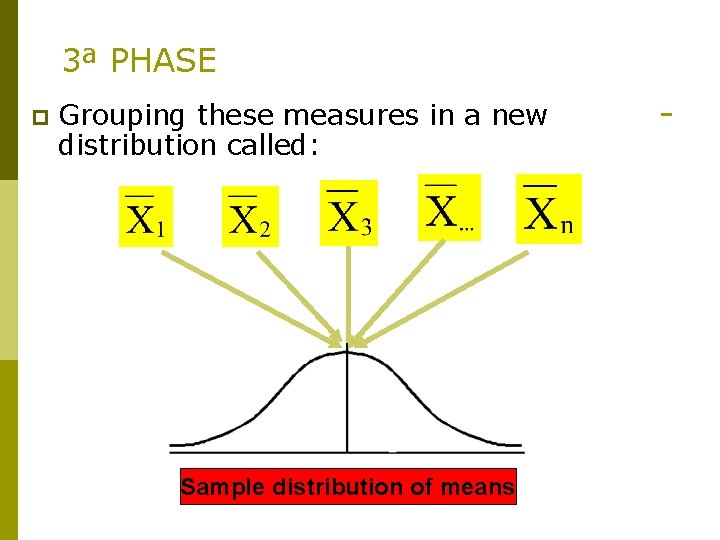
3ª PHASE p Grouping these measures in a new distribution called: Sample distribution of means
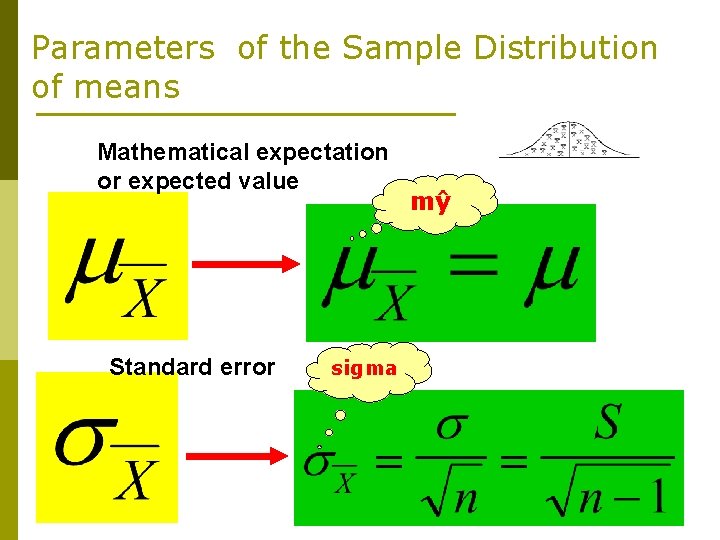
Parameters of the Sample Distribution of means Mathematical expectation or expected value Standard error sigma mŷ
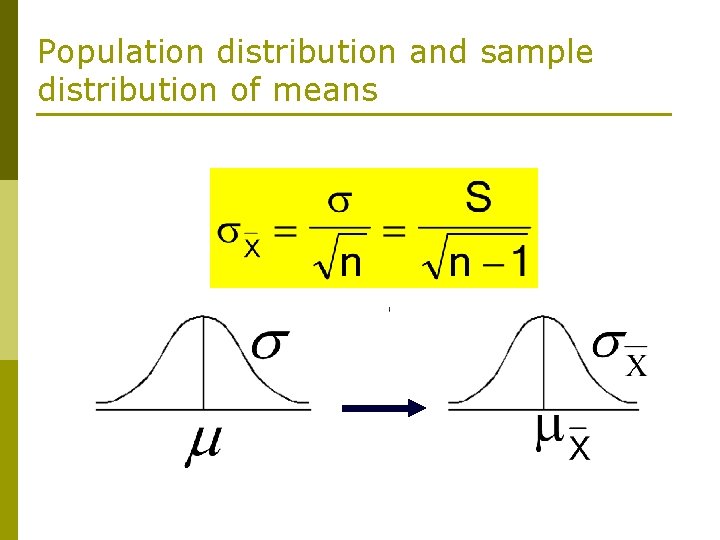
Population distribution and sample distribution of means
CARACTERISTICS of sample distributions of means p 1ª) The statistics obtained in the samples are grouped around the population parameter. p 2ª) As you increase n, the statistics will be more grouped around the parameter. p 3ª) If the samples are large, the graphic representation of the sampling distribution, we can observe that:
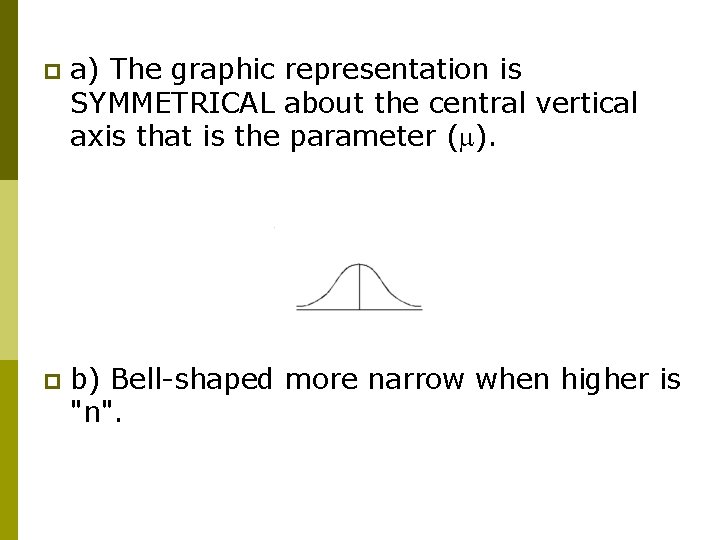
p a) The graphic representation is SYMMETRICAL about the central vertical axis that is the parameter ( ). p b) Bell-shaped more narrow when higher is "n".
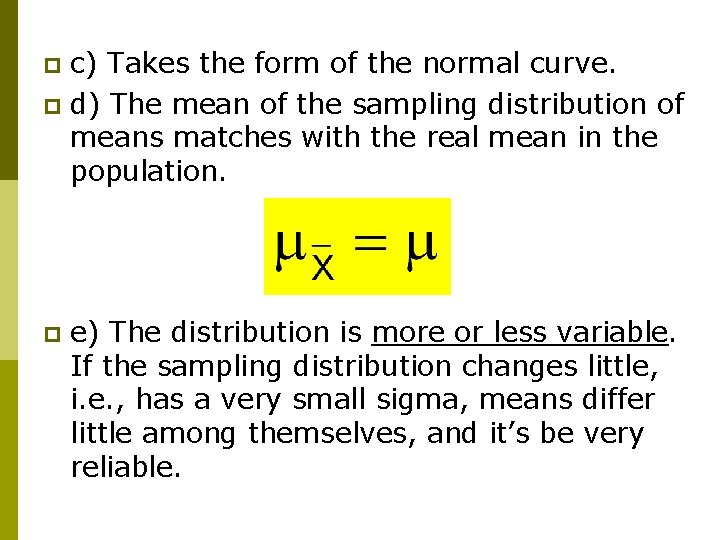
c) Takes the form of the normal curve. p d) The mean of the sampling distribution of means matches with the real mean in the population. p p e) The distribution is more or less variable. If the sampling distribution changes little, i. e. , has a very small sigma, means differ little among themselves, and it’s be very reliable.
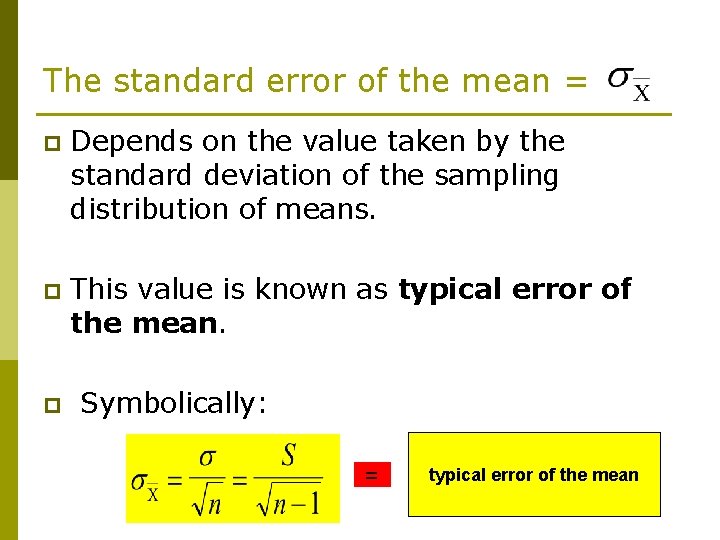
The standard error of the mean = p Depends on the value taken by the standard deviation of the sampling distribution of means. p This value is known as typical error of the mean. p Symbolically: = typical error of the mean
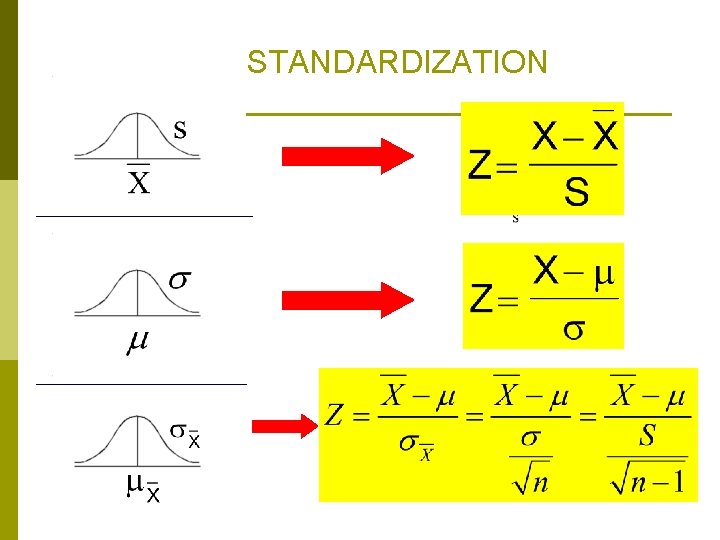
STANDARDIZATION
p In D. M. we do not work directly with theoretical scores, but typical scores. p Typify the D. M. allows us to calculate probabilities (if you also know the probability model that has the distribution). We can consider Normal Distribution if: n n n≥ 30 in Distrib. of means Πn ≥ 5 y (1 - Π)n ≥ 5 in Distrib. of probability
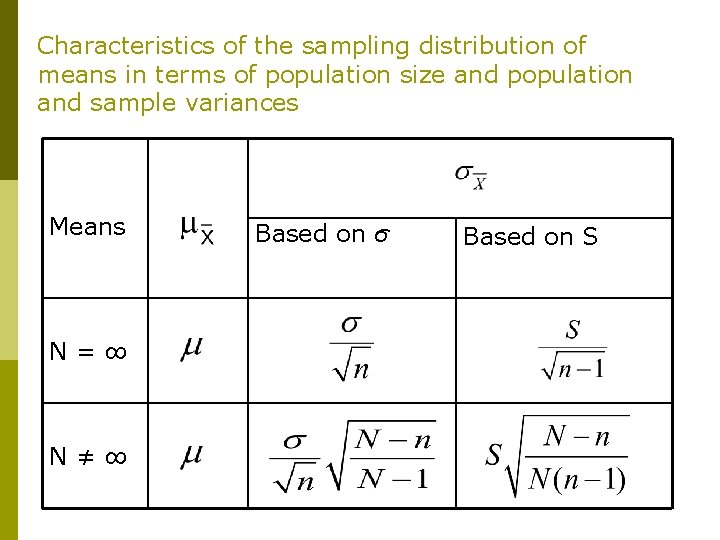
Characteristics of the sampling distribution of means in terms of population size and population and sample variances Means N=∞ N≠∞ Based on σ Based on S
Sampling Distribution of Means EXAMPLE 1 (suppose we know variance)
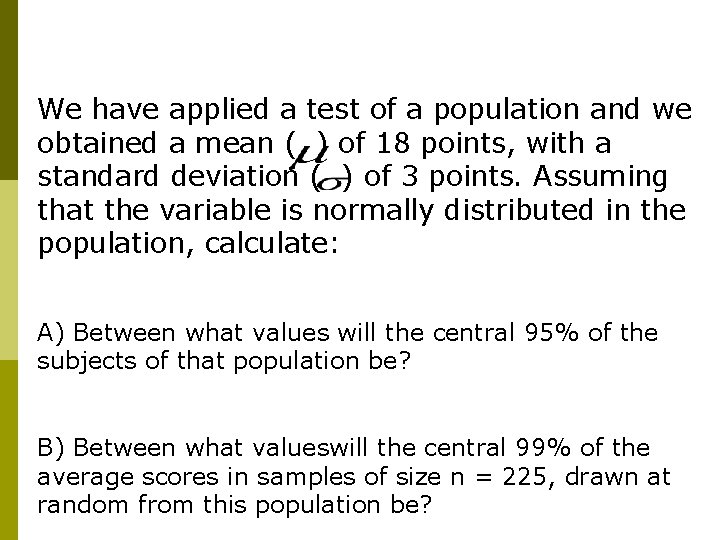
We have applied a test of a population and we obtained a mean ( ) of 18 points, with a standard deviation ( ) of 3 points. Assuming that the variable is normally distributed in the population, calculate: A) Between what values will the central 95% of the subjects of that population be? B) Between what valueswill the central 99% of the average scores in samples of size n = 225, drawn at random from this population be?
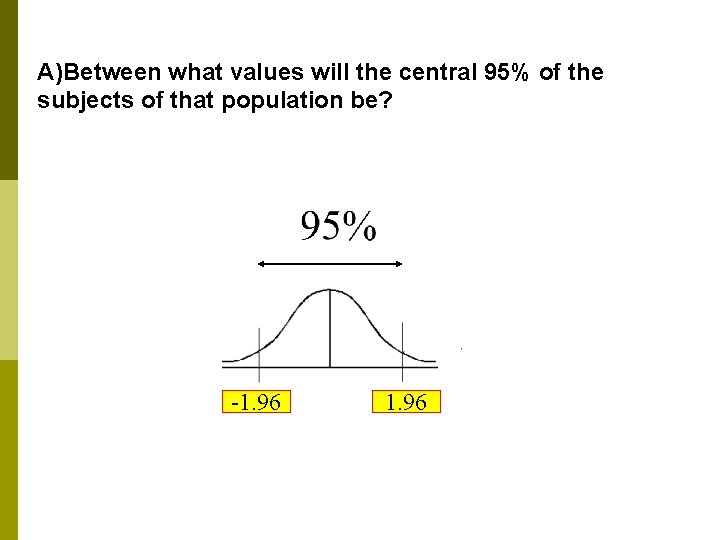
A)Between what values will the central 95% of the subjects of that population be? -1. 96
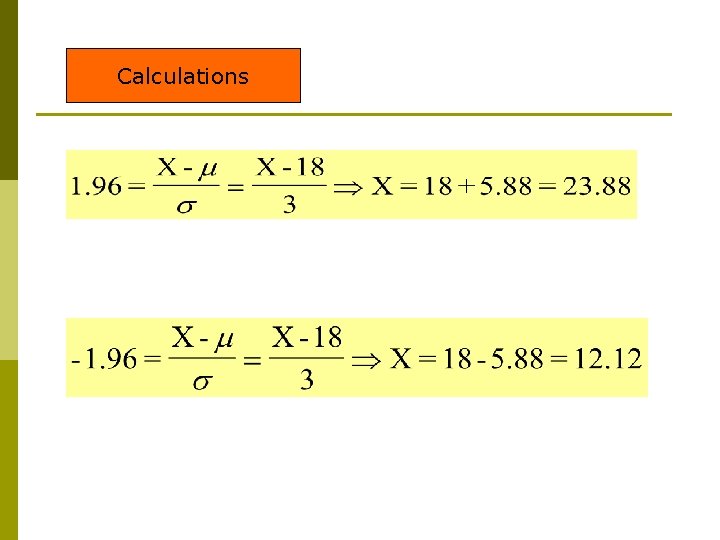
Calculations
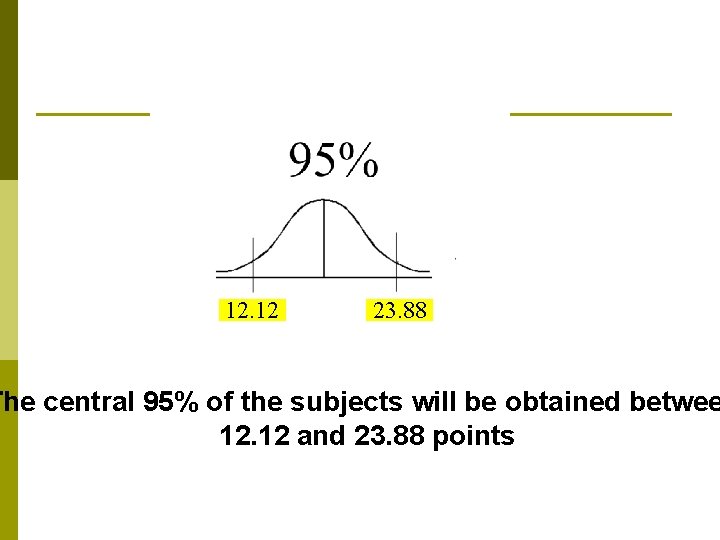
12. 12 23. 88 The central 95% of the subjects will be obtained betwee 12. 12 and 23. 88 points
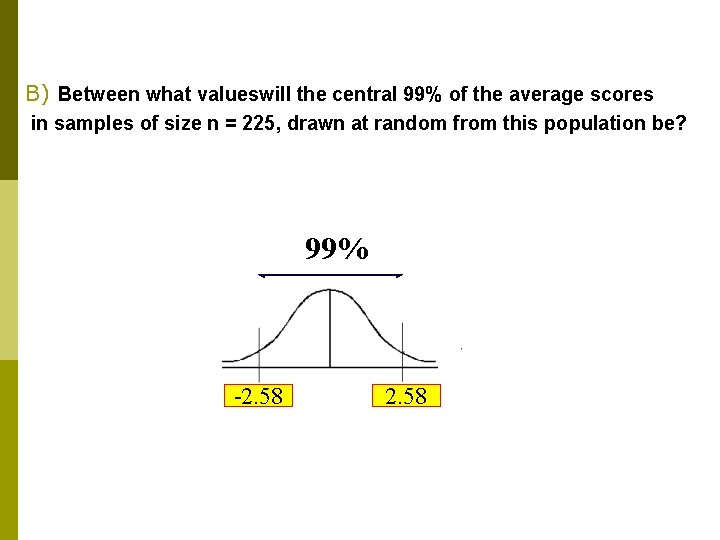
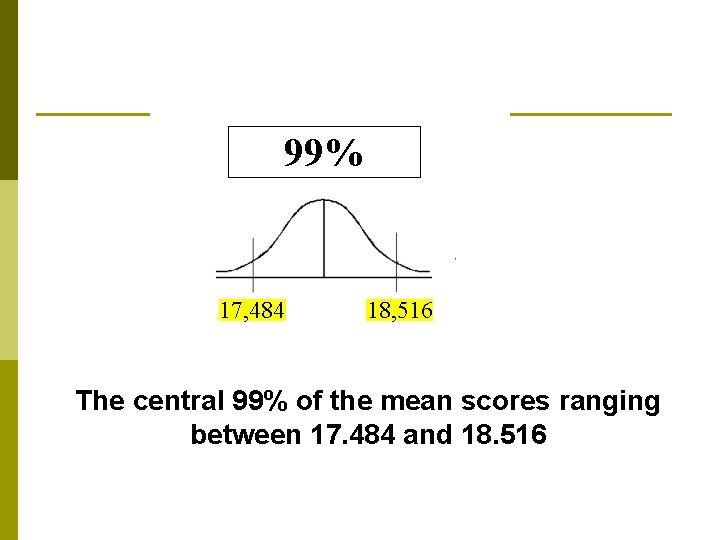
B) Between what valueswill the central 99% of the average scores in samples of size n = 225, drawn at random from this population be? 99% -2. 58
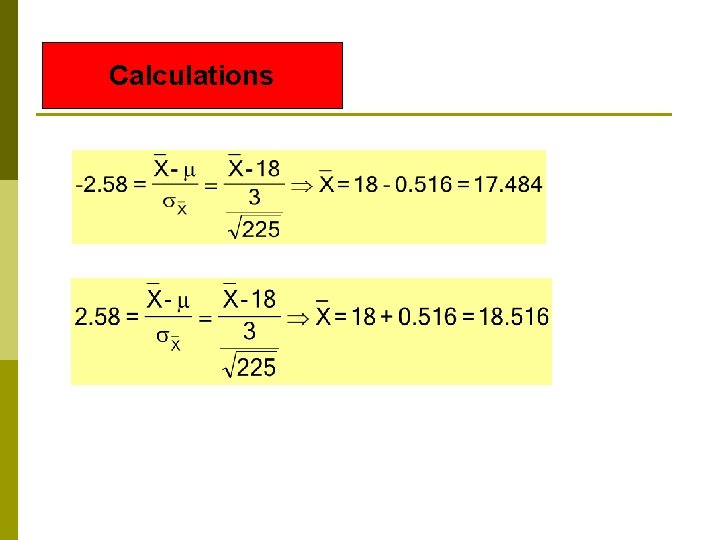
Calculations
99% 17, 484 18, 516 The central 99% of the mean scores ranging between 17. 484 and 18. 516
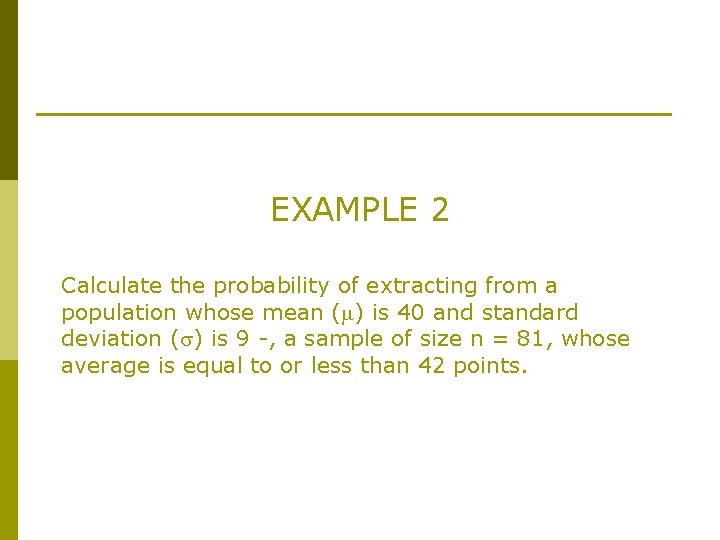
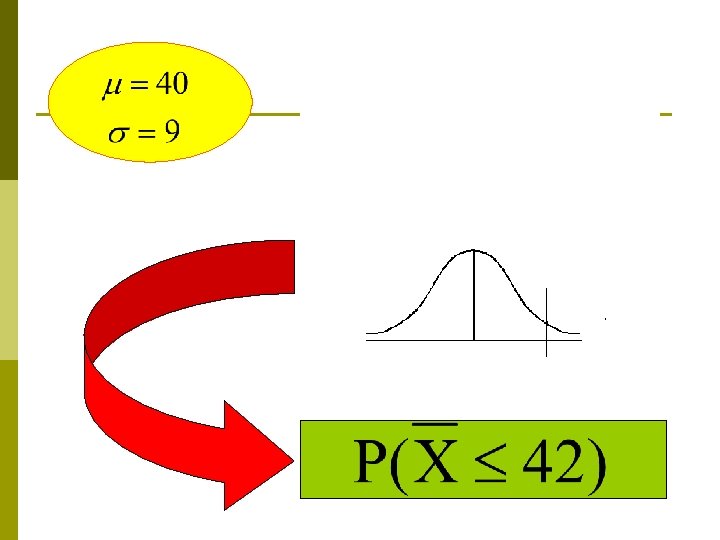
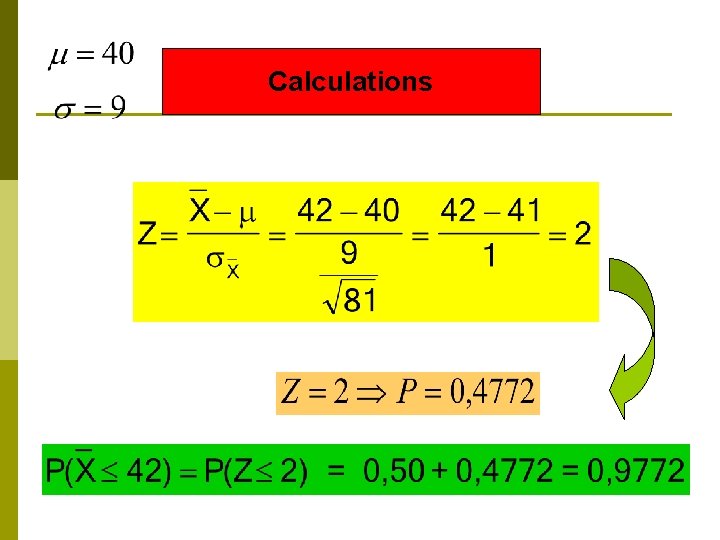
EXAMPLE 2 Calculate the probability of extracting from a population whose mean ( ) is 40 and standard deviation ( ) is 9 -, a sample of size n = 81, whose average is equal to or less than 42 points.
Calculations
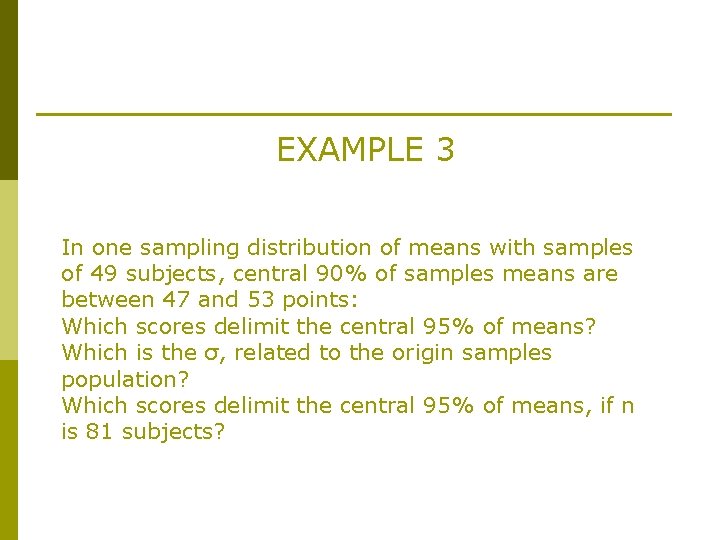
EXAMPLE 3 In one sampling distribution of means with samples of 49 subjects, central 90% of samples means are between 47 and 53 points: Which scores delimit the central 95% of means? Which is the σ, related to the origin samples population? Which scores delimit the central 95% of means, if n is 81 subjects?
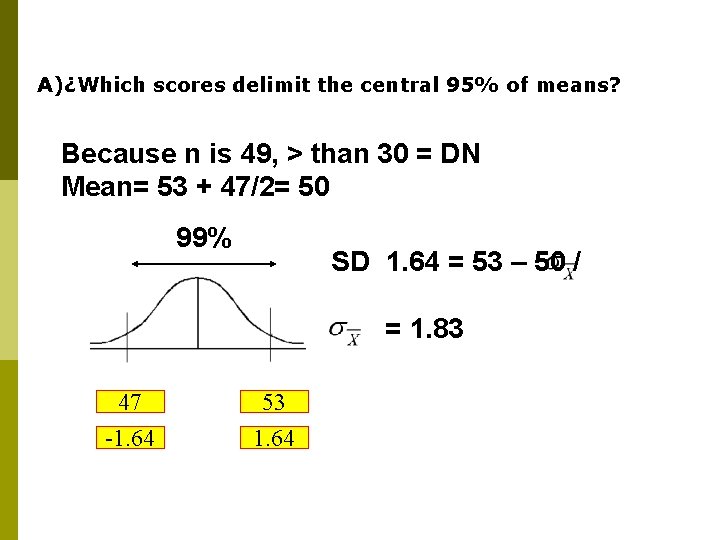
A)¿Which scores delimit the central 95% of means? Because n is 49, > than 30 = DN Mean= 53 + 47/2= 50 99% SD 1. 64 = 53 – 50 / = 1. 83 47 -1. 64 53 1. 64
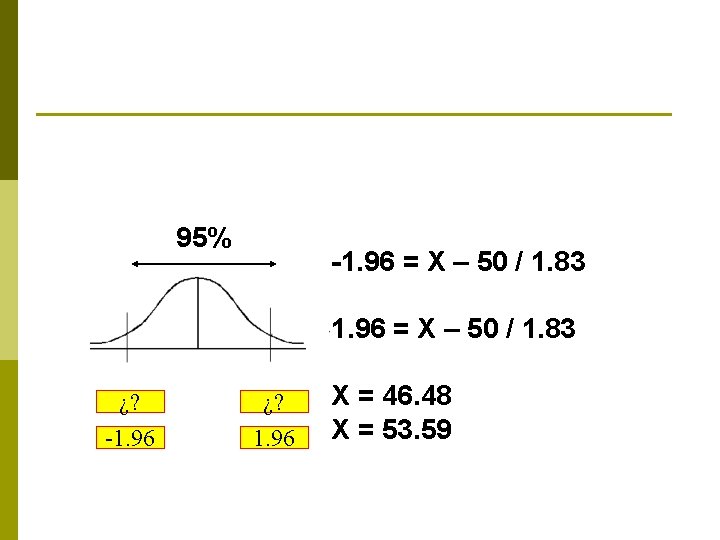
95% -1. 96 = X – 50 / 1. 83 ¿? -1. 96 ¿? 1. 96 X = 46. 48 X = 53. 59
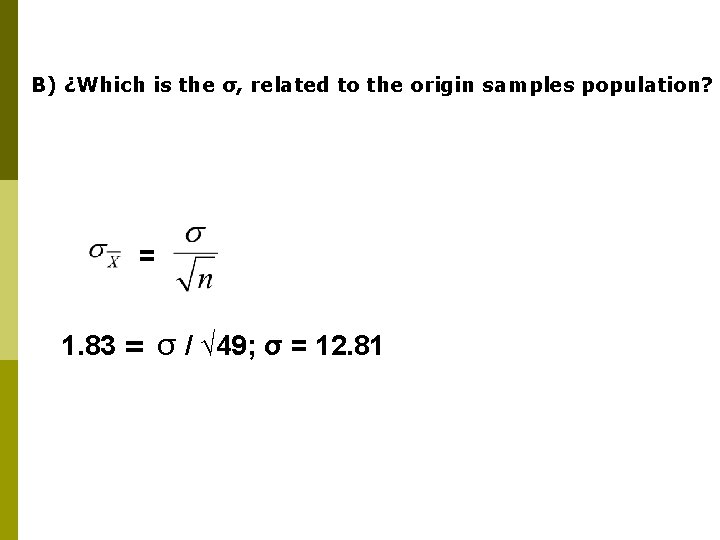
B) ¿Which is the σ, related to the origin samples population? = 1. 83 = σ / √ 49; σ = 12. 81
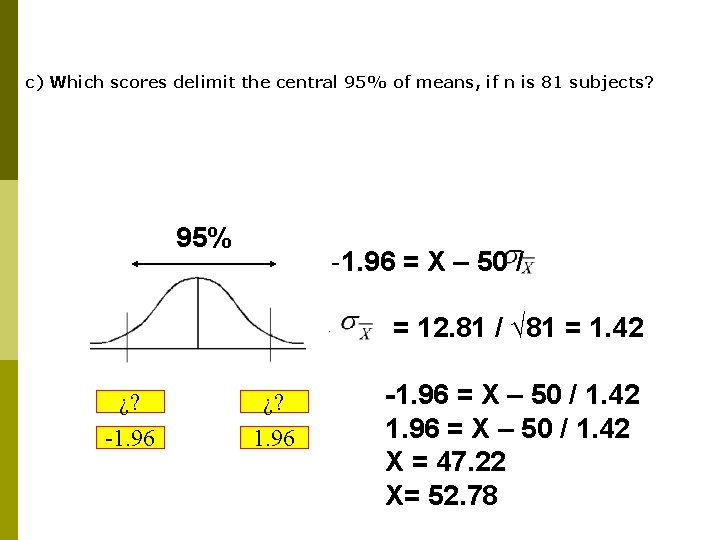
c) Which scores delimit the central 95% of means, if n is 81 subjects? 95% -1. 96 = X – 50 / = 12. 81 / √ 81 = 1. 42 ¿? -1. 96 ¿? 1. 96 -1. 96 = X – 50 / 1. 42 X = 47. 22 X= 52. 78
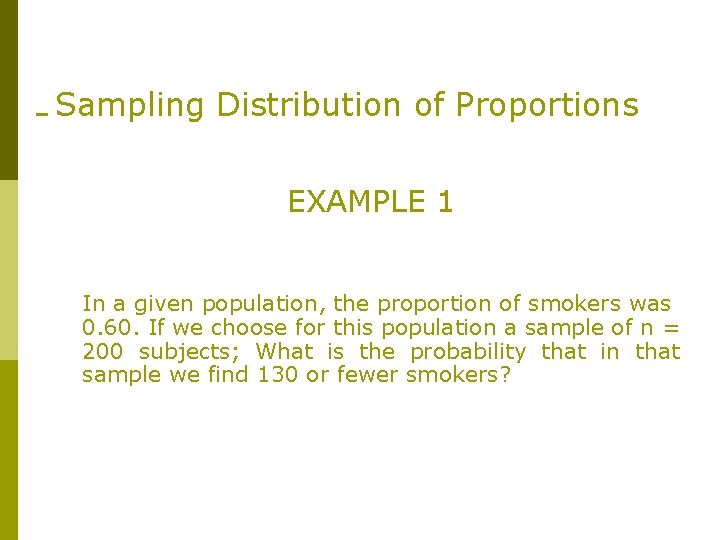
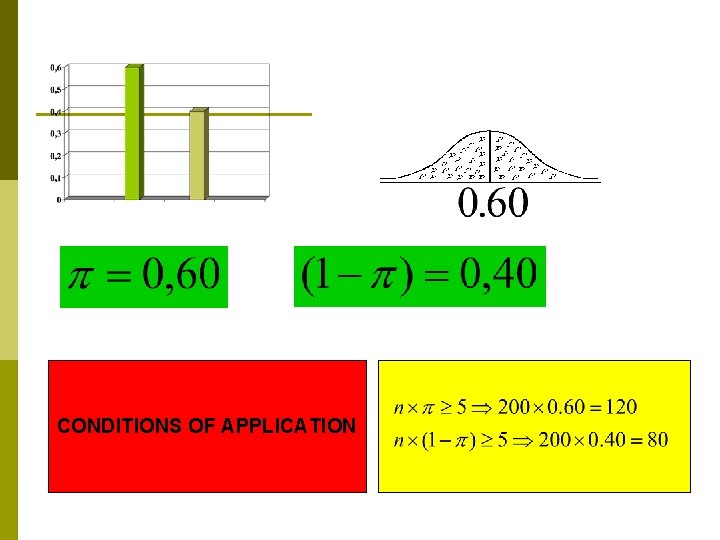
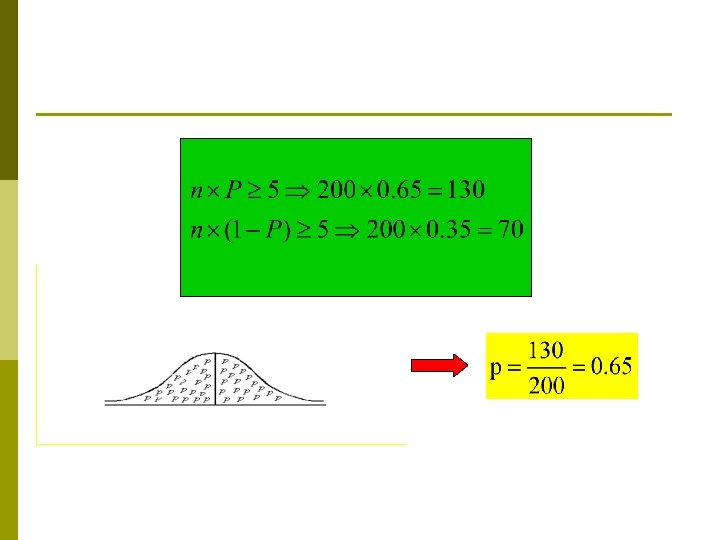
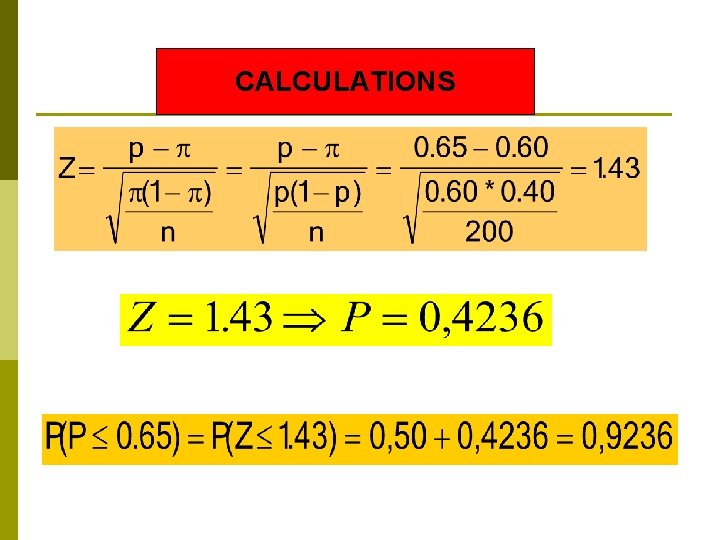
Sampling Distribution of Proportions EXAMPLE 1 In a given population, the proportion of smokers was 0. 60. If we choose for this population a sample of n = 200 subjects; What is the probability that in that sample we find 130 or fewer smokers?
CONDITIONS OF APPLICATION
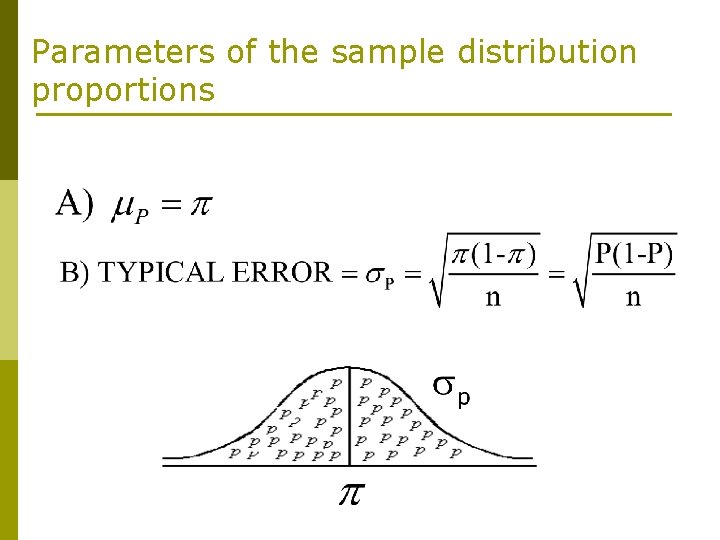
Parameters of the sample distribution proportions
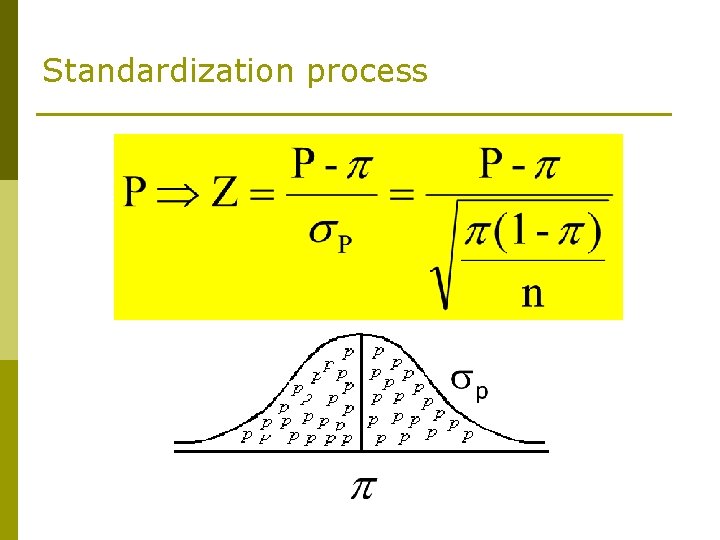
Standardization process
CALCULATIONS
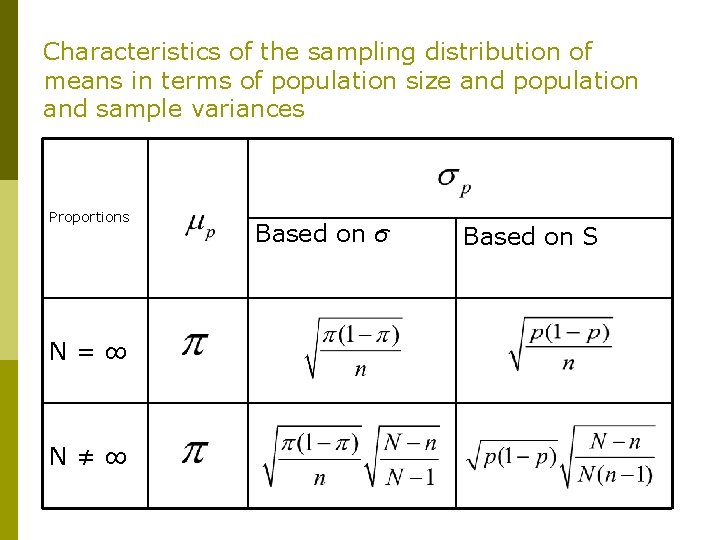
Characteristics of the sampling distribution of means in terms of population size and population and sample variances Proportions N=∞ N≠∞ Based on σ Based on S
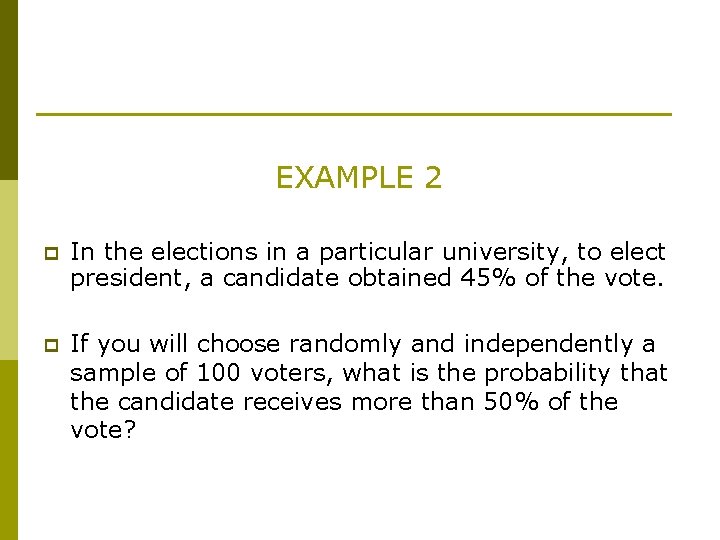
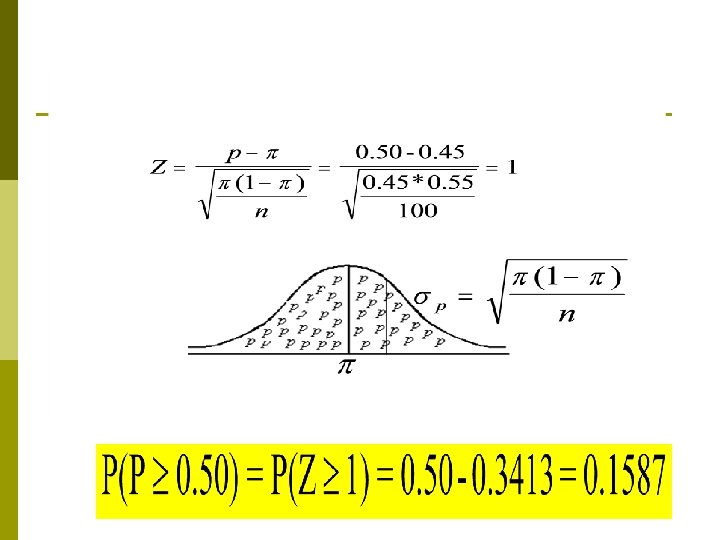
EXAMPLE 2 p In the elections in a particular university, to elect president, a candidate obtained 45% of the vote. p If you will choose randomly and independently a sample of 100 voters, what is the probability that the candidate receives more than 50% of the vote?
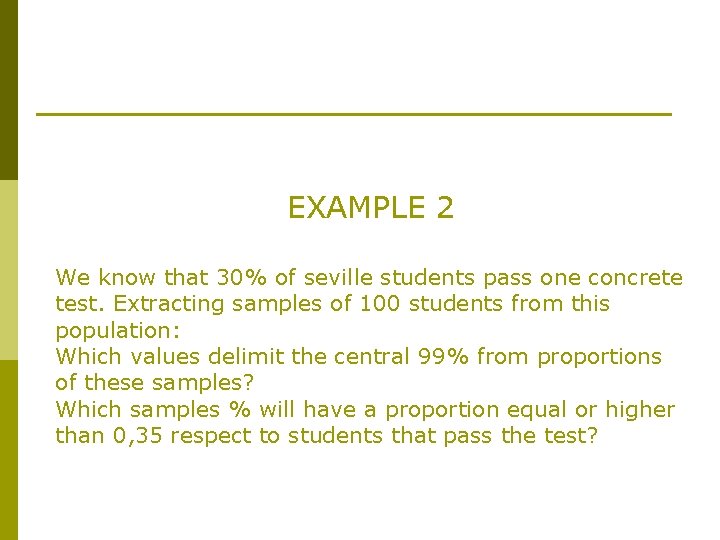
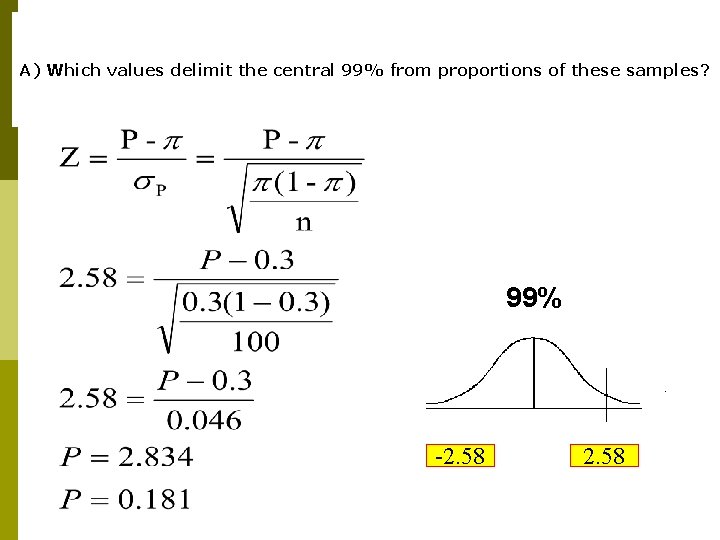
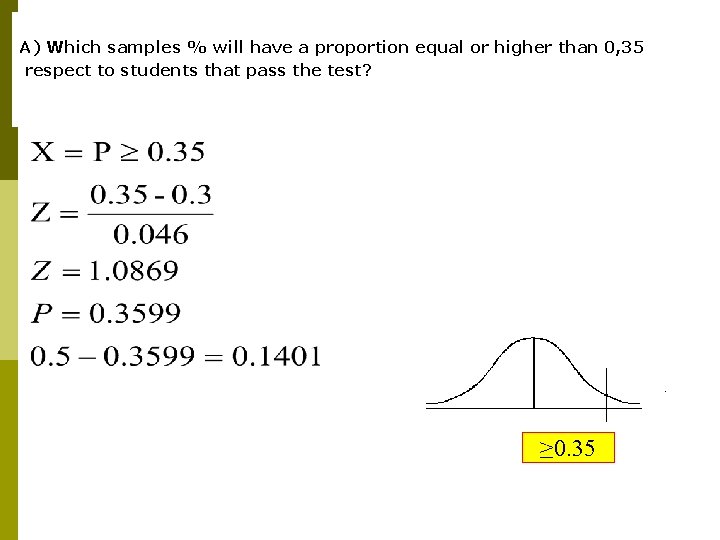
EXAMPLE 2 We know that 30% of seville students pass one concrete test. Extracting samples of 100 students from this population: Which values delimit the central 99% from proportions of these samples? Which samples % will have a proportion equal or higher than 0, 35 respect to students that pass the test?
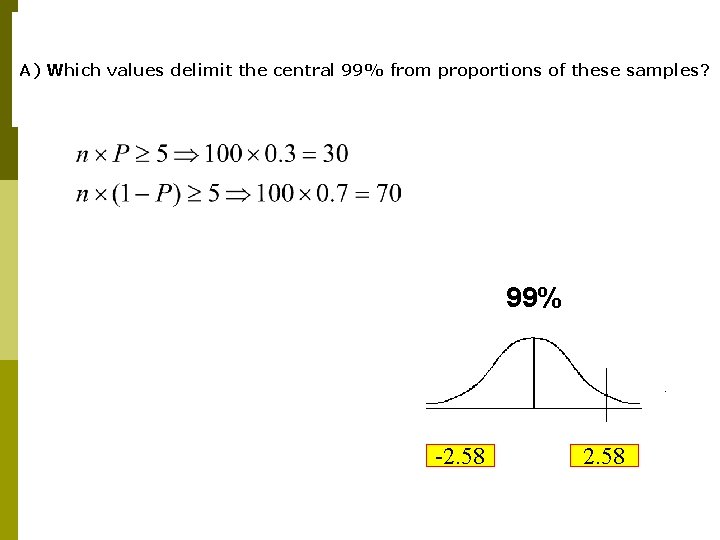
A) Which values delimit the central 99% from proportions of these samples? 99% -2. 58
A) Which values delimit the central 99% from proportions of these samples? 99% -2. 58
A) Which samples % will have a proportion equal or higher than 0, 35 respect to students that pass the test? ≥ 0. 35