
Chapter 6 Implementation and Evaluation Copyright 2014 2009
- Slides: 26
Chapter 6 Implementation and Evaluation Copyright © 2014, 2009 by Saunders, an imprint of Elsevier Inc. All rights reserved.
Chapter 6 Lesson 6. 1 Copyright © 2014, 2009 by Saunders, an imprint of Elsevier Inc. All rights reserved.
Learning Objectives Theory 1) Set priorities for providing care to a group of patients. 2) Identify factors to consider in implementing the plan of care. 3) Describe the Standard Steps commonly carried out for all nursing procedures. Clinical Practice 1) Develop a useful method of organizing work for the day. 2) Use the Standard Steps for all nursing procedures. Copyright © 2014, 2009 by Saunders, an imprint of Elsevier Inc. All rights reserved. Slide 3
Implementation Implementing care follows assessment, nursing diagnosis, and planning The phase of the nursing process in which nursing interventions (or orders) are carried out Copyright © 2014, 2009 by Saunders, an imprint of Elsevier Inc. All rights reserved. Slide 4
Priority Setting Change-of-shift report should give clues as to the priority of each action to be implemented Priorities of care may need to be altered if patient’s condition becomes more acute Copyright © 2014, 2009 by Saunders, an imprint of Elsevier Inc. All rights reserved. Slide 5
Considerations for Care Delivery Before carrying out specific interventions listed on the plan of care, identify: Ø Reason for the intervention Rationale for the intervention Ø Usual standard of care Ø Expected outcome Ø Potential dangers Ø Some interventions may require an independent nursing action (not requiring a physician’s order) Ø Check the facility’s policy Copyright © 2014, 2009 by Saunders, an imprint of Elsevier Inc. All rights reserved. Slide 6
Interdisciplinary Care Some agencies use interdisciplinary care plans, clinical pathways, or care maps to guide care Interdisciplinary approach to managing patient care Ø An outgrowth of managed care Ø Still uses the nursing process Ø Usually standardized to a medical diagnosis and customized to each patient Ø Care plan not part of patient’s chart when an interdisciplinary care plan is used; however, nursing process still used Copyright © 2014, 2009 by Saunders, an imprint of Elsevier Inc. All rights reserved. Slide 7
Implementing Care Employees and students expected to perform at standard of care listed in the procedure manual For efficient time use, consider which interventions for a patient can be combined Copyright © 2014, 2009 by Saunders, an imprint of Elsevier Inc. All rights reserved. Slide 8
Implementation in Long-Term Care Routine care delegated to nursing assistants Exercise interventions performed by nursing assistants, physical therapy aides, or restorative aides Medications may be administered by LVNs/LPNs or nursing assistants with certification in medication administration Nurse performs any invasive or sterile procedure Copyright © 2014, 2009 by Saunders, an imprint of Elsevier Inc. All rights reserved. Slide 9
Implementation in Home Health Care In home health, family may be implementing the interventions Nurse making home visits teaches family to: Administer medications Ø Change dressings Ø Perform range-of-motion exercises Ø Perform treatments Ø The nurse performs any invasive procedures or procedures where strict sterility is mandatory Copyright © 2014, 2009 by Saunders, an imprint of Elsevier Inc. All rights reserved. Slide 10
Documentation of the Nursing Process Each intervention must be documented in the patient’s chart Examples: medications administered, dressings changed, vital signs measured Ø Procedures not documented are considered not performed Ø Care is documented on flow sheets daily Ø Copyright © 2014, 2009 by Saunders, an imprint of Elsevier Inc. All rights reserved. Slide 11
Question 1 During the implementation of the nursing process: 3) the planned nursing interventions are carried out. reassessment of data is used to determine whether the expected outcomes have been achieved. revision of the nursing care plan is performed. 4) goals are established for the patient. 1) 2) Copyright © 2014, 2009 by Saunders, an imprint of Elsevier Inc. All rights reserved. Slide 12
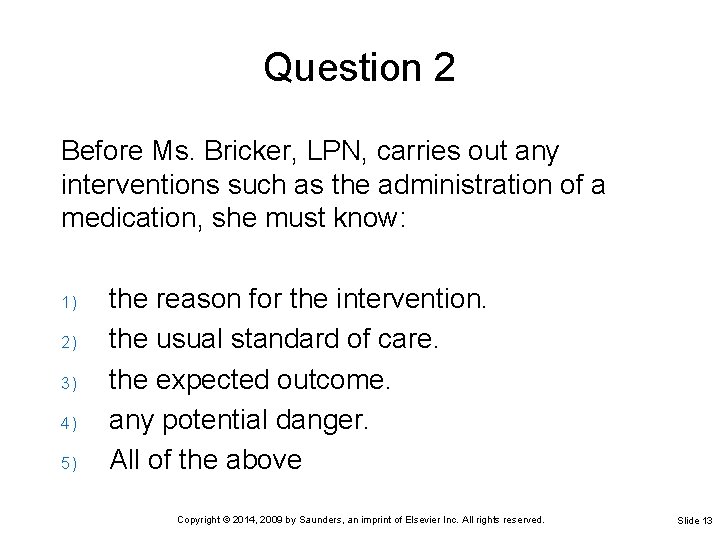
Question 2 Before Ms. Bricker, LPN, carries out any interventions such as the administration of a medication, she must know: 1) 2) 3) 4) 5) the reason for the intervention. the usual standard of care. the expected outcome. any potential danger. All of the above Copyright © 2014, 2009 by Saunders, an imprint of Elsevier Inc. All rights reserved. Slide 13
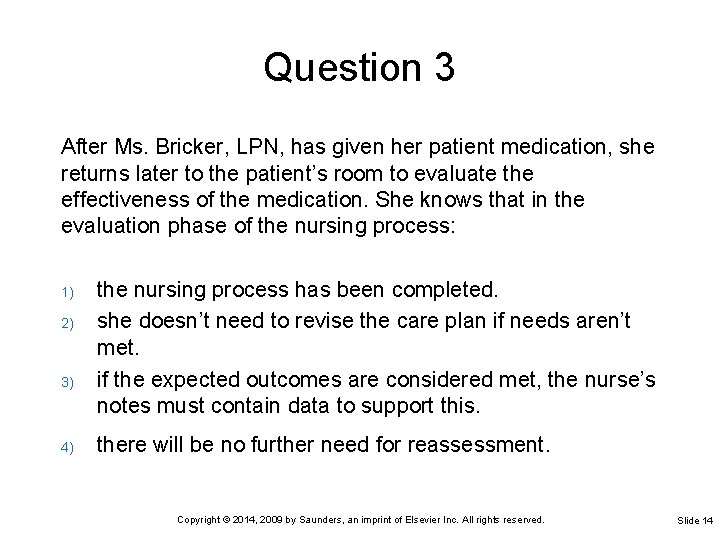
Question 3 After Ms. Bricker, LPN, has given her patient medication, she returns later to the patient’s room to evaluate the effectiveness of the medication. She knows that in the evaluation phase of the nursing process: 1) 2) 3) 4) the nursing process has been completed. she doesn’t need to revise the care plan if needs aren’t met. if the expected outcomes are considered met, the nurse’s notes must contain data to support this. there will be no further need for reassessment. Copyright © 2014, 2009 by Saunders, an imprint of Elsevier Inc. All rights reserved. Slide 14
Chapter 6 Lesson 6. 2 Copyright © 2014, 2009 by Saunders, an imprint of Elsevier Inc. All rights reserved.
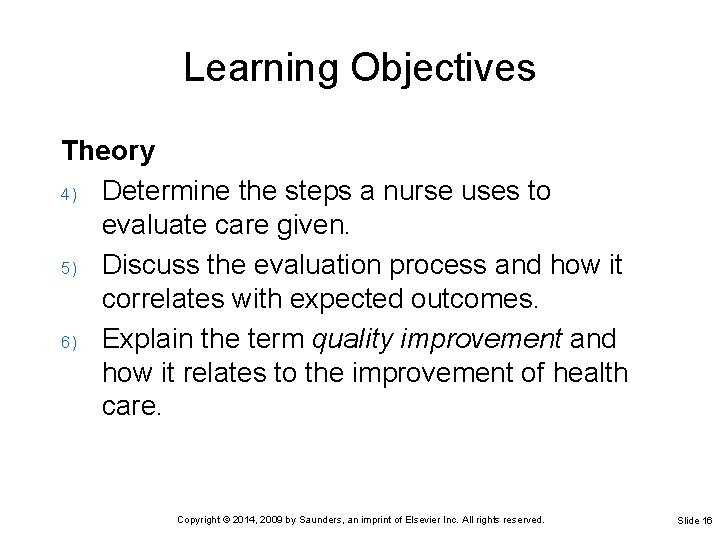
Learning Objectives Theory 4) Determine the steps a nurse uses to evaluate care given. 5) Discuss the evaluation process and how it correlates with expected outcomes. 6) Explain the term quality improvement and how it relates to the improvement of health care. Copyright © 2014, 2009 by Saunders, an imprint of Elsevier Inc. All rights reserved. Slide 16
Learning Objectives Clinical Practice 3) Revise the nursing care plan as needed. 4) Write an individualized nursing care plan for an assigned patient. 5) Implement a nursing care plan and evaluate care provided. Copyright © 2014, 2009 by Saunders, an imprint of Elsevier Inc. All rights reserved. Slide 17
Evaluation Based on NFLPN Standard 4 c—Evaluation Once interventions have been implemented, they must be evaluated for effectiveness in reaching the patient’s goals or outcomes Patient should provide feedback about whether the expected outcome has been met Copyright © 2014, 2009 by Saunders, an imprint of Elsevier Inc. All rights reserved. Slide 18
Evaluation in Long-Term Care and Home Health Care Patient and family should be consulted to find out if the care plan is meeting needs adequately If expected outcomes are not being met, the interventions are revised Copyright © 2014, 2009 by Saunders, an imprint of Elsevier Inc. All rights reserved. Slide 19
Revising the Nursing Care Plan If goals/outcomes are not being reached, the plan must be revised (a continual process) If goals are reached and the problem is resolved, it is evaluated, signed off in the nurses’ notes as met, and removed from the plan of care Copyright © 2014, 2009 by Saunders, an imprint of Elsevier Inc. All rights reserved. Slide 20
Quality Improvement Outcome-based quality improvement to determine whether outcomes are effective Agency-wide evaluation of care delivered by all departments against standards set for each department Audits at predetermined intervals Evaluation goal: continuous quality improvement Copyright © 2014, 2009 by Saunders, an imprint of Elsevier Inc. All rights reserved. Slide 21
Constructing a Nursing Care Plan RN may construct the initial nursing care plan If patient admitted to long-term care facility when RN is not available, LPN/LVN may assemble a preliminary nursing care plan that an RN will review and validate as needed the next day Students, like nurses, must be prepared to care for the patient. A nursing care plan for their assigned patients provides that information. Copyright © 2014, 2009 by Saunders, an imprint of Elsevier Inc. All rights reserved. Slide 22
Constructing a Nursing Care Plan (cont’d) 1) 2) 3) 4) 5) Collect patient data for a database Analyze the database for potential problems Choose appropriate nursing diagnoses Rank the nursing diagnoses in order of priority Plan the care by defining goals and writing expected outcomes Copyright © 2014, 2009 by Saunders, an imprint of Elsevier Inc. All rights reserved. Slide 23
Constructing a Nursing Care Plan (cont’d) 6) 7) 8) Plan nursing care by choosing appropriate nursing interventions Implement the nursing interventions Evaluate outcomes of each nursing intervention; determine whether progress toward achieving expected outcomes has been made Copyright © 2014, 2009 by Saunders, an imprint of Elsevier Inc. All rights reserved. Slide 24
Question 4 Debbie, a student nurse, is learning about care plans. She knows all of the following are true regarding care plans except: 1) 2) 3) 4) the family and patient are invited to the care planning. the care plan for the home health patient encompasses the needs and concerns of the family as well as the patient. an LPN is responsible for constructing the care plan. students are required by most instructors to come to the clinical experience with a nursing care plan in hand for assigned patients. Copyright © 2014, 2009 by Saunders, an imprint of Elsevier Inc. All rights reserved. Slide 25
Question 5 Flora, an LPN, is helping her patient understand the side effects of a medication. This is what type of action? 1) 2) 3) 4) Independent Dependent Interdependent Evaluation Copyright © 2014, 2009 by Saunders, an imprint of Elsevier Inc. All rights reserved. Slide 26