
Chapter 6 HumanisticExistential and SolutionFocused Approaches to Psychotherapy




- Slides: 58
Chapter 6 Humanistic–Existential and Solution-Focused Approaches to Psychotherapy Candice Knight © Springer Publishing Company, LLC. 1
INTRODUCTION • The humanistic–existential approach emphasizes holism, self-actualization, facilitative communication, and therapeutic relationship. • Major humanistic–existential approaches include the following: o Person-centered therapy o Existential psychotherapy o Gestalt therapy o Emotion-focused therapy (EFT) • Solution-focused therapy (SFT) is a postmodern, social constructivist psychotherapy with humanistic– existential elements. 2 © Springer Publishing Company, LLC.
NURSING AND THE HUMANISTIC–EXISTENTIAL APPROACH • In advanced practice psychiatric nursing and other mental health disciplines, the humanistic–existential concepts of empathic attunement and therapeutic relationship are emphasized. • The following major theoretical orientations are commonly taught as the foundational psychotherapies of this approach: person-centered psychotherapy, Gestalt psychotherapy, and existential psychotherapy. • Other important humanistic–existential therapies include transactional analysis, focusing, actualizing therapy, redecision therapy, EFT, and motivational interviewing. • Several nursing models and theories have drawn from the humanistic–existential approach: o Travelbee’s Human-to-Human Relationship Model of Nursing is an application of the existential work of Søren Kierkegaard and Victor Frankl—emphasizes free will and the search for meaning in experiences of pain, illness, and distress. o Paterson and Zderad’s humanistic nursing approach views nursing as a lived dialogue between patient and nurse, with the phenomenological method of inquiry at the center of importance. o Watson’s Theory of Human Caring emphasizes a caring relationship with patients that includes Carl Rogers’s unconditional acceptance and positive regard as well as creating caring moments of healing. © Springer Publishing Company, LLC. 3
HISTORICAL ROOTS OF HUMANISTIC–EXISTENTIAL PSYCHOTHERAPY • Historical roots of this approach extend back to the birth of the following philosophies: o Humanism, a reform movement of the 14 th-century European renaissance, focused on human values rather than religious ideologies. Dominant themes were happiness, spontaneity, creativity, actualization, holism, and the goodness of the human spirit. o Existentialism emerged as a reaction to the dominant philosophy of rationalism and the objectivity of science during the mid-19 th century. Important themes include personal choice and commitment, responsibility, courage, human freedom, emotions, and imagination. o Phenomenology, which emerged during the early 20 th century, is dedicated to the descriptive study of consciousness and subjective experience completely free of preconceptions, interpretation, explanation, and evaluation. • In the United States, the philosophies of humanism, existentialism, and phenomenology merged into the humanistic–existential movement soon after World War II. • Five decades of substantial advances in theory, practice, and research have accumulated to support the effectiveness of humanistic–existential psychotherapy. 4 © Springer Publishing Company, LLC.
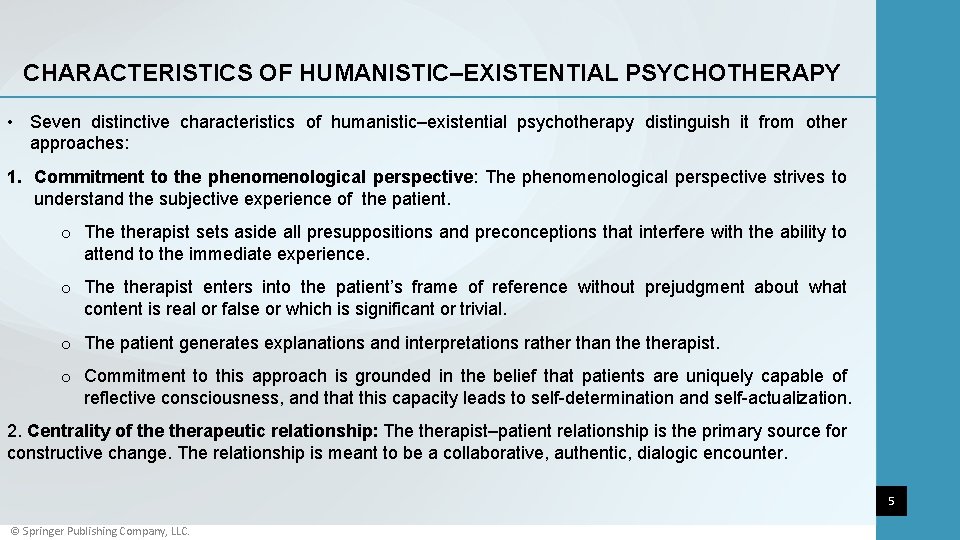
CHARACTERISTICS OF HUMANISTIC–EXISTENTIAL PSYCHOTHERAPY • Seven distinctive characteristics of humanistic–existential psychotherapy distinguish it from other approaches: 1. Commitment to the phenomenological perspective: The phenomenological perspective strives to understand the subjective experience of the patient. o The therapist sets aside all presuppositions and preconceptions that interfere with the ability to attend to the immediate experience. o The therapist enters into the patient’s frame of reference without prejudgment about what content is real or false or which is significant or trivial. o The patient generates explanations and interpretations rather than therapist. o Commitment to this approach is grounded in the belief that patients are uniquely capable of reflective consciousness, and that this capacity leads to self-determination and self-actualization. 2. Centrality of therapeutic relationship: The therapist–patient relationship is the primary source for constructive change. The relationship is meant to be a collaborative, authentic, dialogic encounter. 5 © Springer Publishing Company, LLC.
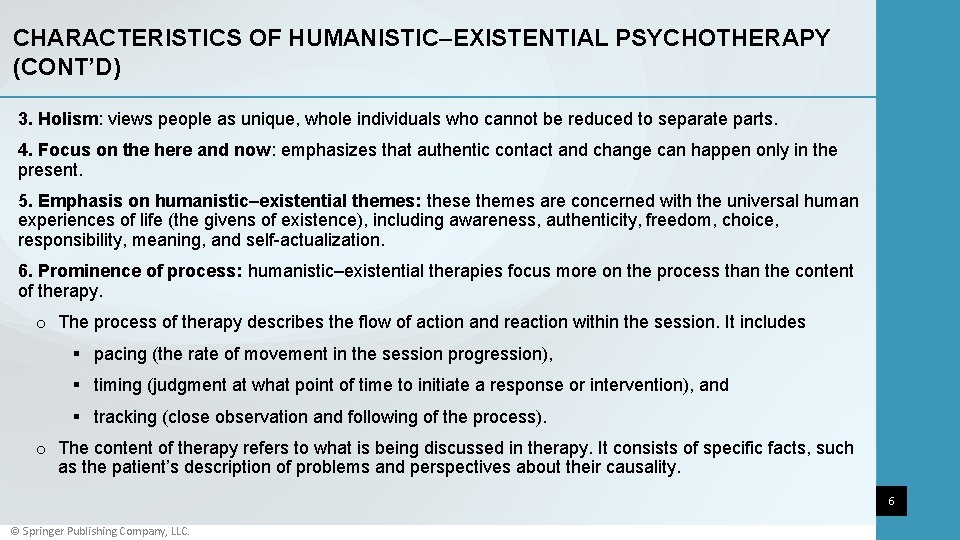
CHARACTERISTICS OF HUMANISTIC–EXISTENTIAL PSYCHOTHERAPY (CONT’D) 3. Holism: views people as unique, whole individuals who cannot be reduced to separate parts. 4. Focus on the here and now: emphasizes that authentic contact and change can happen only in the present. 5. Emphasis on humanistic–existential themes: these themes are concerned with the universal human experiences of life (the givens of existence), including awareness, authenticity, freedom, choice, responsibility, meaning, and self-actualization. 6. Prominence of process: humanistic–existential therapies focus more on the process than the content of therapy. o The process of therapy describes the flow of action and reaction within the session. It includes § pacing (the rate of movement in the session progression), § timing (judgment at what point of time to initiate a response or intervention), and § tracking (close observation and following of the process). o The content of therapy refers to what is being discussed in therapy. It consists of specific facts, such as the patient’s description of problems and perspectives about their causality. 6 © Springer Publishing Company, LLC.
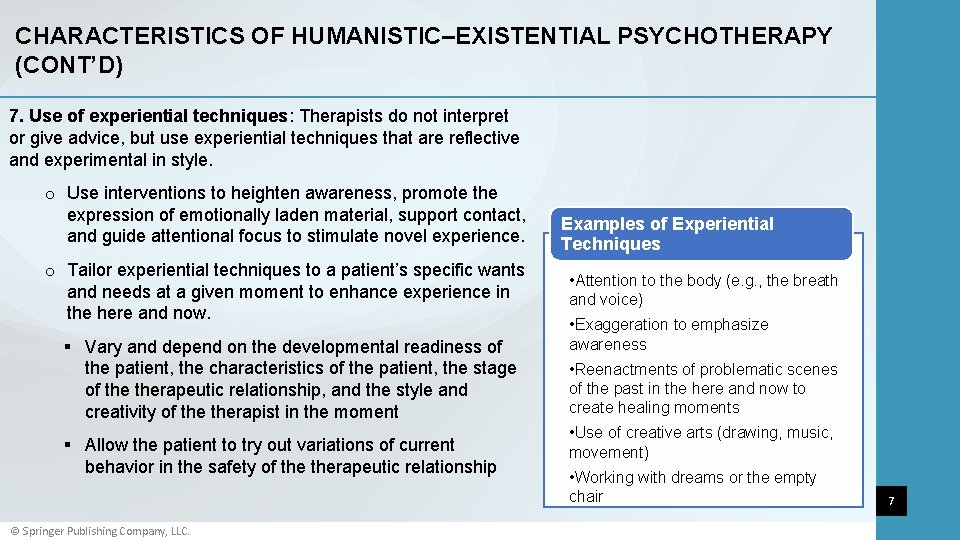
CHARACTERISTICS OF HUMANISTIC–EXISTENTIAL PSYCHOTHERAPY (CONT’D) 7. Use of experiential techniques: Therapists do not interpret or give advice, but use experiential techniques that are reflective and experimental in style. o Use interventions to heighten awareness, promote the expression of emotionally laden material, support contact, and guide attentional focus to stimulate novel experience. o Tailor experiential techniques to a patient’s specific wants and needs at a given moment to enhance experience in the here and now. § Vary and depend on the developmental readiness of the patient, the characteristics of the patient, the stage of therapeutic relationship, and the style and creativity of therapist in the moment § Allow the patient to try out variations of current behavior in the safety of therapeutic relationship © Springer Publishing Company, LLC. Examples of Experiential Techniques • Attention to the body (e. g. , the breath and voice) • Exaggeration to emphasize awareness • Reenactments of problematic scenes of the past in the here and now to create healing moments • Use of creative arts (drawing, music, movement) • Working with dreams or the empty chair 7
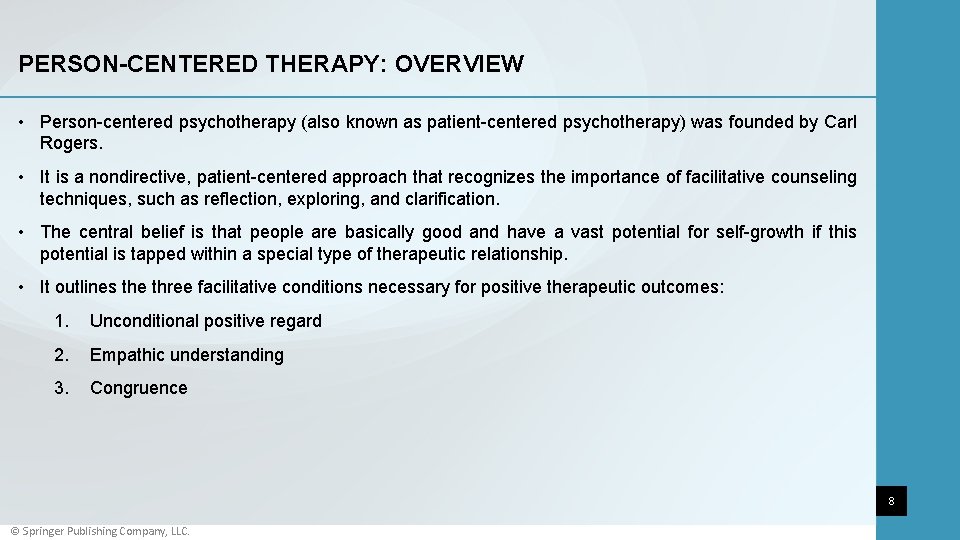
PERSON-CENTERED THERAPY: OVERVIEW • Person-centered psychotherapy (also known as patient-centered psychotherapy) was founded by Carl Rogers. • It is a nondirective, patient-centered approach that recognizes the importance of facilitative counseling techniques, such as reflection, exploring, and clarification. • The central belief is that people are basically good and have a vast potential for self-growth if this potential is tapped within a special type of therapeutic relationship. • It outlines the three facilitative conditions necessary for positive therapeutic outcomes: 1. Unconditional positive regard 2. Empathic understanding 3. Congruence 8 © Springer Publishing Company, LLC.
PERSON-CENTERED THERAPY: KEY CONCEPTS • Belief in a positive human nature: recognizes that there is a positive center at the core of all individuals. People are thought to be trustworthy, creative, and resourceful. o They are capable of self-understanding and self-direction and are able to live effective and productive lives. o People become destructive only when a poor self-concept or external constraints override the core sense of goodness. • Self-concept: an organized, consistent set of perceptions about the self, continually influenced by experience and its interpretation o Self-concept includes self-worth (what a person thinks about self), self-image (how a person sees self), and ideal self (how a person would like to be). o People are in a state of congruence with a higher sense of self-worth when their self-image and ideal self are similar (a necessary state for self-actualization). • Actualizing tendency: the innate drive; basic motivational force; and directional process in humans to grow, develop, and strive toward self-realization and fulfillment. 9 © Springer Publishing Company, LLC.
PERSON-CENTERED THERAPY: KEY CONCEPTS (CONT’D) • Fully functioning person: an individual who is fully engaged in the process of self-actualization is a fully functioning person. He or she demonstrates the following: o Knowledge of subjective experience o Existential living emphasizing choice, freedom, and responsibility o Awareness of emotions o Ability to take risks and seek new experiences o Engagement in a continual process of change 10 © Springer Publishing Company, LLC.
GOALS OF PERSON-CENTERED THERAPY • The goal of person-centered therapy is for the patient to become a fully functioning person engaged in the process of self-actualization. • When achieving this level of development, the patient is able to live life more authentically and cope well with current and future problems. • The therapist provides a climate conducive to helping the person achieve these goals. 11 © Springer Publishing Company, LLC.
PSYCHOTHERAPEUTIC INTERVENTIONS: ASSESSMENT IN PERSONCENTERED THERAPY • The therapist begins the assessment by asking the patient where to begin and what issues to work on. • The patient’s phenomenological experience is the focus rather than the presenting problem. • The therapist creates an understanding atmosphere that encourages clarification and reflection of present feelings. Example: o To the patient’s comment, “I’m depressed most of the time, ” therapist might respond with, “You constantly feel unhappy? ” o The patient is then able to pursue his or her own line of thought, resulting in a fuller exposure of the patient’s subjective experience. • Traditional assessment procedures (e. g. , taking a psychiatric history or using psychometric tests) are not used because they encourage an external focus and imply that therapist is the expert who provides the solutions. • Diagnosing is not highly regarded in this approach. If providing a diagnosis is necessary, a collaborative approach is used in which the patient and therapist together formulate the diagnosis. 12 © Springer Publishing Company, LLC.
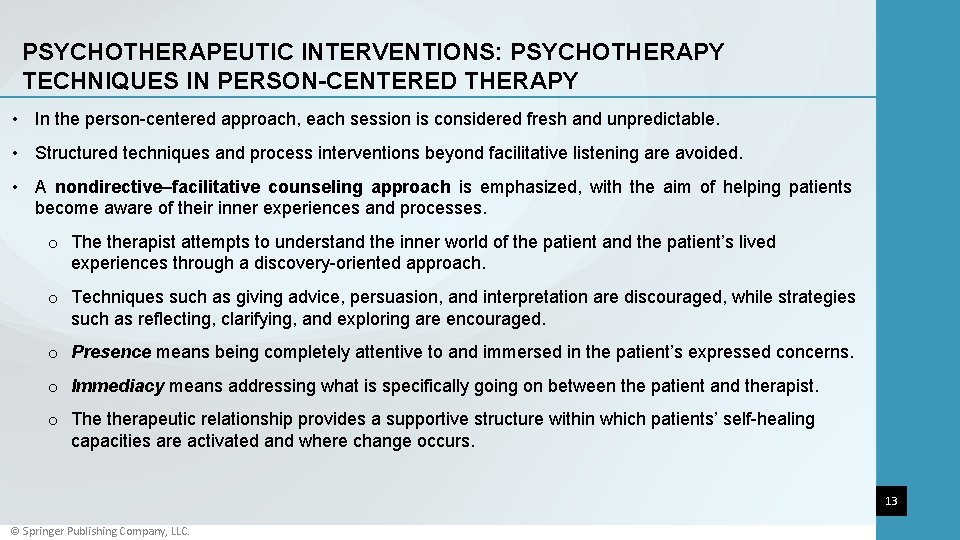
PSYCHOTHERAPEUTIC INTERVENTIONS: PSYCHOTHERAPY TECHNIQUES IN PERSON-CENTERED THERAPY • In the person-centered approach, each session is considered fresh and unpredictable. • Structured techniques and process interventions beyond facilitative listening are avoided. • A nondirective–facilitative counseling approach is emphasized, with the aim of helping patients become aware of their inner experiences and processes. o The therapist attempts to understand the inner world of the patient and the patient’s lived experiences through a discovery-oriented approach. o Techniques such as giving advice, persuasion, and interpretation are discouraged, while strategies such as reflecting, clarifying, and exploring are encouraged. o Presence means being completely attentive to and immersed in the patient’s expressed concerns. o Immediacy means addressing what is specifically going on between the patient and therapist. o The therapeutic relationship provides a supportive structure within which patients’ self-healing capacities are activated and where change occurs. 13 © Springer Publishing Company, LLC.
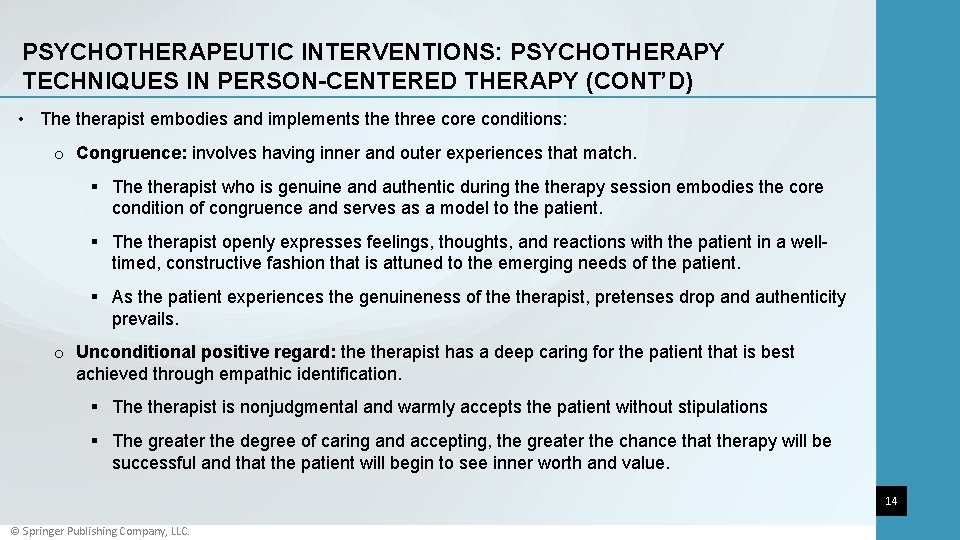
PSYCHOTHERAPEUTIC INTERVENTIONS: PSYCHOTHERAPY TECHNIQUES IN PERSON-CENTERED THERAPY (CONT’D) • The therapist embodies and implements the three core conditions: o Congruence: involves having inner and outer experiences that match. § The therapist who is genuine and authentic during therapy session embodies the core condition of congruence and serves as a model to the patient. § The therapist openly expresses feelings, thoughts, and reactions with the patient in a welltimed, constructive fashion that is attuned to the emerging needs of the patient. § As the patient experiences the genuineness of therapist, pretenses drop and authenticity prevails. o Unconditional positive regard: therapist has a deep caring for the patient that is best achieved through empathic identification. § The therapist is nonjudgmental and warmly accepts the patient without stipulations § The greater the degree of caring and accepting, the greater the chance that therapy will be successful and that the patient will begin to see inner worth and value. 14 © Springer Publishing Company, LLC.
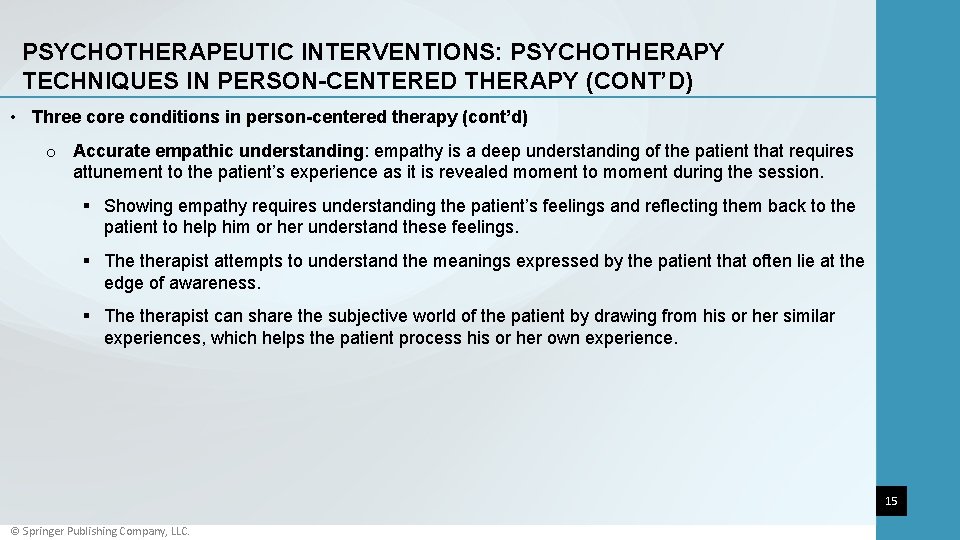
PSYCHOTHERAPEUTIC INTERVENTIONS: PSYCHOTHERAPY TECHNIQUES IN PERSON-CENTERED THERAPY (CONT’D) • Three core conditions in person-centered therapy (cont’d) o Accurate empathic understanding: empathy is a deep understanding of the patient that requires attunement to the patient’s experience as it is revealed moment to moment during the session. § Showing empathy requires understanding the patient’s feelings and reflecting them back to the patient to help him or her understand these feelings. § The therapist attempts to understand the meanings expressed by the patient that often lie at the edge of awareness. § The therapist can share the subjective world of the patient by drawing from his or her similar experiences, which helps the patient process his or her own experience. 15 © Springer Publishing Company, LLC.
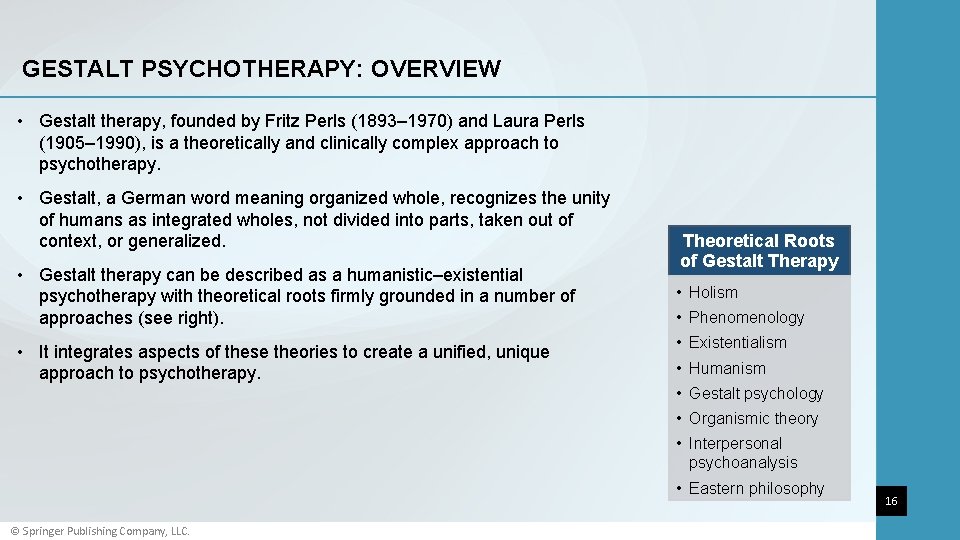
GESTALT PSYCHOTHERAPY: OVERVIEW • Gestalt therapy, founded by Fritz Perls (1893– 1970) and Laura Perls (1905– 1990), is a theoretically and clinically complex approach to psychotherapy. • Gestalt, a German word meaning organized whole, recognizes the unity of humans as integrated wholes, not divided into parts, taken out of context, or generalized. • Gestalt therapy can be described as a humanistic–existential psychotherapy with theoretical roots firmly grounded in a number of approaches (see right). • It integrates aspects of these theories to create a unified, unique approach to psychotherapy. Theoretical Roots of Gestalt Therapy • Holism • Phenomenology • Existentialism • Humanism • Gestalt psychology • Organismic theory • Interpersonal psychoanalysis • Eastern philosophy © Springer Publishing Company, LLC. 16
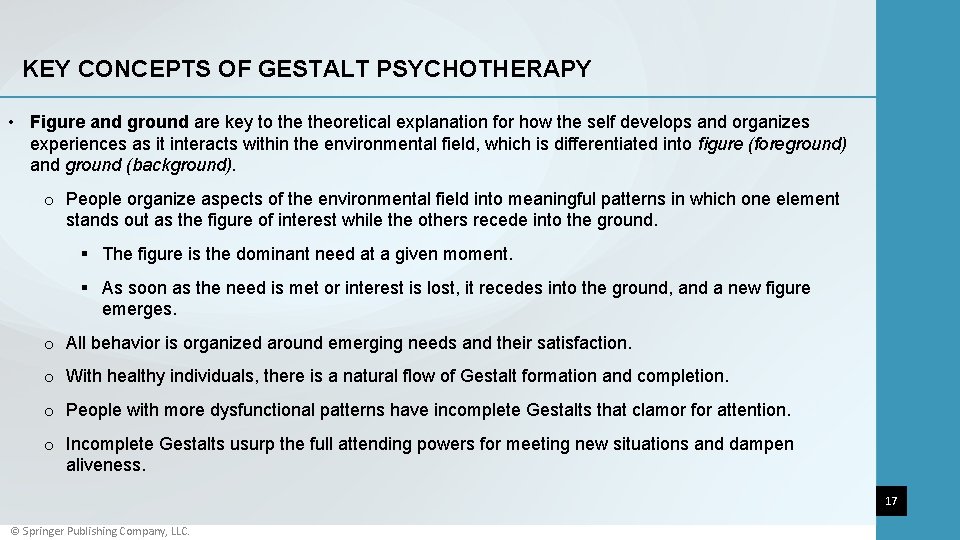
KEY CONCEPTS OF GESTALT PSYCHOTHERAPY • Figure and ground are key to theoretical explanation for how the self develops and organizes experiences as it interacts within the environmental field, which is differentiated into figure (foreground) and ground (background). o People organize aspects of the environmental field into meaningful patterns in which one element stands out as the figure of interest while the others recede into the ground. § The figure is the dominant need at a given moment. § As soon as the need is met or interest is lost, it recedes into the ground, and a new figure emerges. o All behavior is organized around emerging needs and their satisfaction. o With healthy individuals, there is a natural flow of Gestalt formation and completion. o People with more dysfunctional patterns have incomplete Gestalts that clamor for attention. o Incomplete Gestalts usurp the full attending powers for meeting new situations and dampen aliveness. 17 © Springer Publishing Company, LLC.
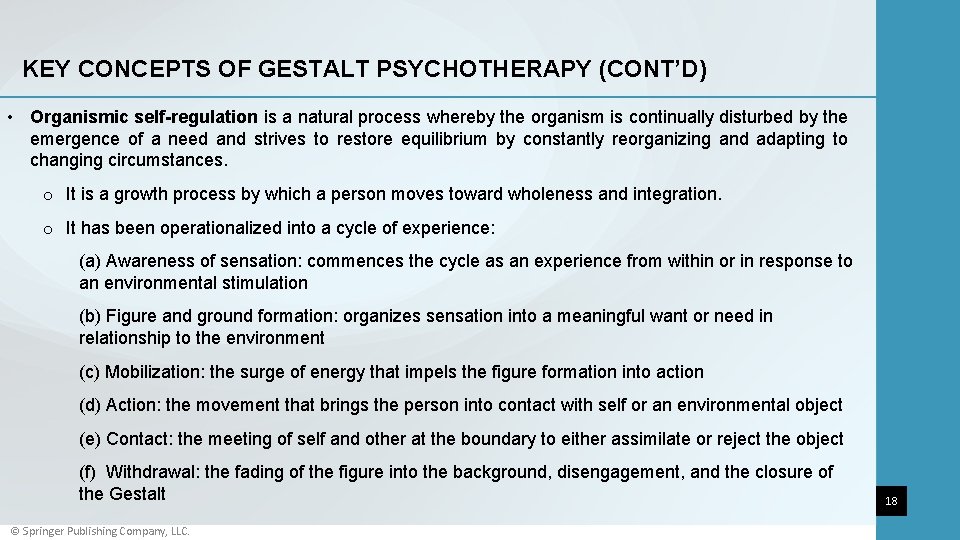
KEY CONCEPTS OF GESTALT PSYCHOTHERAPY (CONT’D) • Organismic self-regulation is a natural process whereby the organism is continually disturbed by the emergence of a need and strives to restore equilibrium by constantly reorganizing and adapting to changing circumstances. o It is a growth process by which a person moves toward wholeness and integration. o It has been operationalized into a cycle of experience: (a) Awareness of sensation: commences the cycle as an experience from within or in response to an environmental stimulation (b) Figure and ground formation: organizes sensation into a meaningful want or need in relationship to the environment (c) Mobilization: the surge of energy that impels the figure formation into action (d) Action: the movement that brings the person into contact with self or an environmental object (e) Contact: the meeting of self and other at the boundary to either assimilate or reject the object (f) Withdrawal: the fading of the figure into the background, disengagement, and the closure of the Gestalt © Springer Publishing Company, LLC. 18
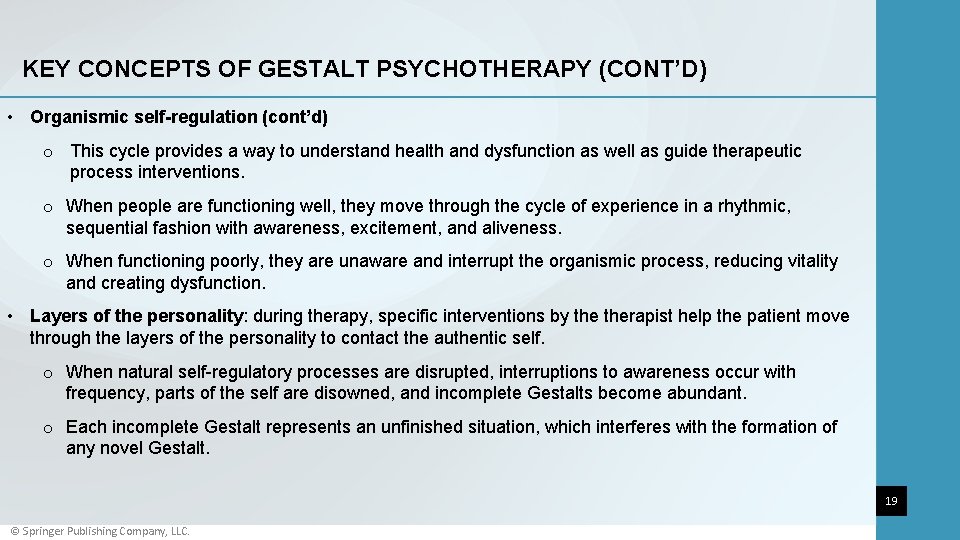
KEY CONCEPTS OF GESTALT PSYCHOTHERAPY (CONT’D) • Organismic self-regulation (cont’d) o This cycle provides a way to understand health and dysfunction as well as guide therapeutic process interventions. o When people are functioning well, they move through the cycle of experience in a rhythmic, sequential fashion with awareness, excitement, and aliveness. o When functioning poorly, they are unaware and interrupt the organismic process, reducing vitality and creating dysfunction. • Layers of the personality: during therapy, specific interventions by therapist help the patient move through the layers of the personality to contact the authentic self. o When natural self-regulatory processes are disrupted, interruptions to awareness occur with frequency, parts of the self are disowned, and incomplete Gestalts become abundant. o Each incomplete Gestalt represents an unfinished situation, which interferes with the formation of any novel Gestalt. 19 © Springer Publishing Company, LLC.
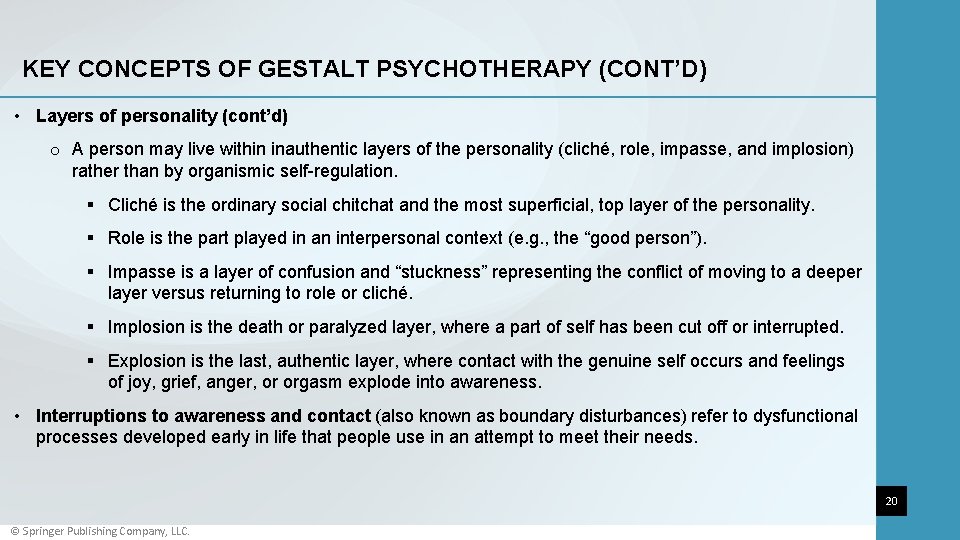
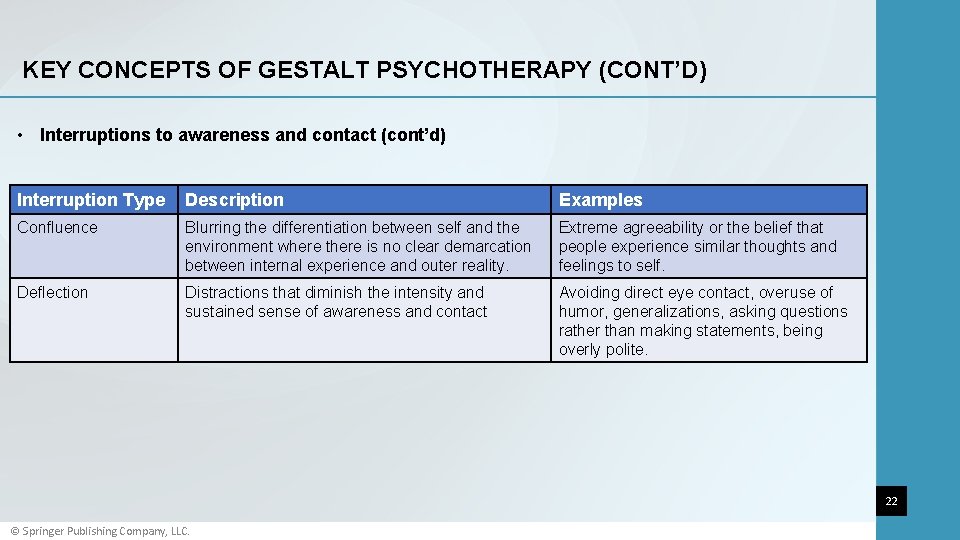
KEY CONCEPTS OF GESTALT PSYCHOTHERAPY (CONT’D) • Layers of personality (cont’d) o A person may live within inauthentic layers of the personality (cliché, role, impasse, and implosion) rather than by organismic self-regulation. § Cliché is the ordinary social chitchat and the most superficial, top layer of the personality. § Role is the part played in an interpersonal context (e. g. , the “good person”). § Impasse is a layer of confusion and “stuckness” representing the conflict of moving to a deeper layer versus returning to role or cliché. § Implosion is the death or paralyzed layer, where a part of self has been cut off or interrupted. § Explosion is the last, authentic layer, where contact with the genuine self occurs and feelings of joy, grief, anger, or orgasm explode into awareness. • Interruptions to awareness and contact (also known as boundary disturbances) refer to dysfunctional processes developed early in life that people use in an attempt to meet their needs. 20 © Springer Publishing Company, LLC.
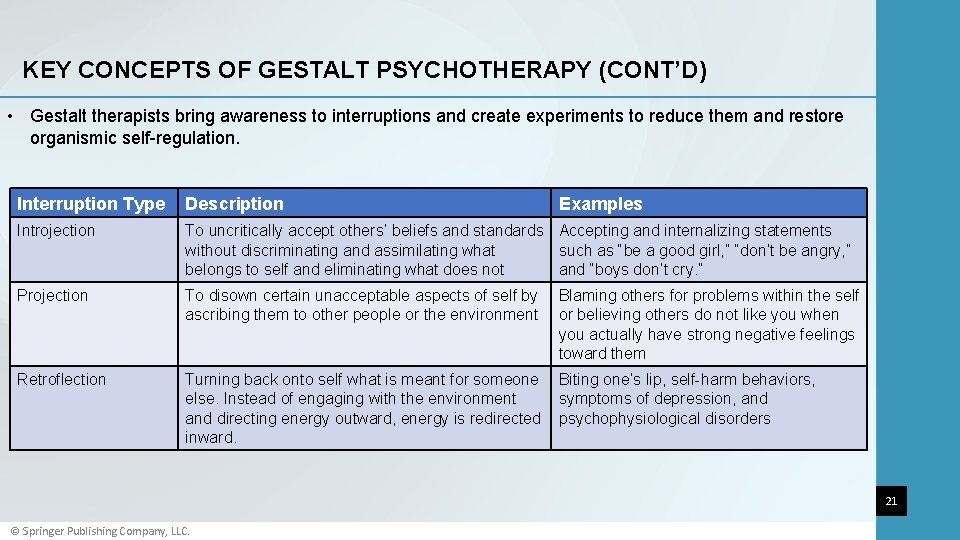
KEY CONCEPTS OF GESTALT PSYCHOTHERAPY (CONT’D) • Gestalt therapists bring awareness to interruptions and create experiments to reduce them and restore organismic self-regulation. Interruption Type Description Examples Introjection To uncritically accept others’ beliefs and standards Accepting and internalizing statements without discriminating and assimilating what such as “be a good girl, ” “don’t be angry, ” belongs to self and eliminating what does not and “boys don’t cry. ” Projection To disown certain unacceptable aspects of self by ascribing them to other people or the environment Blaming others for problems within the self or believing others do not like you when you actually have strong negative feelings toward them Retroflection Turning back onto self what is meant for someone else. Instead of engaging with the environment and directing energy outward, energy is redirected inward. Biting one’s lip, self-harm behaviors, symptoms of depression, and psychophysiological disorders 21 © Springer Publishing Company, LLC.
KEY CONCEPTS OF GESTALT PSYCHOTHERAPY (CONT’D) • Interruptions to awareness and contact (cont’d) Interruption Type Description Examples Confluence Blurring the differentiation between self and the environment where there is no clear demarcation between internal experience and outer reality. Extreme agreeability or the belief that people experience similar thoughts and feelings to self. Deflection Distractions that diminish the intensity and sustained sense of awareness and contact Avoiding direct eye contact, overuse of humor, generalizations, asking questions rather than making statements, being overly polite. 22 © Springer Publishing Company, LLC.
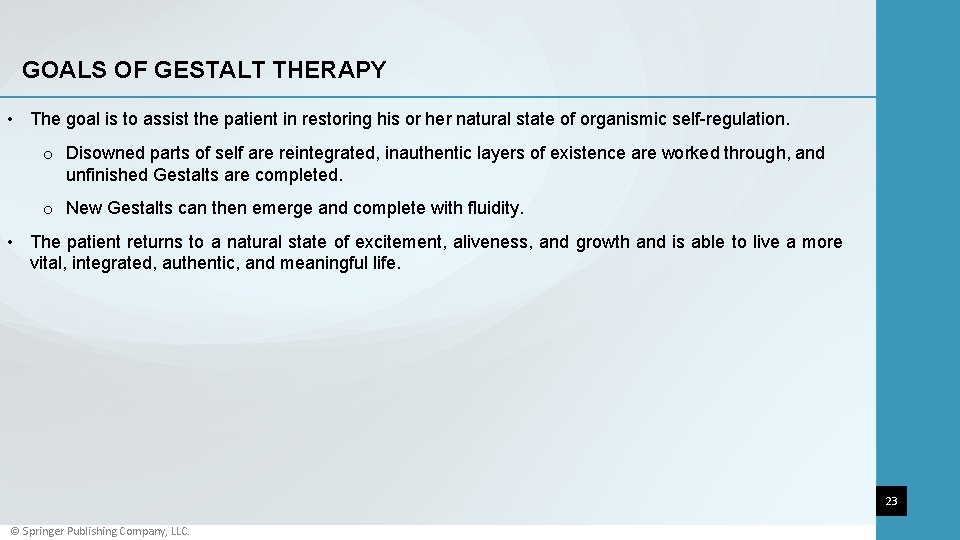
GOALS OF GESTALT THERAPY • The goal is to assist the patient in restoring his or her natural state of organismic self-regulation. o Disowned parts of self are reintegrated, inauthentic layers of existence are worked through, and unfinished Gestalts are completed. o New Gestalts can then emerge and complete with fluidity. • The patient returns to a natural state of excitement, aliveness, and growth and is able to live a more vital, integrated, authentic, and meaningful life. 23 © Springer Publishing Company, LLC.
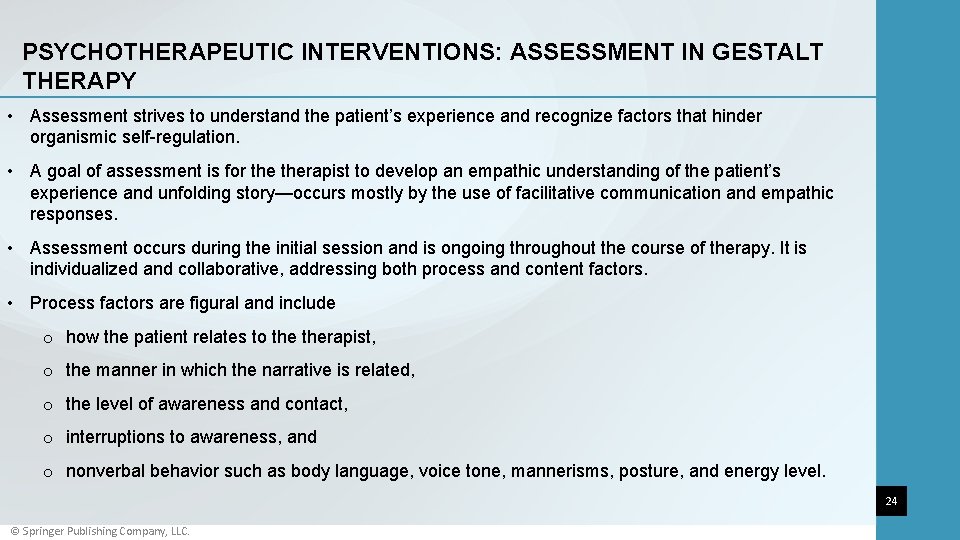
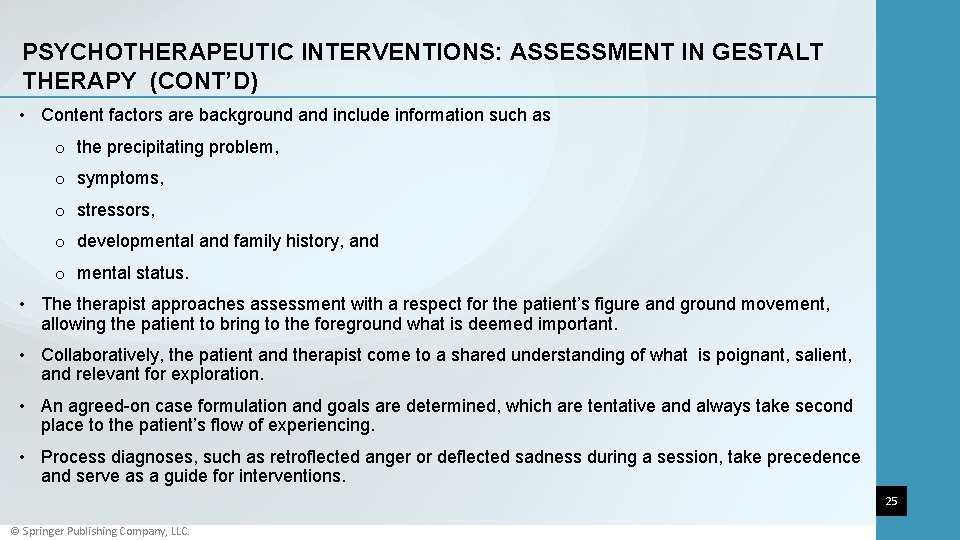
PSYCHOTHERAPEUTIC INTERVENTIONS: ASSESSMENT IN GESTALT THERAPY • Assessment strives to understand the patient’s experience and recognize factors that hinder organismic self-regulation. • A goal of assessment is for therapist to develop an empathic understanding of the patient’s experience and unfolding story—occurs mostly by the use of facilitative communication and empathic responses. • Assessment occurs during the initial session and is ongoing throughout the course of therapy. It is individualized and collaborative, addressing both process and content factors. • Process factors are figural and include o how the patient relates to therapist, o the manner in which the narrative is related, o the level of awareness and contact, o interruptions to awareness, and o nonverbal behavior such as body language, voice tone, mannerisms, posture, and energy level. 24 © Springer Publishing Company, LLC.
PSYCHOTHERAPEUTIC INTERVENTIONS: ASSESSMENT IN GESTALT THERAPY (CONT’D) • Content factors are background and include information such as o the precipitating problem, o symptoms, o stressors, o developmental and family history, and o mental status. • The therapist approaches assessment with a respect for the patient’s figure and ground movement, allowing the patient to bring to the foreground what is deemed important. • Collaboratively, the patient and therapist come to a shared understanding of what is poignant, salient, and relevant for exploration. • An agreed-on case formulation and goals are determined, which are tentative and always take second place to the patient’s flow of experiencing. • Process diagnoses, such as retroflected anger or deflected sadness during a session, take precedence and serve as a guide for interventions. 25 © Springer Publishing Company, LLC.
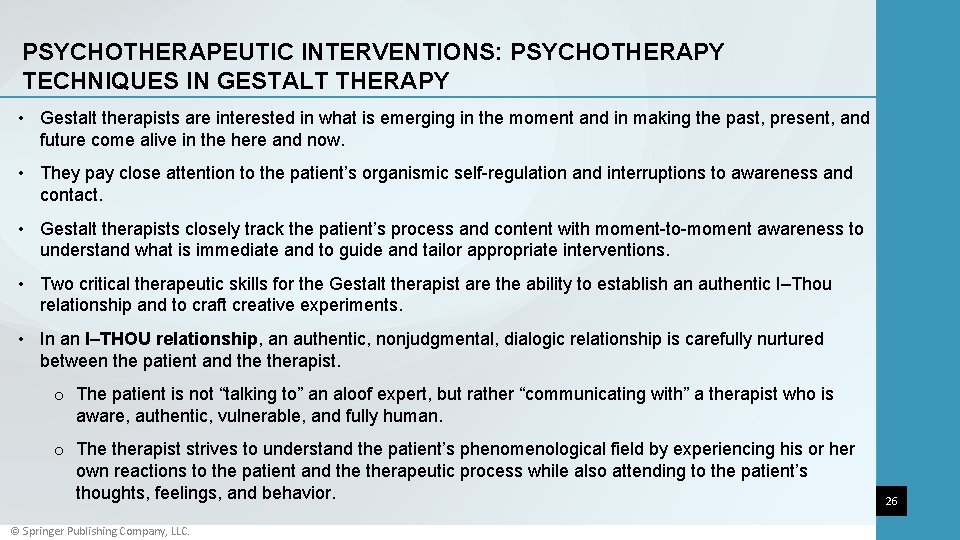
PSYCHOTHERAPEUTIC INTERVENTIONS: PSYCHOTHERAPY TECHNIQUES IN GESTALT THERAPY • Gestalt therapists are interested in what is emerging in the moment and in making the past, present, and future come alive in the here and now. • They pay close attention to the patient’s organismic self-regulation and interruptions to awareness and contact. • Gestalt therapists closely track the patient’s process and content with moment-to-moment awareness to understand what is immediate and to guide and tailor appropriate interventions. • Two critical therapeutic skills for the Gestalt therapist are the ability to establish an authentic I–Thou relationship and to craft creative experiments. • In an I–THOU relationship, an authentic, nonjudgmental, dialogic relationship is carefully nurtured between the patient and therapist. o The patient is not “talking to” an aloof expert, but rather “communicating with” a therapist who is aware, authentic, vulnerable, and fully human. o The therapist strives to understand the patient’s phenomenological field by experiencing his or her own reactions to the patient and therapeutic process while also attending to the patient’s thoughts, feelings, and behavior. © Springer Publishing Company, LLC. 26
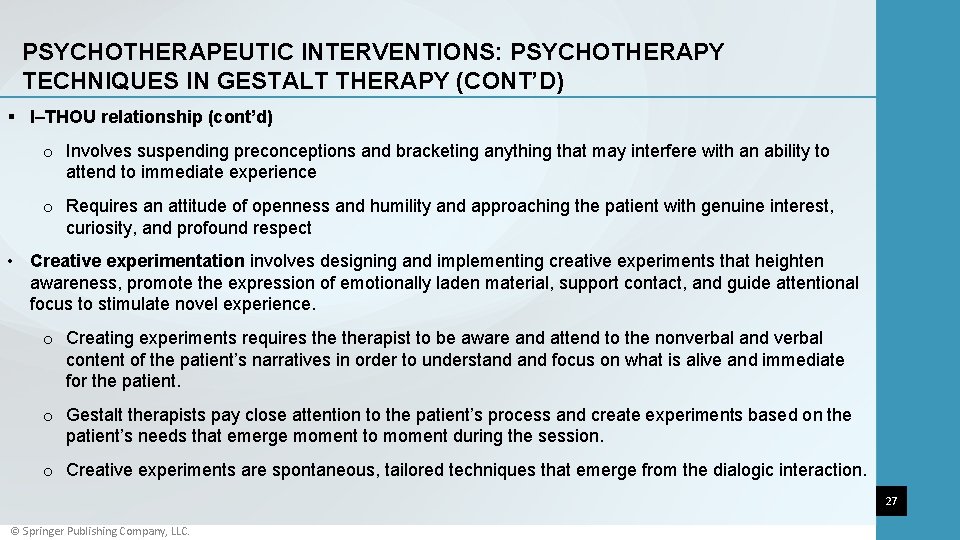
PSYCHOTHERAPEUTIC INTERVENTIONS: PSYCHOTHERAPY TECHNIQUES IN GESTALT THERAPY (CONT’D) § I–THOU relationship (cont’d) o Involves suspending preconceptions and bracketing anything that may interfere with an ability to attend to immediate experience o Requires an attitude of openness and humility and approaching the patient with genuine interest, curiosity, and profound respect • Creative experimentation involves designing and implementing creative experiments that heighten awareness, promote the expression of emotionally laden material, support contact, and guide attentional focus to stimulate novel experience. o Creating experiments requires therapist to be aware and attend to the nonverbal and verbal content of the patient’s narratives in order to understand focus on what is alive and immediate for the patient. o Gestalt therapists pay close attention to the patient’s process and create experiments based on the patient’s needs that emerge moment to moment during the session. o Creative experiments are spontaneous, tailored techniques that emerge from the dialogic interaction. 27 © Springer Publishing Company, LLC.
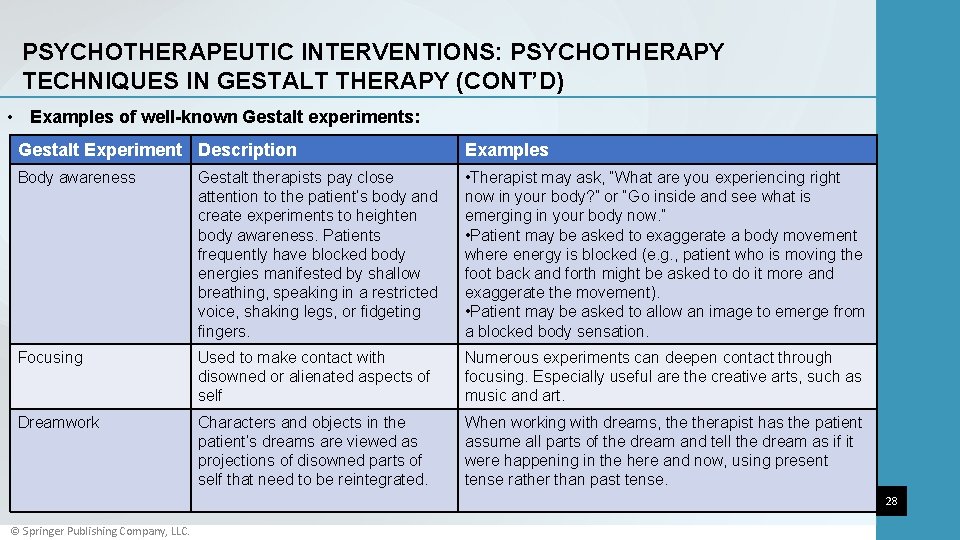
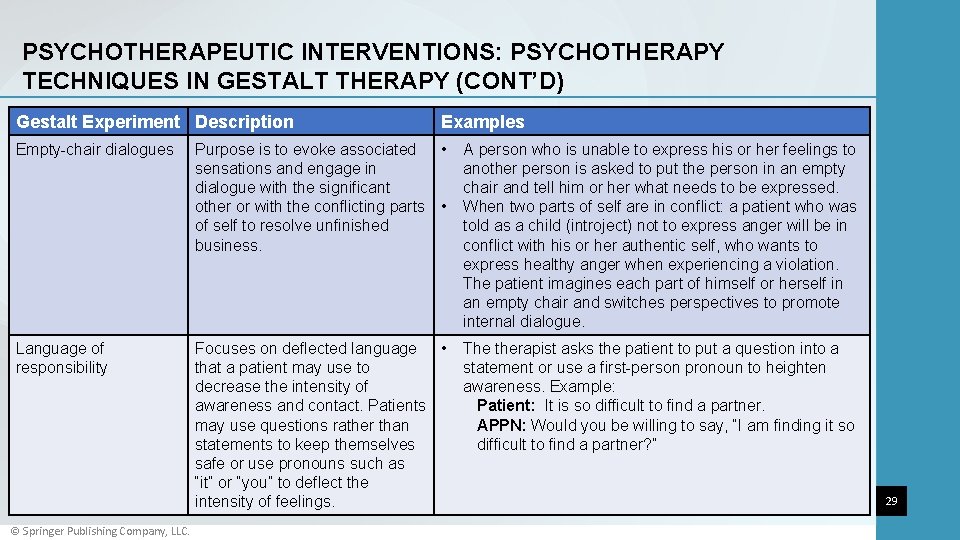
PSYCHOTHERAPEUTIC INTERVENTIONS: PSYCHOTHERAPY TECHNIQUES IN GESTALT THERAPY (CONT’D) • Examples of well-known Gestalt experiments: Gestalt Experiment Description Examples Body awareness Gestalt therapists pay close attention to the patient’s body and create experiments to heighten body awareness. Patients frequently have blocked body energies manifested by shallow breathing, speaking in a restricted voice, shaking legs, or fidgeting fingers. • Therapist may ask, “What are you experiencing right now in your body? ” or “Go inside and see what is emerging in your body now. ” • Patient may be asked to exaggerate a body movement where energy is blocked (e. g. , patient who is moving the foot back and forth might be asked to do it more and exaggerate the movement). • Patient may be asked to allow an image to emerge from a blocked body sensation. Focusing Used to make contact with disowned or alienated aspects of self Numerous experiments can deepen contact through focusing. Especially useful are the creative arts, such as music and art. Dreamwork Characters and objects in the patient’s dreams are viewed as projections of disowned parts of self that need to be reintegrated. When working with dreams, therapist has the patient assume all parts of the dream and tell the dream as if it were happening in the here and now, using present tense rather than past tense. 28 © Springer Publishing Company, LLC.
PSYCHOTHERAPEUTIC INTERVENTIONS: PSYCHOTHERAPY TECHNIQUES IN GESTALT THERAPY (CONT’D) Gestalt Experiment Description Examples Empty-chair dialogues Purpose is to evoke associated • sensations and engage in dialogue with the significant other or with the conflicting parts • of self to resolve unfinished business. A person who is unable to express his or her feelings to another person is asked to put the person in an empty chair and tell him or her what needs to be expressed. When two parts of self are in conflict: a patient who was told as a child (introject) not to express anger will be in conflict with his or her authentic self, who wants to express healthy anger when experiencing a violation. The patient imagines each part of himself or herself in an empty chair and switches perspectives to promote internal dialogue. Language of responsibility Focuses on deflected language • that a patient may use to decrease the intensity of awareness and contact. Patients may use questions rather than statements to keep themselves safe or use pronouns such as “it” or “you” to deflect the intensity of feelings. The therapist asks the patient to put a question into a statement or use a first-person pronoun to heighten awareness. Example: Patient: It is so difficult to find a partner. APPN: Would you be willing to say, “I am finding it so difficult to find a partner? ” © Springer Publishing Company, LLC. 29
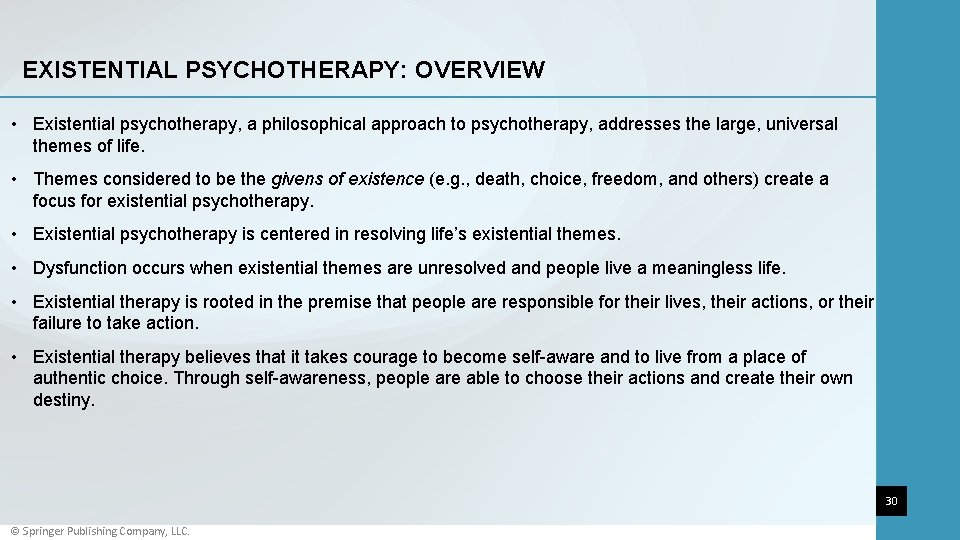
EXISTENTIAL PSYCHOTHERAPY: OVERVIEW • Existential psychotherapy, a philosophical approach to psychotherapy, addresses the large, universal themes of life. • Themes considered to be the givens of existence (e. g. , death, choice, freedom, and others) create a focus for existential psychotherapy. • Existential psychotherapy is centered in resolving life’s existential themes. • Dysfunction occurs when existential themes are unresolved and people live a meaningless life. • Existential therapy is rooted in the premise that people are responsible for their lives, their actions, or their failure to take action. • Existential therapy believes that it takes courage to become self-aware and to live from a place of authentic choice. Through self-awareness, people are able to choose their actions and create their own destiny. 30 © Springer Publishing Company, LLC.
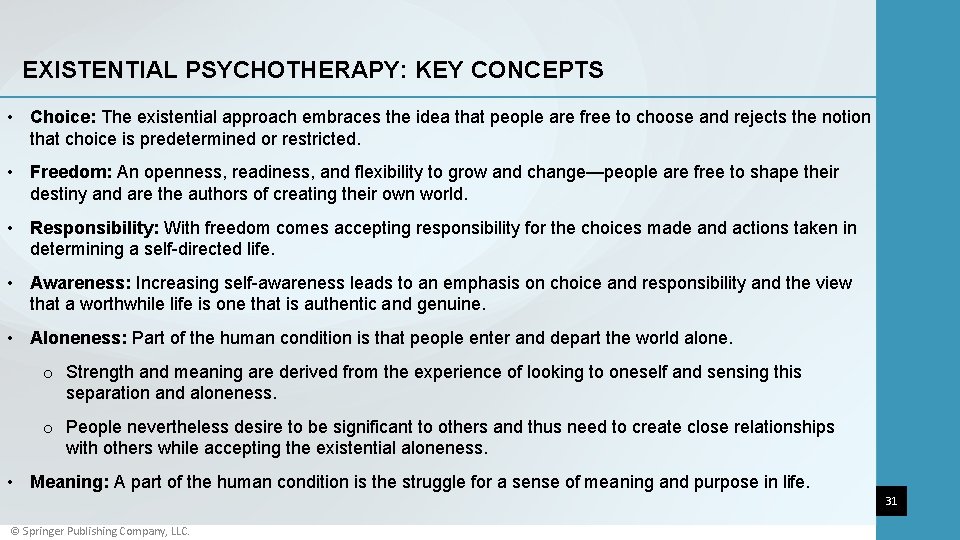
EXISTENTIAL PSYCHOTHERAPY: KEY CONCEPTS • Choice: The existential approach embraces the idea that people are free to choose and rejects the notion that choice is predetermined or restricted. • Freedom: An openness, readiness, and flexibility to grow and change—people are free to shape their destiny and are the authors of creating their own world. • Responsibility: With freedom comes accepting responsibility for the choices made and actions taken in determining a self-directed life. • Awareness: Increasing self-awareness leads to an emphasis on choice and responsibility and the view that a worthwhile life is one that is authentic and genuine. • Aloneness: Part of the human condition is that people enter and depart the world alone. o Strength and meaning are derived from the experience of looking to oneself and sensing this separation and aloneness. o People nevertheless desire to be significant to others and thus need to create close relationships with others while accepting the existential aloneness. • Meaning: A part of the human condition is the struggle for a sense of meaning and purpose in life. 31 © Springer Publishing Company, LLC.
EXISTENTIAL PSYCHOTHERAPY: KEY CONCEPTS (CONT’D) • Existential anxiety: As awareness of the consequences of freedom, choice, responsibility, isolation, and death increases, anxiety is inevitable. o Existential anxiety is a stimulus for growth and an appropriate response to having the courage to be. o The aim of therapy is not to eliminate anxiety, but to be aware of it and embrace it in order to live a fulfilling life. • Death: Awareness of death is the terrible truth and ultimate human concern that gives significance to life. o The fear of death and the fear of life are related, for the fear of death looms over those who are afraid to participate fully in life. o Existentialists believe that those who fear death also fear life, so the fear of death must be faced before one can truly live. • Awe: A state of being that incorporates wonder, dread, mystery, veneration, and paradox. 32 © Springer Publishing Company, LLC.
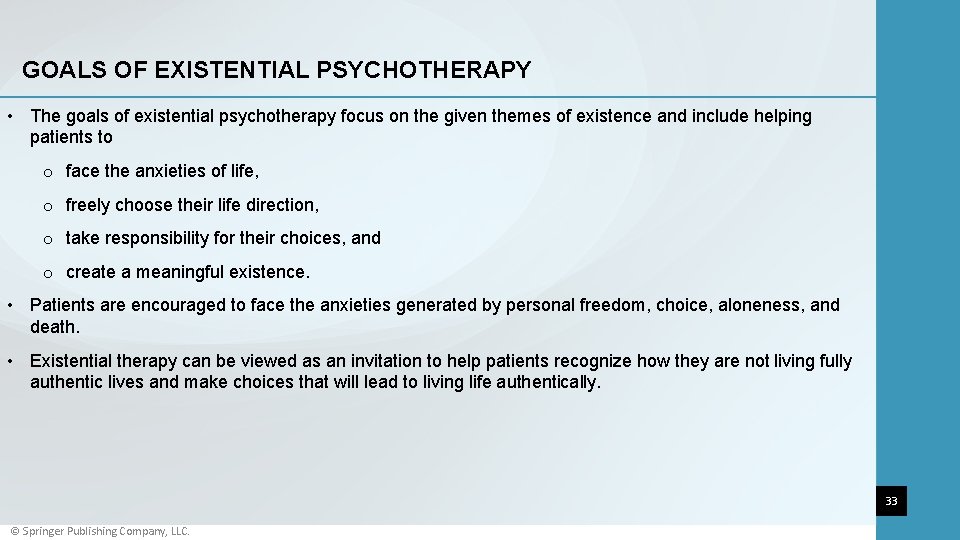
GOALS OF EXISTENTIAL PSYCHOTHERAPY • The goals of existential psychotherapy focus on the given themes of existence and include helping patients to o face the anxieties of life, o freely choose their life direction, o take responsibility for their choices, and o create a meaningful existence. • Patients are encouraged to face the anxieties generated by personal freedom, choice, aloneness, and death. • Existential therapy can be viewed as an invitation to help patients recognize how they are not living fully authentic lives and make choices that will lead to living life authentically. 33 © Springer Publishing Company, LLC.
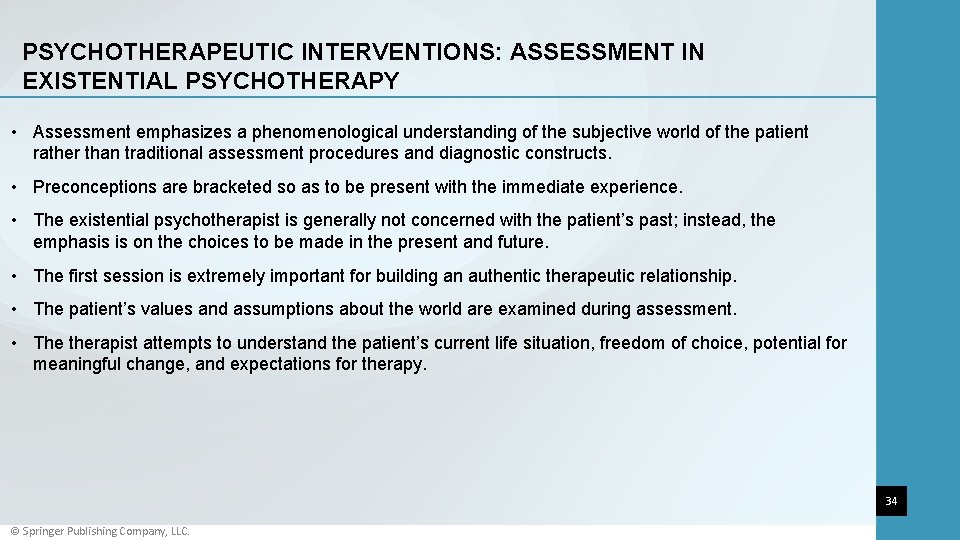
PSYCHOTHERAPEUTIC INTERVENTIONS: ASSESSMENT IN EXISTENTIAL PSYCHOTHERAPY • Assessment emphasizes a phenomenological understanding of the subjective world of the patient rather than traditional assessment procedures and diagnostic constructs. • Preconceptions are bracketed so as to be present with the immediate experience. • The existential psychotherapist is generally not concerned with the patient’s past; instead, the emphasis is on the choices to be made in the present and future. • The first session is extremely important for building an authentic therapeutic relationship. • The patient’s values and assumptions about the world are examined during assessment. • The therapist attempts to understand the patient’s current life situation, freedom of choice, potential for meaningful change, and expectations for therapy. 34 © Springer Publishing Company, LLC.
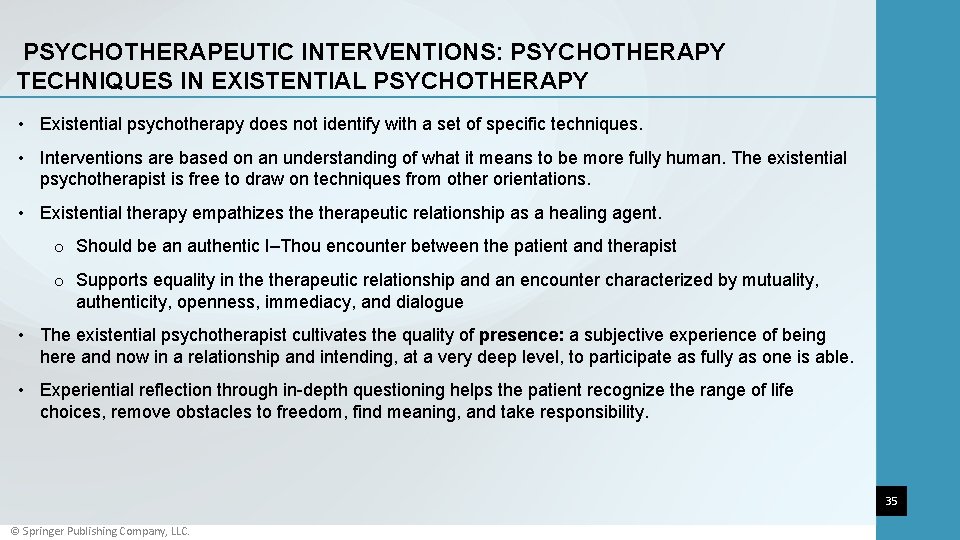
PSYCHOTHERAPEUTIC INTERVENTIONS: PSYCHOTHERAPY TECHNIQUES IN EXISTENTIAL PSYCHOTHERAPY • Existential psychotherapy does not identify with a set of specific techniques. • Interventions are based on an understanding of what it means to be more fully human. The existential psychotherapist is free to draw on techniques from other orientations. • Existential therapy empathizes therapeutic relationship as a healing agent. o Should be an authentic I–Thou encounter between the patient and therapist o Supports equality in therapeutic relationship and an encounter characterized by mutuality, authenticity, openness, immediacy, and dialogue • The existential psychotherapist cultivates the quality of presence: a subjective experience of being here and now in a relationship and intending, at a very deep level, to participate as fully as one is able. • Experiential reflection through in-depth questioning helps the patient recognize the range of life choices, remove obstacles to freedom, find meaning, and take responsibility. 35 © Springer Publishing Company, LLC.
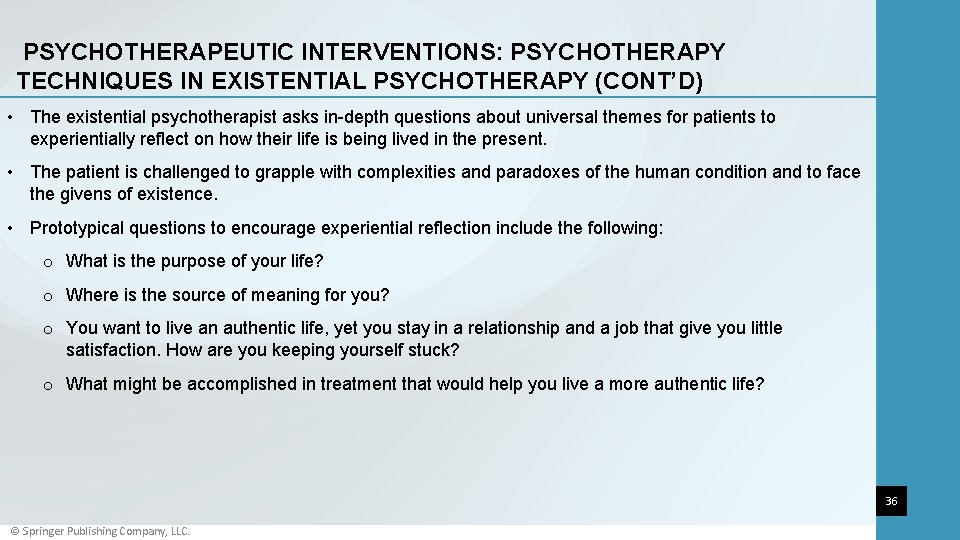
PSYCHOTHERAPEUTIC INTERVENTIONS: PSYCHOTHERAPY TECHNIQUES IN EXISTENTIAL PSYCHOTHERAPY (CONT’D) • The existential psychotherapist asks in-depth questions about universal themes for patients to experientially reflect on how their life is being lived in the present. • The patient is challenged to grapple with complexities and paradoxes of the human condition and to face the givens of existence. • Prototypical questions to encourage experiential reflection include the following: o What is the purpose of your life? o Where is the source of meaning for you? o You want to live an authentic life, yet you stay in a relationship and a job that give you little satisfaction. How are you keeping yourself stuck? o What might be accomplished in treatment that would help you live a more authentic life? 36 © Springer Publishing Company, LLC.
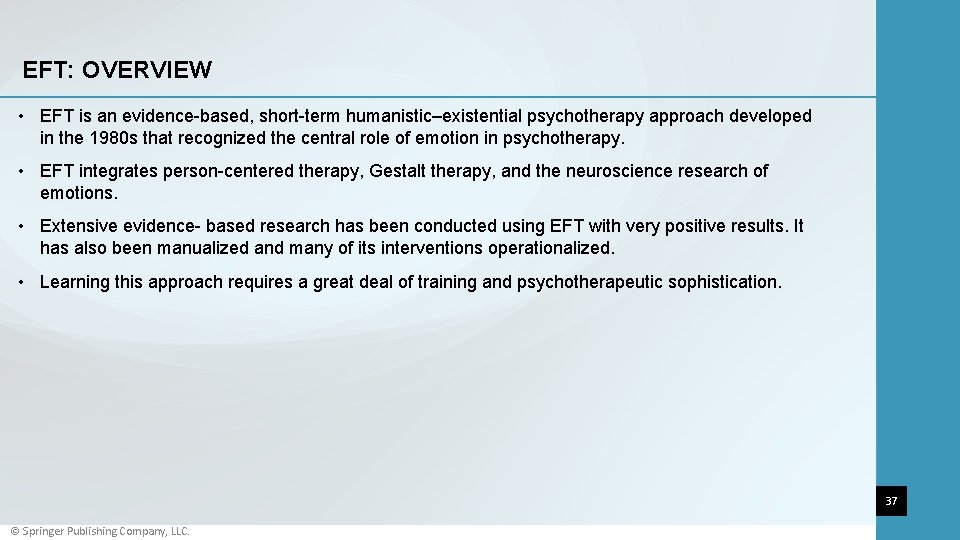
EFT: OVERVIEW • EFT is an evidence-based, short-term humanistic–existential psychotherapy approach developed in the 1980 s that recognized the central role of emotion in psychotherapy. • EFT integrates person-centered therapy, Gestalt therapy, and the neuroscience research of emotions. • Extensive evidence- based research has been conducted using EFT with very positive results. It has also been manualized and many of its interventions operationalized. • Learning this approach requires a great deal of training and psychotherapeutic sophistication. 37 © Springer Publishing Company, LLC.
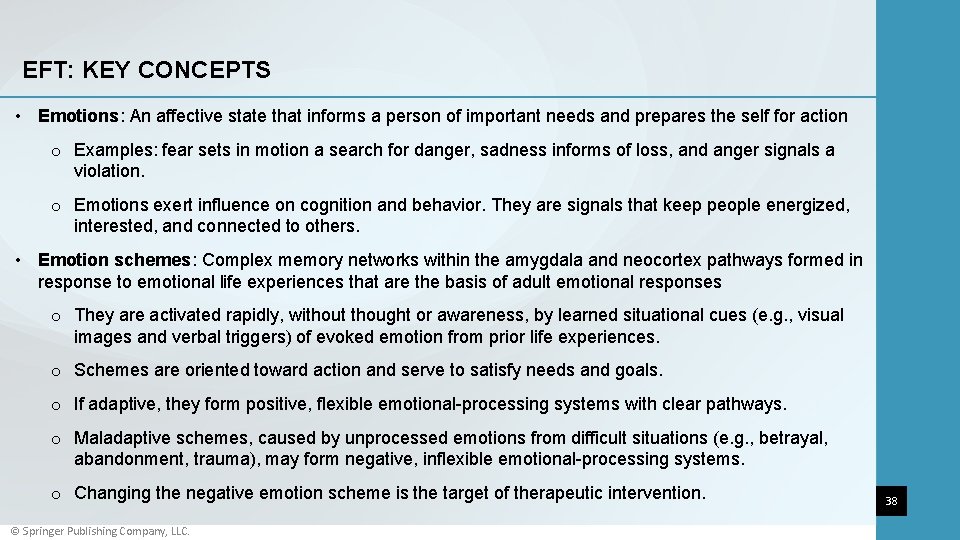
EFT: KEY CONCEPTS • Emotions: An affective state that informs a person of important needs and prepares the self for action o Examples: fear sets in motion a search for danger, sadness informs of loss, and anger signals a violation. o Emotions exert influence on cognition and behavior. They are signals that keep people energized, interested, and connected to others. • Emotion schemes: Complex memory networks within the amygdala and neocortex pathways formed in response to emotional life experiences that are the basis of adult emotional responses o They are activated rapidly, without thought or awareness, by learned situational cues (e. g. , visual images and verbal triggers) of evoked emotion from prior life experiences. o Schemes are oriented toward action and serve to satisfy needs and goals. o If adaptive, they form positive, flexible emotional-processing systems with clear pathways. o Maladaptive schemes, caused by unprocessed emotions from difficult situations (e. g. , betrayal, abandonment, trauma), may form negative, inflexible emotional-processing systems. o Changing the negative emotion scheme is the target of therapeutic intervention. © Springer Publishing Company, LLC. 38
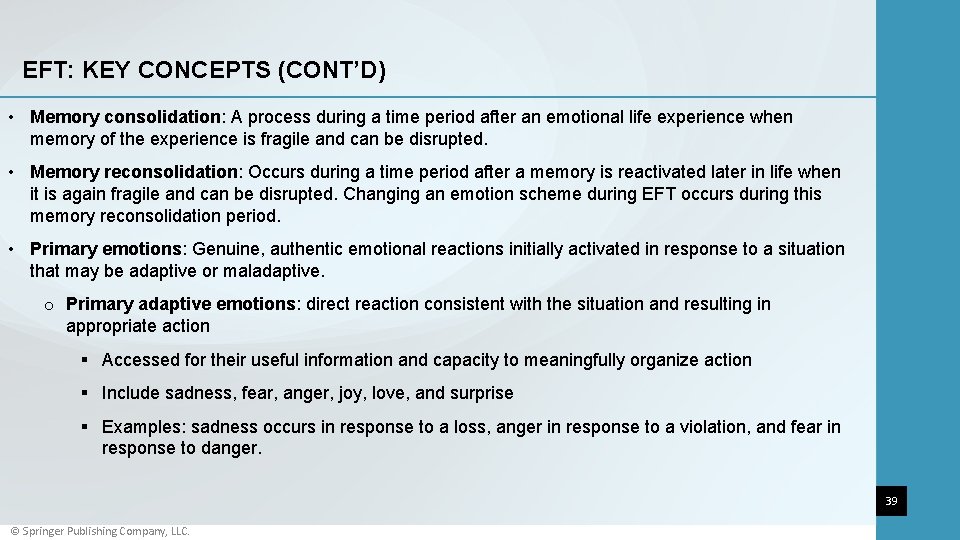
EFT: KEY CONCEPTS (CONT’D) • Memory consolidation: A process during a time period after an emotional life experience when memory of the experience is fragile and can be disrupted. • Memory reconsolidation: Occurs during a time period after a memory is reactivated later in life when it is again fragile and can be disrupted. Changing an emotion scheme during EFT occurs during this memory reconsolidation period. • Primary emotions: Genuine, authentic emotional reactions initially activated in response to a situation that may be adaptive or maladaptive. o Primary adaptive emotions: direct reaction consistent with the situation and resulting in appropriate action § Accessed for their useful information and capacity to meaningfully organize action § Include sadness, fear, anger, joy, love, and surprise § Examples: sadness occurs in response to a loss, anger in response to a violation, and fear in response to danger. 39 © Springer Publishing Company, LLC.
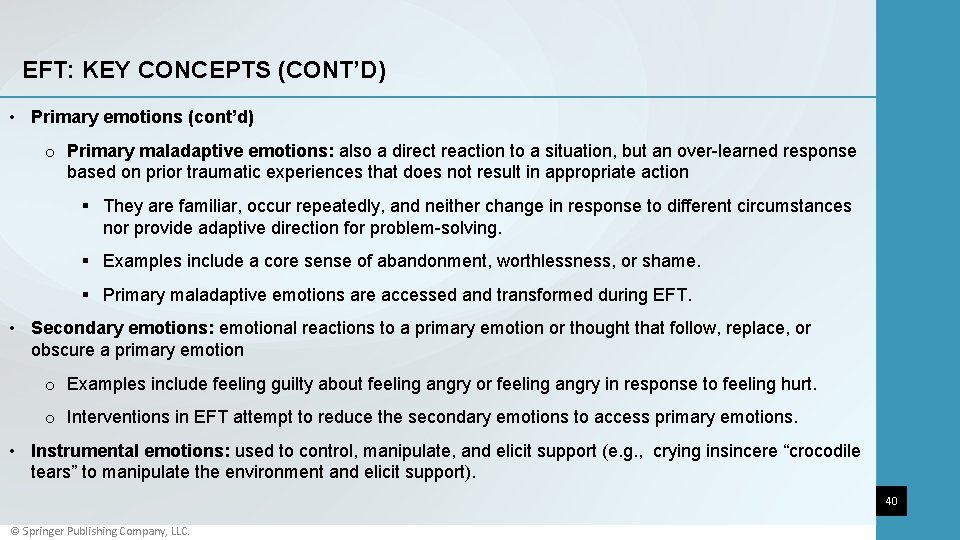
EFT: KEY CONCEPTS (CONT’D) • Primary emotions (cont’d) o Primary maladaptive emotions: also a direct reaction to a situation, but an over-learned response based on prior traumatic experiences that does not result in appropriate action § They are familiar, occur repeatedly, and neither change in response to different circumstances nor provide adaptive direction for problem-solving. § Examples include a core sense of abandonment, worthlessness, or shame. § Primary maladaptive emotions are accessed and transformed during EFT. • Secondary emotions: emotional reactions to a primary emotion or thought that follow, replace, or obscure a primary emotion o Examples include feeling guilty about feeling angry or feeling angry in response to feeling hurt. o Interventions in EFT attempt to reduce the secondary emotions to access primary emotions. • Instrumental emotions: used to control, manipulate, and elicit support (e. g. , crying insincere “crocodile tears” to manipulate the environment and elicit support). 40 © Springer Publishing Company, LLC.
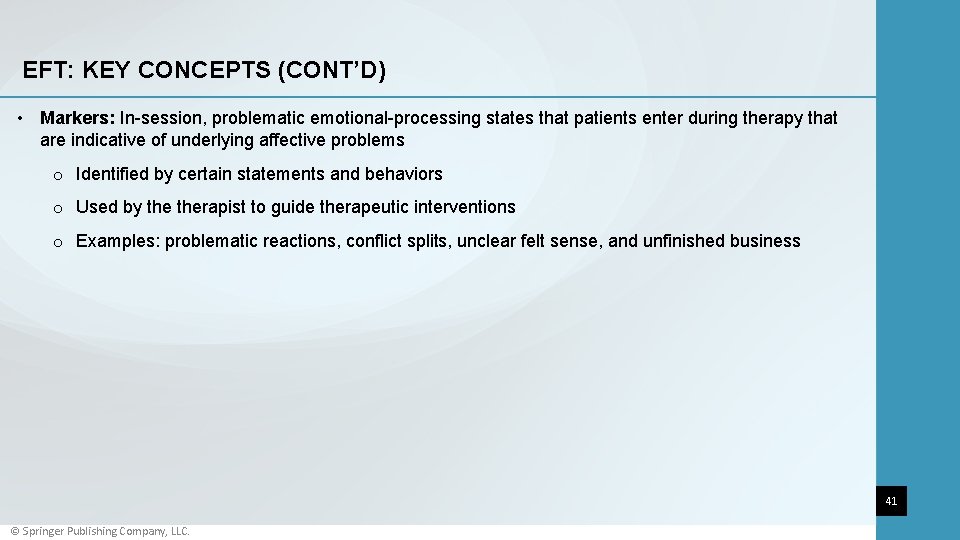
EFT: KEY CONCEPTS (CONT’D) • Markers: In-session, problematic emotional-processing states that patients enter during therapy that are indicative of underlying affective problems o Identified by certain statements and behaviors o Used by therapist to guide therapeutic interventions o Examples: problematic reactions, conflict splits, unclear felt sense, and unfinished business 41 © Springer Publishing Company, LLC.
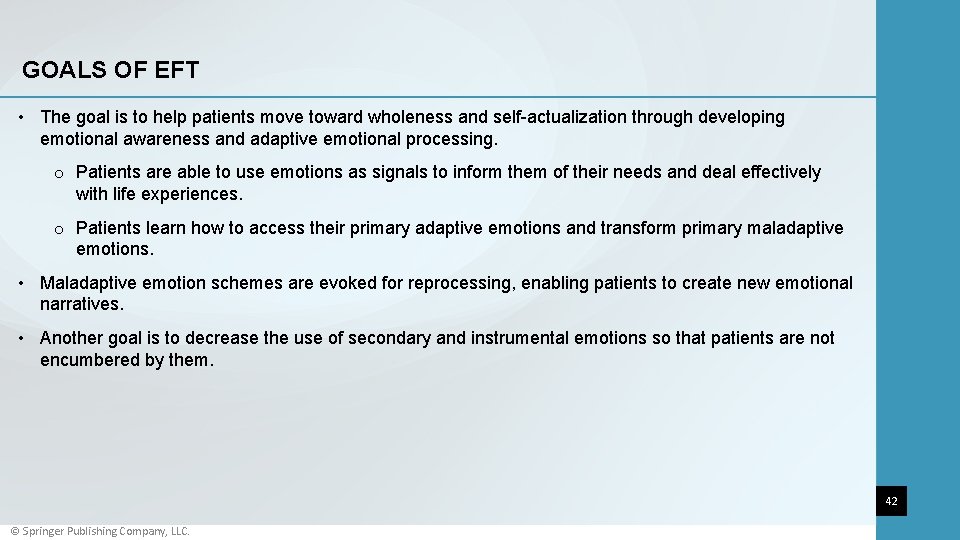
GOALS OF EFT • The goal is to help patients move toward wholeness and self-actualization through developing emotional awareness and adaptive emotional processing. o Patients are able to use emotions as signals to inform them of their needs and deal effectively with life experiences. o Patients learn how to access their primary adaptive emotions and transform primary maladaptive emotions. • Maladaptive emotion schemes are evoked for reprocessing, enabling patients to create new emotional narratives. • Another goal is to decrease the use of secondary and instrumental emotions so that patients are not encumbered by them. 42 © Springer Publishing Company, LLC.
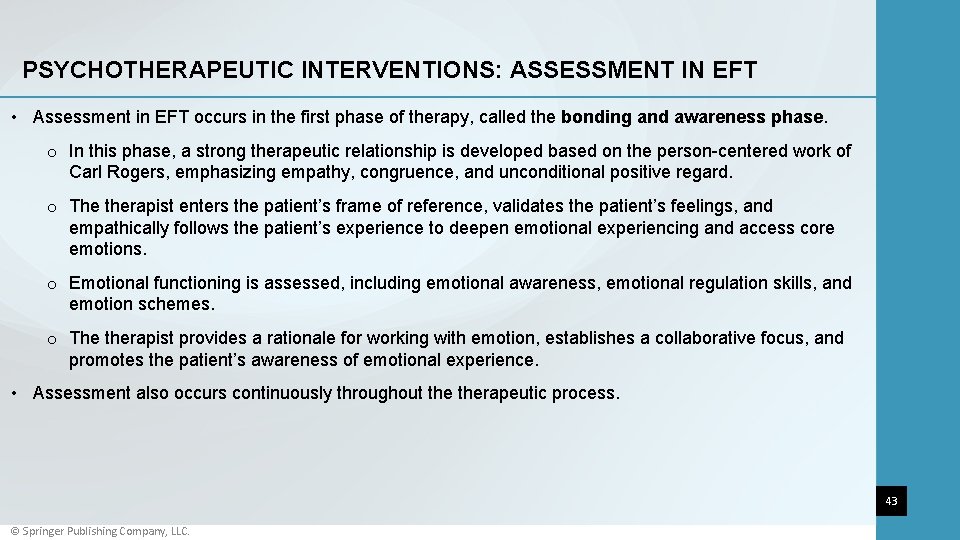
PSYCHOTHERAPEUTIC INTERVENTIONS: ASSESSMENT IN EFT • Assessment in EFT occurs in the first phase of therapy, called the bonding and awareness phase. o In this phase, a strong therapeutic relationship is developed based on the person-centered work of Carl Rogers, emphasizing empathy, congruence, and unconditional positive regard. o The therapist enters the patient’s frame of reference, validates the patient’s feelings, and empathically follows the patient’s experience to deepen emotional experiencing and access core emotions. o Emotional functioning is assessed, including emotional awareness, emotional regulation skills, and emotion schemes. o The therapist provides a rationale for working with emotion, establishes a collaborative focus, and promotes the patient’s awareness of emotional experience. • Assessment also occurs continuously throughout therapeutic process. 43 © Springer Publishing Company, LLC.
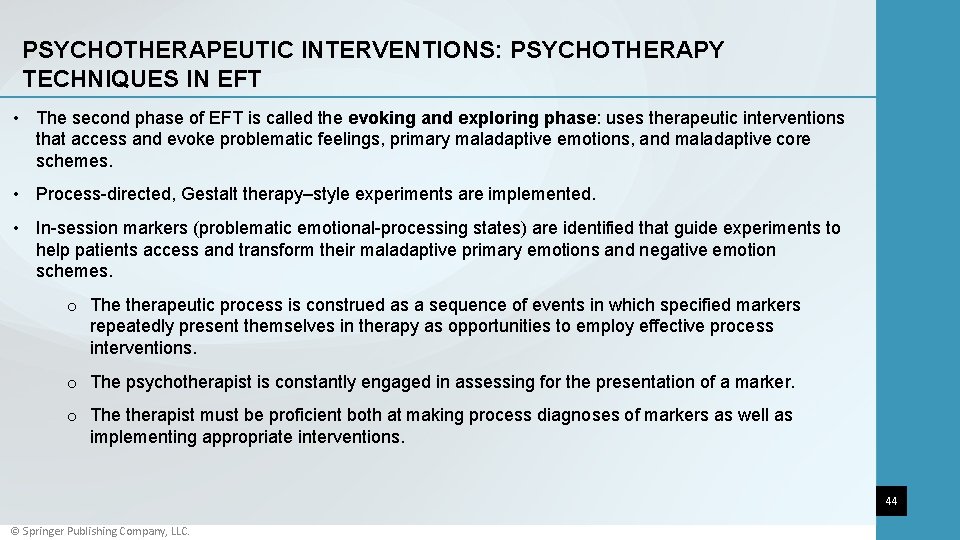
PSYCHOTHERAPEUTIC INTERVENTIONS: PSYCHOTHERAPY TECHNIQUES IN EFT • The second phase of EFT is called the evoking and exploring phase: uses therapeutic interventions that access and evoke problematic feelings, primary maladaptive emotions, and maladaptive core schemes. • Process-directed, Gestalt therapy–style experiments are implemented. • In-session markers (problematic emotional-processing states) are identified that guide experiments to help patients access and transform their maladaptive primary emotions and negative emotion schemes. o The therapeutic process is construed as a sequence of events in which specified markers repeatedly present themselves in therapy as opportunities to employ effective process interventions. o The psychotherapist is constantly engaged in assessing for the presentation of a marker. o The therapist must be proficient both at making process diagnoses of markers as well as implementing appropriate interventions. 44 © Springer Publishing Company, LLC.
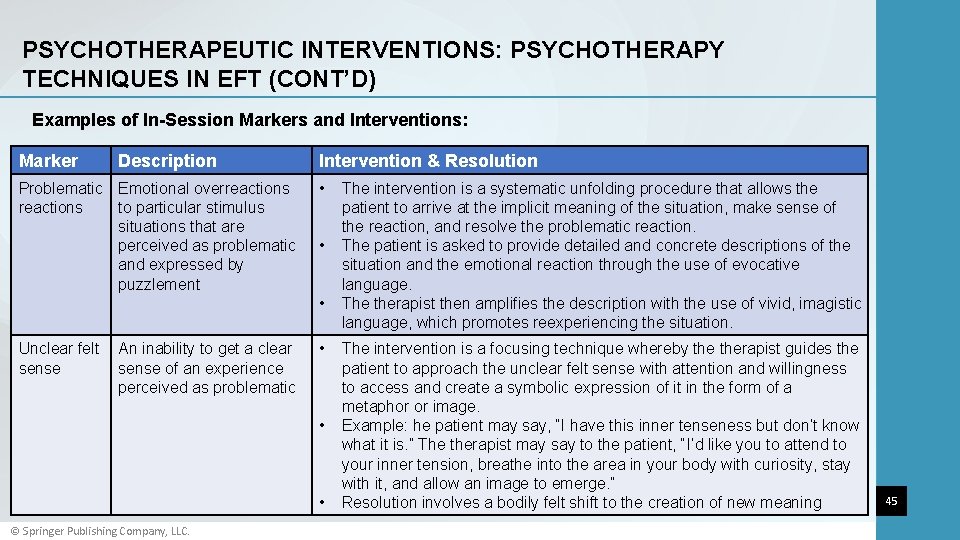
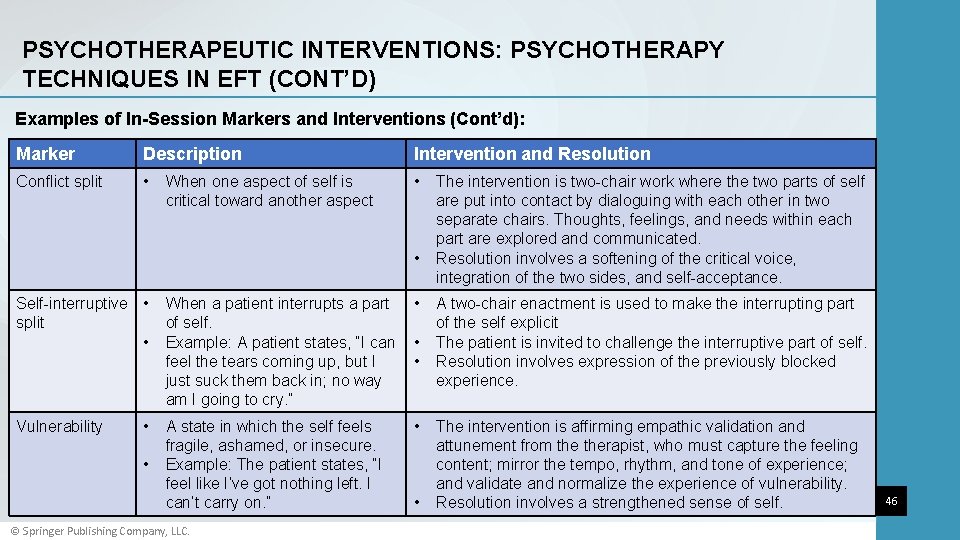
PSYCHOTHERAPEUTIC INTERVENTIONS: PSYCHOTHERAPY TECHNIQUES IN EFT (CONT’D) Examples of In-Session Markers and Interventions: Marker Description Problematic Emotional overreactions to particular stimulus situations that are perceived as problematic and expressed by puzzlement Intervention & Resolution • • • Unclear felt sense An inability to get a clear sense of an experience perceived as problematic • • • © Springer Publishing Company, LLC. The intervention is a systematic unfolding procedure that allows the patient to arrive at the implicit meaning of the situation, make sense of the reaction, and resolve the problematic reaction. The patient is asked to provide detailed and concrete descriptions of the situation and the emotional reaction through the use of evocative language. The therapist then amplifies the description with the use of vivid, imagistic language, which promotes reexperiencing the situation. The intervention is a focusing technique whereby therapist guides the patient to approach the unclear felt sense with attention and willingness to access and create a symbolic expression of it in the form of a metaphor or image. Example: he patient may say, “I have this inner tenseness but don’t know what it is. ” The therapist may say to the patient, “I’d like you to attend to your inner tension, breathe into the area in your body with curiosity, stay with it, and allow an image to emerge. ” Resolution involves a bodily felt shift to the creation of new meaning 45
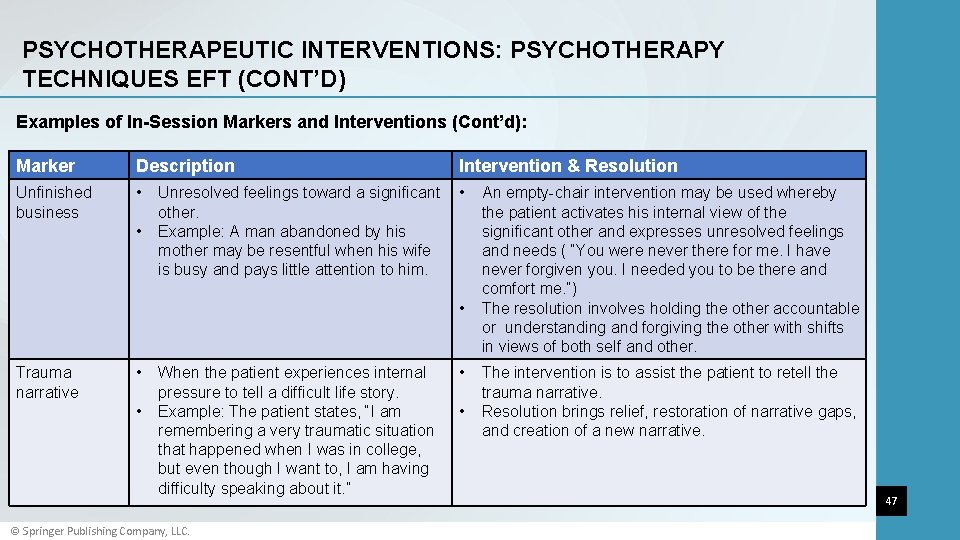
PSYCHOTHERAPEUTIC INTERVENTIONS: PSYCHOTHERAPY TECHNIQUES IN EFT (CONT’D) Examples of In-Session Markers and Interventions (Cont’d): Marker Description Intervention and Resolution Conflict split • • When one aspect of self is critical toward another aspect • Self-interruptive • split • Vulnerability • • When a patient interrupts a part of self. Example: A patient states, “I can feel the tears coming up, but I just suck them back in; no way am I going to cry. ” • A state in which the self feels fragile, ashamed, or insecure. Example: The patient states, “I feel like I’ve got nothing left. I can’t carry on. ” • © Springer Publishing Company, LLC. • • • The intervention is two-chair work where the two parts of self are put into contact by dialoguing with each other in two separate chairs. Thoughts, feelings, and needs within each part are explored and communicated. Resolution involves a softening of the critical voice, integration of the two sides, and self-acceptance. A two-chair enactment is used to make the interrupting part of the self explicit The patient is invited to challenge the interruptive part of self. Resolution involves expression of the previously blocked experience. The intervention is affirming empathic validation and attunement from therapist, who must capture the feeling content; mirror the tempo, rhythm, and tone of experience; and validate and normalize the experience of vulnerability. Resolution involves a strengthened sense of self. 46
PSYCHOTHERAPEUTIC INTERVENTIONS: PSYCHOTHERAPY TECHNIQUES EFT (CONT’D) Examples of In-Session Markers and Interventions (Cont’d): Marker Description Intervention & Resolution Unfinished business • • • Unresolved feelings toward a significant other. Example: A man abandoned by his mother may be resentful when his wife is busy and pays little attention to him. • Trauma narrative • • When the patient experiences internal pressure to tell a difficult life story. Example: The patient states, “I am remembering a very traumatic situation that happened when I was in college, but even though I want to, I am having difficulty speaking about it. ” © Springer Publishing Company, LLC. • • An empty-chair intervention may be used whereby the patient activates his internal view of the significant other and expresses unresolved feelings and needs ( “You were never there for me. I have never forgiven you. I needed you to be there and comfort me. ”) The resolution involves holding the other accountable or understanding and forgiving the other with shifts in views of both self and other. The intervention is to assist the patient to retell the trauma narrative. Resolution brings relief, restoration of narrative gaps, and creation of a new narrative. 47
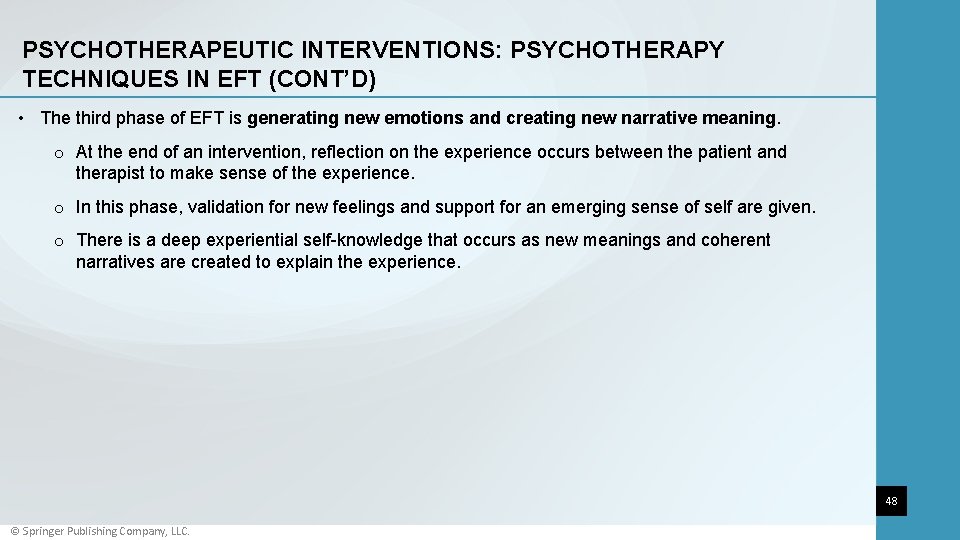
PSYCHOTHERAPEUTIC INTERVENTIONS: PSYCHOTHERAPY TECHNIQUES IN EFT (CONT’D) • The third phase of EFT is generating new emotions and creating new narrative meaning. o At the end of an intervention, reflection on the experience occurs between the patient and therapist to make sense of the experience. o In this phase, validation for new feelings and support for an emerging sense of self are given. o There is a deep experiential self-knowledge that occurs as new meanings and coherent narratives are created to explain the experience. 48 © Springer Publishing Company, LLC.
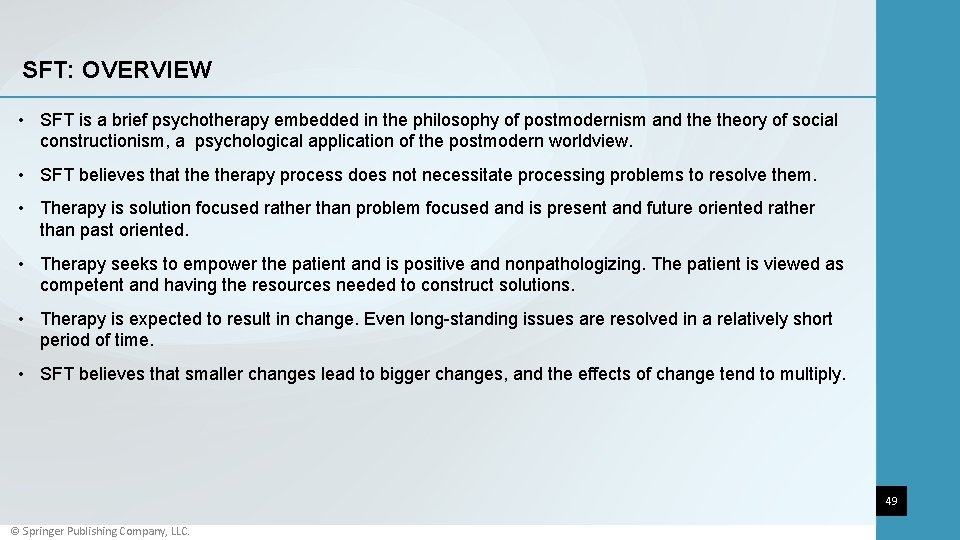
SFT: OVERVIEW • SFT is a brief psychotherapy embedded in the philosophy of postmodernism and theory of social constructionism, a psychological application of the postmodern worldview. • SFT believes that therapy process does not necessitate processing problems to resolve them. • Therapy is solution focused rather than problem focused and is present and future oriented rather than past oriented. • Therapy seeks to empower the patient and is positive and nonpathologizing. The patient is viewed as competent and having the resources needed to construct solutions. • Therapy is expected to result in change. Even long-standing issues are resolved in a relatively short period of time. • SFT believes that smaller changes lead to bigger changes, and the effects of change tend to multiply. 49 © Springer Publishing Company, LLC.
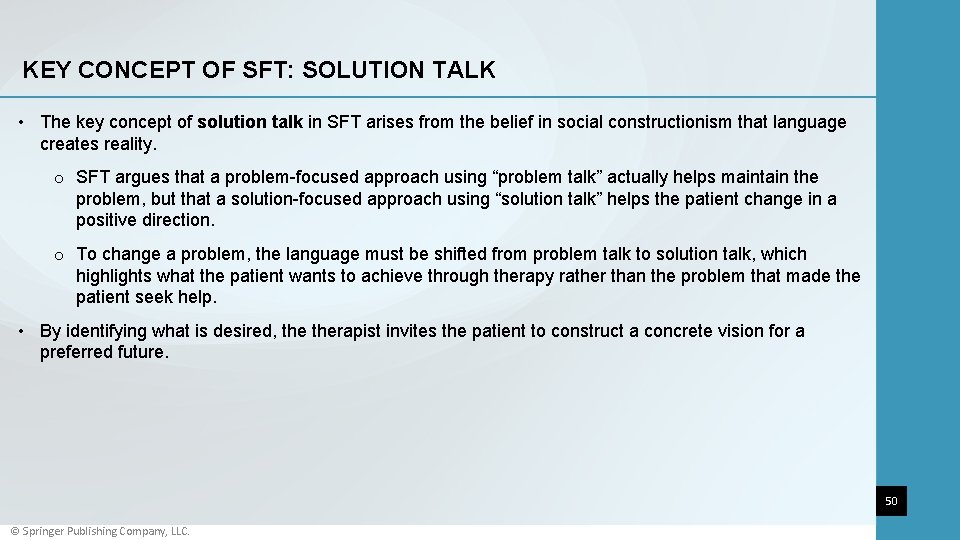
KEY CONCEPT OF SFT: SOLUTION TALK • The key concept of solution talk in SFT arises from the belief in social constructionism that language creates reality. o SFT argues that a problem-focused approach using “problem talk” actually helps maintain the problem, but that a solution-focused approach using “solution talk” helps the patient change in a positive direction. o To change a problem, the language must be shifted from problem talk to solution talk, which highlights what the patient wants to achieve through therapy rather than the problem that made the patient seek help. • By identifying what is desired, therapist invites the patient to construct a concrete vision for a preferred future. 50 © Springer Publishing Company, LLC.
GOALS OF SFT • SFT helps the patient change by constructing solutions to problems rather than dwelling on them. • The two key therapeutic goals are to determine 1) how the patient wants his or her life to be different, and 2) what it will take to make it happen. • Creating a detailed picture of what it will be like in the future when things change creates a feeling of hope and makes the solution seem possible to the patient. 51 © Springer Publishing Company, LLC.
PSYCHOTHERAPEUTIC INTERVENTIONS: ASSESSMENT IN SFT • During assessment, therapist creates a positive climate of hope, respect, dialogue, inquiry, and affirmation. • SFT focuses on the present and future rather than the past. o The therapist pays little attention to history taking and traditional assessment data. o This type of knowledge is believed to be inconsequential and may actually hamper the development of solutions. • The therapist does not give the patient a diagnosis, which is believed to be irrelevant to finding solutions. • During the assessment, a goal that is important and meaningful to the patient is established. o The goal focuses on desirable behaviors (e. g. , I will, rather than I will not) and is concrete, specific, and behavioral. o It includes a detailed explanation as to how it will be accomplished, which increases the ability to achieve the goal. 52 © Springer Publishing Company, LLC.
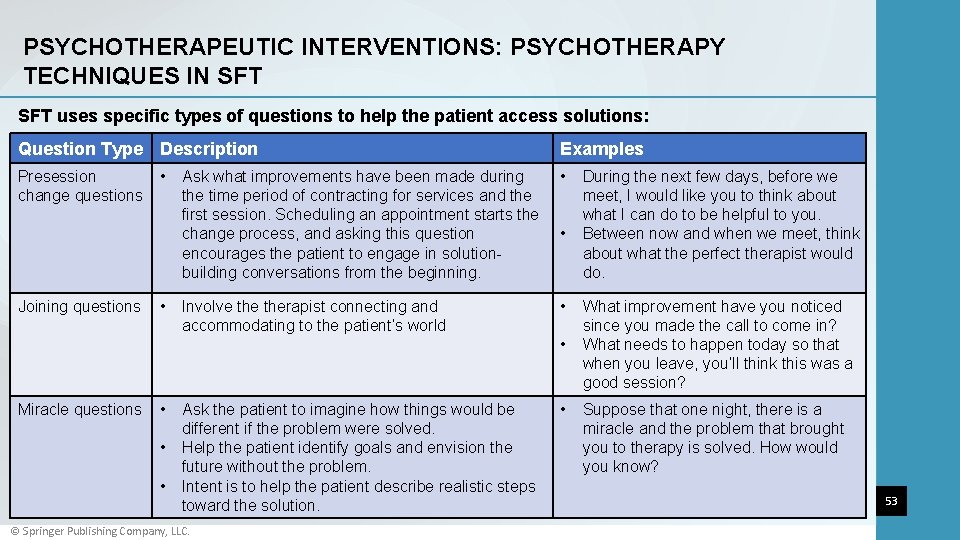
PSYCHOTHERAPEUTIC INTERVENTIONS: PSYCHOTHERAPY TECHNIQUES IN SFT uses specific types of questions to help the patient access solutions: Question Type Description Presession change questions Joining questions • • Examples Ask what improvements have been made during the time period of contracting for services and the first session. Scheduling an appointment starts the change process, and asking this question encourages the patient to engage in solutionbuilding conversations from the beginning. • Involve therapist connecting and accommodating to the patient’s world • • • Miracle questions • • • Ask the patient to imagine how things would be different if the problem were solved. Help the patient identify goals and envision the future without the problem. Intent is to help the patient describe realistic steps toward the solution. © Springer Publishing Company, LLC. • During the next few days, before we meet, I would like you to think about what I can do to be helpful to you. Between now and when we meet, think about what the perfect therapist would do. What improvement have you noticed since you made the call to come in? What needs to happen today so that when you leave, you’ll think this was a good session? Suppose that one night, there is a miracle and the problem that brought you to therapy is solved. How would you know? 53
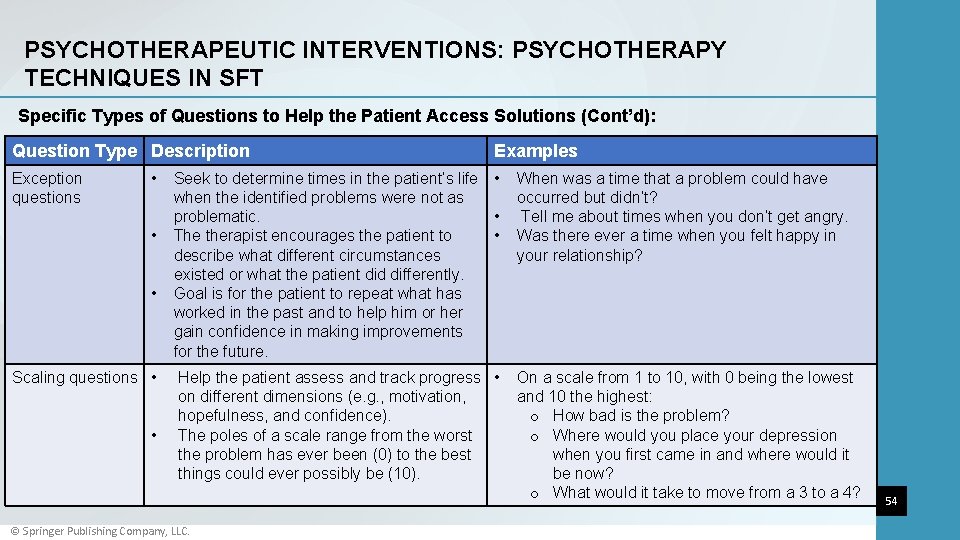
PSYCHOTHERAPEUTIC INTERVENTIONS: PSYCHOTHERAPY TECHNIQUES IN SFT Specific Types of Questions to Help the Patient Access Solutions (Cont’d): Question Type Description Exception questions • • • Scaling questions • • Seek to determine times in the patient’s life when the identified problems were not as problematic. The therapist encourages the patient to describe what different circumstances existed or what the patient did differently. Goal is for the patient to repeat what has worked in the past and to help him or her gain confidence in making improvements for the future. Examples • • • Help the patient assess and track progress • on different dimensions (e. g. , motivation, hopefulness, and confidence). The poles of a scale range from the worst the problem has ever been (0) to the best things could ever possibly be (10). © Springer Publishing Company, LLC. When was a time that a problem could have occurred but didn’t? Tell me about times when you don’t get angry. Was there ever a time when you felt happy in your relationship? On a scale from 1 to 10, with 0 being the lowest and 10 the highest: o How bad is the problem? o Where would you place your depression when you first came in and where would it be now? o What would it take to move from a 3 to a 4? 54
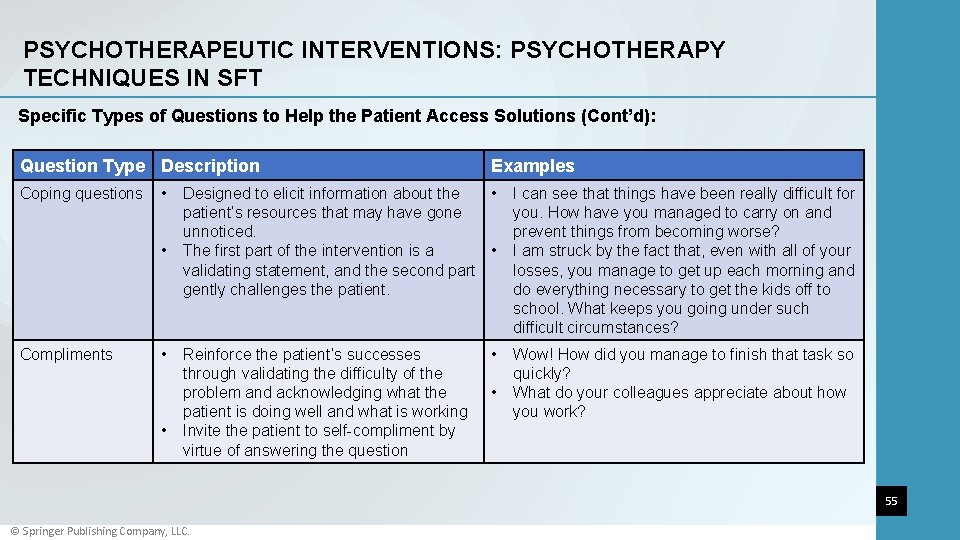
PSYCHOTHERAPEUTIC INTERVENTIONS: PSYCHOTHERAPY TECHNIQUES IN SFT Specific Types of Questions to Help the Patient Access Solutions (Cont’d): Question Type Description Coping questions • • Compliments • • Examples Designed to elicit information about the • patient’s resources that may have gone unnoticed. The first part of the intervention is a • validating statement, and the second part gently challenges the patient. I can see that things have been really difficult for you. How have you managed to carry on and prevent things from becoming worse? I am struck by the fact that, even with all of your losses, you manage to get up each morning and do everything necessary to get the kids off to school. What keeps you going under such difficult circumstances? • Wow! How did you manage to finish that task so quickly? What do your colleagues appreciate about how you work? Reinforce the patient’s successes through validating the difficulty of the problem and acknowledging what the patient is doing well and what is working Invite the patient to self-compliment by virtue of answering the question • 55 © Springer Publishing Company, LLC.
PSYCHOTHERAPEUTIC INTERVENTIONS: PSYCHOTHERAPY TECHNIQUES IN SFT • Experiments or homework assignments are suggested by therapist for the patient to try between sessions. o Examples of experiments or assignments for between sessions: Suppose the patient states that she wants to feel more competent. An experiment or homework might be: § Let yourself envisage that when you leave the office today, you feel more competent. What will you be doing differently? Try that during the week. § During the week, record any time you feel competent and then notice what you were thinking and doing. o At the start of each new session, therapist will ask about what learning has occurred since the last session and review experiments and homework assignments. 56 © Springer Publishing Company, LLC.
EVIDENCE-BASED RESEARCH • Five decades of substantial advances in theory, practice, and evidence- based research support the effectiveness of humanistic–existential psychotherapy for a wide range of patient problems. • The research demonstrates that the humanistic–existential psychotherapies are as effective or more effective than other major psychotherapy approaches. • Person-centered therapy, Gestalt therapy, existential therapy, and EFT have effect sizes comparable with therapies such as cognitive behavioral therapy, and therapy gains are maintained over time. • Person-centered therapy is experiencing a major revival, with current research validating the importance of therapeutic working alliance as first studied by Carl Rogers and colleagues. • Much of the research that has been done in humanistic–existential therapies is process research, which looks at what occurs during the session to bring about positive results. 57 © Springer Publishing Company, LLC.
POST-MASTER’S HUMANISTIC–EXISTENTIAL PSYCHOTHERAPY TRAINING AND CERTIFICATION REQUIREMENTS • Experiential learning in a group setting is at the heart of humanistic–existential psychotherapy training. o Theory and practice are interwoven throughout the training experience. o Theoretical concepts are taught primarily through informal lectures and processing experiential work in the here and now rather than talking about therapy sessions that occur outside the group. o Individual therapy is usually included as part of the training. • There are no national certifying exams in humanistic–existential therapy. • Organized training programs are found in private, postgraduate training institutes and are approximately 2 to 4 years in length. o Intensive weekend and summer programs are also available at most institutes. o Institutes generally provide a certificate of completion and place their graduate’s name on their website for referral purposes. 58 © Springer Publishing Company, LLC.