
CHAPTER 6 Human Systems Section 1 Economic Geography
- Slides: 8
CHAPTER 6 Human Systems Section 1: Economic Geography Section 2: Urban and Rural Geography Section 3: Political Geography
SECTION 1 Economic Geography Question: What words or phrases describe three main types of economic systems?
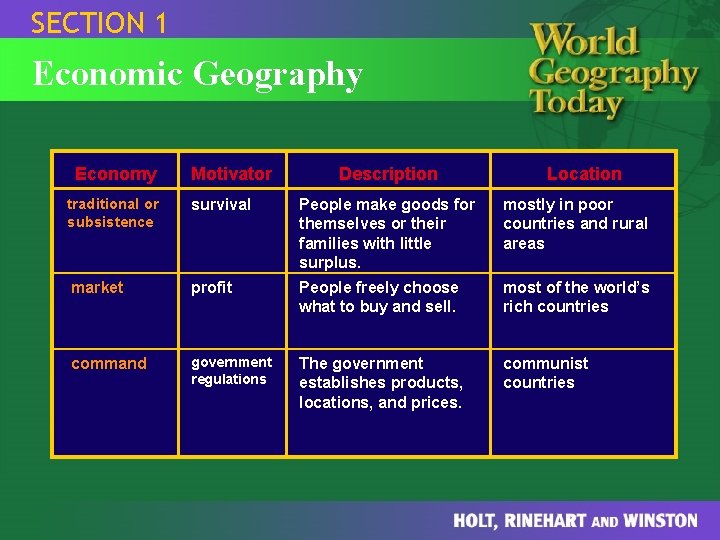
SECTION 1 Economic Geography Economy Motivator Description Location traditional or subsistence survival People make goods for themselves or their families with little surplus. mostly in poor countries and rural areas market profit People freely choose what to buy and sell. most of the world’s rich countries command government regulations The government establishes products, locations, and prices. communist countries
SECTION 2 Urban and Rural Geography Question: How have people used land throughout human history?
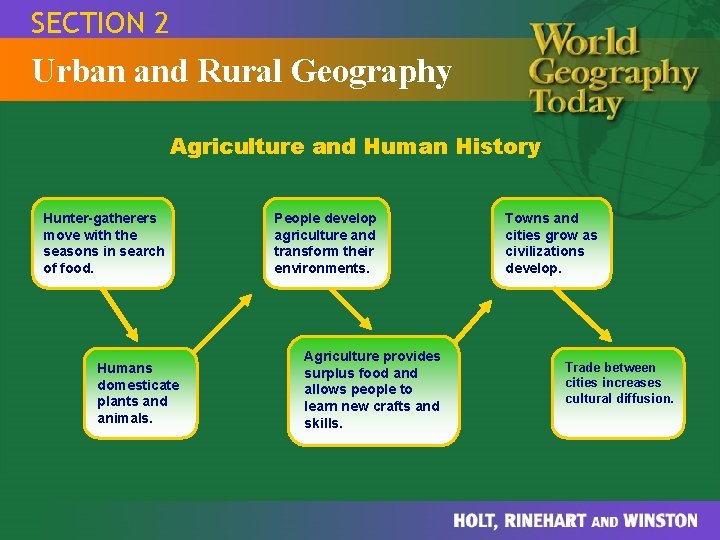
SECTION 2 Urban and Rural Geography Agriculture and Human History Hunter-gatherers move with the seasons in search of food. Humans domesticate plants and animals. People develop agriculture and transform their environments. Agriculture provides surplus food and allows people to learn new crafts and skills. Towns and cities grow as civilizations develop. Trade between cities increases cultural diffusion.
SECTION 3 Political Geography Question: What are three main types of geographic boundaries?
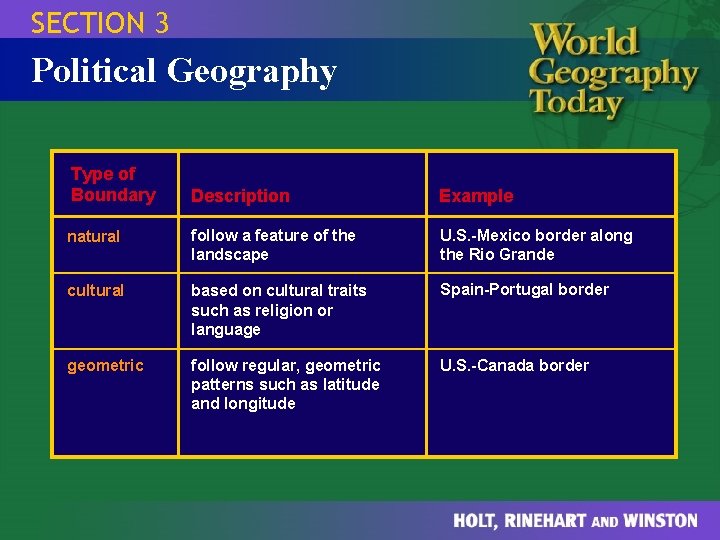
SECTION 3 Political Geography Type of Boundary Description Example natural follow a feature of the landscape U. S. -Mexico border along the Rio Grande cultural based on cultural traits such as religion or language Spain-Portugal border geometric follow regular, geometric patterns such as latitude and longitude U. S. -Canada border
CHAPTER 6 Chapter Wrap-Up 1. Which type of economic activity is located at the site of the resource being exploited? Which activity can be located almost anywhere? 2. What are some common measures of development? 3. How did the development of early cities affect people’s daily lives? 4. How do people satisfy their basic needs with subsistence agriculture? 5. What are some of the ways countries interact with each other?