
CHAPTER 6 HOW CELLS HARVEST CHEMICAL ENERGY Objecives
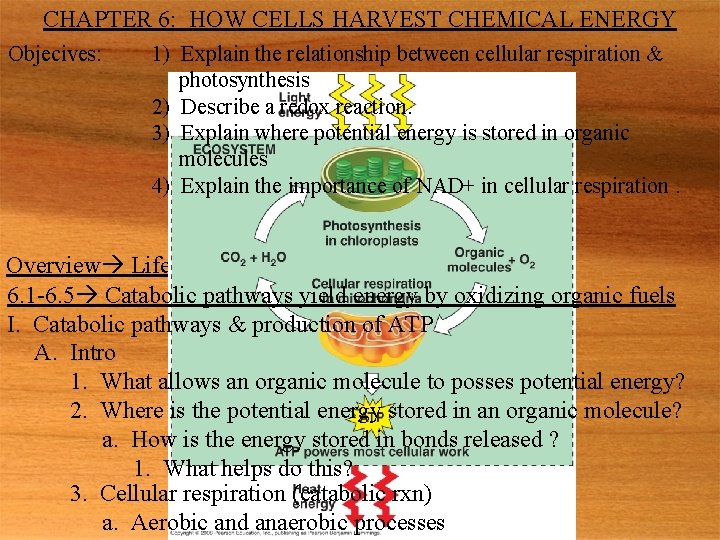
CHAPTER 6: HOW CELLS HARVEST CHEMICAL ENERGY Objecives: 1) Explain the relationship between cellular respiration & photosynthesis 2) Describe a redox reaction. 3) Explain where potential energy is stored in organic molecules 4) Explain the importance of NAD+ in cellular respiration. Overview Life is work 6. 1 -6. 5 Catabolic pathways yield energy by oxidizing organic fuels I. Catabolic pathways & production of ATP A. Intro 1. What allows an organic molecule to posses potential energy? 2. Where is the potential energy stored in an organic molecule? a. How is the energy stored in bonds released ? 1. What helps do this? 3. Cellular respiration (catabolic rxn) a. Aerobic and anaerobic processes
b. Aerobic 1. O 2 as one reactant Organic compounds + O 2 CO 2 + H 2 O + Energy 2. Most common fuel/organic compound used a. Glucose C 6 H 12 O 6 + 6 O 2 6 CO 2 + 6 H 2 O + Energy (ATP + heat) D. Stepwise energy harvest via NAD+ & the electron transport chain 1. Oxidizing C 6 H 12 O 6 CO 2 + H 2 O happens in steps a. Controlled (steps) vs. Uncontrolled 1. “Burning” wood a. A rxn that releases energy b. Uncontrolled 1. Energy released in a single chemical rxn 2. Wood Light & heat
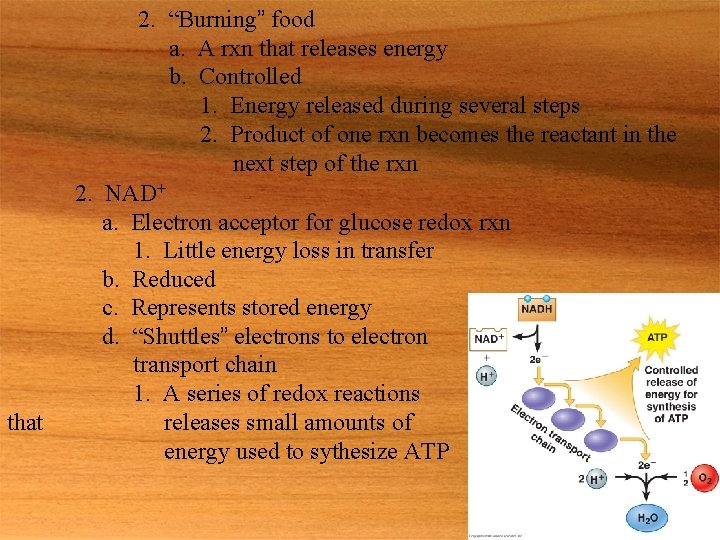
that 2. “Burning” food a. A rxn that releases energy b. Controlled 1. Energy released during several steps 2. Product of one rxn becomes the reactant in the next step of the rxn 2. NAD+ a. Electron acceptor for glucose redox rxn 1. Little energy loss in transfer b. Reduced c. Represents stored energy d. “Shuttles” electrons to electron transport chain 1. A series of redox reactions releases small amounts of energy used to sythesize ATP
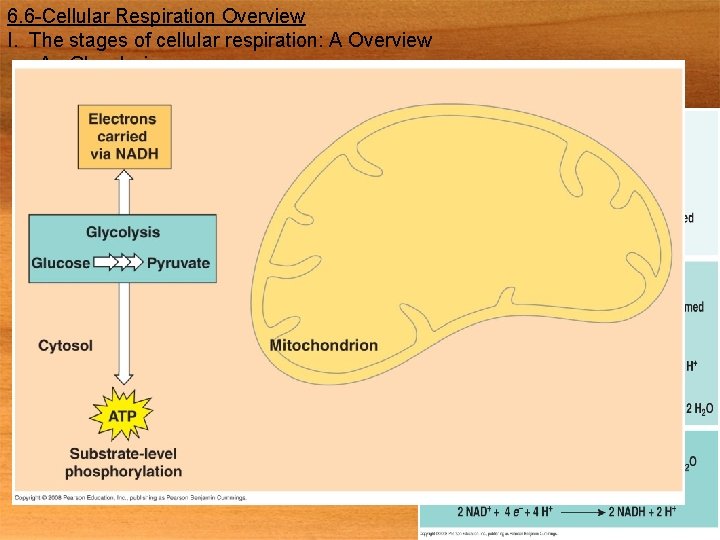
6. 6 -Cellular Respiration Overview I. The stages of cellular respiration: A Overview A. Glycolysis 1. Anaerobic stage of cellular respiration a. Does not require O 2 2. Occurs outside the mitochondria a. Cytosol 3. Glucose 2 pyruvic acid molecules a. A 3 -carbon molecule 4. Energy a. 2 ATP molecules are needed to split glucose b. 4 ATP molecules formed by energy released from splitting glucose c. A net gain of 2 ATP d. 2 NADH molecules released 5. Glycolysis is only 3. 5 % efficient a. For every glucose molecule broken down by glycolysis only 3. 5% is converted to energy

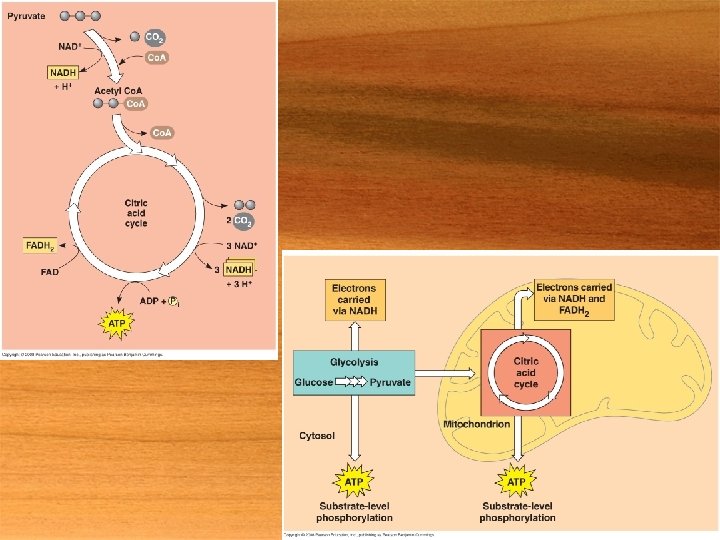
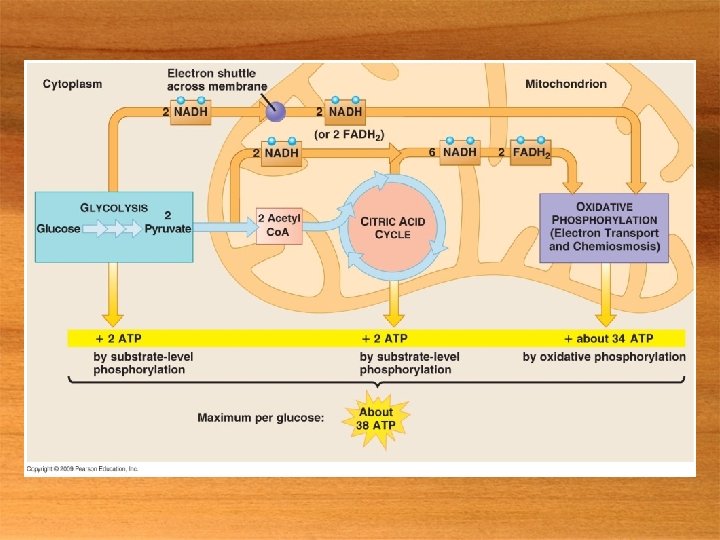
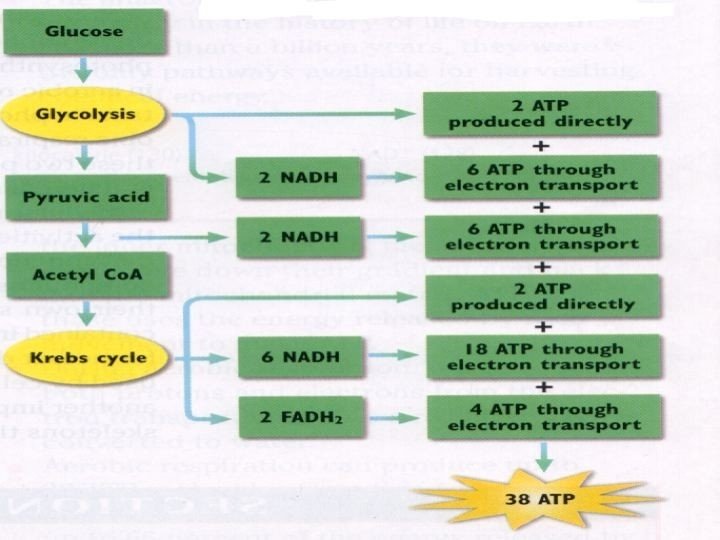
B. Aerobic respiration 1. Occurs within the mitochondria 2. The Pyruvic acid molecules from glycolysis enter the mitochondria a. Each pyruvic acid acetyl Co. A 1. 1 NADH released/ pyruvic acid 3. The Krebs Cycle/Citric Acid Cycle a. Acetyl Co. A enters the Krebs cycle b. Through a series of 5 main steps 1. 3 NADH released/ Acetyl Co. A 2. 1 FADH 2 released/ Acetyl Co. A 3. 1 ATP released/ Acetyl Co. A Remember: For every glucose molecule entering glycolysis, 2 pyruvic acid molecules are created. This in turn creates 2 acetyl Co. A molecules. This results in: 2 NADH Pyruvic Acid 6 NADH For each glucose molecule 2 FADH 2 Kreb Cycle 2 ATP
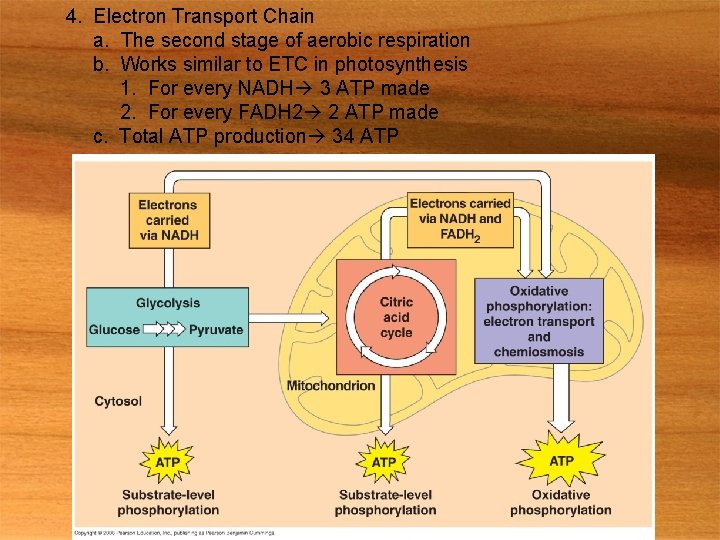
4. Electron Transport Chain a. The second stage of aerobic respiration b. Works similar to ETC in photosynthesis 1. For every NADH 3 ATP made 2. For every FADH 2 2 ATP made c. Total ATP production 34 ATP
5. How efficient is aerobic respiration? a. 40% efficient 1. For every glucose molecule that enters aerobic respiration, 40% is converted to usable energy!! b. Comparison 1. An automobile is only 25% efficient
- Slides: 10