
Chapter 6 Functions 1 Opening Problem Find the
Chapter 6 Functions 1
Opening Problem Find the sum of integers from 1 to 10, from 20 to 37, and from 35 to 49, respectively. 2
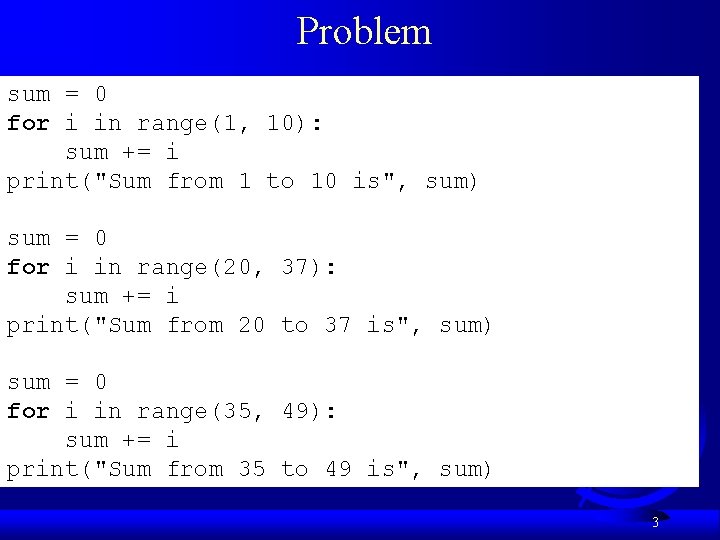
Problem sum = 0 for i in range(1, 10): sum += i print("Sum from 1 to 10 is", sum) sum = 0 for i in range(20, 37): sum += i print("Sum from 20 to 37 is", sum) sum = 0 for i in range(35, 49): sum += i print("Sum from 35 to 49 is", sum) 3
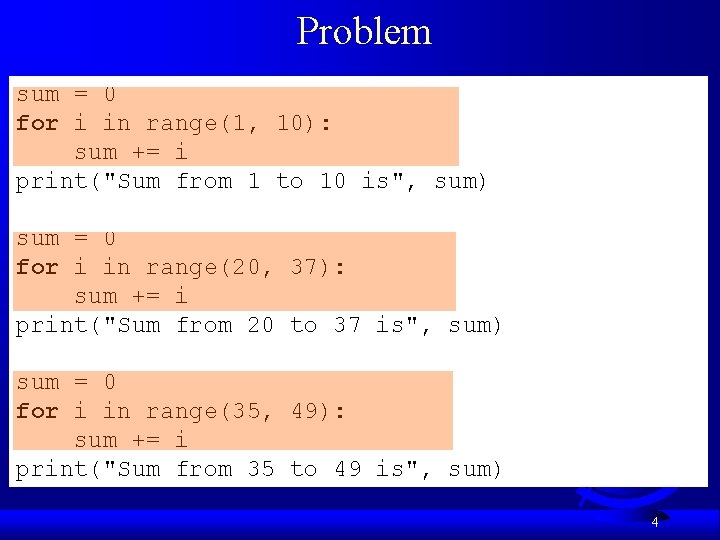
Problem sum = 0 for i in range(1, 10): sum += i print("Sum from 1 to 10 is", sum) sum = 0 for i in range(20, 37): sum += i print("Sum from 20 to 37 is", sum) sum = 0 for i in range(35, 49): sum += i print("Sum from 35 to 49 is", sum) 4
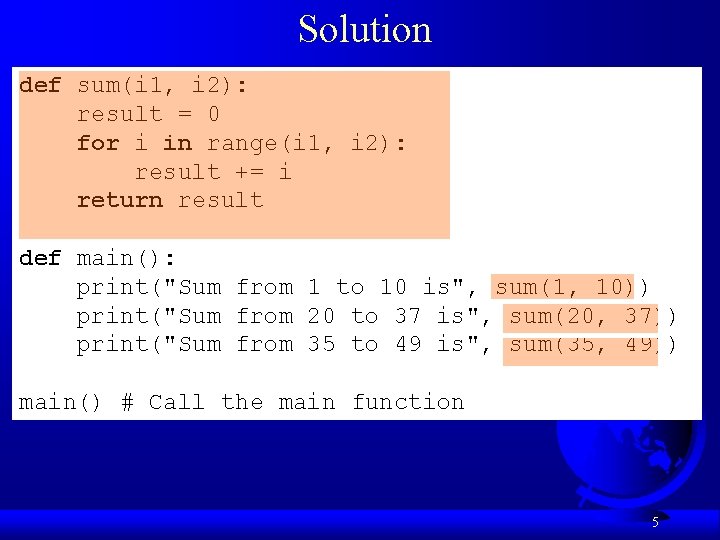
Solution def sum(i 1, i 2): result = 0 for i in range(i 1, i 2): result += i return result def main(): print("Sum from 1 to 10 is", sum(1, 10)) print("Sum from 20 to 37 is", sum(20, 37)) print("Sum from 35 to 49 is", sum(35, 49)) main() # Call the main function 5
Objectives F F F F To define functions (§ 6. 2). To invoke value-returning functions (§ 6. 3). To invoke functions that does not return a value (§ 6. 4). To pass arguments by values (§ 6. 5). To pass arguments by values (§ 6. 6). To develop reusable code that is modular, easy to read, easy to debug, and easy to maintain (§ 6. 7). To create modules for reusing functions (§§ 6. 7 -6. 8). To determine the scope of variables (§ 6. 9). To define functions with default arguments (§ 6. 10). To return multiple values from a function (§ 6. 11). To apply the concept of function abstraction in software development (§ 6. 12). To design and implement functions using stepwise refinement (§ 6. 13). To simplify drawing programs using functions (§ 6. 14). 6
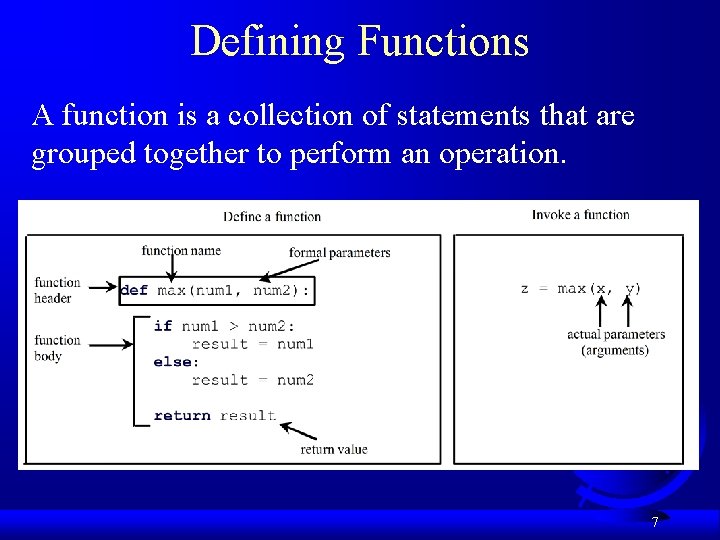
Defining Functions A function is a collection of statements that are grouped together to perform an operation. 7
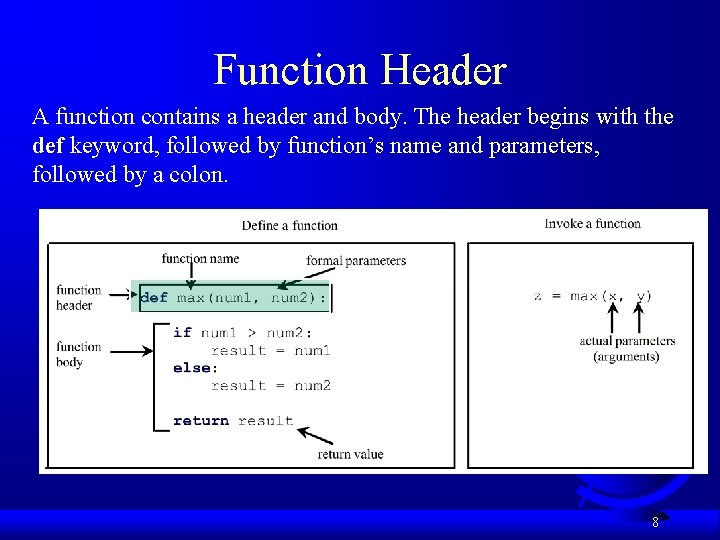
Function Header A function contains a header and body. The header begins with the def keyword, followed by function’s name and parameters, followed by a colon. 8
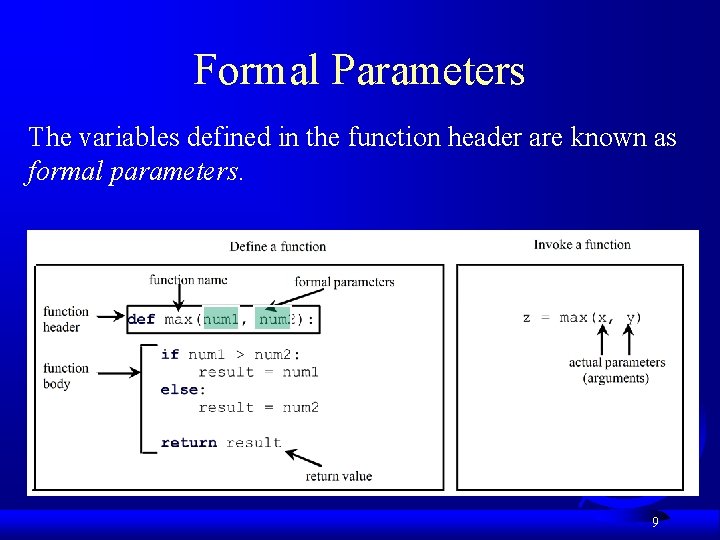
Formal Parameters The variables defined in the function header are known as formal parameters. 9
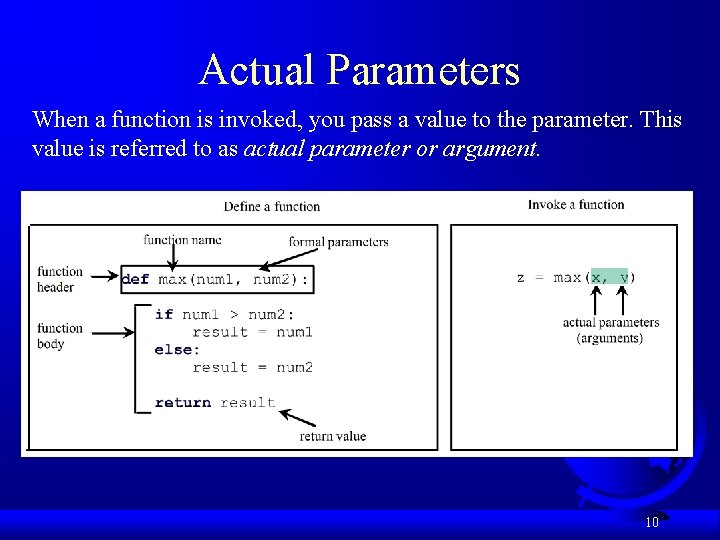
Actual Parameters When a function is invoked, you pass a value to the parameter. This value is referred to as actual parameter or argument. 10
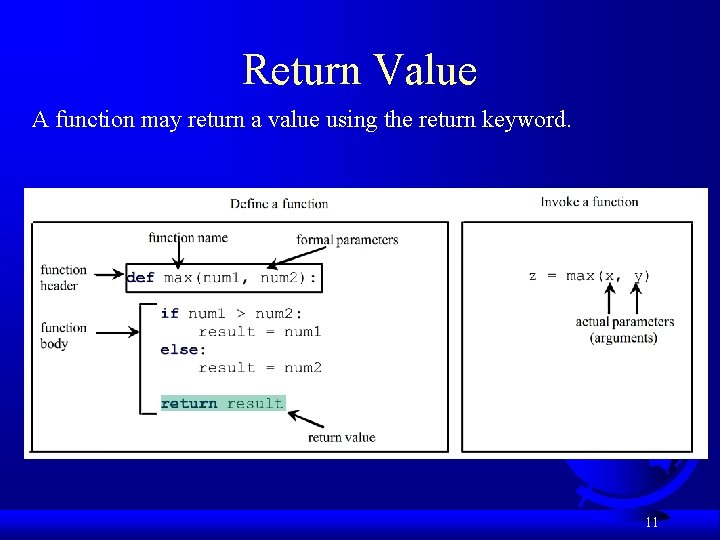
Return Value A function may return a value using the return keyword. 11
Calling Functions Testing the max function This program demonstrates calling a function max to return the largest of the int values Test. Max 12
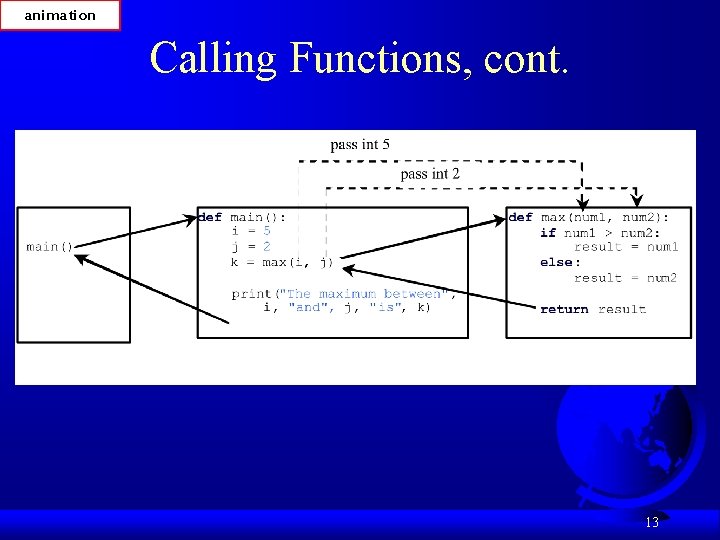
animation Calling Functions, cont. 13
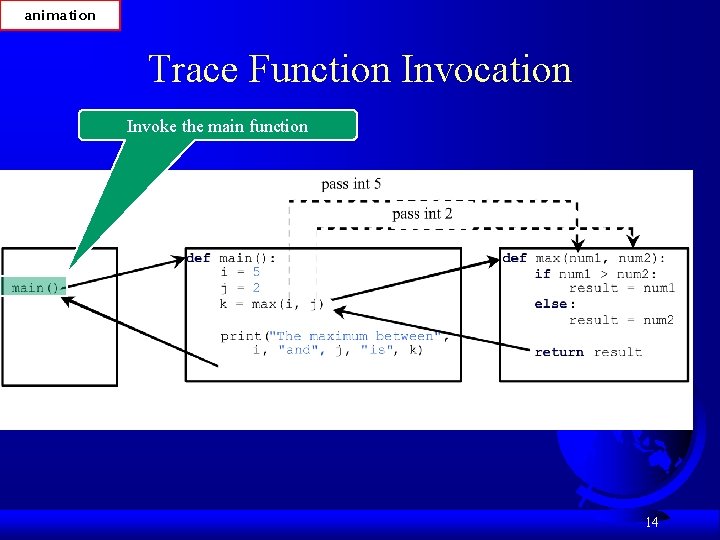
animation Trace Function Invocation Invoke the main function 14
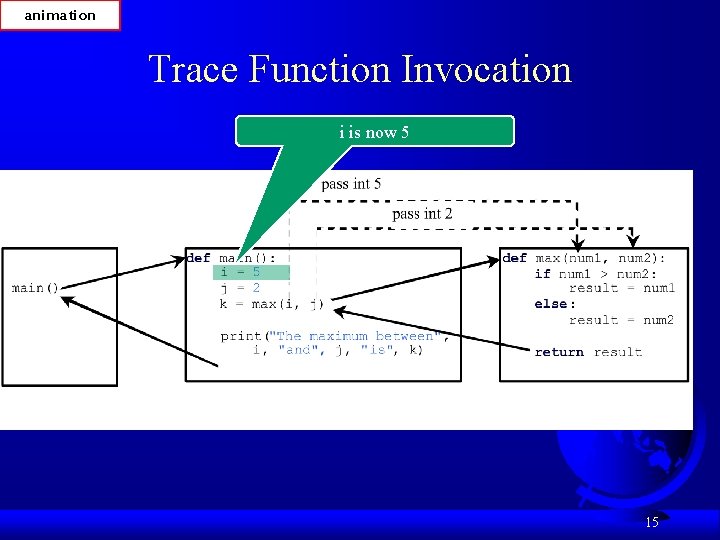
animation Trace Function Invocation i is now 5 15
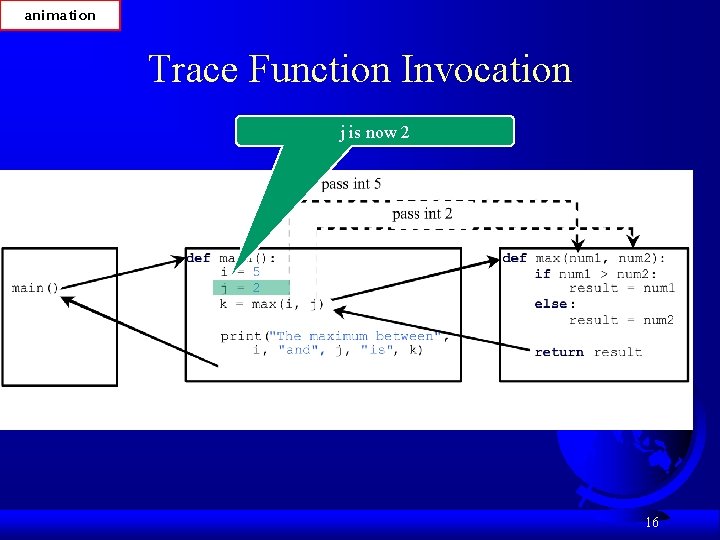
animation Trace Function Invocation j is now 2 16
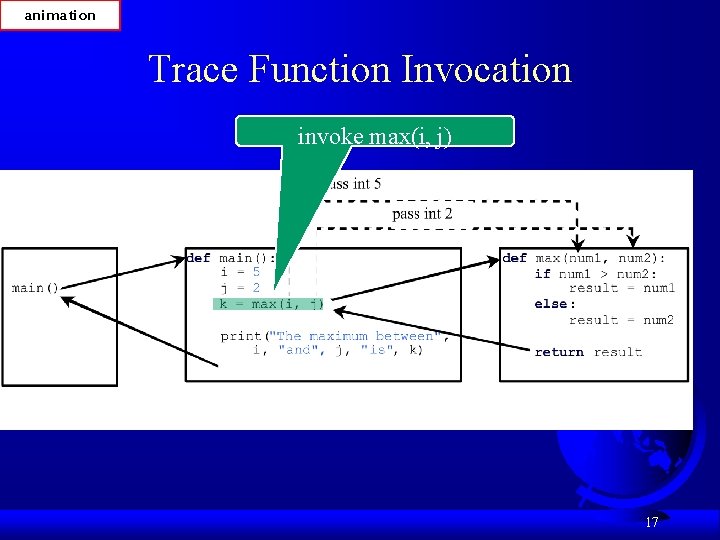
animation Trace Function Invocation invoke max(i, j) 17
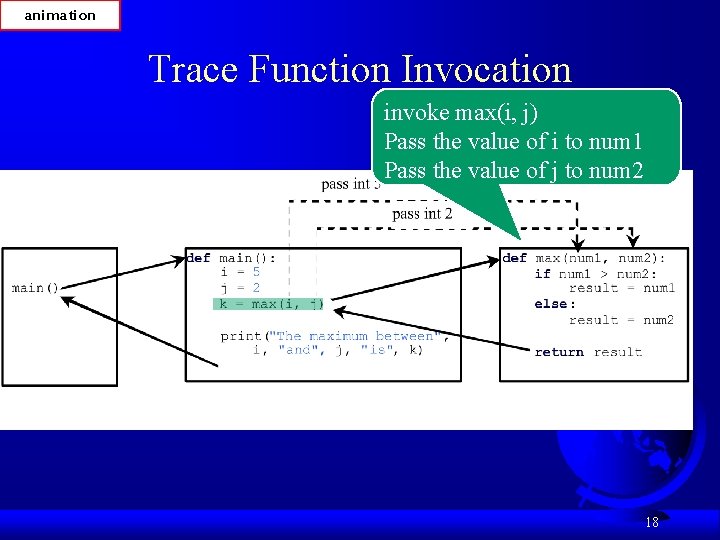
animation Trace Function Invocation invoke max(i, j) Pass the value of i to num 1 Pass the value of j to num 2 18
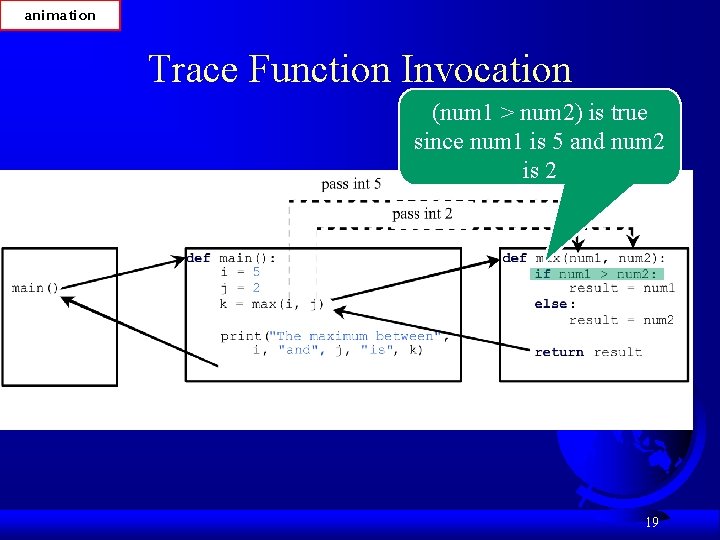
animation Trace Function Invocation (num 1 > num 2) is true since num 1 is 5 and num 2 is 2 19
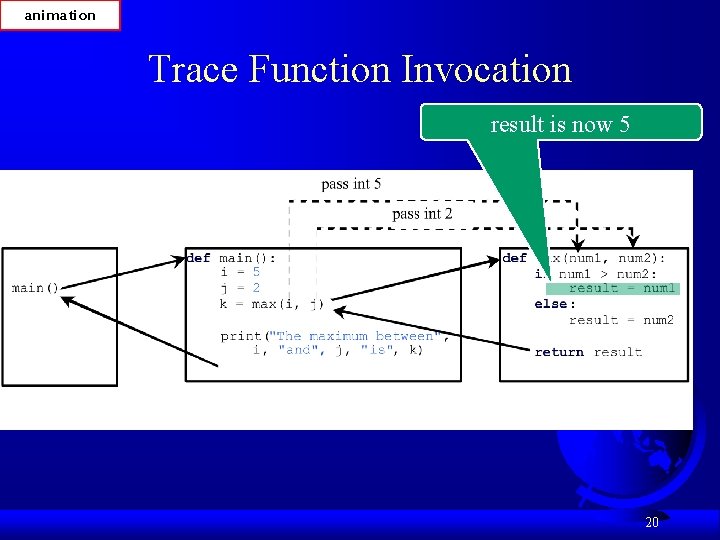
animation Trace Function Invocation result is now 5 20
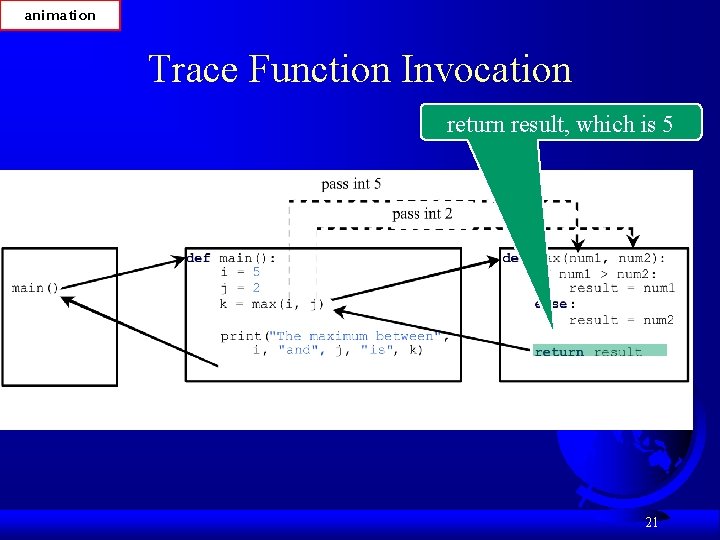
animation Trace Function Invocation return result, which is 5 21
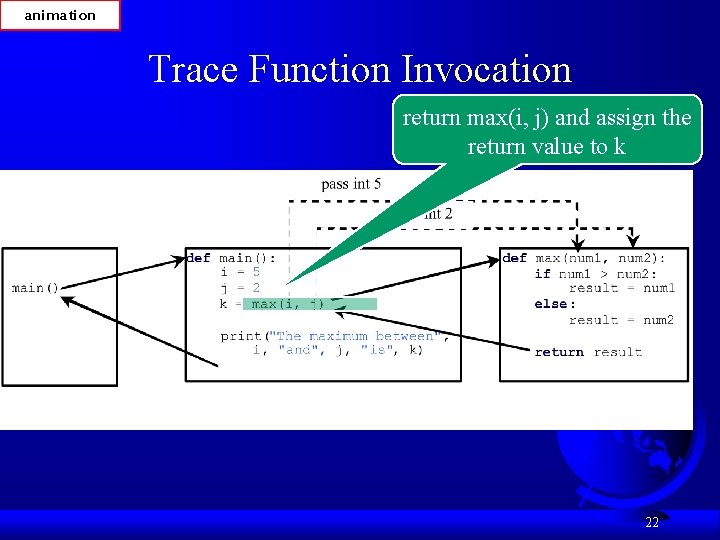
animation Trace Function Invocation return max(i, j) and assign the return value to k 22
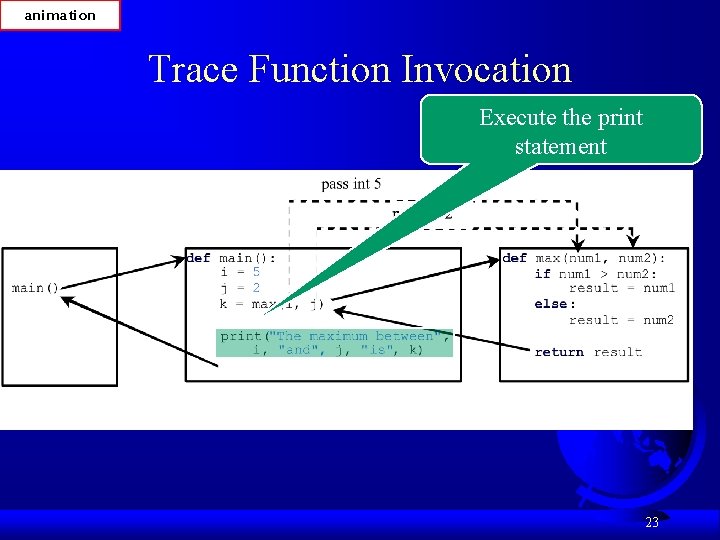
animation Trace Function Invocation Execute the print statement 23
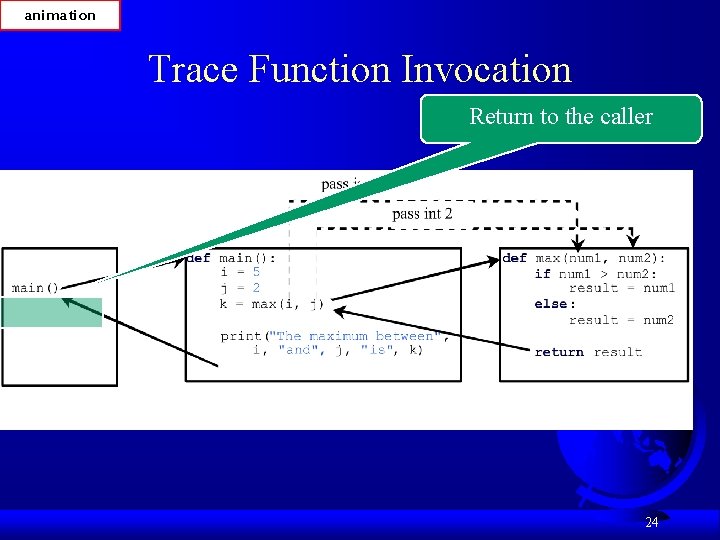
animation Trace Function Invocation Return to the caller 24
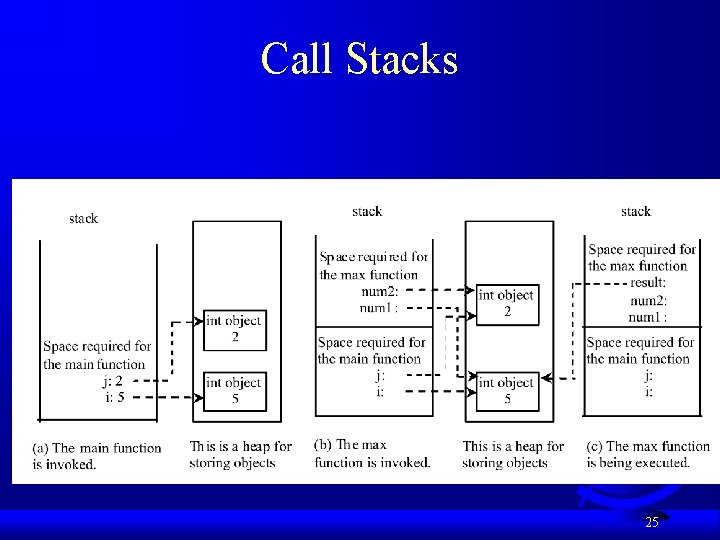
Call Stacks 25
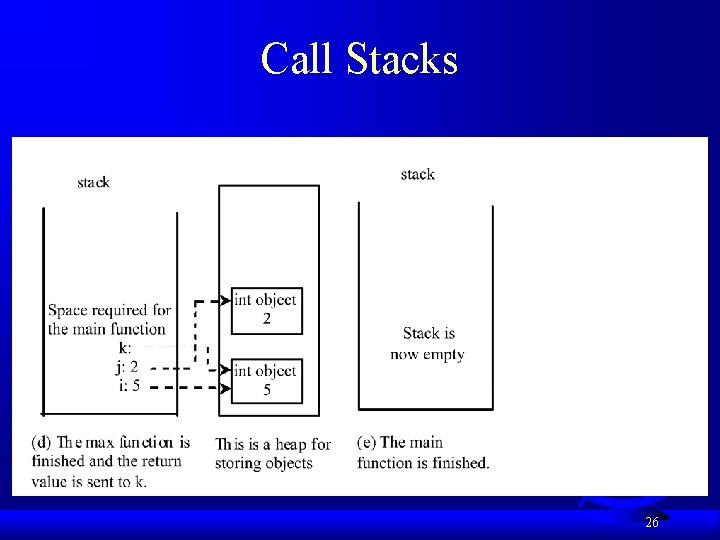
Call Stacks 26
Functions With/Without Return Values This type of function does not return a value. The function performs some actions. Print. Grade. Function Return. Grade. Function 27
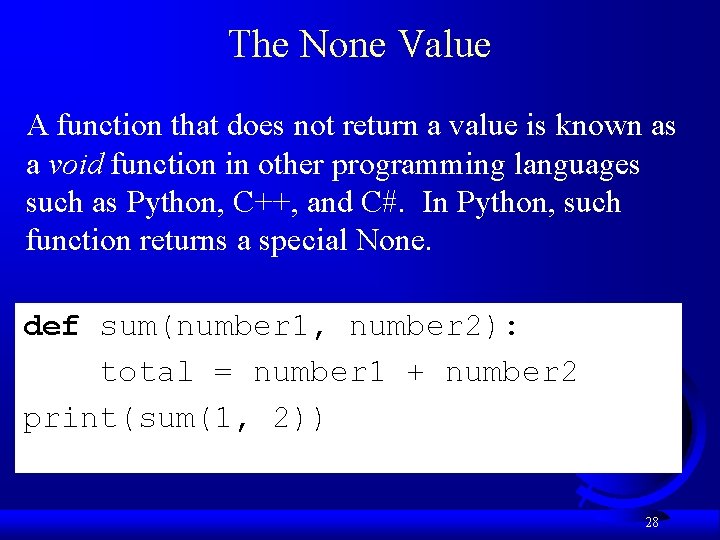
The None Value A function that does not return a value is known as a void function in other programming languages such as Python, C++, and C#. In Python, such function returns a special None. def sum(number 1, number 2): total = number 1 + number 2 print(sum(1, 2)) 28
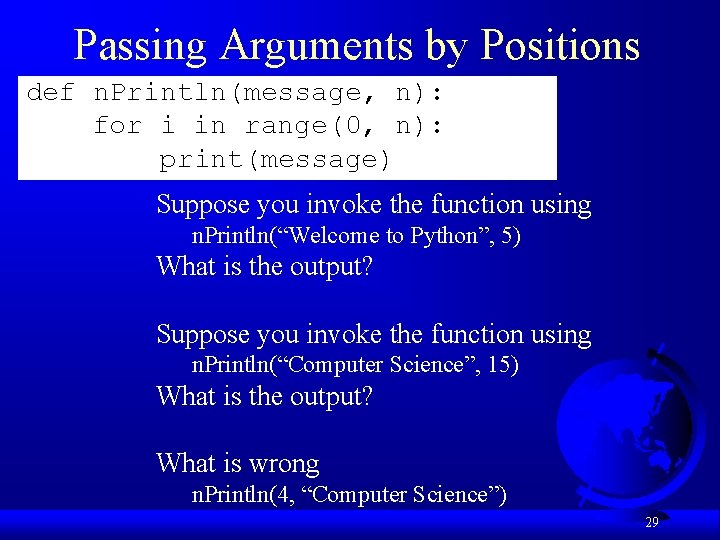
Passing Arguments by Positions def n. Println(message, n): for i in range(0, n): print(message) Suppose you invoke the function using n. Println(“Welcome to Python”, 5) What is the output? Suppose you invoke the function using n. Println(“Computer Science”, 15) What is the output? What is wrong n. Println(4, “Computer Science”) 29
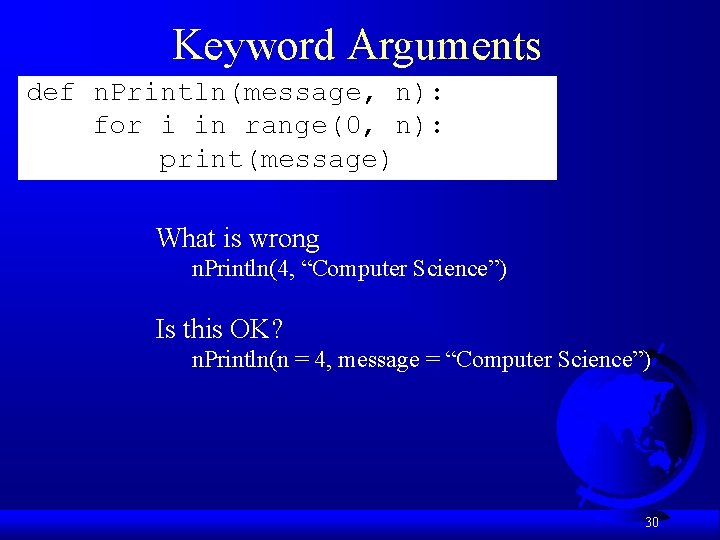
Keyword Arguments def n. Println(message, n): for i in range(0, n): print(message) What is wrong n. Println(4, “Computer Science”) Is this OK? n. Println(n = 4, message = “Computer Science”) 30
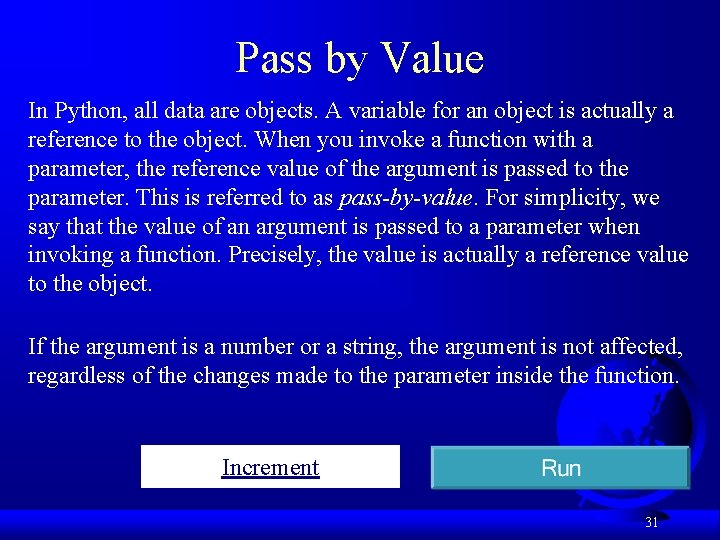
Pass by Value In Python, all data are objects. A variable for an object is actually a reference to the object. When you invoke a function with a parameter, the reference value of the argument is passed to the parameter. This is referred to as pass-by-value. For simplicity, we say that the value of an argument is passed to a parameter when invoking a function. Precisely, the value is actually a reference value to the object. If the argument is a number or a string, the argument is not affected, regardless of the changes made to the parameter inside the function. Increment 31
Modularizing Code Functions can be used to reduce redundant coding and enable code reuse. Functions can also be used to modularize code and improve the quality of the program. GCDFunction Test. GCDFunction Prime. Number. Function 32
Problem: Converting Decimals to Hexadecimals Write a function that converts a decimal integer to a hexadecimal. Decimal 2 Hex. Conversion 33
Scope of Variables Scope: the part of the program where the variable can be referenced. A variable created inside a function is referred to as a local variable. Local variables can only be accessed inside a function. The scope of a local variable starts from its creation and continues to the end of the function that contains the variable. In Python, you can also use global variables. They are created outside all functions and are accessible to all functions in their scope. 34
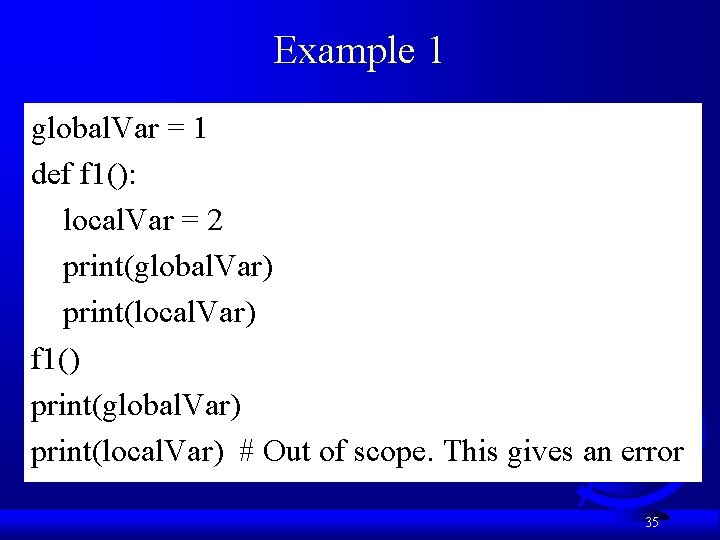
Example 1 global. Var = 1 def f 1(): local. Var = 2 print(global. Var) print(local. Var) f 1() print(global. Var) print(local. Var) # Out of scope. This gives an error 35
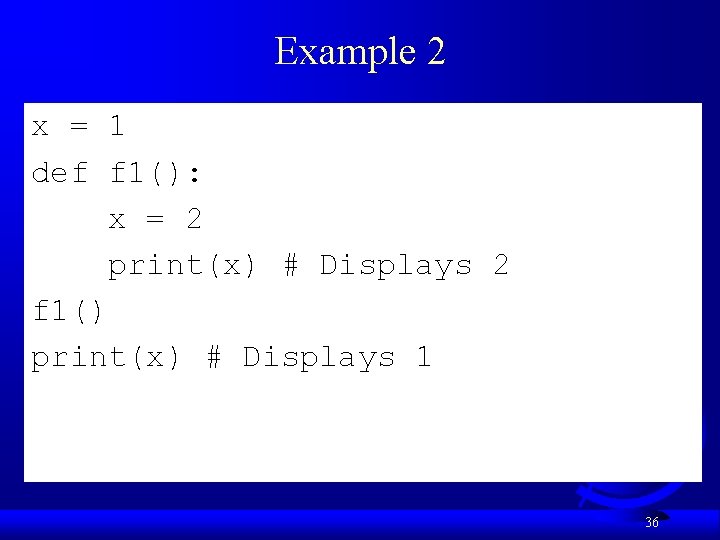
Example 2 x = 1 def f 1(): x = 2 print(x) # Displays 2 f 1() print(x) # Displays 1 36
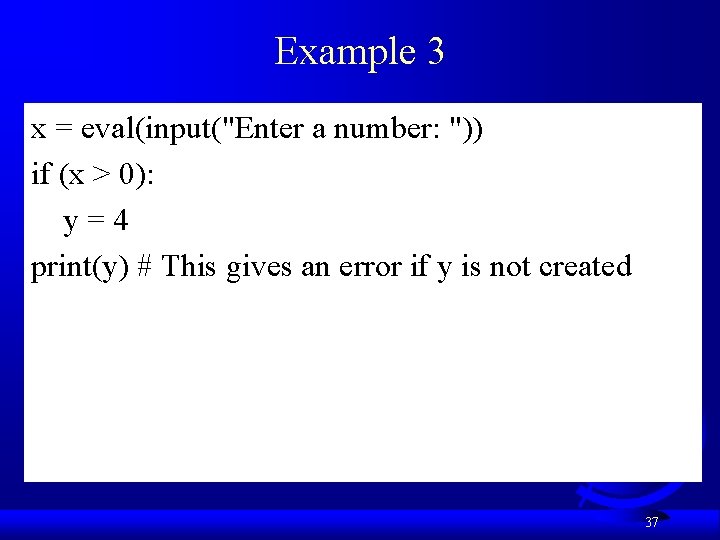
Example 3 x = eval(input("Enter a number: ")) if (x > 0): y=4 print(y) # This gives an error if y is not created 37
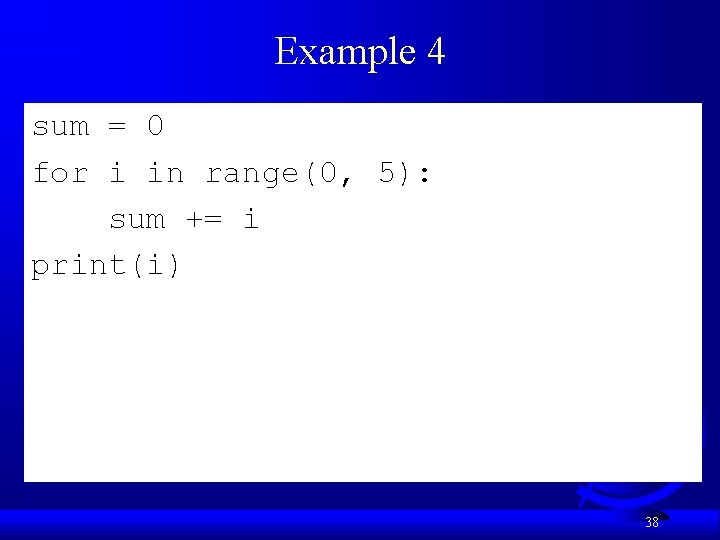
Example 4 sum = 0 for i in range(0, 5): sum += i print(i) 38
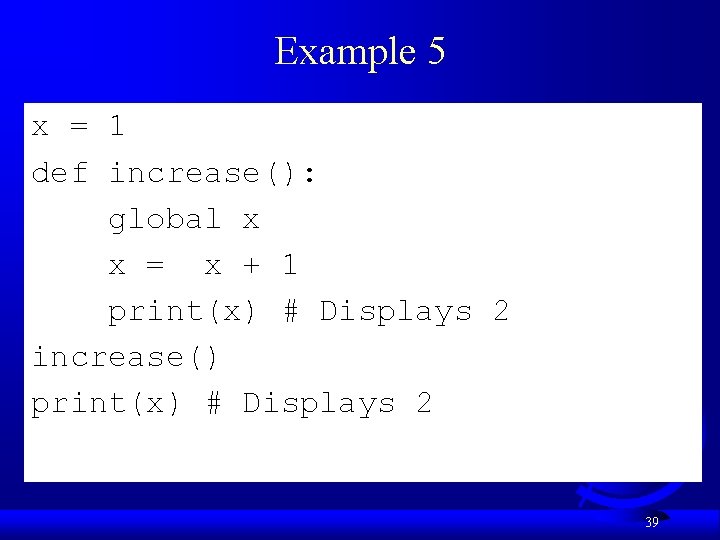
Example 5 x = 1 def increase(): global x x = x + 1 print(x) # Displays 2 increase() print(x) # Displays 2 39
Default Arguments Python allows you to define functions with default argument values. The default values are passed to the parameters when a function is invoked without the arguments. Default. Argument. Demo 40
Returning Multiple Values Python allows a function to return multiple values. Listing 5. 9 defines a function that takes two numbers and returns them in non-descending order. Multiple. Return. Value. Demo 41
Generating Random Characters Random. Character Test. Random. Character 42
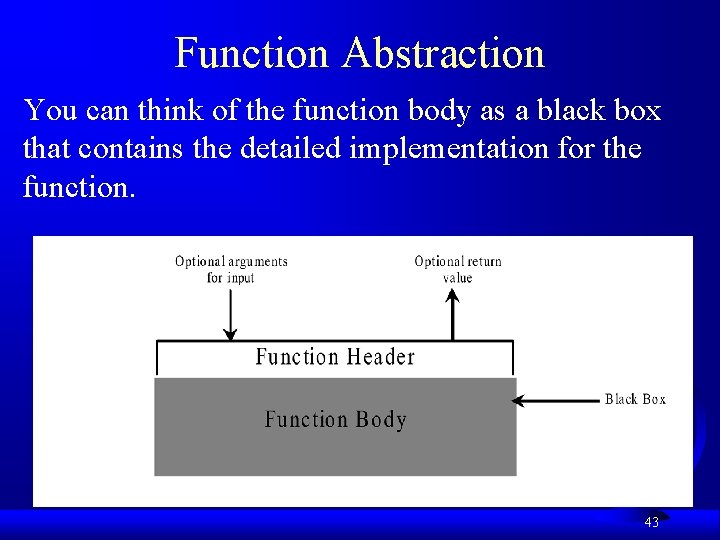
Function Abstraction You can think of the function body as a black box that contains the detailed implementation for the function. 43
Benefits of Functions • Write a function once and reuse it anywhere. • Information hiding. Hide the implementation from the user. • Reduce complexity. 44
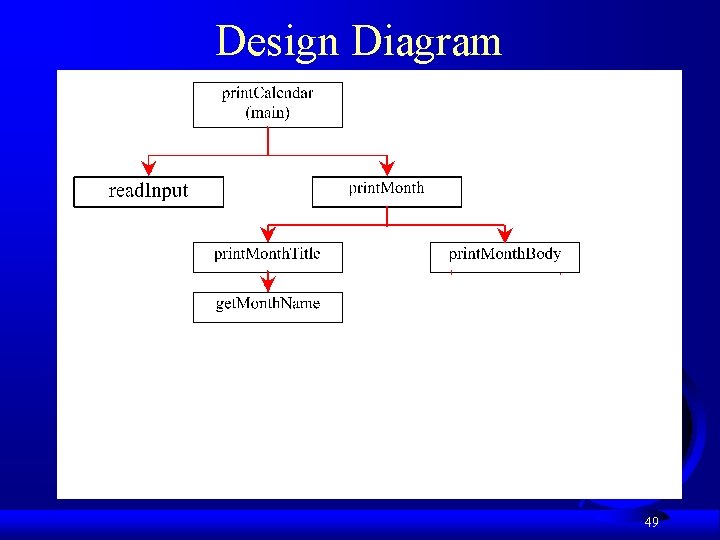
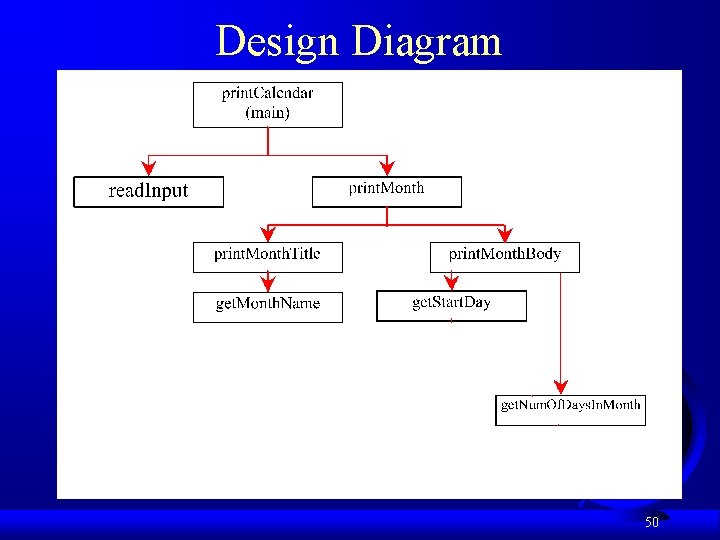
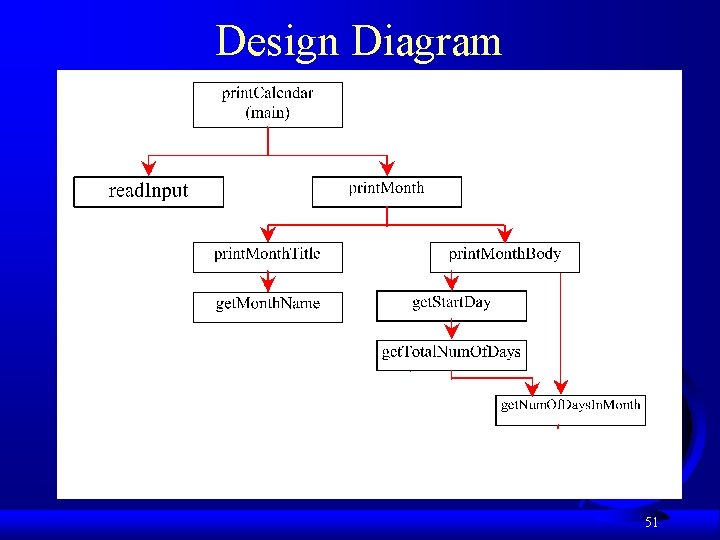
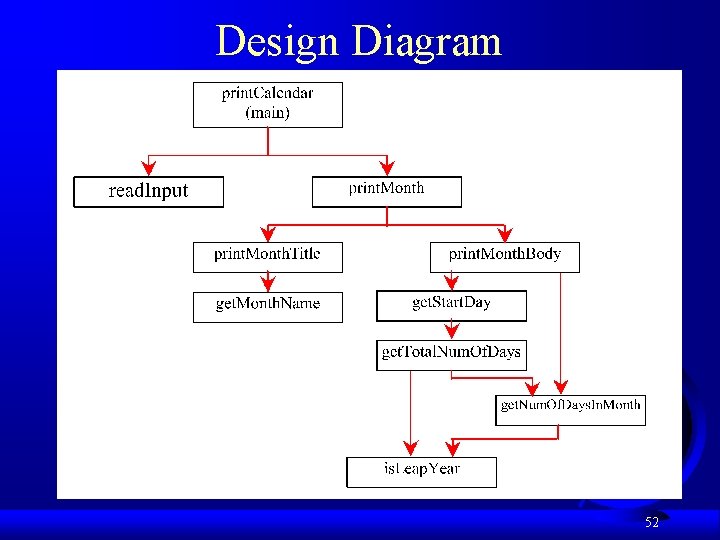
Stepwise Refinement The concept of function abstraction can be applied to the process of developing programs. When writing a large program, you can use the “divide and conquer” strategy, also known as stepwise refinement, to decompose it into subproblems. The subproblems can be further decomposed into smaller, more manageable problems. 45
Print. Calender Case Study Let us use the Print. Calendar example to demonstrate the stepwise refinement approach. Print. Calendar 46
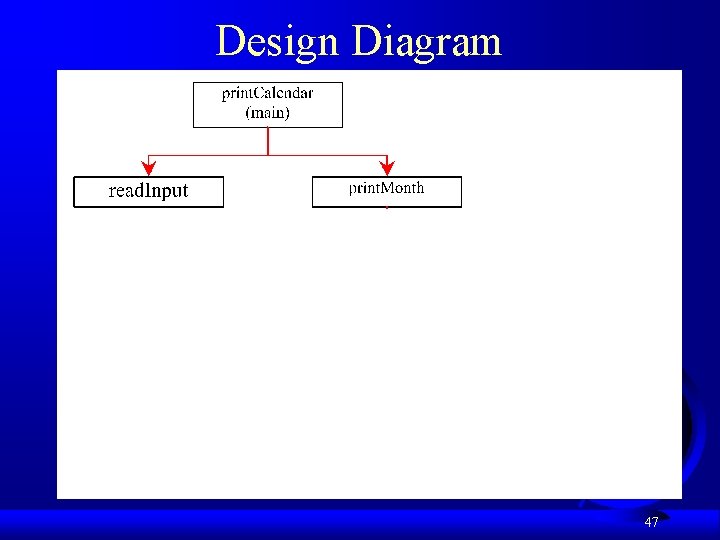
Design Diagram 47
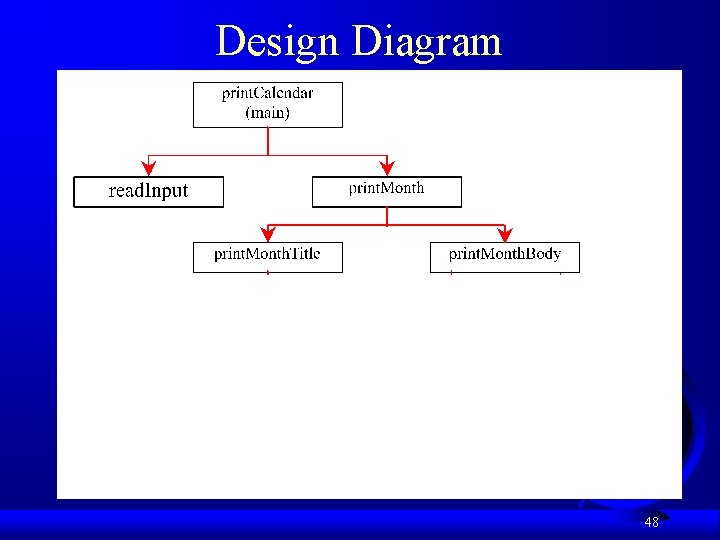
Design Diagram 48
Design Diagram 49
Design Diagram 50
Design Diagram 51
Design Diagram 52
Implementation: Top-Down Top-down approach is to implement one function in the structure chart at a time from the top to the bottom. Stubs can be used for the functions waiting to be implemented. A stub is a simple but incomplete version of a function. The use of stubs enables you to test invoking the function from a caller. Implement the main function first and then use a stub for the print. Month function. For example, let print. Month display the year and the month in the stub. Thus, your program may begin like this: A Skeleton for print. Calendar 53
Implementation: Bottom-Up Bottom-up approach is to implement one function in the structure chart at a time from the bottom to the top. For each function implemented, write a test program to test it. Both top-down and bottom-up functions are fine. Both approaches implement the functions incrementally and help to isolate programming errors and makes debugging easy. Sometimes, they can be used together. 54
Turtle: Developing Reusable Graphics Functions def draw. Line(x 1, y 1, x 2, y 2): Useful. Turtle. Functions def write. String(s, x, y): def draw. Point(x, y): def draw. Circle(x = 0, y = 0, radius = 10): def draw. Rectangle(x = 0, y = 0, width = 10, height = 10): Use. Custom. Turtle. Functions 55
- Slides: 55