
Chapter 6 Free Electron Fermi Gas Free Electron
- Slides: 41
Chapter 6: Free Electron Fermi Gas
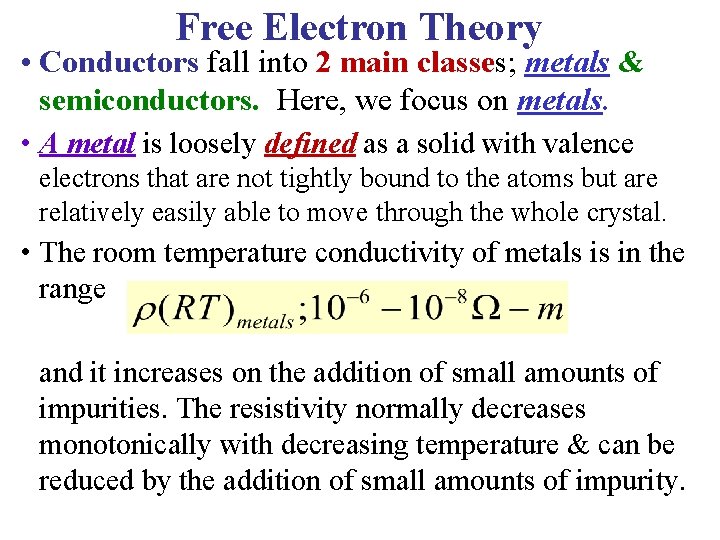
Free Electron Theory • Conductors fall into 2 main classes; metals & semiconductors. Here, we focus on metals. • A metal is loosely defined as a solid with valence electrons that are not tightly bound to the atoms but are relatively easily able to move through the whole crystal. • The room temperature conductivity of metals is in the range and it increases on the addition of small amounts of impurities. The resistivity normally decreases monotonically with decreasing temperature & can be reduced by the addition of small amounts of impurity.
Question! Why do mobile (conducting) electrons occur in some solids & not in others? • When the interactions between electrons are considered, this becomes a Very Difficult Question to Answer. D Some Common Physical Properties of Metals: Great Physical Strength, High Density, Good Electrical and Thermal Conductivity, etc. • Here, we outline a surprisingly simple theory which does a very good job of explaining many of these common properties of metals.
“The Free Electron Model” • We begin with the assumption that conduction electrons exist & that they consist of the valence electrons from the metal atoms. • Thus, metallic Na, Mg & Al are assumed to have 1, 2 & 3 mobile electrons per atom, respectively. • This model seems at first as if it is Way Too Simple! • But, this simple model works remarkably well for many metals & it will be used to help to explain many properties of metals.
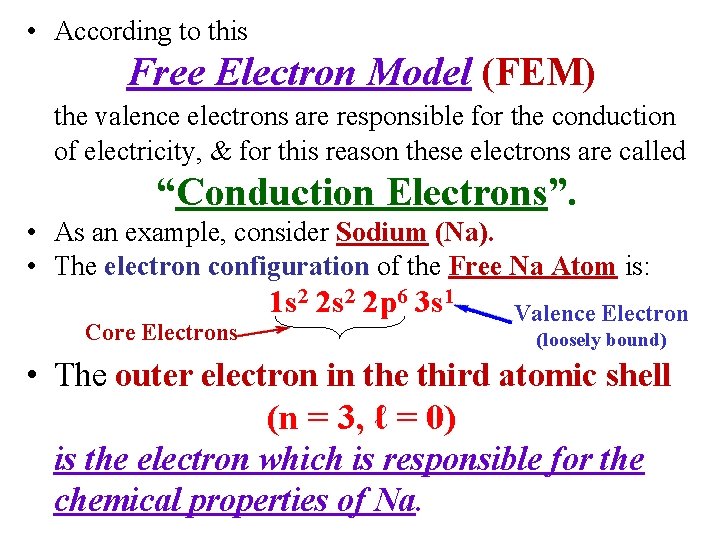
• According to this Free Electron Model (FEM) the valence electrons are responsible for the conduction of electricity, & for this reason these electrons are called “Conduction Electrons”. • As an example, consider Sodium (Na). • The electron configuration of the Free Na Atom is: Core Electrons 1 s 2 2 p 6 3 s 1 Valence Electron (loosely bound) • The outer electron in the third atomic shell (n = 3, ℓ = 0) is the electron which is responsible for the chemical properties of Na.
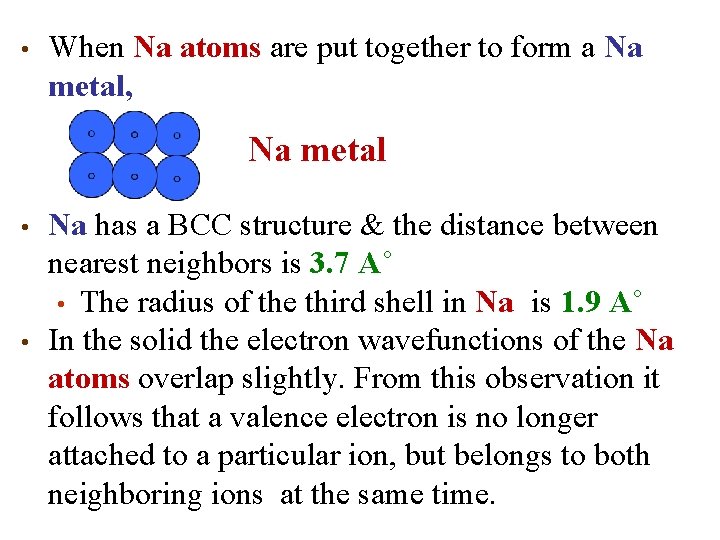
• When Na atoms are put together to form a Na metal, Na metal • • Na has a BCC structure & the distance between nearest neighbors is 3. 7 A˚ • The radius of the third shell in Na iis 1. 9 A˚ In the solid the electron wavefunctions of the Na atoms overlap slightly. From this observation it follows that a valence electron is no longer attached to a particular ion, but belongs to both neighboring ions at the same time.
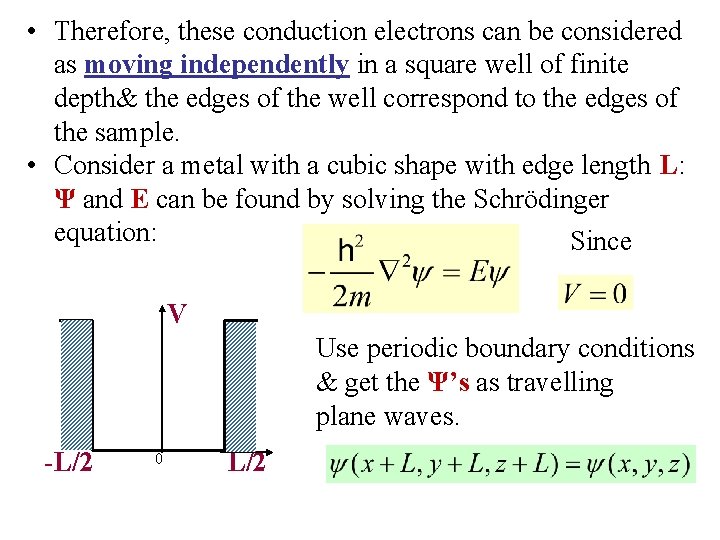
• Therefore, these conduction electrons can be considered as moving independently in a square well of finite depth& the edges of the well correspond to the edges of the sample. • Consider a metal with a cubic shape with edge length L: Ψ and E can be found by solving the Schrödinger equation: Since V Use periodic boundary conditions & get the Ψ’s as travelling plane waves. -L/2 0 L/2
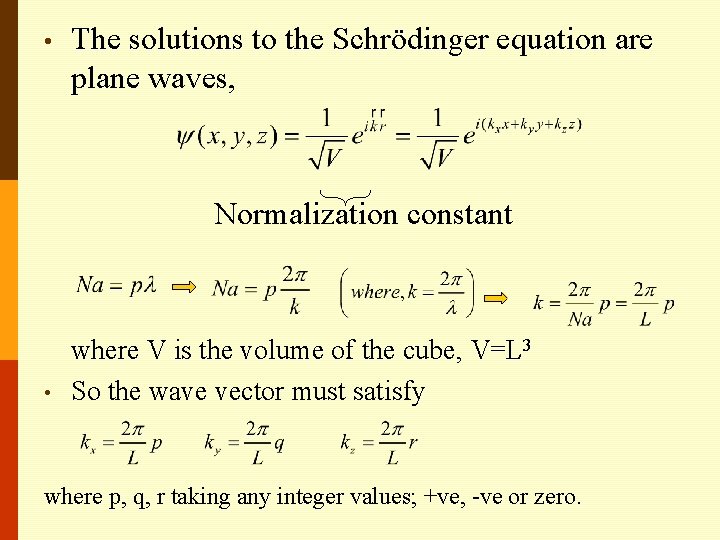
• The solutions to the Schrödinger equation are plane waves, Normalization constant • where V is the volume of the cube, V=L 3 So the wave vector must satisfy where p, q, r taking any integer values; +ve, -ve or zero.
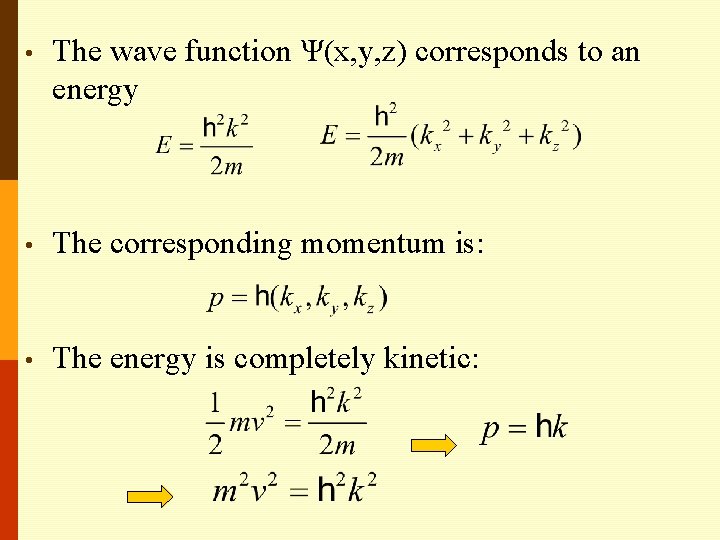
• The wave function Ψ(x, y, z) corresponds to an energy • The corresponding momentum is: • The energy is completely kinetic:
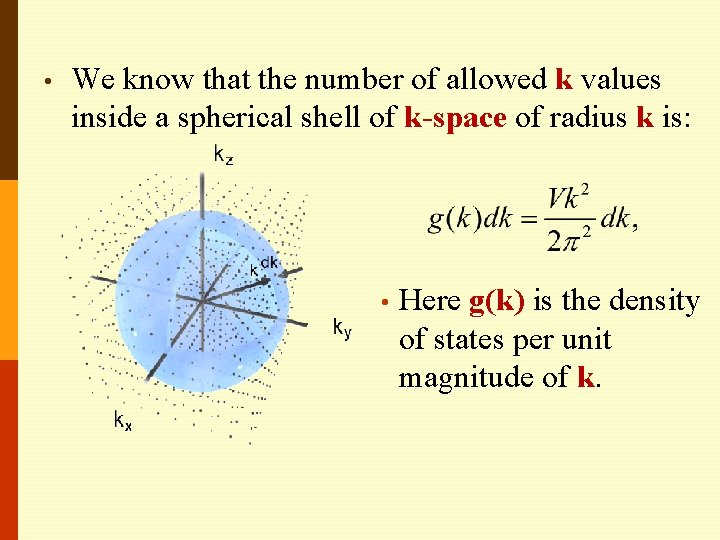
• We know that the number of allowed k values inside a spherical shell of k-space of radius k is: • Here g(k) is the density of states per unit magnitude of k.
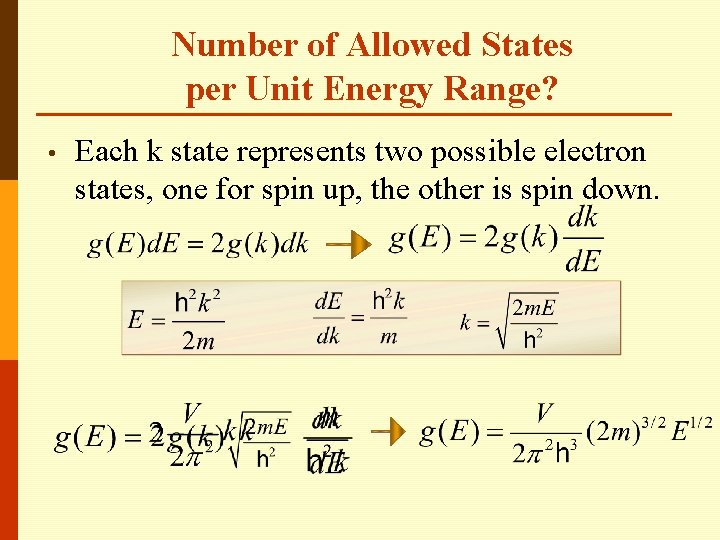
Number of Allowed States per Unit Energy Range? • Each k state represents two possible electron states, one for spin up, the other is spin down.
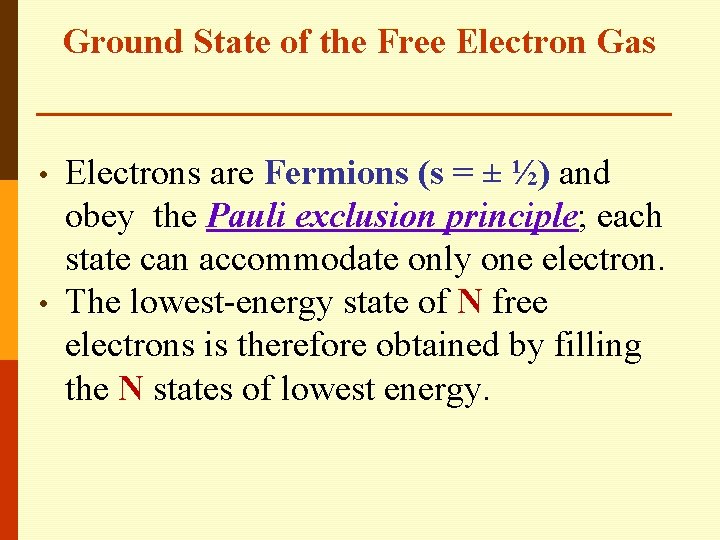
Ground State of the Free Electron Gas • • Electrons are Fermions (s = ± ½) and obey the Pauli exclusion principle; each state can accommodate only one electron. The lowest-energy state of N free electrons is therefore obtained by filling the N states of lowest energy.
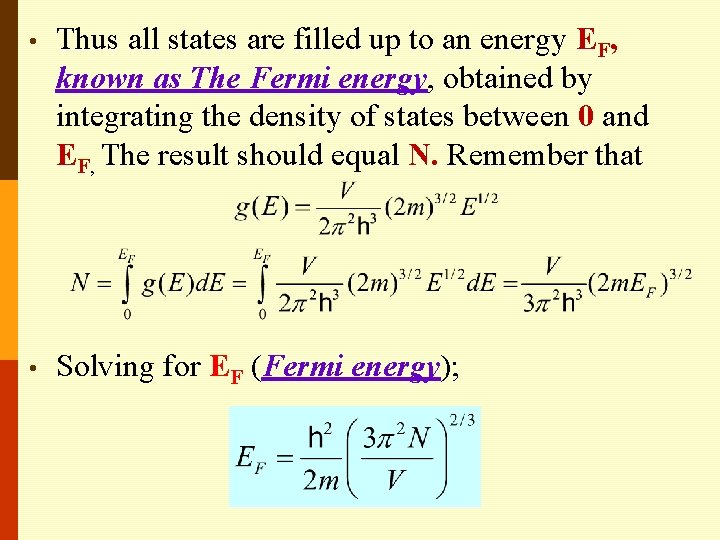
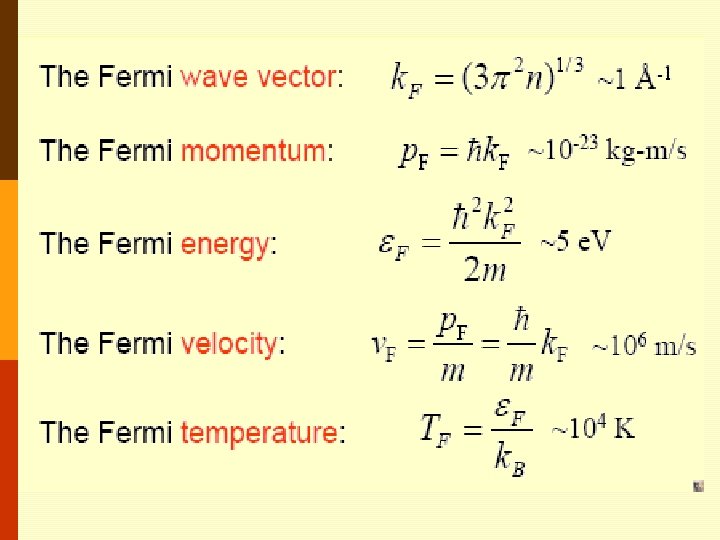
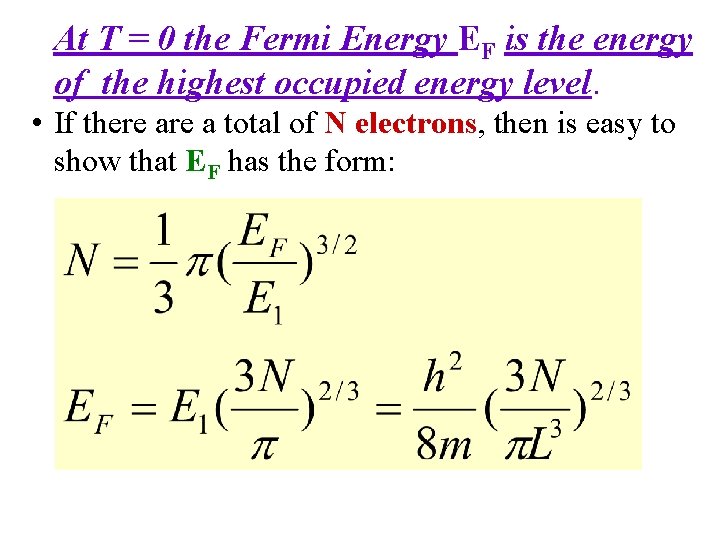
• Thus all states are filled up to an energy EF, known as The Fermi energy, obtained by integrating the density of states between 0 and EF, The result should equal N. Remember that • Solving for EF (Fermi energy);
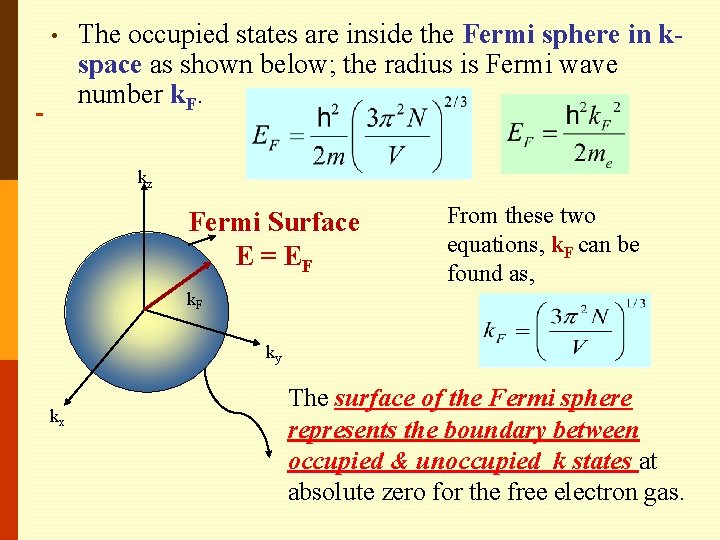
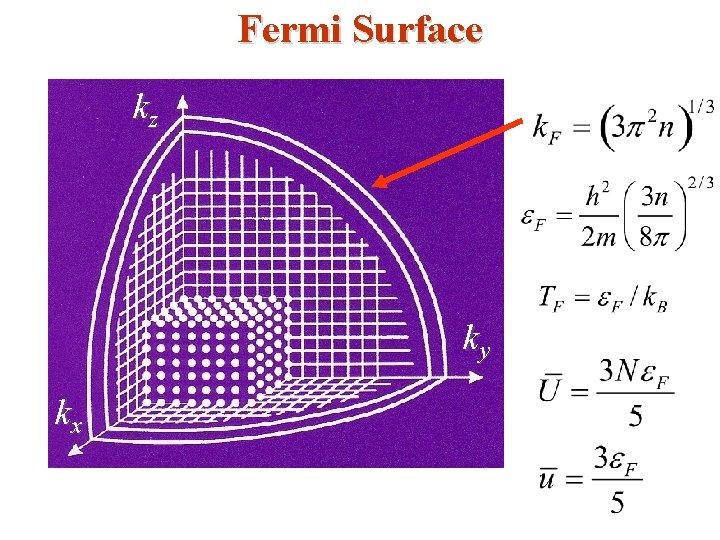
• The occupied states are inside the Fermi sphere in kspace as shown below; the radius is Fermi wave number k. F. kz Fermi Surface E = EF From these two equations, k. F can be found as, k. F ky kx The surface of the Fermi sphere represents the boundary between occupied & unoccupied k states at absolute zero for the free electron gas.
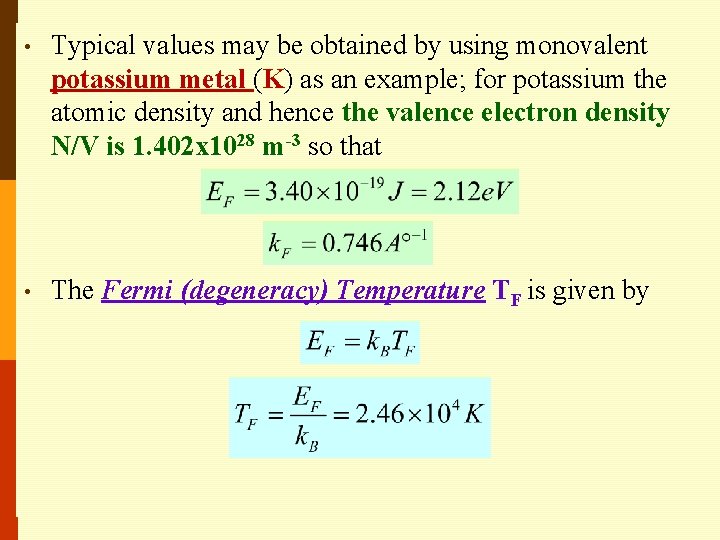
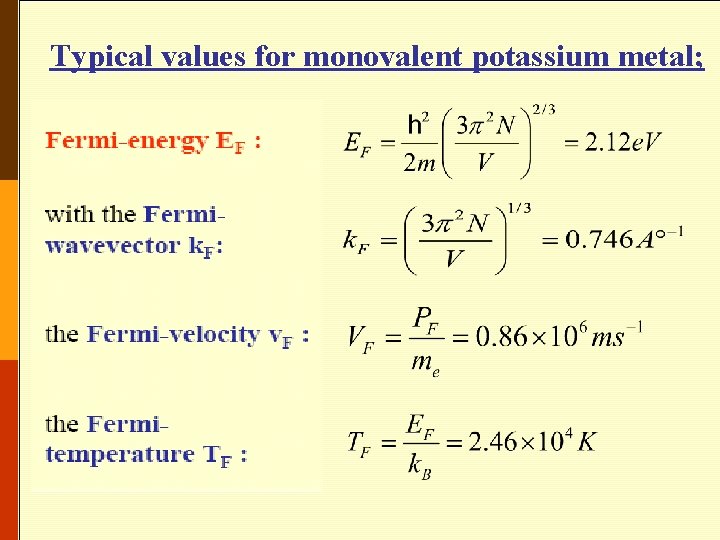
• Typical values may be obtained by using monovalent potassium metal (K) as an example; for potassium the atomic density and hence the valence electron density N/V is 1. 402 x 1028 m-3 so that • The Fermi (degeneracy) Temperature TF is given by
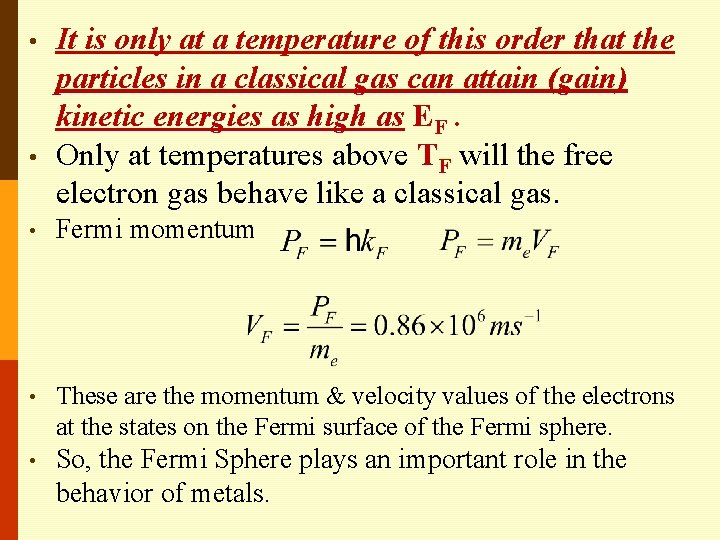
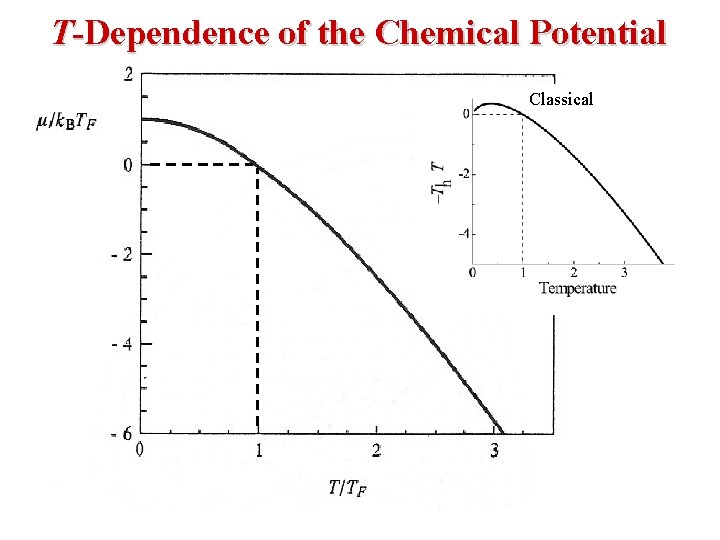
• • It is only at a temperature of this order that the particles in a classical gas can attain (gain) kinetic energies as high as EF. Only at temperatures above TF will the free electron gas behave like a classical gas. • Fermi momentum • These are the momentum & velocity values of the electrons at the states on the Fermi surface of the Fermi sphere. • So, the Fermi Sphere plays an important role in the behavior of metals.
Typical values for monovalent potassium metal;
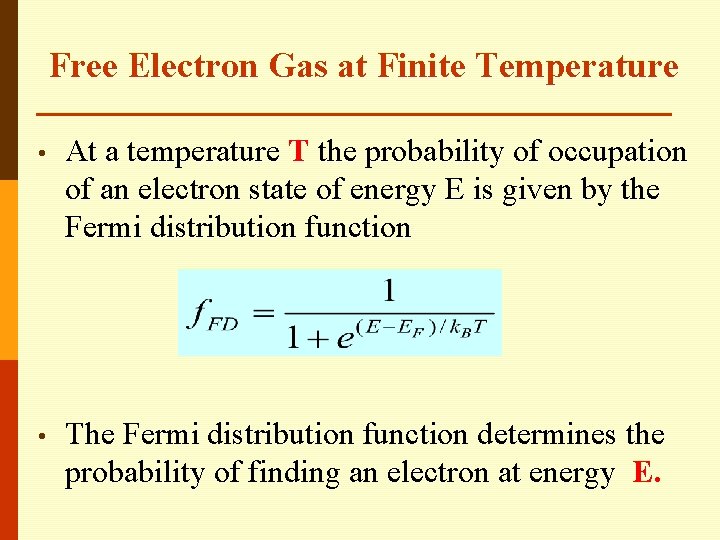
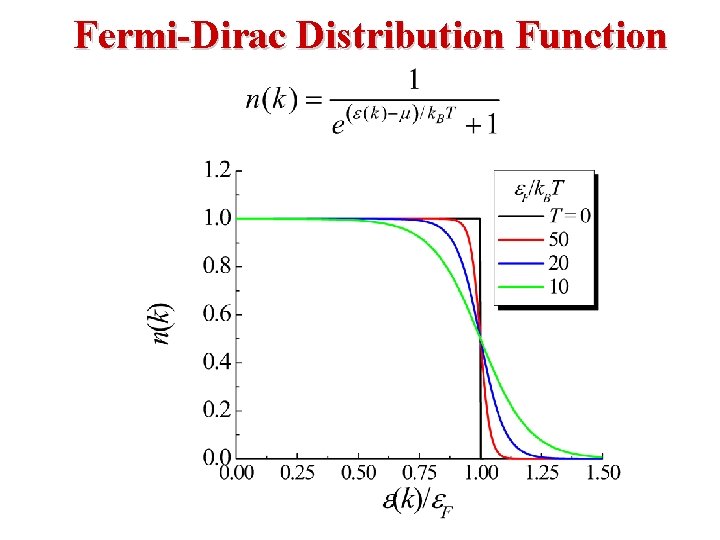
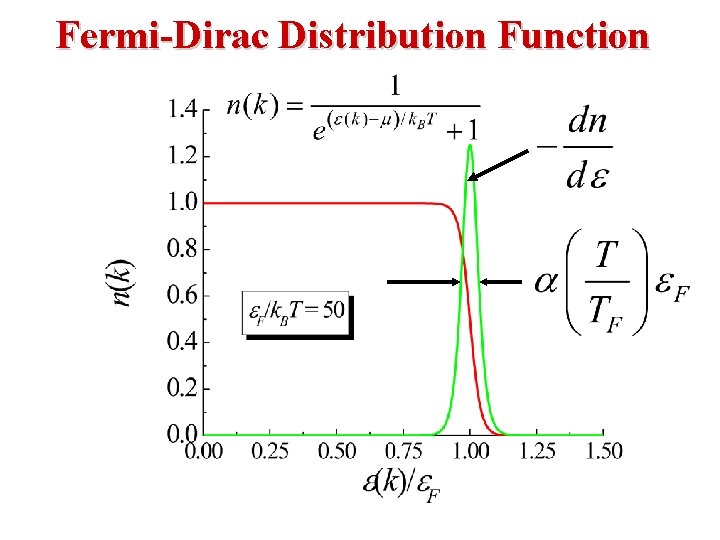
Free Electron Gas at Finite Temperature • At a temperature T the probability of occupation of an electron state of energy E is given by the Fermi distribution function • The Fermi distribution function determines the probability of finding an electron at energy E.
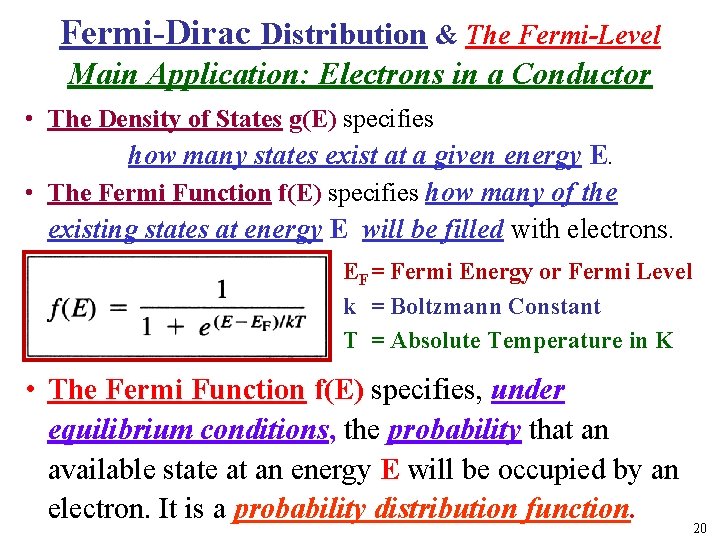
Fermi-Dirac Distribution & The Fermi-Level Main Application: Electrons in a Conductor • The Density of States g(E) specifies how many states exist at a given energy E. • The Fermi Function f(E) specifies how many of the existing states at energy E will be filled with electrons. EF = Fermi Energy or Fermi Level k = Boltzmann Constant T = Absolute Temperature in K • I • The Fermi Function f(E) specifies, under equilibrium conditions, the probability that an available state at an energy E will be occupied by an electron. It is a probability distribution function. 20
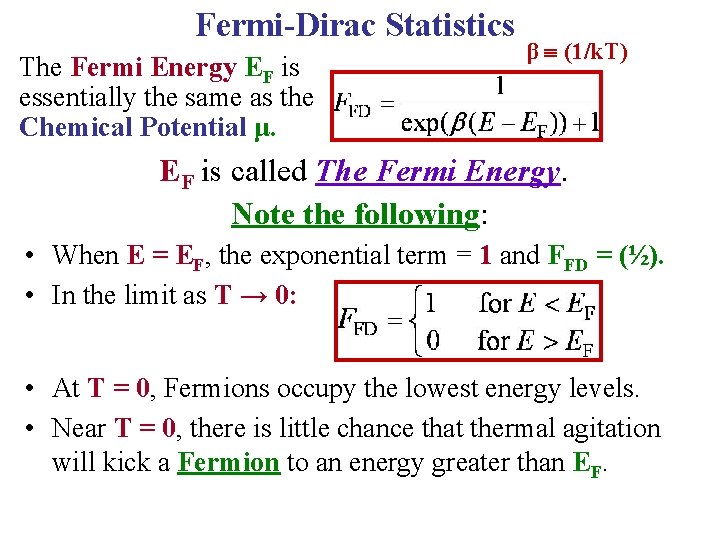
Fermi-Dirac Statistics The Fermi Energy EF is essentially the same as the Chemical Potential μ. β (1/k. T) EF is called The Fermi Energy. Note the following: • When E = EF, the exponential term = 1 and FFD = (½). • In the limit as T → 0: L L • At T = 0, Fermions occupy the lowest energy levels. • Near T = 0, there is little chance that thermal agitation will kick a Fermion to an energy greater than EF.
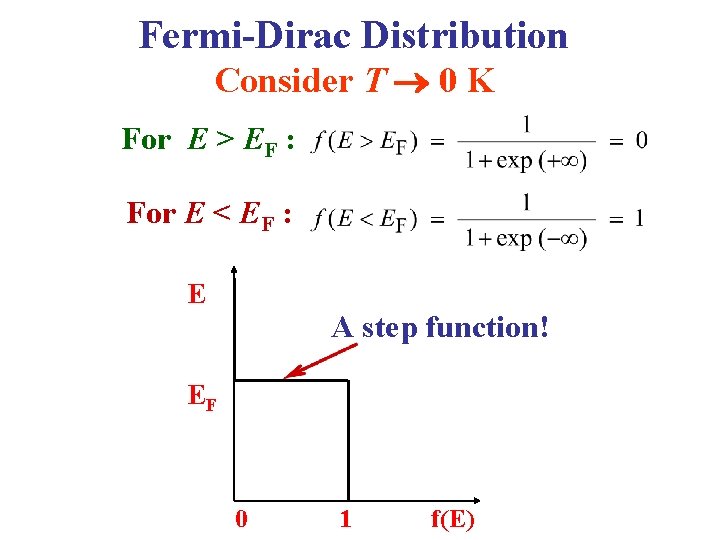
Fermi-Dirac Distribution Consider T 0 K For E > EF : For E < EF : E A step function! EF 0 1 f(E)
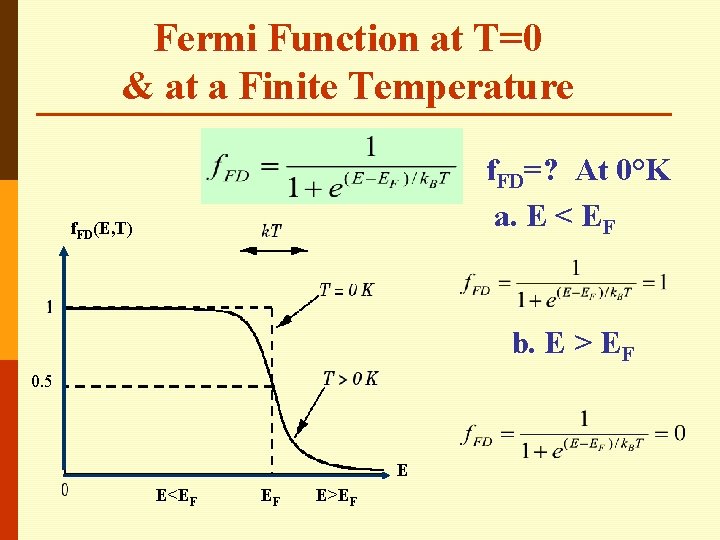
Fermi Function at T=0 & at a Finite Temperature f. FD=? At 0°K a. E < EF f. FD(E, T) b. E > EF 0. 5 E E<EF EF E>EF
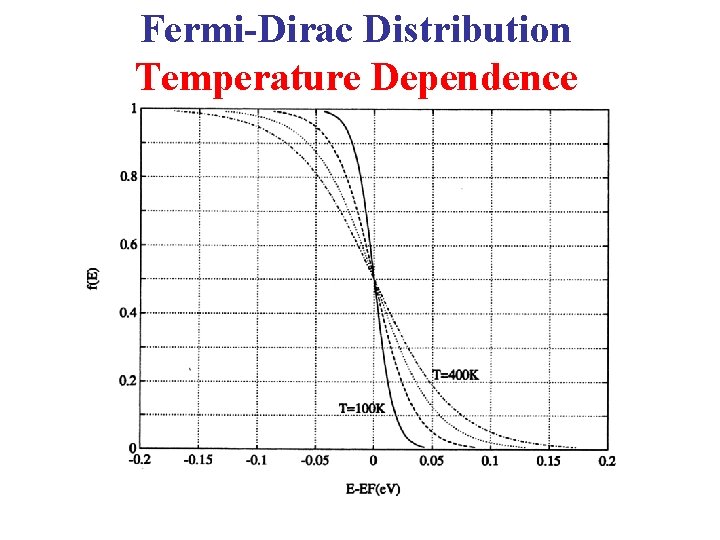
Fermi-Dirac Distribution Temperature Dependence
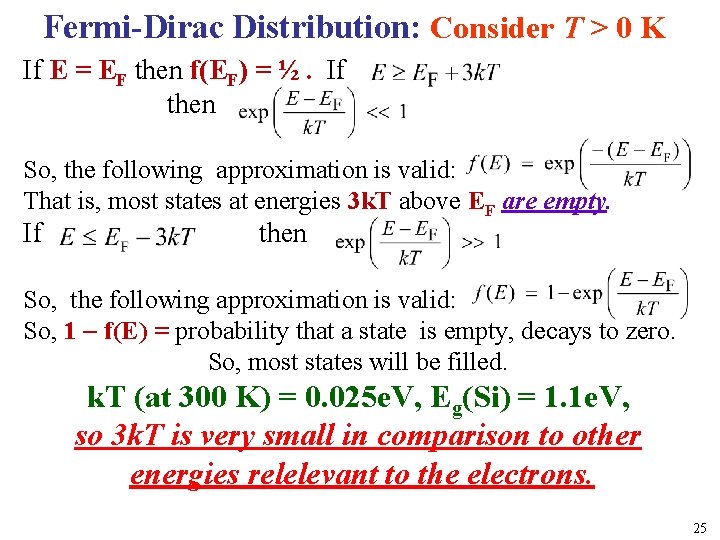
Fermi-Dirac Distribution: Consider T > 0 K If E = EF then f(EF) = ½. If then So, the following approximation is valid: That is, most states at energies 3 k. T above EF are empty. If l then So, the following approximation is valid: So, 1 f(E) = probability that a state is empty, decays to zero. So, most states will be filled. k. T (at 300 K) = 0. 025 e. V, Eg(Si) = 1. 1 e. V, so 3 k. T is very small in comparison to other energies relelevant to the electrons. 25
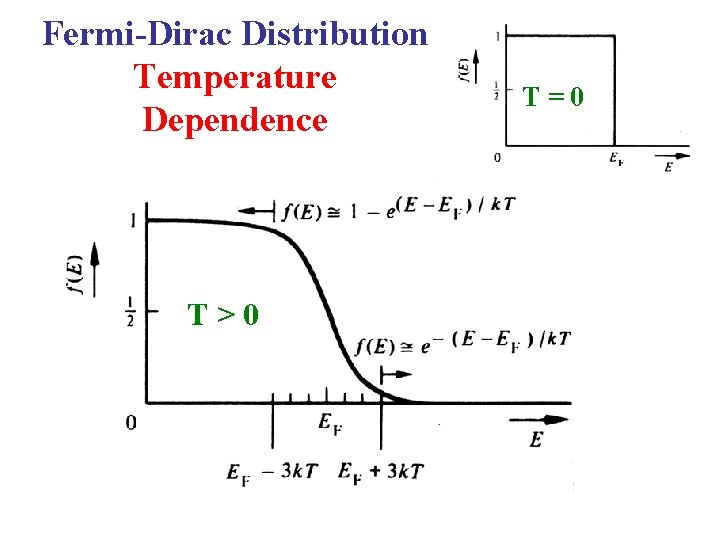
Fermi-Dirac Distribution Temperature Dependence T>0 T=0
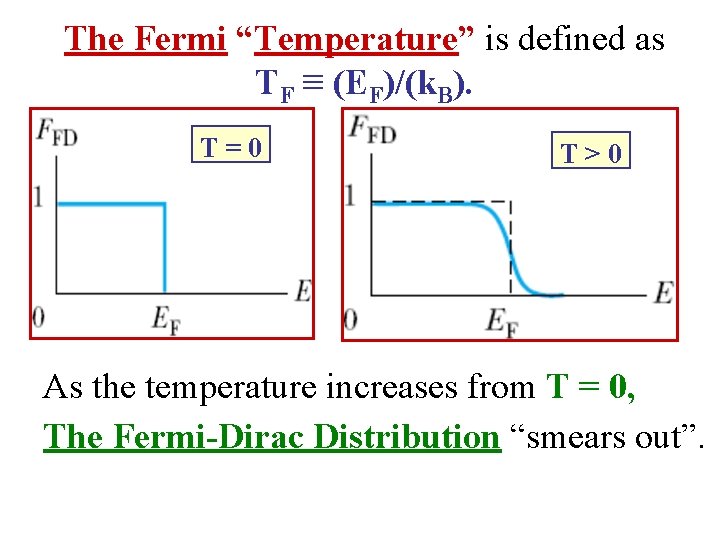
The Fermi “Temperature” is defined as TF ≡ (EF)/(k. B). T=0 T>0 As the temperature increases from T = 0, The Fermi-Dirac Distribution “smears out”.
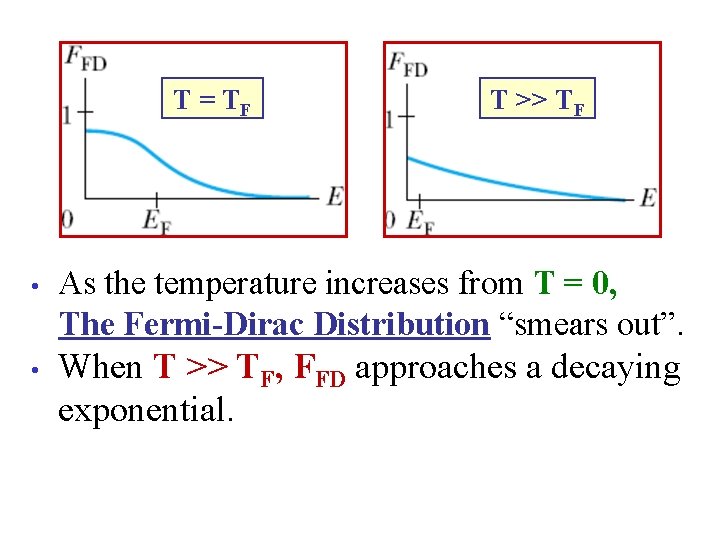
T = TF T >> TF • As the temperature increases from T = 0, The Fermi-Dirac Distribution “smears out”. • When T >> TF, FFD approaches a decaying exponential.
At T = 0 the Fermi Energy EF is the energy of the highest occupied energy level. • If there a total of N electrons, then is easy to show that EF has the form:
Fermi-Dirac Distribution Function
T-Dependence of the Chemical Potential Classical
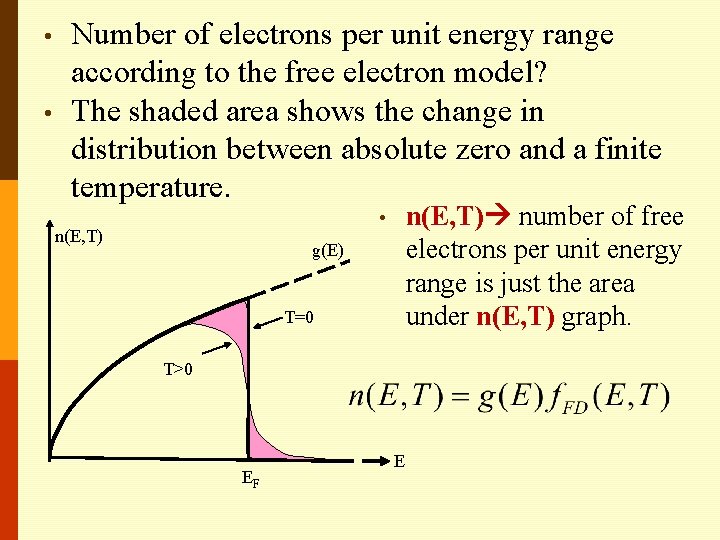
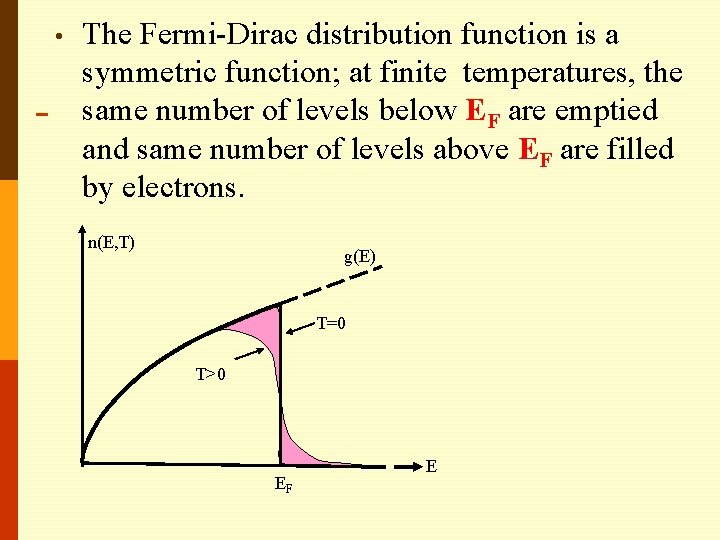
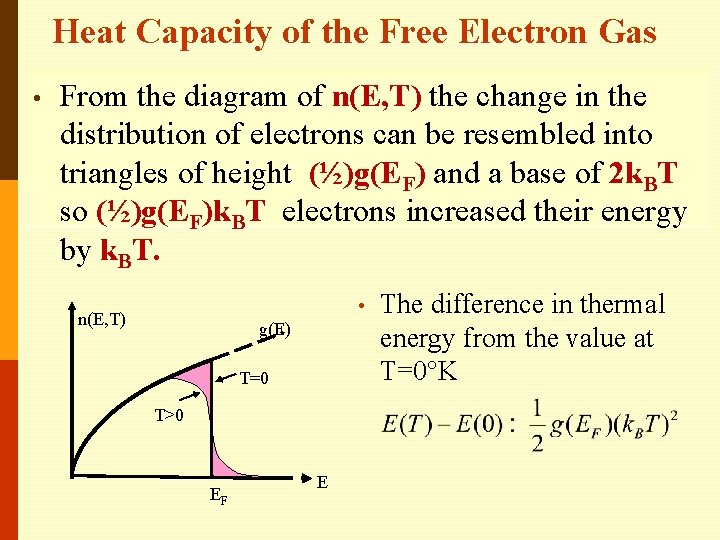
• • Number of electrons per unit energy range according to the free electron model? The shaded area shows the change in distribution between absolute zero and a finite temperature. n(E, T) number of free electrons per unit energy range is just the area under n(E, T) graph. • n(E, T) g(E) T=0 T>0 EF E
• The Fermi-Dirac distribution function is a symmetric function; at finite temperatures, the same number of levels below EF are emptied and same number of levels above EF are filled by electrons. n(E, T) g(E) T=0 T>0 EF E
Fermi Surface kz ky kx
Fermi-Dirac Distribution Function
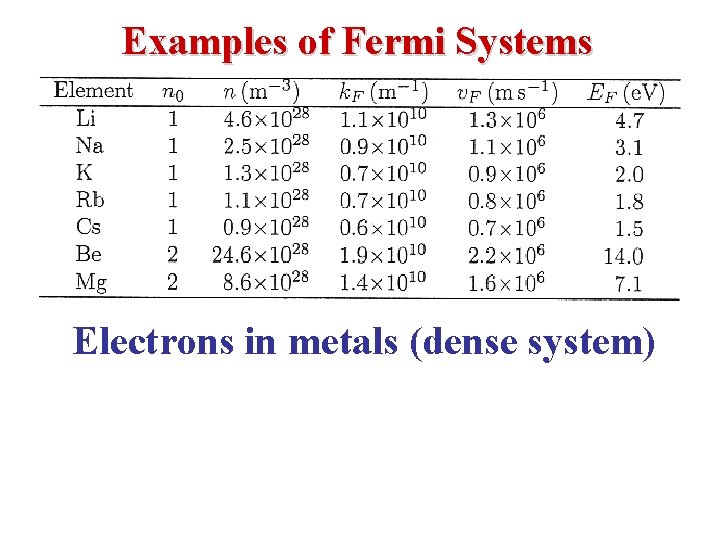
Examples of Fermi Systems Electrons in metals (dense system)
Heat Capacity of the Free Electron Gas • From the diagram of n(E, T) the change in the distribution of electrons can be resembled into triangles of height (½)g(EF) and a base of 2 k. BT so (½)g(EF)k. BT electrons increased their energy by k. BT. • n(E, T) g(E) T=0 T>0 EF E The difference in thermal energy from the value at T=0°K
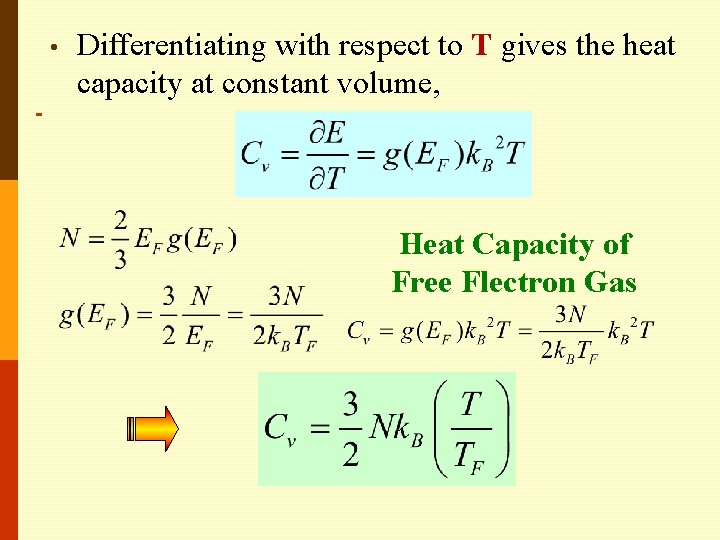
• Differentiating with respect to T gives the heat capacity at constant volume, Heat Capacity of Free Flectron Gas
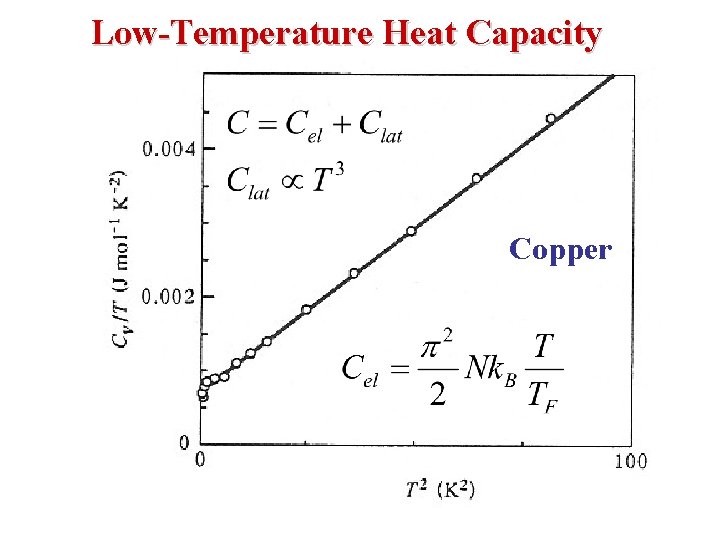
Low-Temperature Heat Capacity Copper
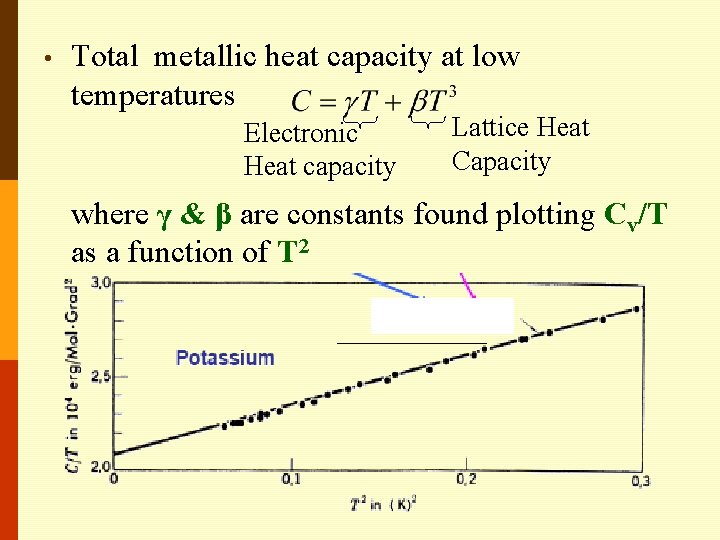
• Total metallic heat capacity at low temperatures Electronic Heat capacity Lattice Heat Capacity where γ & β are constants found plotting Cv/T as a function of T 2
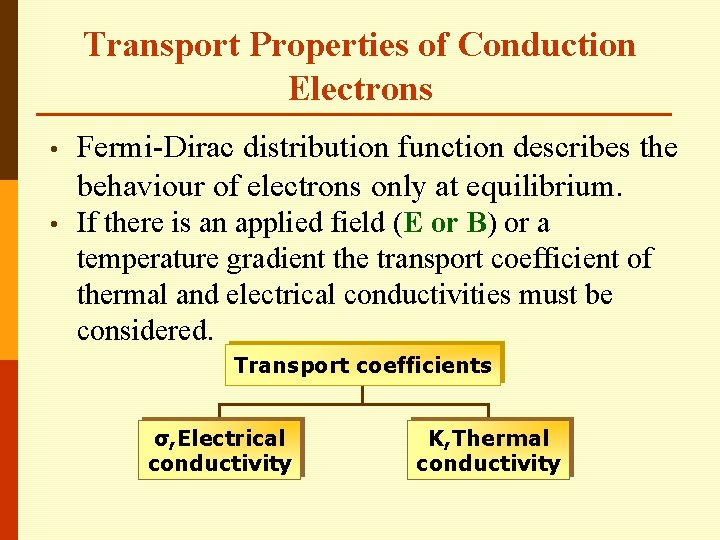
Transport Properties of Conduction Electrons • Fermi-Dirac distribution function describes the behaviour of electrons only at equilibrium. • If there is an applied field (E or B) or a temperature gradient the transport coefficient of thermal and electrical conductivities must be considered. Transport coefficients σ, Electrical conductivity K, Thermal conductivity