
Chapter 6 Fitness Assessment Objectives After this presentation
Chapter 6 Fitness Assessment
Objectives • After this presentation, the participant will be able to: • • Understand the relationship between sales and the fitness assessment and its importance to building the value of the personal trainer. Understand how to administer a health history questionnaire and then from that be able to stratify a client’s overall risk for fitness assessment. Understand the importance of posture, how it relates to movement observation, and how to assess it. Understand how to perform a comprehensive health-related fitness assessment, obtain subjective and objective information about clients, and how to use the information collected to help design an exercise program.
Definition • Fitness Assessment – A systematic problem-solving method that provides the fitness professional with a basis for making educated decisions about exercise and acute variable selection – Not designed to diagnose any condition, but rather to observe each client’s individual structural and functional status, creating a starting point from which to work – Integrate sales techniques and utilize a chance to build value into your services.

Fitness Assessment Components • Use a variety of observation methods to obtain a balanced overview of a client – Subjective Information • General and medical history (ex. Past injuries and surgeries) – Objective Information • • • Physiologic assessment HR BP* Body composition Cardiorespiratory assessments Static and dynamic postural assessments Performance assessments
Subjective Information • Gathered from a prospective client to give the fitness professional feedback regarding personal history such as occupation, lifestyle, and medical background. – One of the easiest forms of gathering this information is through a questionnaire. • Physical Activity Readiness Questionnaire (PAR-Q) is directed toward detecting any possible cardiorespiratory dysfunction, such as coronary heart disease (CHD)
General History • Ask some very basic questions concerning a client’s history and personal background to obtain a wealth of information. – Occupation • • Does your occupation require extended periods of sitting? Does your occupation require extended periods of repetitive movements? Does your occupation require you to wear shoes with a heel (dress shoes)? Is your occupation mentally stressful (causes anxiety)? – Lifestyle • Recreation • Hobbies
Medical History • Find out a client’s medical history to obtain information about life-threatening or chronic diseases as well as structural and functional health – Past injuries – Past surgeries – Chronic conditions – Medications
Objective Information • Gathered to provide the fitness professional with forms of measurable information. • Can be used to compare beginning numbers to those measured weeks, months, or years later, denoting improvements in the client as well as the effectiveness of the training program. – – – Physiologic assessments Body composition assessments Cardiorespiratory assessments Posture and movement assessments Performance assessments
Physiologic Assessments • Provide valuable information regarding the status of the client’s health – Heart rate – Blood pressure
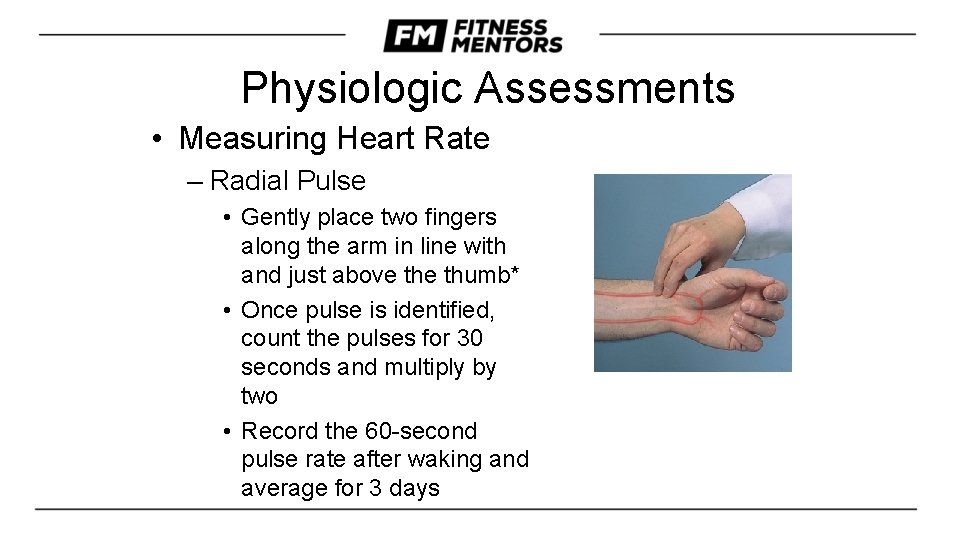
Physiologic Assessments • Measuring Heart Rate – Radial Pulse • Gently place two fingers along the arm in line with and just above thumb* • Once pulse is identified, count the pulses for 30 seconds and multiply by two • Record the 60 -second pulse rate after waking and average for 3 days
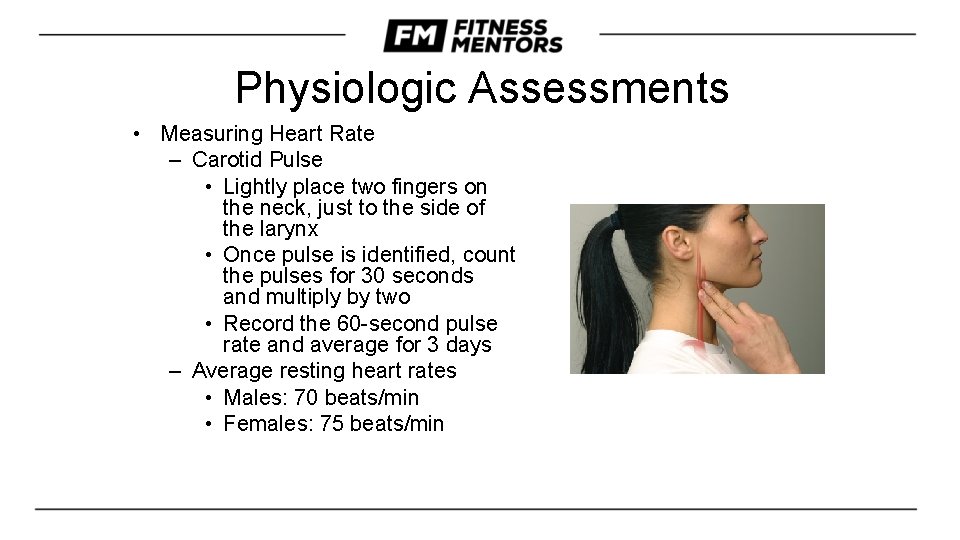
Physiologic Assessments • Measuring Heart Rate – Carotid Pulse • Lightly place two fingers on the neck, just to the side of the larynx • Once pulse is identified, count the pulses for 30 seconds and multiply by two • Record the 60 -second pulse rate and average for 3 days – Average resting heart rates • Males: 70 beats/min • Females: 75 beats/min
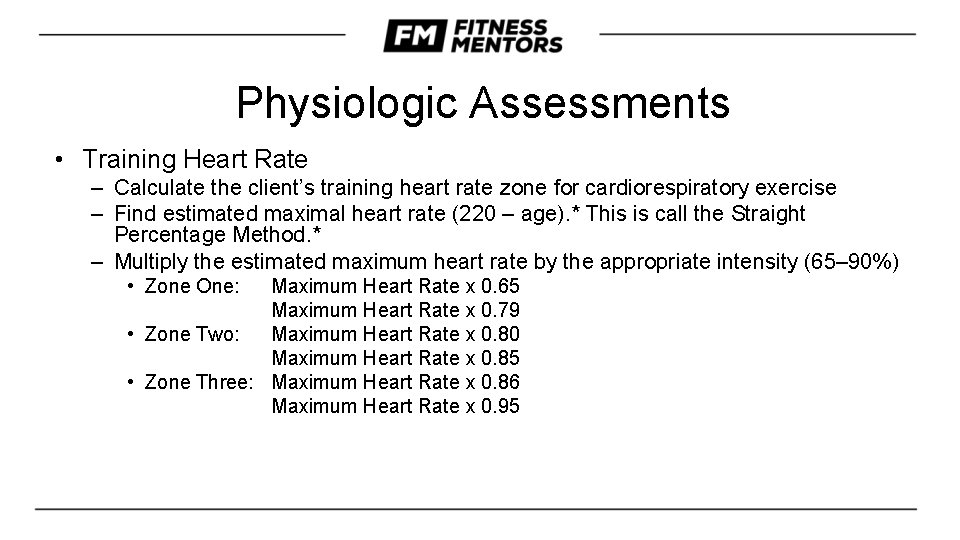
Physiologic Assessments • Training Heart Rate – Calculate the client’s training heart rate zone for cardiorespiratory exercise – Find estimated maximal heart rate (220 – age). * This is call the Straight Percentage Method. * – Multiply the estimated maximum heart rate by the appropriate intensity (65– 90%) • Zone One: Maximum Heart Rate x 0. 65 Maximum Heart Rate x 0. 79 • Zone Two: Maximum Heart Rate x 0. 80 Maximum Heart Rate x 0. 85 • Zone Three: Maximum Heart Rate x 0. 86 Maximum Heart Rate x 0. 95
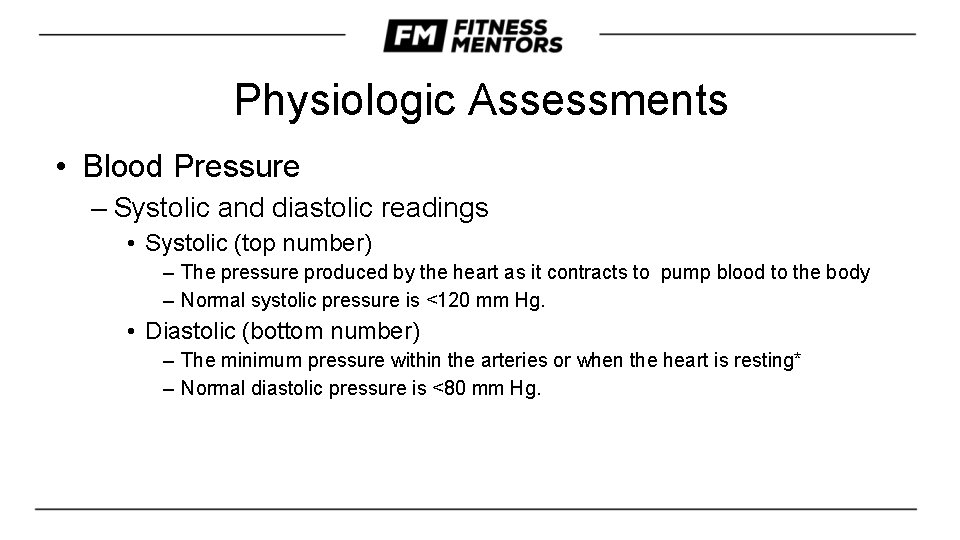
Physiologic Assessments • Blood Pressure – Systolic and diastolic readings • Systolic (top number) – The pressure produced by the heart as it contracts to pump blood to the body – Normal systolic pressure is <120 mm Hg. • Diastolic (bottom number) – The minimum pressure within the arteries or when the heart is resting* – Normal diastolic pressure is <80 mm Hg.
Physiologic Assessments • Blood Pressure Testing – Instruct the client to assume a comfortable seated position and place the appropriate-size cuff just above the elbow. – Rest the arm on a supported chair or support the client’s arm using yours and place the stethoscope over the brachial artery using a minimal amount of pressure. – Rapidly inflate the cuff to 20 to 30 mm Hg above the point when the pulse can no longer be felt at the wrist. – Release the pressure at a rate of about 2 mm Hg per second, listening for sounds. – To determine the systolic pressure, listen for the first observation of sound. – Diastolic pressure is determined when the sounds fade away.

Body Composition • There a variety of methods used to estimate body composition, they vary according to cost, accuracy, and skill needed to perform them. – Skinfold: measures skin fold thickness – Bioelectrical impedance: measures resistance to electrical current – Hydrostatic weighing: Measure body density by measuring buoyancy (ability to float)
Body Composition • Some benefits of body composition testing include: • To identify client’s health risk for excessively high or low levels of body fat – – To promote client’s understanding of body fat To monitor changes in body composition To help estimate healthy body weight for clients and athletes To assist in exercise program design
Skinfold Measurement • Effective for trainers without a lab at their disposal – Indirect measure of adipose tissue through thickness of skin – Take a minimum of two measurements at each site – Be accurate when locating landmarks – Do not measure after exercise – Not effective on extremely obese clients
Body Composition • Body Fat – Skin-Fold Caliper method • Durnin–Womersley formula’s four sites of measurement – – Biceps Triceps Subscapular Iliac crest
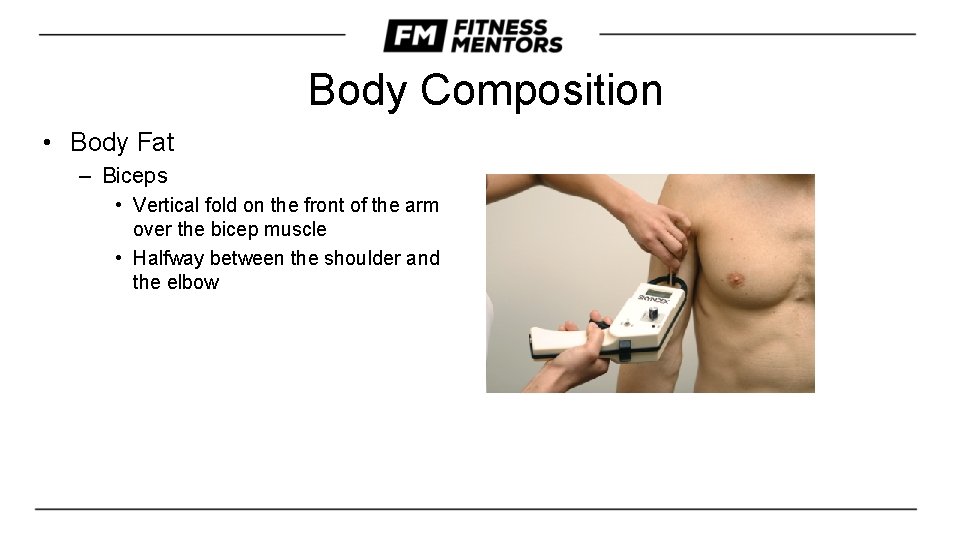
Body Composition • Body Fat – Biceps • Vertical fold on the front of the arm over the bicep muscle • Halfway between the shoulder and the elbow
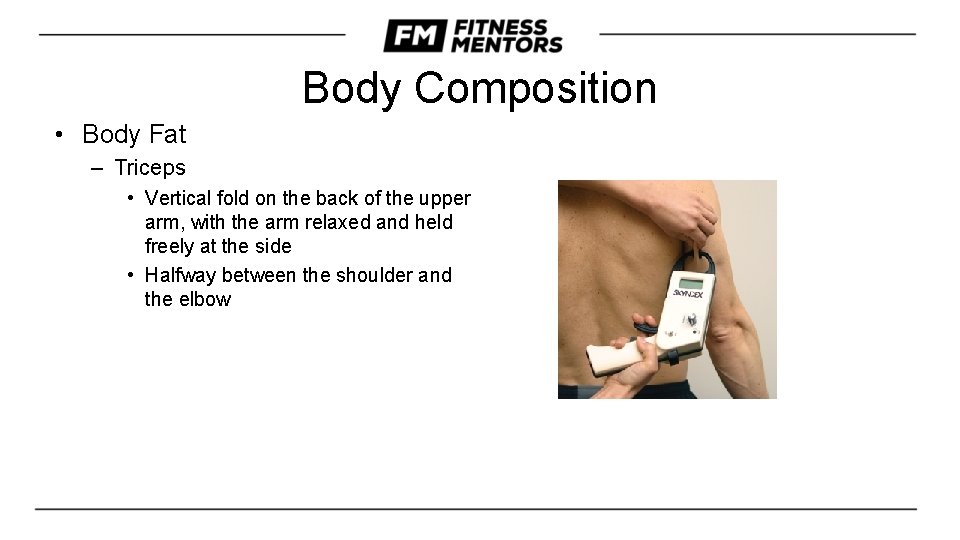
Body Composition • Body Fat – Triceps • Vertical fold on the back of the upper arm, with the arm relaxed and held freely at the side • Halfway between the shoulder and the elbow

Body Composition • Body Fat – Subscapular • At a 45 -degree angle, 1 to 2 cm below the inferior angle of the scapula
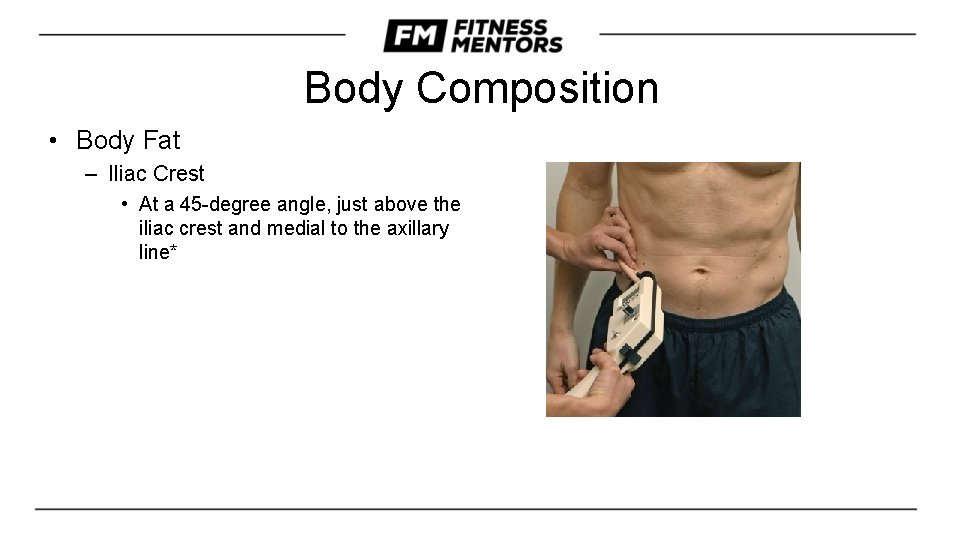
Body Composition • Body Fat – Iliac Crest • At a 45 -degree angle, just above the iliac crest and medial to the axillary line*
Body Composition • Calculating Body Fat Percentages – After the four sites have been measured, add the totals of the four sites. – Use the table in the textbook for corresponding body fat percentage.
Body Composition • Circumference Measurements – Another source of feedback used with clients who have the goal of altering body composition. This type of body composition method would be best for clients who are obese. * – Most important factor is consistency • Take measurements on the same side of the body each time you test and retest
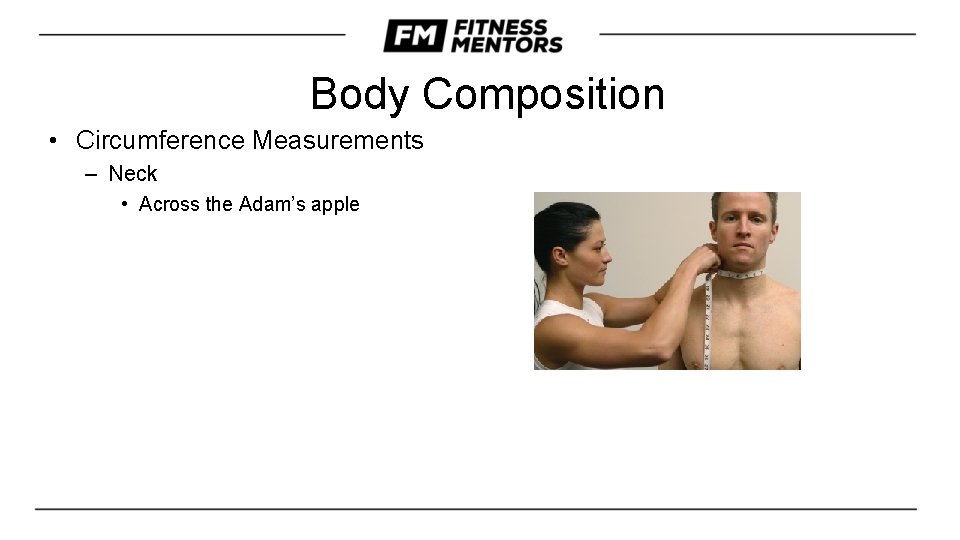
Body Composition • Circumference Measurements – Neck • Across the Adam’s apple
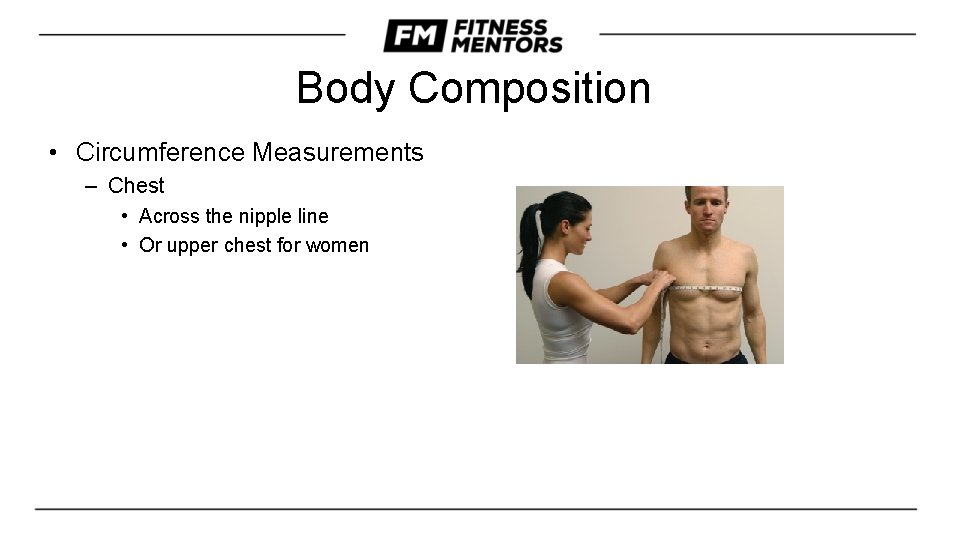
Body Composition • Circumference Measurements – Chest • Across the nipple line • Or upper chest for women
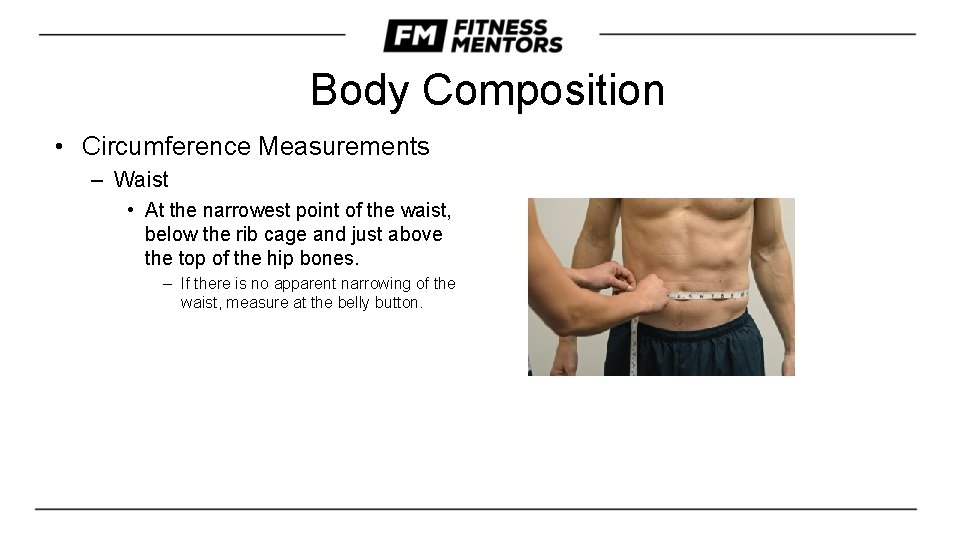
Body Composition • Circumference Measurements – Waist • At the narrowest point of the waist, below the rib cage and just above the top of the hip bones. – If there is no apparent narrowing of the waist, measure at the belly button.
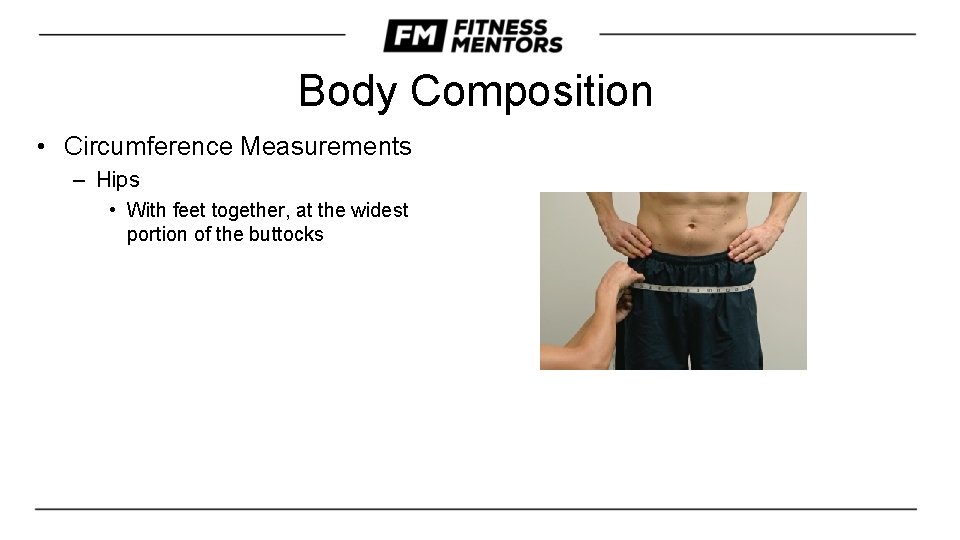
Body Composition • Circumference Measurements – Hips • With feet together, at the widest portion of the buttocks
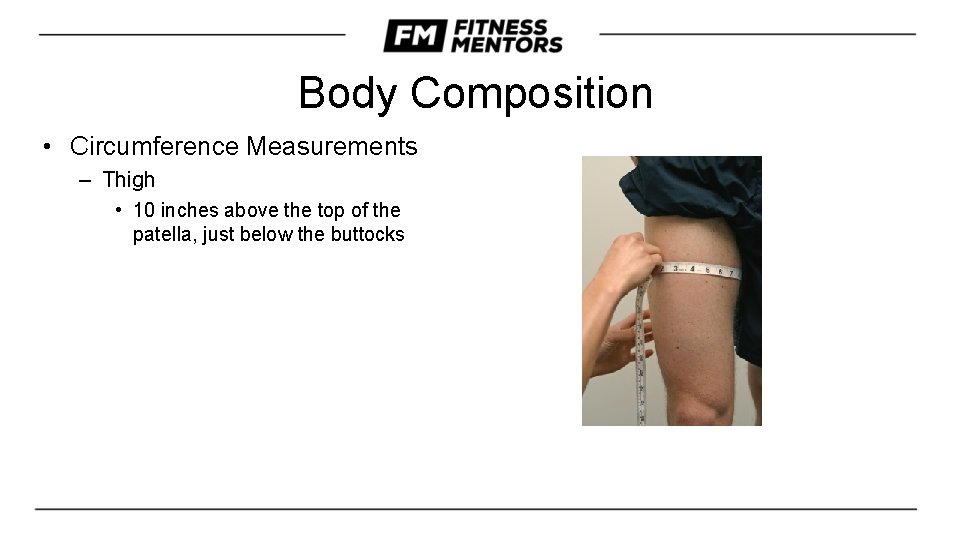
Body Composition • Circumference Measurements – Thigh • 10 inches above the top of the patella, just below the buttocks
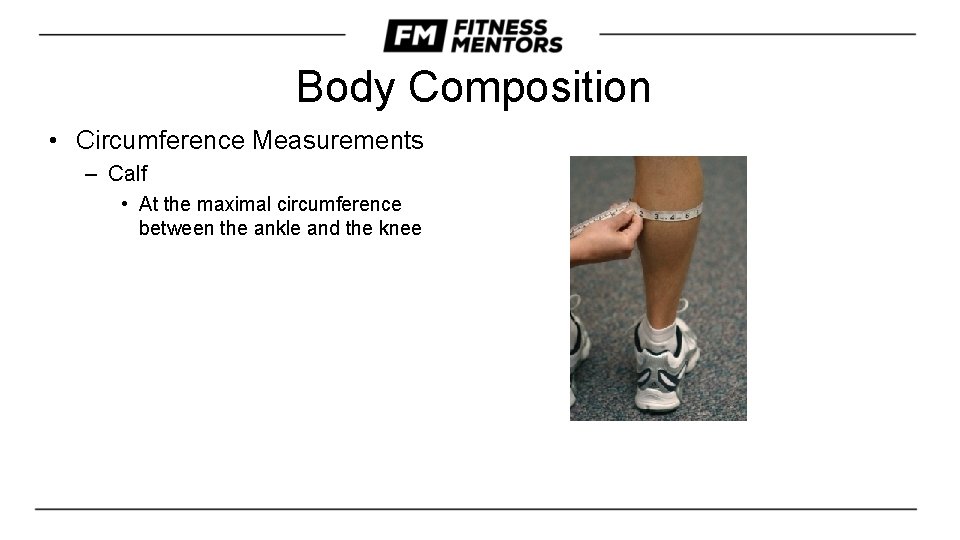
Body Composition • Circumference Measurements – Calf • At the maximal circumference between the ankle and the knee
Body Composition • Body Mass Index (BMI) – To assess weight relative to height, divide body weight (in kilograms) by height (in meters squared) or kg/m 2 – Obesity-related health problems increase when a person’s BMI exceeds 25.
Cardiorespiratory • Provide valuable information regarding cardiorespiratory efficiency and overall condition • Provide a starting point for cardiorespiratory training zone specific to their physical condition and goal • Two common forms – Step Test – Rockport Walk Test
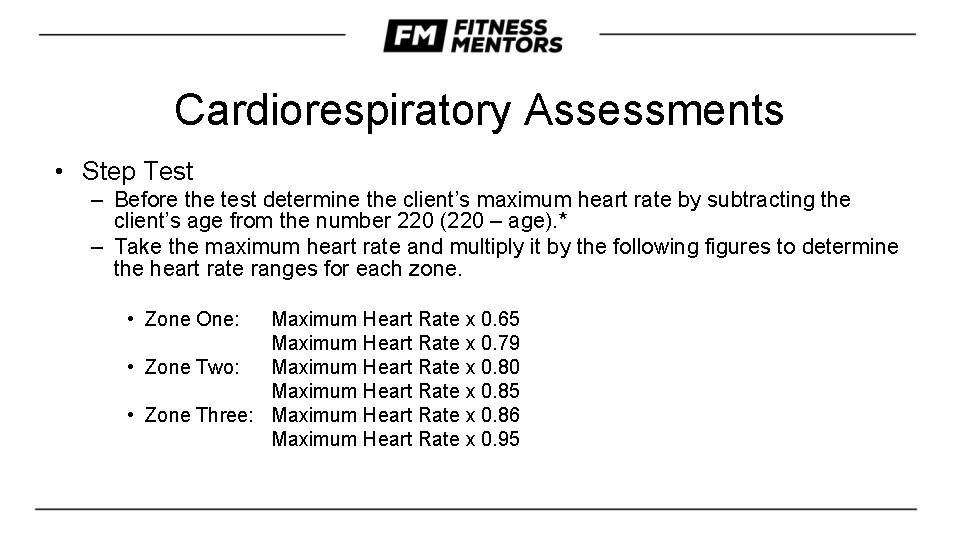
Cardiorespiratory Assessments • Step Test – Before the test determine the client’s maximum heart rate by subtracting the client’s age from the number 220 (220 – age). * – Take the maximum heart rate and multiply it by the following figures to determine the heart rate ranges for each zone. • Zone One: Maximum Heart Rate x 0. 65 Maximum Heart Rate x 0. 79 • Zone Two: Maximum Heart Rate x 0. 80 Maximum Heart Rate x 0. 85 • Zone Three: Maximum Heart Rate x 0. 86 Maximum Heart Rate x 0. 95
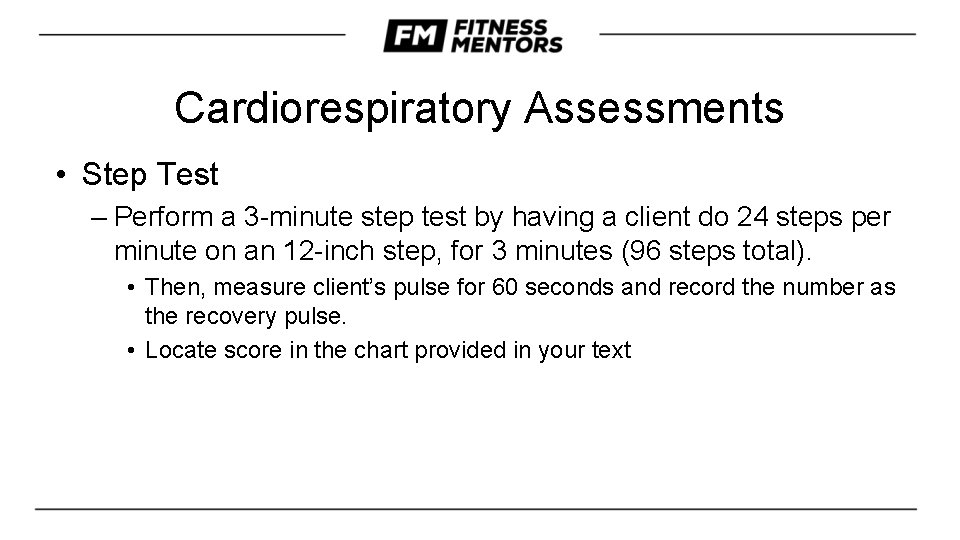
Cardiorespiratory Assessments • Step Test – Perform a 3 -minute step test by having a client do 24 steps per minute on an 12 -inch step, for 3 minutes (96 steps total). • Then, measure client’s pulse for 60 seconds and record the number as the recovery pulse. • Locate score in the chart provided in your text
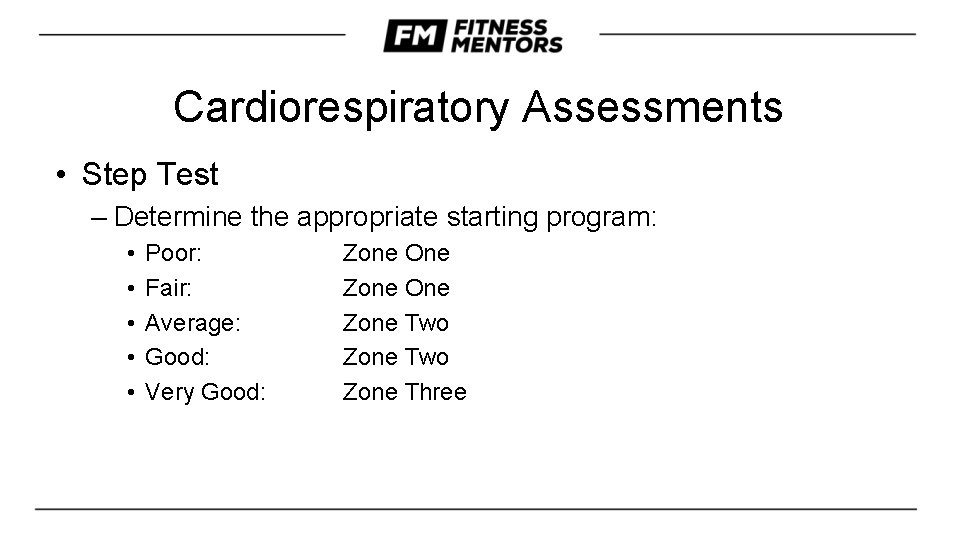
Cardiorespiratory Assessments • Step Test – Determine the appropriate starting program: • • • Poor: Fair: Average: Good: Very Good: Zone One Zone Two Zone Three
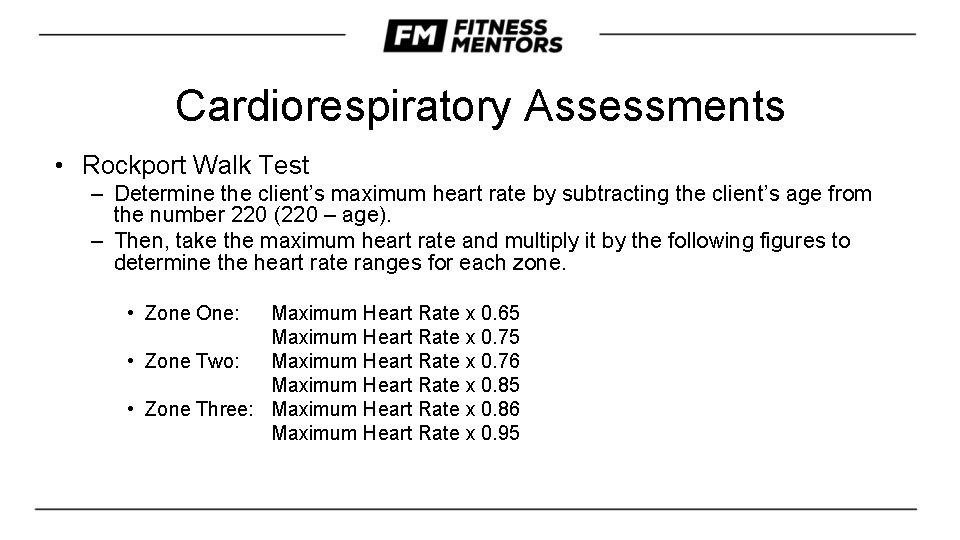
Cardiorespiratory Assessments • Rockport Walk Test – Determine the client’s maximum heart rate by subtracting the client’s age from the number 220 (220 – age). – Then, take the maximum heart rate and multiply it by the following figures to determine the heart rate ranges for each zone. • Zone One: Maximum Heart Rate x 0. 65 Maximum Heart Rate x 0. 75 • Zone Two: Maximum Heart Rate x 0. 76 Maximum Heart Rate x 0. 85 • Zone Three: Maximum Heart Rate x 0. 86 Maximum Heart Rate x 0. 95
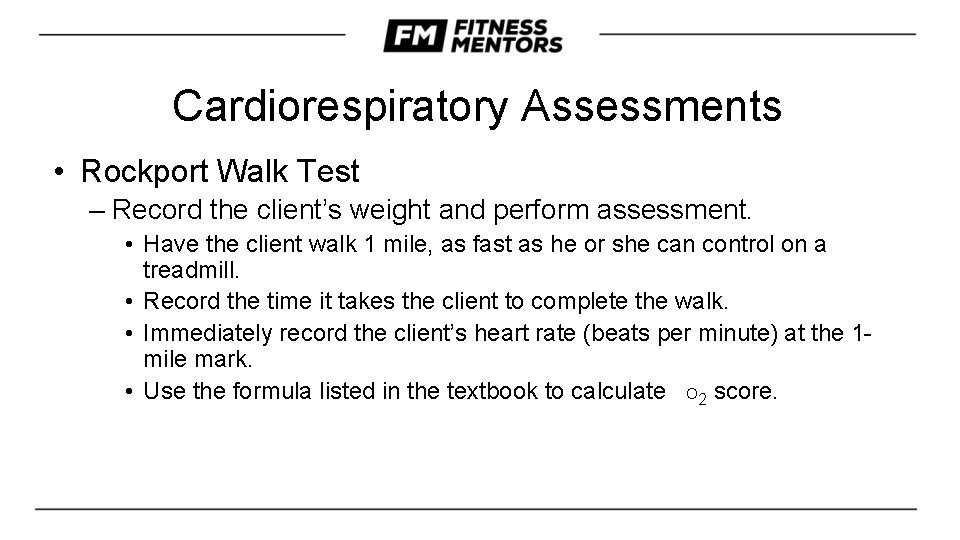
Cardiorespiratory Assessments • Rockport Walk Test – Record the client’s weight and perform assessment. • Have the client walk 1 mile, as fast as he or she can control on a treadmill. • Record the time it takes the client to complete the walk. • Immediately record the client’s heart rate (beats per minute) at the 1 mile mark. • Use the formula listed in the textbook to calculate O 2 score.
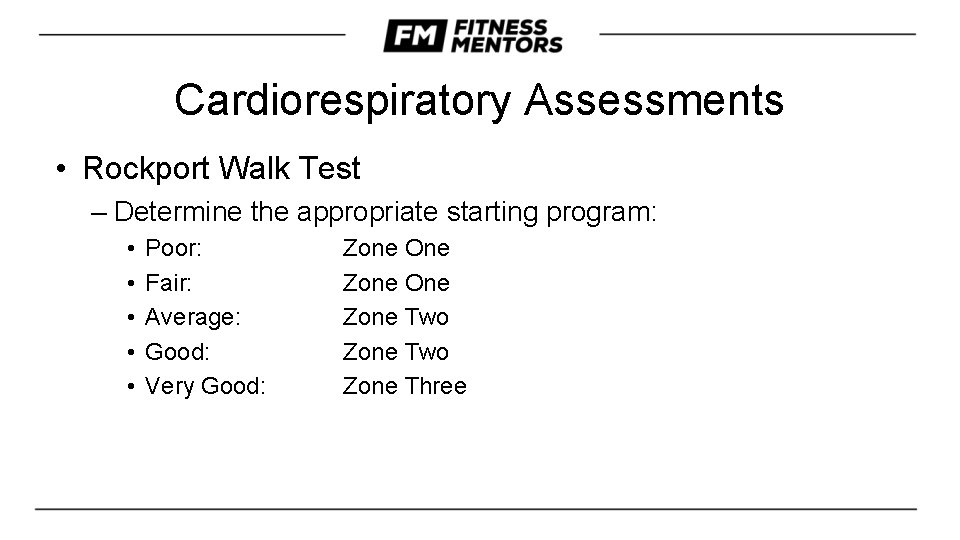
Cardiorespiratory Assessments • Rockport Walk Test – Determine the appropriate starting program: • • • Poor: Fair: Average: Good: Very Good: Zone One Zone Two Zone Three
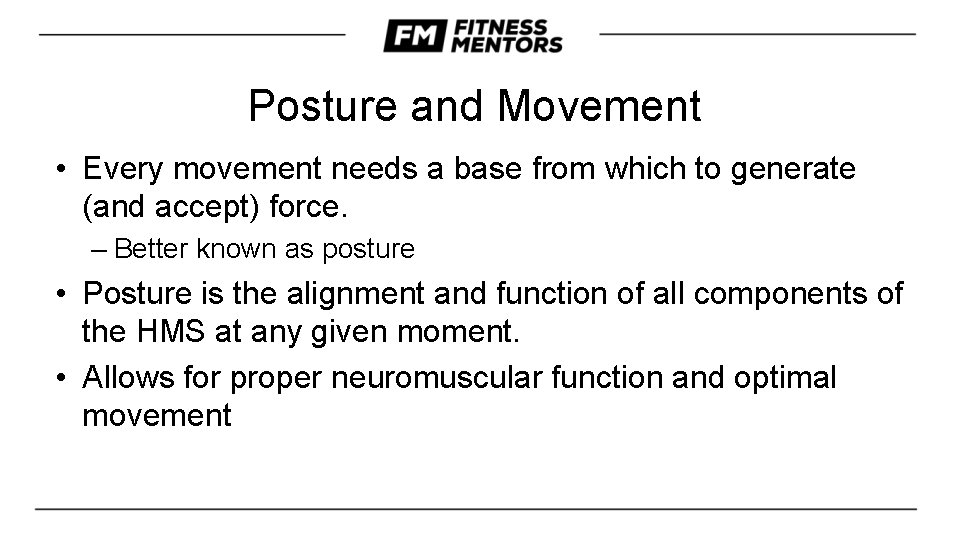
Posture and Movement • Every movement needs a base from which to generate (and accept) force. – Better known as posture • Posture is the alignment and function of all components of the HMS at any given moment. • Allows for proper neuromuscular function and optimal movement
Posture • Proper posture ensures that the muscles of the body are optimally aligned at the proper length–tension relationships necessary for efficient functioning of force– couples and joint motion (neuromuscular efficiency). • Neuromuscular efficiency is the ability of the nervous system to properly recruit all muscles in all planes of motion.
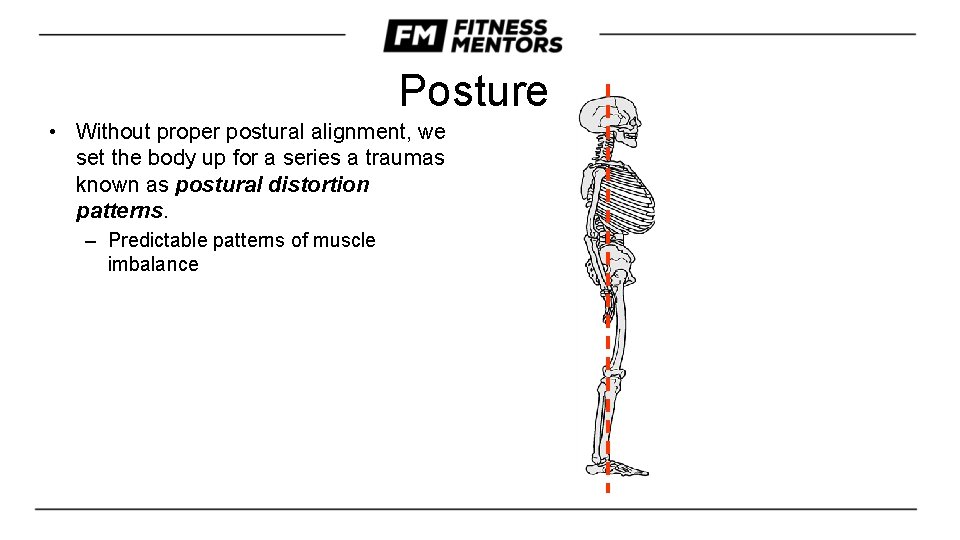
Posture • Without proper postural alignment, we set the body up for a series a traumas known as postural distortion patterns. – Predictable patterns of muscle imbalance
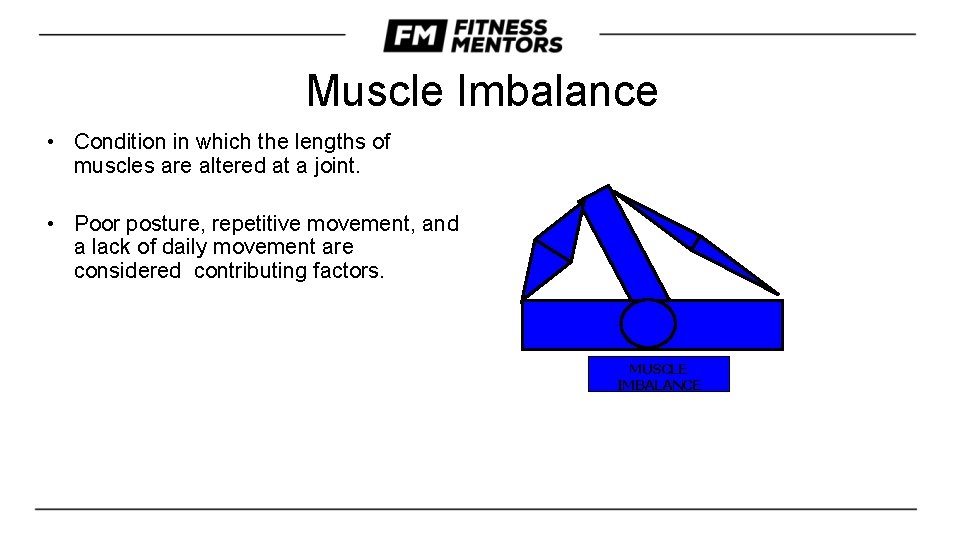
Muscle Imbalance • Condition in which the lengths of muscles are altered at a joint. • Poor posture, repetitive movement, and a lack of daily movement are considered contributing factors. MUSCLE IMBALANCE
Postural Distortions • Predictable Patterns of Muscle Imbalance – Lower Crossed Syndrome – Upper Crossed Syndrome – Pronation Distortion Syndrome
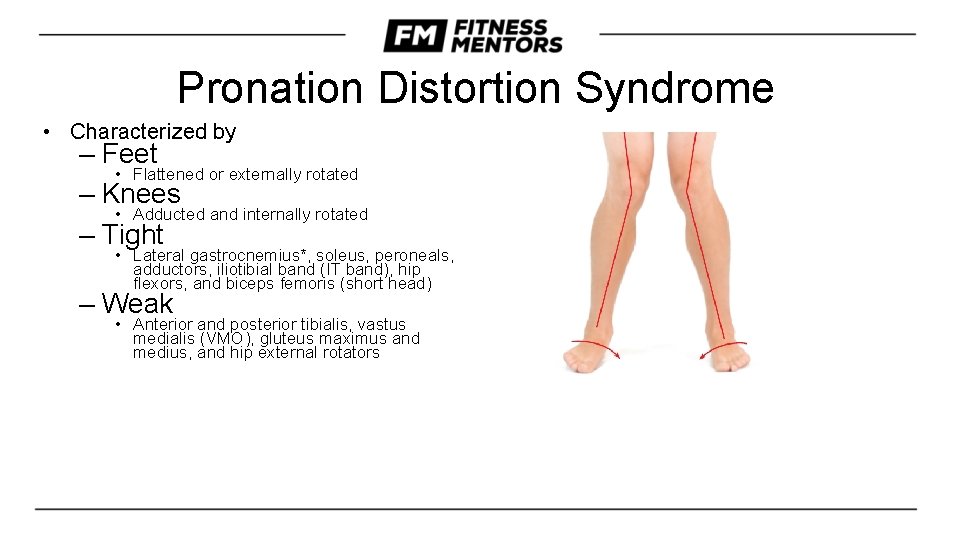
Pronation Distortion Syndrome • Characterized by – Feet • Flattened or externally rotated – Knees • Adducted and internally rotated – Tight • Lateral gastrocnemius*, soleus, peroneals, adductors, iliotibial band (IT band), hip flexors, and biceps femoris (short head) – Weak • Anterior and posterior tibialis, vastus medialis (VMO), gluteus maximus and medius, and hip external rotators
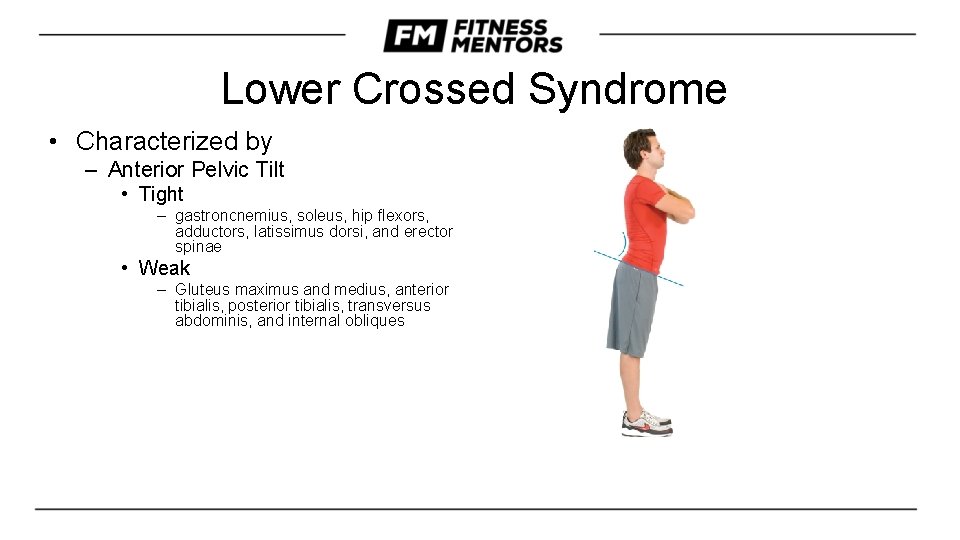
Lower Crossed Syndrome • Characterized by – Anterior Pelvic Tilt • Tight – gastroncnemius, soleus, hip flexors, adductors, latissimus dorsi, and erector spinae • Weak – Gluteus maximus and medius, anterior tibialis, posterior tibialis, transversus abdominis, and internal obliques
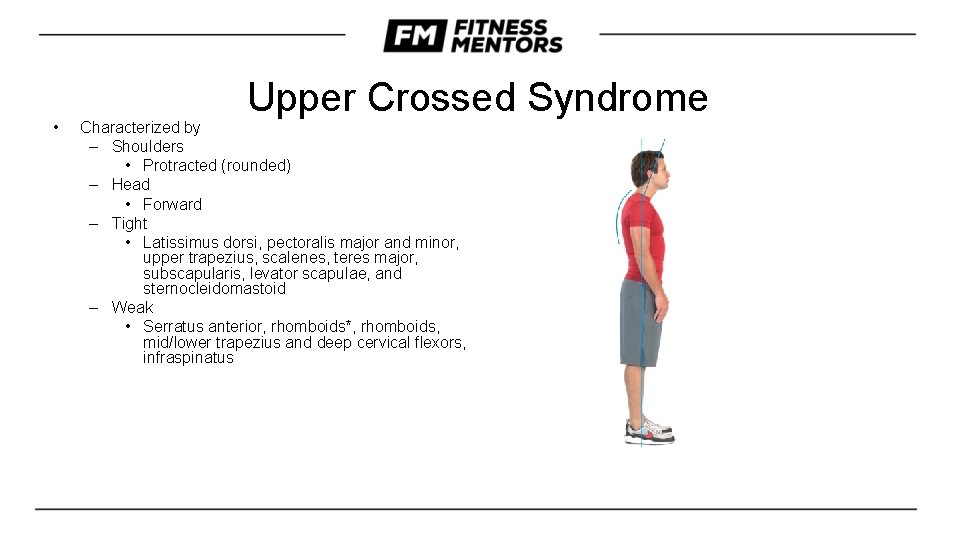
• Upper Crossed Syndrome Characterized by – Shoulders • Protracted (rounded) – Head • Forward – Tight • Latissimus dorsi, pectoralis major and minor, upper trapezius, scalenes, teres major, subscapularis, levator scapulae, and sternocleidomastoid – Weak • Serratus anterior, rhomboids*, rhomboids, mid/lower trapezius and deep cervical flexors, infraspinatus
Movement Observations • Dynamic postural observations (looking at movement) are often the quickest way to gain an overall impression of a client’s functional status. • Should relate to basic functions such as squatting, pushing, pulling, and balancing. • Can also be incorporated as a first workout for your client.
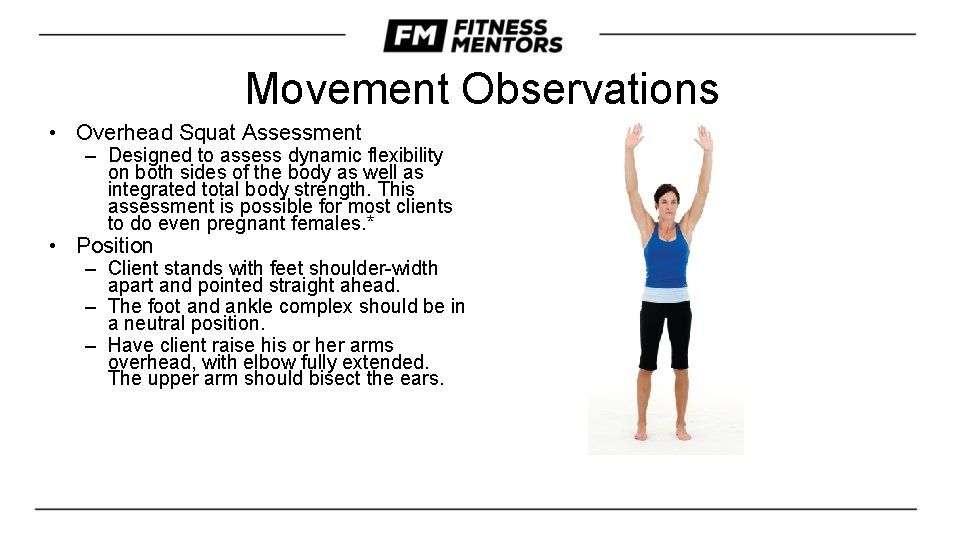
Movement Observations • Overhead Squat Assessment – Designed to assess dynamic flexibility on both sides of the body as well as integrated total body strength. This assessment is possible for most clients to do even pregnant females. * • Position – Client stands with feet shoulder-width apart and pointed straight ahead. – The foot and ankle complex should be in a neutral position. – Have client raise his or her arms overhead, with elbow fully extended. The upper arm should bisect the ears.
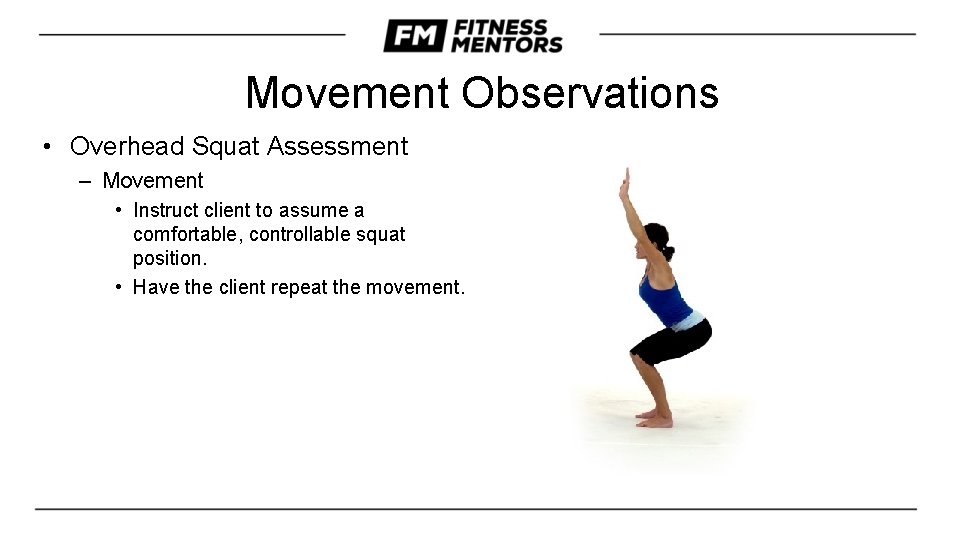
Movement Observations • Overhead Squat Assessment – Movement • Instruct client to assume a comfortable, controllable squat position. • Have the client repeat the movement.
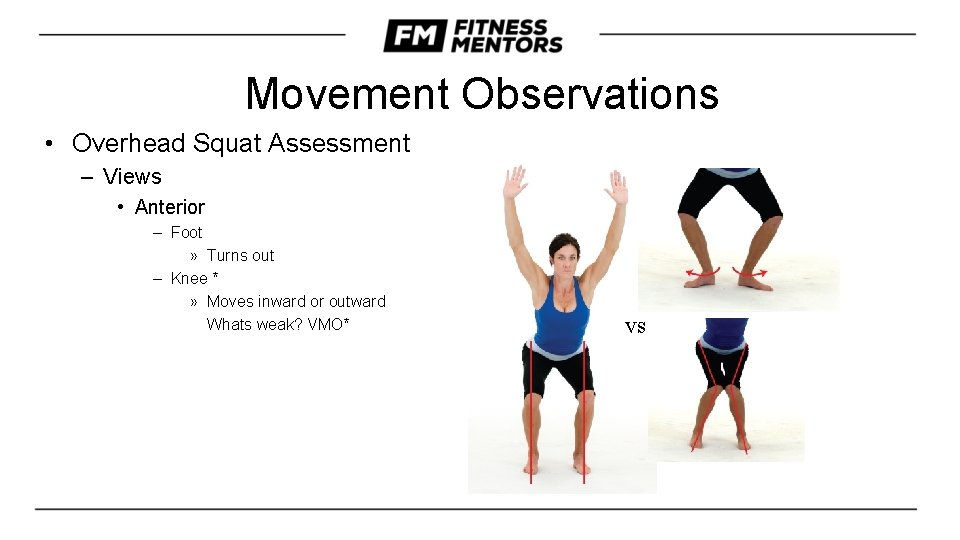
Movement Observations • Overhead Squat Assessment – Views • Anterior – Foot » Turns out – Knee * » Moves inward or outward Whats weak? VMO* vs.
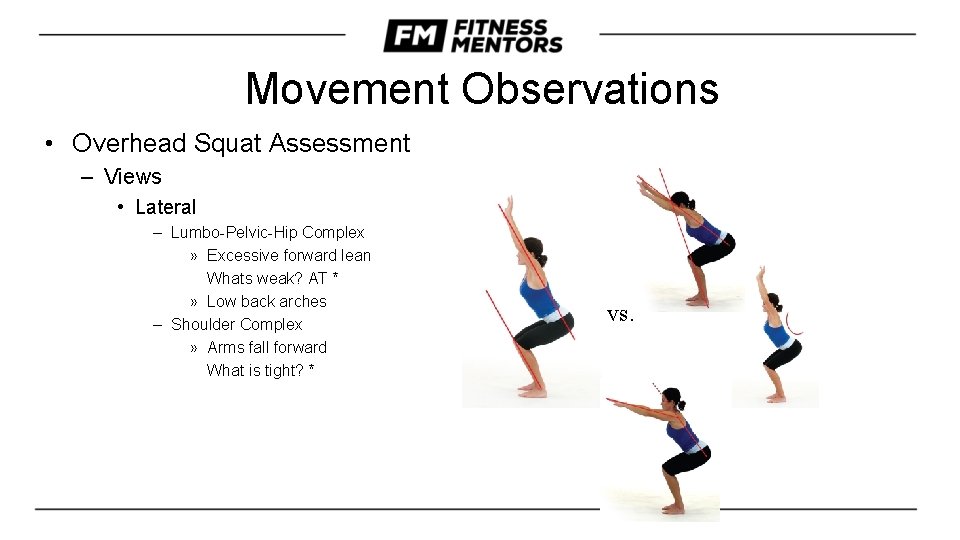
Movement Observations • Overhead Squat Assessment – Views • Lateral – Lumbo-Pelvic-Hip Complex » Excessive forward lean Whats weak? AT * » Low back arches – Shoulder Complex » Arms fall forward What is tight? * vs.
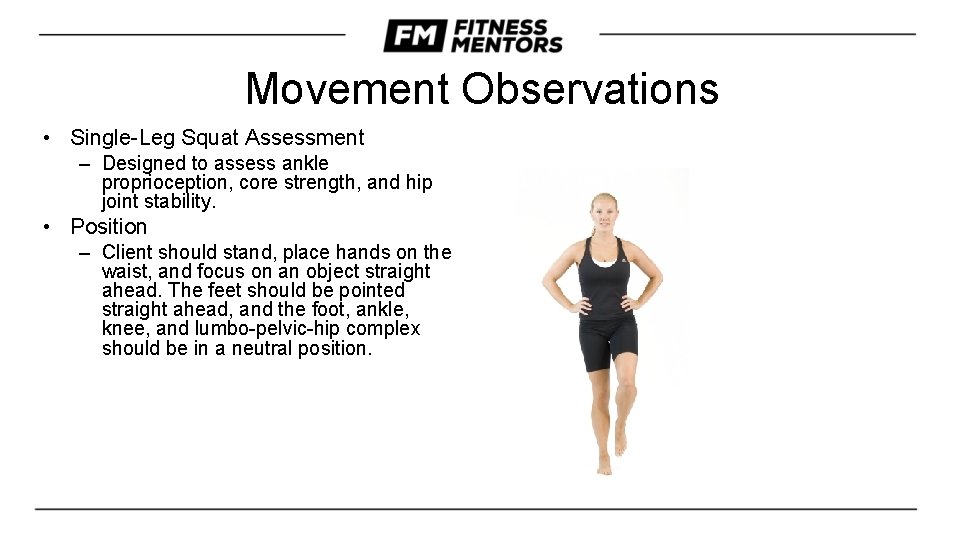
Movement Observations • Single-Leg Squat Assessment – Designed to assess ankle proprioception, core strength, and hip joint stability. • Position – Client should stand, place hands on the waist, and focus on an object straight ahead. The feet should be pointed straight ahead, and the foot, ankle, knee, and lumbo-pelvic-hip complex should be in a neutral position.
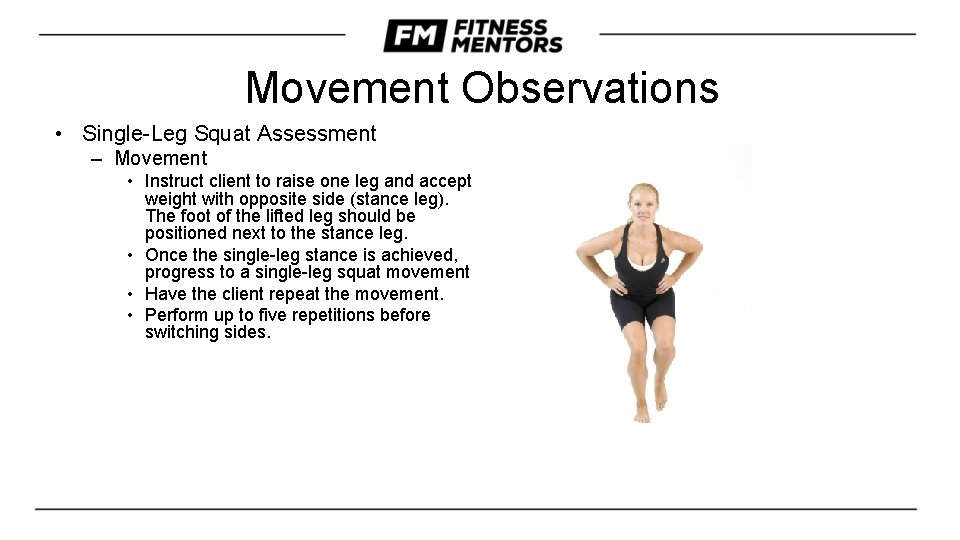
Movement Observations • Single-Leg Squat Assessment – Movement • Instruct client to raise one leg and accept weight with opposite side (stance leg). The foot of the lifted leg should be positioned next to the stance leg. • Once the single-leg stance is achieved, progress to a single-leg squat movement • Have the client repeat the movement. • Perform up to five repetitions before switching sides.
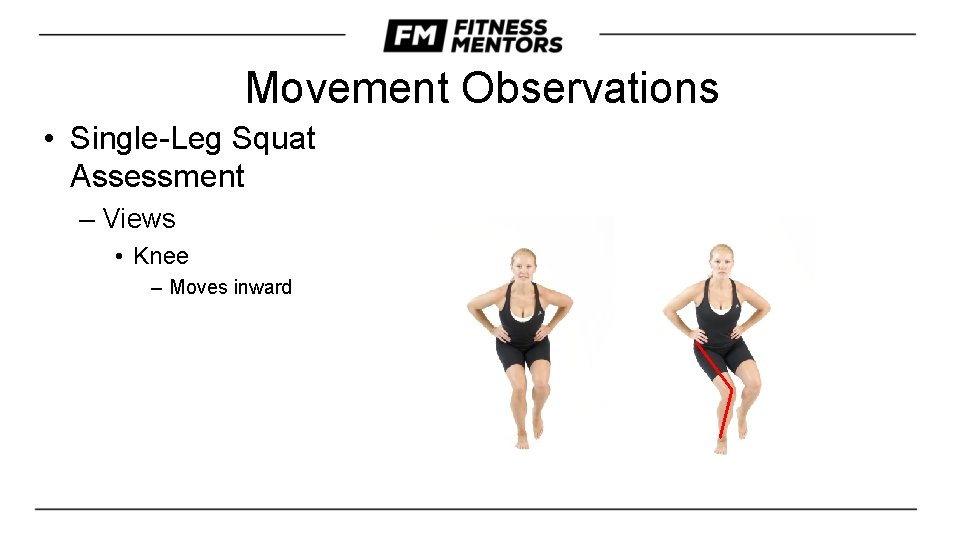
Movement Observations • Single-Leg Squat Assessment – Views • Knee – Moves inward
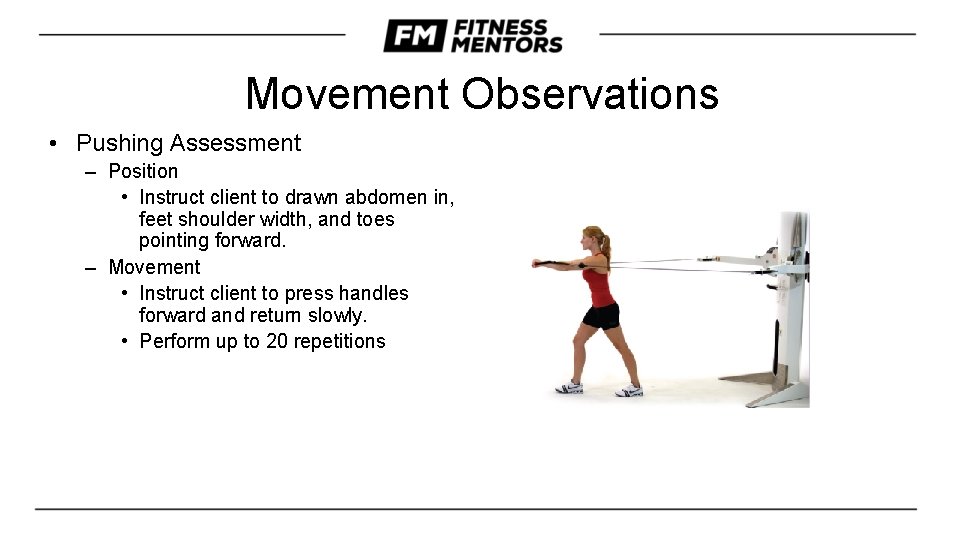
Movement Observations • Pushing Assessment – Position • Instruct client to drawn abdomen in, feet shoulder width, and toes pointing forward. – Movement • Instruct client to press handles forward and return slowly. • Perform up to 20 repetitions
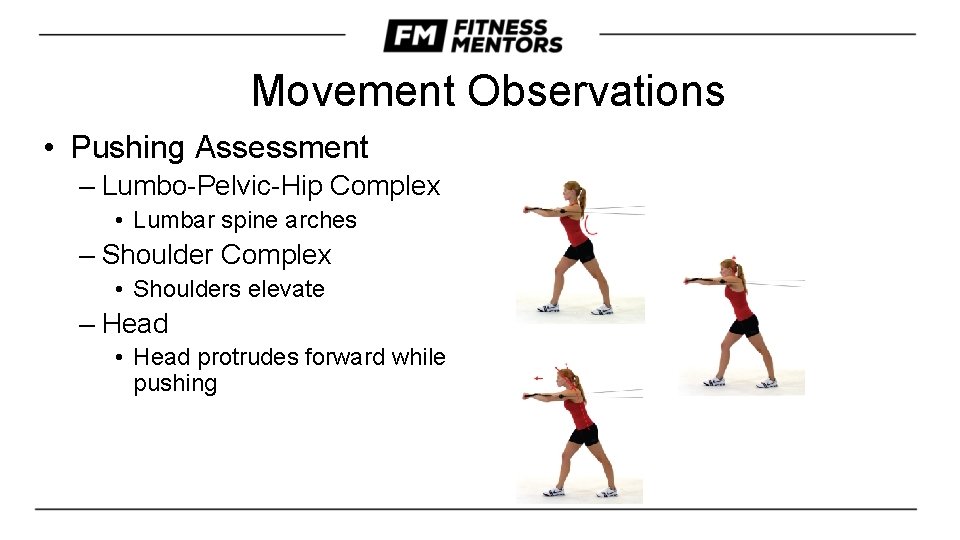
Movement Observations • Pushing Assessment – Lumbo-Pelvic-Hip Complex • Lumbar spine arches – Shoulder Complex • Shoulders elevate – Head • Head protrudes forward while pushing
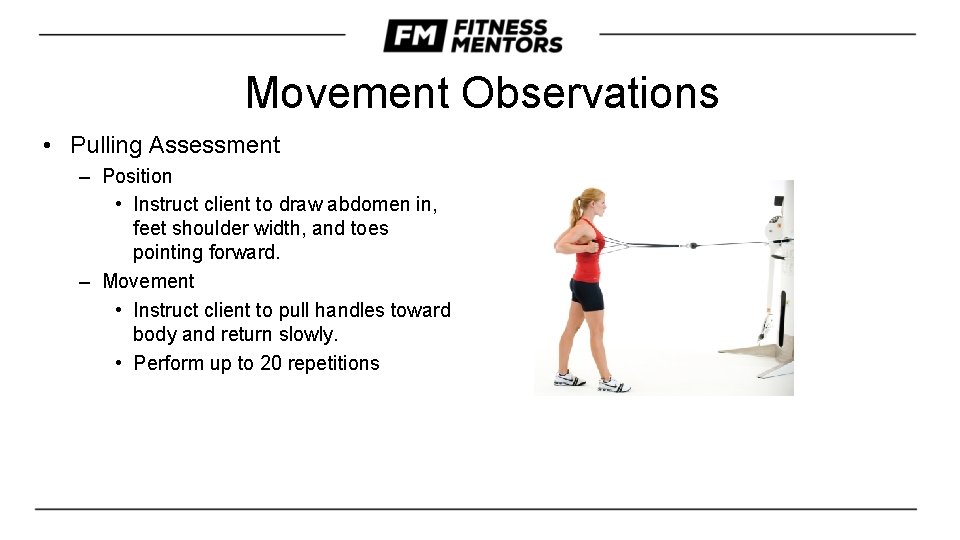
Movement Observations • Pulling Assessment – Position • Instruct client to draw abdomen in, feet shoulder width, and toes pointing forward. – Movement • Instruct client to pull handles toward body and return slowly. • Perform up to 20 repetitions
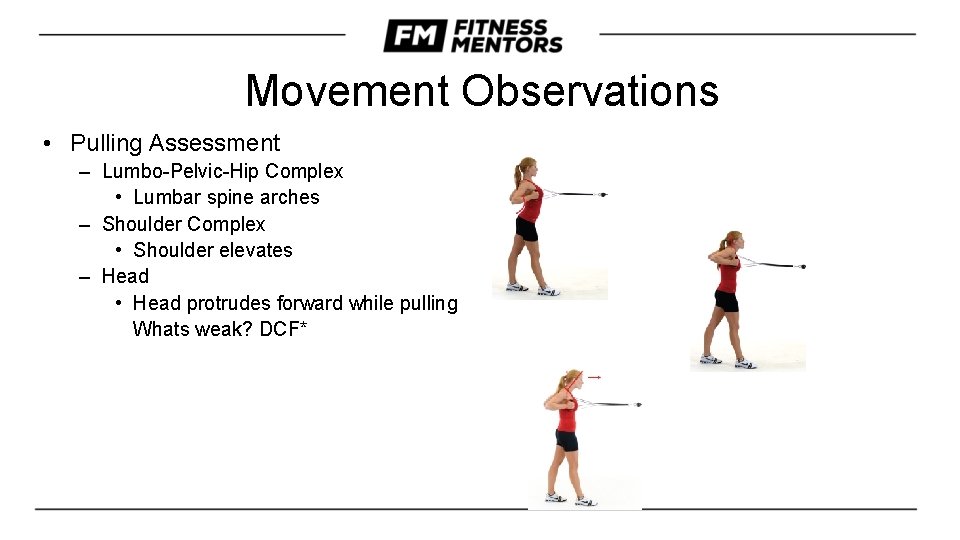
Movement Observations • Pulling Assessment – Lumbo-Pelvic-Hip Complex • Lumbar spine arches – Shoulder Complex • Shoulder elevates – Head • Head protrudes forward while pulling Whats weak? DCF*
Performance • Performance assessments can be used for clients trying to improve athletic performance. • Basic performance assessments include: – Davies Test – Shark Skill Test – Bench Press Strength Assessment – Leg Press Strength Assessment
Performance Assessments • Davies Test – Designed to assess upper extremity agility and stabilization – May not be suitable for individuals who lack shoulder stability
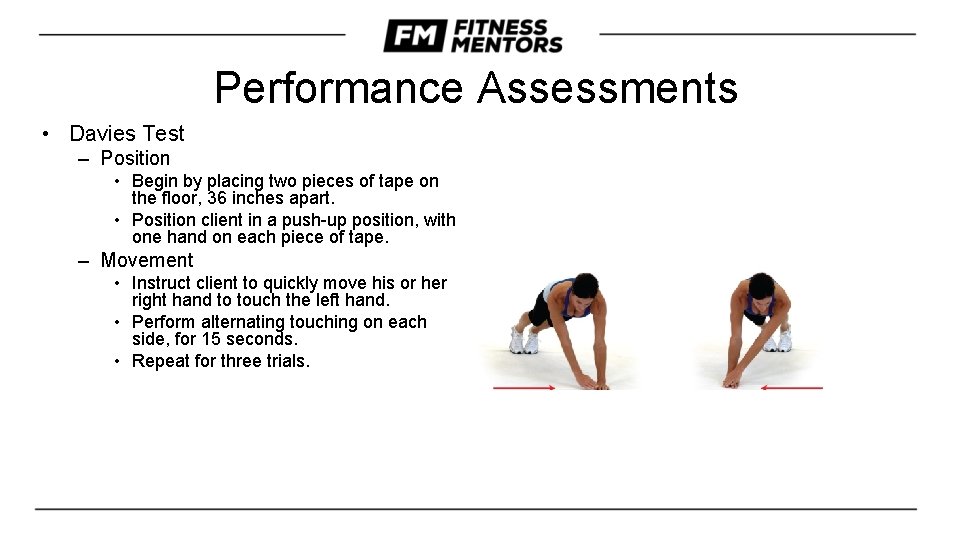
Performance Assessments • Davies Test – Position • Begin by placing two pieces of tape on the floor, 36 inches apart. • Position client in a push-up position, with one hand on each piece of tape. – Movement • Instruct client to quickly move his or her right hand to touch the left hand. • Perform alternating touching on each side, for 15 seconds. • Repeat for three trials.
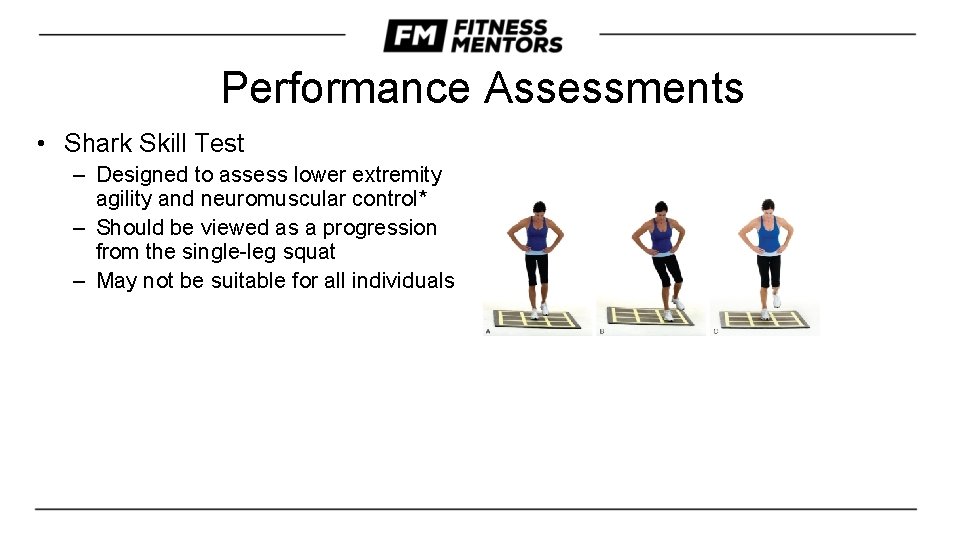
Performance Assessments • Shark Skill Test – Designed to assess lower extremity agility and neuromuscular control* – Should be viewed as a progression from the single-leg squat – May not be suitable for all individuals
Performance Assessments • Shark Skill Test – Position • Position client in the center box of a box grid, with hands on hips and standing on one leg. – Movement • Instruct client to hop to each box in a designated pattern, always returning to the center box. Be consistent with the pattern that you expect of the client. • Perform one practice run through the boxes with each foot. • Perform twice with each foot (four times total). Keep track of time. • Penalize 0. 10 seconds for each of the following faults: – – Nonhopping leg touches ground Hands come off hips Foot goes into wrong square Foot does not return to center square
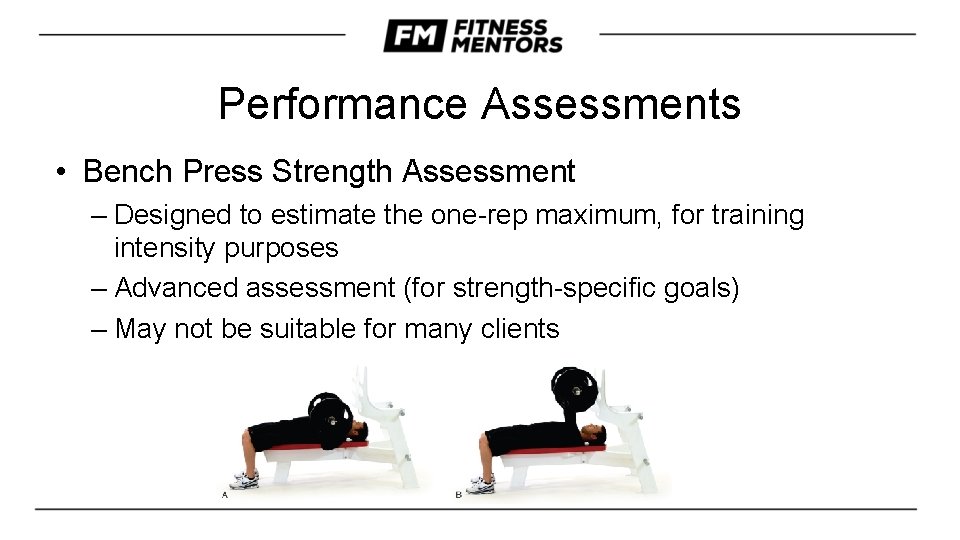
Performance Assessments • Bench Press Strength Assessment – Designed to estimate the one-rep maximum, for training intensity purposes – Advanced assessment (for strength-specific goals) – May not be suitable for many clients
Performance Assessments • Bench Press Strength Assessment – Position • Position client on a bench, lying on his or her back. Feet should be pointed straight ahead. The low back should be in a neutral position. – Movement • Instruct client to warm with a light weight for 8 -10 repetitions then rest 1 minute • Add 10 to 20 pounds (10– 20% of initial load) and perform 3 to 5 repetitions then rest 2 minutes • Repeat this step into a true 1 rep maximum has been achieved
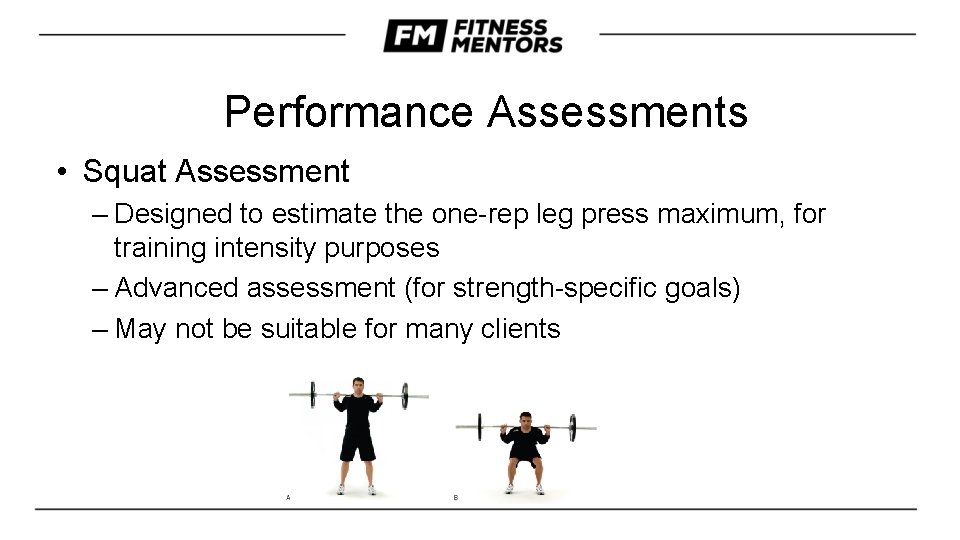
Performance Assessments • Squat Assessment – Designed to estimate the one-rep leg press maximum, for training intensity purposes – Advanced assessment (for strength-specific goals) – May not be suitable for many clients
Performance Assessments • Squat Strength Assessment – Position • Position standing with bar on his or her back. Feet should be pointed straight ahead and knees in line with the toes. The low back should be in a neutral position. – Movement • Instruct client to perform 3– 5 repetitions with perfect form. • Chart amount of weight used for accomplished repetitions. • Refer to the appendix of the textbook for comparison charts to estimate the one-rep maximum.
Summary • The fitness assessment enables the fitness professional to decide the appropriate selection of flexibility, cardiorespiratory, core, balance, power, and strength training exercises.
- Slides: 68