
Chapter 6 Final Consumers and Their Buying Behavior

Chapter 6: Final Consumers and Their Buying Behavior For use only with Perreault and Mc. Carthy texts. © The Mc. Graw-Hill Companies, Inc. , 1999 Irwin/Mc. Graw-Hill
Possible Needs Motivating a Person to Some Action For use only with Perreault and Mc. Carthy texts. © The Mc. Graw-Hill Companies, Inc. , 1999 Irwin/Mc. Graw-Hill
For use only with Perreault and Mc. Carthy texts. © The Mc. Graw-Hill Companies, Inc. , 1999 Irwin/Mc. Graw-Hill
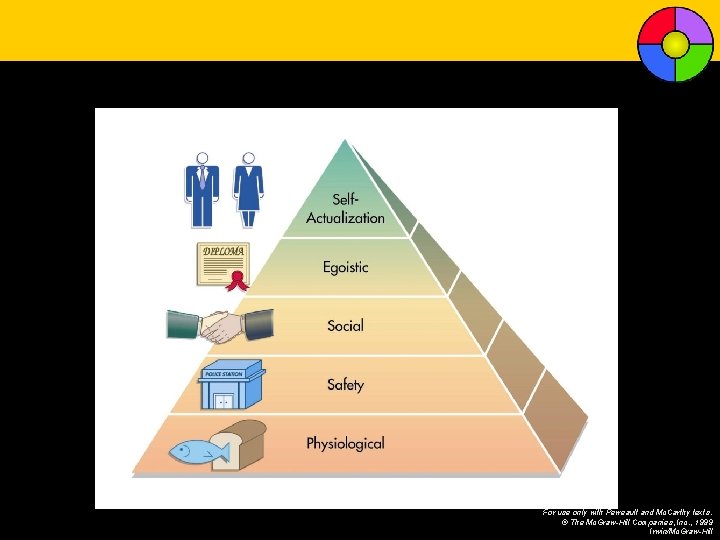
l l l l l l Several Needs at the Same Time: PSSP Hierarchy of Needs (Exhibit 6 -4) Summary Overview Many different levels of needs can appeal to or motivate a person. The PSSP pyramid shown here helps apply motivation theory to the particular needs of consumers and marketing managers trying to develop marketing mixes to meet those needs. Key Issues �� Physiological needs: the most basic needs people experience. • Examples: biological needs for food, liquid, and rest. �� Safety needs: concerned with protection and physical well-being. • Examples: health, medicine, exercise, security. �� Social needs: derived from a person’s interactions with others. • Examples: love, friendship, status. �� Personal needs: concerned with an individual’s need for personal satisfaction, unrelated to what others do. • Examples: self-esteem, fun, and freedom. Discussion Question: Can you provide an example of products or services whose marketing mixes attempt to fulfill the four types of needs? NOTE: Some products may try to satisfy only one type of need, while others may attempt to satisfy more than one type. This slide relates to material on pp. 156 -157. �� For use only with Perreault and Mc. Carthy texts. © The Mc. Graw-Hill Companies, Inc. , 1999 Irwin/Mc. Graw-Hill
Lifestyle Dimensions (and some related demographic dimensions) For use only with Perreault and Mc. Carthy texts. © The Mc. Graw-Hill Companies, Inc. , 1999 Irwin/Mc. Graw-Hill
Characteristics and Attitudes of Middle and Lower Classes l Middle classes l Lower classes l Plan and save for the future l Live for the present l Analyze alternatives l "Feel" what is "best" l Understand how the world l l works Feel they have opportunities Willing to take risks Confident about decision making Want long-run quality or value l Have simplistic ideas about how things work l Feel controlled by the world l "Play it safe" l Want help with decision making l Want short-run satisfaction For use only with Perreault and Mc. Carthy texts. © The Mc. Graw-Hill Companies, Inc. , 1999 Irwin/Mc. Graw-Hill
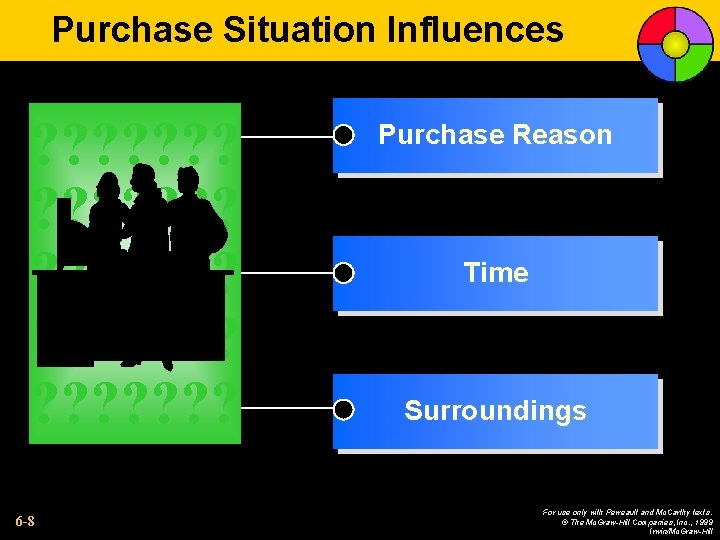
Purchase Situation Influences ? ? ? ? ? ? ? ? ? 6 -8 Purchase Reason Time Surroundings For use only with Perreault and Mc. Carthy texts. © The Mc. Graw-Hill Companies, Inc. , 1999 Irwin/Mc. Graw-Hill
![Consumer Decision Process l 1] Problem Recognition l 2] Information Search l 3] Evaluation](http://slidetodoc.com/presentation_image/cb73da5651b39444c04a03b44f57b00a/image-8.jpg "Consumer Decision Process l 1] Problem Recognition l 2] Information Search l 3] Evaluation")
Consumer Decision Process l 1] Problem Recognition l 2] Information Search l 3] Evaluation of Alternatives l 4] Purchase Decision & Purchase l 5] Post-Purchase Evaluation For use only with Perreault and Mc. Carthy texts. © The Mc. Graw-Hill Companies, Inc. , 1999 Irwin/Mc. Graw-Hill
l Problem Recognition – consumer becomes aware of a discrepancy between their existing and their desired state of affairs. l Information Search – gathering information in order to determine the alternative means to solve the problem. l Information Search can be internal only or also external l Evoked Set – Brands that immediately come to mind to solve a problem For use only with Perreault and Mc. Carthy texts. © The Mc. Graw-Hill Companies, Inc. , 1999 Irwin/Mc. Graw-Hill
l Evaluation of Alternatives – person looks at the merits of the choices available l Purchase Decision & Purchase – Deciding to buy, where to buy, and how to buy. l Post-Purchase Evaluation – individual consumes the product and decides how well product solved the problem. l Dissonance – tension caused by uncertainty about the rightness of a decision (pg 169). For use only with Perreault and Mc. Carthy texts. © The Mc. Graw-Hill Companies, Inc. , 1999 Irwin/Mc. Graw-Hill
3 Consumer Problem Solving Processes l Routinized Response Behavior l Limited Problem Solving l Extensive Problem Solving For use only with Perreault and Mc. Carthy texts. © The Mc. Graw-Hill Companies, Inc. , 1999 Irwin/Mc. Graw-Hill
Routinized Response Behavior l Definition - when consumers regularly select a particular way of satisfying a need when it occurs (pg 169) l Internal Search for Information l Individual currently satisfied with the brand l Little (no) information search For use only with Perreault and Mc. Carthy texts. © The Mc. Graw-Hill Companies, Inc. , 1999 Irwin/Mc. Graw-Hill
Limited Problem Solving l Defined - when some effort is required in deciding the best way to satisfy a need (pg 169) l Some ? ’s about the product or l Get information about an unfamiliar brand in a familiar product category l Decision criteria set, but new information needed to pick a brand For use only with Perreault and Mc. Carthy texts. © The Mc. Graw-Hill Companies, Inc. , 1999 Irwin/Mc. Graw-Hill
Extensive Problem Solving l Defined - consumers put much effort into deciding how to satisfy a need (pg 169) l Purchaser unfamiliar with product category or high purchase risk l Must set decision criteria l Extensive information search (internal and external) l High time cost to use EPS For use only with Perreault and Mc. Carthy texts. © The Mc. Graw-Hill Companies, Inc. , 1999 Irwin/Mc. Graw-Hill
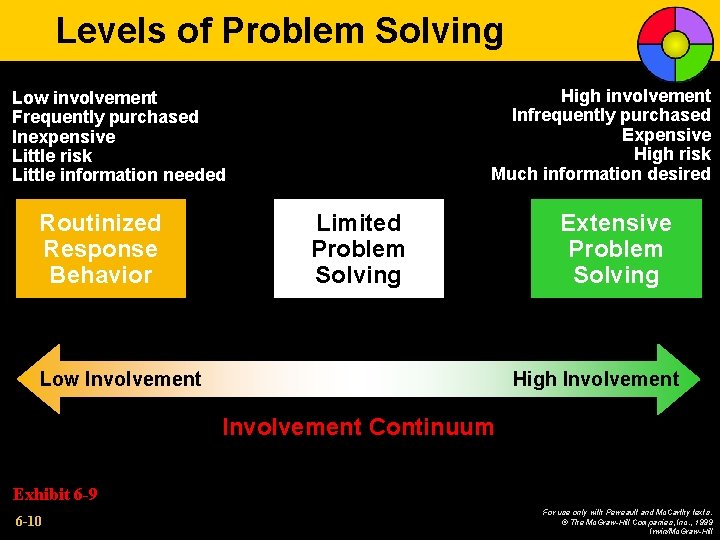
Levels of Problem Solving High involvement Infrequently purchased Expensive High risk Much information desired Low involvement Frequently purchased Inexpensive Little risk Little information needed Routinized Response Behavior Limited Problem Solving Low Involvement Extensive Problem Solving High Involvement Continuum Exhibit 6 -9 6 -10 For use only with Perreault and Mc. Carthy texts. © The Mc. Graw-Hill Companies, Inc. , 1999 Irwin/Mc. Graw-Hill
- Slides: 15