
Chapter 6 Featurebased alignment Advanced Computer Vision d

Chapter 6 Feature-based alignment Advanced Computer Vision 張家豪 地理所 博二 d 05228003@ntu. edu. tw
Feature-based Alignment • Match extracted features across different images • Verify the geometrical consistency of matching features • Applications: – Image stitching – Augmented reality –…

Feature-based Alignment • Outline: – 2 D and 3 D feature-based alignment – Pose estimation – Geometric intrinsic calibration
2 D and 3 D Feature-based Alignment • Estimate the motion between two or more sets of matched 2 D or 3 D points • In this section: – Restrict to global parametric transformations – Curved surfaces with higher order transformation – Non-rigid or elastic deformations will not be discussed here.
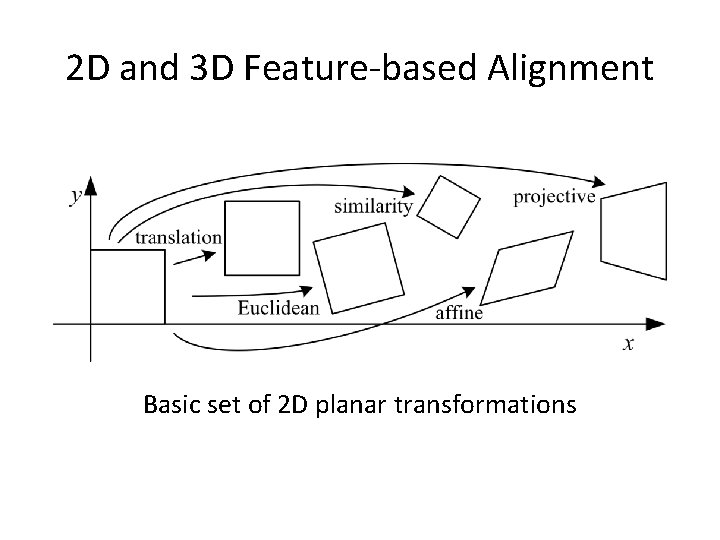
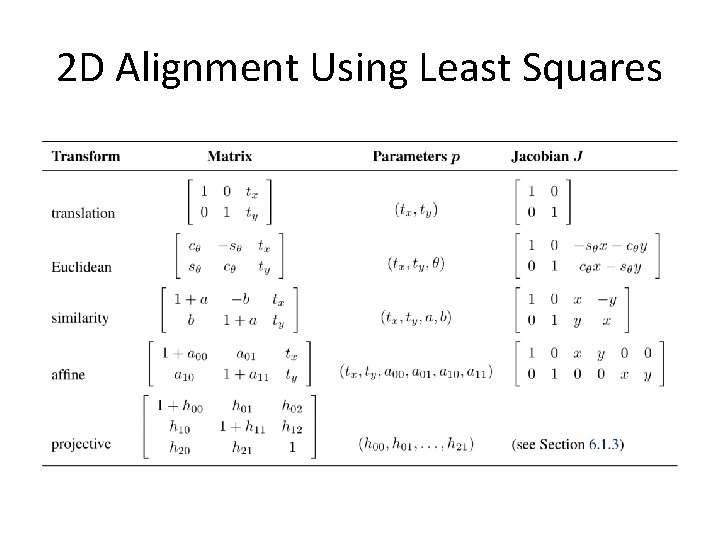
2 D and 3 D Feature-based Alignment Basic set of 2 D planar transformations
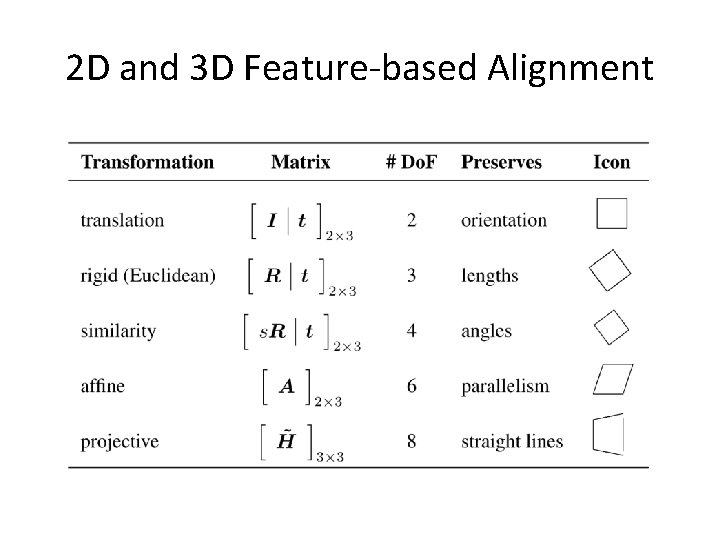
2 D and 3 D Feature-based Alignment
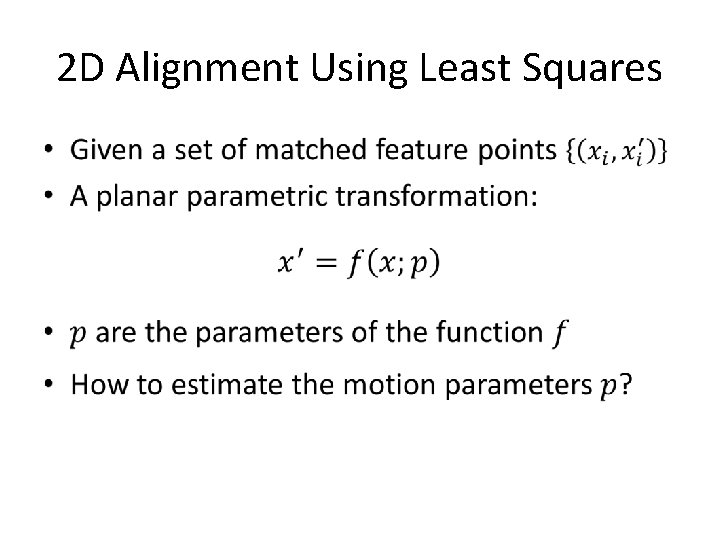
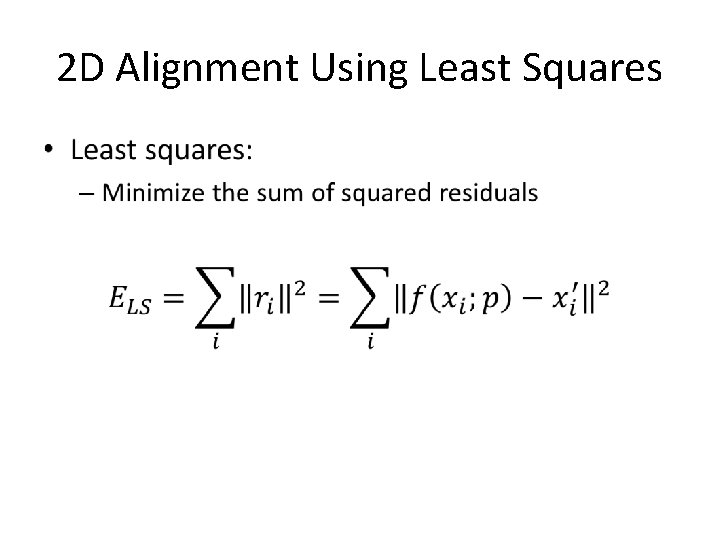
2 D Alignment Using Least Squares •
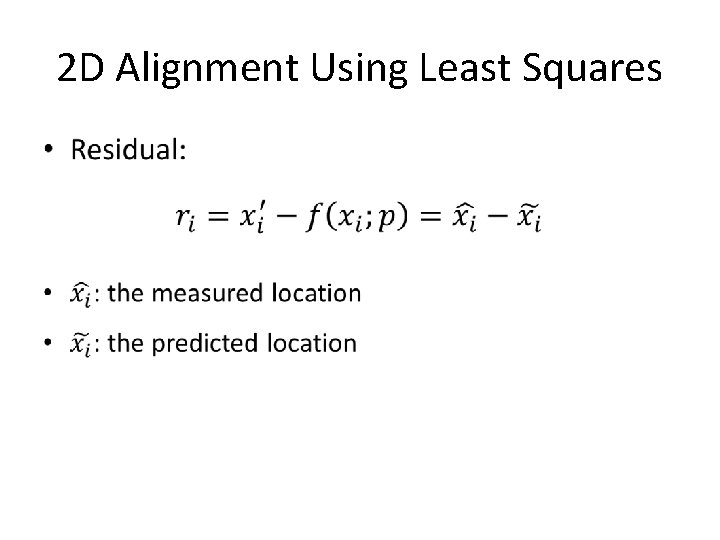
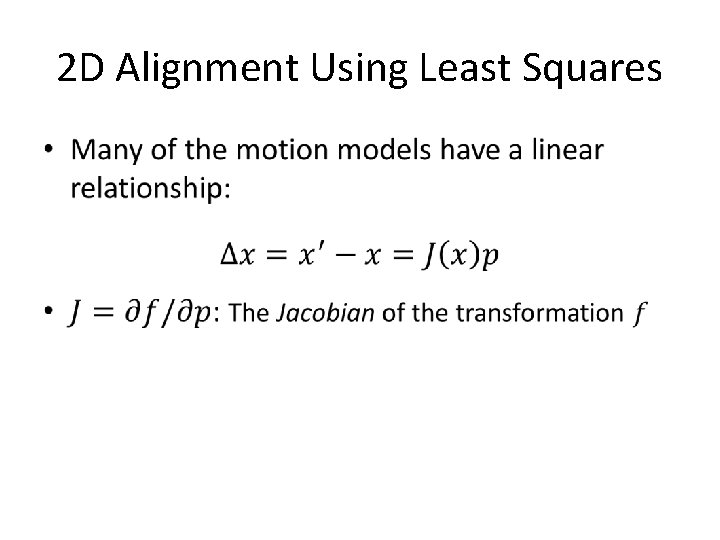
2 D Alignment Using Least Squares •
2 D Alignment Using Least Squares •
2 D Alignment Using Least Squares •
2 D Alignment Using Least Squares
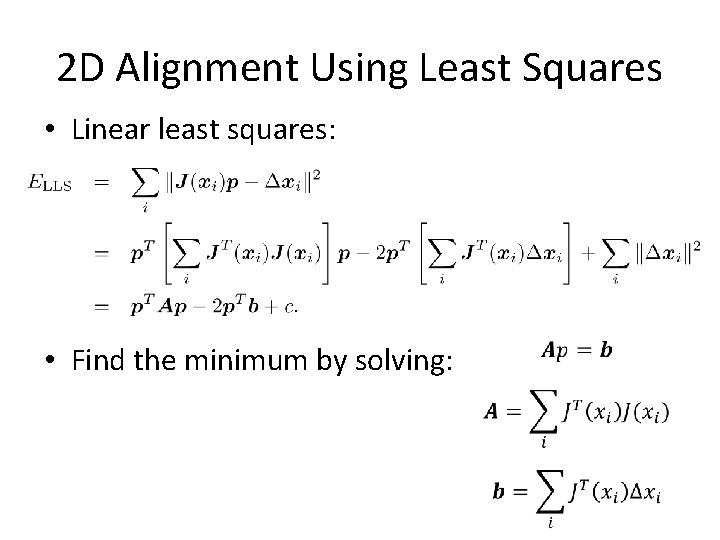
2 D Alignment Using Least Squares • Linear least squares: • Find the minimum by solving:
Iterative algorithms • Most problems do not have a simple linear relationship – non-linear least squares – non-linear regression
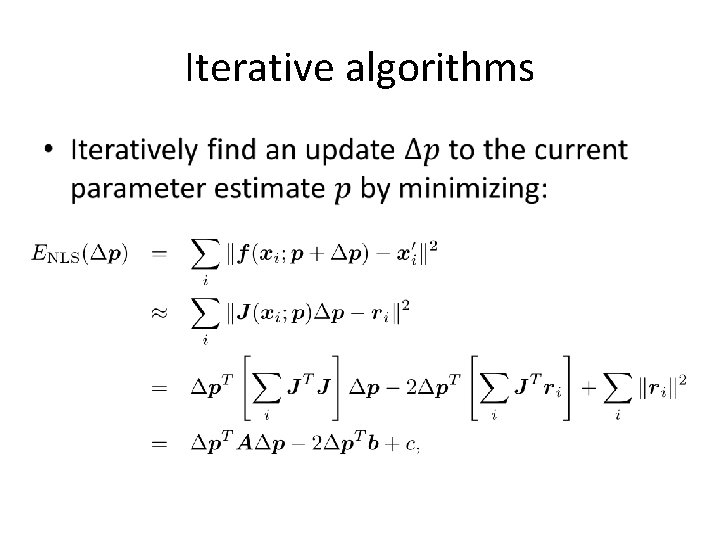
Iterative algorithms •
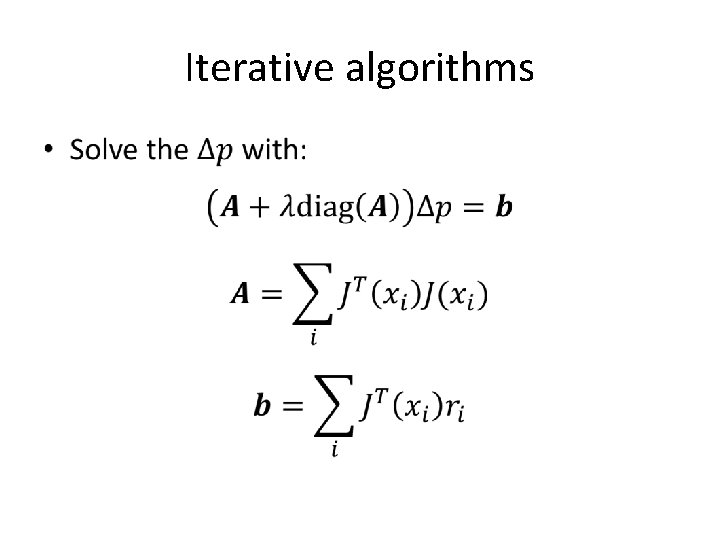
Iterative algorithms •
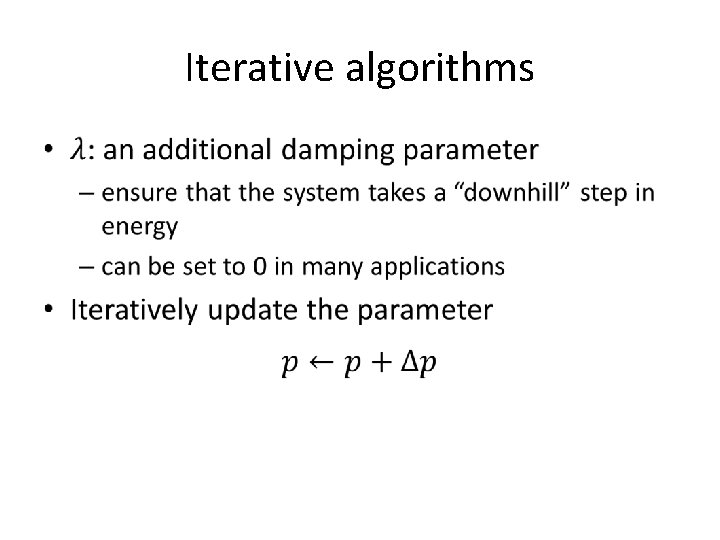
Iterative algorithms •
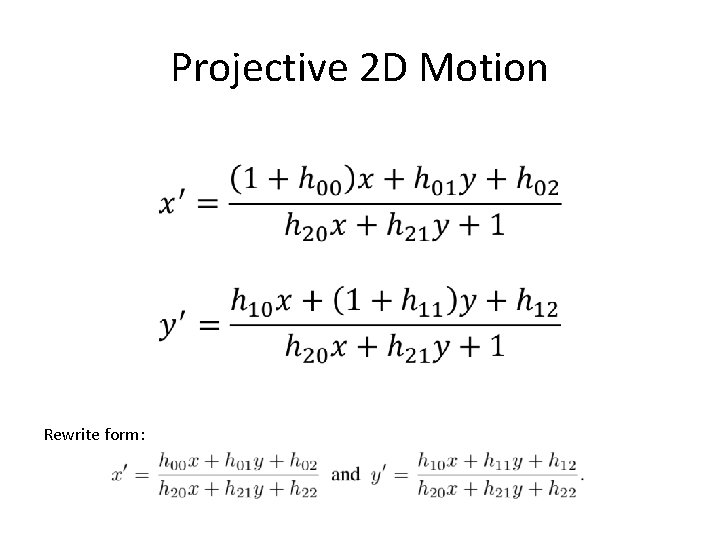
Projective 2 D Motion • Rewrite form:
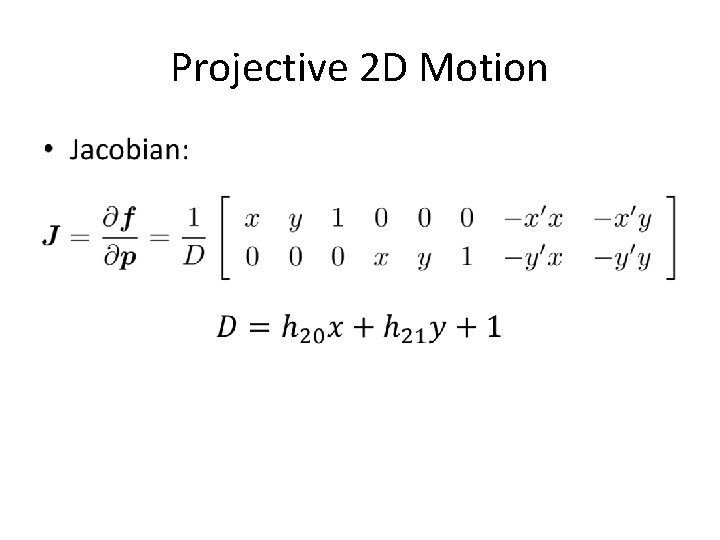
Projective 2 D Motion •
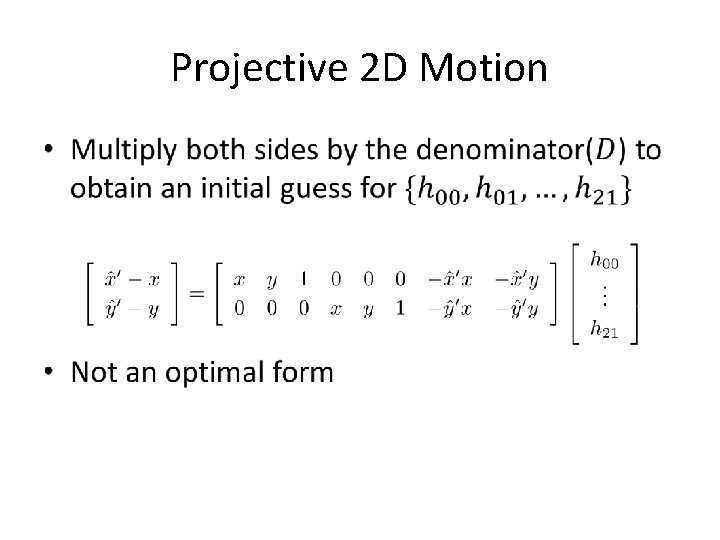
Projective 2 D Motion •
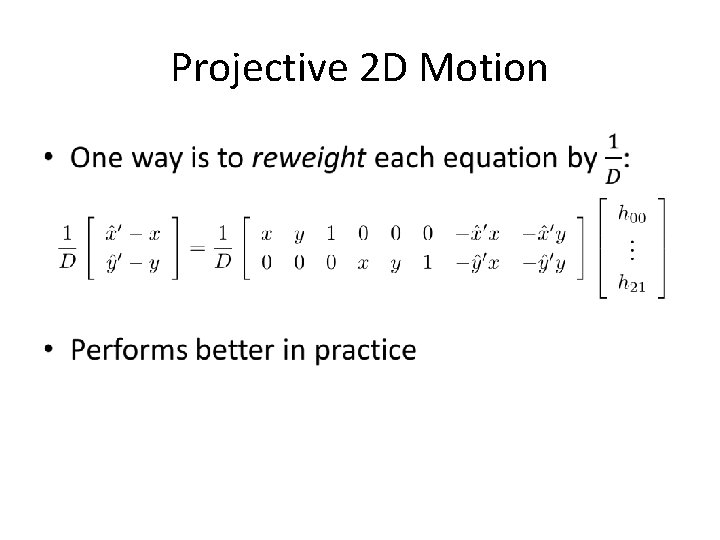
Projective 2 D Motion •
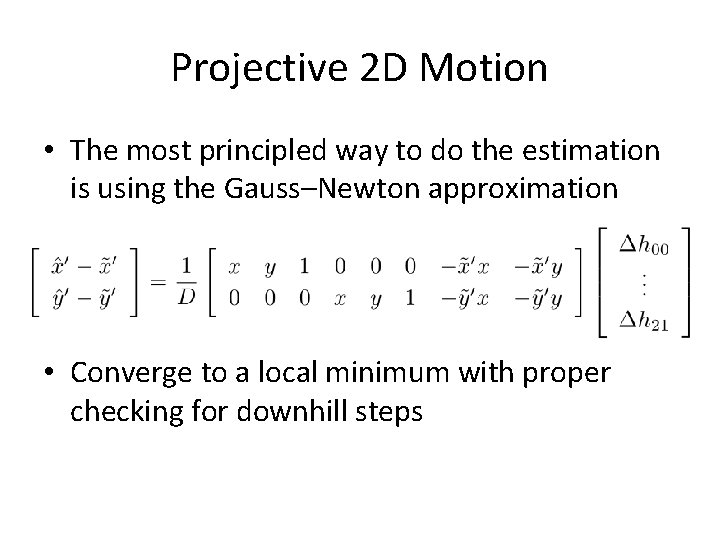
Projective 2 D Motion • The most principled way to do the estimation is using the Gauss–Newton approximation • Converge to a local minimum with proper checking for downhill steps
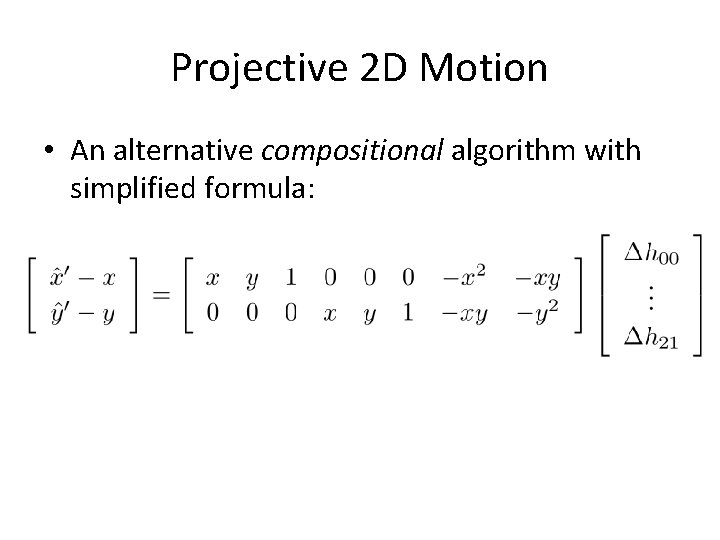
Projective 2 D Motion • An alternative compositional algorithm with simplified formula:
Robust least squares • More robust versions of least squares are required when there are outliers among the correspondences
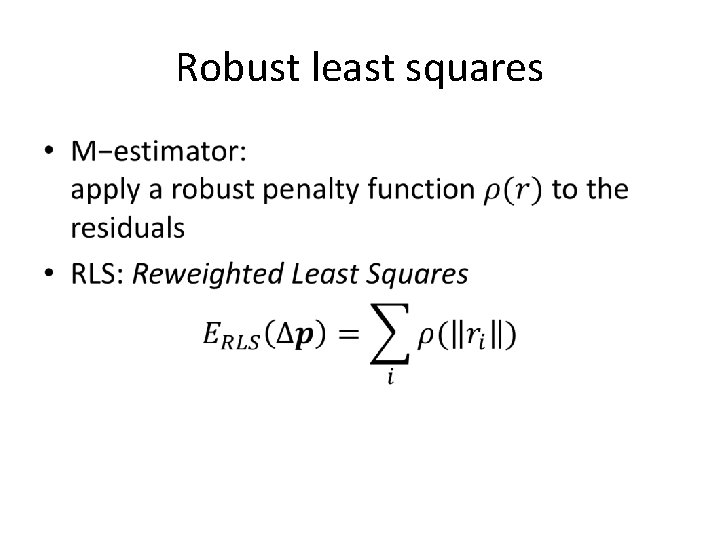
Robust least squares •
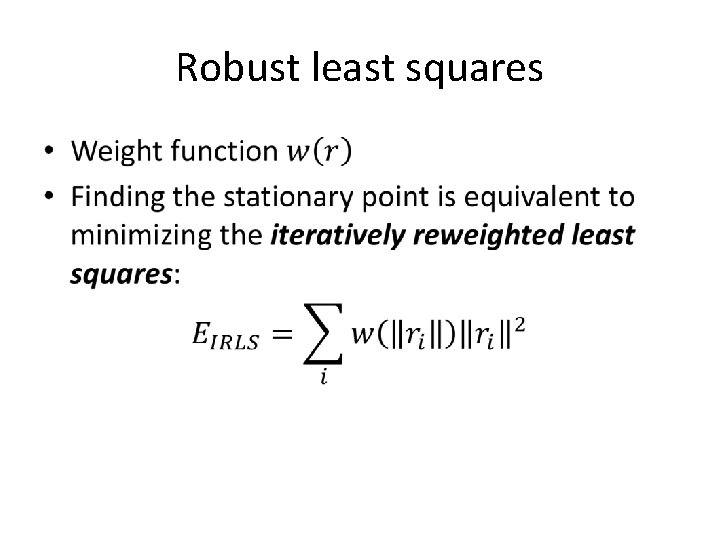
Robust least squares •
RANSAC and Least Median of Squares • Sometimes, too many outliers will prevent IRLS (or other gradient descent algorithms) from converging to the global optimum. • A better approach is find a starting set of inlier correspondences
RANSAC and Least Median of Squares • RANSAC (RANdom SAmple Consensus) • Least Median of Squares
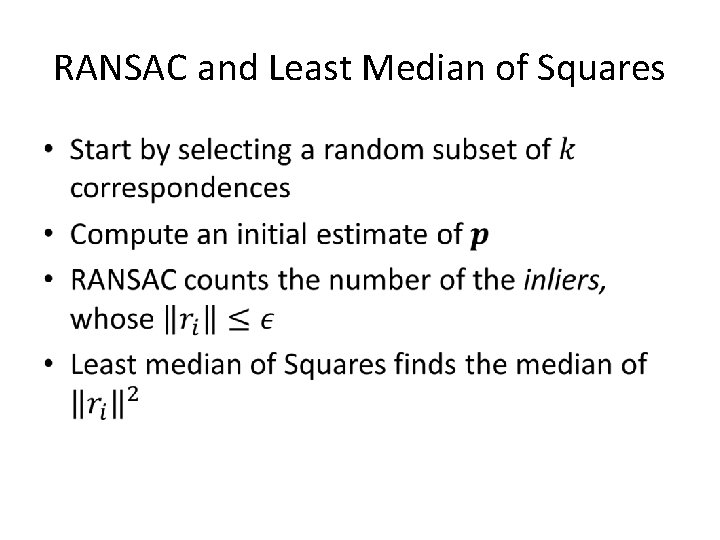
RANSAC and Least Median of Squares •
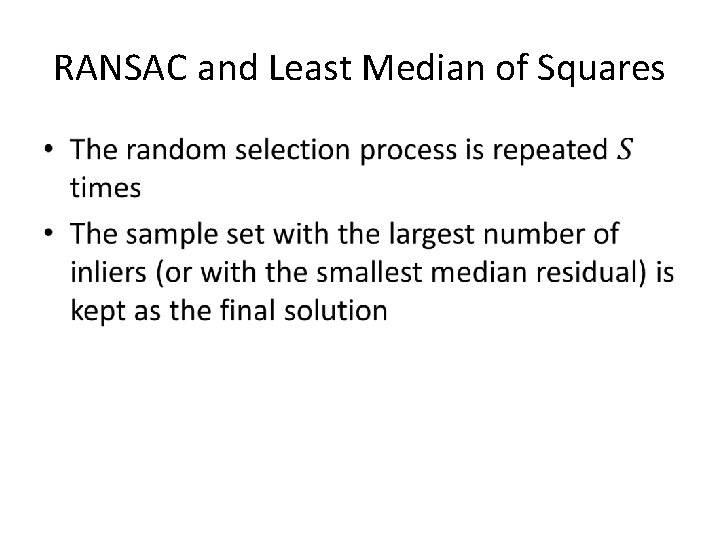
RANSAC and Least Median of Squares •
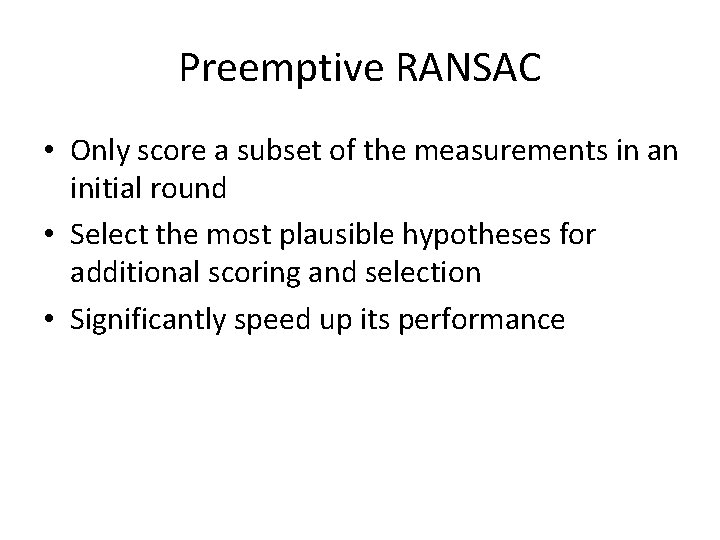
Preemptive RANSAC • Only score a subset of the measurements in an initial round • Select the most plausible hypotheses for additional scoring and selection • Significantly speed up its performance
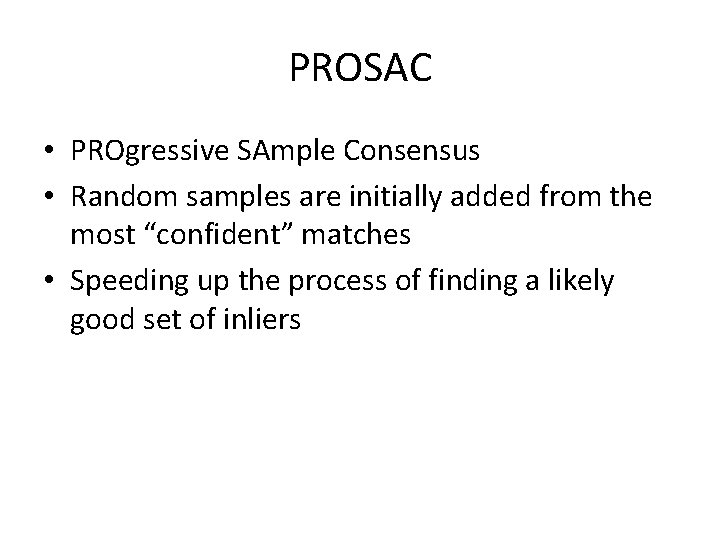
PROSAC • PROgressive SAmple Consensus • Random samples are initially added from the most “confident” matches • Speeding up the process of finding a likely good set of inliers
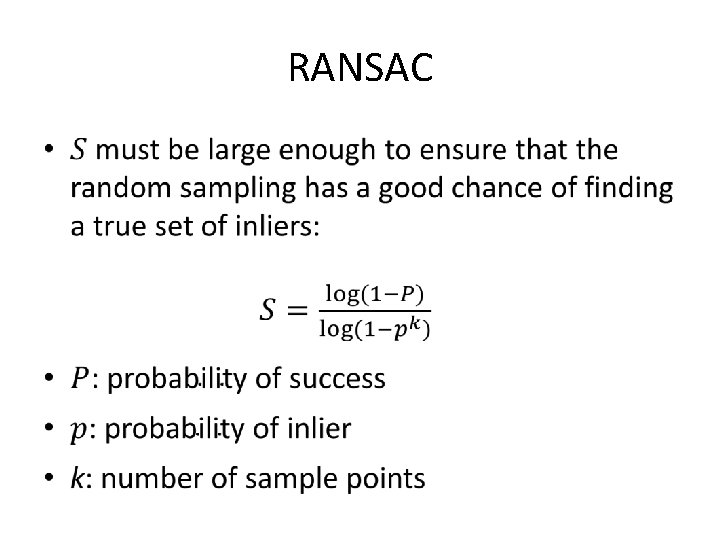
RANSAC •
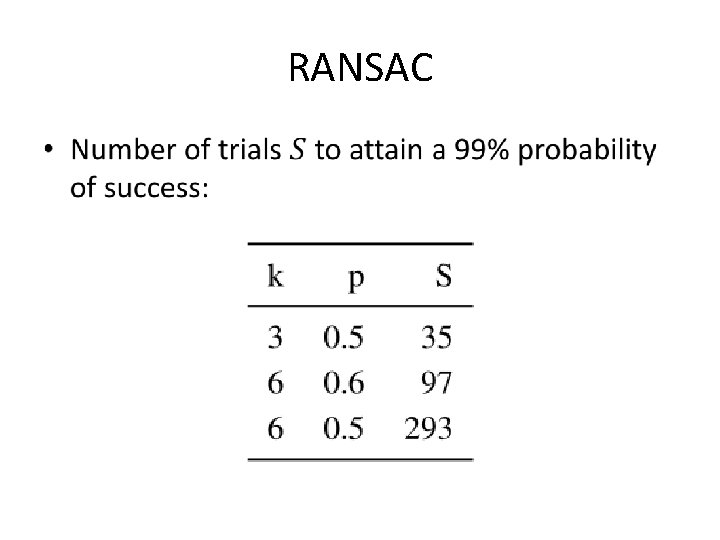
RANSAC •
RANSAC • The number of trials S grows quickly with the number of sample points k used • Use the minimum number of sample points to reduce the number of trials • Which is also normally used in practice
3 D Alignment • Many computer vision applications require the alignment of 3 D points • Linear 3 D transformations can use regular least squares to estimate parameters
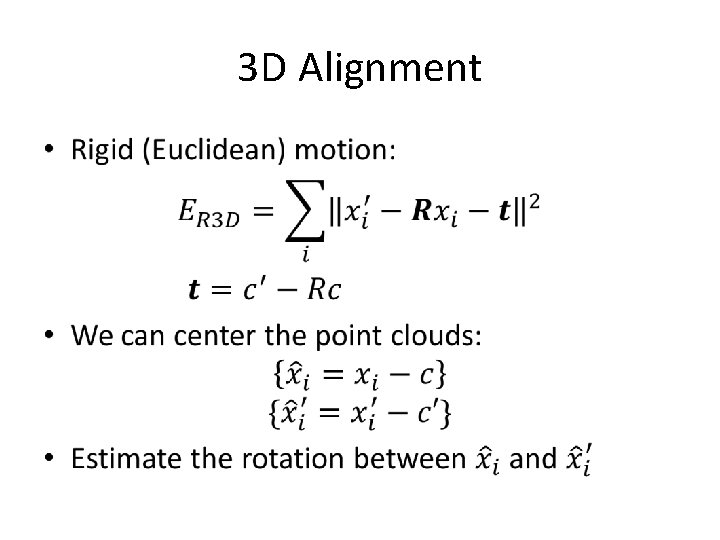
3 D Alignment •
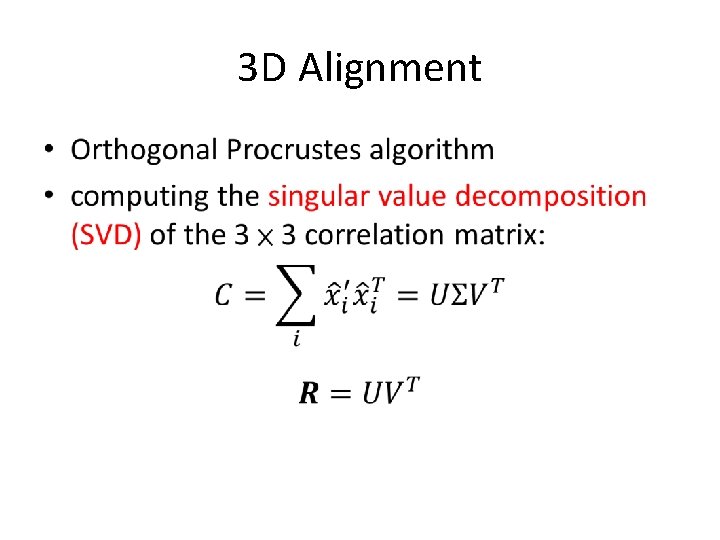
3 D Alignment •
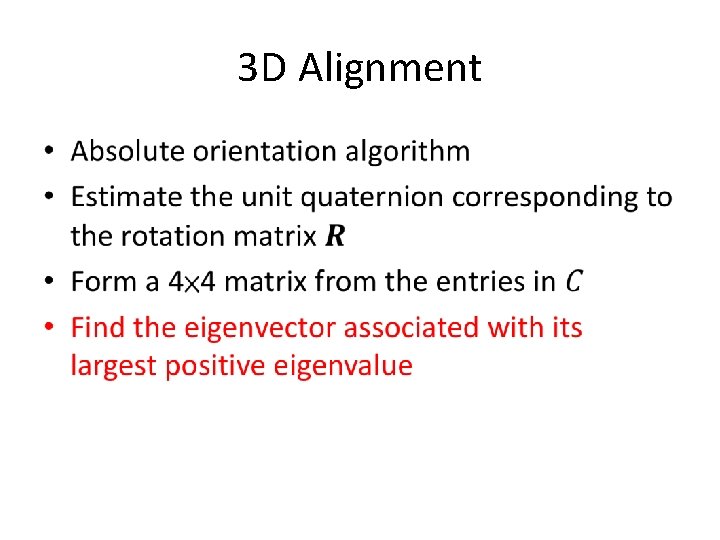
3 D Alignment •
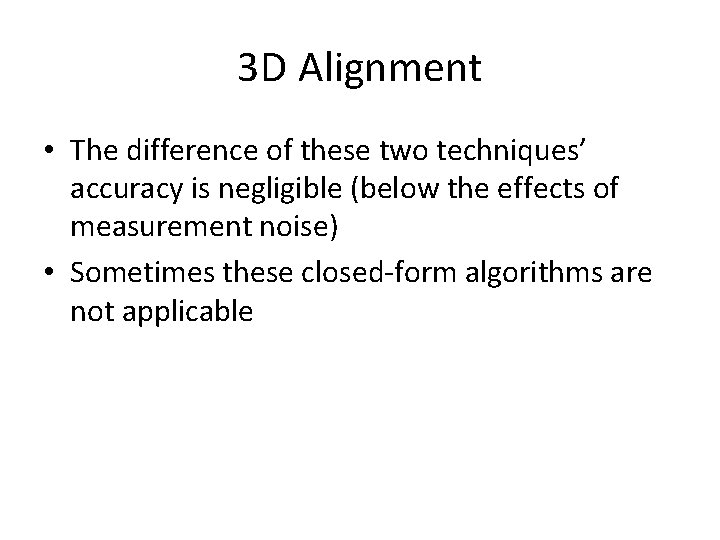
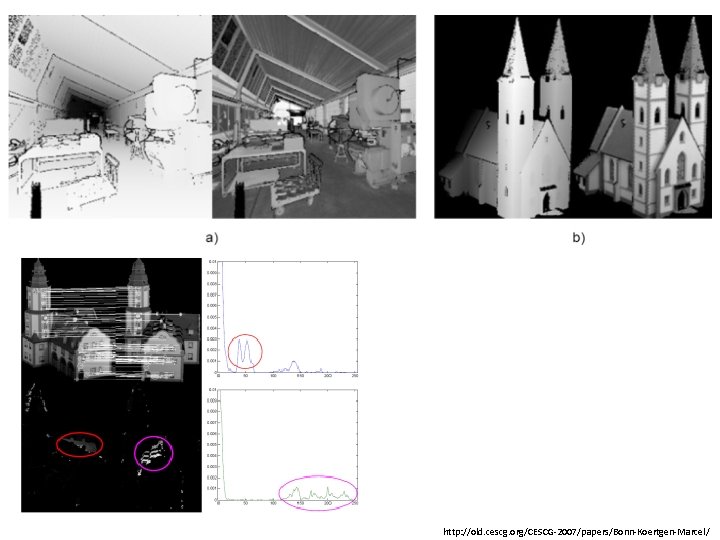
3 D Alignment • The difference of these two techniques’ accuracy is negligible (below the effects of measurement noise) • Sometimes these closed-form algorithms are not applicable
http: //old. cescg. org/CESCG-2007/papers/Bonn-Koertgen-Marcel/
Pose Estimation • Estimate an object’s 3 D pose from a set of 2 D point projections – Linear algorithms – Iterative algorithms
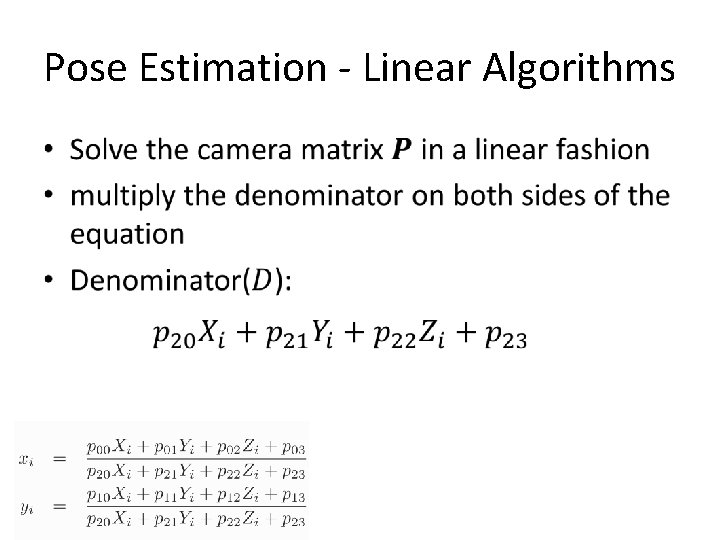
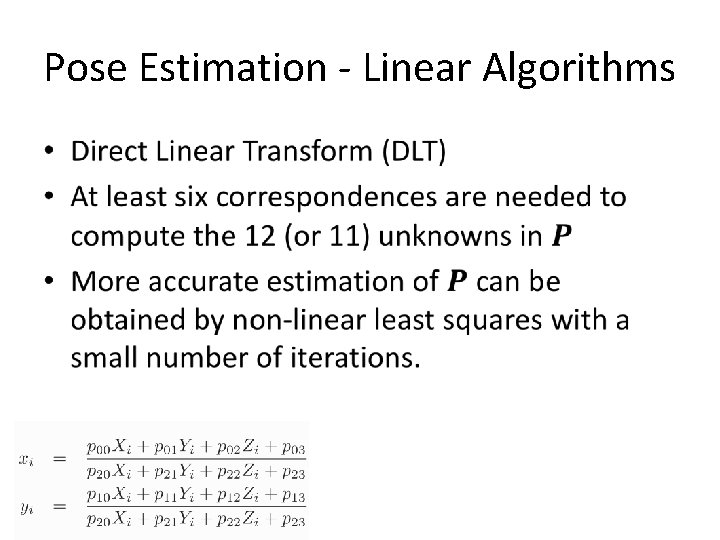
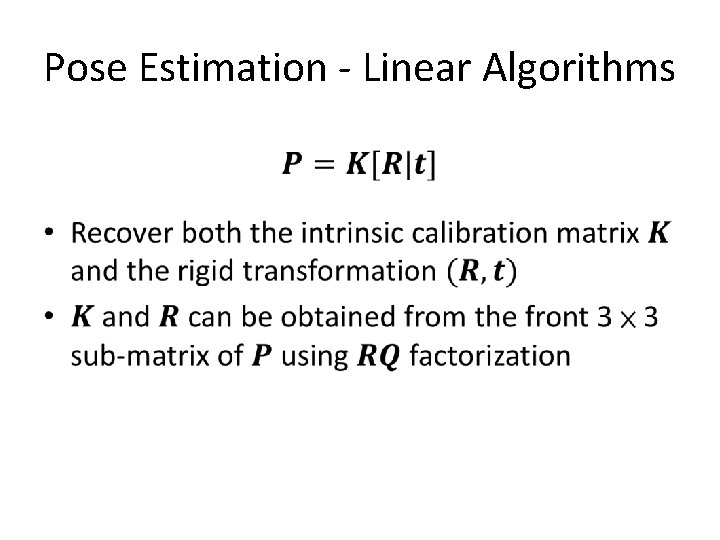
Pose Estimation - Linear Algorithms • Simplest way to recover the pose of the camera • Form a set of linear equations analogous to those used for 2 D motion estimation from the camera matrix form of perspective projection
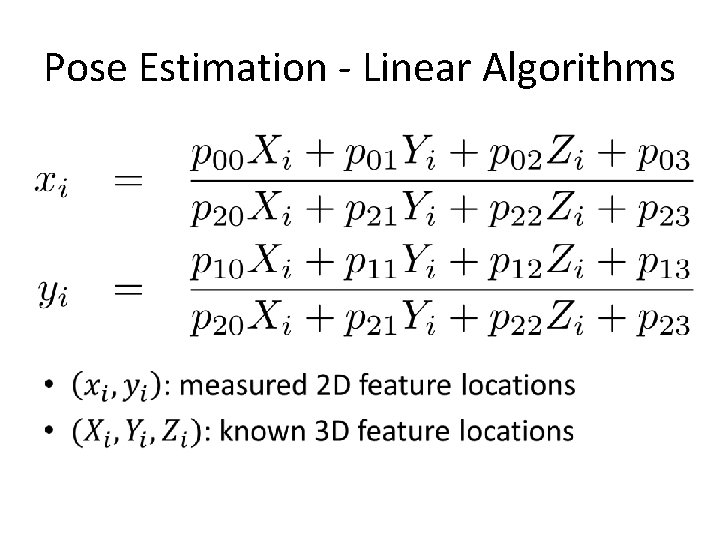
Pose Estimation - Linear Algorithms •
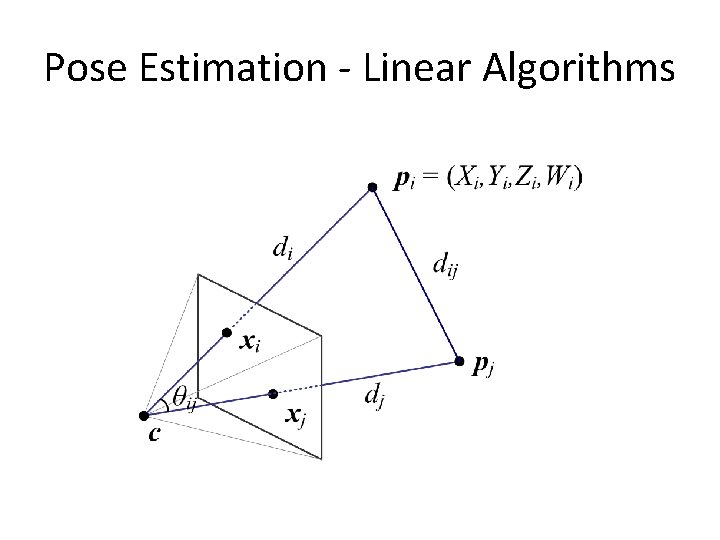
Pose Estimation - Linear Algorithms
Pose Estimation - Linear Algorithms •
Pose Estimation - Linear Algorithms •
Pose Estimation - Linear Algorithms •
Pose Estimation - Linear Algorithms •
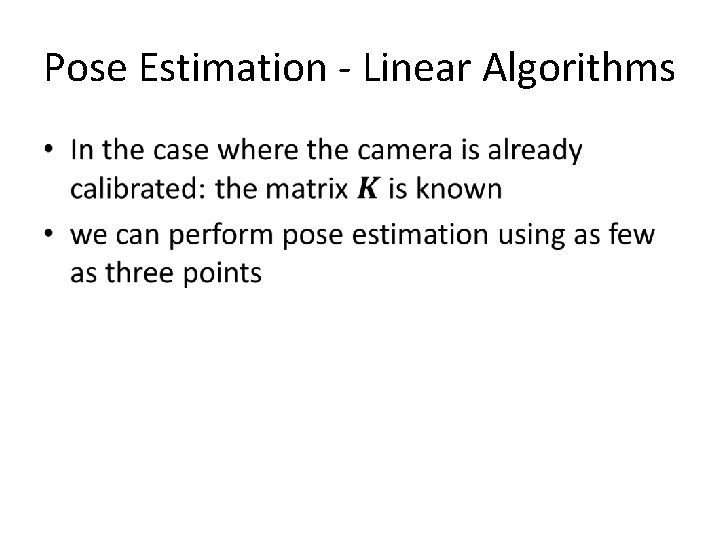
Pose Estimation - Linear Algorithms •
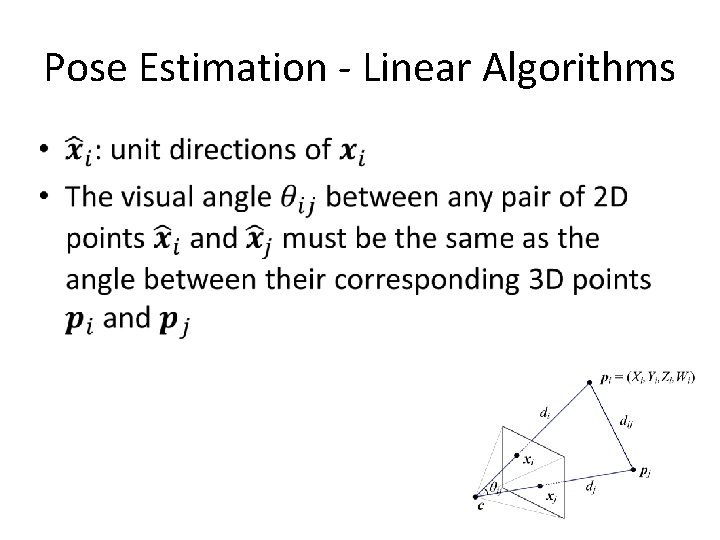
Pose Estimation - Linear Algorithms •
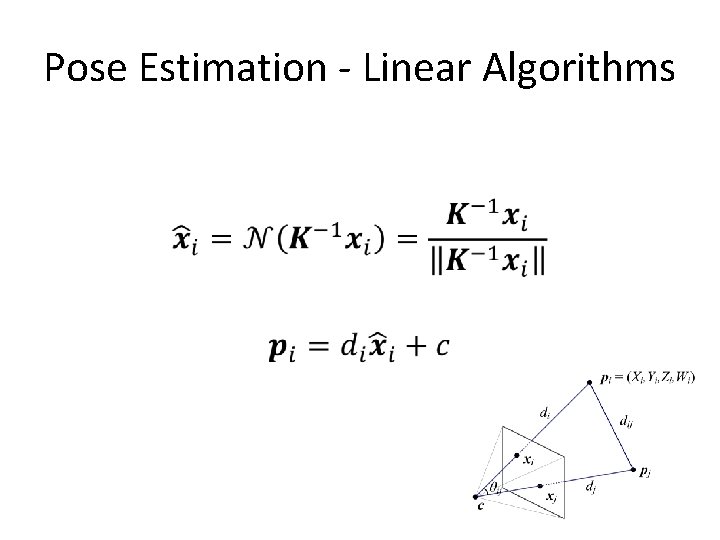
Pose Estimation - Linear Algorithms •
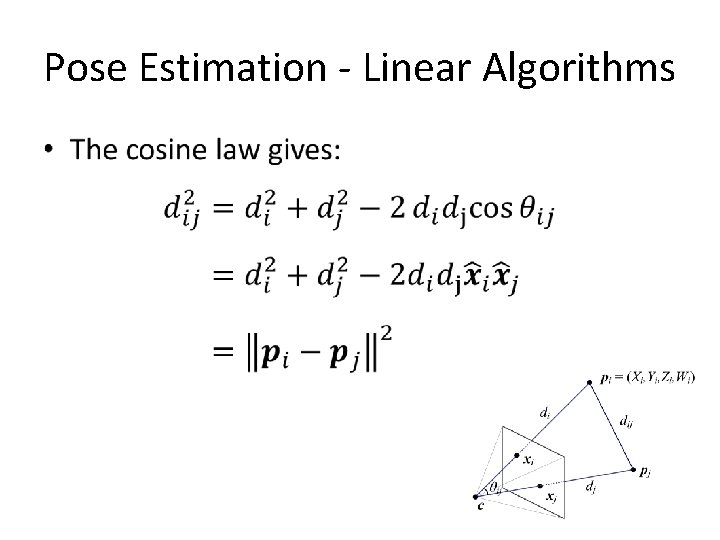
Pose Estimation - Linear Algorithms •
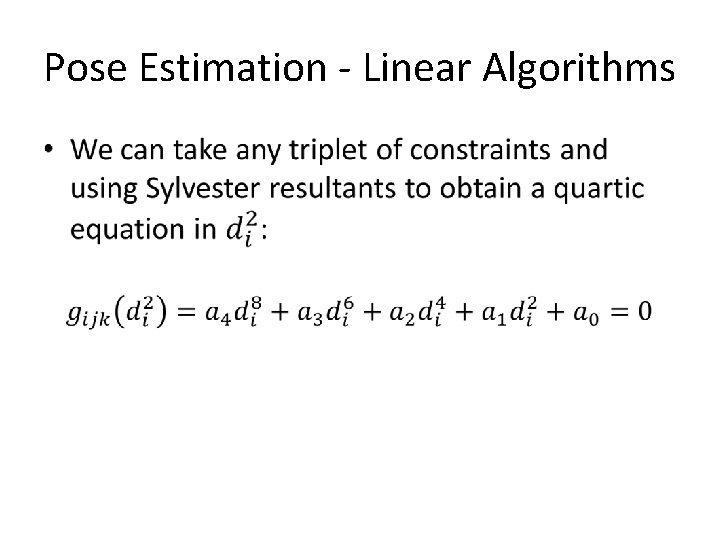
Pose Estimation - Linear Algorithms •
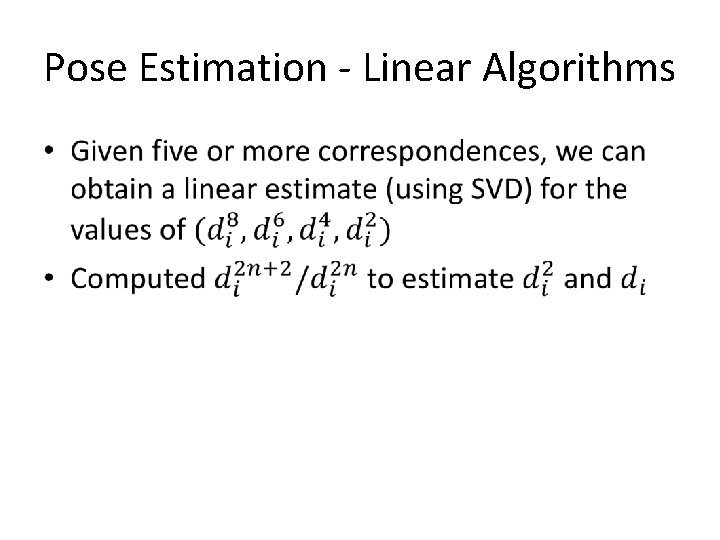
Pose Estimation - Linear Algorithms •
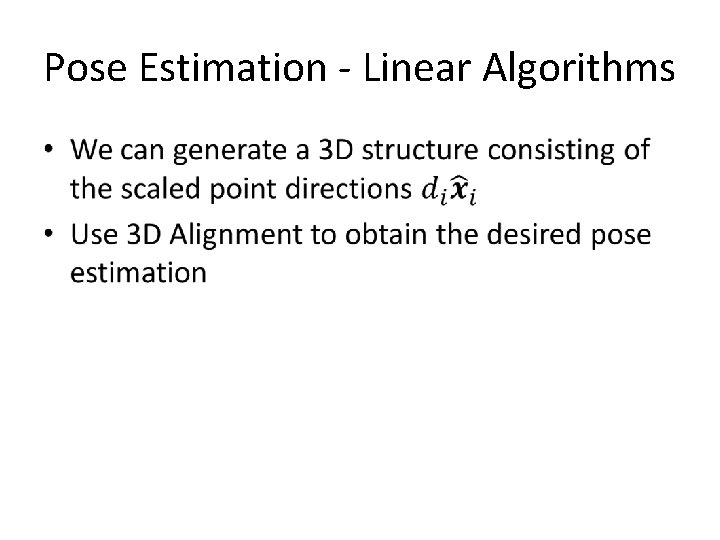
Pose Estimation - Linear Algorithms •
Pose Estimation - Linear Algorithms • Minimal Pn. P solutions can be quite noise sensitive • Also suffer from bas-relief ambiguities • Use the linear algorithm to obtain an initial pose estimation • Optimize this estimation using the iterative algorithm
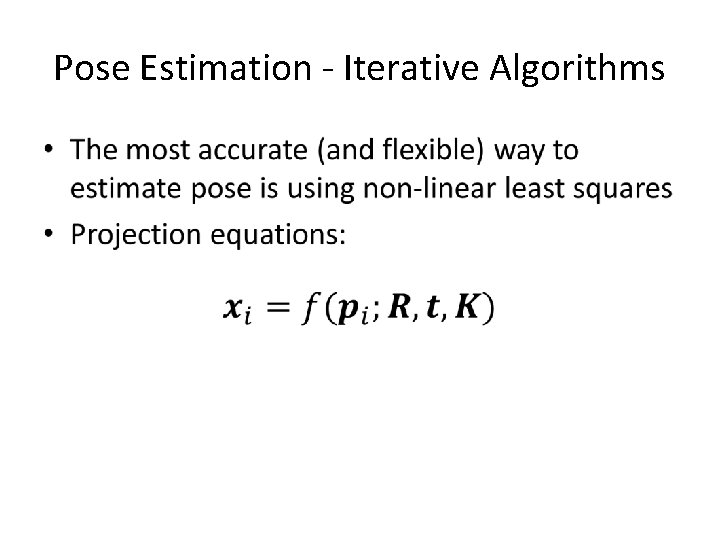
Pose Estimation - Iterative Algorithms •
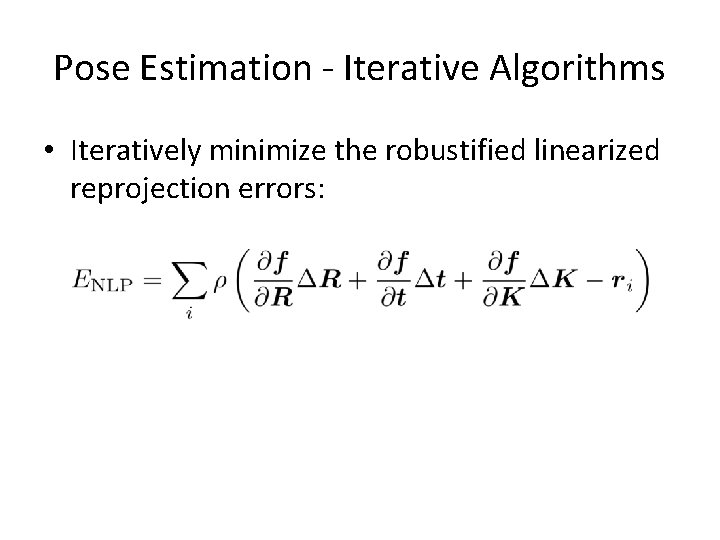
Pose Estimation - Iterative Algorithms • Iteratively minimize the robustified linearized reprojection errors:
Pose Estimation - Iterative Algorithms • An easier to understand (and implement) version of the above non-linear regression problem can be constructed by re-writing the projection equations as a concatenation of simpler steps
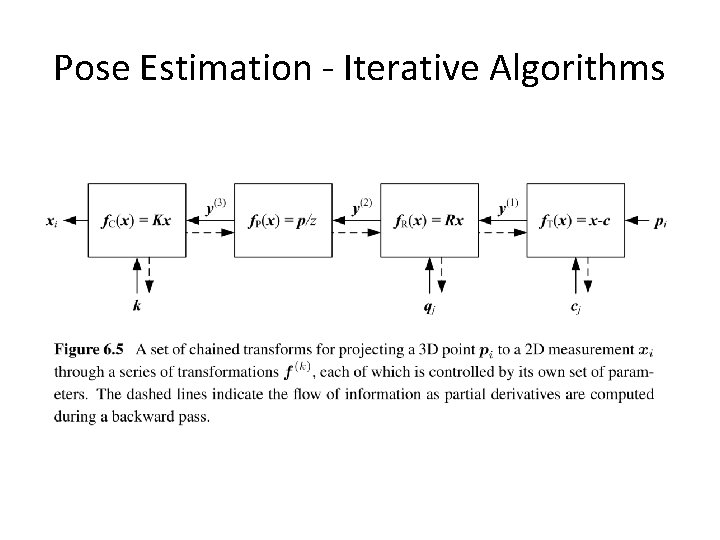
Pose Estimation - Iterative Algorithms
Geometric Intrinsic Calibration • Intrinsic and extrinsic calibration can be computed at the same time – Intrinsic calibration: Internal camera calibration parameters – Extrinsic calibration: Pose of the camera • The classic approach to camera calibration
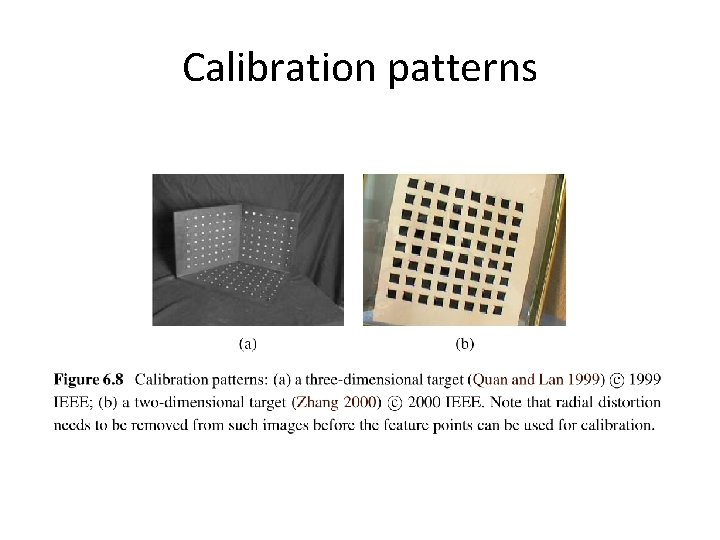
Calibration patterns • One of the more reliable ways to estimate a camera’s intrinsic parameters • In photogrammetry, it is common to set up a camera in a large field looking at distant calibration targets whose exact location has been pre-computed using surveying equipment
Calibration patterns
Calibration patterns • Span the calibration object as much of the workspace as possible if a smaller calibration rig needs to be used • Estimate the covariance in the parameters to determine the quality of calibration
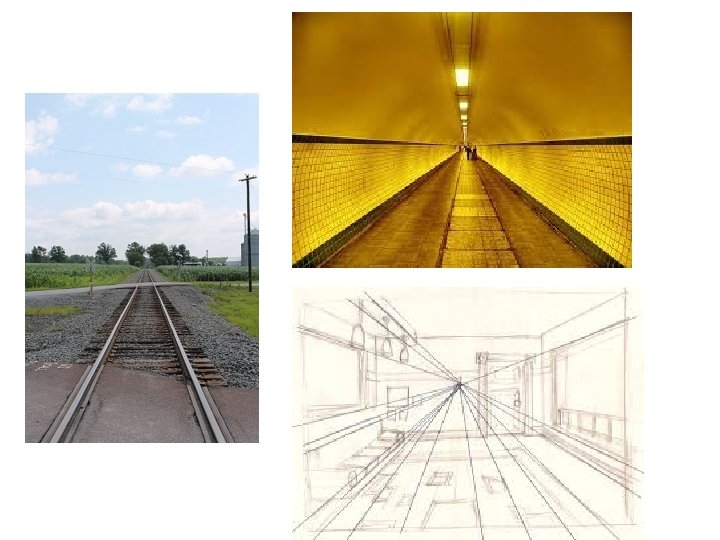
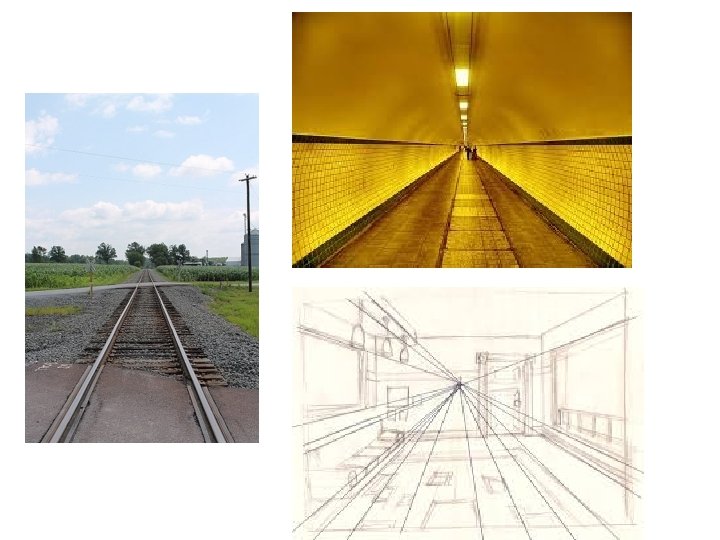
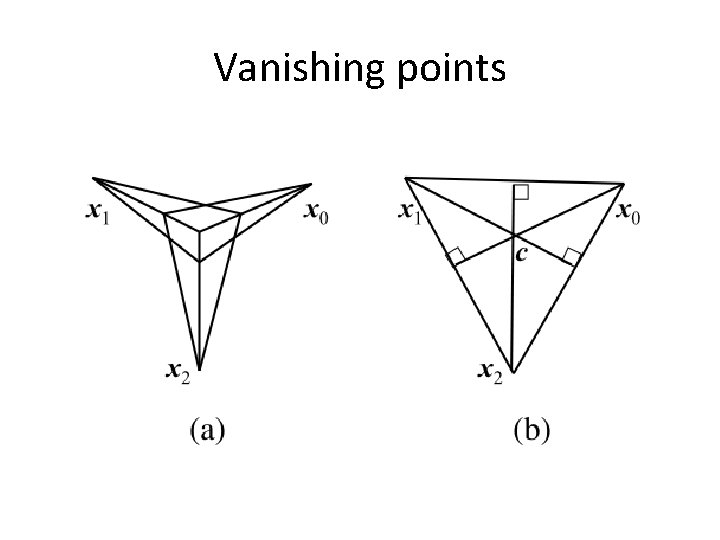
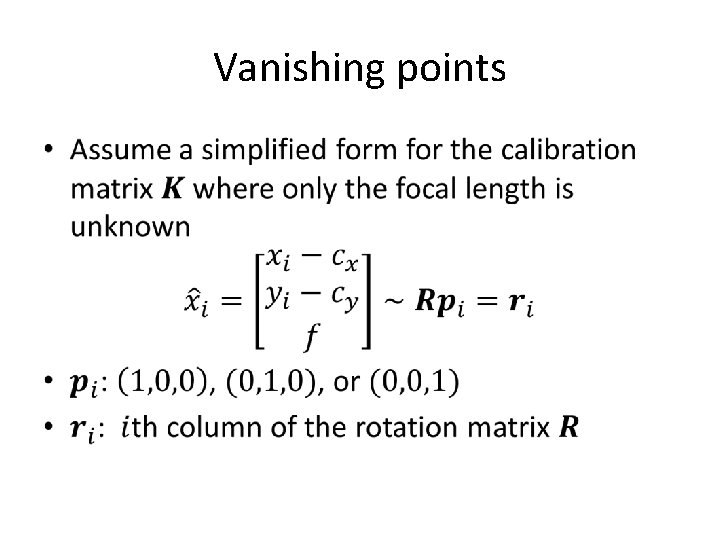
Vanishing points • A man-made scene with a lot of rectangular objects such as boxes or room walls • Intersect the 2 D lines corresponding to 3 D parallel lines to compute their vanishing points • Use these to determine the intrinsic and extrinsic calibration parameters
Vanishing points
Vanishing points •
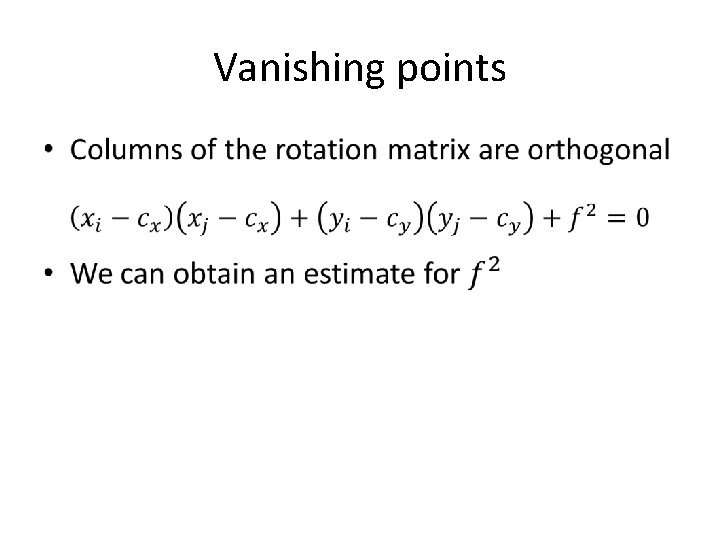
Vanishing points •
Vanishing points • It is also possible to estimate the optical center as the orthocenter of the triangle formed by the three vanishing points • It is more accurate to re-estimate using non-linear least squares
Rotational motion • When no calibration targets are available but you can rotate the camera around its front nodal point • We can calibrate the camera from a set of overlapping images by assuming that it is undergoing pure rotational motion
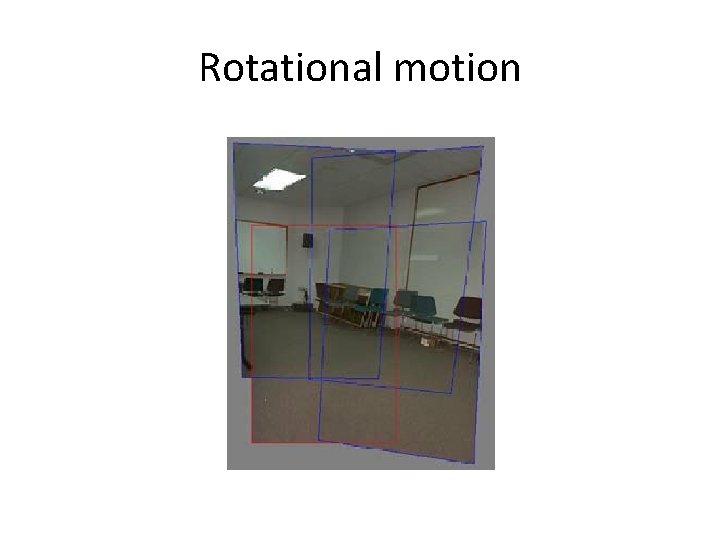
Rotational motion
Radial distortion • When images are taken with wide-angle lenses, it is often necessary to model lens distortions such as radial distortion – barrel distortion – pincushion distortion
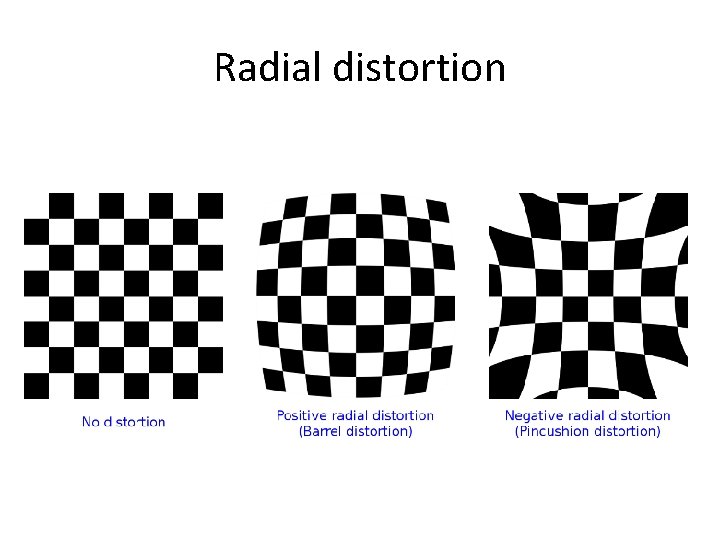
Radial distortion
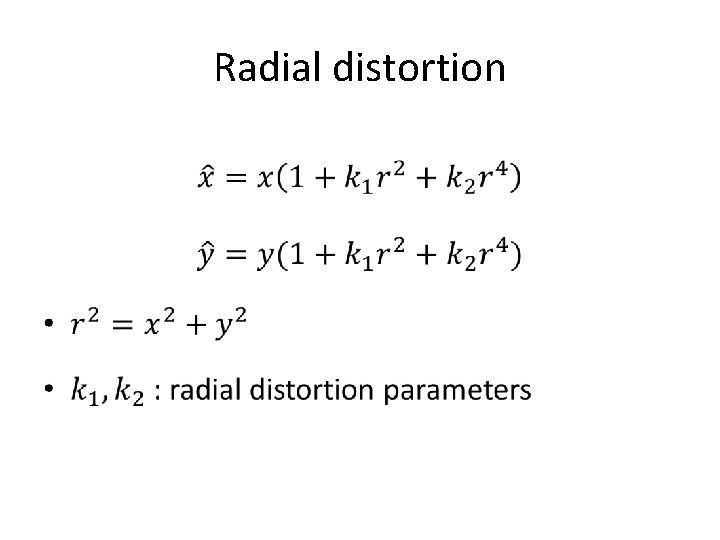
Radial distortion •
Radial distortion • A lot of different ways to estimate the radial distortion parameters • One of the simplest and most useful way: – Take an image of a scene with a lot of straight lines – Adjust the parameters until all of the lines are straight – Plumb-line method
Radial distortion • Another approach is to use several overlapping images and to combine the estimation of the radial distortion parameters with the image alignment process
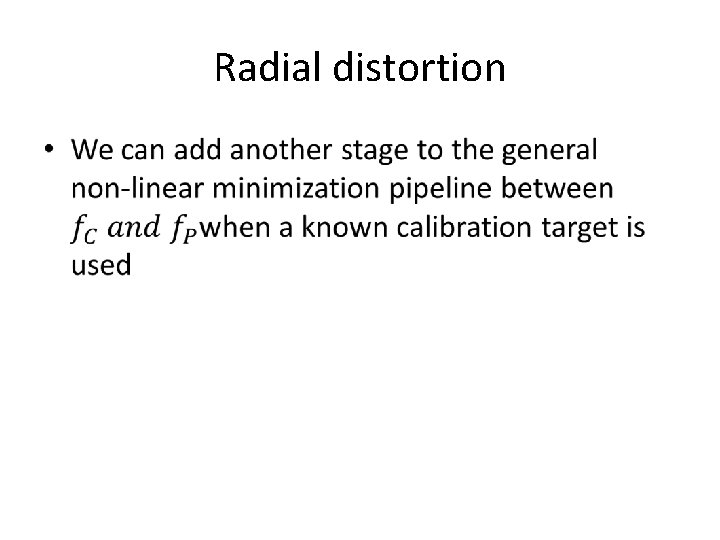
Radial distortion •
Radial distortion • Sometimes we need more general models of lens distortion • The general approach of either using calibration rigs with known 3 D positions or self -calibration through the use of multiple overlapping images of a scene can both be used
- Slides: 81