
Chapter 6 Exchange Economies Intermediate Microeconomics A ToolBuilding

Chapter 6 Exchange Economies Intermediate Microeconomics: A Tool-Building Approach Routledge, UK © 2016 Samiran Banerjee

Partial vs. general equilibrium Partial equilibrium analysis Looking at one market in isolation, is there a price so that this market is in equilibrium? Answer: See Chapter 1 General equilibrium analysis Looking at all markets, are there prices so that each market is in equilibrium simultaneously? Since markets are interrelated, it is not obvious if this is even possible!
Simplest general equilibrium model • Two consumers, a and b • Two goods, x 1 and x 2 • No production • Consumers exchange what they bring to the market Two-person pure exchange economy • Consumer a’s characteristic: ea = (ua, ωa) • Consumer b’s characteristic: eb = (ub, ωb) • The economy: e = (ea, eb) Utility function and endowment List of consumers’ characteristics
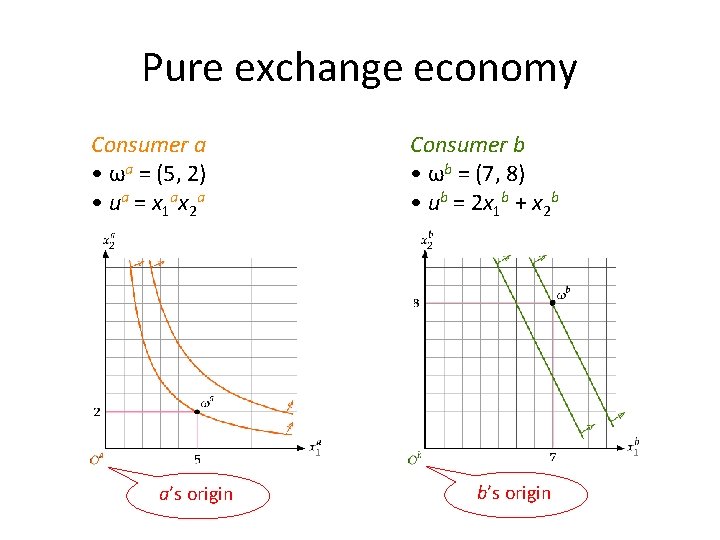
Pure exchange economy Consumer a • ωa = (5, 2) • u a = x 1 ax 2 a a’s origin Consumer b • ωb = (7, 8) • ub = 2 x 1 b + x 2 b b’s origin
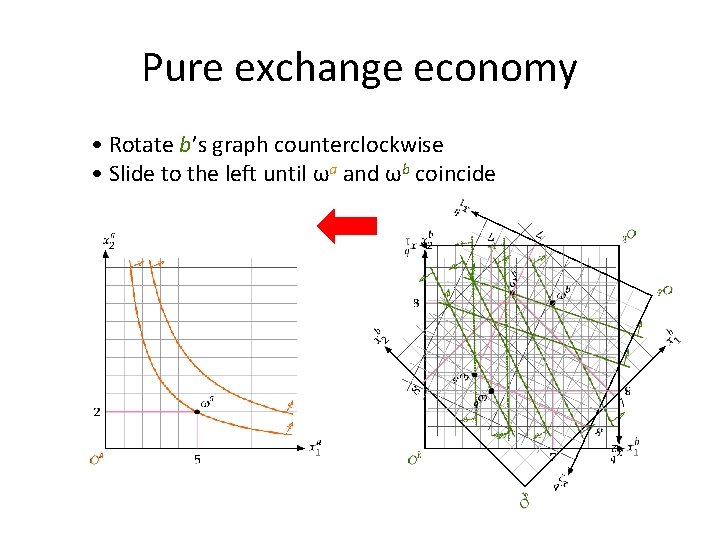
Pure exchange economy • Rotate b’s graph counterclockwise • Slide to the left until ωa and ωb coincide

Pure exchange economy • Every point in the Edgeworth box is a feasible allocation • The point ω is the initial endowment of this economy • ω = (ωa, ωb) = ((5, 2), (7, 8)) Length and height of the Edgeworth box • Aggregate endowment, Ω = (12, 10) b’s origin Edgeworth box a’s origin
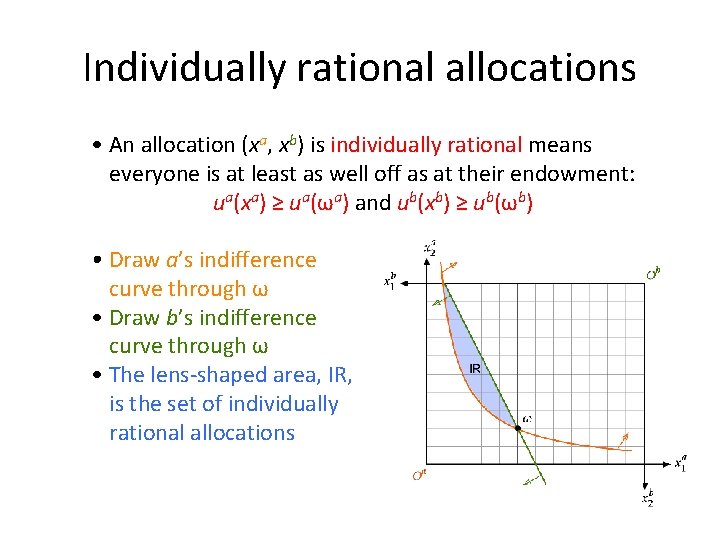
Individually rational allocations • An allocation (xa, xb) is individually rational means everyone is at least as well off as at their endowment: ua(xa) ≥ ua(ωa) and ub(xb) ≥ ub(ωb) • Draw a’s indifference curve through ω • Draw b’s indifference curve through ω • The lens-shaped area, IR, is the set of individually rational allocations
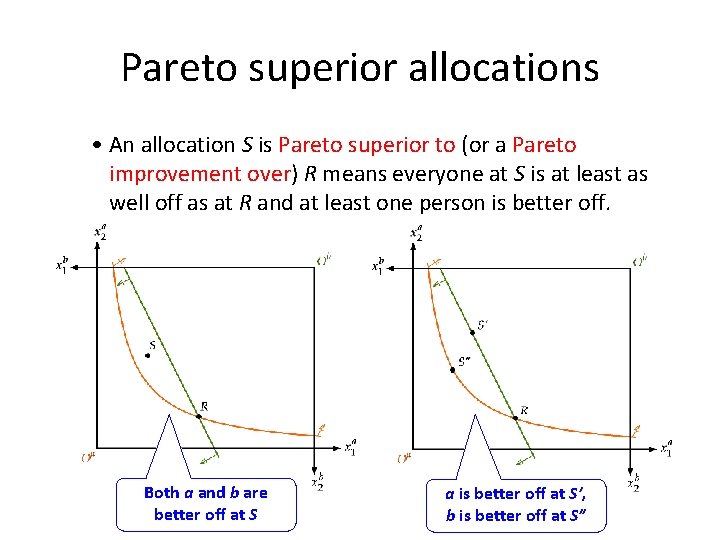
Pareto superior allocations • An allocation S is Pareto superior to (or a Pareto improvement over) R means everyone at S is at least as well off as at R and at least one person is better off. Both a and b are better off at S a is better off at S’, b is better off at S”
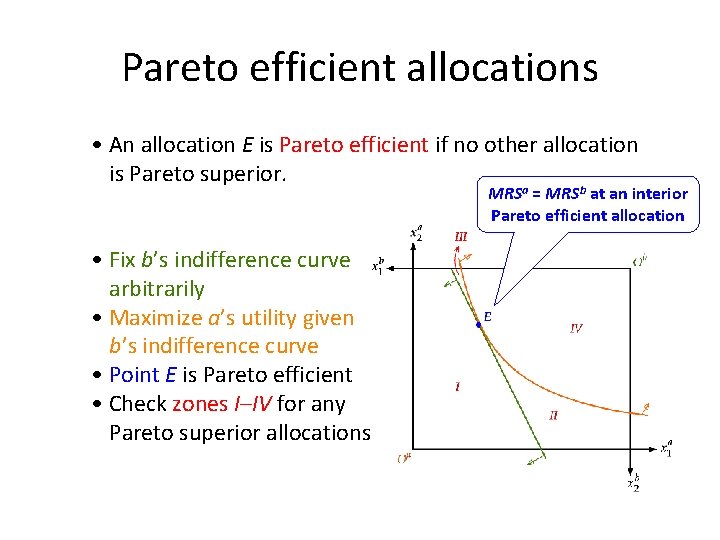
Pareto efficient allocations • An allocation E is Pareto efficient if no other allocation is Pareto superior. MRSa = MRSb at an interior Pareto efficient allocation • Fix b’s indifference curve arbitrarily • Maximize a’s utility given b’s indifference curve • Point E is Pareto efficient • Check zones I–IV for any Pareto superior allocations
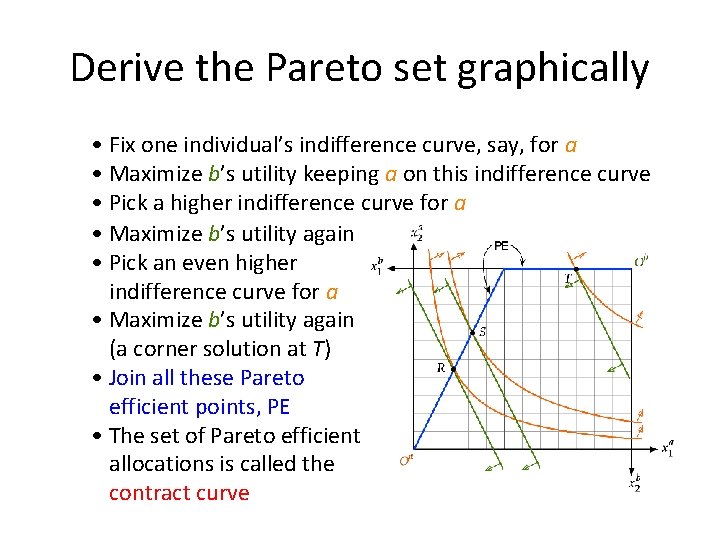
Derive the Pareto set graphically • Fix one individual’s indifference curve, say, for a • Maximize b’s utility keeping a on this indifference curve • Pick a higher indifference curve for a • Maximize b’s utility again • Pick an even higher indifference curve for a • Maximize b’s utility again (a corner solution at T) • Join all these Pareto efficient points, PE • The set of Pareto efficient allocations is called the contract curve
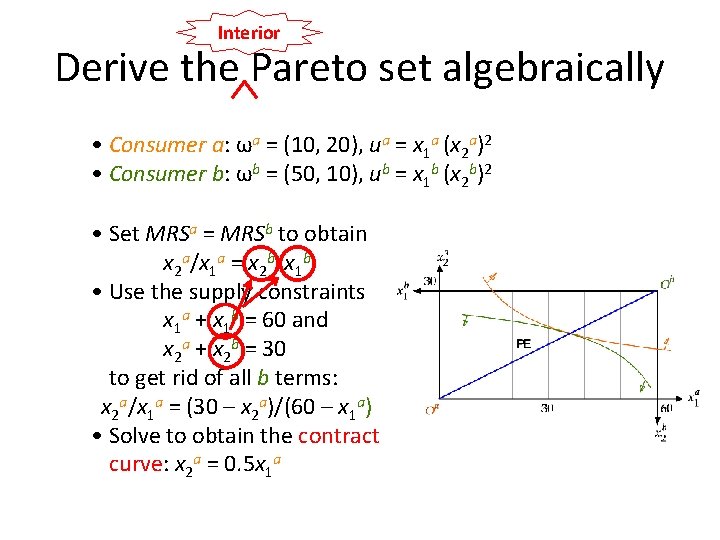
Interior Derive the Pareto set algebraically • Consumer a: ωa = (10, 20), ua = x 1 a (x 2 a)2 • Consumer b: ωb = (50, 10), ub = x 1 b (x 2 b)2 • Set MRSa = MRSb to obtain x 2 a/x 1 a = x 2 b/x 1 b • Use the supply constraints x 1 a + x 1 b = 60 and x 2 a + x 2 b = 30 to get rid of all b terms: x 2 a/x 1 a = (30 – x 2 a)/(60 – x 1 a) • Solve to obtain the contract curve: x 2 a = 0. 5 x 1 a
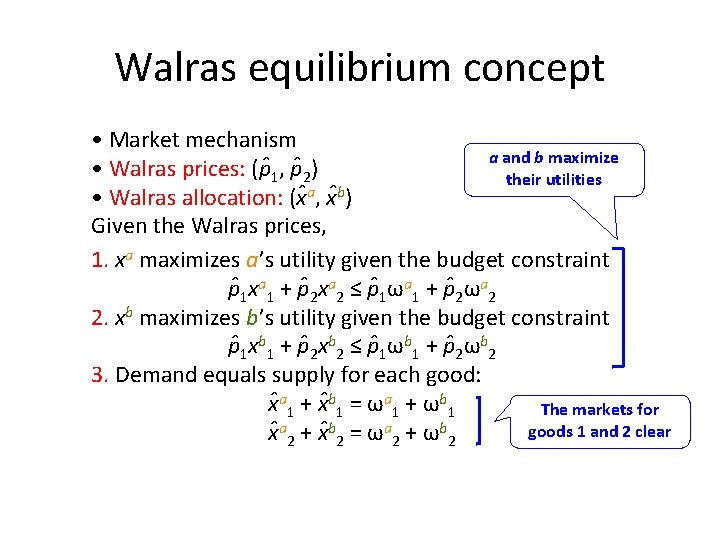
Walras equilibrium concept • Market mechanism a and b maximize • Walras prices: (pˆ 1, pˆ 2) their utilities a b • Walras allocation: (xˆ , xˆ ) Given the Walras prices, 1. xa maximizes a’s utility given the budget constraint pˆ 1 xa 1 + pˆ 2 xa 2 ≤ pˆ 1ωa 1 + pˆ 2ωa 2 2. xb maximizes b’s utility given the budget constraint pˆ 1 xb 1 + pˆ 2 xb 2 ≤ pˆ 1ωb 1 + pˆ 2ωb 2 3. Demand equals supply for each good: ˆxa 1 + xˆb 1 = ωa 1 + ωb 1 The markets for goods 1 and 2 clear ˆxa 2 + xˆb 2 = ωa 2 + ωb 2
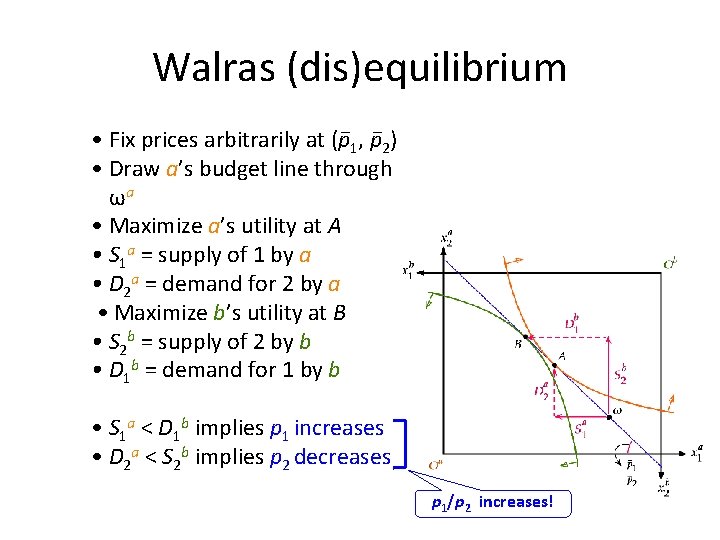
Walras (dis)equilibrium • Fix prices arbitrarily at (p– 1, p– 2) • Draw a’s budget line through ωa • Maximize a’s utility at A • S 1 a = supply of 1 by a • D 2 a = demand for 2 by a • Maximize b’s utility at B • S 2 b = supply of 2 by b • D 1 b = demand for 1 by b • S 1 a < D 1 b implies p 1 increases • D 2 a < S 2 b implies p 2 decreases p 1/p 2 increases!
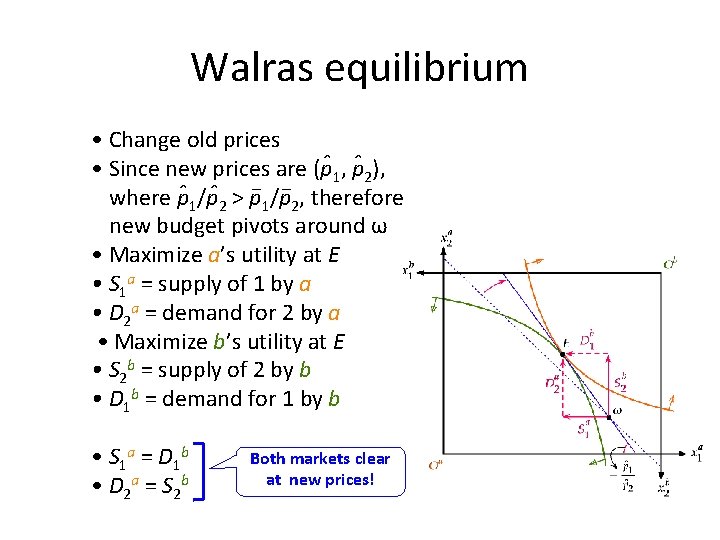
Walras equilibrium • Change old prices ˆ 2), • Since new prices are (pˆ 1, p where pˆ 1/pˆ 2 > p– 1/p– 2, therefore new budget pivots around ω • Maximize a’s utility at E • S 1 a = supply of 1 by a • D 2 a = demand for 2 by a • Maximize b’s utility at E • S 2 b = supply of 2 by b • D 1 b = demand for 1 by b • S 1 a = D 1 b • D 2 a = S 2 b Both markets clear at new prices!
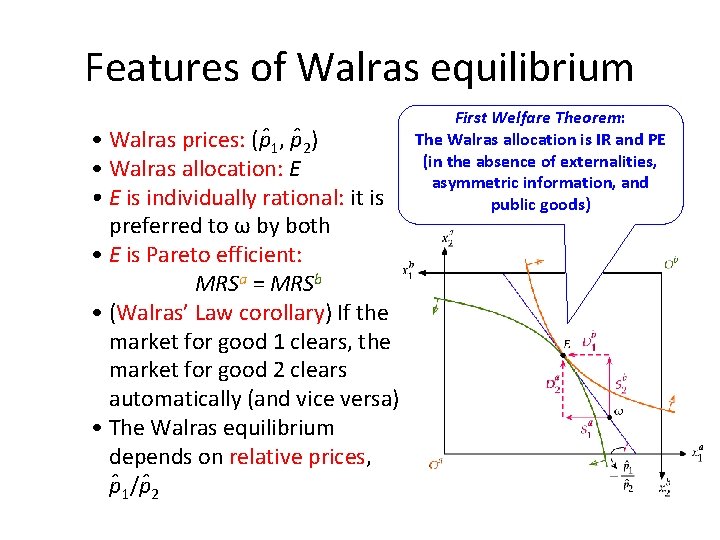
Features of Walras equilibrium • Walras prices: (pˆ 1, pˆ 2) • Walras allocation: E • E is individually rational: it is preferred to ω by both • E is Pareto efficient: MRSa = MRSb • (Walras’ Law corollary) If the market for good 1 clears, the market for good 2 clears automatically (and vice versa) • The Walras equilibrium depends on relative prices, ˆp 1/pˆ 2 First Welfare Theorem: The Walras allocation is IR and PE (in the absence of externalities, asymmetric information, and public goods)
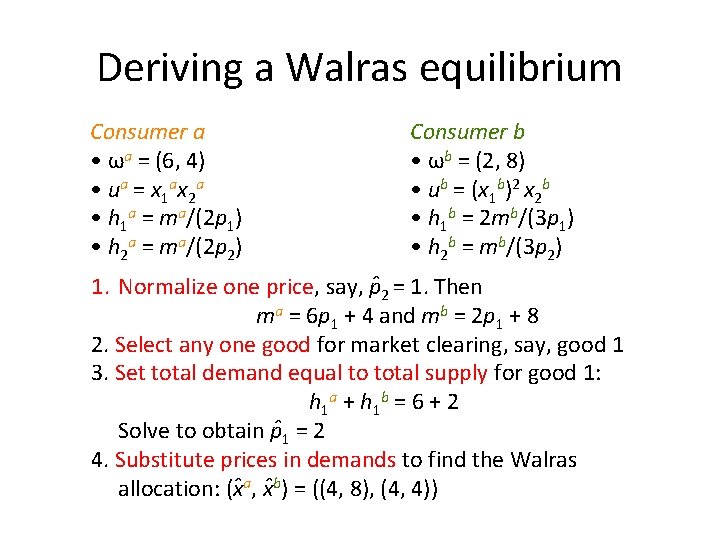
Deriving a Walras equilibrium Consumer a • ωa = (6, 4) • u a = x 1 ax 2 a • h 1 a = ma/(2 p 1) • h 2 a = ma/(2 p 2) Consumer b • ωb = (2, 8) • ub = (x 1 b)2 x 2 b • h 1 b = 2 mb/(3 p 1) • h 2 b = mb/(3 p 2) 1. Normalize one price, say, pˆ 2 = 1. Then ma = 6 p 1 + 4 and mb = 2 p 1 + 8 2. Select any one good for market clearing, say, good 1 3. Set total demand equal to total supply for good 1: h 1 a + h 1 b = 6 + 2 Solve to obtain pˆ 1 = 2 4. Substitute prices in demands to find the Walras allocation: (xˆ a, xˆb) = ((4, 8), (4, 4))
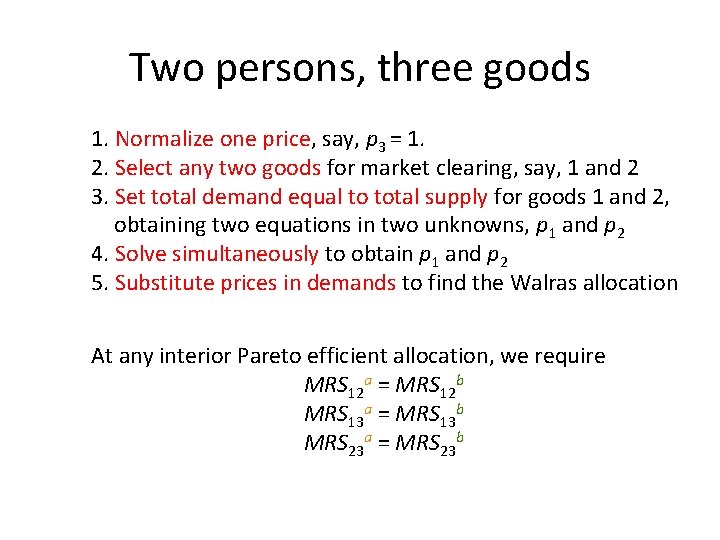
Two persons, three goods 1. Normalize one price, say, p 3 = 1. 2. Select any two goods for market clearing, say, 1 and 2 3. Set total demand equal to total supply for goods 1 and 2, obtaining two equations in two unknowns, p 1 and p 2 4. Solve simultaneously to obtain p 1 and p 2 5. Substitute prices in demands to find the Walras allocation At any interior Pareto efficient allocation, we require MRS 12 a = MRS 12 b MRS 13 a = MRS 13 b MRS 23 a = MRS 23 b
- Slides: 17