
Chapter 6 Ethical Principles Applied to Sport Management
- Slides: 13
Chapter 6 Ethical Principles Applied to Sport Management
Introduction • Ethics – The systematic study of the values guiding our decision making – Ethics reflect how we believe people should behave and how we want the world to operate • Ethical dilemma – Practical conflict involving equally compelling values or social obligations; solved when we articulate which commonly held values we admire most • Morality – The list of those actions people ought to do or refrain from doing
Ethical Considerations • Decisions that affect diverse groups of people with conflicting interests (e. g. , athletes, fans, media, community, businesses) • Sport managers’ decisions about ethical dilemmas tend to fall under greater public scrutiny • Ethical analysis involves a systematic process of reasoning: – Weighing pros/cons of two or more seemingly valid choices that reflect equally cherished values
Ethical Considerations: Codes of Conduct • Need exists for establishing solid ethical climates in corporations. • Code of conduct outlines and explains the principles under which an organization or profession operates. • Codes of conduct should be clear and straightforward and encourage employees to understand the goals they are trying to accomplish.
Ethical Considerations: Morality • Some ethical dilemmas are about choosing between right and wrong or two opposing choices. • Social practices depend on people upholding certain baseline values. • Morals seen as coming from higher order or common sense • Many moral values in society are codified in laws, but moral behavior cannot always be legislated and people cannot be forced to act morally.
Ethical Considerations: Morality in the Work World • Absolutism – Moral precepts are universal—applicable to all circumstances. • Relativism – What is moral depends on the situation. • Commercial moral rules – Rules of the marketplace guide activities such as sales and marketing. • Noncommercial moral rules – Occupations demand loyalty to an oath of office or professional standards to guard against selling out.
Ethical Considerations: Morality and Multiple Roles • Specific jobs in sports do not reside completely in either the commercial or the noncommercial sphere. • Process of making a moral choice, of deciding what is right and wrong, involves understanding the parameters of acceptable behavior in the context of one’s multiple roles in society.
Ethical Considerations: Morality and Corruption • Immoral behavior violates our basic assumptions and corrupts our social institutions. • An immoral decision can lead to systemic corruption that can destroy a sport enterprise. • Corruption usually occurs when people hop from one set of moral precepts to another. • One feature of corruption is that it is systemic.
Ethical Considerations: Moral Reasoning and Work • Contemporary society is characterized by innovation, which continually presents new ethical dilemmas • Periodically need to assess whether our current practices are in keeping with values that underlie a just society • Moral and ethical principles evolve over time
Key Skills: Ensuring Morality in the Workplace • Rules designed to protect integrity of sports operate uncomfortably alongside business structure underwriting sports. • Organizations can help individuals make moral choices by establishing standards, encouraging self-examinations, providing support structures, and enforcing codes.
Key Skills: Self-Examination • An effective tool to remind people of ethical actions and express institutional concern for ethical issues • Ask employees to think about hypothetical ethical dilemmas • Accreditation programs (NCAA)
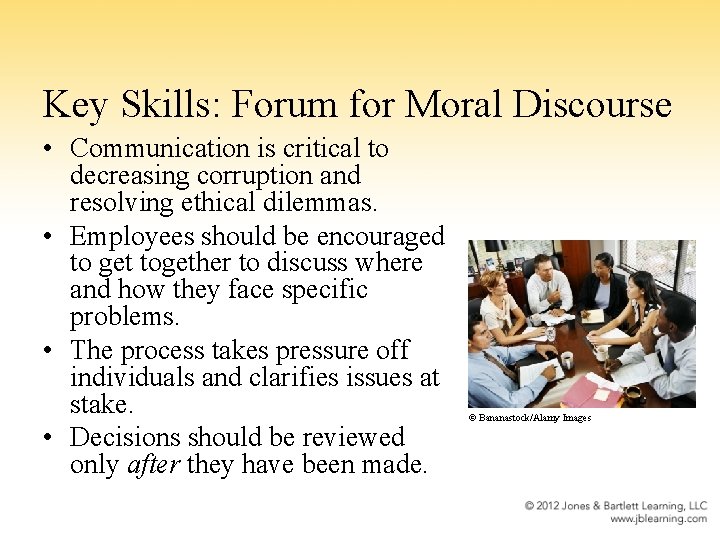
Key Skills: Forum for Moral Discourse • Communication is critical to decreasing corruption and resolving ethical dilemmas. • Employees should be encouraged to get together to discuss where and how they face specific problems. • The process takes pressure off individuals and clarifies issues at stake. • Decisions should be reviewed only after they have been made. © Bananastock/Alamy Images
Key Skills: Consequences • Employees need to know there are consequences for immoral behavior. • If people understand that corruption comes with certain risks, they are less likely to engage in immoral acts. • Discipline must meet two criteria: – It must be (1) meaningful and (2) enforceable.