
Chapter 6 Environmental Abiotic Factors Climatic Factors WATER
Chapter 6 Environmental Abiotic Factors Climatic Factors WATER
Water on the surface of the globe is present under its three physical states: solid, liquid and gaseous.
The human body consists of 65% of water for an adult, 75% for new-born babies and 94% for embryos of 3 days.
The electrical properties of the water dipole give to water some specificities allowing life on Earth: high temperature stability of liquid form of water: water evaporates with difficulty. The temperature range where the water is liquid is great; solvent characteristic allowing allow a very large number of biochemical reactions occur; high surface tension allows the phenomenon of capillarity which allows, among other things, the rising of plants sap and moving of many beings live on the surface of the water.
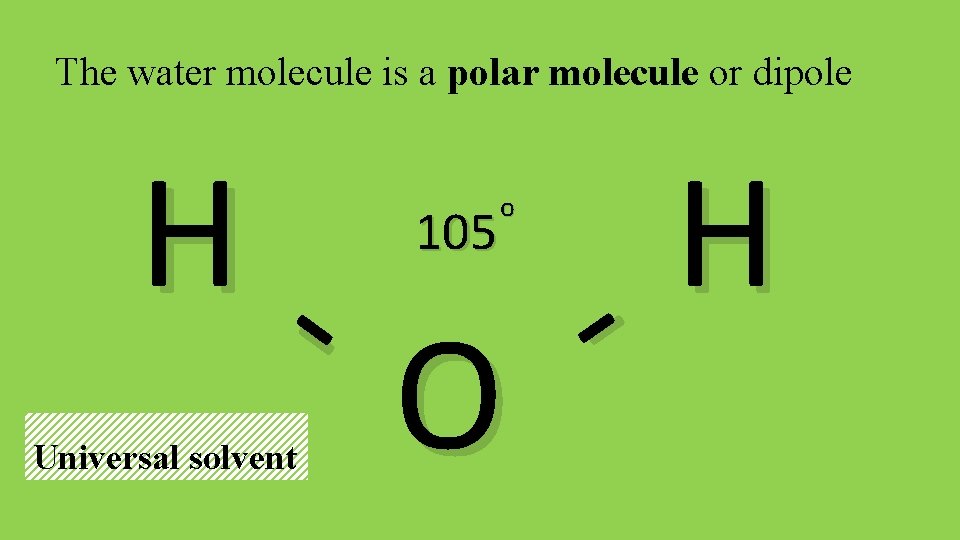
The water molecule is a polar molecule or dipole HUniversal solvent H O 105 o
Hydrogen bonding The polarity of water means that water molecules attract each other, the positive side of one attracting the negative side of another. Such a power link between two molecules is called hydrogen bonding. A water molecule can create up to 4 hydrogen bonds. Therefore liquid water looks like a vast network of water molecules coupling where each molecule gathers generally with three or four other molecules.
Physical characteristics of water Thermal agitation In the gaseous state, agitation of molecules is great; they move in all directions, defying the laws of gravity because thermal energy that they contain is large enough to prevent joining or falling under the influence of their weight. If the water vapour cools down, thermal agitation of the molecules decreased. When thermal energy is no longer sufficient, the molecules are beginning to bind to each other. They combine to form liquid water drops that fall under their weight. When liquid water cools down, thermal agitation of the molecules still gradually decreases. The bonding stiff to become almost straight. Water molecules then formed a highly organized rigid structure. The water turns into ice.
Ice floats on the water The fact that the density of water is greatest at liquid state than solid state has a remarkable result: ice floats on liquid water. In addition, the fact that the density of fresh water is maximum 4 ° C is that the temperature at the bottom of a Lake does not descend below 4 ° C (except in extreme cases). This allows the aquatic life to survive ice periods because water will remain liquid under an insulating coat of ice.
Water inertia Vaporization and fusion heat are very high and are due primarily to the energy required to break the hydrogen bonding between molecules of water. These quantities of energy guarantee high stability of the temperature of the water. It is also known as inertia that has an essential biological meaning: important biochemical reactions usually occur between narrow temperature ranges.
FEATURE OF WATER IN THE NATURE Humidity Relative humidity Fog Dew Cloud Rain
Precipitation Efficiency Precipitation efficiency is an important physical parameter in vapor, cloud, and surface rainfall budgets. Although it has been intensively studied for more than five decades (e. g. , Braham 1952), it remains a difficult and complex quantity for definition and estimation. Generally, precipitation efficiency is precipitation divided by sources associated with the precipitation in convective systems. There are two ways to define precipitation efficiency.
Factors affecting precipitation Different areas of the Earth’s surface receive different amounts of precipitation. Latitude: it rain more in the areas near the equator than in the temperature zones and polar regions. The temperature is higher near the Equator so there is more evaporation. Altitude: it rains more in high areas than in low areas. Level of humidity: it rains more on the coast than inland. Seas are a source of humidity.
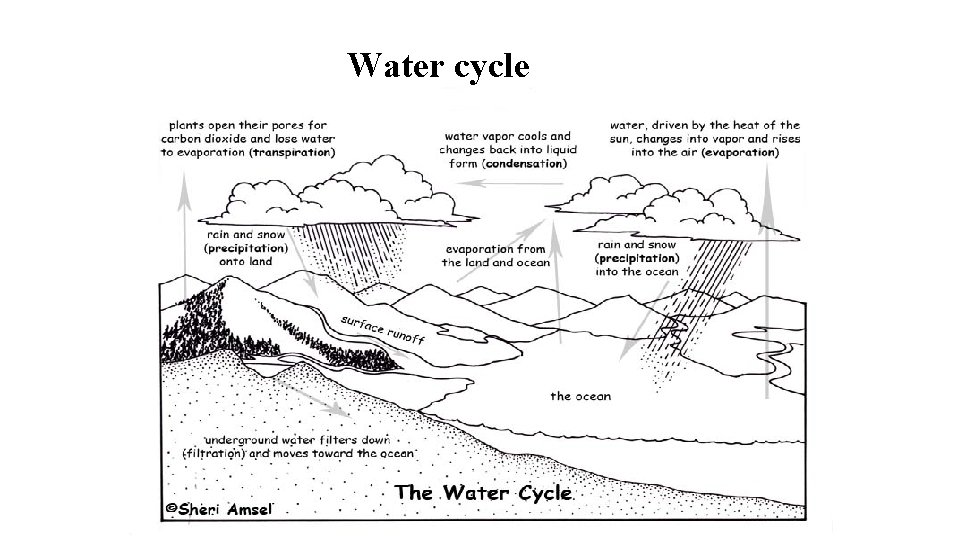
Water cycle
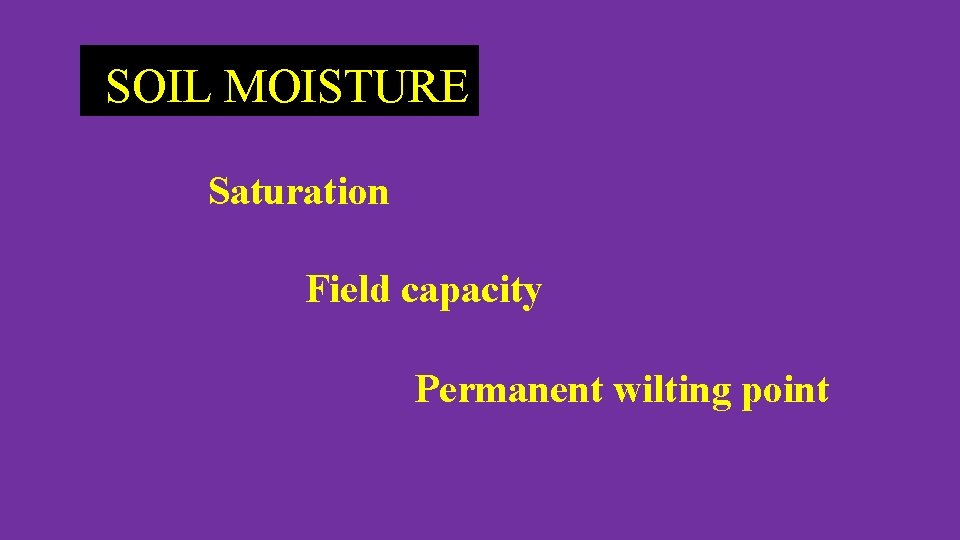
SOIL MOISTURE Saturation Field capacity Permanent wilting point
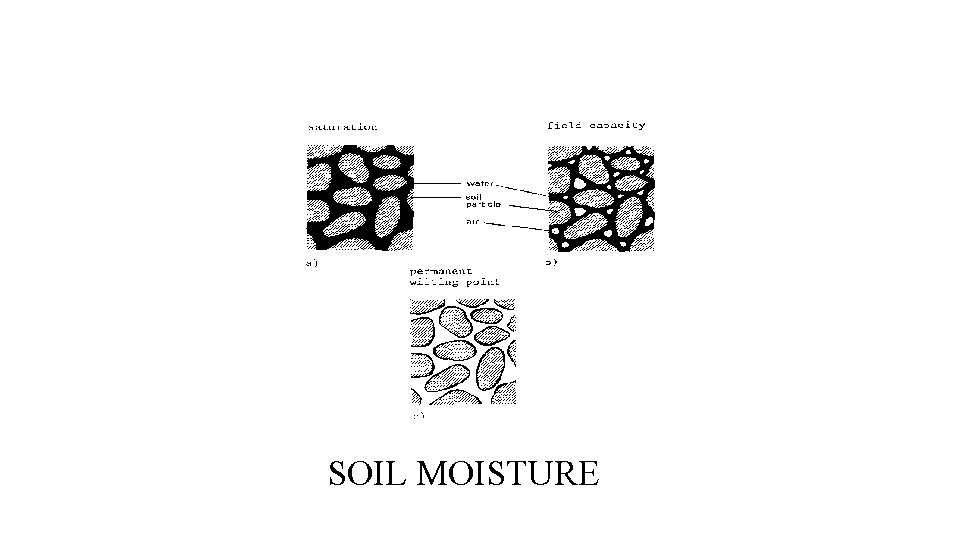
SOIL MOISTURE
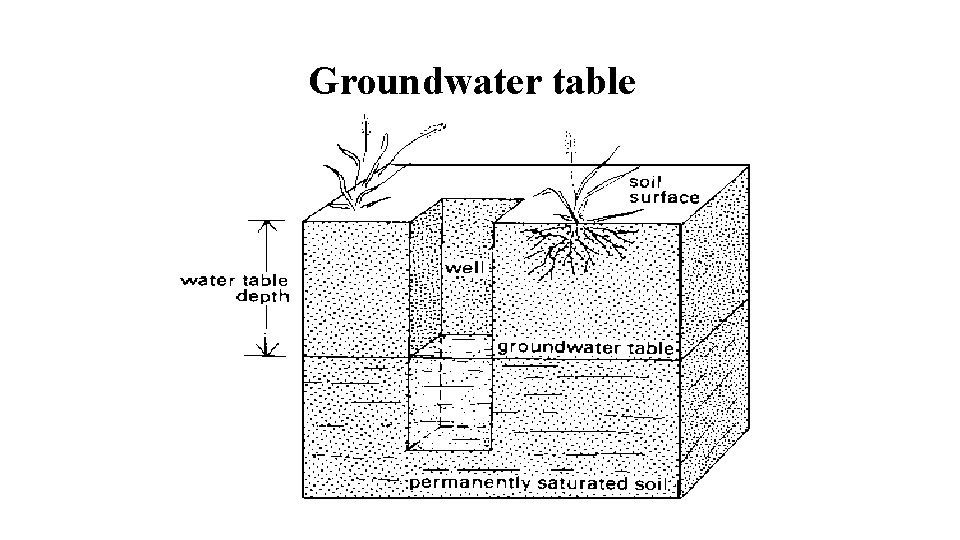
Groundwater table
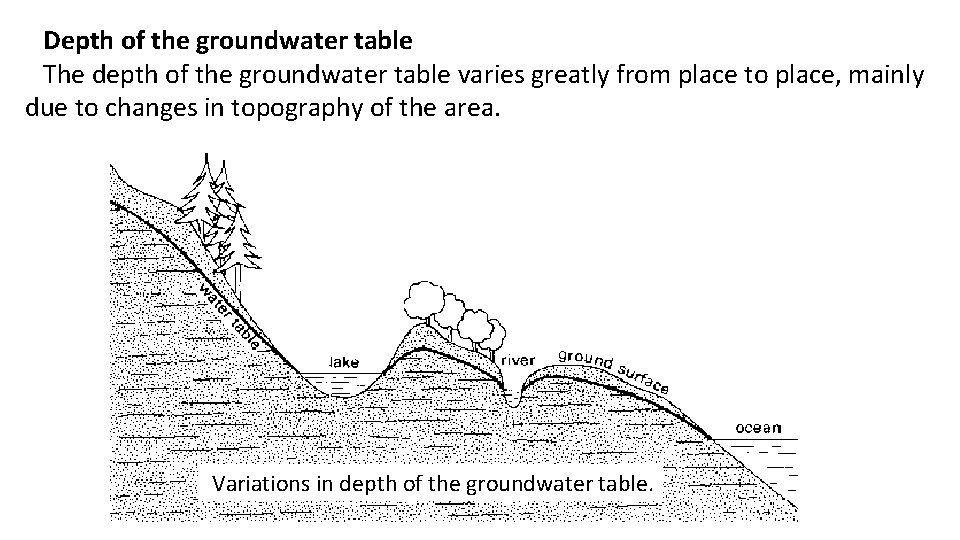
Depth of the groundwater table The depth of the groundwater table varies greatly from place to place, mainly due to changes in topography of the area. Variations in depth of the groundwater table.
Perched groundwater table A perched groundwater layer can be found on top of an impermeable layer rather close to the surface (20 to 100 cm). It covers usually a limited area. The top of the perched water layer is called the perched groundwater table.
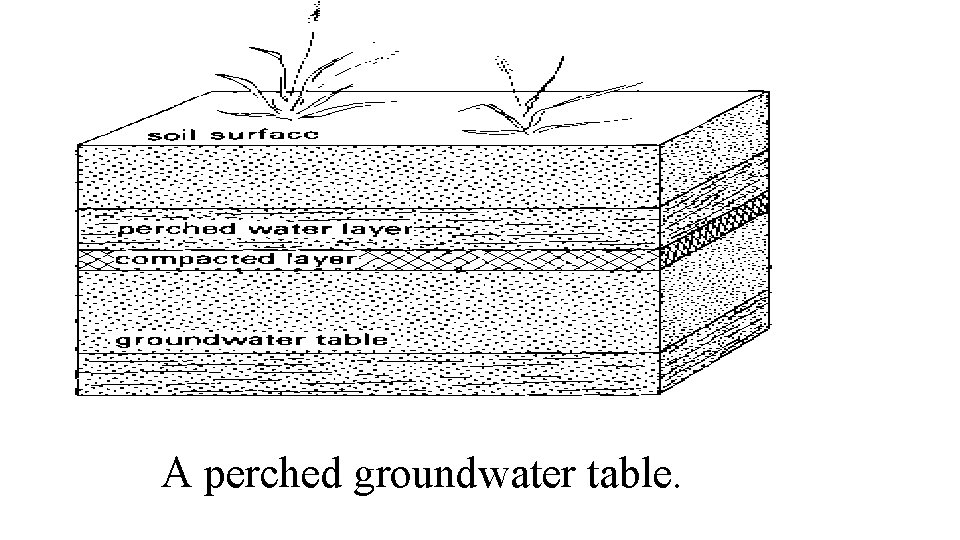
A perched groundwater table.
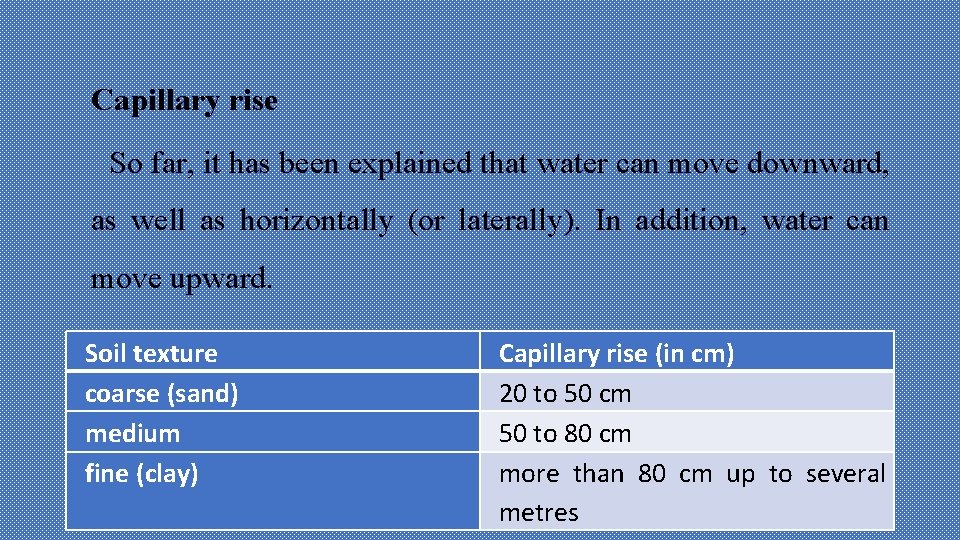
Capillary rise So far, it has been explained that water can move downward, as well as horizontally (or laterally). In addition, water can move upward. Soil texture coarse (sand) medium fine (clay) Capillary rise (in cm) 20 to 50 cm 50 to 80 cm more than 80 cm up to several metres
IMPORTANCE OF WATER TO PLANTS Water is important for plants because of the following reasons: Water helps in the germination of seeds. Water helps in the process of photosynthesis by which plants prepare their food. Water helps in the transport of nutrients and minerals from the soil to the plants. Water helps in the maintenance of the plant structure by providing the appropriate pressure to the plant tissues Water provides habitat in the form of ponds, rivers, lakes and sea for a large number of plants.
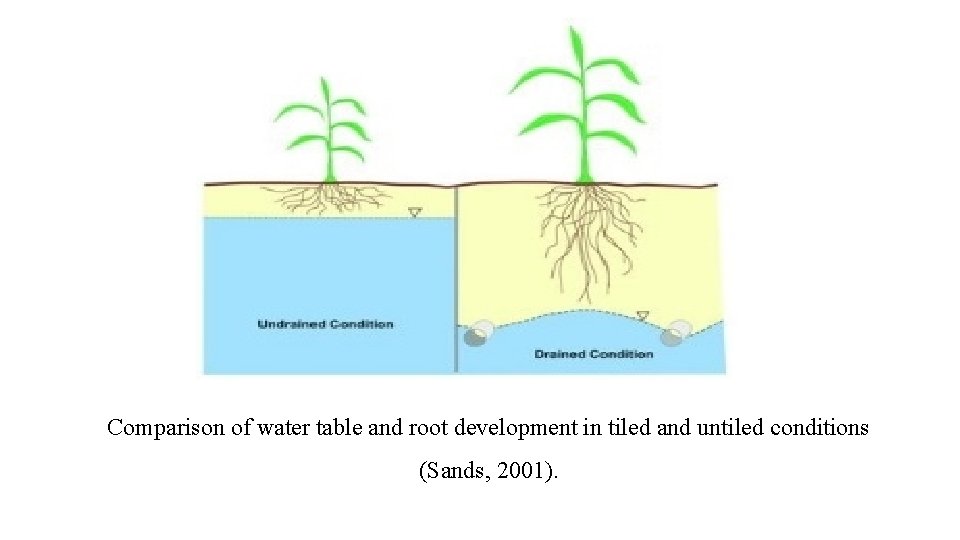
Comparison of water table and root development in tiled and untiled conditions (Sands, 2001).
The effects of drought on trees and shrubs can be characterized as short term or long term. Short-term damage, caused by one dry spell, includes wilting, leaf scorch, and some defoliation. Longterm damage from drought happens over a period of years and includes stunted growth, branch die-back, and possible death of the plant. Many woody plants can take up to three years after a drought to display negative long-term effects.
dryness causes of stress in plant growth, yield 50 -30% reduction in drought stress due to low humidity in plant growth occurs as a result of the high evapotranspiration, temperature high intensity of sunlight(Ghodsi et al, 1998)
Drought in the sun, the light reaction of photosynthesis and continued production of free radicals of oxygen leading to plant death is light and oxidation. Absorb nutrients from the upper soil horizon, which is found in most foods, the drought reduced (Bagheri, 2009). The increase in drought conditions, accumulation of salts and ions in the upper layers of the soil around the root cause osmotic stress and ion toxicity.
The amount of abscisic acid had to be stored in the chloroplasts in the guard cells used and the construction of ABA in guard cells and mesophyll increased. With the increase of ABA, potassium and calcium out of the cell where it is guard cell. The result of this process stomatal closure, with the loss of water in the guard cell. Lack of water, the rate of photosynthesis in plants decreases.
Strategies Adaptations of Plants to Arid Environments Drought-escaping plants – annuals which germinate and grow only when there is sufficient moisture available to complete their life cycle. Only their seeds persist during times of drought. Annuals. Drought-evading plants – non-succulent perennials which restrict their growth activity to periods when moisture is available. Typically, they are drought-deciduous shrubs which go dormant or die back during dry periods. Drought-enduring plants – evergreen shrubs. Extensive root systems coupled with various morphological and physiological adaptations of their aerial parts enable these hardy xerophytes to maintain growth even in times of extreme water stress. Creosote bush (Larrea tridentata). Drought-resisting plants – succulent perennials. The water stored in their swollen leaves and stems is usually used very sparingly. Cacti The major adaptation of both drought-escaping and drought-evading plants is an ability of accurately predict the wet season and to restrict their major growth and reproductive activities to the wet part of the year.
Classification of plant according to water conditions Hydrophytes Mesophytes Xerophytes
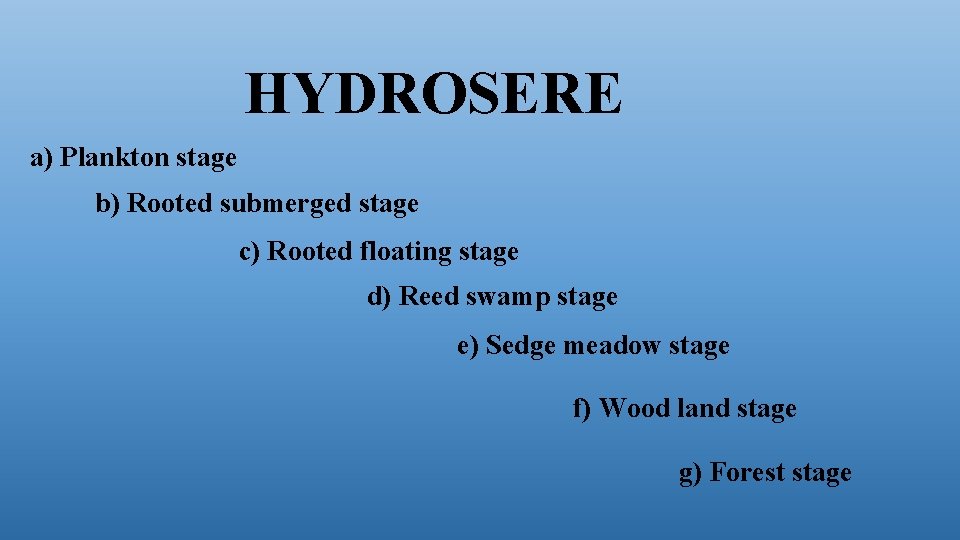
HYDROSERE a) Plankton stage b) Rooted submerged stage c) Rooted floating stage d) Reed swamp stage e) Sedge meadow stage f) Wood land stage g) Forest stage
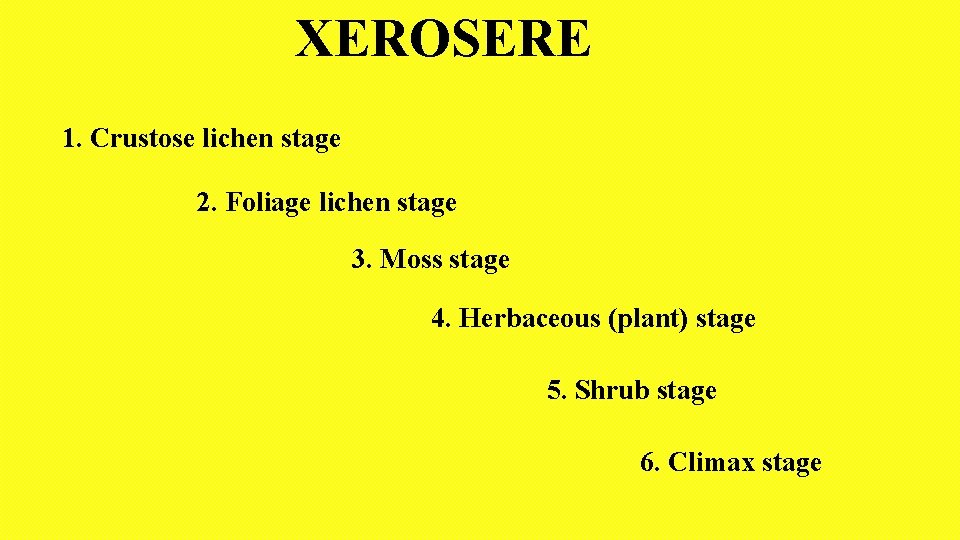
XEROSERE 1. Crustose lichen stage 2. Foliage lichen stage 3. Moss stage 4. Herbaceous (plant) stage 5. Shrub stage 6. Climax stage
- Slides: 30