
Chapter 6 Enhancing Group and Team Communication Skills






- Slides: 19
Chapter 6 Enhancing Group and Team Communication Skills This multimedia product and its contents are protected under copyright law: uany public performance or display, including transmission of any image over network; upreparation of any derivative work including the extraction, in whole or in part, of any images; uany rental, lease, or lending of the program. Copyright © Allyn & Bacon 2006
Verbal dynamics: barriers u. Bypassing: two people assign different meanings to words u. Allness: simple and untrue generalizations or stereotypes u. Fact-inference: not fact, but conclusion drawn Copyright © Allyn & Bacon 2006
Types of listening u. Hearing message sent u. Analyzing determining purpose of speaker u. Empathizing requires concentration & sensitivity Copyright © Allyn & Bacon 2006
Barriers to Effective Listening u. Prejudging communicator u. Prejudging communication u. Rehearsing response Copyright © Allyn & Bacon 2006
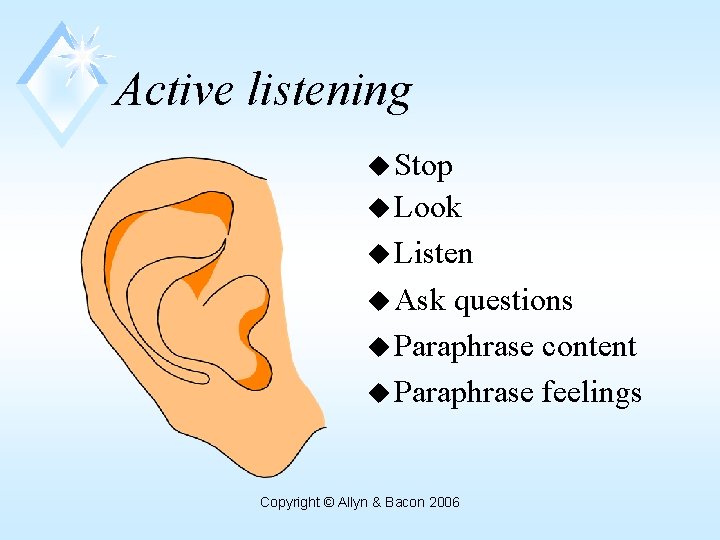
Active listening u Stop u Look u Listen u Ask questions u Paraphrase content u Paraphrase feelings Copyright © Allyn & Bacon 2006
Nonverbal communication u Behavior that does not rely on written or spoken words u Includes body posture & movement, eye contact, facial expression, seating arrangement, spatial relationship, personal appearance, use of time & tone of voice Copyright © Allyn & Bacon 2006
Importance to groups & teams u. More time spent communicating nonverbally than verbally u. Nonverbal cues more credible than verbal messages u. Emotions & feelings expressed nonverbally Copyright © Allyn & Bacon 2006
Ekman &Friesen categories u. Emblems-replace spoken word control flow u. Illustrators- accompany verbal message u. Affect u. Regulatorsu. Adaptors- satisfy personal needs displays- display emotion Copyright © Allyn & Bacon 2006
Eye contact functions u. Cognitive - cues about thought process u. Monitoringseek feedback from others u. Regulatory- control flow of conversation u. Expressivereveal emotions, feelings, attitudes Copyright © Allyn & Bacon 2006
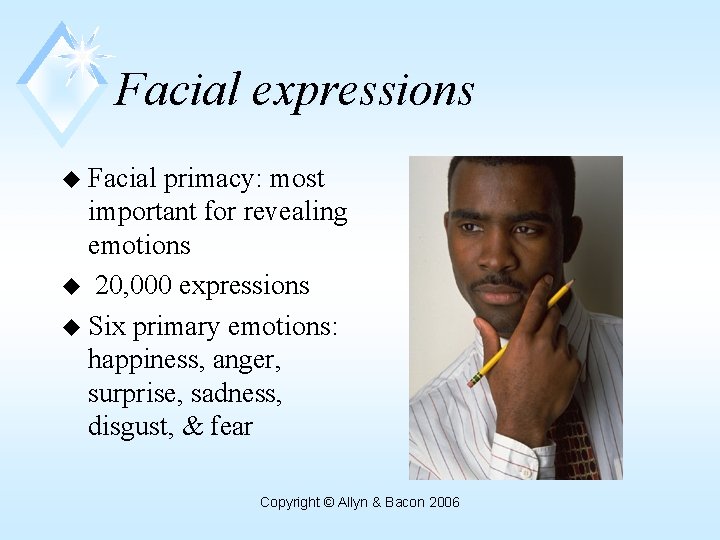
Facial expressions u Facial primacy: most important for revealing emotions u 20, 000 expressions u Six primary emotions: happiness, anger, surprise, sadness, disgust, & fear Copyright © Allyn & Bacon 2006
Vocal cues Paralanguage is pitch, rate, volume, & voice quality u Help make inferences about competence, personality & emotional states u Include pronunciation & articulation & filled & unfilled pauses u Should be evaluated in context of other behaviors Copyright © Allyn & Bacon 2006
Territoriality u Personal spacestake out and defend areas u Small group ecology- consistent way people arrange themselves Copyright © Allyn & Bacon 2006
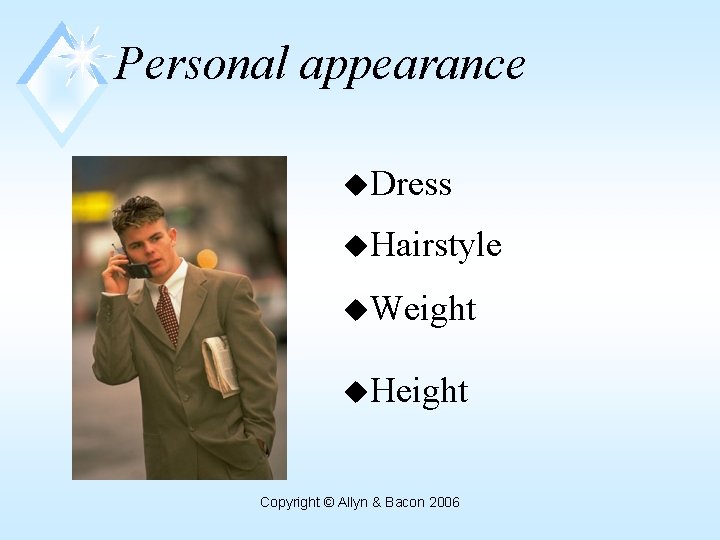
Personal appearance u. Dress u. Hairstyle u. Weight u. Height Copyright © Allyn & Bacon 2006
Attractive individuals perceived to be. . . u More effective in changing attitudes u More credible u Happier u More popular u More sociable u More successful Copyright © Allyn & Bacon 2006
Other nonverbal factors. . . u. Communication environment u clean, well-lighted place Copyright © Allyn & Bacon 2006
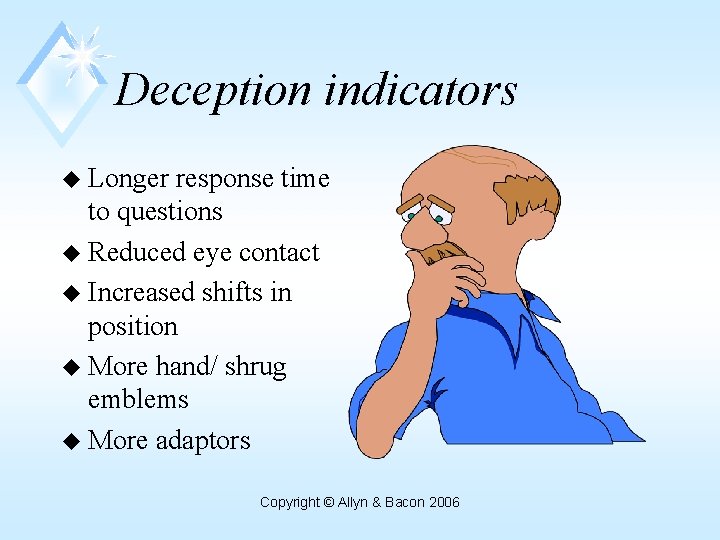
Deception indicators u Longer response time to questions u Reduced eye contact u Increased shifts in position u More hand/ shrug emblems u More adaptors Copyright © Allyn & Bacon 2006
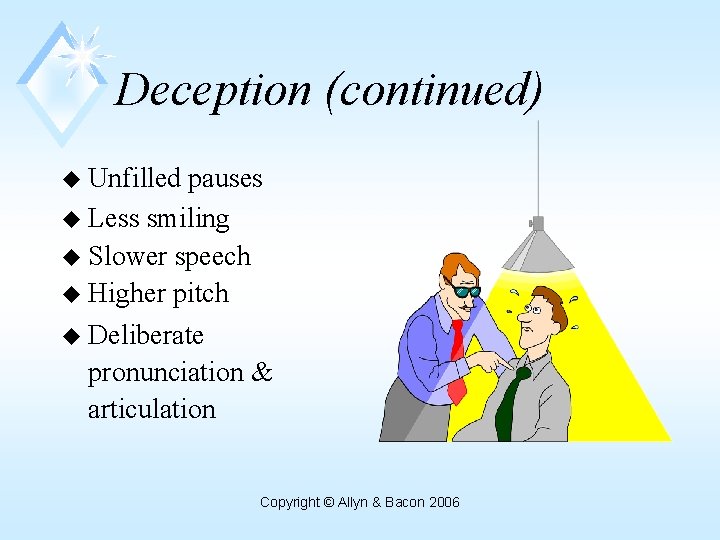
Deception (continued) u Unfilled pauses u Less smiling u Slower speech u Higher pitch u Deliberate pronunciation & articulation Copyright © Allyn & Bacon 2006
Interpreting clues u Consider context u Look for clusters of clues u Consider idiosyncrasies u Consider cultural & gender differences u Learn from past experiences Copyright © Allyn & Bacon 2006
Look for clues that communicate: u Immediacy-liking & disliking u Power-influence & status u Responsivenessinterest & attention Copyright © Allyn & Bacon 2006