
Chapter 6 Energy Relationships in Chemical Reactions Nature
- Slides: 13
Chapter 6 Energy Relationships in Chemical Reactions • Nature and types of energy • First law of thermodynamics • Thermochemistry • Enthalpy
Chapter 18 (partial) Thermodynamics • Second and third laws of thermodynamics • Gibbs free energy (briefly) • Spontaneity • Entropy
Energy is the capacity to do work • Radiant energy comes from the sun and is earth’s primary energy source • Thermal energy is the energy associated with the random motion of atoms and molecules • Chemical energy is the energy stored within the bonds of chemical substances • Nuclear energy is the energy stored within the collection of neutrons and protons in the atom • Potential energy is the energy available by virtue of an object’s position
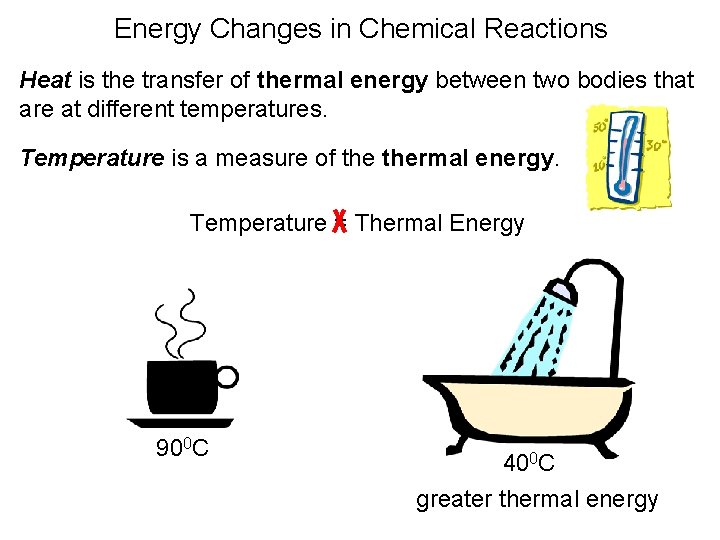
Energy Changes in Chemical Reactions Heat is the transfer of thermal energy between two bodies that are at different temperatures. Temperature is a measure of thermal energy. Temperature = Thermal Energy 900 C 400 C greater thermal energy
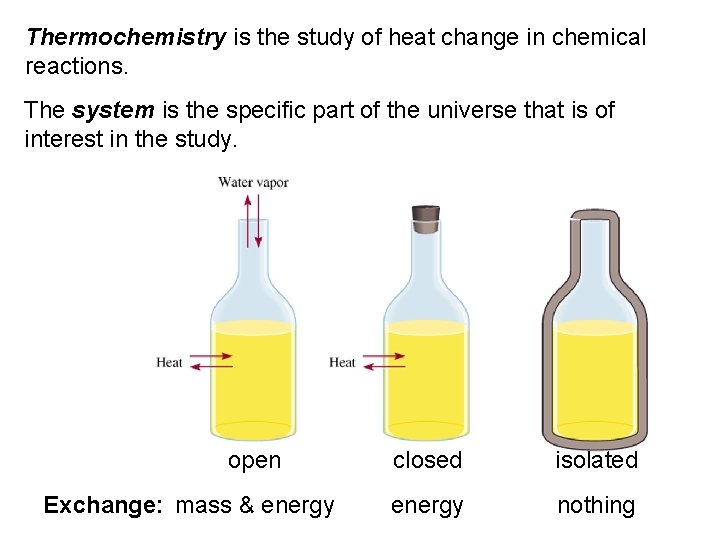
Thermochemistry is the study of heat change in chemical reactions. The system is the specific part of the universe that is of interest in the study. open Exchange: mass & energy closed isolated energy nothing
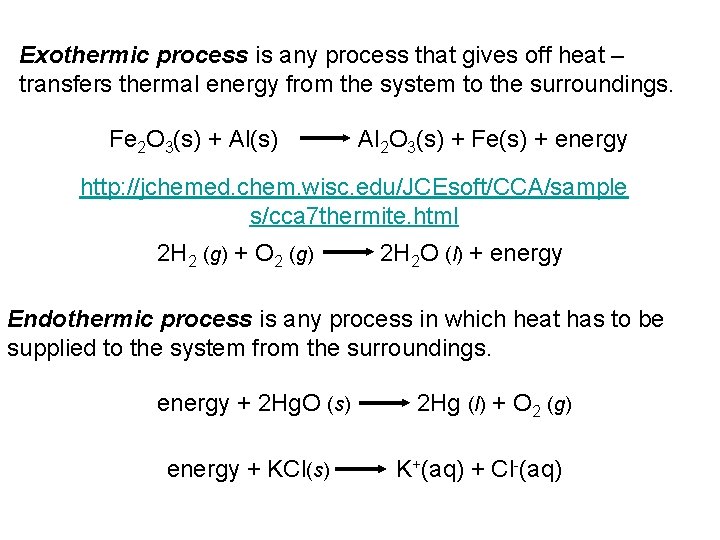
Exothermic process is any process that gives off heat – transfers thermal energy from the system to the surroundings. Fe 2 O 3(s) + Al(s) Al 2 O 3(s) + Fe(s) + energy http: //jchemed. chem. wisc. edu/JCEsoft/CCA/sample s/cca 7 thermite. html 2 H 2 (g) + O 2 (g) 2 H 2 O (l) + energy Endothermic process is any process in which heat has to be supplied to the system from the surroundings. energy + 2 Hg. O (s) energy + KCl(s) 2 Hg (l) + O 2 (g) K+(aq) + Cl-(aq)
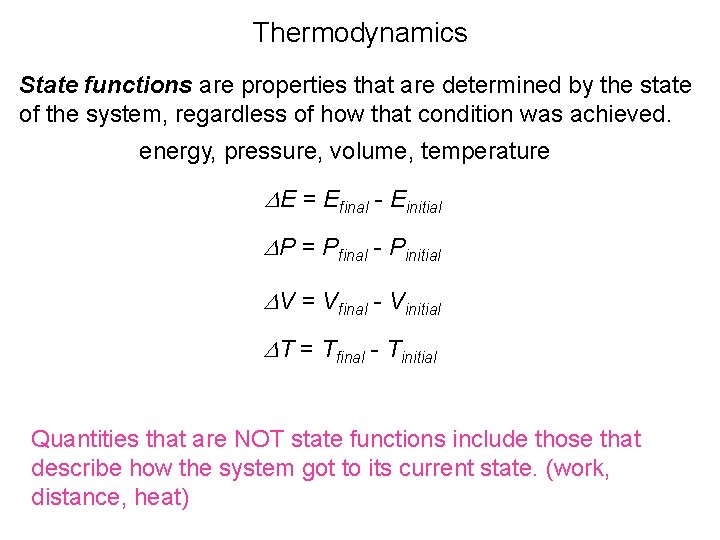
Thermodynamics State functions are properties that are determined by the state of the system, regardless of how that condition was achieved. energy, pressure, volume, temperature DE = Efinal - Einitial DP = Pfinal - Pinitial DV = Vfinal - Vinitial DT = Tfinal - Tinitial Quantities that are NOT state functions include those that describe how the system got to its current state. (work, distance, heat)
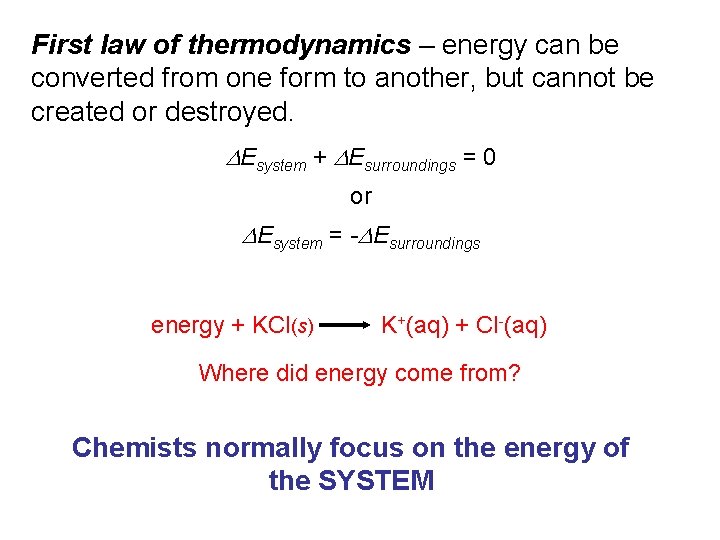
First law of thermodynamics – energy can be converted from one form to another, but cannot be created or destroyed. DEsystem + DEsurroundings = 0 or DEsystem = -DEsurroundings energy + KCl(s) K+(aq) + Cl-(aq) Where did energy come from? Chemists normally focus on the energy of the SYSTEM
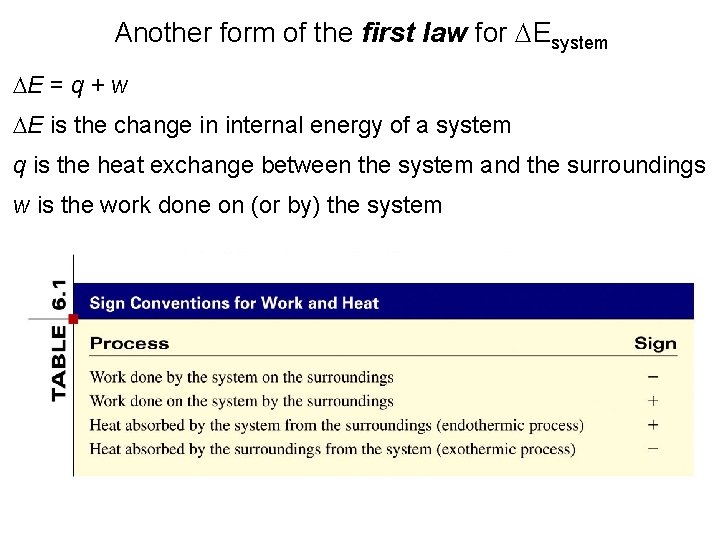
Another form of the first law for DEsystem DE = q + w DE is the change in internal energy of a system q is the heat exchange between the system and the surroundings w is the work done on (or by) the system
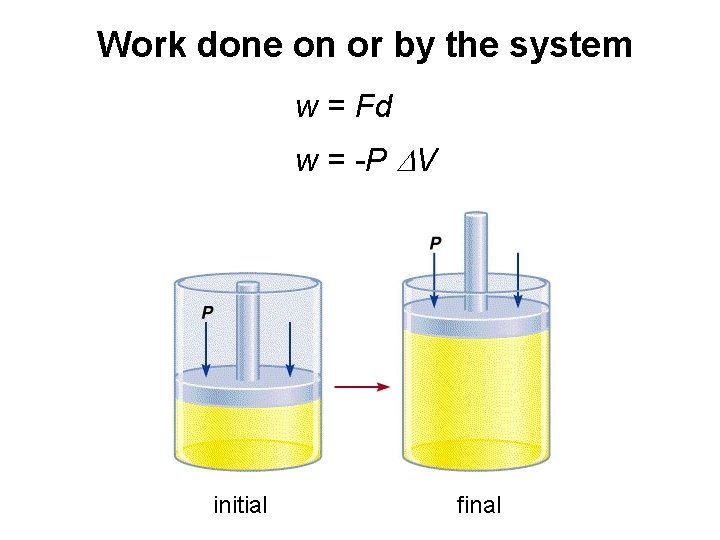
Work done on or by the system w = Fd w = -P DV initial final
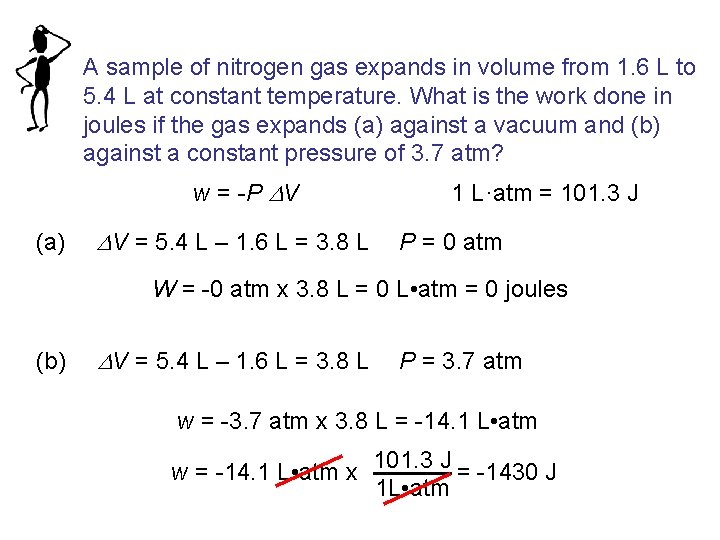
A sample of nitrogen gas expands in volume from 1. 6 L to 5. 4 L at constant temperature. What is the work done in joules if the gas expands (a) against a vacuum and (b) against a constant pressure of 3. 7 atm? w = -P DV (a) DV = 5. 4 L – 1. 6 L = 3. 8 L 1 L·atm = 101. 3 J P = 0 atm W = -0 atm x 3. 8 L = 0 L • atm = 0 joules (b) DV = 5. 4 L – 1. 6 L = 3. 8 L P = 3. 7 atm w = -3. 7 atm x 3. 8 L = -14. 1 L • atm 101. 3 J = -1430 J w = -14. 1 L • atm x 1 L • atm
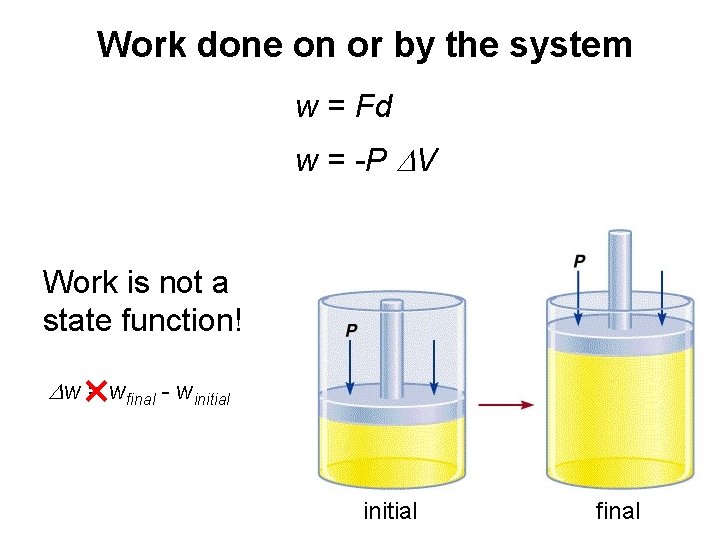
Work done on or by the system w = Fd w = -P DV Work is not a state function! Dw = wfinal - winitial final
Next time… • Heat • Energy involved in chemical reactions