
Chapter 6 Energy is transferred and transformed by
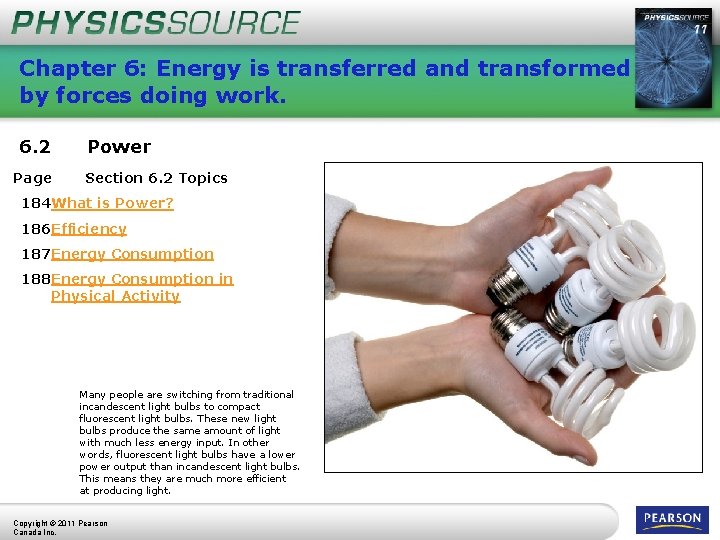
Chapter 6: Energy is transferred and transformed by forces doing work. 6. 2 Page Power Section 6. 2 Topics 184 What is Power? 186 Efficiency 187 Energy Consumption 188 Energy Consumption in Physical Activity Many people are switching from traditional incandescent light bulbs to compact fluorescent light bulbs. These new light bulbs produce the same amount of light with much less energy input. In other words, fluorescent light bulbs have a lower power output than incandescent light bulbs. This means they are much more efficient at producing light. Copyright © 2011 Pearson Canada Inc.
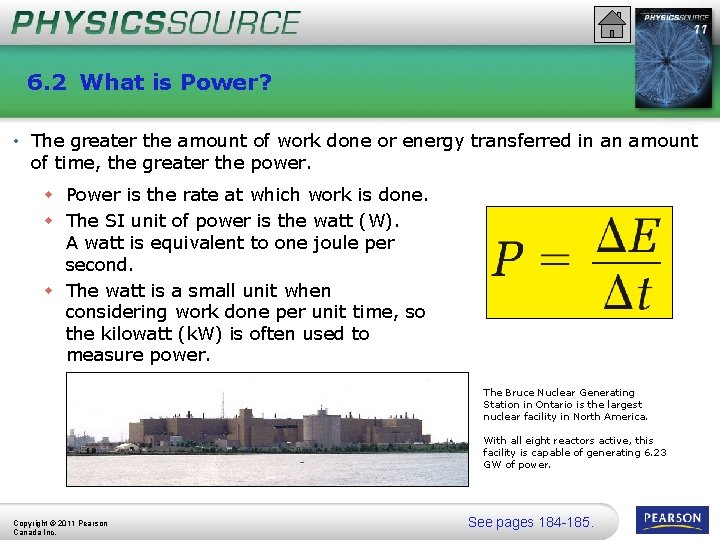
6. 2 What is Power? • The greater the amount of work done or energy transferred in an amount of time, the greater the power. w Power is the rate at which work is done. w The SI unit of power is the watt (W). A watt is equivalent to one joule per second. w The watt is a small unit when considering work done per unit time, so the kilowatt (k. W) is often used to measure power. The Bruce Nuclear Generating Station in Ontario is the largest nuclear facility in North America. With all eight reactors active, this facility is capable of generating 6. 23 GW of power. Copyright © 2011 Pearson Canada Inc. See pages 184 -185.
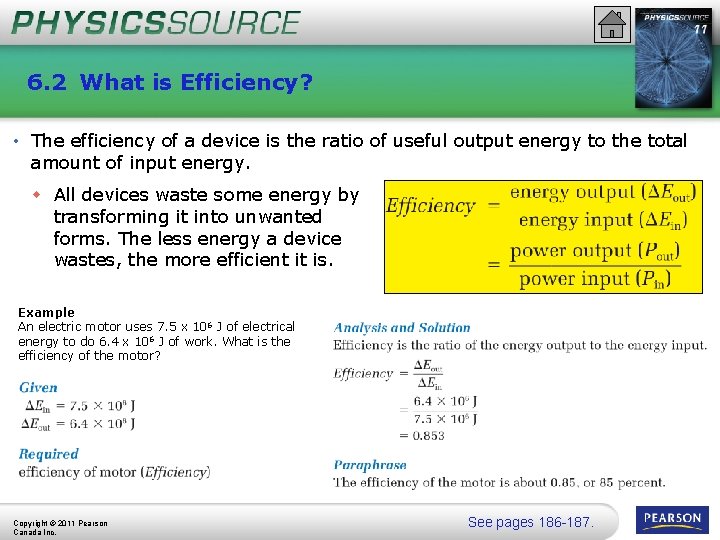
6. 2 What is Efficiency? • The efficiency of a device is the ratio of useful output energy to the total amount of input energy. w All devices waste some energy by transforming it into unwanted forms. The less energy a device wastes, the more efficient it is. Example An electric motor uses 7. 5 x 10⁶ J of electrical energy to do 6. 4 x 10⁶ J of work. What is the efficiency of the motor? Copyright © 2011 Pearson Canada Inc. See pages 186 -187.
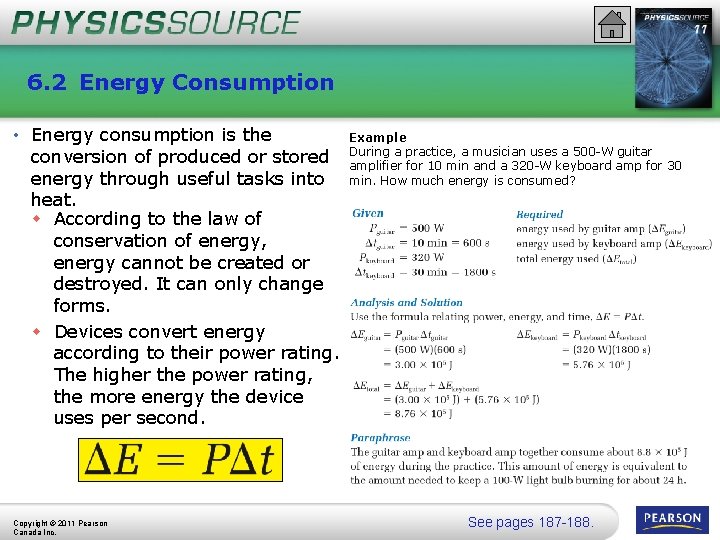
6. 2 Energy Consumption • Energy consumption is the conversion of produced or stored energy through useful tasks into heat. w According to the law of conservation of energy, energy cannot be created or destroyed. It can only change forms. w Devices convert energy according to their power rating. The higher the power rating, the more energy the device uses per second. Copyright © 2011 Pearson Canada Inc. Example During a practice, a musician uses a 500 -W guitar amplifier for 10 min and a 320 -W keyboard amp for 30 min. How much energy is consumed? See pages 187 -188.

6. 2 Energy Consumption in Physical Activity • Human activity consumes energy, which can be calculated if the power rating of the activity is known. The table lists power ratings of some typical activities. Healthrelated fields use power ratings such as these to calculate energy expenditure in kilocalories (kcal). Kilocalories can be easily converted to joules: 1 kcal = 4. 187 k. J Copyright © 2011 Pearson Canada Inc. See pages 188 -189.
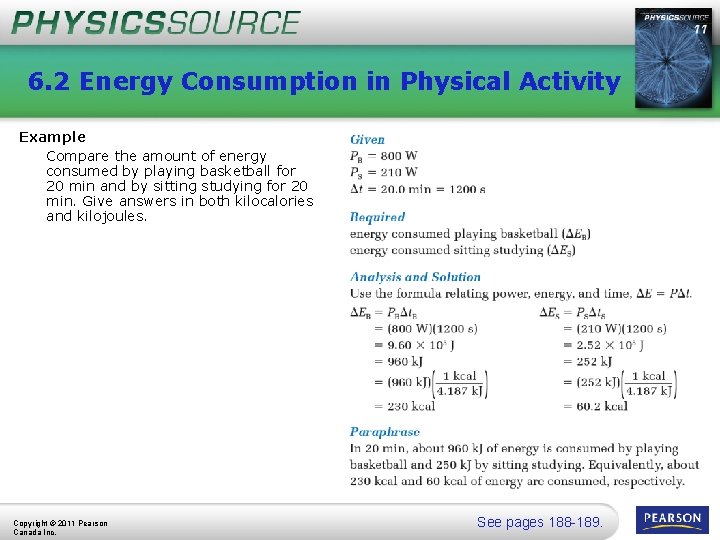
6. 2 Energy Consumption in Physical Activity Example Compare the amount of energy consumed by playing basketball for 20 min and by sitting studying for 20 min. Give answers in both kilocalories and kilojoules. Copyright © 2011 Pearson Canada Inc. See pages 188 -189.
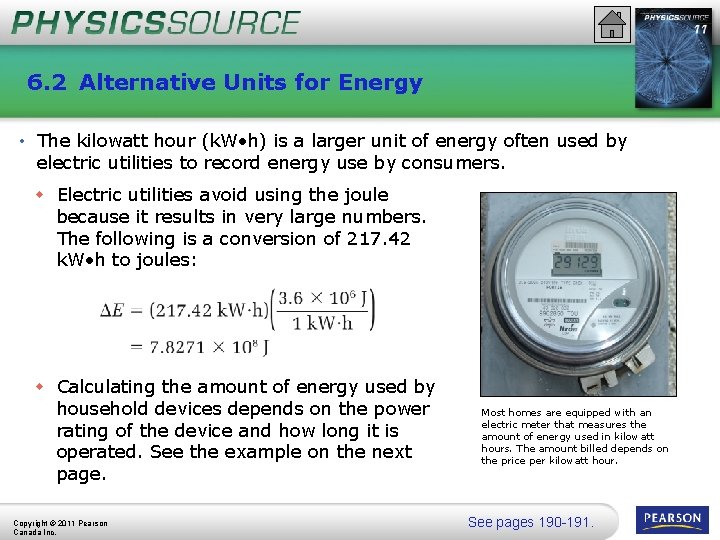
6. 2 Alternative Units for Energy • The kilowatt hour (k. W • h) is a larger unit of energy often used by electric utilities to record energy use by consumers. w Electric utilities avoid using the joule because it results in very large numbers. The following is a conversion of 217. 42 k. W • h to joules: w Calculating the amount of energy used by household devices depends on the power rating of the device and how long it is operated. See the example on the next page. Copyright © 2011 Pearson Canada Inc. Most homes are equipped with an electric meter that measures the amount of energy used in kilowatt hours. The amount billed depends on the price per kilowatt hour. See pages 190 -191.
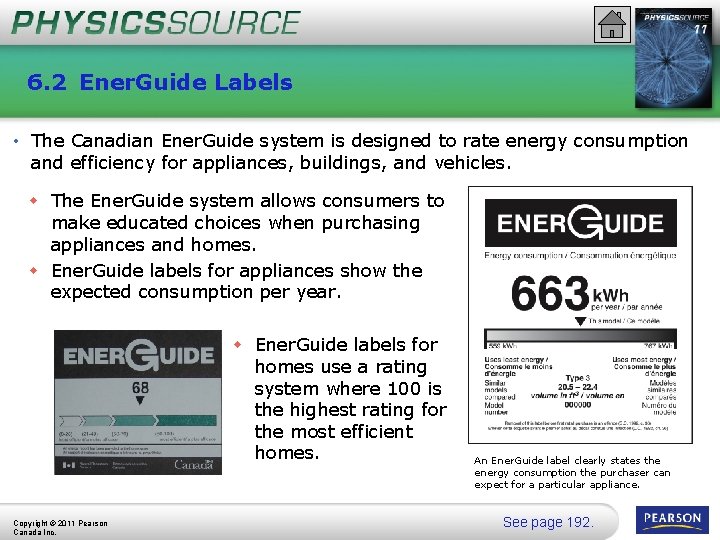
6. 2 Ener. Guide Labels • The Canadian Ener. Guide system is designed to rate energy consumption and efficiency for appliances, buildings, and vehicles. w The Ener. Guide system allows consumers to make educated choices when purchasing appliances and homes. w Ener. Guide labels for appliances show the expected consumption per year. w Ener. Guide labels for homes use a rating system where 100 is the highest rating for the most efficient homes. Copyright © 2011 Pearson Canada Inc. An Ener. Guide label clearly states the energy consumption the purchaser can expect for a particular appliance. See page 192.
Physics. Source Resources Copyright © 2011 Pearson Canada Inc.
- Slides: 9