
Chapter 6 Electricity and Electric Charge The Structure
- Slides: 33
Chapter 6 Electricity and Electric Charge
The Structure of Matter �All matter is made of charged particles �Electric Charge – a property of sub-atomic particles (protons, electrons, ect…) � 2 Types of charge �Positive �Negative �Unit of electric charge – coulomb (C)
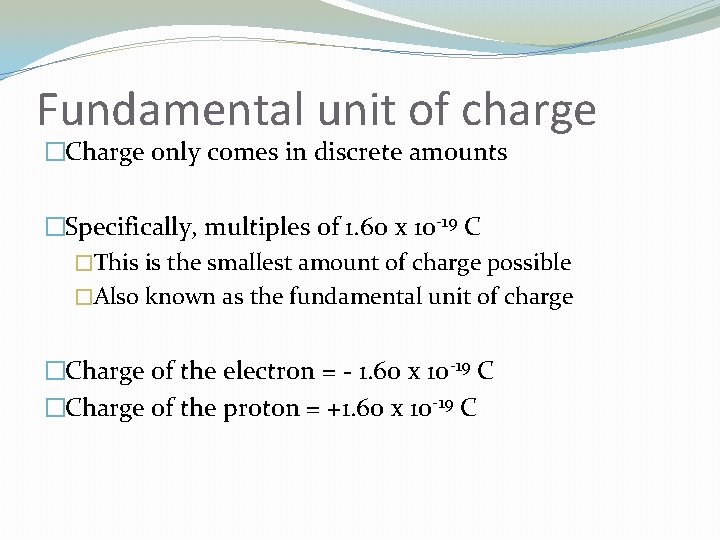
Fundamental unit of charge �Charge only comes in discrete amounts �Specifically, multiples of 1. 60 x 10 -19 C �This is the smallest amount of charge possible �Also known as the fundamental unit of charge �Charge of the electron = - 1. 60 x 10 -19 C �Charge 0 f the proton = +1. 60 x 10 -19 C
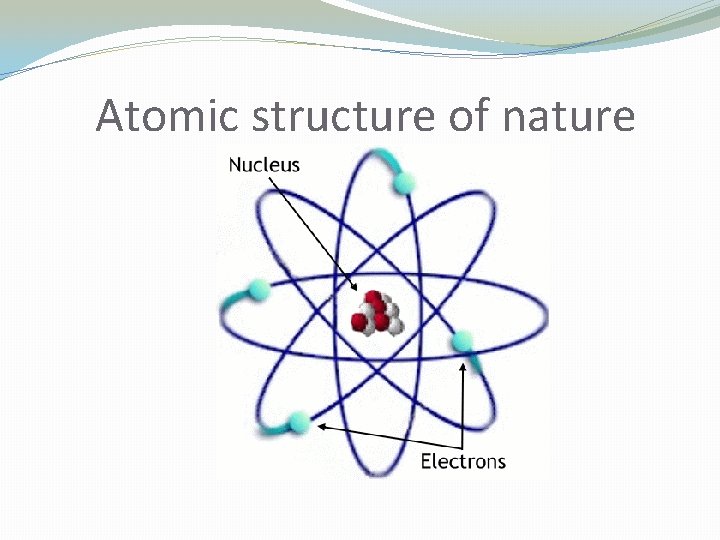
Atomic structure of nature
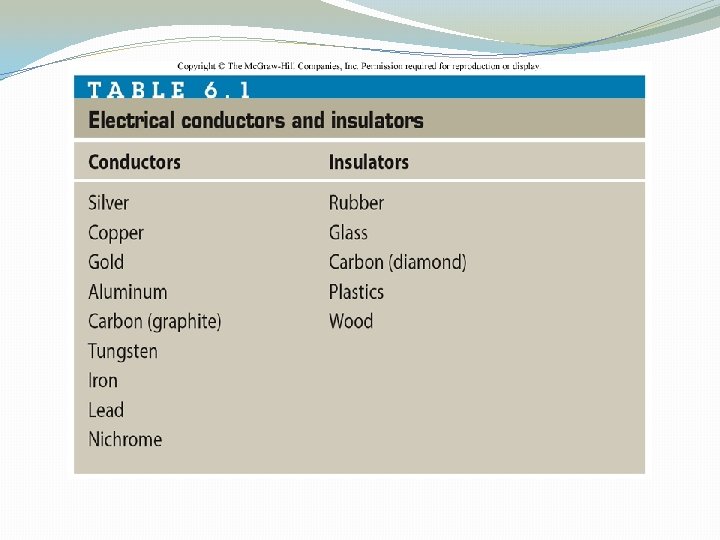
Conductors and Insulators �Insulators – outer electrons are tightly bound to each atom �Conductors – outer electrons are free to move from atom to atom
Forces Between Charged Particles �Charged particles exert forces on each other �RULE: Opposite charges attract, like charges repel �This force is extremely strong �Given by Coulombs law:
Example �Find the force of repulsion between 2 protons separated by a distance of 0. 5 m.
Nature Strives For Neutrality �Atoms have an equal number of protons and electrons �Therefore, they are electrically neutral �This is why we rarely experience electrostatic forces
Charging an Object by Friction �Electrons can be stripped off of a material through friction �In the process, they are transferred from one object to another �Both objects are now charged �One has a net positive charge �The other has a net negative charge �They both have the same magnitude of charge
Example of Charging by friction �In the process of rubbing a glass rod with silk, 1. 5 x 10 6 electrons are transferred to the silk. Find the net charge of each object after rubbing.
Polarization �When a charged object is brought near other objects, they become polarized �This causes them to be attracted to the charged object �Water is an example of a molecule that is naturally polarized
Electric Fields: A Different Approach to the Force Between Charged Particles �A charge produces a force field surrounding it known as an electric field �We can visualize the field by drawing electric field lines �Field lines indicate the direction of the force on a positive charge
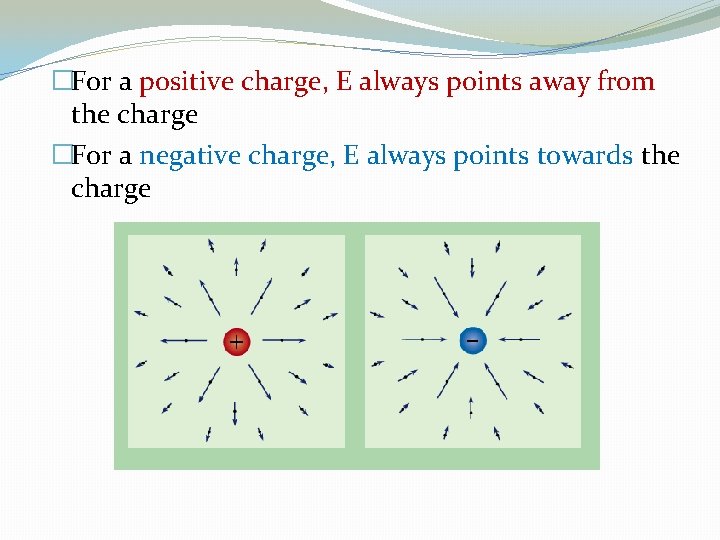
�For a positive charge, E always points away from the charge �For a negative charge, E always points towards the charge
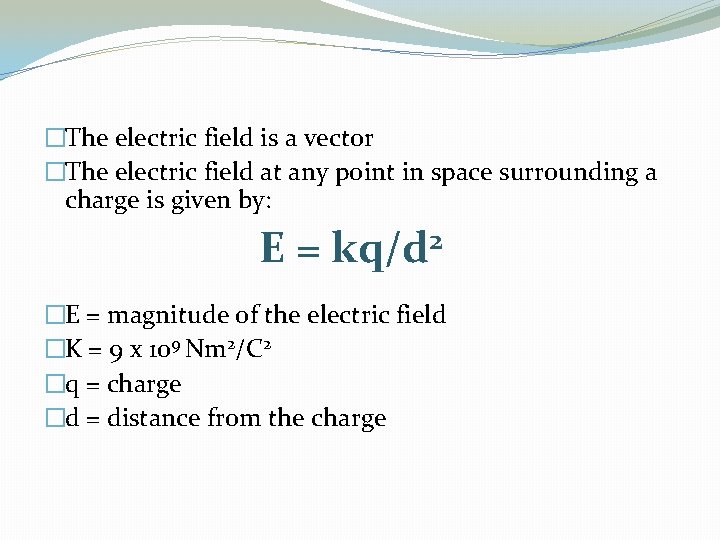
�The electric field is a vector �The electric field at any point in space surrounding a charge is given by: E = kq/d 2 �E = magnitude of the electric field �K = 9 x 10⁹ Nm 2/C 2 �q = charge �d = distance from the charge
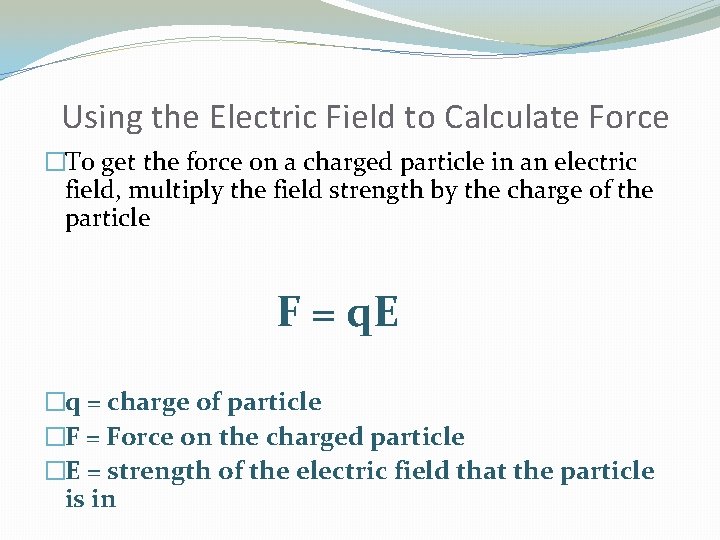
Using the Electric Field to Calculate Force �To get the force on a charged particle in an electric field, multiply the field strength by the charge of the particle F = q. E �q = charge of particle �F = Force on the charged particle �E = strength of the electric field that the particle is in
Electric Potential Energy �Work must be done to move a charge in the presence of another charge �The charge therefore undergoes a change in electric potential energy (EPE) �The change in EPE divided by the amount of charge moved is called the electric potential difference between the two points
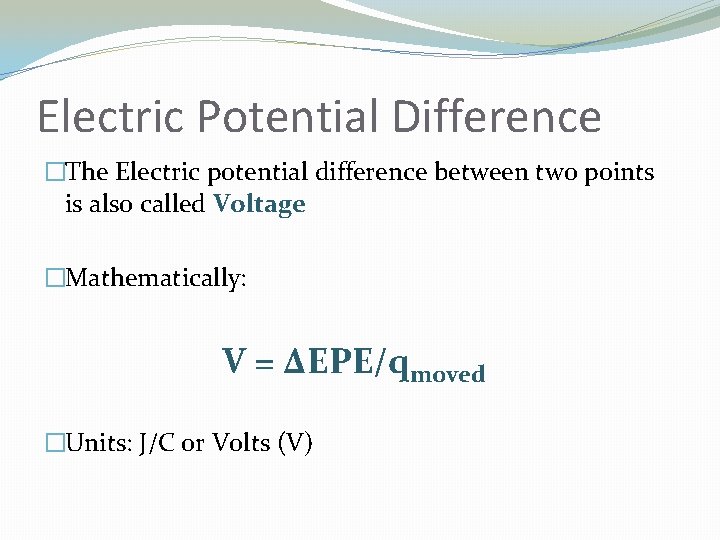
Electric Potential Difference �The Electric potential difference between two points is also called Voltage �Mathematically: V = ΔEPE/qmoved �Units: J/C or Volts (V)
�Positive charge flows from regions of higher potential to lower potential �Like mass moving from higher potential to lower potential �Negative charge flows from lower to higher potential
Conceptual examples using Voltage �Suppose a potential difference of 12 V exists between two points. How much potential energy does 2 C of charge gain moving between these points?
The Same Question Reworded �Suppose a potential difference of 12 V exists between two points. How much work must be done to move 2 C of charge between these points?
Electric current �Current is the flow of charge �The amount of charge passing through an area per second is called the current �Formula: I = q/t �Units: C/s or Amperes (Amps)
�Charge will only flow between regions of different electric potential energy �Therefore, the flow of charge is related to the potential energy difference between two points �In other words, current is directly proportional to voltage
Resistance �Electrons encounter obstacles as they move through a wire �This is known as resistance �Collisions between electrons and atoms in the wire generate heat
Factors That Affect Resistance �Each material (aluminum, copper, ect. . ) has a unique resistance due to their unique atomic structure �The resistance of a wire: �increases with length �increases with temperature �decreases with area
�Higher resistance in a wire means it is more difficult for charge to flow �Therefore, current is inversely proportional to resistance
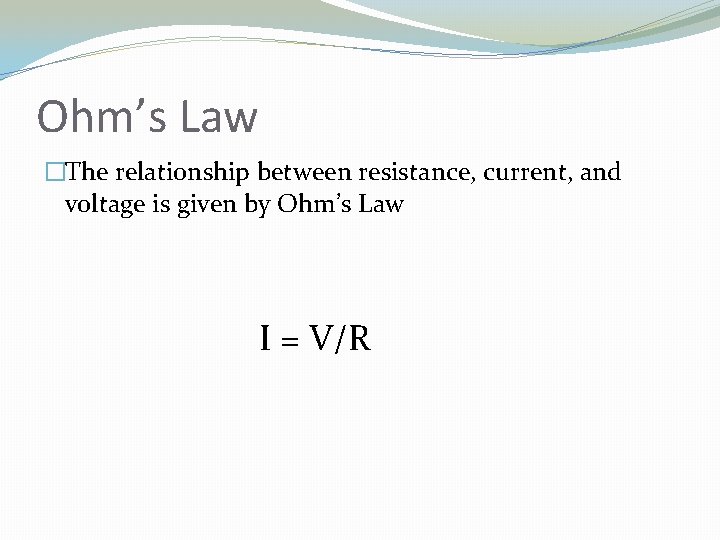
Ohm’s Law �The relationship between resistance, current, and voltage is given by Ohm’s Law I = V/R
Simple Circuits and Circuit Diagrams
The role of a battery in a circuit
A Gravitational Analogy to a Simple Circuit
Resistors in Series �The total resistance of the circuit is given by: �The total current can be found using Ohm’s Law: �This current flows through each resistor in series and is the same for each resistor �The voltage across each resistor is different, and can be calculated using Ohm’s law:
Resistors in Parallel �The total resistance of the circuit is given by: �The total Current is therefore: �The voltage across each resistor is the same and equal to the battery voltage �The current through each is different and can be found using Ohm’s law
Household Circuits