
Chapter 6 Economic Activity Section 6 1 Economic

- Slides: 55
Chapter 6 Economic Activity
Section 6. 1 Economic Measurement
Learning Objectives • 6. 1 -1 Identify common indicators used to measure economic activity. • 6. 1 -2 Describe the four stages of the business cycle. • 6. 1 -3 Explain three classifications of economic indicators. Copyright Goodheart-Willcox Co. , Inc. May not be posted to a publicly accessible website.
Key Terms • gross domestic product (GDP) • standard of living • inflation rate • consumer price index (CPI) • deflation • interest rate • labor force • • • unemployment rate specialization stock market business cycle expansion peak recession depression trough Copyright Goodheart-Willcox Co. , Inc. May not be posted to a publicly accessible website.
Essential Question What can past economic data reveal about the future? Copyright Goodheart-Willcox Co. , Inc. May not be posted to a publicly accessible website.
Economic Indicators • Economic activity is the production, distribution, and consumption of products – A healthy economy is one that is experiencing growth through high productivity, a high rate of employment, and stable prices in the market – An indicator shows the condition or existence of something Copyright Goodheart-Willcox Co. , Inc. May not be posted to a publicly accessible website.
Economic Indicators (Continued) • Gross domestic product (GDP) is the market value of all final products produced in a country during a specific period of time – Also known as economic output – Measured in dollars – One of the most closely followed economic indicators Copyright Goodheart-Willcox Co. , Inc. May not be posted to a publicly accessible website.
Economic Indicators (Continued) • Per capita GDP is the GDP of a nation, divided by its population – Shows the amount of economic output for each person in the country – One way to measure a country’s standard of living • Standard of living refers to the financial wellbeing of the average person in a country • Increasing this is one of a government’s goals Copyright Goodheart-Willcox Co. , Inc. May not be posted to a publicly accessible website.
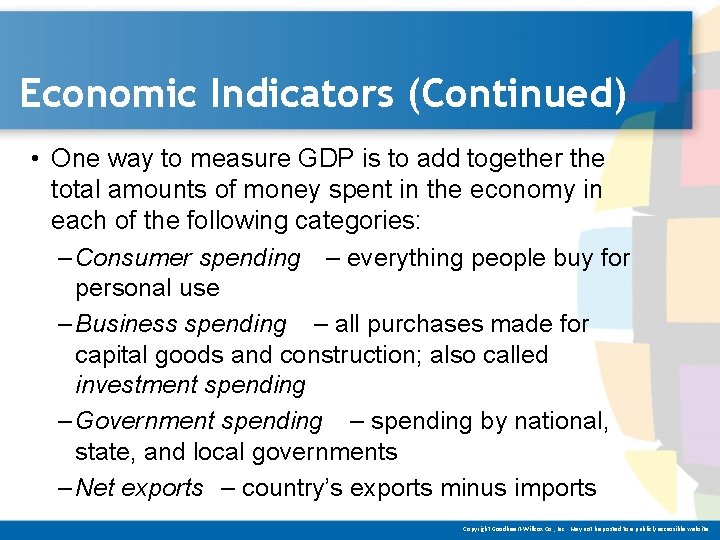
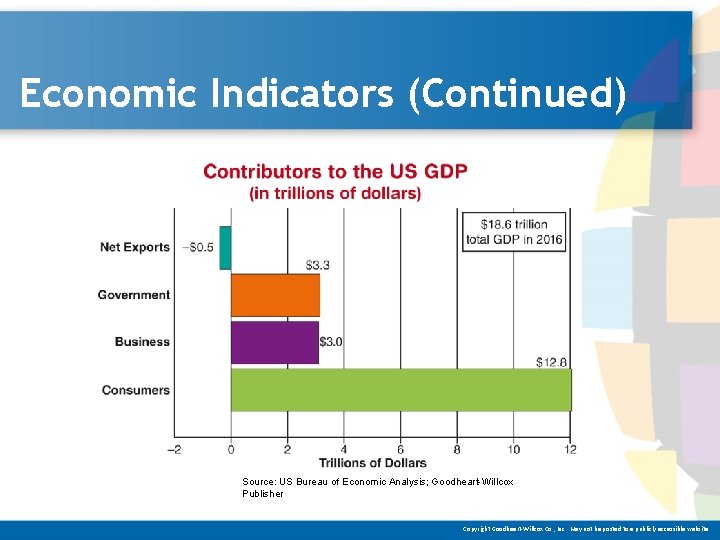
Economic Indicators (Continued) • One way to measure GDP is to add together the total amounts of money spent in the economy in each of the following categories: – Consumer spending – everything people buy for personal use – Business spending – all purchases made for capital goods and construction; also called investment spending – Government spending – spending by national, state, and local governments – Net exports – country’s exports minus imports Copyright Goodheart-Willcox Co. , Inc. May not be posted to a publicly accessible website.
Economic Indicators (Continued) Source: US Bureau of Economic Analysis; Goodheart-Willcox Publisher Copyright Goodheart-Willcox Co. , Inc. May not be posted to a publicly accessible website.
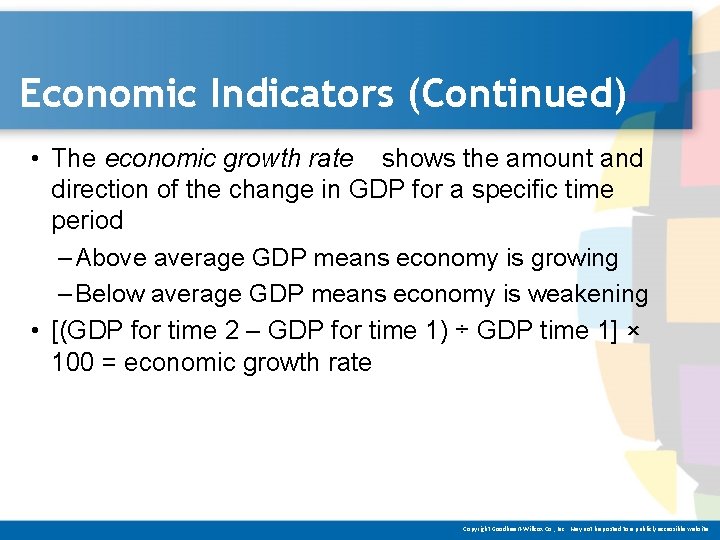
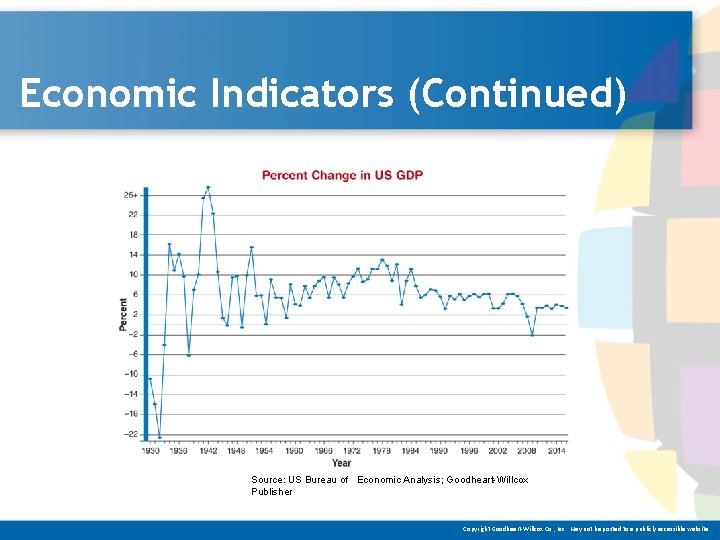
Economic Indicators (Continued) • The economic growth rate shows the amount and direction of the change in GDP for a specific time period – Above average GDP means economy is growing – Below average GDP means economy is weakening • [(GDP for time 2 – GDP for time 1) ÷ GDP time 1] × 100 = economic growth rate Copyright Goodheart-Willcox Co. , Inc. May not be posted to a publicly accessible website.
Economic Indicators (Continued) Source: US Bureau of Economic Analysis; Goodheart-Willcox Publisher Copyright Goodheart-Willcox Co. , Inc. May not be posted to a publicly accessible website.
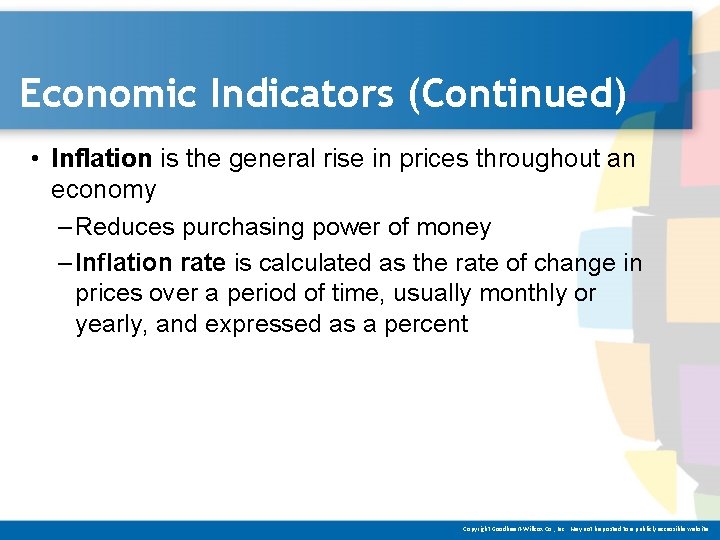
Economic Indicators (Continued) • Inflation is the general rise in prices throughout an economy – Reduces purchasing power of money – Inflation rate is calculated as the rate of change in prices over a period of time, usually monthly or yearly, and expressed as a percent Copyright Goodheart-Willcox Co. , Inc. May not be posted to a publicly accessible website.
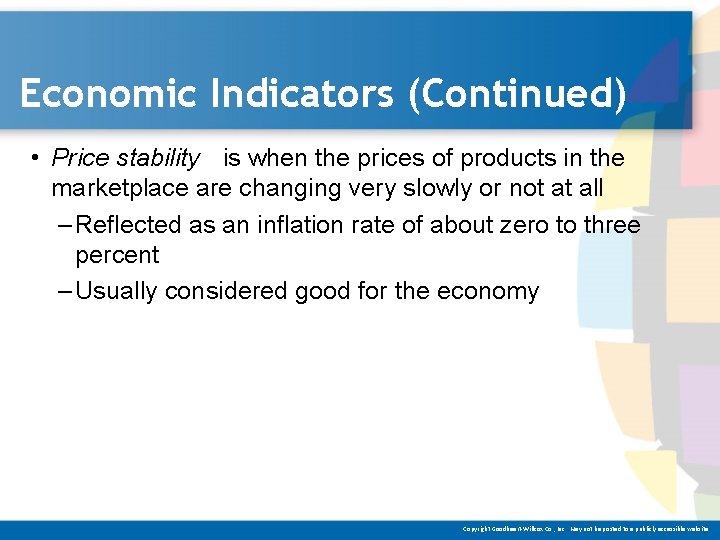
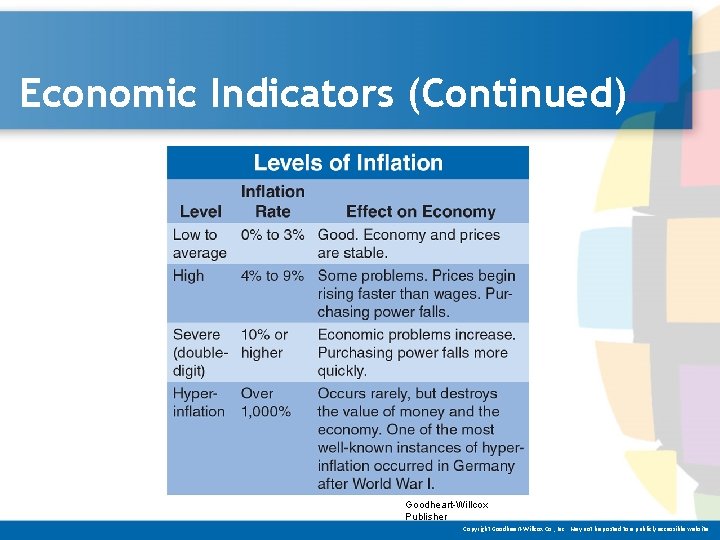
Economic Indicators (Continued) • Price stability is when the prices of products in the marketplace are changing very slowly or not at all – Reflected as an inflation rate of about zero to three percent – Usually considered good for the economy Copyright Goodheart-Willcox Co. , Inc. May not be posted to a publicly accessible website.
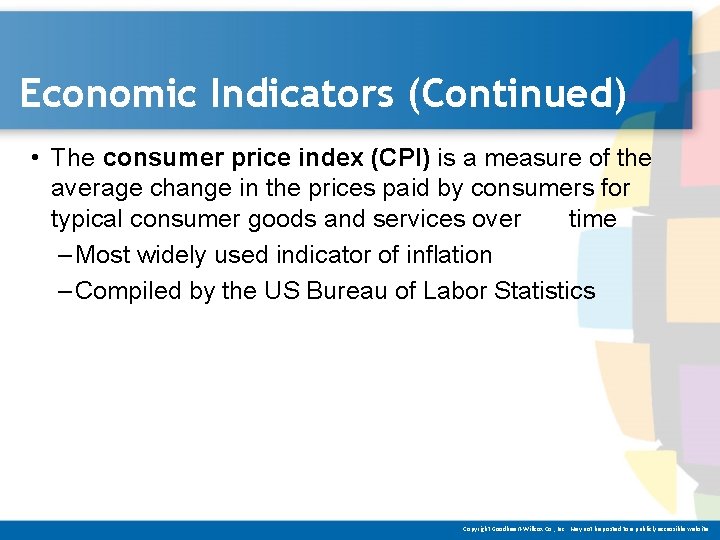
Economic Indicators (Continued) • The consumer price index (CPI) is a measure of the average change in the prices paid by consumers for typical consumer goods and services over time – Most widely used indicator of inflation – Compiled by the US Bureau of Labor Statistics Copyright Goodheart-Willcox Co. , Inc. May not be posted to a publicly accessible website.
Economic Indicators (Continued) Goodheart-Willcox Publisher Copyright Goodheart-Willcox Co. , Inc. May not be posted to a publicly accessible website.
Economic Indicators (Continued) • Severe inflation is also called double-digit inflation • Hyperinflation is an extremely rapid, out-of-control rise in inflation • Deflation is a general decline in prices throughout an economy Copyright Goodheart-Willcox Co. , Inc. May not be posted to a publicly accessible website.
Economic Indicators (Continued) • Interest is the amount a borrower pays to a lender for a loan • An interest rate represents the cost of a loan and is expressed as a percent of the amount borrowed Copyright Goodheart-Willcox Co. , Inc. May not be posted to a publicly accessible website.
Economic Indicators (Continued) • All the people in the nation who are capable of working and want to work are called the labor force – Does not include children, individuals who are retired, or people who choose not to work – Includes civilian workers and those who are in the military • Labor is important in an economy Copyright Goodheart-Willcox Co. , Inc. May not be posted to a publicly accessible website.
Economic Indicators (Continued) • The civilian labor force is divided into two categories – Employed includes everyone who is working – Unemployed includes those who do not have a job, but are actively looking for one • The unemployment rate is the percentage of the civilian labor force that is unemployed • If every person who is willing and able to work has a job, the economy would be at full employment Copyright Goodheart-Willcox Co. , Inc. May not be posted to a publicly accessible website.
Economic Indicators (Continued) • Productivity is a measure of a worker’s production in a specific amount of time • Specialization is focusing on the production of specific goods so more products can be produced with the same amount of labor – Often centered on the factors of production – Can also apply to labor Copyright Goodheart-Willcox Co. , Inc. May not be posted to a publicly accessible website.
Economic Indicators (Continued) • The stock market is a system and marketplace for buying and selling stocks – A stock represents the right of ownership in a corporation • Ownership of a corporation is divided into shares • People who buy shares of stock in a company are called stockholders , or shareholders – When the value increases, it indicates the value of businesses is rising Copyright Goodheart-Willcox Co. , Inc. May not be posted to a publicly accessible website.
Economic Indicators (Continued) • A bond is a certificate of debt issued by an organization or a government – Sold to investors – Can be traded in a market among investors • Trading means to buy or sell • There are markets for various corporate and government bonds Copyright Goodheart-Willcox Co. , Inc. May not be posted to a publicly accessible website.
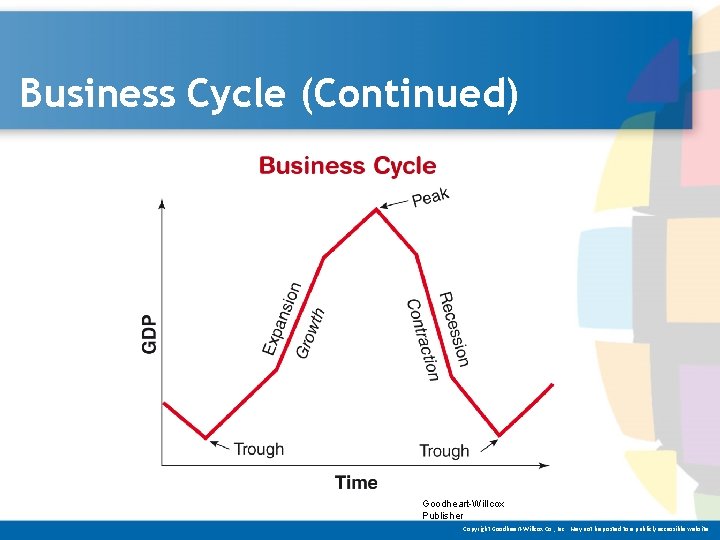
Business Cycle • Alternating periods of expansion and contraction in the economy are called the business cycle • Four stages – Expansion – Peak – Recession – Trough Copyright Goodheart-Willcox Co. , Inc. May not be posted to a publicly accessible website.
Business Cycle (Continued) Goodheart-Willcox Publisher Copyright Goodheart-Willcox Co. , Inc. May not be posted to a publicly accessible website.
Business Cycle (Continued) • Economic expansion is a period in which the economy is growing and the GDP is rising – Usually begins with an increase in consumer demand for goods and services – Prosperity is a time of growth and financial wellbeing Copyright Goodheart-Willcox Co. , Inc. May not be posted to a publicly accessible website.
Business Cycle (Continued) • The peak is the highest point in the business cycle and marks the end of expansion – Consumer demand for goods and services starts to slow – Businesses react by reducing production and workers Copyright Goodheart-Willcox Co. , Inc. May not be posted to a publicly accessible website.
Business Cycle (Continued) • Recession is a period of significant decline in the total output, income, employment, and trade in an economy – A contraction is a decline – A period of economic contraction that is severe and lasts a long time is called a depression Copyright Goodheart-Willcox Co. , Inc. May not be posted to a publicly accessible website.
Business Cycle (Continued) • A trough is the lowest stage of a business cycle and marks the end of a recession • The period of expansion that follows a trough is called economic recovery Copyright Goodheart-Willcox Co. , Inc. May not be posted to a publicly accessible website.
Economic Indicators and the Business Cycle • A leading indicator changes before a change in economic activity – Example: stock market • A lagging indicator changes after a change in economic activity – Example: unemployment rate • A coincident indicator changes at the same time as a change in economic activity – Examples: GDP and inflation rate Copyright Goodheart-Willcox Co. , Inc. May not be posted to a publicly accessible website.
Section 6. 1 Review 1. What is a healthy economy? A healthy economy is one that is experiencing growth through high productivity , a high rate of employment , and stable prices in the market. 2. State the most significant effect of rising inflation. The most significant effect of inflation is that it reduces the purchasing power of money. Copyright Goodheart-Willcox Co. , Inc. May not be posted to a publicly accessible website.
Section 6. 1 Review (Continued) 3. What is per capita GDP, and what does it show ? Per capita GDP is the GDP of a nation, divided by the nation’s population. It shows the amount of economic output for each person in the country. Copyright Goodheart-Willcox Co. , Inc. May not be posted to a publicly accessible website.
Section 6. 1 Review (Continued) 4. What is meant by full employment ? If every person who is willing and able to work has a job, the economy would be at full employment. 5. Name the type of economic indicator that changes after a change in economic activity. A lagging indicator. Copyright Goodheart-Willcox Co. , Inc. May not be posted to a publicly accessible website.
Section 6. 2 Government and the Economy
Learning Objectives • 6. 2 -1 Describe four basic market structures. • 6. 2 -2 Identify the role of government in the US economy. Copyright Goodheart-Willcox Co. , Inc. May not be posted to a publicly accessible website.
Key Terms • • market structure monopoly oligopoly monopolistic competition • perfect competition • price competition • nonprice competition • fiscal policy • monetary policy • Federal Reserve System • money supply • price-fixing • collusion • externality Copyright Goodheart-Willcox Co. , Inc. May not be posted to a publicly accessible website.
Essential Question Why do governments exist in our society? Copyright Goodheart-Willcox Co. , Inc. May not be posted to a publicly accessible website.
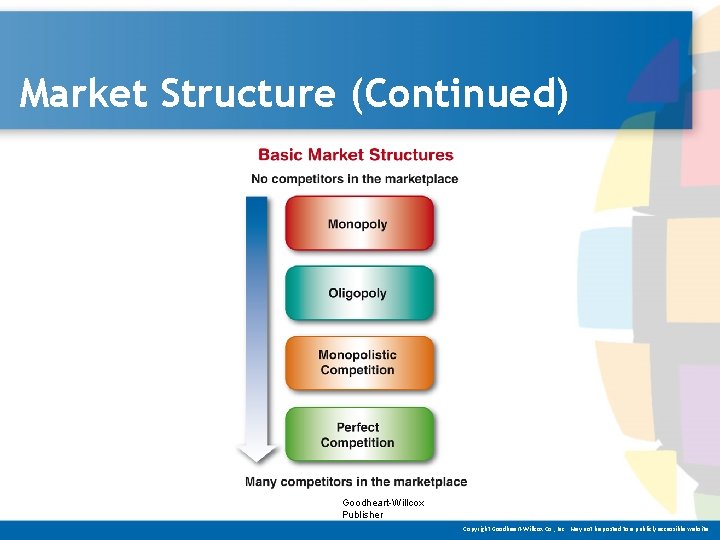
Market Structure • Market structure is how a market is organized based on the number of businesses competing for sales in an industry – Monopolies – Oligopolies – Monopolistic competition – Perfect competition Copyright Goodheart-Willcox Co. , Inc. May not be posted to a publicly accessible website.
Market Structure (Continued) Goodheart-Willcox Publisher Copyright Goodheart-Willcox Co. , Inc. May not be posted to a publicly accessible website.
Market Structure (Continued) • A monopoly is a market structure with one business that has complete control of a market’s entire supply of a product • An oligopoly is a market structure with a small number of businesses selling the same or similar products • Monopolistic competition, or imperfect competition , is a large number of businesses selling similar—but not the same—products at different prices • Perfect competition is characterized by a large number of businesses selling the same products at the same prices Copyright Goodheart-Willcox Co. , Inc. May not be posted to a publicly accessible website.
Market Structure (Continued) • Price competition is when a lower price is the main reason for customers to buy from one business over another • Nonprice competition is when strategies other than price are used to attract customers Copyright Goodheart-Willcox Co. , Inc. May not be posted to a publicly accessible website.
Role of Government in the US Economy • Acts as a regulator • Acts as a provider – Provides public goods and services – Provides a legal framework • Manages the economy • Promotes competition • Corrects for externalities Copyright Goodheart-Willcox Co. , Inc. May not be posted to a publicly accessible website.
Role of Government in the US Economy (Continued) • Managing the economy – Fiscal policy – Monetary policy Copyright Goodheart-Willcox Co. , Inc. May not be posted to a publicly accessible website.
Role of Government in the US Economy (Continued) • Fiscal policy is the tax spending decisions made by the president and Congress – Used to boost the economy when it is weak – Used to reduce the extreme highs and lows of the business cycle Copyright Goodheart-Willcox Co. , Inc. May not be posted to a publicly accessible website.
Role of Government in the US Economy (Continued) • Monetary policy regulates the supply of money and interest rates by a central bank in an economy – The Federal Reserve System is the central bank of the United States, created by Congress in 1913 – The Fed looks at many economic indicators to evaluate the condition of the economy – Money supply is the total money circulating at any one time in a country Copyright Goodheart-Willcox Co. , Inc. May not be posted to a publicly accessible website.
Role of Government in the US Economy (Continued) • Providing public goods and services – Governmental agencies collect taxes to pay for them – Main motives in a market economy are money and profit Copyright Goodheart-Willcox Co. , Inc. May not be posted to a publicly accessible website.
Role of Government in the US Economy (Continued) • Providing a legal framework – Necessary for a market economy to function – Needed to define and enforce property rights and provide for public safety Copyright Goodheart-Willcox Co. , Inc. May not be posted to a publicly accessible website.
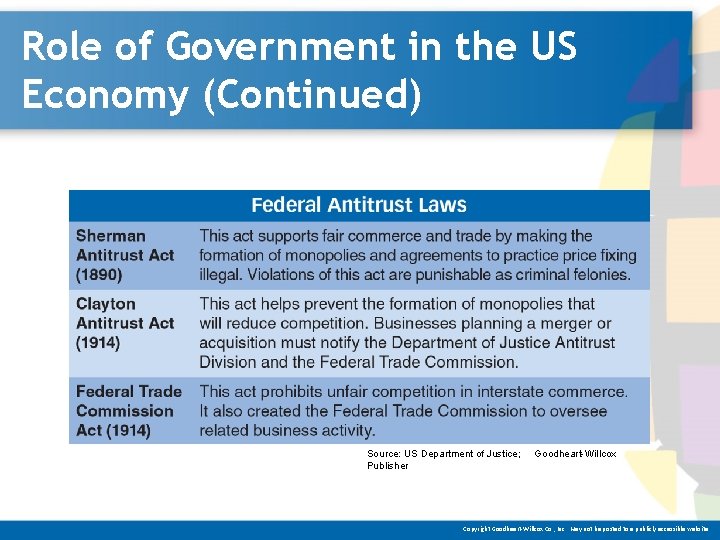
Role of Government in the US Economy (Continued) • Promoting competition – Antitrust laws promote fair trade, open markets, and competition among businesses – Price-fixing occurs when two or more businesses in an industry agree to sell the same product or service at a set price – When two or more businesses work together to remove their competition, set prices, and control distribution, it is called collusion Copyright Goodheart-Willcox Co. , Inc. May not be posted to a publicly accessible website.
Role of Government in the US Economy (Continued) Source: US Department of Justice; Publisher Goodheart-Willcox Copyright Goodheart-Willcox Co. , Inc. May not be posted to a publicly accessible website.
Role of Government in the US Economy (Continued) • Correcting for externalities – An externality is something that is not directly connected to an economic activity, but that affects people – Government can impose fines and taxes on industries to reduce externalities Copyright Goodheart-Willcox Co. , Inc. May not be posted to a publicly accessible website.
Section 6. 2 Review 1. Which market structure is characterized by a large number of businesses selling similar—but not the same—products at different prices ? Monopolistic competition. Copyright Goodheart-Willcox Co. , Inc. May not be posted to a publicly accessible website.
Section 6. 2 Review (Continued) 2. Distinguish between price and nonprice competition. Price competition is when a lower price is the main reason for customers to buy from one business over another. Nonprice competition is when strategies other than price are used to attract customers. Copyright Goodheart-Willcox Co. , Inc. May not be posted to a publicly accessible website.
Section 6. 2 Review (Continued) 3. How does the government manage the economy? The government takes a role to manage the economy. This is done through fiscal and monetary policies. 4. What two major policies are used by the government to manage the economy? Fiscal policy and monetary policy. Copyright Goodheart-Willcox Co. , Inc. May not be posted to a publicly accessible website.
Section 6. 2 Review (Continued) 5. Name one antitrust law. (Any) Sherman Antitrust Act, Clayton Antitrust Act, and Federal Trade Commission Act. Copyright Goodheart-Willcox Co. , Inc. May not be posted to a publicly accessible website.