
Chapter 6 Early Contingency Theories of Effective Leadership

- Slides: 23
Chapter 6 Early Contingency Theories of Effective Leadership Copyright © 2010 Pearson Education, Inc. Leadership in Organizations 6 -1
Learning Objectives n n Understand why it is necessary to consider the leadership situation when studying leadership Understand how aspects of the situation can enhance or diminish the effects of leader behavior. Understand how aspects of the situation can serve as a substitute for the influence of formal leaders Understand the primary contingency theories of effective leadership Copyright © 2010 Pearson Education, Inc. Leadership in Organizations 6 -2
Learning Objectives (Cont. ) n n Understand the conceptual weaknesses of each contingency theory Understand the findings from empirical research on contingency theories and the limitations of this research Understand the implications of situational theories for improving leadership Understand the limitations of the research on contingency theories Copyright © 2010 Pearson Education, Inc. Leadership in Organizations 6 -3
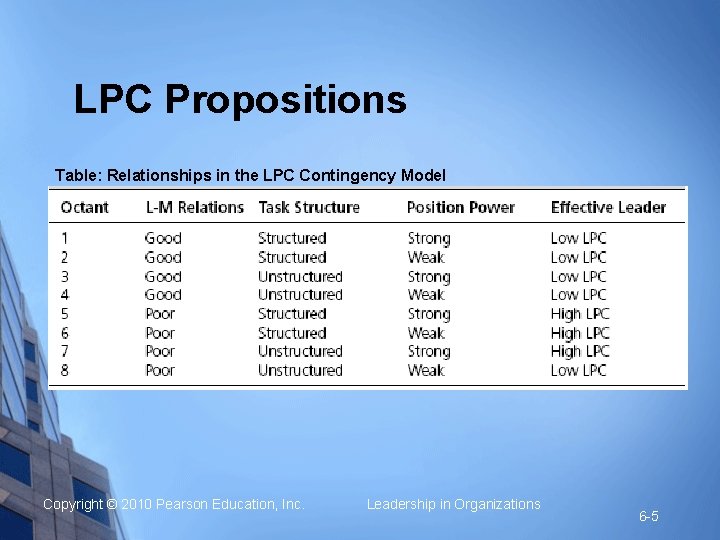
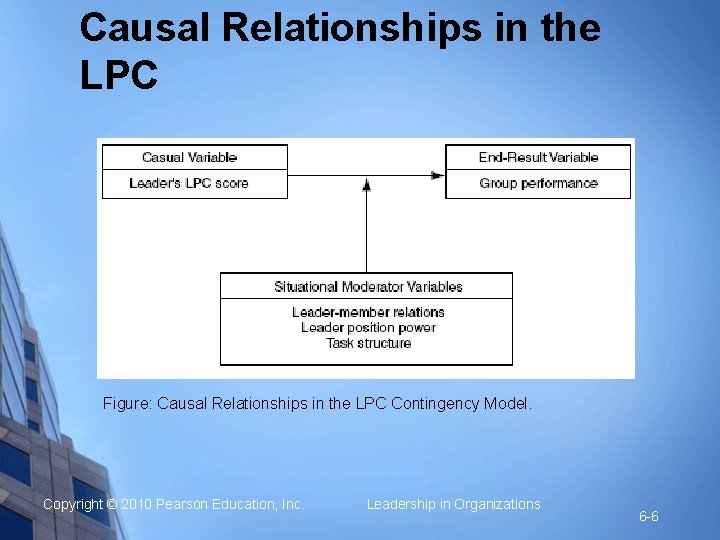
LPC Contingency Theory n LPC Score n n n High LPC – A leader primarily motivated to have close, interpersonal relationships with other people Low LPC – A leader primarily motivated by achievement of task objectives Situational Variables n n n Leader-member relations Position Power Task Structure Copyright © 2010 Pearson Education, Inc. Leadership in Organizations 6 -4
LPC Propositions Table: Relationships in the LPC Contingency Model Copyright © 2010 Pearson Education, Inc. Leadership in Organizations 6 -5
Causal Relationships in the LPC Figure: Causal Relationships in the LPC Contingency Model. Copyright © 2010 Pearson Education, Inc. Leadership in Organizations 6 -6
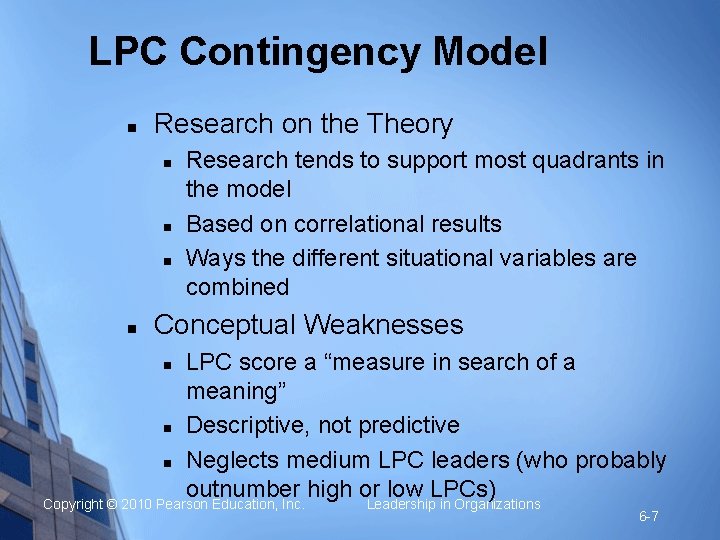
LPC Contingency Model n Research on the Theory n n Research tends to support most quadrants in the model Based on correlational results Ways the different situational variables are combined Conceptual Weaknesses n n n LPC score a “measure in search of a meaning” Descriptive, not predictive Neglects medium LPC leaders (who probably outnumber high or low LPCs) Copyright © 2010 Pearson Education, Inc. Leadership in Organizations 6 -7
Path-Goal Theory of Leadership “The motivational function of the leader consists of increasing personal payoffs to subordinates for work-goal attainment and making the path to these payoffs easier to travel by clarifying it, reducing roadblocks and pitfalls, and increasing the opportunities for personal satisfaction with the leader” Copyright © 2010 Pearson Education, Inc. Leadership in Organizations 6 -8
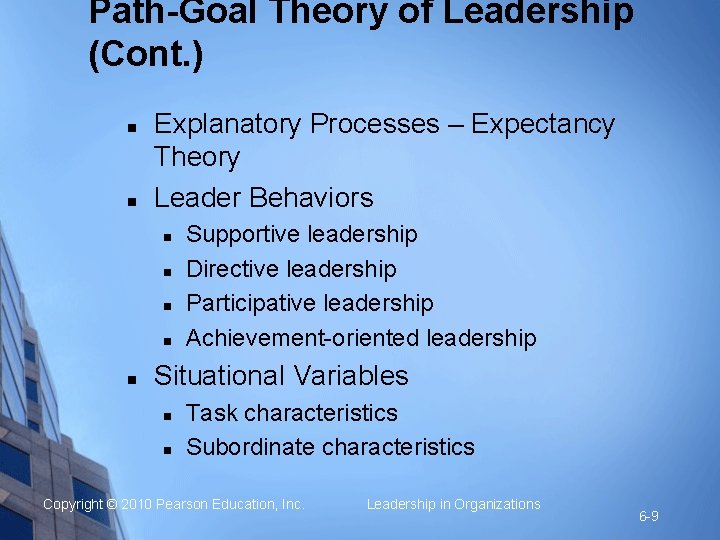
Path-Goal Theory of Leadership (Cont. ) n n Explanatory Processes – Expectancy Theory Leader Behaviors n n n Supportive leadership Directive leadership Participative leadership Achievement-oriented leadership Situational Variables n n Task characteristics Subordinate characteristics Copyright © 2010 Pearson Education, Inc. Leadership in Organizations 6 -9
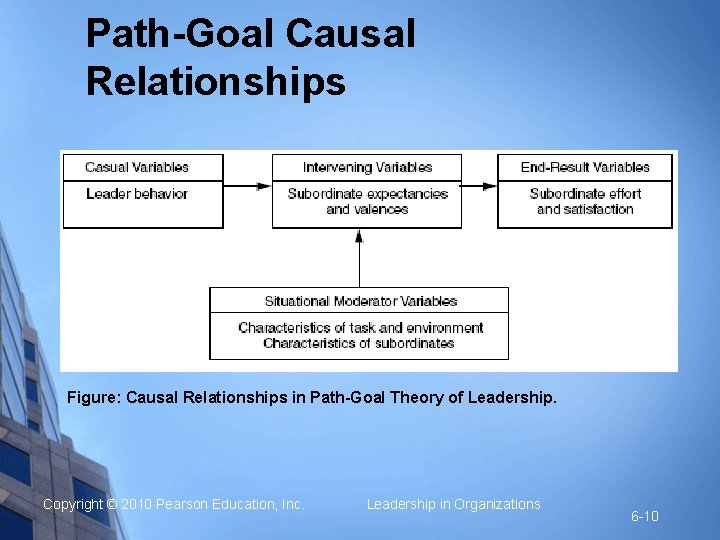
Path-Goal Causal Relationships Figure: Causal Relationships in Path-Goal Theory of Leadership. Copyright © 2010 Pearson Education, Inc. Leadership in Organizations 6 -10
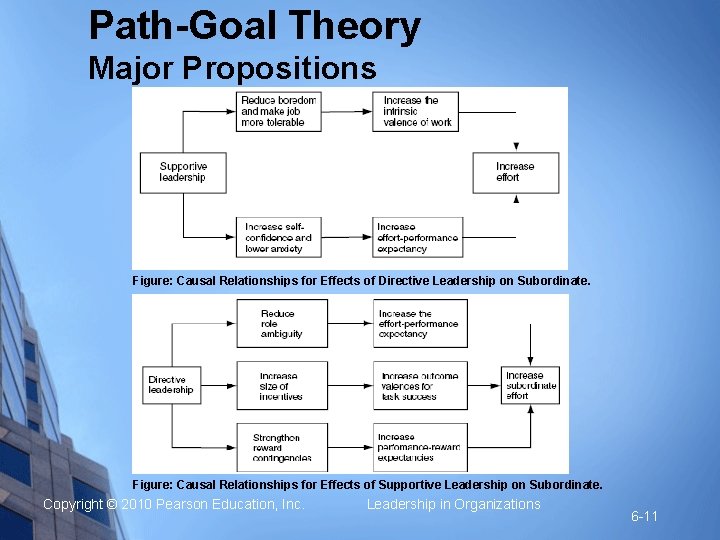
Path-Goal Theory Major Propositions Figure: Causal Relationships for Effects of Directive Leadership on Subordinate. Figure: Causal Relationships for Effects of Supportive Leadership on Subordinate. Copyright © 2010 Pearson Education, Inc. Leadership in Organizations 6 -11
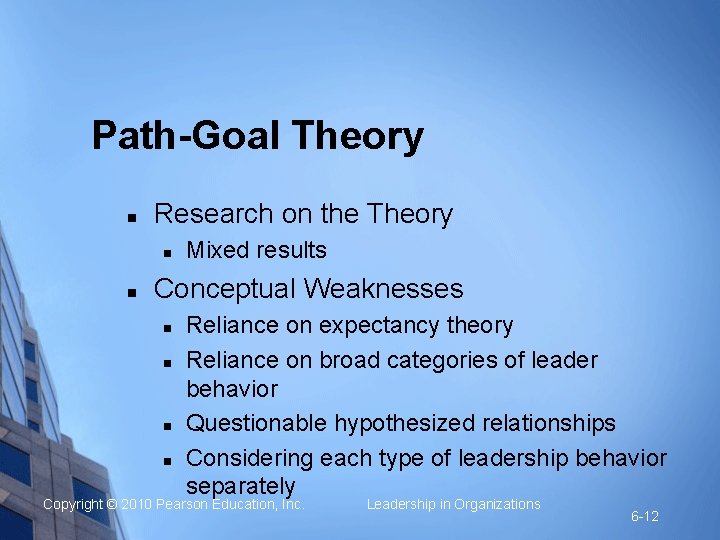
Path-Goal Theory n Research on the Theory n n Mixed results Conceptual Weaknesses n n Reliance on expectancy theory Reliance on broad categories of leader behavior Questionable hypothesized relationships Considering each type of leadership behavior separately Copyright © 2010 Pearson Education, Inc. Leadership in Organizations 6 -12
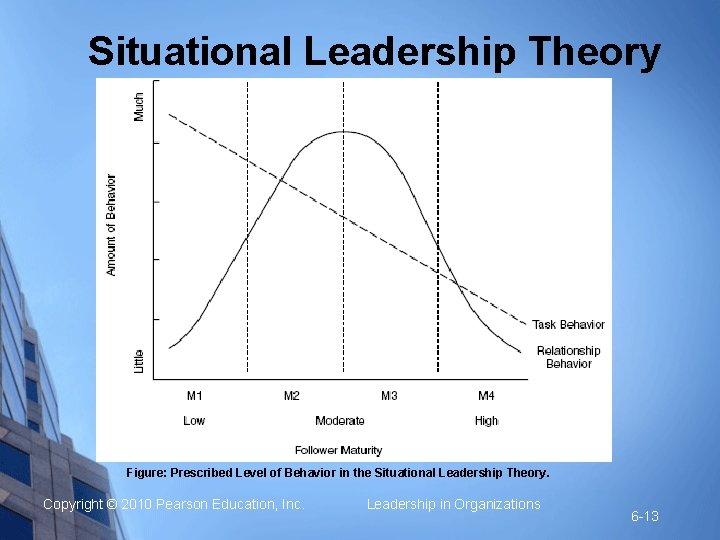
Situational Leadership Theory Figure: Prescribed Level of Behavior in the Situational Leadership Theory. Copyright © 2010 Pearson Education, Inc. Leadership in Organizations 6 -13
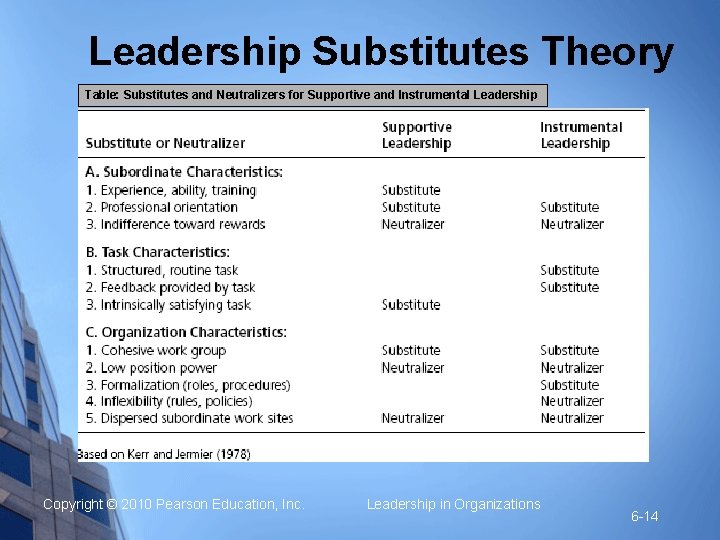
Leadership Substitutes Theory Table: Substitutes and Neutralizers for Supportive and Instrumental Leadership Copyright © 2010 Pearson Education, Inc. Leadership in Organizations 6 -14
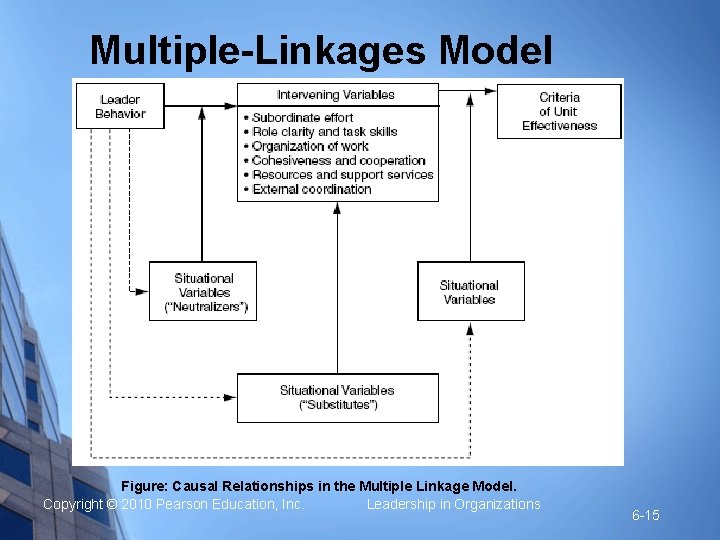
Multiple-Linkages Model Figure: Causal Relationships in the Multiple Linkage Model. Copyright © 2010 Pearson Education, Inc. Leadership in Organizations 6 -15
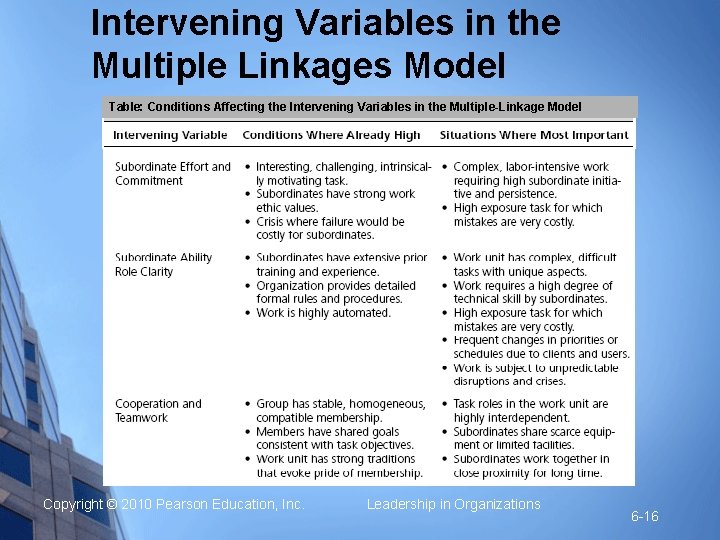
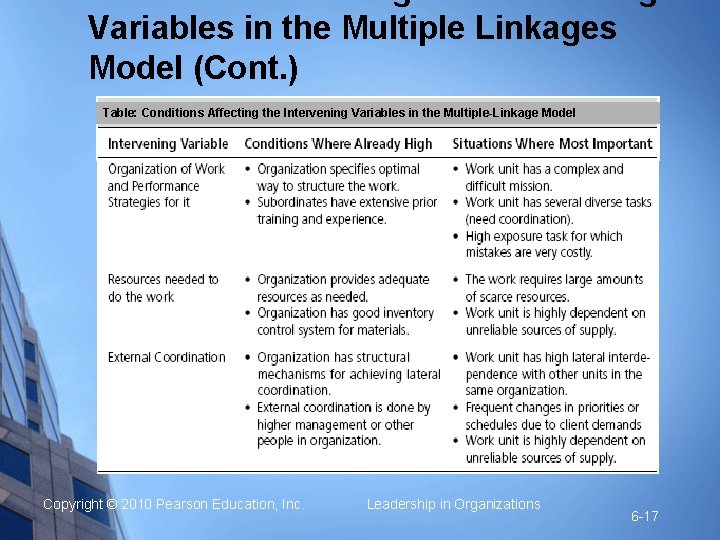
Intervening Variables in the Multiple Linkages Model Table: Conditions Affecting the Intervening Variables in the Multiple-Linkage Model Copyright © 2010 Pearson Education, Inc. Leadership in Organizations 6 -16
Variables in the Multiple Linkages Model (Cont. ) Table: Conditions Affecting the Intervening Variables in the Multiple-Linkage Model Copyright © 2010 Pearson Education, Inc. Leadership in Organizations 6 -17
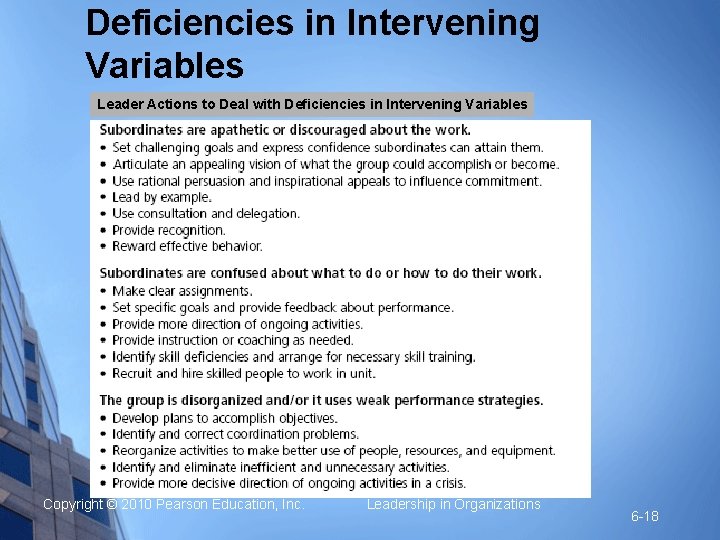
Deficiencies in Intervening Variables Leader Actions to Deal with Deficiencies in Intervening Variables Copyright © 2010 Pearson Education, Inc. Leadership in Organizations 6 -18
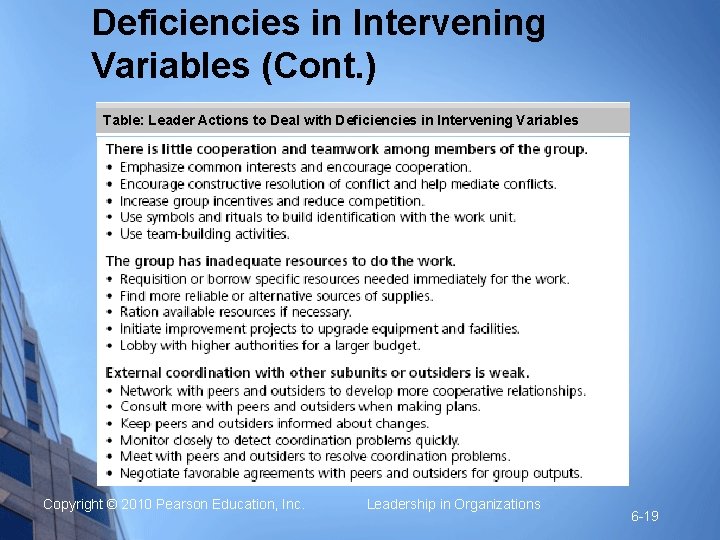
Deficiencies in Intervening Variables (Cont. ) Table: Leader Actions to Deal with Deficiencies in Intervening Variables Copyright © 2010 Pearson Education, Inc. Leadership in Organizations 6 -19
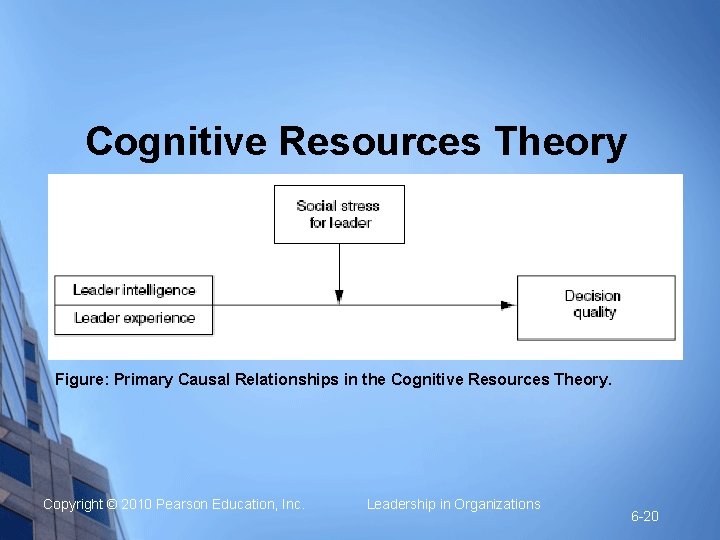
Cognitive Resources Theory Figure: Primary Causal Relationships in the Cognitive Resources Theory. Copyright © 2010 Pearson Education, Inc. Leadership in Organizations 6 -20
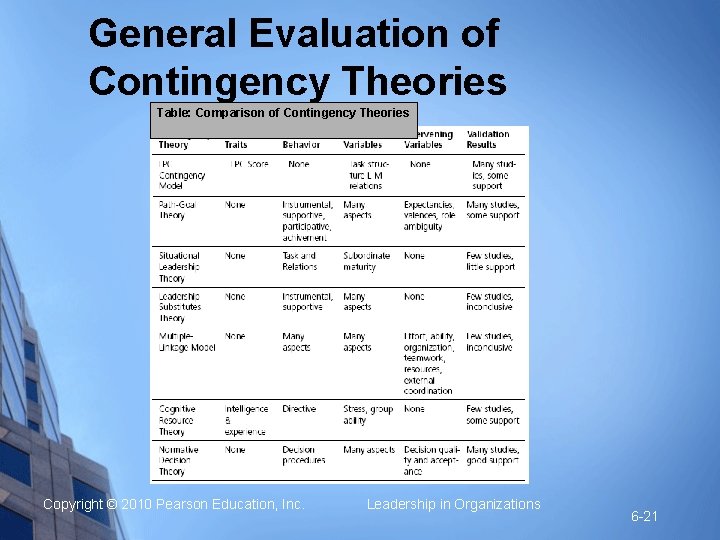
General Evaluation of Contingency Theories Table: Comparison of Contingency Theories Copyright © 2010 Pearson Education, Inc. Leadership in Organizations 6 -21
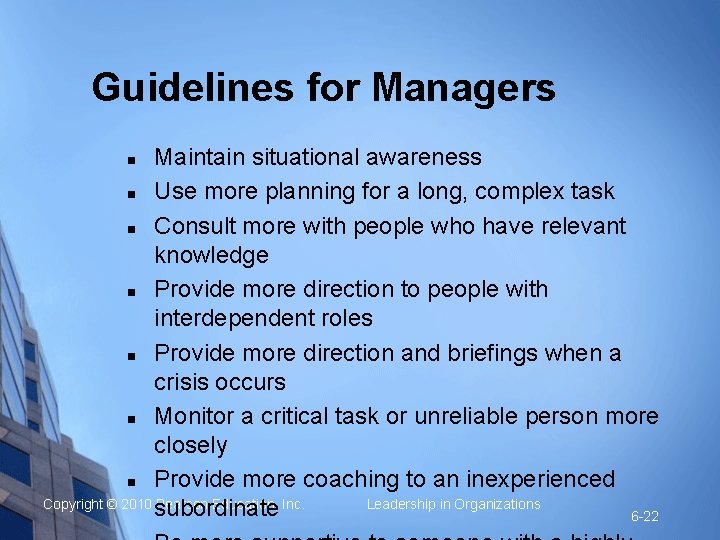
Guidelines for Managers Maintain situational awareness n Use more planning for a long, complex task n Consult more with people who have relevant knowledge n Provide more direction to people with interdependent roles n Provide more direction and briefings when a crisis occurs n Monitor a critical task or unreliable person more closely n Provide more coaching to an inexperienced Copyright © 2010 Pearson Education, Inc. Leadership in Organizations subordinate 6 -22 n
All rights reserved. No part of this publication may be reproduced, stored in a retrieval system, or transmitted, in any form or by any means, electronic, mechanical, photocopying, recording, or otherwise, without the prior written permission of the publisher. Printed in the United States of America. Copyright © 2010 Pearson Education, Inc. Leadership in Organizations 6 -23