
CHAPTER 6 Differential Equations Calculus AB Homework 6
CHAPTER 6 Differential Equations
Calculus AB Homework 6. 1 Page 411 3 -15 every three, 30, 35, 45, 55, 62 6. 2 Page 420 4 -48 every four (omit 16), 65 6. 3 Page 431: 5 -50 every five, 64, 66, 83 abc, 90
CHAPTER 6 Section 3: Separation of Variables and the Logistic Equation
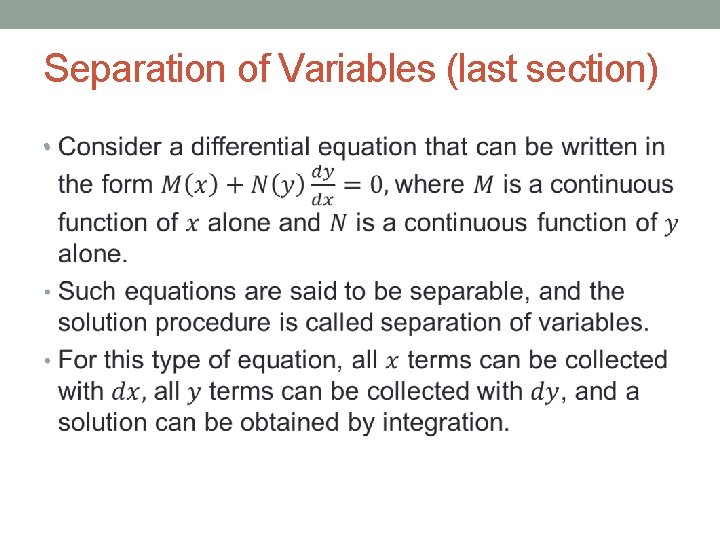
Separation of Variables (last section) •
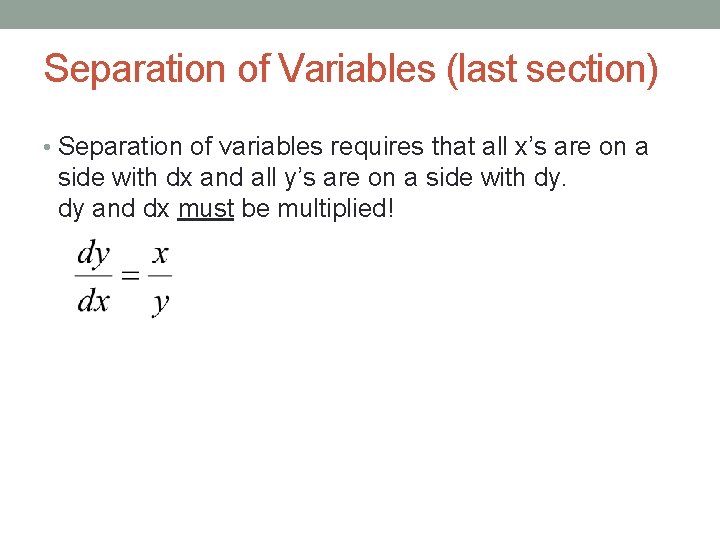
Separation of Variables (last section) • Separation of variables requires that all x’s are on a side with dx and all y’s are on a side with dy. dy and dx must be multiplied!
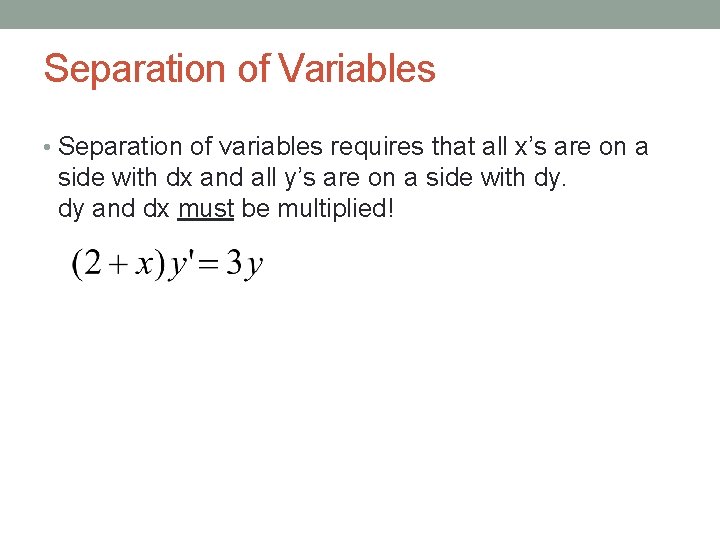
Separation of Variables • Separation of variables requires that all x’s are on a side with dx and all y’s are on a side with dy. dy and dx must be multiplied!
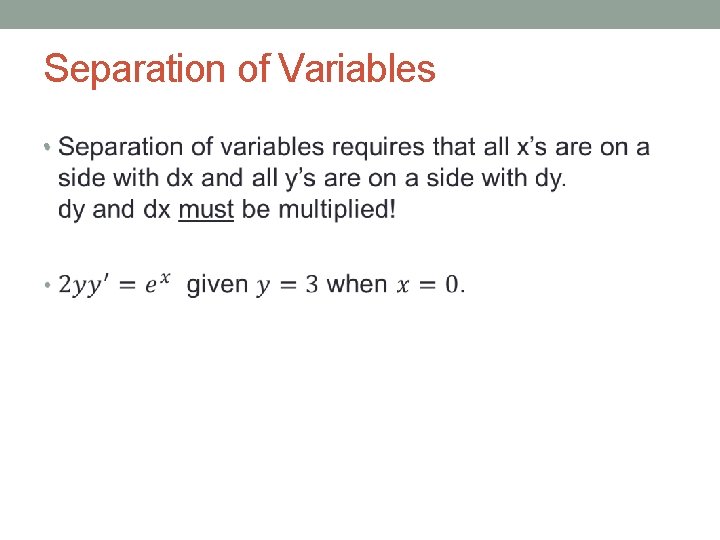
Separation of Variables •
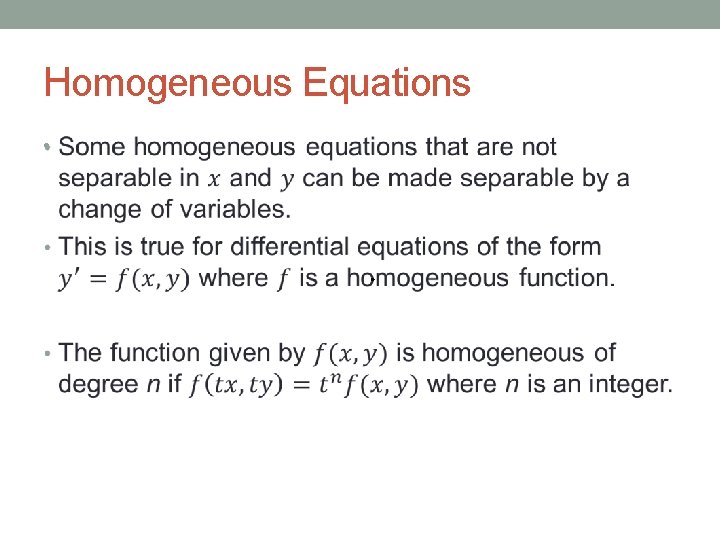
Homogeneous Equations •
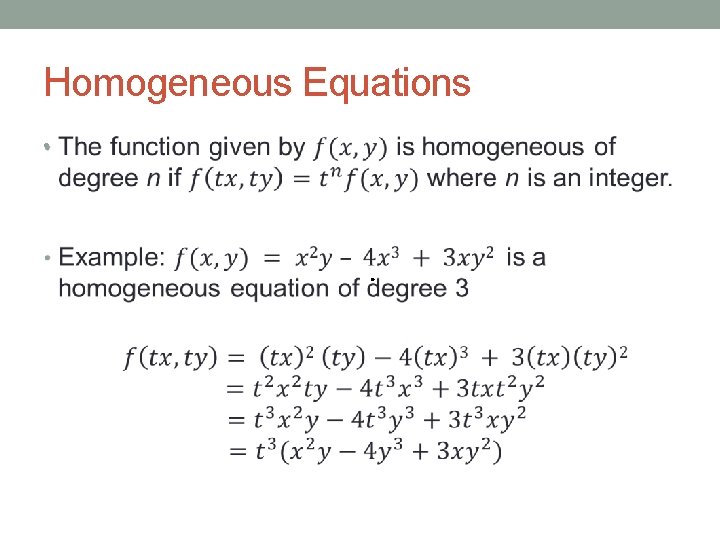
Homogeneous Equations •
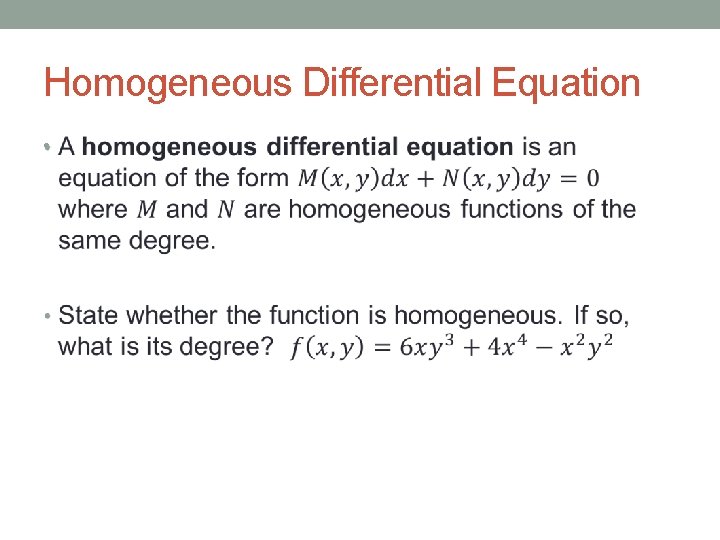
Homogeneous Differential Equation •
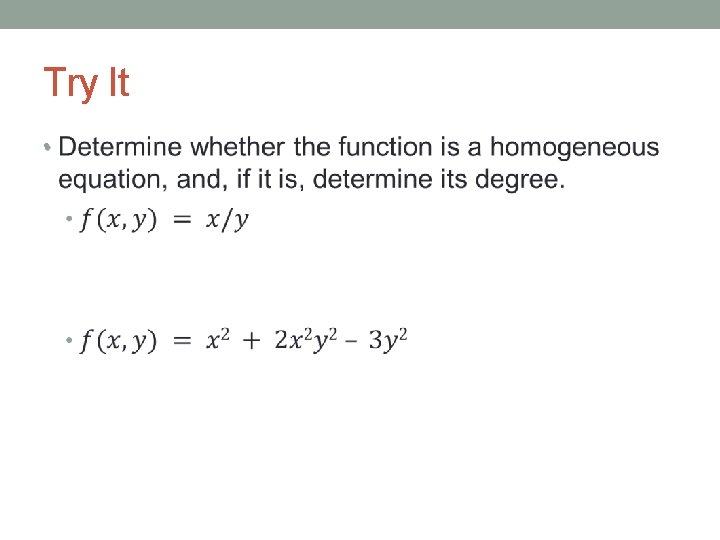
Try It •
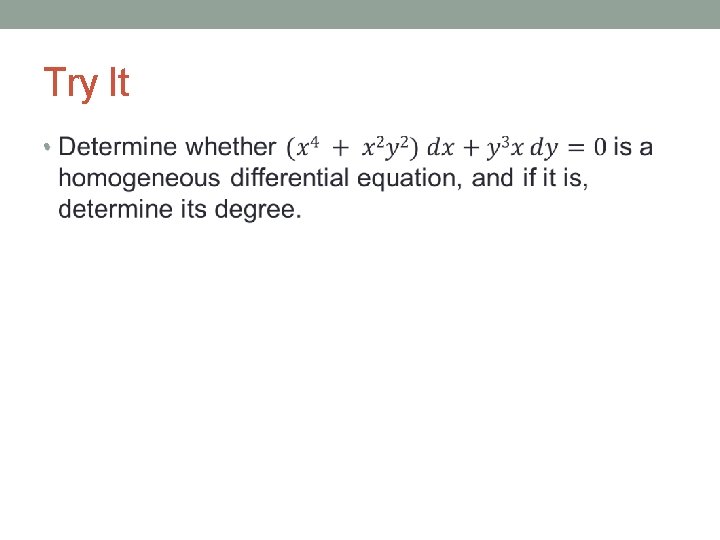
Try It •
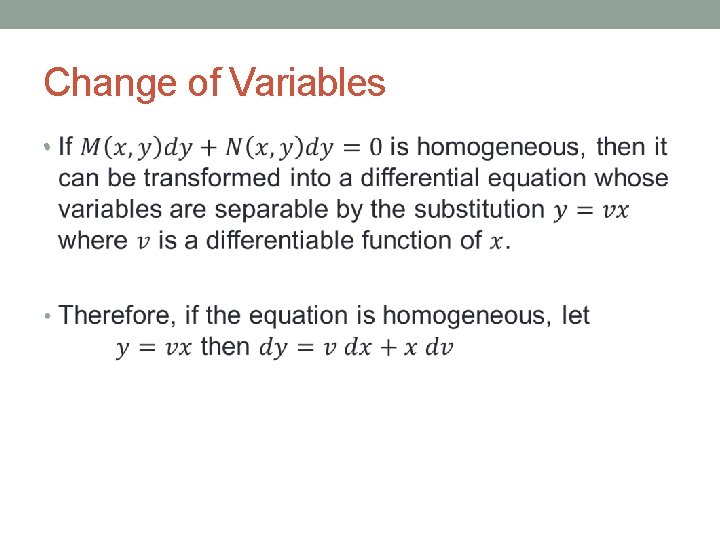
Change of Variables •
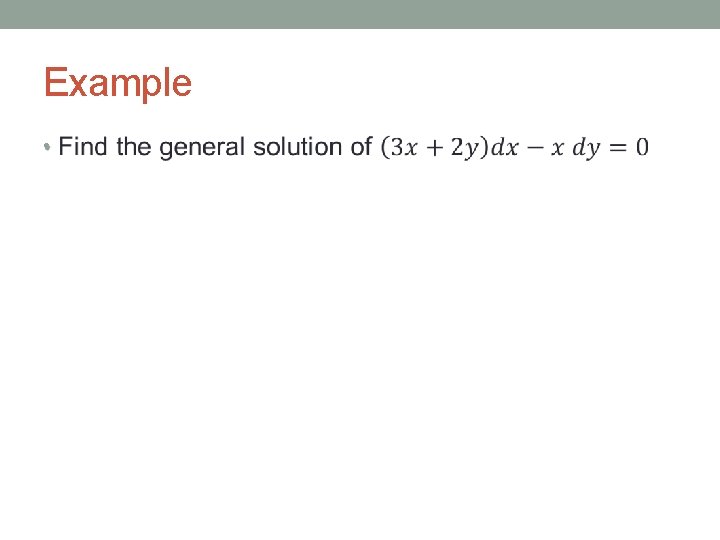
Example •
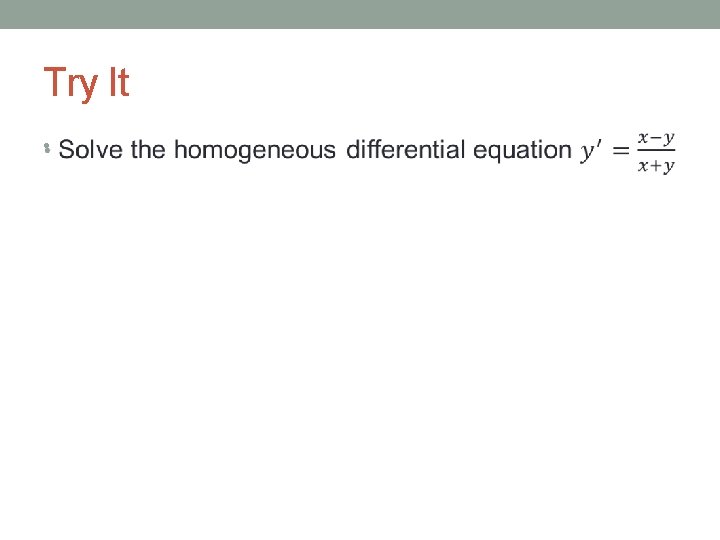
Try It •
Applications • A new legal requirement is being publicized through a public awareness campaign to a population of 1 million citizens. The rate at which the population hears about the requirement is assumed to be proportional to the number of people who are not yet aware of the requirement. By the end of 1 year, half of the population has heard of the requirement. How many will have heard of it be the end of 2 years?
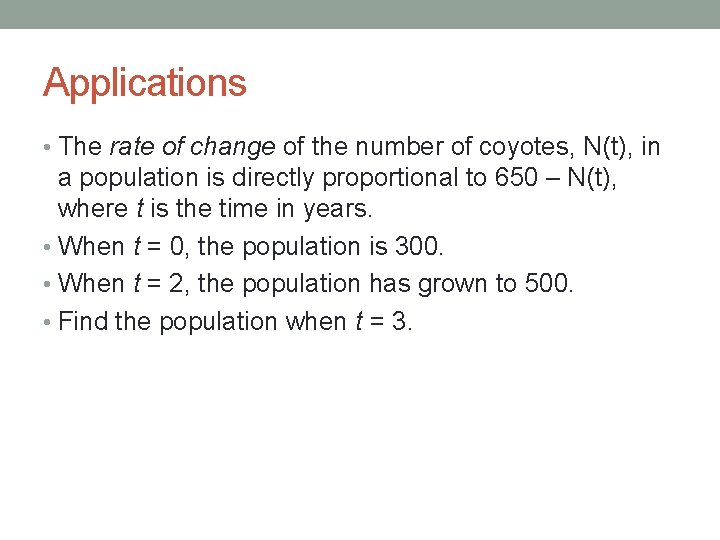
Applications • The rate of change of the number of coyotes, N(t), in a population is directly proportional to 650 – N(t), where t is the time in years. • When t = 0, the population is 300. • When t = 2, the population has grown to 500. • Find the population when t = 3.
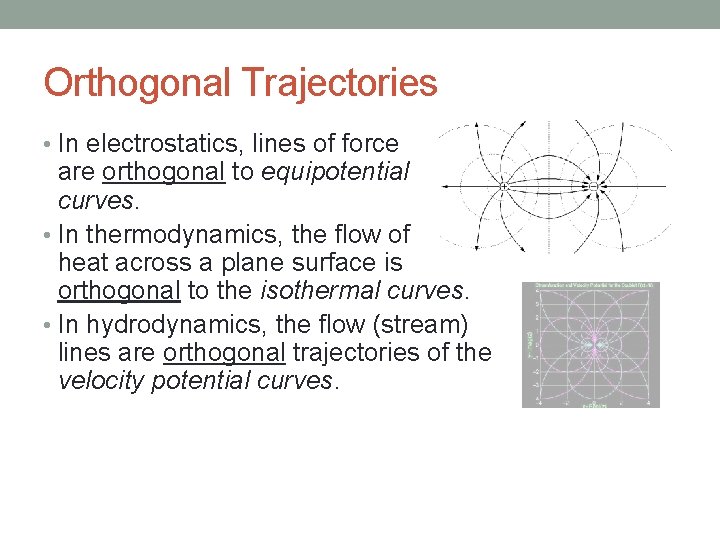
Orthogonal Trajectories • In electrostatics, lines of force are orthogonal to equipotential curves. • In thermodynamics, the flow of heat across a plane surface is orthogonal to the isothermal curves. • In hydrodynamics, the flow (stream) lines are orthogonal trajectories of the velocity potential curves.
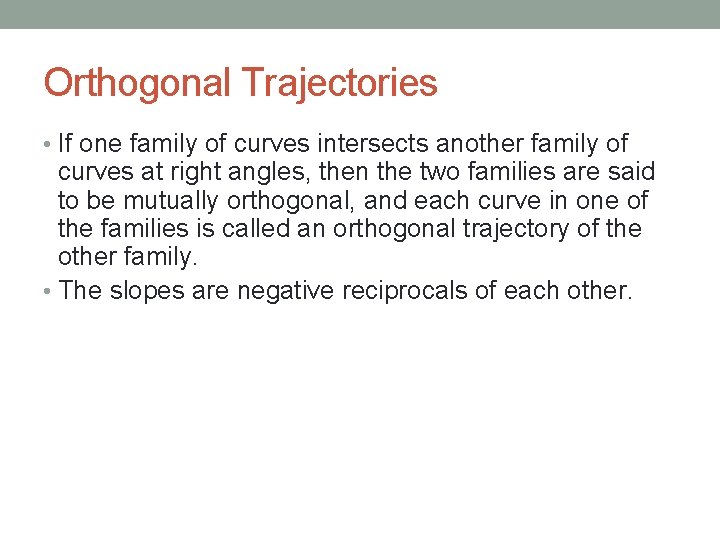
Orthogonal Trajectories • If one family of curves intersects another family of curves at right angles, then the two families are said to be mutually orthogonal, and each curve in one of the families is called an orthogonal trajectory of the other family. • The slopes are negative reciprocals of each other.
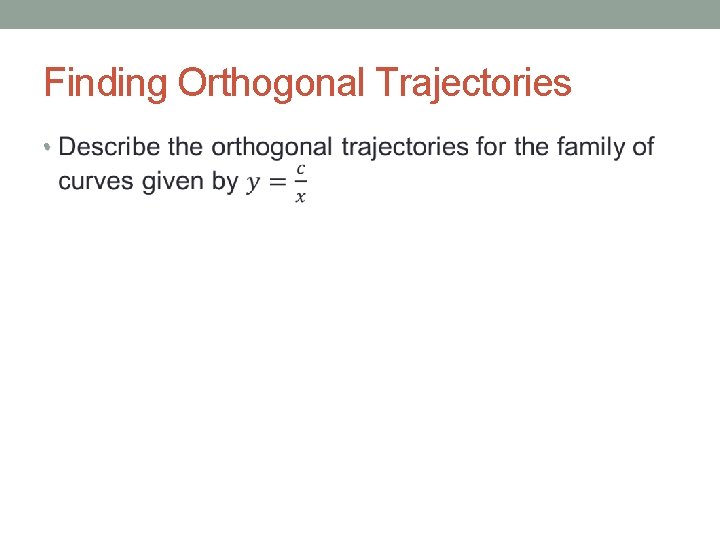
Finding Orthogonal Trajectories •
Homework AB • Page 431: • 5 -50 every five, 64, 66, 83 abc, 90
- Slides: 21