
Chapter 6 Developing a Theoretical or Conceptual Context

- Slides: 16
Chapter 6 Developing a Theoretical or Conceptual Context Copyright © 2008 Wolters Kluwer Health | Lippincott Williams & Wilkins
Theory An abstraction that purports to account for or explain phenomena • Classical theory—An abstract generalization that systematically explains relationships among phenomena • Descriptive theory—A theory that thoroughly describes a phenomenon, based on rich observations of it Copyright © 2008 Wolters Kluwer Health | Lippincott Williams & Wilkins
Theory (cont’d) • Grand theory—A theory that attempts to explain large aspects of human experience • Middle-range theory—A theory that focuses on a specific aspect of human experience Copyright © 2008 Wolters Kluwer Health | Lippincott Williams & Wilkins
Conceptual Models • Deal with abstractions, assembled in a coherent scheme • Represent a less formal attempt than theories to explain phenomena • Do not have formal propositions about relationships among phenomena Copyright © 2008 Wolters Kluwer Health | Lippincott Williams & Wilkins
Framework • Theoretical framework (based on theory) • Conceptual framework (based on a conceptual model) Copyright © 2008 Wolters Kluwer Health | Lippincott Williams & Wilkins
Commonalities Between Theories and Conceptual Models • Use concepts as building blocks • Require conceptual definitions of key concepts • Can be depicted in a schematic model • Are created by humans • Are developed inductively Copyright © 2008 Wolters Kluwer Health | Lippincott Williams & Wilkins
Commonalities Between Theories and Conceptual Models (cont’d) • Cannot be proven—they are supported to greater or lesser degrees • Can be used to generate hypotheses • Can serve as a stimulus to research Copyright © 2008 Wolters Kluwer Health | Lippincott Williams & Wilkins
5 -Step Process for Developing Conceptual Definitions 1. Develop a preliminary definition 2. Do an in-depth literature review 3. Identify exemplary cases 4. Map the concept’s meaning 5. State the revised conceptual definition Copyright © 2008 Wolters Kluwer Health | Lippincott Williams & Wilkins
Conceptual Models of Nursing Formal explanations of what nursing practice is Four concepts central to models of nursing: • Person • Environment • Health • Nursing Copyright © 2008 Wolters Kluwer Health | Lippincott Williams & Wilkins
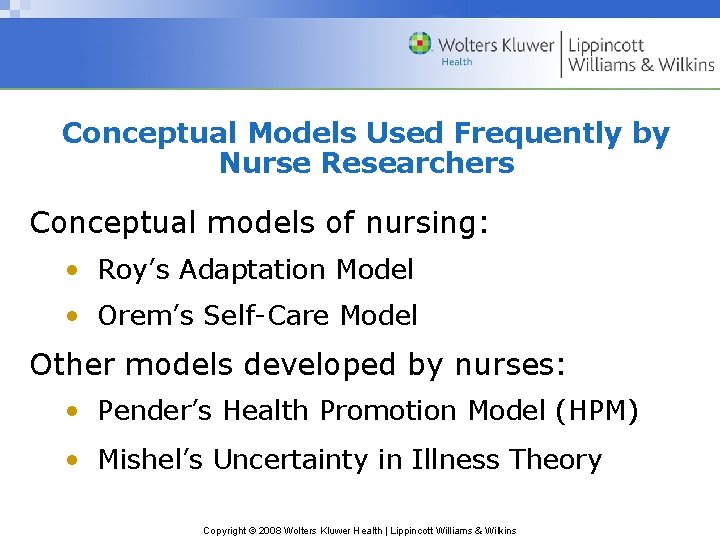
Conceptual Models Used Frequently by Nurse Researchers Conceptual models of nursing: • Roy’s Adaptation Model • Orem’s Self-Care Model Other models developed by nurses: • Pender’s Health Promotion Model (HPM) • Mishel’s Uncertainty in Illness Theory Copyright © 2008 Wolters Kluwer Health | Lippincott Williams & Wilkins
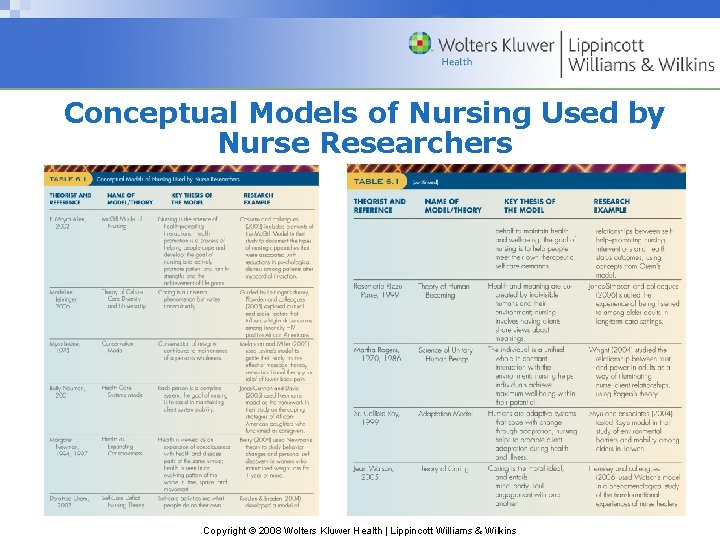
Conceptual Models of Nursing Used by Nurse Researchers Copyright © 2008 Wolters Kluwer Health | Lippincott Williams & Wilkins
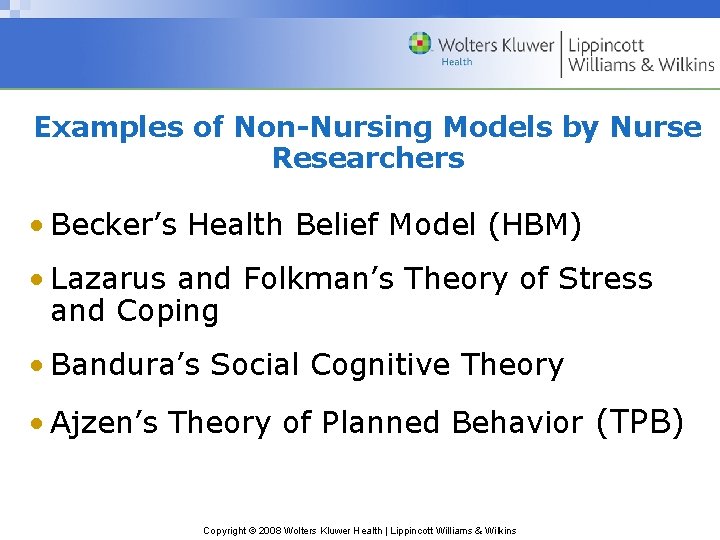
Examples of Non-Nursing Models by Nurse Researchers • Becker’s Health Belief Model (HBM) • Lazarus and Folkman’s Theory of Stress and Coping • Bandura’s Social Cognitive Theory • Ajzen’s Theory of Planned Behavior (TPB) Copyright © 2008 Wolters Kluwer Health | Lippincott Williams & Wilkins
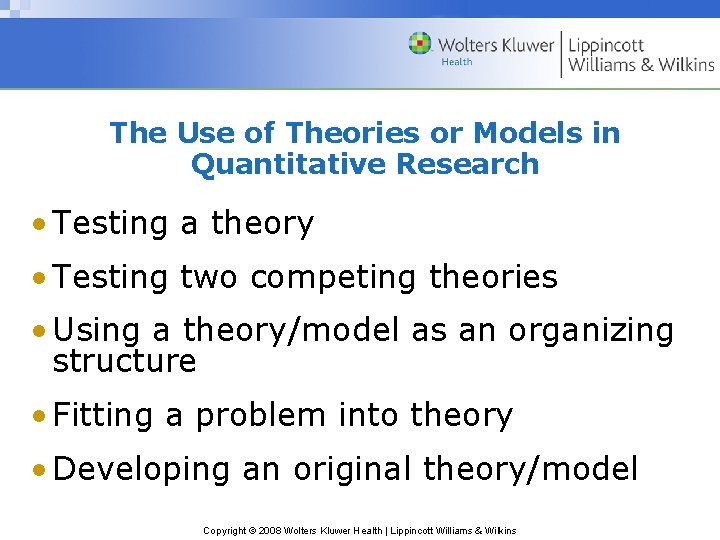
The Use of Theories or Models in Quantitative Research • Testing a theory • Testing two competing theories • Using a theory/model as an organizing structure • Fitting a problem into theory • Developing an original theory/model Copyright © 2008 Wolters Kluwer Health | Lippincott Williams & Wilkins
Theories in Qualitative Research • Substantive theory—conceptualizations of the target phenomena • Theory embedded in a research tradition § Grounded theory (symbolic interactionism) § Ethnography (cultural theories: ideational and materialistic) § Phenomenology (phenomenological theory of human experience) Copyright © 2008 Wolters Kluwer Health | Lippincott Williams & Wilkins
Examples of Questions to Assess a Model or Theory • Clarity: Are key concepts defined? Are definitions clear? • Complexity: Is theory sufficiently rich? Overly complex? • Grounding: Is there an empirical basis for theory? Copyright © 2008 Wolters Kluwer Health | Lippincott Williams & Wilkins
Examples of Questions to Assess a Model or Theory (cont’d) • Appropriateness: Are key concepts within the domain of nursing? • Importance: Will testing theory contribute to nursing’s evidence base? • Competition: Are theories that better explain the key phenomenon? Copyright © 2008 Wolters Kluwer Health | Lippincott Williams & Wilkins