
chapter 6 Definitions Sensation The detection of physical


- Slides: 49
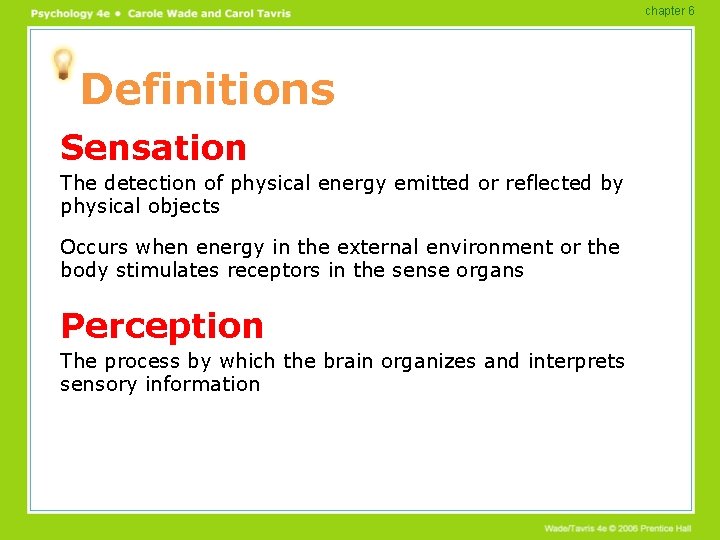
chapter 6 Definitions Sensation The detection of physical energy emitted or reflected by physical objects Occurs when energy in the external environment or the body stimulates receptors in the sense organs Perception The process by which the brain organizes and interprets sensory information
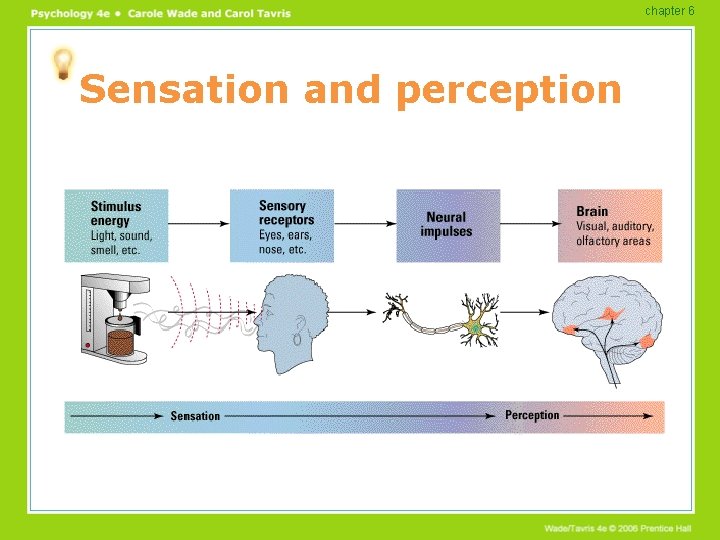
chapter 6 Sensation and perception
Sensation • What are the sensory systems? • Sight, sounds, touch, pain, smell, taste, sensation of movement • Why are the sensory systems important? • Perception of external world • Maintains arousal, forms body image, regulates movement • Basis for our knowledge about the world and our surroundings.
Psychophysics • Correlates quantitative aspects of physical stimuli (energy) with the sensations they evoke – 4 elementary attributes: 1. Modality 2. Intensity 3. Duration 4. Location
Attributes of Sensation: Modality • Quality of a sensation • Different forms of energy = Different sensations • 5 major: vision, hearing, touch, taste, smell – Submodalities: » Touch – sweet, salty, bitter, sour » Vision – color, movement • Law of Specific Energies • 1826 Johannes Muller • Each modality = activated by a specific stimulus = different sensory nerve fiber « Sensory receptors are maximally sensitive to a specific energy
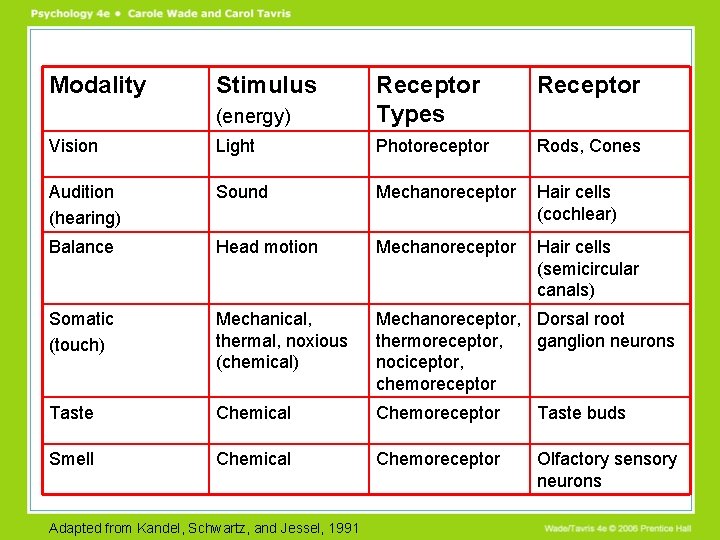
Modality Stimulus Receptor (energy) Receptor Types Vision Light Photoreceptor Rods, Cones Audition (hearing) Sound Mechanoreceptor Hair cells (cochlear) Balance Head motion Mechanoreceptor Hair cells (semicircular canals) Somatic (touch) Mechanical, thermal, noxious (chemical) Mechanoreceptor, Dorsal root thermoreceptor, ganglion neurons nociceptor, chemoreceptor Taste Chemical Chemoreceptor Taste buds Smell Chemical Chemoreceptor Olfactory sensory neurons Adapted from Kandel, Schwartz, and Jessel, 1991
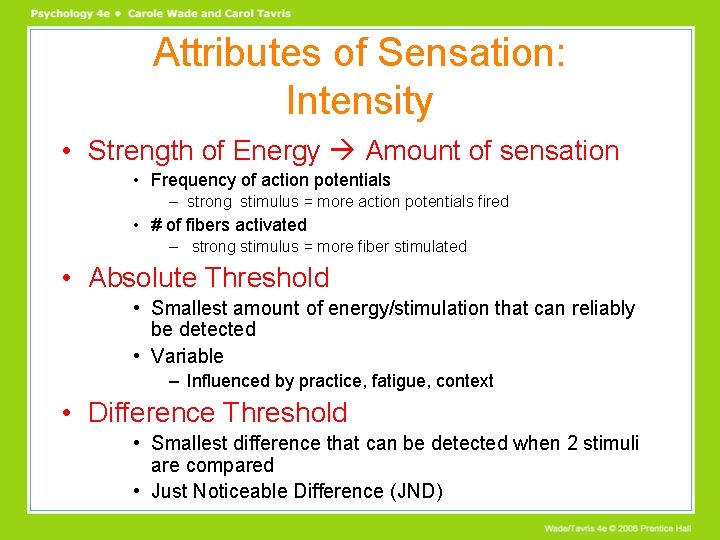
Attributes of Sensation: Intensity • Strength of Energy Amount of sensation • Frequency of action potentials – strong stimulus = more action potentials fired • # of fibers activated – strong stimulus = more fiber stimulated • Absolute Threshold • Smallest amount of energy/stimulation that can reliably be detected • Variable – Influenced by practice, fatigue, context
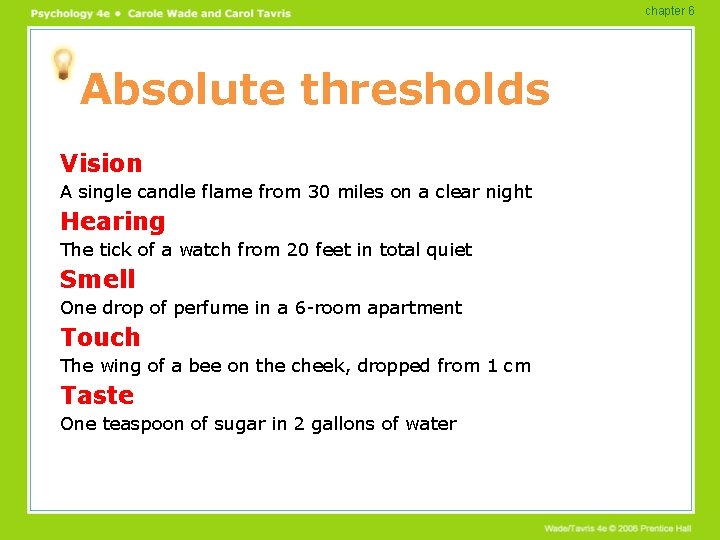
chapter 6 Absolute thresholds Vision A single candle flame from 30 miles on a clear night Hearing The tick of a watch from 20 feet in total quiet Smell One drop of perfume in a 6 -room apartment Touch The wing of a bee on the cheek, dropped from 1 cm Taste One teaspoon of sugar in 2 gallons of water
Attributes of Sensation: Intensity • Strength of Energy Amount of sensation • Frequency of action potentials – strong stimulus = more action potentials fired • # of fibers activated – strong stimulus = more fiber stimulated • Absolute Threshold • Smallest amount of energy/stimulation that can reliably be detected • Variable – Influenced by practice, fatigue, context • Difference Threshold • Smallest difference that can be detected when 2 stimuli are compared • Just Noticeable Difference (JND)
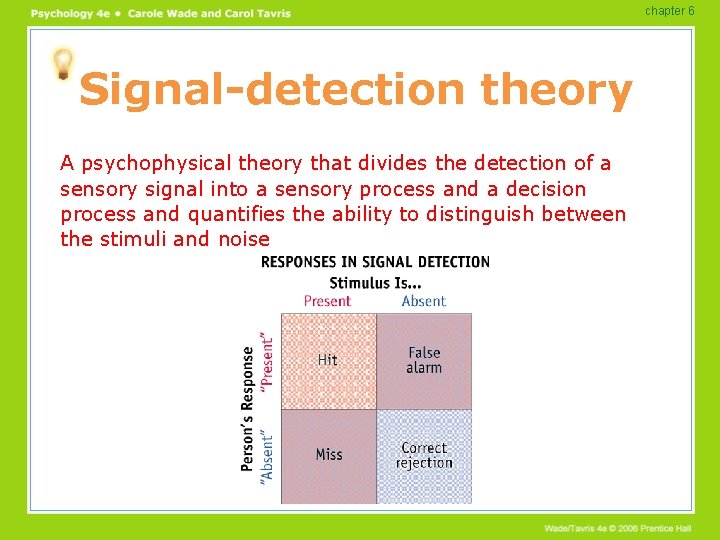
chapter 6 Signal-detection theory A psychophysical theory that divides the detection of a sensory signal into a sensory process and a decision process and quantifies the ability to distinguish between the stimuli and noise
Drugs – Mechanism of Action on the sensation of pain • Drugs that elevate the pain threshold – Morphine » Reduces detectibility of painful stimuli = raises threshold » Elevates criterion used to determine if a stimuli is painful = creates noise – Marijuana » Elevates criterion used to determine if stimuli is painful = makes noise
Attributes of Sensation: Duration • Stimulus intensity and Perceived Intensity • Adaptation – The reduction or disappearance of sensory responsiveness when stimulation is unchanging or repetitious – Prevents us from having to respond continuously to unimportant information • Deprivation – The absence of normal levels of sensory stimulation
Attributes of Sensation: Location • Spatial aspects of sensation: – Ability to locate origin of sensation – Ability to distinguish 2 closely spaced stimuli • Two-Point Threshold – Minimum distance between 2 stimuli that allows them to be perceived as distinct • Function of receptive field of receptor and sensory neurons
Commonalities of the Senses • All extract same basic information • Modality, intensity, duration, location • Similar organization • Sensory receptors for specific type of energy • Receptor transforms energy into electrochemical signal action potentials • Travel up afferent fibers to the brain • Relay information to Thalamus (except smell) • Continue on to specific regions in cortex
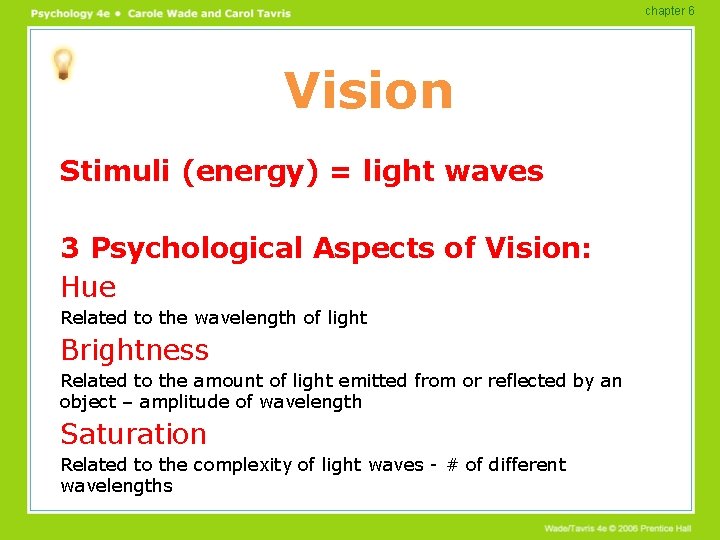
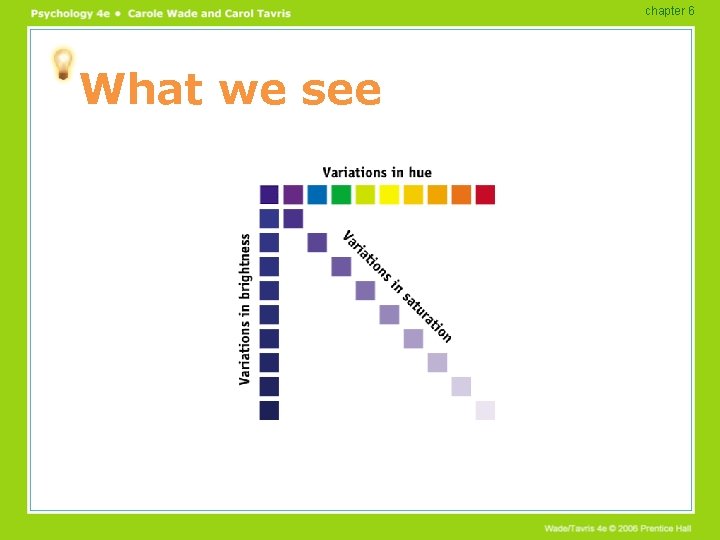
chapter 6 Vision Stimuli (energy) = light waves 3 Psychological Aspects of Vision: Hue Related to the wavelength of light Brightness Related to the amount of light emitted from or reflected by an object – amplitude of wavelength Saturation Related to the complexity of light waves - # of different wavelengths
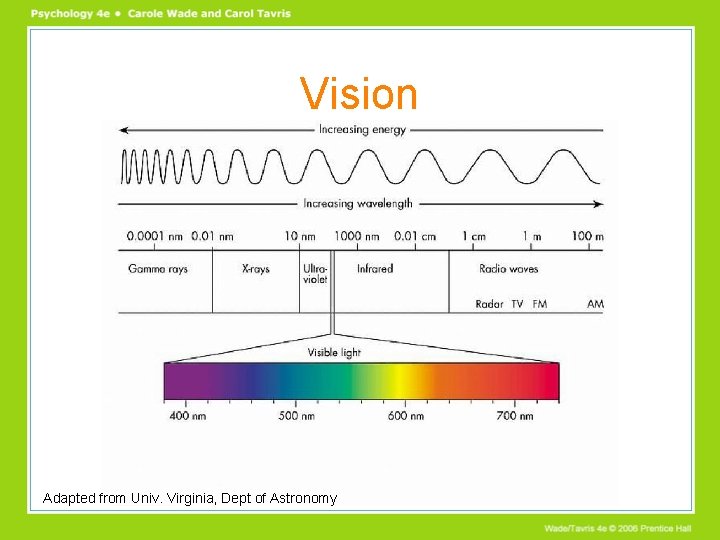
Vision Adapted from Univ. Virginia, Dept of Astronomy
chapter 6 What we see
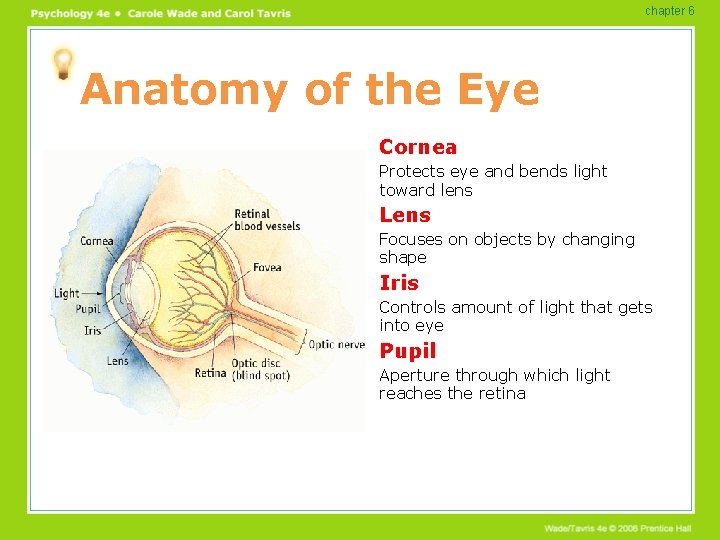
chapter 6 Anatomy of the Eye Cornea Protects eye and bends light toward lens Lens Focuses on objects by changing shape Iris Controls amount of light that gets into eye Pupil Aperture through which light reaches the retina
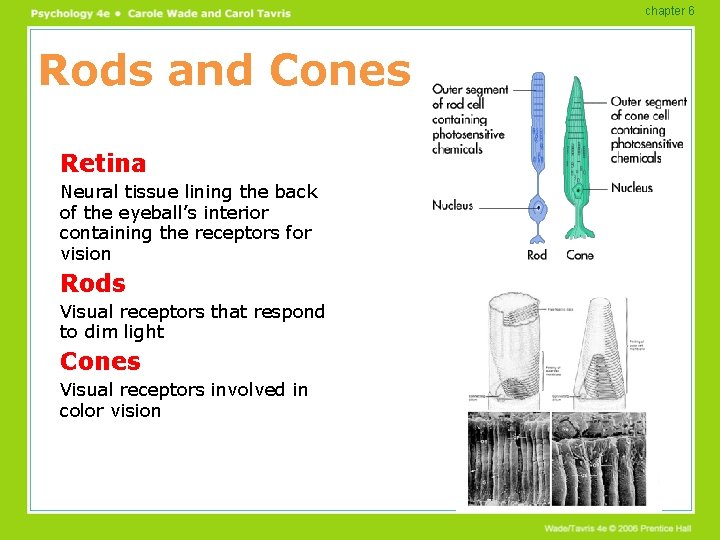
chapter 6 Rods and Cones Retina Neural tissue lining the back of the eyeball’s interior containing the receptors for vision Rods Visual receptors that respond to dim light Cones Visual receptors involved in color vision
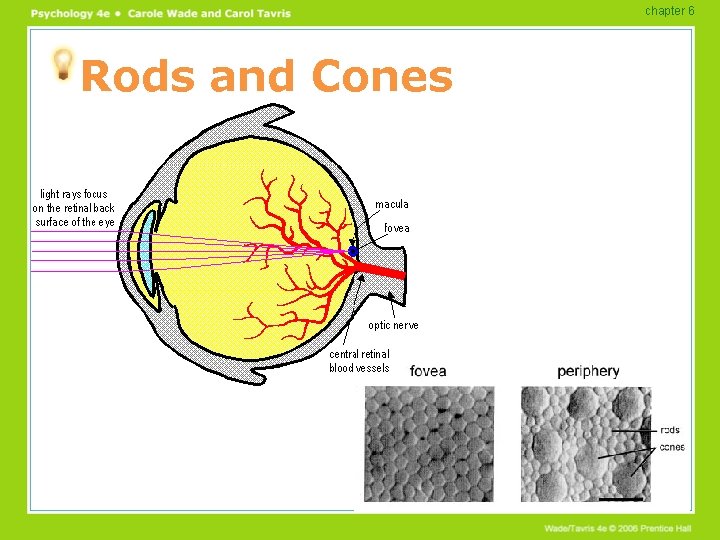
chapter 6 Rods and Cones
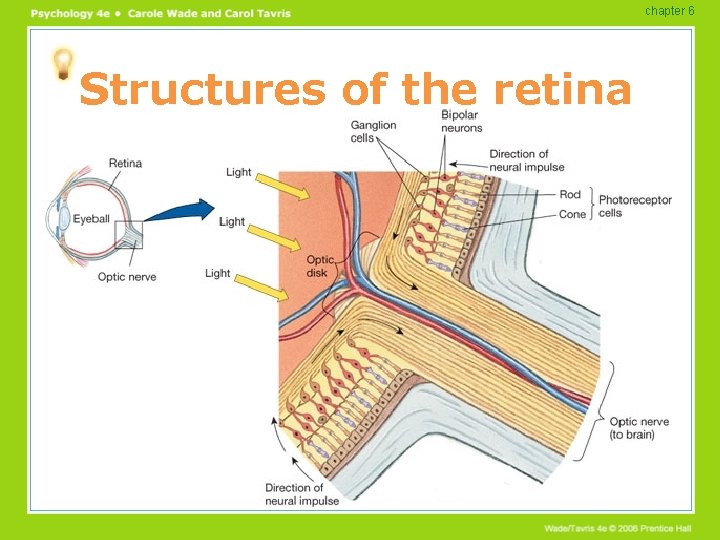
chapter 6 Structures of the retina
chapter 6 Your turn You have a hard time locating your red car at night, in the poorly lit mall parking lot. Why? 1. Your rods are less sensitive to color in dim light. 2. Your cones, which detect color, do not function well in dim light. 3. Your ganglion cells receive insufficient overall stimulation to function. 4. Your rods, which detect color, do not function well in dim light.
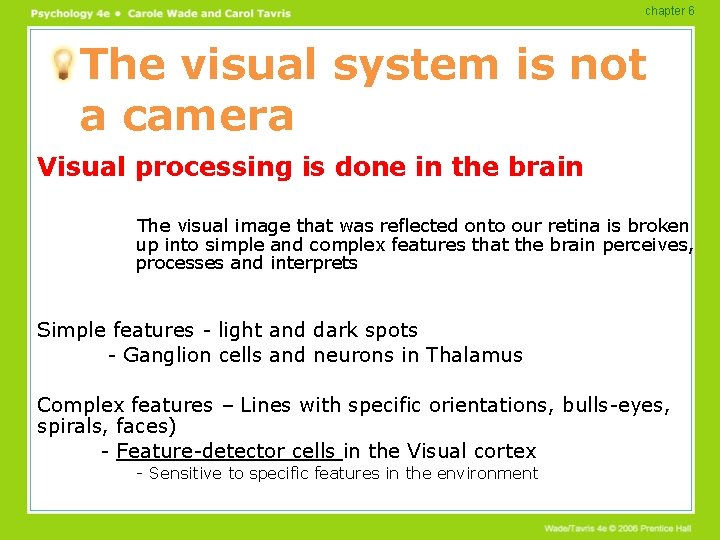
chapter 6 The visual system is not a camera Visual processing is done in the brain The visual image that was reflected onto our retina is broken up into simple and complex features that the brain perceives, processes and interprets Simple features - light and dark spots - Ganglion cells and neurons in Thalamus Complex features – Lines with specific orientations, bulls-eyes, spirals, faces) - Feature-detector cells in the Visual cortex - Sensitive to specific features in the environment
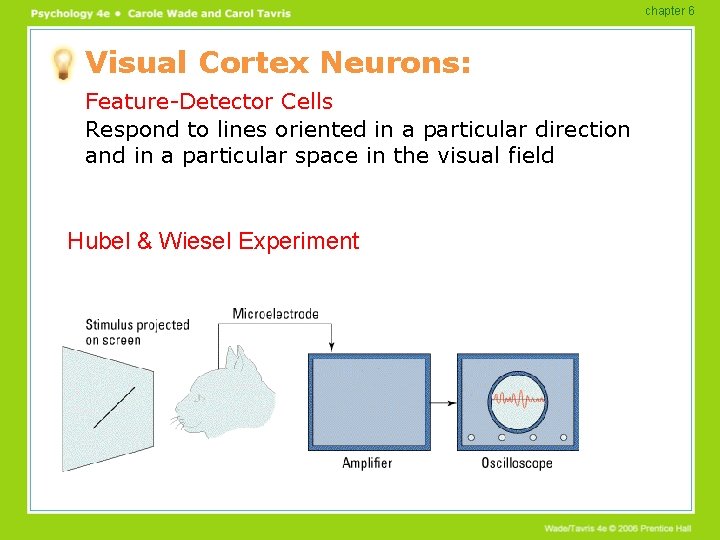
chapter 6 Visual Cortex Neurons: Feature-Detector Cells Respond to lines oriented in a particular direction and in a particular space in the visual field Hubel & Wiesel Experiment
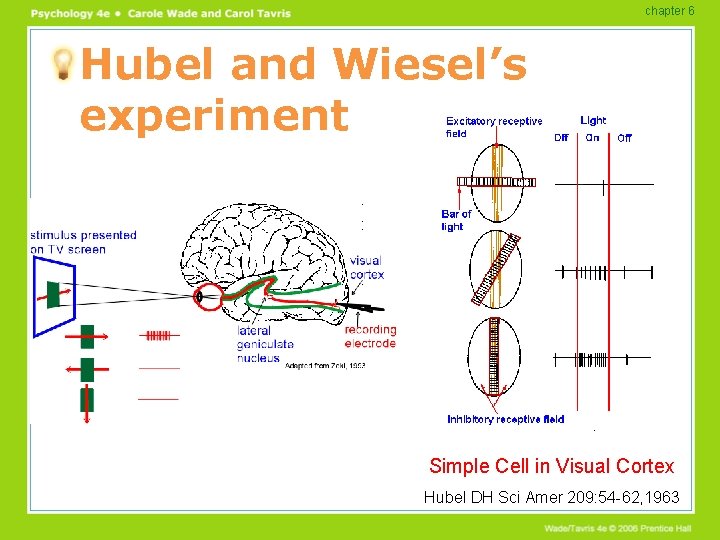
chapter 6 Hubel and Wiesel’s experiment Simple Cell in Visual Cortex Hubel DH Sci Amer 209: 54 -62, 1963
How do we see color? • Two theories: – Trichromatic theory – Opponent-process theory
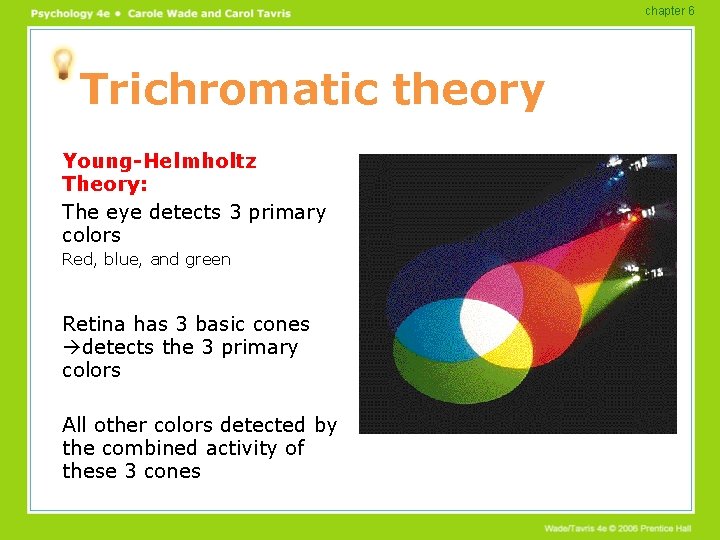
chapter 6 Trichromatic theory Young-Helmholtz Theory: The eye detects 3 primary colors Red, blue, and green Retina has 3 basic cones detects the 3 primary colors All other colors detected by the combined activity of these 3 cones
chapter 6 Opponent-process theory The visual system treats pairs of colors as opposing or antagonistic • 3 opponent channels – Red-Green – Blue-Yellow – Black-White If opponent-process cells are inhibited by a color then removal of the color results in a burst of activity • Many respond in the opposite fashion to red and green, i. e. fire in response to red and turn off in response to green • Negative afterimage
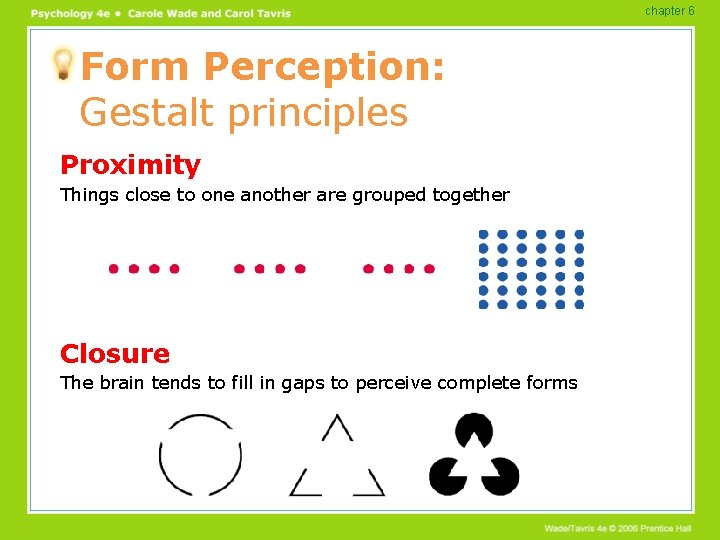
chapter 6 Form Perception: Gestalt principles Proximity Things close to one another are grouped together Closure The brain tends to fill in gaps to perceive complete forms
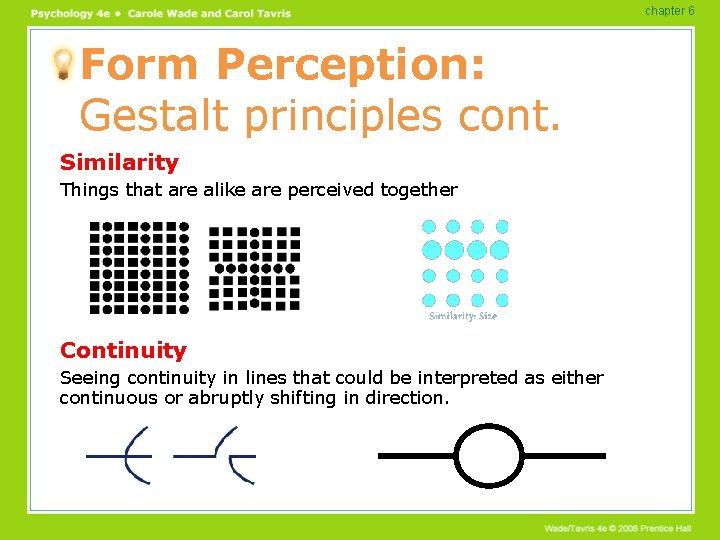
chapter 6 Form Perception: Gestalt principles cont. Similarity Things that are alike are perceived together Continuity Seeing continuity in lines that could be interpreted as either continuous or abruptly shifting in direction.
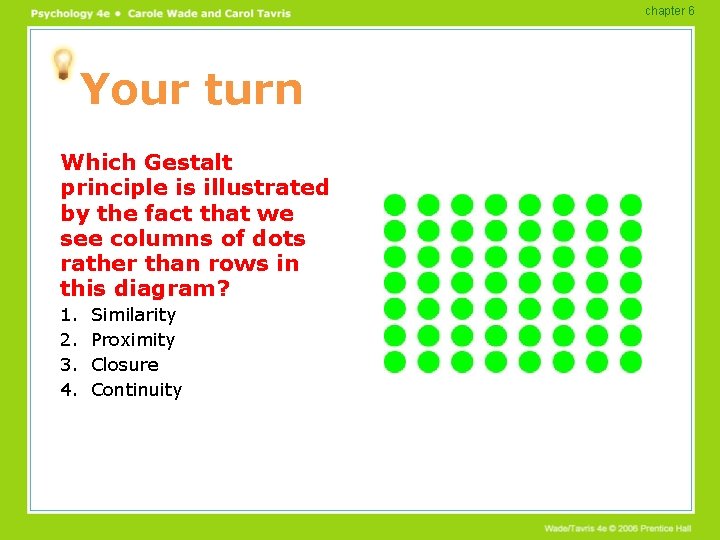
chapter 6 Your turn Which Gestalt principle is illustrated by the fact that we see columns of dots rather than rows in this diagram? 1. 2. 3. 4. Similarity Proximity Closure Continuity
chapter 6 Depth and distance perception Binocular cues Require both eyes working together Convergence Turning inward of the eyes, which occurs when they focus on a nearby object Retinal disparity The slight difference in lateral separation between two objects as seen by the right and left eyes
chapter 6 Depth and distance perception Monocular cues For objects over 50 feet away Does not depend on both eyes Interposition Linear Perspective Light and Shadow Motion Parallax Relative Size Relative Clarity Texture Gradients
chapter 6 Visual constancies The accurate perception of objects as stable or unchanged despite changes in the sensory patterns they produce Shape constancy Location constancy Size constancy Brightness constancy Color constancy
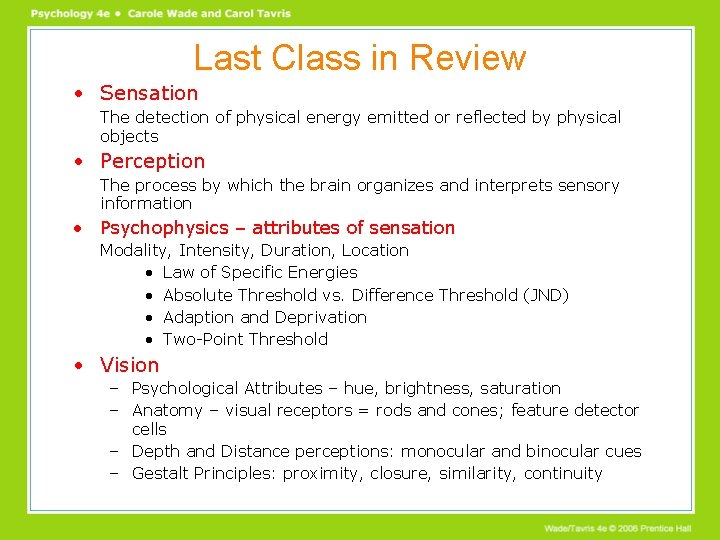
Last Class in Review • Sensation The detection of physical energy emitted or reflected by physical objects • Perception The process by which the brain organizes and interprets sensory information • Psychophysics – attributes of sensation Modality, Intensity, Duration, Location • Law of Specific Energies • Absolute Threshold vs. Difference Threshold (JND) • Adaption and Deprivation • Two-Point Threshold • Vision – Psychological Attributes – hue, brightness, saturation – Anatomy – visual receptors = rods and cones; feature detector cells – Depth and Distance perceptions: monocular and binocular cues – Gestalt Principles: proximity, closure, similarity, continuity
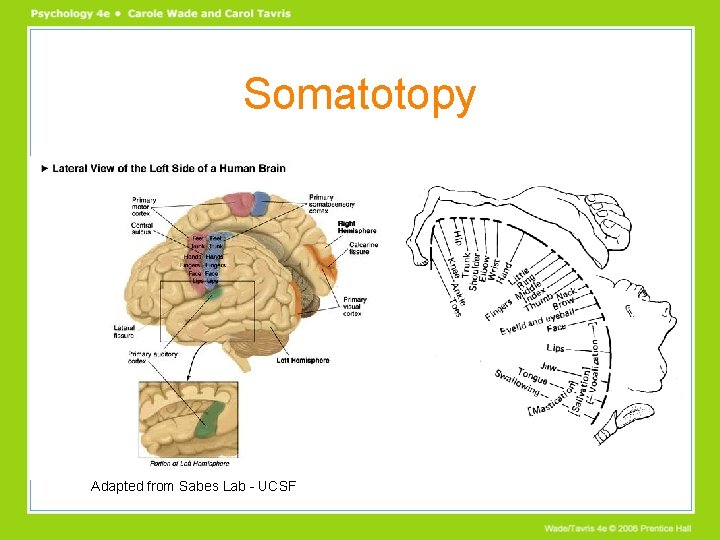
chapter 6 Sensation and Perception Learning Objectives: 1. What are the 3 main psychological dimensions of hearing? 2. What are the major structures of the inner ear that contribute to the sense of hearing? 3. Understand how the Gestalt principles may apply to other sensations, such as hearing. 4. What are the 5 major tastes? Why do people tastes things differently? 5. What are the basic senses of the skin? How is sensation organized? (hint: understand somatotopy) 6. How does gate-control theory account for our perception of pain? 7. Is there any evidence that some perceptual abilities are present from birth? What are these abilities and what is the evidence? 8. What 5 factors can influence our perception?
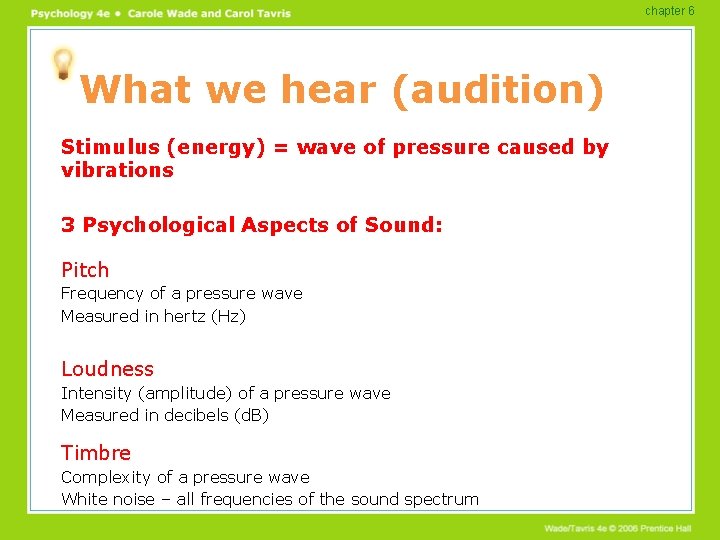
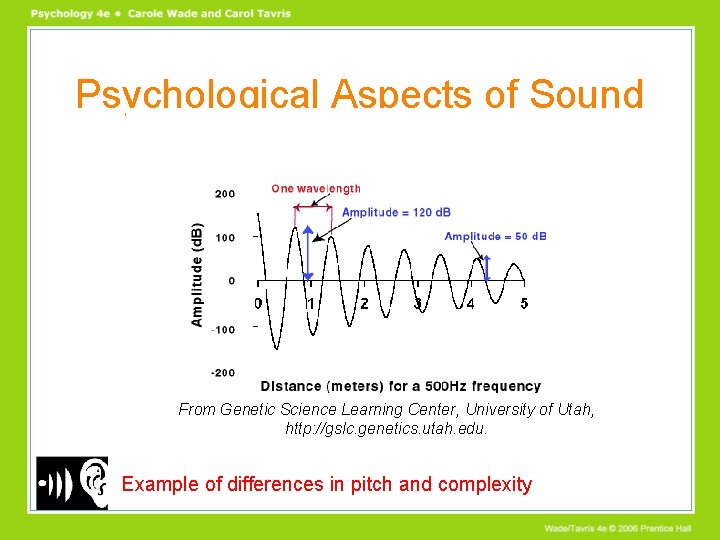
chapter 6 What we hear (audition) Stimulus (energy) = wave of pressure caused by vibrations 3 Psychological Aspects of Sound: Pitch Frequency of a pressure wave Measured in hertz (Hz) Loudness Intensity (amplitude) of a pressure wave Measured in decibels (d. B) Timbre Complexity of a pressure wave White noise – all frequencies of the sound spectrum
Psychological Aspects of Sound From Genetic Science Learning Center, University of Utah, http: //gslc. genetics. utah. edu. Example of differences in pitch and complexity
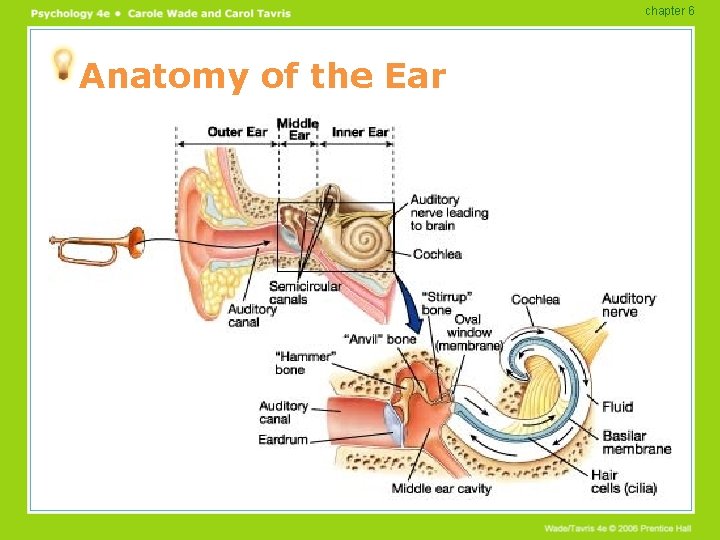
chapter 6 Anatomy of the Ear
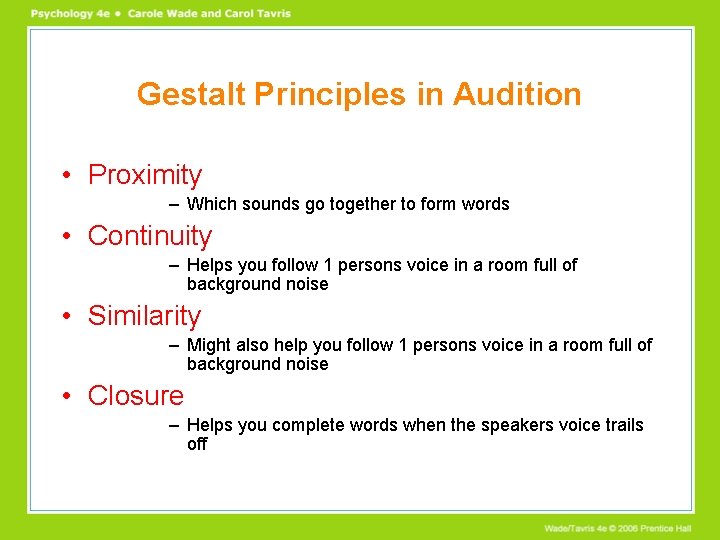
Gestalt Principles in Audition • Proximity – Which sounds go together to form words • Continuity – Helps you follow 1 persons voice in a room full of background noise • Similarity – Might also help you follow 1 persons voice in a room full of background noise • Closure – Helps you complete words when the speakers voice trails off
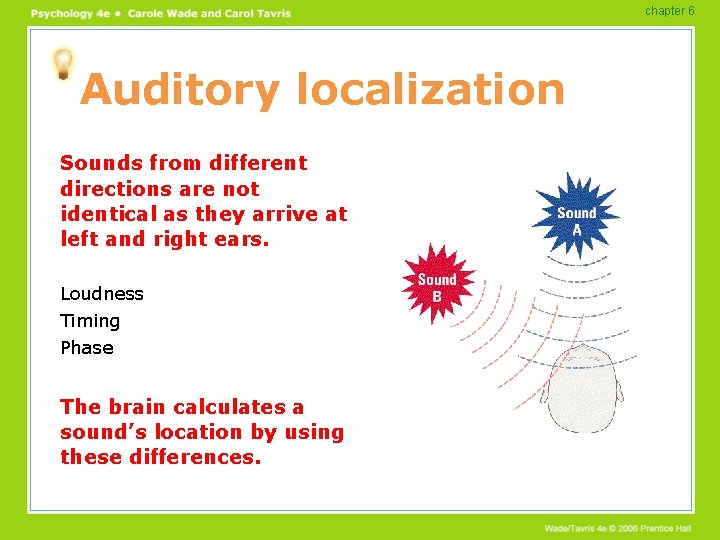
chapter 6 Auditory localization Sounds from different directions are not identical as they arrive at left and right ears. Loudness Timing Phase The brain calculates a sound’s location by using these differences.
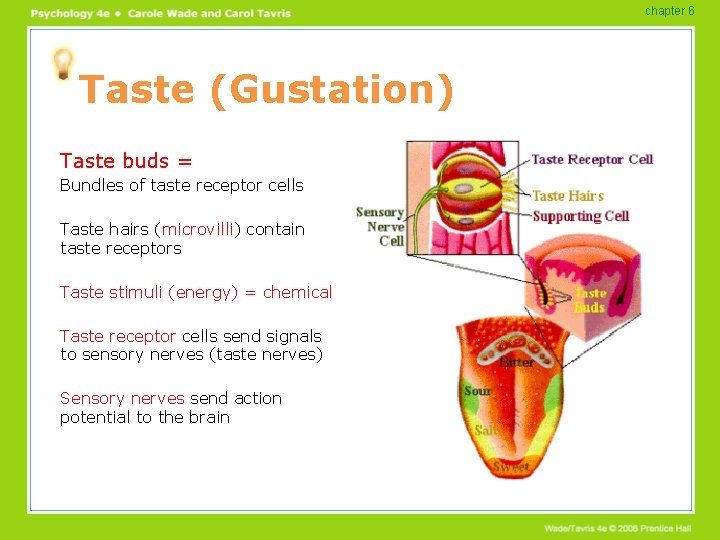
chapter 6 Taste (Gustation) Taste buds = Bundles of taste receptor cells Taste hairs (microvilli) contain taste receptors Taste stimuli (energy) = chemical Taste receptor cells send signals to sensory nerves (taste nerves) Sensory nerves send action potential to the brain
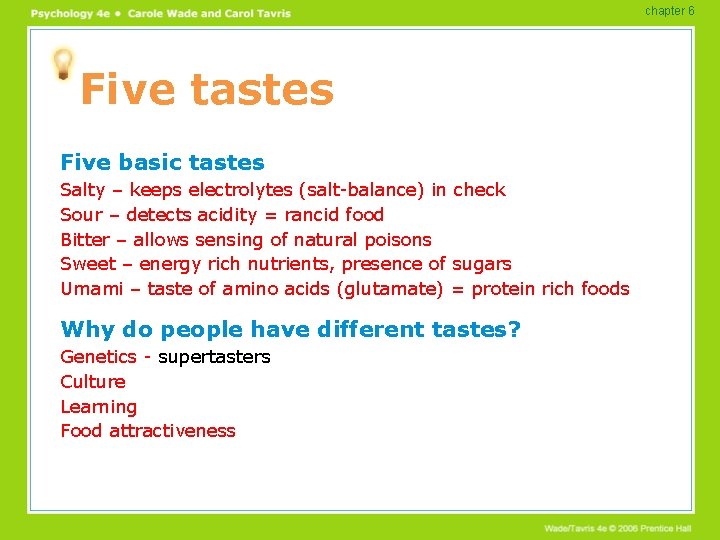
chapter 6 Five tastes Five basic tastes Salty – keeps electrolytes (salt-balance) in check Sour – detects acidity = rancid food Bitter – allows sensing of natural poisons Sweet – energy rich nutrients, presence of sugars Umami – taste of amino acids (glutamate) = protein rich foods Why do people have different tastes? Genetics - supertasters Culture Learning Food attractiveness
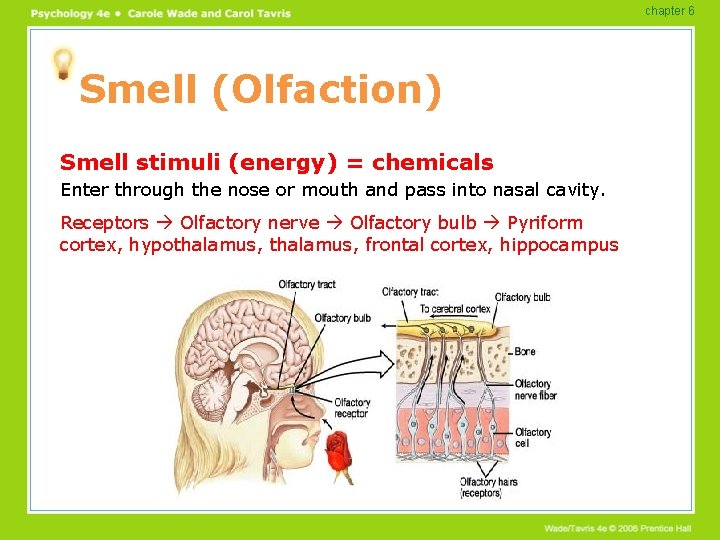
chapter 6 Smell (Olfaction) Smell stimuli (energy) = chemicals Enter through the nose or mouth and pass into nasal cavity. Receptors Olfactory nerve Olfactory bulb Pyriform cortex, hypothalamus, frontal cortex, hippocampus
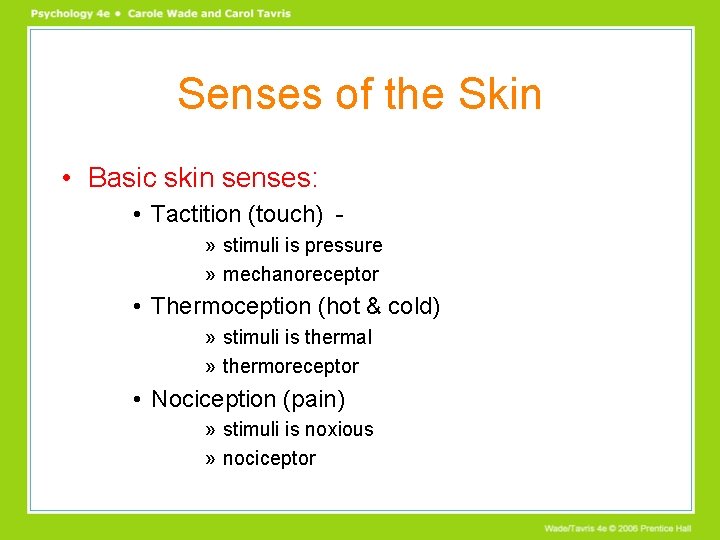
Senses of the Skin • Basic skin senses: • Tactition (touch) » stimuli is pressure » mechanoreceptor • Thermoception (hot & cold) » stimuli is thermal » thermoreceptor • Nociception (pain) » stimuli is noxious » nociceptor
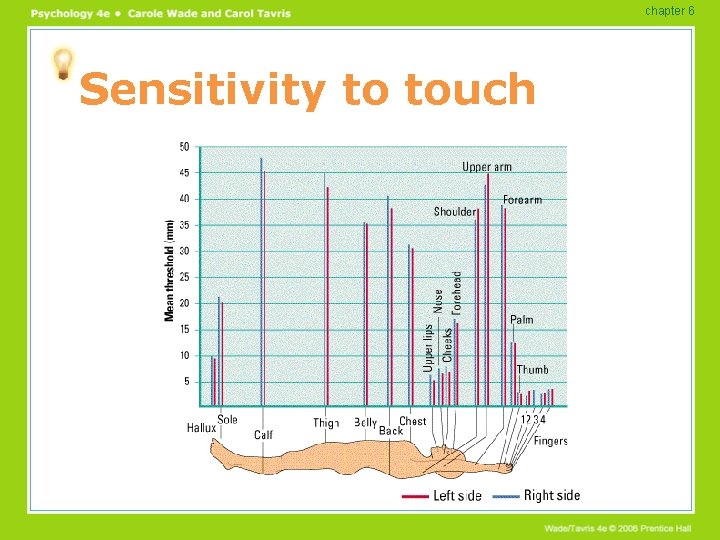
chapter 6 Sensitivity to touch
Somatotopy Adapted from Sabes Lab - UCSF
chapter 6 The environment within Kinesthesis The sense of body position and movement of body parts Equilibrium The sense of balance - Semicircular canals Sense organs in the inner ear, which contribute to equilibrium by responding to rotation of the head
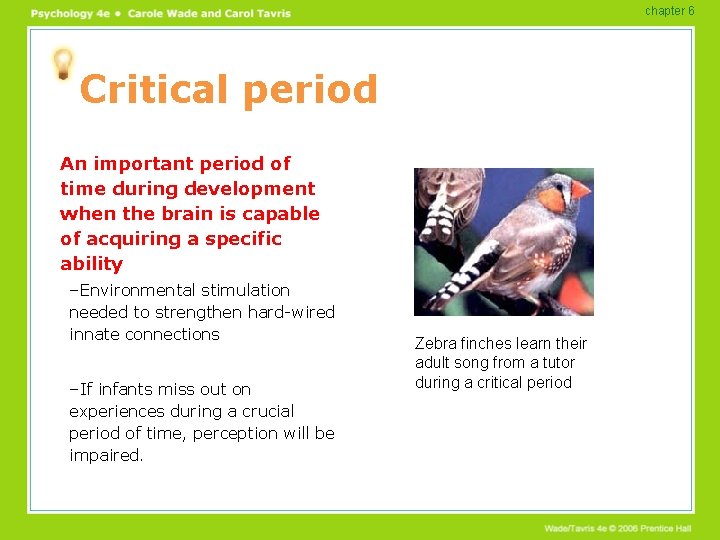
chapter 6 Critical period An important period of time during development when the brain is capable of acquiring a specific ability –Environmental stimulation needed to strengthen hard-wired innate connections –If infants miss out on experiences during a crucial period of time, perception will be impaired. Zebra finches learn their adult song from a tutor during a critical period