
Chapter 6 Decision Trees An Example Outlook sunny
- Slides: 20
Chapter 6 Decision Trees
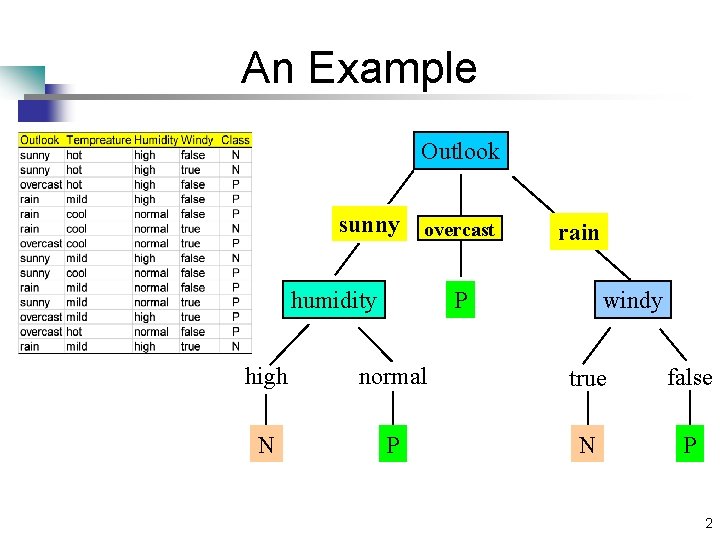
An Example Outlook sunny overcast humidity rain windy P high normal true false N P 2
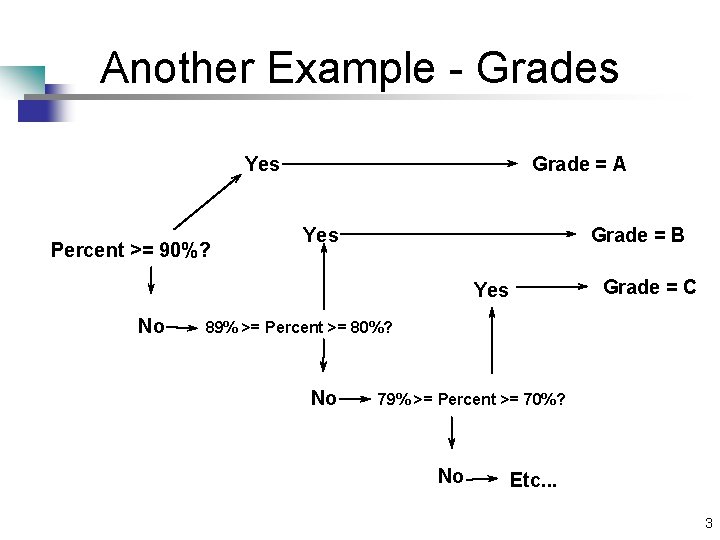
Another Example - Grades Yes Percent >= 90%? Grade = A Yes Grade = B Grade = C Yes No 89% >= Percent >= 80%? No 79% >= Percent >= 70%? No Etc. . . 3
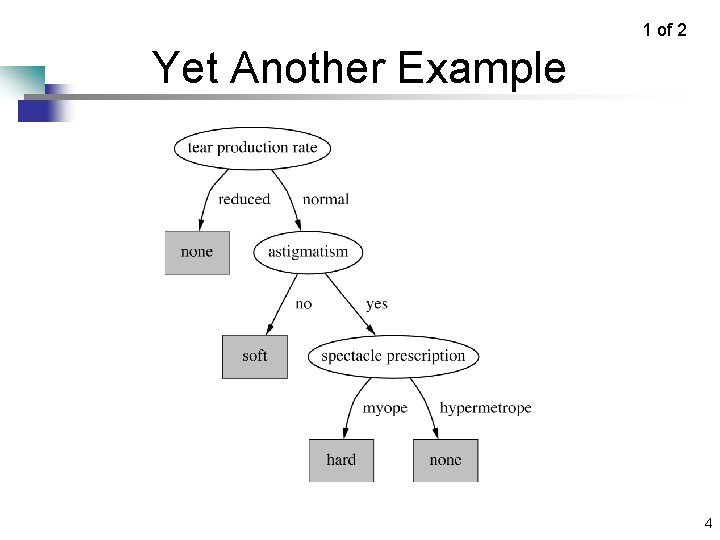
1 of 2 Yet Another Example 4
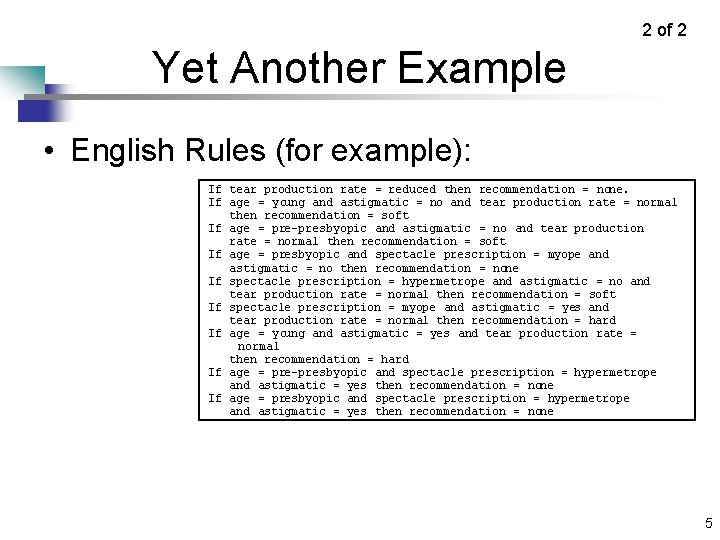
2 of 2 Yet Another Example • English Rules (for example): If tear production rate = reduced then recommendation = none. If age = young and astigmatic = no and tear production rate = normal then recommendation = soft If age = pre-presbyopic and astigmatic = no and tear production rate = normal then recommendation = soft If age = presbyopic and spectacle prescription = myope and astigmatic = no then recommendation = none If spectacle prescription = hypermetrope and astigmatic = no and tear production rate = normal then recommendation = soft If spectacle prescription = myope and astigmatic = yes and tear production rate = normal then recommendation = hard If age = young and astigmatic = yes and tear production rate = normal then recommendation = hard If age = pre-presbyopic and spectacle prescription = hypermetrope and astigmatic = yes then recommendation = none If age = presbyopic and spectacle prescription = hypermetrope and astigmatic = yes then recommendation = none 5
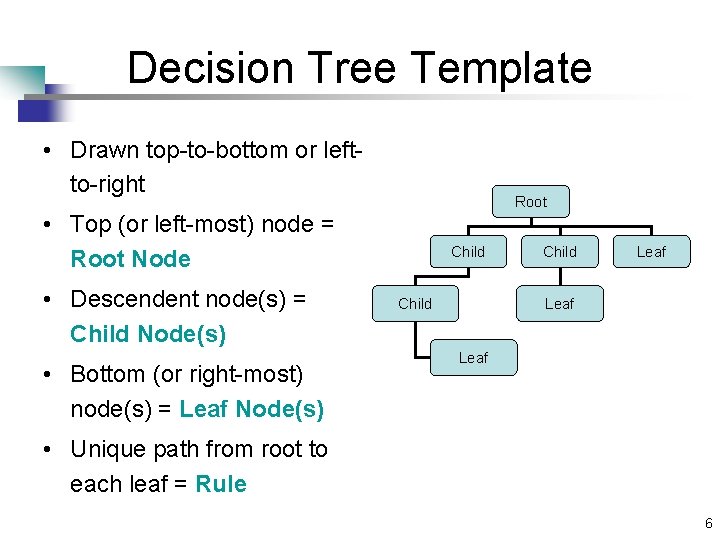
Decision Tree Template • Drawn top-to-bottom or leftto-right Root • Top (or left-most) node = Root Node • Descendent node(s) = Child Node(s) • Bottom (or right-most) node(s) = Leaf Node(s) Child Leaf • Unique path from root to each leaf = Rule 6
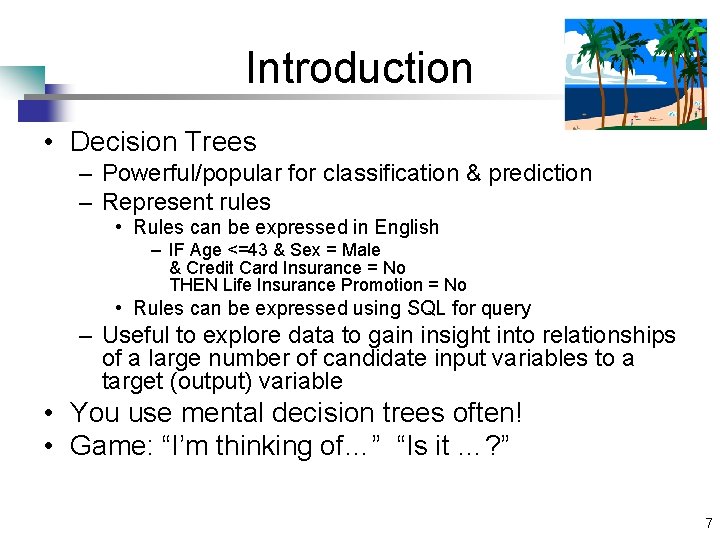
Introduction • Decision Trees – Powerful/popular for classification & prediction – Represent rules • Rules can be expressed in English – IF Age <=43 & Sex = Male & Credit Card Insurance = No THEN Life Insurance Promotion = No • Rules can be expressed using SQL for query – Useful to explore data to gain insight into relationships of a large number of candidate input variables to a target (output) variable • You use mental decision trees often! • Game: “I’m thinking of…” “Is it …? ” 7
Decision Tree – What is it? • A structure that can be used to divide up a large collection of records into successively smaller sets of records by applying a sequence of simple decision rules • A decision tree model consists of a set of rules for dividing a large heterogeneous population into smaller, more homogeneous groups with respect to a particular target variable 8
Decision Tree Types • Binary trees – only two choices in each split. Can be non-uniform (uneven) in depth • N-way trees or ternary trees – three or more choices in at least one of its splits (3 way, 4 -way, etc. ) 9
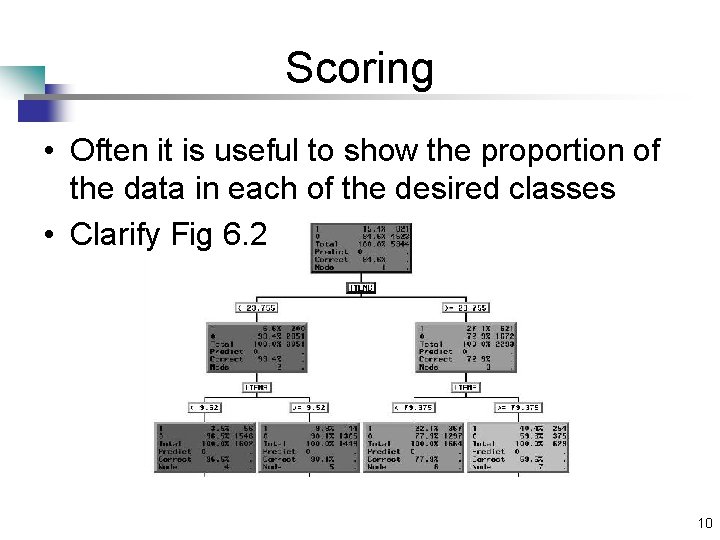
Scoring • Often it is useful to show the proportion of the data in each of the desired classes • Clarify Fig 6. 2 10
Decision Tree Splits (Growth) • The best split at root or child nodes is defined as one that does the best job of separating the data into groups where a single class predominates in each group – Example: US Population data input categorical variables/attributes include: • Zip code • Gender • Age – Split the above according to the above “best split” rule 11
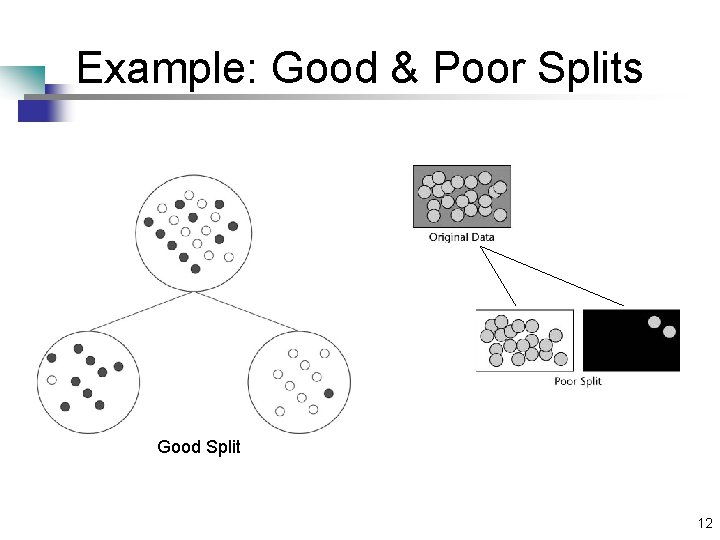
Example: Good & Poor Splits Good Split 12
Split Criteria • The best split is defined as one that does the best job of separating the data into groups where a single class predominates in each group • Measure used to evaluate a potential split is purity – The best split is one that increases purity of the sub-sets by the greatest amount – A good split also creates nodes of similar size or at least does not create very small nodes 13
Tests for Choosing Best Split • Purity (Diversity) Measures: – Gini (population diversity) – Entropy (information gain) – Information Gain Ratio – Chi-square Test We will only explore Gini in class 14
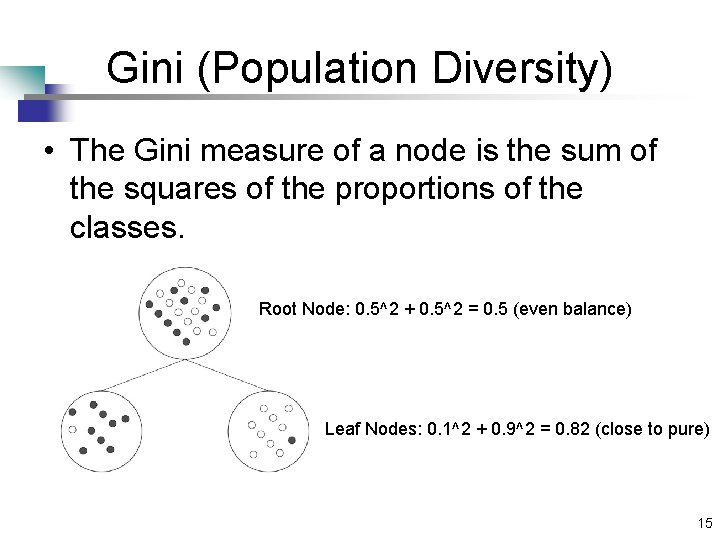
Gini (Population Diversity) • The Gini measure of a node is the sum of the squares of the proportions of the classes. Root Node: 0. 5^2 + 0. 5^2 = 0. 5 (even balance) Leaf Nodes: 0. 1^2 + 0. 9^2 = 0. 82 (close to pure) 15
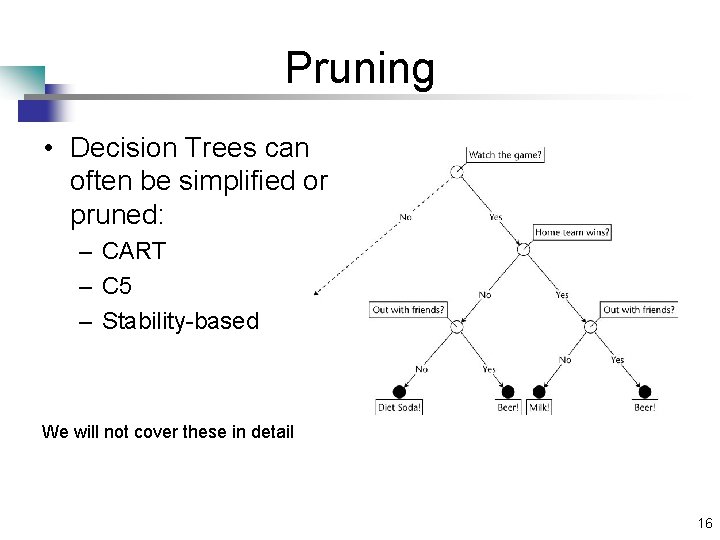
Pruning • Decision Trees can often be simplified or pruned: – CART – C 5 – Stability-based We will not cover these in detail 16
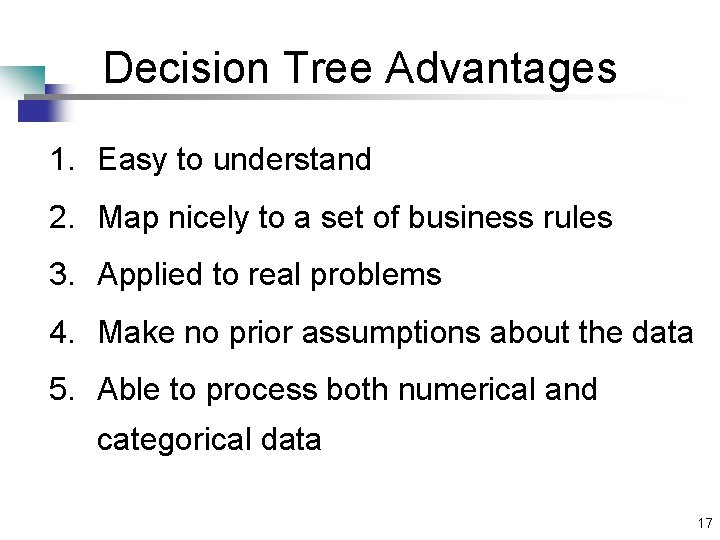
Decision Tree Advantages 1. Easy to understand 2. Map nicely to a set of business rules 3. Applied to real problems 4. Make no prior assumptions about the data 5. Able to process both numerical and categorical data 17
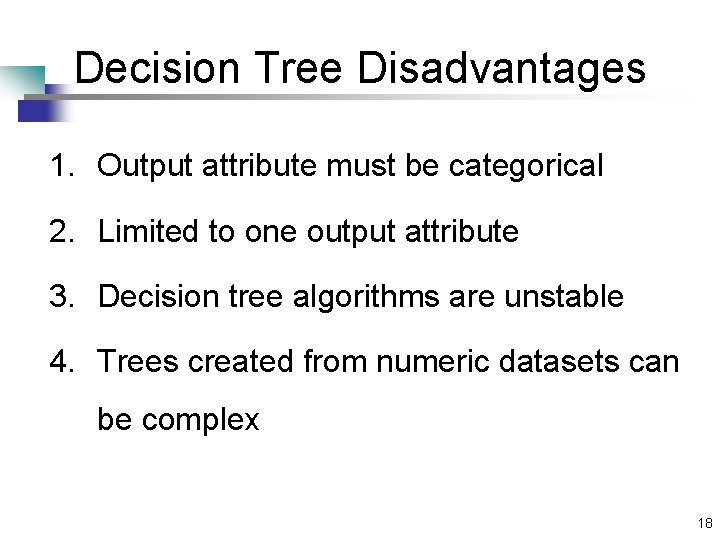
Decision Tree Disadvantages 1. Output attribute must be categorical 2. Limited to one output attribute 3. Decision tree algorithms are unstable 4. Trees created from numeric datasets can be complex 18
Alternative Representations • Box Diagram • Tree Ring Diagram • Decision Table • Supplementary Material 19
End of Chapter 6 20