
Chapter 6 Dating Single Life and Mate Selection



- Slides: 29
Chapter 6 Dating, Single Life, and Mate Selection
Chapter Outline • Premarital American Dating • Dating and Extended Singleness • Changing Sexual Mores • Date Rape and Courtship Violence
Chapter Outline • Cohabitation: Unmarried-Couple Households • Finding the One and Only: Mate Selection • Engagement
Why Do We Date? 1. 2. 3. Dating fills time between puberty and marriage. It is often simple recreation, an end in itself. Dating is a way to gain social status based on whom and how often one dates. Dating is an opportunity for the sexes to interact and learn about each other. Dating is also an avenue to selfknowledge.
Why Do We Date? 4. Dating meets ego needs. A person needs to be understood and considered important. 5. Dating leads to mate selection for most individuals.
Modern Dating Characteristics 1. There is greater opportunity for informal, opposite-sex interaction. 2. Subsequent dating is less formal. 3. There no longer seems to be a set progression of stages from first meeting to marriage.
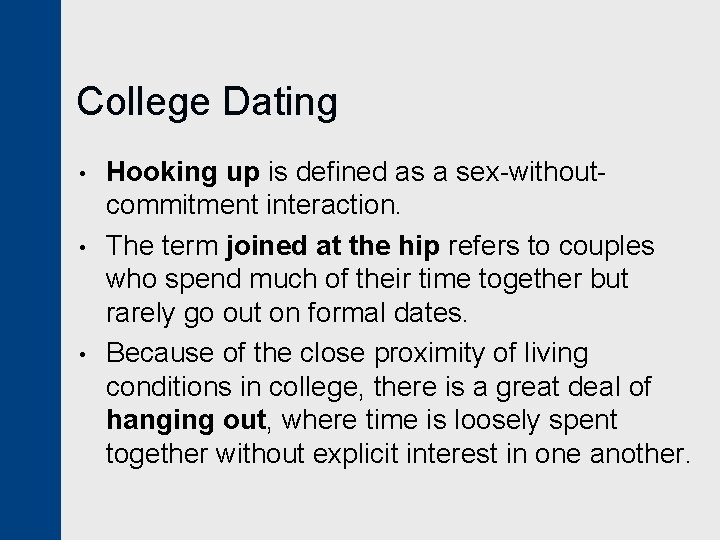
College Dating • • • Hooking up is defined as a sex-withoutcommitment interaction. The term joined at the hip refers to couples who spend much of their time together but rarely go out on formal dates. Because of the close proximity of living conditions in college, there is a great deal of hanging out, where time is loosely spent together without explicit interest in one another.
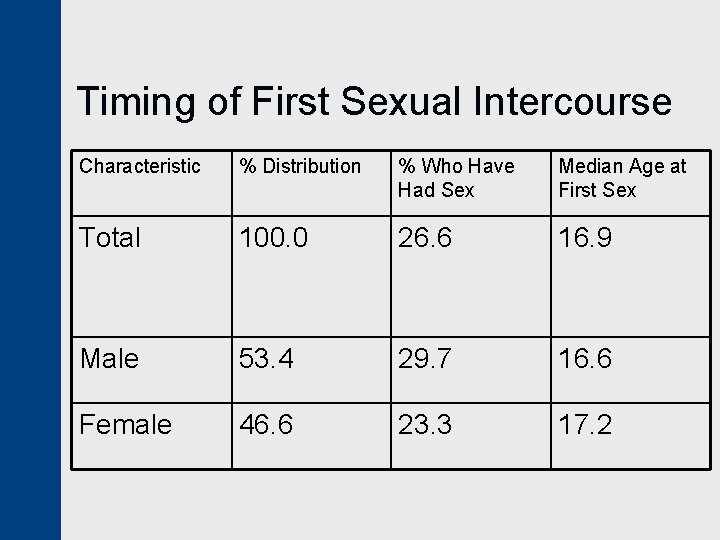
Timing of First Sexual Intercourse Characteristic % Distribution % Who Have Had Sex Median Age at First Sex Total 100. 0 26. 6 16. 9 Male 53. 4 29. 7 16. 6 Female 46. 6 23. 3 17. 2
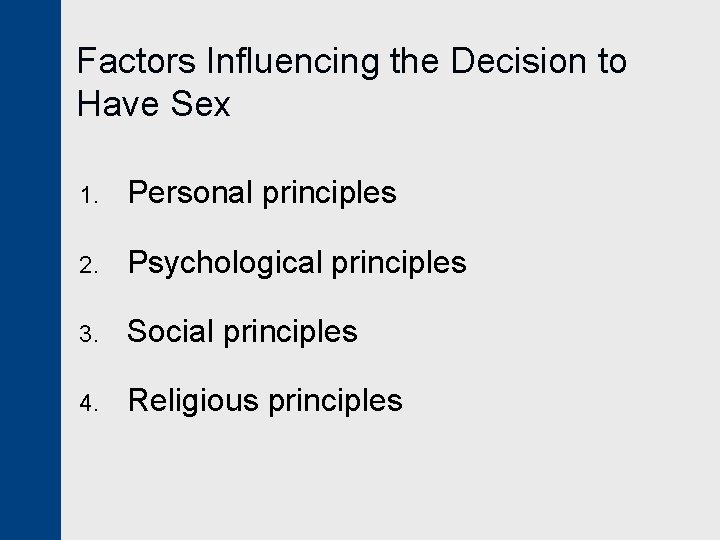
Factors Influencing the Decision to Have Sex 1. Personal principles 2. Psychological principles 3. Social principles 4. Religious principles
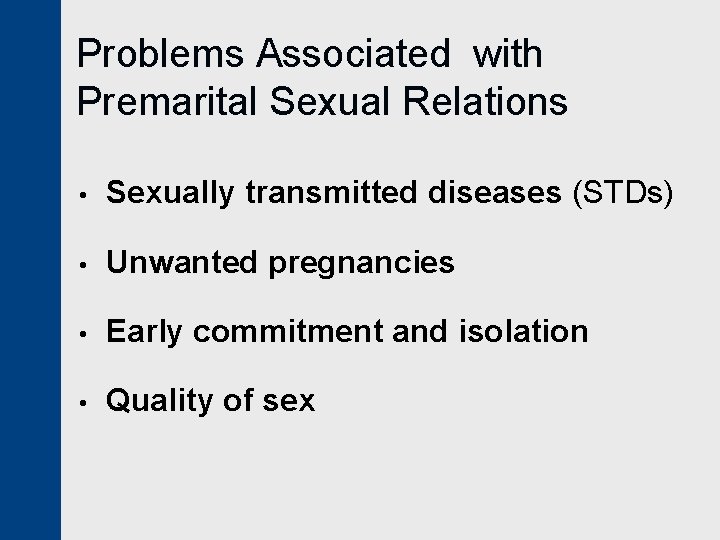
Problems Associated with Premarital Sexual Relations • Sexually transmitted diseases (STDs) • Unwanted pregnancies • Early commitment and isolation • Quality of sex
Date Rape and Courtship Violence The term date rape has suddenly become popular in the mass media. A better term that encompasses rape but also speaks to broader problems is acquaintance violence.
Miscommunication About Sex 1. Many men and women do not discuss their sexual intentions openly and frankly. 2. Differences exist in perceptions of sexual intent. 3. The use of token resistance by some women may create a belief in some men that protest encountered is not really meant by the woman.
Miscommunication About Sex 4. There are differing expectations concerning the stage of the relationship when sexual intercourse is appropriate. 5. Miscommunication is more common when alcohol or drugs are being used.
Statutory Rape Statutory rape is the case in which an adult has consensual sex with a minor.
Cohabitation A couple’s desire to spend more time together may lead them to cohabit, that is, live together without marriage.
Cohabitation & Common Law Marriage • • An unmarried partner is now defined by the Census Bureau as a person unrelated to the householder, but who shares living quarters and has a close personal relationship with the householder. In some states, a couple living together for more than a certain number of years can be treated as legally married, which is called a common law marriage.
Factors Influencing Cohabitation • • Society’s increased tolerance toward nonmarital sexual relations makes intimate cohabitation more acceptable. Higher education, especially for women, and the increasing entry of women into the workforce have lessened women’s dependence on marriage as a way of economic survival.
Factors Influencing Cohabitation • Increasing urbanization leads to increased anonymity and fewer restrictions on individuals. • The high rate of divorce may make young people more wary of rushing into a marital relationship.
Cohabiting Relationships 1. 2. 3. 4. Many couples consider these experiences to be no more than short-lived sexual flings. Other couples consider cohabitation a practical arrangement. Some see cohabitation as a trial marriage, while others see it as a permanent alternative to marriage. For some who have been divorced, the fear of making the same mistake again leads them to cohabitation.
Mate Selection • Propinquity refers to dating and marrying someone living quite close geographically. • Homogamy is the tendency of people to marry persons similar to themselves. • Endogamy is the tendency of people to marry within their own group.
Mate Selection • • • Exogamy is a requirement that people marry outside their group. In our culture, requirements to marry outside your group are limited to incest and same-sex prohibitions. Miscegenation laws prohibiting interracial marriages are no longer legal in the U. S.
First Impressions § The halo effect is the tendency for first impressions to influence succeeding evaluations. § Cognitive compatibility (how the other thinks, what his/ her interests are, and so on) are also important first impressions.
Quick Quiz
1. The term joined at the hip refers to a) b) c) d) a sex-without-commitment interaction. couples who spend much of their time together but rarely go out on formal dates. where time is loosely spent together without explicit interest in one another. None of these.
Answer: b • The term joined at the hip refers to couples who spend much of their time together but rarely go out on formal dates.
2. The requirement that people marry outside their group is a) Propinquity b) Homogamy c) Endogamy d) Exogamy
Answer: d • Exogamy is the requirement that people marry outside their group.
3. Which of the following is listed in the text as a common reason for cohabitation? a) b) c) d) Practical Purposes Sex Trial Marriage All of the above
Answer: d • Couples studied listed practical purposes, sex and a chance to have a trial marriage all as reasons to cohabitate.