
Chapter 6 Cultivation 1 The Cultural Indicators Project
- Slides: 9
Chapter 6 Cultivation 1
The Cultural Indicators Project Initiated in 1967 by George Gerbner p Investigates the “cultivation” effect p Cultivation hypothesis p n For people who watch a lot of television the real world starts to resemble the world of television. 2
Components of the Cultural Indicators Project Cultivation analysis p Institutional process analysis p n p Examines the production, management, and distribution of media messages Message system analysis n Investigates images in media content 3
Conceptual Roots of the Cultivation Hypothesis Television is the great storyteller of our age. p Mainstreaming p n p When heavy television viewers absorb dominant attitudes and beliefs that are presented repetitively on television Resonance n When real-world events support the distorted image of reality shown on television 4
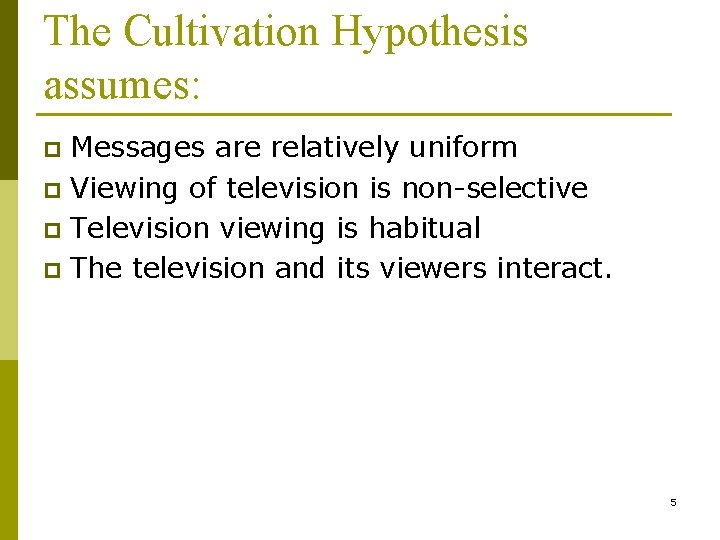
The Cultivation Hypothesis assumes: Messages are relatively uniform p Viewing of television is non-selective p Television viewing is habitual p The television and its viewers interact. p 5
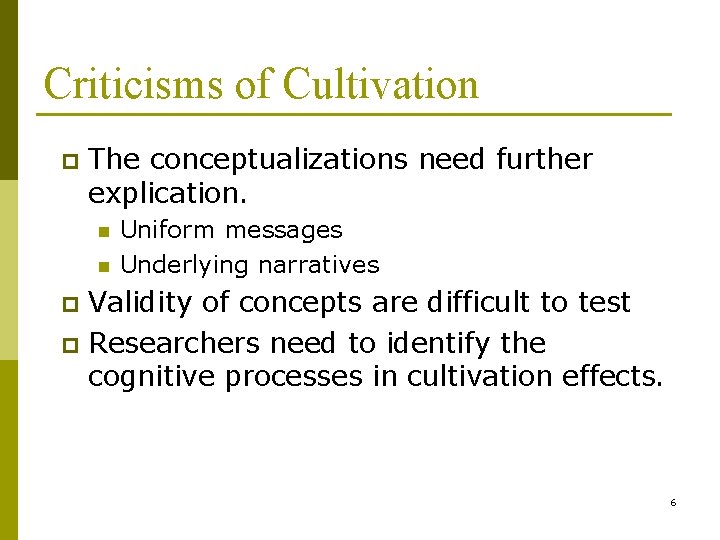
Criticisms of Cultivation p The conceptualizations need further explication. n n Uniform messages Underlying narratives Validity of concepts are difficult to test p Researchers need to identify the cognitive processes in cultivation effects. p 6
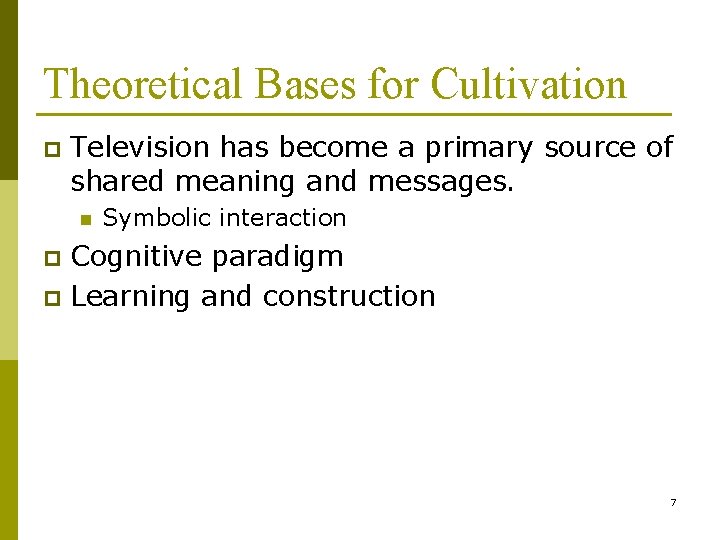
Theoretical Bases for Cultivation p Television has become a primary source of shared meaning and messages. n Symbolic interaction Cognitive paradigm p Learning and construction p 7
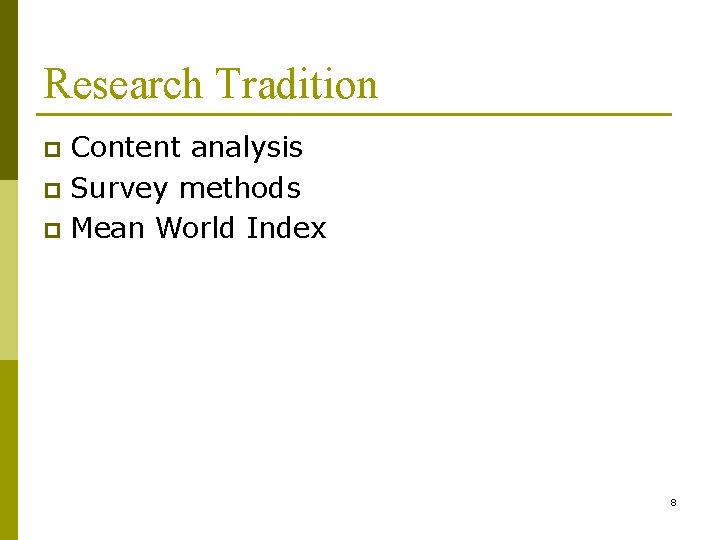
Research Tradition Content analysis p Survey methods p Mean World Index p 8
Recent Research and Future Trends Collecting evidence for cultivation effects p Expansion of studies into other countries p Some studies attempt to determine “global” perceptions of social reality. p The growing popularity of cable, satellite, VCRs, and the Internet p 9